❌

Reading view

Roblox Set to Introduce AI Game-Building Feature, Including on iOS

Roblox executives Nick Tornow and Vlad Loktev, on the Roblox blog:

Twenty years ago, Roblox launched with a simple idea: “You make the game.” At the time, that was a radical proposition — most games were made by studios and professionals, and the idea that anyone could be a creator was far from obvious. But we believed it. And the millions of creators who built on Roblox proved it. As we look to a future where any one of Roblox’s 132 million daily active users could come up with the next hit game, we’re taking that original idea further than we ever have. Over the coming months, we’ll share a series of announcements that will give every creator a clear runway to go further and fulfill the promise of “You make the game” for more people than ever before.

Today, we’re announcing Build, a new mobile-first creation tab within the Roblox app, and a new suite of AI-powered tools within Studio for creators of every level. On July 28, we’ll begin testing these new agentic tools. With Build and Studio, creators can delegate the parts of development that don’t require their full attention.

This sounds really cool and fun. But you know what else was really cool and fun? AI coding apps that ran on iOS, like Bitrig, Replit, and Vibecode — all of which Apple put the kibosh on back in the winter. You of course are free to use any tool you want to build apps for iOS on a desktop computer, but Apple decided to disallowing building iOS apps on iOS.

But it’s OK for Roblox to allow AI-assisted game generation on iOS ... because Roblox is already so big and popular? How can Apple justify allowing Roblox to do this while disallowing anyone else?

  •  

OpenAI’s Product Shake-Up Put the Complexifiers in Charge

Wired, back on May 15:

OpenAI says it’s folding ChatGPT, its AI coding agent Codex, and its developer-facing API into one core product team. The company says that Codex is increasingly powering its consumer and enterprise offerings, which are gaining the ability to perform digital tasks autonomously on behalf of users.

Other OpenAI leaders are also taking on larger roles at the company as part of the changes. OpenAI’s head of Codex, Thibault Sottiaux, has been tapped to lead the company’s core product and platform teams. Sottiaux was a key leader in building Codex into one of the company’s fastest-growing products of all time. He’s also one of the leaders overseeing development of OpenAI’s forthcoming “super app,” which aims to combine Codex, ChatGPT, and the company’s Atlas web browser into a unified desktop application.

I’ll give them credit for sticking with a plan for two whole months to get this out the door. But the problem is they went the wrong way. Instead of putting the eggheads from Codex in charge of ChatGPT, they should have put the product-minded people from ChatGPT in charge of Codex. Codex, I’m finally learning, is sprawling and confusing. It needs a strong dose of focus, clarity, and coherence — attributes that ChatGPT exhibited in spades. Instead, by putting the Codex dorks in charge, they’ve injected ChatGPT with confusion, incoherence, and sprawl.

Claude, the app OpenAI’s leadership is obsessed with copying now, is so goddamn confusing that it has Extensions, Plugins, Capabilities, Skills, and Connectors — and they’re all different things. You’ve let your own AI overuse turn your brain to mush if you think that makes sense, but even more so if you think that’s the model to copy.

I’ve been waiting for a while now for someone to explain all of this clearly and succinctly, worried that maybe it was my job to figure it out and do the clear succinct explaining. All of this dogshit from OpenAI and Anthropic presents itself as though it can be explained clearly and succinctly. But it’s just a veneer of coherence. It’s all just been thrown together in an AI blender and poured out as mush.

  •  

MG Siegler: ‘OpenAI Makes ChatGPT ChatGPT Again’

MG Siegler, writing at Spyglass:

In that light, we can see the dilemma. But there were also probably about a dozen better ways to do this roll-out — as highlighted by how fast they’re fixing these things — and they just missed the mark. While they undoubtedly knew there would be some backlash, they probably didn’t realize there would be this much. Again. All that points to perhaps a disturbing trend where OpenAI doesn’t really understand their user base. Which you almost can understand given how they clearly stumbled into ChatGPT in the first place. Still, here they are with those billion users. A problem that all of their competitors would love to have. But still a problem if you want to fundamentally change what you are as a product.

But those are bigger, existential issues. All I wanted was chat back in the ChatGPT app. Front and center. And I got it. It’s not perfect. It’s still bloated. But at least it’s usable again now and not a confusing mess of ideas out of the box.

MG is pretty scathing, but I still think he’s taking it too easy on OpenAI for what a colossal fuck-up this remains. There was nothing wrong with the way things were, with two apps — the simple ChatGPT and the complex Codex. (Well, the Codex Mac app being an Electron turd was wrong, but that complaint seems quaint at this point.)

Adding “ChatGPT” as a tab to Codex is fine. Renaming Codex to “ChatGPT” is stupid. They have not made ChatGPT “ChatGPT” again.

There is nothing — not one single tiny feature — in the new ChatGPT app that makes me want to use it instead of ChatGPT Classic. And there is so much in ChatGPT Classic that works better or just isn’t available in the new ChatGPT. You can’t even just delete a chat in the new app — you have to “archive” it first, then fish around to find the archive and delete it there.

I don’t think the problem is that OpenAI “doesn’t really understand their user base”. I think it’s that decisions are now being made by AI research eggheads who don’t understand their own products. They think this makes sense. So of course they don’t understand their user base — who uses the ChatGPT product — either. I mean what sense does it make that the ChatGPT app for iOS and Android is still the old ChatGPT, which on the Mac is now “ChatGPT Classic”, but there’s a totally different app that is an entire order of magnitude more complicated on the Mac now named “ChatGPT”?

The only good solution is to pretend this last week didn’t happen and go back to calling ChatGPT “ChatGPT” and Codex “Codex”. If they want to give one of them a new name, don’t call ChatGPT “ChatGPT Classic” — instead rename Codex “ChatGPT Codex”. There, done. All problems solved.

The Codex app is clearly capable of amazing things. But the reason that there are a billion users of ChatGPT but only a few million users of Codex — by OpenAI’s own accounting — is because ChatGPT is simple and focused and based on a single coherent concept: chat. The frustration of the eggheads now running product at OpenAI is obvious: how come these hundreds of millions of morons using ChatGPT aren’t running Codex instead? Somehow they thought they could fix this by giving Codex the ChatGPT name. This is like if Apple had gotten rid of the Messages app on the Mac and replaced it with Xcode, which they renamed to “Messages”. Now they’ve put an “iMessage” tab in the Xcode sidebar and re-released the Messages app everyone knew and loved as “Messages Classic”.

OpenAI separated itself from its competition — especially Anthropic — by being good at product. Now their product decisions are being made by people who don’t understand why Apple makes both iMovie and Final Cut Pro, or GarageBand and Logic Pro.

  •  

OpenAI Starts Cleaning Up the Utter Mess It Made of ChatGPT

Thibault “Tibo” Sottiaux, the OpenAI engineering lead who’s taking the most public credit for this and thus probably deserves the most blame, on Twitter/X:

Evening! We’ve gotten lots of great feedback on the new ChatGPT desktop app (which we didn’t get totally quite right on the first try), and as a result, we’ve made some changes.

1/ ChatGPT conversation history and projects are now visible in the sidebar. Also, your Chat and Work history now sync across web, mobile, and desktop. Local tasks still stay on your computer.

How in the world did they ship this without sync?

2/ You can now easily switch between Chat and Work modes inside ChatGPT on desktop, which is now also consistent with how it shows on web and mobile.

Bringing back “chat” to ChatGPT is literally the least they needed to do. Hiding chat in an obscure corner of the interface from an app named “ChatGPT” would be like removing text editing from TextEdit.

The updates OpenAI shipped yesterday address some of the abject incoherence of the initial rollout of the “new” ChatGPT, but it’s still dogshit. The new app remains a 1.5 GB Electron monstrosity (and if it’s not technically Electron that’s because they’ve created another bloated layer of abstraction around Electron — Sottiaux oversees the only engineering group in the world that looked at Electron and thought it was too slim and close to the metal).

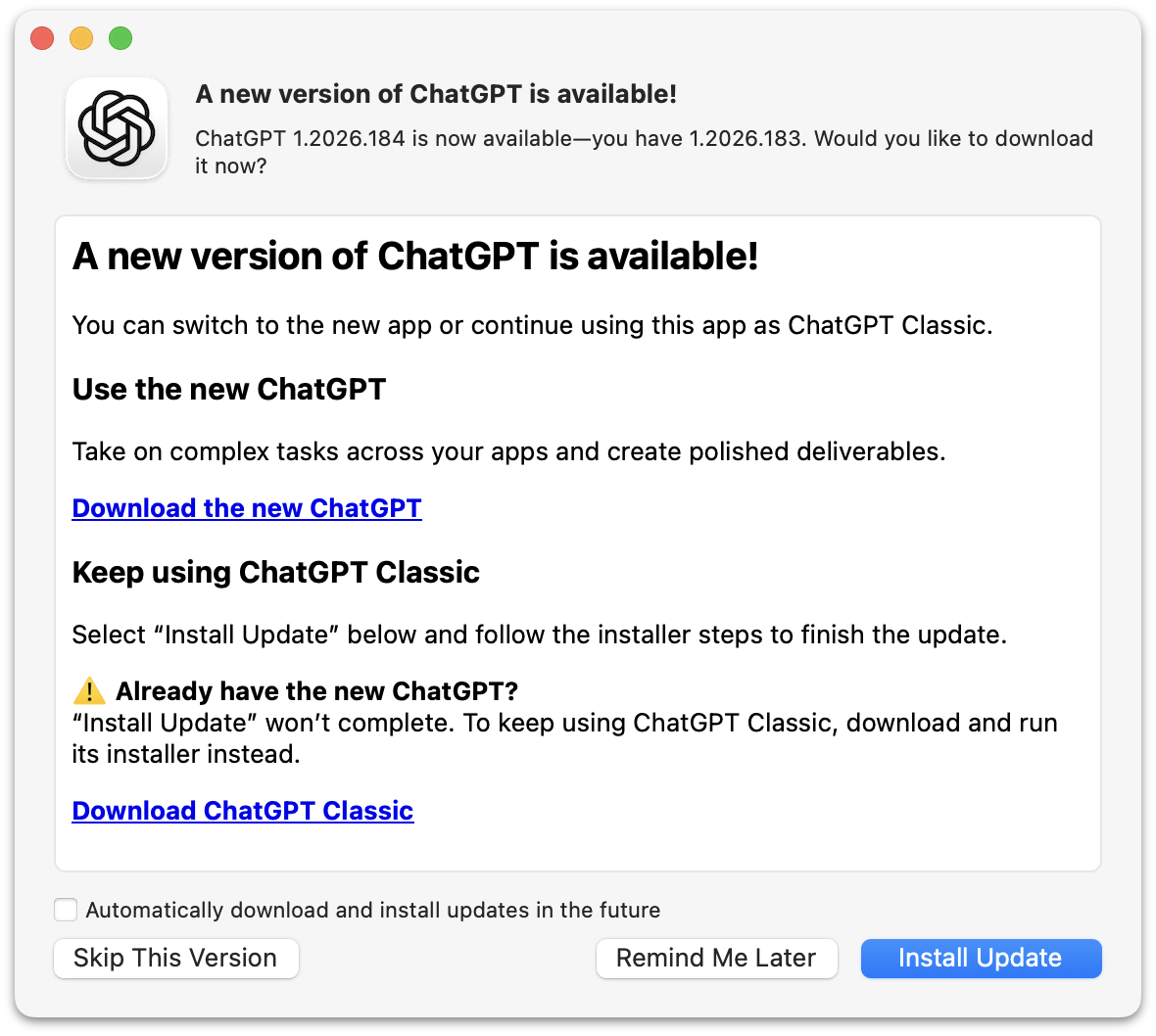
Here’s the software update dialog I saw today in the old version of ChatGPT, which is now named ChatGPT Classic:

Screenshot of the last pre-“Classic” ChatGPT app’s Check for Updates dialog, with confusing instructions.

What they’re trying to say here is that if you’ve ever installed the new ChatGPT the “Install Update” button in this dialog will do nothing. It will take some time to do nothing, but ultimately do nothing. Except quit ChatGPT.

If you’ve never installed the new ChatGPT, this dialog box will update the old ChatGPT to the latest version, which is now renamed “ChatGPT Classic”. If you have tried the new ChatGPT, you need to install ChatGPT Classic manually, even though you’re seeing this update dialog box in a slightly older version of the app you want to keep using. But at least they now offer a supported way to install ChatGPT Classic.

This whole thing makes the “New Coke”/”Coke Classic” fiasco from the 1980s look like a well-thought-out change.

  •  

Linus Torvalds: ‘AI Is a Tool, Just Like Other Tools We Use. And It’s Clearly a Useful One.’

Linus Torvalds:

I realize that some people really dislike AI, but this is an area where I’m willing to absolutely put my foot down as the top-level maintainer.

Linux is not one of those anti-AI projects, and if somebody has issues with that, they can do the open-source thing and fork it.

Or just walk away.

AI is a tool, just like other tools we use. And it’s clearly a useful one.

It may not have been that “clearly” even just a year ago, but it’s no longer in question today.

There are other questions around AI (like what the economy of it will actually look like in the end), but “is it useful” is no longer one of those questions. Anybody who doubts that clearly hasn’t actually used it.

  •  

BBEdit 16

Speaking of BBEdit, version 16 dropped just before WWDC, and adds a slew of nifty improvements, headlined by vastly expanded support for Shortcuts. You can also search for text in images, use the W3C HTML syntax checker, and of all things, use vi keyboard emulation. There’s a lot more, of course — and as always the changes, improvements, and additions are copiously documented in the release notes.

New licenses are $60, upgrades from v15 cost $30, and upgrades from older versions are $40. In the Mac App Store it’s a $5/month or $50/year subscription.

See also: Jason Snell at Six Colors and Adam Engst at TidBITs.

  •  

ArtfulType: Markdown Writing App for the 68K Macintosh

Sean Malseed — “Action Retro” on YouTube — created a Markdown editor for the original Macintosh. Source code on GitHub; intro video on YouTube. It’s written in C, not Pascal, and uses the modern Retro68 GCC-derived compiler.

I absolutely love that this exists. I don’t like the actual app at all. I guess “full screen” mode is the point of some “distraction free” editors, but I for one would never look twice at a Mac app that didn’t use windows. Full-screen mode just wasn’t a thing back then, except for games. ArtfulType is not a Mac-assed 1984 Mac app.

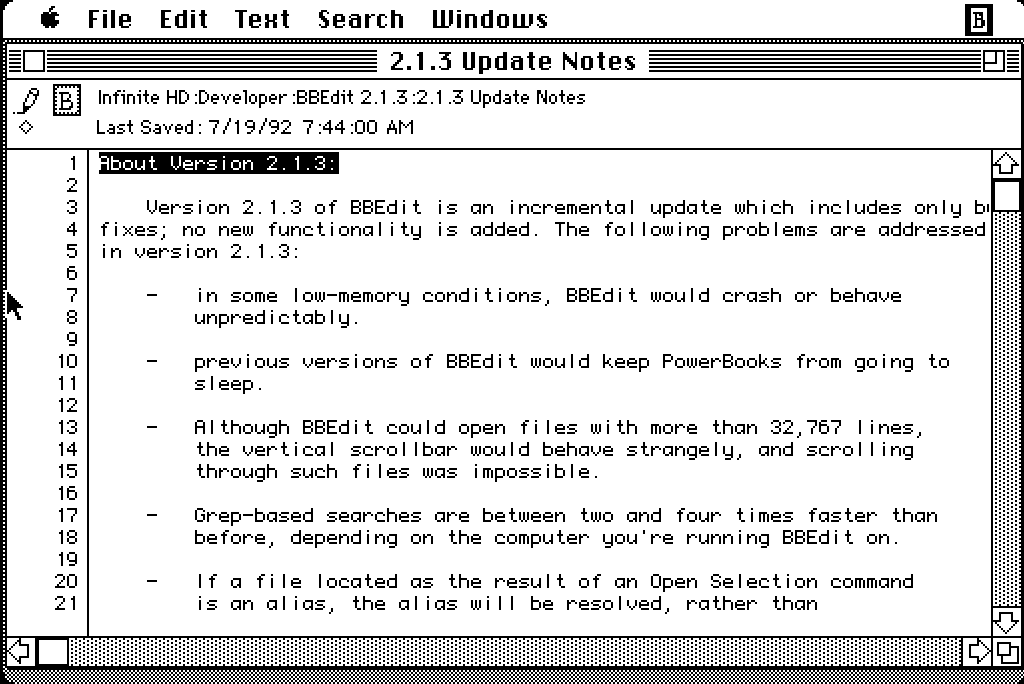
If I wanted to write in Markdown on a classic Mac, I’d use BBEdit, which was the app I originally created Markdown for use in. And one of two apps I primarily still use it in. But BBEdit won’t run on an original 128 KB Macintosh, because Rich Siegel didn’t create it until 1989, and the earliest public version was BBEdit 2 in 1992. BBEdit 2.1.3 does run in System 5 on Infinite Mac, but crashes if launched on System 3. I 100 percent see the appeal of using a 1980s retro Mac, but I don’t see the appeal of using one that can’t run System 6.

  •  

Google and Epic Give Up Fighting — Third-Party Android App Stores Are Coming Next Week

Sean Hollister, reporting for The Verge (gift link):

Here’s Google’s full statement on withdrawing its proposed modifications to Judge Donato’s permanent injunction, via Google spokesperson Dan Jackson:

We’ve agreed with Epic to withdraw our motion to modify the US Court’s injunction rather than prolonging this process which creates uncertainty for the ecosystem. This allows us to focus on executing our recently announced global business model evolution to deliver greater app store choice, lower prices, and more opportunities for developers and users. We remain committed to maintaining Android’s industry-leading security and fostering a competitive ecosystem where every app store and developer has the freedom to compete. In parallel, we continue to comply with the US Court’s injunction.

Google had previously announced that it would launch its sideloaded Registered App Store program in the rest of the world, beginning with the new version of Android later this year. That means there may be two different tracks for Android: stores-within-a-store in the United States and Registered App Stores everywhere else.

Google is already informing US app developers that their apps and game listings will automatically be provided to third-party app stores starting July 22nd, unless they opt out, and it’s launched a specific page for its Play Catalog Access Program for third-party app stores to enroll.

I presume that this new agreement between Google and Epic includes ripping up the “no criticism of Play Store” gag order that the highly principled Tim Sweeney had agreed to in exchange for $800 million back in March?

Anyway, it will be interesting to see what developers do. My guess is that all the big app developers will opt out of this. Games, though, maybe not?

  •  

European Commission Adds Exemptions for Watches and Earbuds to Portable Battery Removal Rules

The European Commission:

The European Commission adopted a delegated act today (14 July) introducing new rules that exempt additional products from EU requirements on the removability and replaceability of portable batteries.

Under the EU’s Batteries Regulation, portable batteries in products sold in the EU must generally be removable and replaceable by consumers. This helps extend products’ lifetime by allowing battery replacements and supports recycling by making it easier to collect used batteries. [...]

The Commission is now adding six new product categories to the existing list of exemptions. This includes wearable devices such as smartwatches and fitness trackers, electric toys, and products within the scope of the ATEX Directive (equipment used in explosive atmospheres such as explosion-proof motors, sensors, pumps or forklift trucks).

See, exemptions aren’t hard, especially to stupid regulations.

  •  

Quiche Browser Now Defaults to No-AI Web Search Results

Quiche Industries (Greg de J.):

Starting today, Quiche Browser disables AI overviews in search results by default, out of the box.

Compare how much space and time they waste. I love the web too much to let that nonsense bury links to real websites made by humans.

This is my modest contribution to the fight against the dead internet theory. Why no other browser does that is beyond me.

To elaborate a bit:

• It simply opens search results in the AI-free versions of Google, DuckDuckGo, Bing, and Brave, whenever they’re selected as the default search engine. • No content blocker involved. Search results are served as-is. • AI features can be turned back on in Settings → Search.

I wrote about Quiche Browser a few months ago, praising it for, amongst numerous other features and aspects, its built-in JavaScript toggle. This is another killer feature. Traditional no-AI web search is a splendid default. Making it an option to enable if that’s what you want is the right way to do this.

  •  

Dithering: ‘Apple Sues OpenAI’

Cover art for Dithering in July 2026. Two young women jumping and frolicking in the summer.

Tuesday’s episode of Dithering was a good one, especially for the DF audience, so we’ve moved it outside the paywall and made it free-to-listen on the web. (We don’t (yet?) have an RSS feed that you can put in your podcast player for these occasional free episodes, alas.) I have a slightly different take on Apple’s lawsuit against OpenAI than I’ve seen expressed elsewhere.

If you don’t subscribe to Dithering, you probably should. Two episodes per week, 15 minutes per episode. Not a minute less, not a minute more. $7/month or $70/year — or, get it included with the Stratechery Plus bundle.

  •  

OpenAI Takes a Second Crack at a Response to Apple’s Trade Secret Theft Lawsuit

OpenAI, in a statement to Bloomberg this week:

“While we take these allegations seriously, we’re not aware of any evidence that this complaint has merit. We believe in fair competition and allowing people the freedom to work wherever they choose, and we’re focused on building innovative technology that empowers people everywhere.”

“We’re not aware of any evidence that this complaint has merit” is very different from, say, “This complaint has no merit.” Again, a curious response.

  •  

Lawyer for Apple Mixed Up Two OpenAI Employees’ Names, Sent One Email to the Wrong Guy, Back in February

David Ingram, reporting for NBC News (which recently added a paywall without gift links, alas):

Apple alleged in a lawsuit last week that OpenAI “never responded” to its concerns this year about what Apple believed was trade secret theft. But emails reviewed by NBC News show that’s not the full story: OpenAI did respond in February to Apple’s initial outreach. The communications became bogged down and, according to OpenAI, abruptly stopped after an outside attorney representing Apple mixed up the names and email addresses of two OpenAI employees who had the last names Wang and Chang.

The emails show that Gabriel Gross, a lawyer for Apple with the law firm Weil, Gotshal & Manges, intended to email an OpenAI employee with the last name Wang but instead emailed a different employee with the last name Chang and confused their interactions. Gross apologized a day later for his mistake, but the interaction appeared to upset OpenAI’s general counsel, who asked Apple to remove the outside counsel from the matter. Apple declined. [...]

By the next morning, a Tuesday, Gross had realized his error and wrote a third email to Chang. He said he had intended to send the second email to the former Apple employee who had gone to work at OpenAI.

“After we had emailed Mr. Wang yesterday about retaining Apple information, he promptly called me and offered to cooperate with Apple in resolving any issues. I then intended to email him again, but accidentally replied to my email chain with you instead. I apologize for the confusion that likely caused,” Gross wrote.

Based on that email, Chang believed the issue had been resolved and didn’t respond, according to Pusateri, the OpenAI spokesperson.

It’s slightly embarrassing to conflate two rhyming surnames and mistakenly send an email intended for one person to the other, but I don’t see how this is a big deal. And I definitely don’t see how it refutes Apple’s claim that OpenAI didn’t respond to Apple’s February letter laying out their initial accusations. The back and forth seems to have gone like this, paraphrasing:

Apple lawyer: Here’s a letter and three exhibits where we lay out our claims of trade secret malfeasance at OpenAI.

Apple lawyer, to the wrong person: Thanks for the phone call.

OpenAI lawyer, who had not yet responded: WTF? I never called this guy.

Apple lawyer: Sorry, that second email wasn’t for you, I made a mistake.

And then at that point, we’re to believe that the OpenAI lawyer presumed the entire matter was settled? That makes no sense. If this is OpenAI’s defense they’re in bigger trouble than I thought. And why did NBC News think this was exculpatory in any way?

  •  

Louie Mantia: ‘The Shape of Apps’

Louie Mantia, with a thoughtful essay on app icon design and the squircle-jail controversy on the Parakeet blog:

It’s worth noting that some of the platform’s best icons look worse, while some of the platform’s worst icons look better.

Ultimately this is what I object to with the squircle mandate. It favors the bottom of the heap by restricting the top. It makes bad icons mediocre but pushes great icons toward mediocrity too. That’s not The Macintosh Way.

Masking all of these app icons to a squircle, and even applying Liquid Glass effects to them, aims to solve this problem. And this follows the same principle of iOS 7, which is to make it easier for all apps to fit in on the platform, especially apps built by designers and developers who aren’t familiar with how to make an icon that looks great next to first-party icons.

Just so I’m clear about my preference, I would love if Apple provided a way for designers to poke outside that squircle boundary. Some of my favorite app icons did that. But also some of my least-favorite app icons ignored this shape entirely, when it was used for every system icon in the last five years. Whenever those apps showed up in my Dock, it was like a stain on my shirt I couldn’t get out.

Despite the genuine loss associated with the squircle restriction, there’s more than one way to design with it.

What a wonderful piece, and of course, it’s replete with example icons. It’s a compelling defense of the direction Apple has taken Mac app icon design.

  •  

OpenAI Releases Codex Micro, a Stupid $230 Hardware Keypad

Remember back in March when then-co-CEO Fidji Simo announced to the company that “We cannot miss this moment because we are distracted by side quests”? And then weeks later they spent “low hundreds of millions” to purchase the TBPN YouTube show? In their continuing effort to focus on core product, they’re now selling a $230 hardware keypad ostensibly for working with Codex, which is no longer an app but just a tab in their craptacular super app.

Quinn Nelson:

No way, that’s crazy. I’ve just been using the keyboard and trackpad that came on my laptop for free like a stupid idiot.

  •  

Gurman on OpenAI’s Upcoming Hardware Product: ‘Movable, Screenless Speaker Built as AI Companion’

Mark Gurman, reporting for Bloomberg:

OpenAI believes the product’s defining feature will be its personality and ability to connect on a humanlike level with users. The speaker incorporates mechanical elements that can move on their own, creating a sense that it is alive and not just an object responding to commands. The machine also will draw on personal information such as emails to better understand its owner.

The goal is for the device to feel like a companion and become a physical manifestation of OpenAI’s ChatGPT. Still, the exact plans could change as the company works through the development and legal process. [...]

Another central difference is that the device includes a rechargeable battery, allowing it to be carried from room to room throughout the day. A user could bring it into the laundry room while doing chores, move it into the kitchen for cooking assistance, and later place it in a living room or bedroom to have it play music. It can also remain plugged into a single room if the customer chooses.

This description doesn’t sound compelling at all to me. If it’s able to move at all, then it ought to be autonomous. Star Wars-style droids are, in my opinion, the end game here. That’s ambitious though. I don’t think either AI or robotics are there yet. But if it can’t move itself, it needs to be wearable, not luggable.

No one wants a companion they need to lug around.

  •  

Eric Seufert: ‘Did Apple Just Signal a Third-Party Expansion of Apple Ads?’

Eric Seufert, Mobile Dev Memo:

The new language could simply accommodate the availability of Apple-owned services on the web and through third-party devices and operating systems; the Apple TV app, for instance, is available on smart TVs, streaming devices, and game consoles. But the addition of “other properties” is conspicuously broad and appears to give Apple the contractual latitude to distribute ads beyond its own services entirely. This would allow for a material expansion of the company’s advertising surface area.

Further, if Apple does indeed plan to expand Apple Ads to third-party surfaces, it would explain why the company did not reveal an update to its AdAttributionKit (AAK, formerly SKAdNetwork, or SKAN) attribution framework at this year’s WWDC.

That would be one way to go.

  •  

Apple Updates Advertising Services Policy With New Rules for Ads in Maps

Sarah Perez, TechCrunch:

In a newly published Apple Advertising Services policy, effective as of July 14, 2026, the iPhone maker shares its rules for advertising on Apple Maps. Notably, it prohibits the broad category of home services businesses, like plumbing, electrical, locksmith, HVAC, pest control, roofing, and general contracting services, among others. [...]

The broader policy also prohibits deceptive or profane ads, political ads, and ads featuring weapons, violence, controlled substances, defamatory material, and more.

Although Apple may expand to other ad categories over time, its initial approach positions Maps and its ads as a more curated, navigation-focused product, rather than an extension of a web search engine.

The easiest way to keep scammy and predatory ads out of Apple Maps would be, you know, not to sell ads in Apple Maps.

  •  
❌