❌

Reading view

Moiré collapse, when a twisted crystal becomes one-dimensional

One of the most striking discoveries in condensed matter physics over the past few years is that simply rotating one atomically thin crystal on top of an identical layer can create entirely new electronic behavior. This idea became famous in 2018, when physicists found that graphene sheets stacked at a very particular “magic angle” could turn into a superconductor, even though a single sheet of graphene is not. That discovery launched an entire field, sometimes called twistronics, built around moiré patterns: the large-scale interference patterns that appear when two crystal lattices are laid on top of each other with a slight mismatch in angle or spacing. In many materials, these patterns reshape how electrons move, sometimes producing superconductivity or other exotic collective states.

Moiré collapse

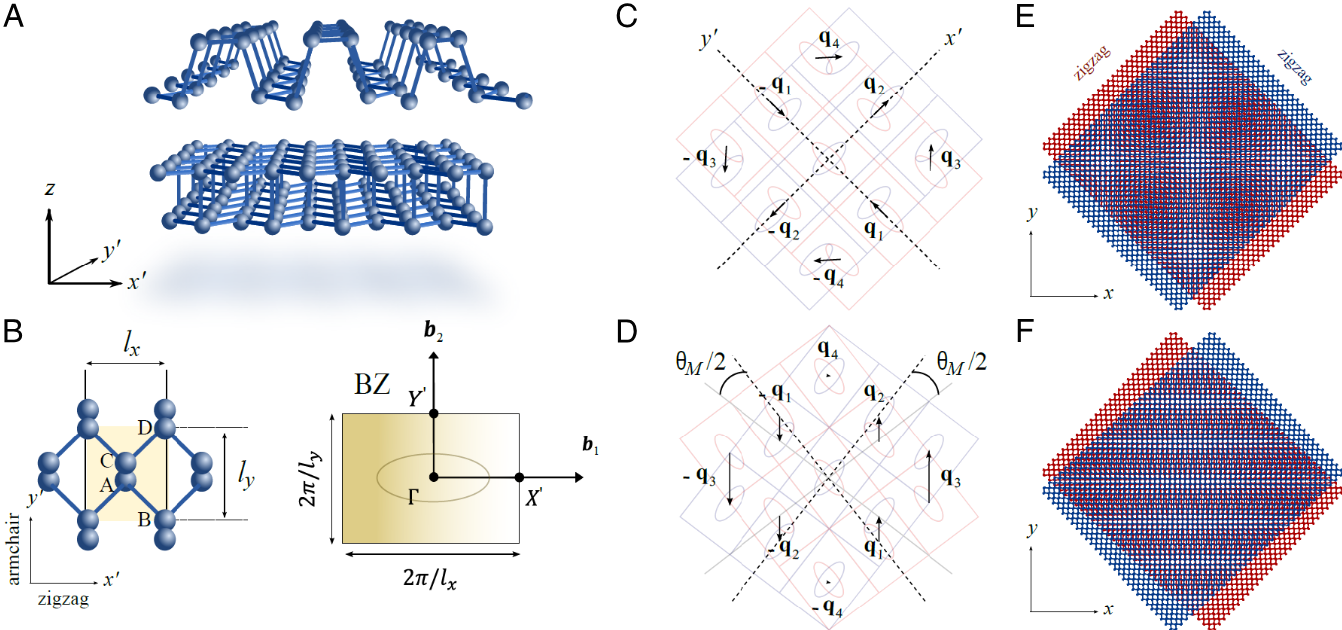
Most of this research has focused on materials whose crystal structure looks roughly the same in every direction, such as graphene, where the interesting physics shows up only at very small twist angles, close to perfect alignment. Now, a team of researchers instead looks at a strongly directional material: bilayer black phosphorus, whose atomic structure behaves very differently along two perpendicular directions in the plane, somewhat like a fabric that stretches easily one way but not the other. That built-in directionality turns out to change the whole logic of moiré physics, producing an effect the authors call moiré collapse. 1
Moiré collapse
Moiré collapse in twisted anisotropic homobilayers. Source: D. J. P. de Sousa et al. (2026) Proc. Natl. Acad. Sci. U. S. A. doi: 10.1073/pnas.2527371123 / fair use

In black phosphorus, the two layers start out rotated 90 degrees relative to each other. As that angle is dialed away from 90 degrees, the moiré pattern does something unusual. Rather than staying a two-dimensional pattern, like a slowly shifting checkerboard, it stretches more and more along one direction until, at a specific angle that depends only on the material’s own geometry, it effectively stops repeating in the other direction altogether. What remains behaves like a one-dimensional crystal, even though the material is still built from ordinary two-dimensional atomic sheets. For twisted bilayer black phosphorus, the calculations place this collapse at a twist of about 71.6 degrees, or equivalently about 18.4 degrees away from the initial 90-degree arrangement.

Pure geometry

This transformation has nothing to do with how electrons repel or attract each other; it is pure geometry. The mathematical description of the moiré pattern, expressed in terms of the directions in which its periodicity repeats, is squeezed from two independent directions down to one. In ordinary space, this means the pattern keeps a well-defined repeat distance along one axis while stretching out indefinitely along the other, with no repeating pattern left in that direction at all.

Such a dramatic structural change reshapes the electrons riding on top of it. At the untwisted 90-degree configuration, the anisotropy of one layer happens to cancel out the anisotropy of the other, so electrons move about equally well in every in-plane direction. As the twist angle approaches the collapse point, that cancellation breaks down. The electron energy bands become sharply directional, and electrons increasingly travel along one preferred line rather than spreading across the plane. Their energy spectrum starts to show the telltale fingerprints of one-dimensional systems, including sharp spikes in the density of available electron states known as one-dimensional van Hove singularities.

Luttinger liquid physics

One-dimensional conductors behave very differently from ordinary metals. In a three-dimensional metal, electrons can mostly be treated as independent particles that only weakly notice one another. Confine them to a single dimension, however, and that picture stops working: electrons cannot slip past each other, so they are forced to move collectively, in a coordinated wave-like fashion. The framework that describes this collective behavior, called Luttinger liquid theory, traces back to work by Sin-Itiro Tomonaga in 1950 and Joaquin Luttinger in 1963, and it has since been confirmed experimentally in systems such as carbon nanotubes. In a Luttinger liquid, the basic excitations are not single electrons at all, but collective ripples of charge and spin, and this leads to electrical transport properties that look qualitatively different from those of a normal metal.

The calculations in this study show that moiré collapse naturally sets up the conditions Luttinger liquid physics requires. As the collapse angle is approached, the one-dimensional electronic channels that form become progressively less coupled to their neighbors, making the correlated, wave-like behavior increasingly favorable. The analysis estimates a Luttinger parameter of about 0.3 for the collapsed black phosphorus system, a value indicating strong electron-electron interactions, and it predicts distinctive collective charge oscillations and unusual, non-metallic patterns in electrical conduction that could, in principle, be measured in the laboratory.

A notable feature of this mechanism is that the electron bands stay quite dispersive even at collapse, with electron speeds exceeding 100 kilometers per second. This sets it apart from most previously studied moiré systems, including twisted graphene, where strong correlations usually arise because the electronic bands become extremely flat and electrons effectively slow to a crawl. Here, the correlated behavior instead comes from the geometric collapse of the moiré lattice itself, with fast-moving electrons confined to one dimension rather than slow ones spread over two.

Moiré collapse is not a peculiarity of one material

To test these ideas, the researchers combined simplified mathematical models with detailed first-principles calculations of the atomic and electronic structure. Beyond black phosphorus, they found the same collapse in twisted bilayer tin selenide, another layered material with strongly directional bonding. The details of the electronic structure differ somewhat because of the specific atomic orbitals involved, but the same geometric collapse into quasi-one-dimensional channels appears, suggesting the phenomenon is not a peculiarity of one material but a general consequence of twisting any sufficiently anisotropic crystal.

Taken together, the findings outline a different strategy for engineering exotic quantum matter. Instead of hunting for a special magic angle that flattens electronic bands, as in twisted graphene, this approach relies on a purely geometric collapse angle at which a two-dimensional moiré material naturally turns one-dimensional. If confirmed in experiments, it would offer a new and versatile platform for studying Luttinger liquids and other correlated electronic phases that only emerge when electrons are squeezed into moving along a single line.


Author: César Tomé López is a science writer and the editor of Mapping Ignorance

Disclaimer: Parts of this article may have been copied verbatim or almost verbatim from the referenced research paper/s.

References

  1. D. J. P. de Sousa, S. Lee, F. Guinea, and T. Low (2026) Moiré collapse and Luttinger liquids in twisted anisotropic homobilayers Proc. Natl. Acad. Sci. U. S. A. doi: 10.1073/pnas.2527371123 ↩

The post Moiré collapse, when a twisted crystal becomes one-dimensional appeared first on Mapping Ignorance.

  •  

Eight lifesaving ways to improve wildfire risk management

Authors: María-Luisa Chas-Amil, Catedrática de Economía Aplicada, Universidade de Santiago de Compostela and Julia María Touza, Professor of Environmental Economics, University of York

fire
The village of Bédar, in the Almería province of Andalusia, after the July 9 fire.
Urci dream/Wikimedia Commons, CC BY-SA


As the flames advanced towards the village of Bédar, in the Almería province of Andalusia, the mayor gave a desperate order to ring the church bells to warn residents. It was not enough. The July 9 Los Gallardos fire, which claimed 13 lives and burnt 7,000 hectares, was Spain’s third deadliest on record.

Most of the victims were retired foreigners living in isolated homes, who died trapped in their vehicles or fleeing on foot along dead-end paths in a landscape dominated by scrubland and rugged terrain, most of which is difficult to access.

High temperatures and extremely dry weather turn scrub, grasslands and bushes into highly flammable fuel. This, combined with complex terrain that makes fire spread faster and unpredictably, poses an enormous challenge for firefighting efforts.

Andalusian legislation requires local emergency plans for forest fires in high-risk areas, and self-protection plans for detached buildings and housing estates. However, there is a widespread problem with compliance and implementation of these measures.

Fires are changing

The disaster in Los Gallardos shows that this problem will only get worse, unless we take decisive and effective action that goes beyond the current dominant paradigm of simply extinguishing and resisting fire.

Where, when and how fires occur is changing. Highly destructive fires are on the rise, housing is expanding into the urban-forest interface. This exposes more homes to fire, and the the risk is increasing most quickly in scrubland and grassland areas, which are not typically associated with fire risk.

This is a major problem for communities that do not know how to respond to a risk they have not often been exposed to. We therefore need to urgently rethink how fire risk is managed.

Improving fire resilience

It is unsustainable to respond only after a disaster has happened. What we need are strategies based on preparedness, mitigation and adaptation. The following eight points are particularly important in achieving this.

1. Manage social vulnerability

Wildfires exacerbate the existing social vulnerabilities that affect people’s ability to anticipate, cope with, withstand and recover from them. In high-risk areas the population may consist of elderly people, people living alone in isolated homes, with financial constraints, or who do not know the local area well.

Fires also pose a risk to local economies. Businesses – including those that provide public services and infrastructure – can be vulnerable for a range of reasons, including flammable facilities, their location, or disruptions to supply chains, essential services and staff mobility.

Targeted planning can identify and address all of these vulnerabilities.

2. Adopt nature-based solutions

Nature-based solutions have not been fully integrated into fire risk management, even though they are widely recognised as essential parts of climate change adaptation and nature restoration.

Nature-based solutions include controlled grazing, the creation of less flammable habitats, green firebreaks, and the restoration of water networks to increase ambient humidity and create areas that slow the spread of fire. These measures also bring many additional benefits for the local population and economy.

3. Create (and update) emergency, self-protection and training plans

Local authorities must draw up emergency plans that the public can access. Isolated dwellings and housing estates must have their own coordinated plans. The plans should include fire hydrants and water supply points, accessible warning systems, access and evacuation routes, and protocols for vulnerable people.

But plans alone are not enough without training. There is also a need for ongoing programmes, tailored to each community, that train people to safely maintain their homes and surroundings, familiarise them with meeting points and shelter areas, and teach them to distinguish between lockdown and evacuation.

Drills are essential. Evacuation is not the same as fleeing, and emergency response must be planned and practised.

4. Promote collective action

Risk reduction is most effective when it is community-based, as this increases overall collective resilience. This means public authorities, community organisations, and the public and private sector must all work alongside one another.

The public should also be actively involved in the design of emergency plans. This builds legitimacy, improves the capacity to respond to fires, and fosters trust and a sense of shared responsibility for preventing fires.

5. Promote integrated and coordinated governance

Fire risk management cannot be the sole responsibility of forestry or firefighting services – it needs an integrated system. All agencies that act in the area must take fire risk into account when making decisions.

In practice, this means avoiding new construction and establishing specific building regulations in high-risk areas, creating buffer zones between different land uses, and promoting uses that help to maintain fire-resilient landscapes.

6. Incentivise risk management

Economic tools and behavioural insights can be leveraged to make self-protection measures and land management the easiest and most rewarding options. This includes nudges: interventions that are designed to encourage but not force people to make certain decisions.

One example of this is payments for environmental services, which financially incentivise land management practices that reduce wildfire risk.

The role of insurance is also evolving in the face of natural and climate-related risks. Instruments are being designed based on a proactive model that incentivises individual and collective risk-reduction behaviour.

7. Improve monitoring and advance warning systems

Up-to-date information on a fire’s development is essential. Real-time monitoring systems, sensors, satellite imagery, predictive models of fire behaviour and alert applications providing detailed information can all improve response capabilities and enable safer evacuations. Integrating these tools into local management plans is a necessary investment.

8. Encourage public and private investment in long-term preparedness

Investments in prevention and preparedness provide significant returns. Growing requirements – both regulatory and voluntary – for the private sector to disclose information on nature-related risks and dependencies are generating new demand for investment products (carbon and biodiversity credits, habitat banks, environmental impact bonds, and so on).

This growing private investment must now be channelled towards measures that strengthen both people’s and the landscape’s wildfire resilience. This is to supplement, not replace public investment.

The Los Gallardos blaze serves as a reminder that we need to fundamentally change the way we understand and manage fire risk. Investment in preparedness and coordinated planning between public authorities, the private sector and the general public could be the key to ensuring that, should the alarm bells ring again, the population is ready to respond.


This article is republished from The Conversation under a Creative Commons license.  Original article.

The post Eight lifesaving ways to improve wildfire risk management appeared first on Mapping Ignorance.

  •  

Substrate dynamics could power brain-inspired chips

Many of today’s electronic devices — from the semiconductors in your cell phone to the photovoltaic cells in your solar panels — are built on thin-film substrates. The thin film is an electronically conductive material while the substrate is an inert material. Or is it?

Physicists and materials scientists have long assumed substrates do not react to electrical stimulus, but new research from the University of California San Diego Alex Frañó’s lab and a team of collaborators has shown that substrates are not inert after all. The discovery 1 has the potential to help engineers build the dense, three-dimensional, brain-inspired computer chips needed for more energy-efficient computing.

substrate
Source: Unsplash

In a human brain, a vast network of neurons works across different regions, enabling every thought and action we take. Yet thoughts that are quick and simple for humans — recognizing faces, differentiating a cat from a dog or solving a captcha — can be devilishly hard and energy-intensive for computers. Quantum materials may provide a solution.

It was this quest to develop new materials that led Frañó’s lab to study vanadium dioxide thin-film devices. When a voltage is applied to the thin film, an electric filament forms — something similar happens when the Earth and atmosphere create a voltage strong enough to result in lightning. The filament in the thin film drives the device’s electrical spiking, much like the signals in our neurons.

This reaction has been studied countless times in labs around the world, but Frañó’s lab was implementing a new technique, developed by graduate student Elliot Kisiel, called dark-field X-ray microscopy. Kisiel, who spent most of his graduate studies at Argonne National Laboratory and is now a Mayer Postdoctoral Fellow there, developed the tool to combine the best of two worlds: electron microscopy and X-ray diffraction.

“Dark-field X-ray microscopy gives us the ability to look at an entire device in one image, which not only greatly improves how fast we can perform these measurements, but also allows us to study the areas surrounding the devices with high fidelity,” he stated.

A changing substrate

Since the lenses for X-rays are often thick and, therefore, absorb most of the X-rays that pass through them, the team needed to look at something that provided more signal, which is why they decided to look at the substrate during some of their preliminary testing with this new technique.

What they saw was completely unexpected: not only was there a change in the thin film, but there was also a change in the substrate, showing for the first time that the two parts were sharing energy or “coupled.” This discovery went against everything scientists had assumed about substrates for decades.

 Materials for a new age of computing

Thin films are so called because they are vanishingly thin — around 100 nanometers — while the substrates they sit on can be 10,000 times thicker. Despite their lopsided sizes, in this experiment, the thin film was able to push and pull on the substrate. Frañó likened the discovery to a tree on a mountaintop being able to move the entire mountain. Furthermore, the substrate also acted on the thin film, each pushing and pulling on the other.

They spent the next four years making sure what they saw wasn’t a fluke. They not only reproduced the results doing the research exactly as they had done it the first time, but they also reproduced the results when they changed certain aspects of the sample, such as the thickness and material of the substrate. They also tested their results using different instrumentation. Much of that work was done at Argonne, which has a synchrotron facility that produces high brilliance X-rays, and at Brookhaven National Laboratory, home to the world’s only all-electric ultrafast electron microscope, which is able to capture exactly how a working device behaves under realistic operating conditions.

It wasn’t a fluke.

“The assumption that substrates are inert needs to be rethought,” Frañó stated. “Going forward, we have to assume that the substrate is undergoing changes when the film is. This is a transformational notion that counters decades of previous supposition.”

This paper is a companion to a paper that was published last year in ACS Nano 2. In that paper, they used dark-field X-ray microscopy to study the thin film, while this paper focuses on the substrate. Together they illustrate how one research result leads to the next research inquiry.

In Frañó’s case, the question he now asks himself is, “What can we do with this new substrate discovery? If a tree is moving the whole mountain, let’s find a way to capitalize on that.”

One idea is that the substrate can act as a medium that can couple materials on either end of the substrate. Currently, thin film devices are connected two-dimensionally, but if researchers could build on both sides of a substrate, it would allow for three-dimensionality, opening up the possibility of denser, more interconnected computer chips, and bringing us one step closer to the next generation of computing.


References

  1.   Elliot Kisiel et al. (2026) Dynamic asymmetric strain imprinted into substrates by an oxide thin film doi:10.1126/science.adt9347 ↩
  2. Elliot Kisiel et al. (2025) High-Resolution Full-Field Structural Microscopy of the Voltage-Induced Filament Formation in VO2-Based Neuromorphic Devices. ACS Nano doi: 10.1021/acsnano.4c14696 ↩

The post Substrate dynamics could power brain-inspired chips appeared first on Mapping Ignorance.

  •  

Doing and experiencing in language: how similar are they?

Author: Marta Sánchez López, Postdoctoral researcher at Research Centre for Basque Language and Texts (CNRS-IKER) – Université Bordeaux Montaigne. She also collaborates with the The Bilingual Mind Research Group (Gogo Elebiduna), University of the Basque Country. 

experiencers
Photo: Pascal Habermann en Unsplash

In our daily life, we perceive many different events around us with different participants involved, such as a woman dancing in a theater, or a man enjoying an ice cream. To produce and understand the sentences that express these events, it is crucial to identify the number of participants involved and the role that each one plays. As in a drama, we have to identify the role that each character has to understand the story.

Agents, patients and experiencers

In some events, there are two characters involved, as in the girl kicks the ball, with the girl and the ball; in others, instead, there is only one, as in the woman dances or the man falls down, with the woman or the man. Each of these participants has a different role. For example, the woman is an agent, because she is doing the action, just the opposite of the man, who is a patient, because he is the one affected. In the case of the girl has fun, this participant has the role of experiencer, the one who experiences the enjoyment.

In psycholinguistics, the mechanisms involved in the processing of agent, patient, and experiencer roles have been investigated through different experiments such as reading sentences while participants’ brain activity or eye-movements are recorded. In these studies, it has been found that agent and patient categories play a crucial role in language comprehension and production. These two roles are used when reading, listening to, and producing sentences, and different mechanisms are involved in their processing (e.g., 12345). Therefore, they form two different categories within the event role repertoire 6. They are two different characters within the drama. However, as I will discuss, there is no experimental evidence for a third character, the experiencer role.

One well-established result regarding the processing of agents and patients comes from experiments where participants are asked to read sentences while their brain activity is recorded by means of electrodes, known as EEG studies. Results of these studies show that the processing of patients elicited an N400 component (a negative brain response that occurs around 400 milliseconds after a stimulus is processed) compared to the processing of agents. This effect is associated with the processing of unexpected elements. For example, when processing the day was breezy so the boy went outside to fly, it is expected to read next a kite based on the preceding context; hence, if an airplane is read instead, as this is unexpected, then an N400 effect appears 7. Something similar happens with the processing of agents and patients: agents are expected, whereas patients unexpected.

Across languages, speakers tend to interpret the first ambiguous noun phrase of a sentence as an agent instead of as a patient, due to the agent preference 8: agents are preferred and are cognitively more salient than patients. Imagine that someone reads the sentence Mary falls down. Before encountering the verb, the reader cannot know whether Mary is an agent or a patient. However, as agents are preferred over patients, the reader interprets that it is an agent by default. Once the verb is reached, there are two options: confirm that Mary is an agent (the expected role) or recategorize it as a patient (the unexpected role). In Mary falls down, it is the second option, Mary is categorized as a patient, because the verb selects this role. This recategorization is reflected in an N400 component. This result shows that agents and patients have different processing mechanisms and that they form two different categories. Furthermore, this effect has been largely found in different languages such as, Basque (Isasi-Isasmendi et al., 2024), Spanish 9, German (Haupt et al., 2008), Hindi (Bickel et al., 2015), or Aïwoo (Sauppe et al., 2023), supporting its robustness.

Therefore, these experimental findings show that there is a preference toward agents over patients. The agent is the protagonist of the show, while the patient plays a secondary role.

What about experiencers?

Linguists have proposed that there are other roles within the event role repertoire, for example, the experiencer role 10.This role corresponds to the participant who experiences a mental state denoted by the verb. Participants of events like loving someone or enjoying an ice cream have this role. The experiencer is the participant who loves or enjoys.

But does experimental evidence show that the experiencer role is a specific role category within the event role repertoire, as agent and patient roles do?

In Sánchez-López (2026), I addressed this question. I investigated whether speakers use a third category, the experiencer role, when processing language. In three reading eye-tracking experiments and in one EEG experiment, I asked Spanish native speakers to read sentences, while their eye-movements and their brain activity were recorded.

In the first two eye-tracking experiments, I compared de processing of sentences with two participants with different combinations of agent, experiencer, and patient roles: (i) María golpea a Juan “Mary hits John”, with an agent (María) and a patient (Juan); (ii) María asusta a Juan “Mary frightens John”, with an agent (María) and an experiencer (Juan); and (iii) María ama a Juan “Mary loves John”, with an experiencer (María) and a patient (Juan).

These two experiments revealed that Spanish native speakers produced higher fixation times on verbs selecting agent-experiencer roles (ii), than on the other two sentence types (i, iii), independently of whether the subject was animate or inanimate (e.g., María/La situación asusta a Juan “Mary/The situation frightens John”). Interestingly, no processing differences were found between sentences selecting agent-patient (i) and experiencer-patient (iii). These findings show that the combination of agent-experiencer involves higher processing cost than other combinations.

But why is the agent-experiencer combination costlier than the others?

A possible explanation could be that the experiencer role is not a specific category within the event role repertoire. As Dowty 11 proposed, agents and experiencers are both grouped within the same category, the one of the proto-agent. Based on this proposal, there are only two roles in the event role repertoire, proto-agent and proto-patient, and proto-agents always become subjects. Hence, in sentences like Mary frightens John, both participants are proto-agents. Since they are both possible candidates to become subject, a competition for subject assignment appears. This competition is reflected in higher processing cost compared to those sentences without competition, sentences with only one proto-agent participant (e.g., Mary hits John or Mary loves John).

To better understand this competition effect, imagine that the proto-agent is the hero of the story and the proto-patient is the villain. In a drama, if there is a hero, there is also a villain. If there are two heroes and no villain in the story, it would be unusual, and probably, it would take more time to understand the story, since this is not expected. Hence, the same happens with sentences like Mary frightens John, which have two proto-agents; this combination is unexpected and it entails higher processing cost than when there is only one proto-agent and one proto-patient.

In another reading experiment using both eye-tracking and EEG techniques, I compared the processing of the three roles, agent, experiencer, and patient again to determine whether this experiencer role behaves like the agent role or not. In these experiments, I used sentences with only one participant involved: (iv) María baila “Mary dances” with an agent, (v) María disfruta “Mary has fun” with an experiencer, and (vi) María se cae “Mary falls down” with a patient. The use of these sentences allowed a more direct comparison of the processing of these roles, since the three roles are subjects. The structure of all sentences is the same (one participant and the verb), and only the event role category changes.

Results revealed that participant looked more at sentences with agents and experiencers than at sentences with patients. Moreover, I found that participants exhibited a preference to interpret the first ambiguous noun phrase (i.e., María) as an agent/experiencer; hence, when they realized that it was a patient instead, an N400 component appeared. But this effect only appeared with patients, not with experiencers, showing that participants processed similarly agents and experiencers, and both different from patients.

What does this evidence show?

These results align with the hypothesis that there are only two role categories within the event role repertoire (Dowty, 1991): proto-agent and proto-patient. Therefore, when the sentences Mary dances or Mary has fun are processed, in both cases, Mary is interpreted as a proto-agent, whereas in Mary falls down, she is interpreted as a patient instead.

All in all, this evidence suggests that agents and experiencers belong to the same role category, the one of the proto-agent. Therefore, when we process language, it seems that we do not differentiate between agents and experiencers, rather we process them similarly. Experiencers are grouped together with agents, being the same character in the event, both proto-agents.

So, proto-agents are the protagonists of the story, the ones that spectators prefer to pay attention to, whereas proto-patients are the secondary characters who complement the story. Regarding experiencers, they do not play a different character in the story, instead, they are also the protagonists.


References

  1. Bickel, B., Witzlack-Makarevich, A., Choudhary, K. K., Schlesewsky, M., & Bornkessel-Schlesewsky, I. (2015). The neurophysiology of language processing shapes the evolution of grammar: Evidence from case marking. PLOS ONE, 10(8), e0132819. https://doi.org/10.1371/journal.pone.0132819 ↩
  2. Gómez-Vidal, B., Arantzeta, M., Laka, J. P., & Laka, I. (2022). Subjects are not all alike: Eye-tracking the agent preference in Spanish. PLOS ONE, 17(8). doi: 10.1371/journal.pone.0272211 ↩
  3. Haupt, F. S., Schlesewsky, M., Roehm, D., Friederici, A. D., & Bornkessel-Schlesewsky, I. (2008). The status of subject–object reanalyses in the language comprehension architecture. Journal of Memory and Language, 59(1), 54–96. https://doi.org/10.1016/j.jml.2008.02.003 ↩
  4. Isasi-Isasmendi, A., Sauppe, S., Andrews, C., Laka, I., Meyer, M., & Bickel, B. (2024). Incremental sentence processing is guided by a preference for agents: EEG evidence from Basque. Language, Cognition and Neuroscience, 39(1), 76–97. https://doi.org/10.1080/23273798.2023.2250023 ↩
  5. Sauppe, S., Næss, Å., Roversi, G., Meyer, M., Bornkessel-Schlesewsky, I., & Bickel, B. (2023). An agent-first preference in a patient-first language during sentence comprehension. Cognitive Science, 47(9), Article 9. https://doi.org/10.1111/cogs.13340 ↩
  6. Rissman, L., & Majid, A. (2019). Thematic roles: Core knowledge or linguistic construct? Psychonomic Bulletin & Review, 26(6), 1850–1869. https://doi.org/10.3758/s13423-019-01634-5 ↩
  7. DeLong, K. A., Urbach, T. P., & Kutas, M. (2005). Probabilistic word pre-activation during language comprehension inferred from electrical brain activity. Nature Neuroscience, 8(8), 1117–1121. https://doi.org/10.1038/nn1504 ↩
  8. Bornkessel‐Schlesewsky, I., & Schlesewsky, M. (2009). The role of prominence information in the real‐time comprehension of transitive constructions: A cross‐linguistic approach. Language and Linguistics Compass, 3(1), 19–58. https://doi.org/10.1111/j.1749-818X.2008.00099.x ↩
  9. Sánchez-López, M. (2026). Processing proto-agents and proto-patients: Eye-tracking and EEG evidence in Spanish [University of the Basque Country]. 10.17605/OSF.IO/WNAR8 ↩
  10. Fillmore, C. J. (1971). Some problems for case grammar. In R. J. O’Brien (Ed.), Report of the 22nd annual round table meeting on linguistics and language studies (pp. 35–56). Georgetown University Press. ↩
  11. Dowty, D. (1991). Thematic proto-roles and argument selection. Language, 67(3), 547–619. https://doi.org/10.1353/lan.1991.0021 ↩

The post Doing and experiencing in language: how similar are they? appeared first on Mapping Ignorance.

  •  
❌