❌

Reading view

SpaceX’s planned $60 billion deal for Cursor raises questions for CIOs

When SpaceX on Tuesday officially announced its plan to purchase AI coding startup Cursor for $60 billion in stock, as it had predicted it would do in April, it presented CIOs and developers with a little good news, a little bad news and a massive pile of uncertainty. 

The details of the proposed acquisition were virtually identical to the terms announced in April, even retaining the $10 billion consolation prize for Cursor should SpaceX back out of the deal.  

But for CIOs and developers, the increasing probability of the deal happening is forcing them to make long-term decisions without many long-term answers about what is likely to happen to Cursor, which says its coding agents are used by 64% of Fortune 500 companies.

But whether the deal is good news for Cursor’s customers, or even those of its rivals, is an open question.

Arnal Dayaratna, research VP for software development at IDC, is firmly in the good news camp. He argued that the main element holding back the company, which he estimated brings in about $2 billion in annual revenue, was access to GPUs. And, he said, SpaceX’s xAI has the ability to resolve that problem.

It’s all about the GPUs

“The implication is that Cursor can get better because it will get better access to more compute, in the form of GPUs. That was what Cursor was struggling to obtain,” Dayaratna said, adding that Cursor joins both Anthropic and Google in aligning with xAI. 

“It is bad news for Anthropic,” he said, pointing out, “[Elon] Musk figured out that GPUs were the limiters, the bottleneck. Not human talent: compute. And it’s not only about GPUs. It’s about the data centers,” as well as the mechanisms needed to support data centers, including electricity access, cooling apparatus, and zoning rights.

“Zoning rights are very difficult to obtain in the United States, and Elon has been able to leverage his political capital” to obtain those rights, Dayaratna said.

Dayaratna also commented on the highly unusual tactic of a company pre-announcing an acquisition and then announcing it “officially” two months later. The reason, he suggested, is that Musk didn’t want the acquisition to delay the SpaceX IPO, but he did want potential investors to know about it. “It gave the IPO more legs, even though it was not formally a part of the IPO. He wanted to socialize it before it happened,” he said.

Jason Andersen, principal analyst at Moor Insights & Strategy, took a far more cautious approach and predicted, “enterprise customers will be very concerned.”

Time for CIO due diligence

“xAI’s models and treatment of guardrails are very different than what Cursor has stood for,” Andersen said, and the key issue involves model choice. “Will Cursor be able to point at models other than Grok? If that is the case, it could go towards helping customers be OK with things for a while,” he said. 

But Andersen stressed the words “for a while.” He argued that Cursor rivals have gotten more sophisticated, which could give enterprise CIOs more alternatives.

“The tooling options from the classic enterprise vendors have gotten really good, and also have a number of features that enable better governance and teaming. For example, Kiro from AWS is already a worthy competitor to Cursor, but there have also been major improvements from Google and Microsoft this year,” Andersen said. “I’d venture to say that Cursor was already facing a substantial competitive challenge in the enterprise, especially as the vibe coding movement lost some steam towards agents that enable so much more developer capability.”

Andersen added, “A lot of SpaceX’s valuation is pinned to xAI and there wasn’t enough IP there for it to be long-term competitive with Anthropic or OpenAI without rapidly injecting new technology.”

Shashi Bellamkonda, principal research director at Info-Tech Research Group, said the current period of due diligence gives CIOs opportunities to ask difficult questions.

“I do believe that enterprise customers will start to ask harder questions now, especially if more of the processing starts moving through Grok or xAI infrastructure,” Bellamkonda said, but he stressed that he does see a SpaceX deal helping Cursor.

“Cursor is already carrying a lot of LLM cost and if SpaceX and xAI can give it access to more compute and a faster, improved Grok model, customers could eventually get better performance at a lower cost. Grok is getting faster and more accurate, and under SpaceX there may be more enterprise appetite for xAI than xAI had on its own,” Bellamkonda said.

Questions about data privacy

But Bellamkonda also pointed to the trust issue, specifically asking whether Cursor would be allowed to continue its zero-data-retention policy under the new ownership.

“Enterprise users with sensitive codebases will want to understand exactly where their data is going, who has access to it, and whether any prompts, code, metadata, or embeddings are touching SpaceX or xAI systems,” Bellamkonda said. “Zero data retention is only valuable if customers believe the controls still apply across the new infrastructure. If they can preserve Cursor’s privacy posture while using xAI and SpaceX compute to improve the product, this could be a very strong outcome for customers. If the data governance is unclear, enterprise buyers will hesitate.”

Justin Greis, CEO of consulting firm Acceligence, echoed Bellamkonda’s concerns.

“For many enterprise customers, Cursor’s zero-data-retention policy was not simply a security feature. It was a foundational part of the procurement and approval process,” Greis said, pointing out that security teams, legal departments, compliance officers, and executive leadership all became more comfortable adopting AI-assisted development because they believed their source code, prompts, and proprietary intellectual property would not be retained, stored, or repurposed.

“Whenever ownership changes, customers naturally revisit those assumptions,” he said. “I would expect enterprise customers to immediately seek clarity on whether existing zero-data-retention commitments remain unchanged, whether those commitments continue to be contractually enforceable, and whether any future modifications could be introduced through changes to terms of service or product strategy.”

Reassessing platform risk

Another concern is whether the move will create greater vendor concentration, and whether that will increase risk exposure. 

“Many organizations are already concerned about becoming overly dependent on a small number of AI providers. If Cursor becomes more tightly integrated into a broader SpaceX technology ecosystem, some enterprises may worry about reduced flexibility and fewer alternatives. I suspect this will be a continued question with SpaceX’s recent IPO and growth plans,” Greis said.

Additionally, he pointed out, “AI coding platforms are rapidly becoming part of critical software delivery infrastructure. When organizations standardize on these tools, they are making a long-term platform decision that influences developer productivity, software quality, security processes, and engineering workflows. A change in ownership naturally prompts a reassessment of platform risk, roadmap alignment, and long-term strategic direction.”

As well, Sanchit Vir Gogia, chief analyst at Greyhound Research, noted, “zero data retention survives only where it stays contractual, auditable, enforceable and fenced from affiliate use. The deeper point is what Cursor has become. It is no longer a developer convenience. It sits inside the act of software creation, close to the intellectual-property bloodstream of the enterprise. That is a control plane, and control planes change hands rarely and consequentially.”

Gogia added that even before an acquisition, Cursor was already weakening its data guarantee. “Even now the promise is layered. Cursor’s own disclosures show that standard Privacy Mode still permits some code data to be stored for product features, while only the stricter legacy setting retains nothing. Zero is the exception, not the default.”

  •  

Databricks pitches LTAP as a new foundation for agentic applications

As enterprises rush to build AI agents that can reason over business data and take action, Databricks argues that the long-standing practice of separating operational and analytical data systems is turning into a liability.

That separation, the cloud-based data warehouse provider says, is becoming increasingly strained as AI agents require simultaneous access to live operational data and historical context to make decisions and take actions in real time, unlike humans, who traditionally can work with data that is minutes or hours old.

At its annual Data + AI Summit, the data warehouse provider introduced Lake Transactional and Analytical Processing (LTAP), a new architecture designed to unify transactional and analytical data on a single storage layer.

The new approach, according to Databricks, differs from traditional online transaction processing (OLTP) and online analytical processing (OLAP) architectures, which typically store operational and analytical data in separate systems.

Traditionally, OLTP databases are optimized for running day-to-day business operations such as order processing, payments, and inventory updates, while OLAP systems are designed for large-scale analytical queries and reporting.

As a result, enterprises often need to rely on ETL pipelines, data replication, and separate infrastructure to move information between the two environments.

LTAP, Databricks said, seeks to eliminate the reliance on ETL pipelines, replicated databases or separate data copies by storing data once in a shared lakehouse layer while allowing dedicated compute engines to handle transactional and analytical workloads independently.

This approach, the company argued, provides AI-driven agents and applications access to both live operational data and historical analytical context without requiring data movement or duplicate copies.

Developer simplicity in the agentic era

Analysts, too, agree with Databricks’ contention that AI agents place new demands on enterprise data architectures.

“Agents don’t behave like people, or even like the apps we built for people. They read for context, loop, try things, then write something back, thousands of times over in ways you can’t fully predict. At that volume, the constant bouncing between production and analytics systems starts becoming the bottleneck. The pressure to collapse that gap is real, and LTAP is one way to approach it,” said Michael Leone, principal analyst at Moor Insights and Strategy.

Bhupendra Chopra, cofounder and CRO at IT consulting firm Kanerika, pointed out that an autonomous agent’s data access pattern makes the traditional architectures brittle: “We’re seeing this directly with clients deploying multi-agent systems, the pipeline layer becomes the ceiling almost immediately as an agent runs hundreds of times per task.”

The analysts also pointed out that the ability to collapse the gap between OLAP and OLTP is likely to help developers design more robust AI agents or applications that enterprises are currently targeting to deploy.

“The most interesting workflow or application patterns are real-time, context-aware applications that combine transactions, analytics, and AI in one flow,” said Stephanie Walter, practice leader of AI stack at HyperFRAME Research.

“Examples include AI agents that update customer workflows while seeing historical account context and fraud systems that act on live transactions and long-term behavioral patterns,” Walter added.

Designing such applications today, however, according to Leone, would require developers to pull together data from transactional systems, data warehouses, vector databases, and other sources through custom integrations, creating significant engineering complexity and maintenance overhead.

Operational simplicity and governance gains for CIOs

For CIOs,  LTAP’s ability to reduce that engineering complexity, according to Ashish Chaturvedi, leader of executive research at HFS Research, will result in operational simplicity as well as cost savings.

“Most prominent advantage would be fewer data pipelines and everything that cascades from eliminating them. Most enterprises don’t realize how much of their data engineering budget is pure plumbing maintenance,” Chaturvedi said.

Kanerika’s Chopra pointed out that a substantial portion of data engineering capacity in mid-to-large enterprises today is consumed by maintaining synchronization between transactional and analytical systems.

The implications, however, Chaturvedi noted, are not limited to developer productivity, architectural simplicity, or cost savings: “The strategic prize is simplified governance. When you have one copy of data under one governance model instead of the same data scattered across operational stores, replicas, warehouses, and vector databases, you’ve solved the governance fragmentation problem.”

That simplification, according to Chopra, will matter operationally for enterprises deploying multiple AI agents, as these workflows can amplify governance gaps at a speed and scale that no human workflow ever did.

LTAP versus HTAP

Despite all its benefits, though, LTAP isn’t the first effort to unify operational and analytical workloads under a single architecture and for years.

The industry has pursued a similar goal through Hybrid Transactional and Analytical Processing (HTAP) architecture, which sought to combine operational and analytical workloads on tightly coupled infrastructure to serve both workload types from the same system.

LTAP, in contrast, separates storage from compute, allowing different engines to access a common data layer while remaining independently scalable, Databricks said.

That separation of compute engines is why analysts think that LTAP might be a better bet than HTAP.

“HTAP never took off because asking one tightly bound system to be great at transactions and great at analytics usually left it mediocre at both, so customers ended up paying a premium for that compromise,” Leone said.

“I think separating storage from compute is the right instinct, and it’s the same move that made the modern cloud data world work in the first place. It matters because the thing that sank HTAP was one workload starving the other, and giving each side its own dedicated engine is exactly how you keep that from happening,” Leone added.

Another reason for HTAP’s failure, according to David Menninger, executive director of software research at ISG, was its requirement for enterprises to replace existing data platforms with a new architecture.

LTAP, by contrast, builds on the now-common practice of separating compute and storage, making the addition of an operational layer less of an architectural transformation and potentially lowering the barrier to adoption, Menninger added.

Not yet the default architecture for AI agents

However, despite the enthusiasm around LTAP, analysts warned CIOs against viewing this as the inevitable successor to existing data architectures.

“CIOs will still need to choose their data architecture based on latency, reliability, ecosystem fit, cost, compliance, and developer experience,” Walter said.

Echoing Walter, Chaturvedi pointed out that for LTAP to become the de facto standard for the industry, Databricks will need more than architectural elegance: “The architecture looks sound on paper. The proof will be in the commit-to-query latency numbers under real load.”

LTAP, Databricks said, is expected to be released soon as part of Lakebase, without providing any specific timelines.

  •  

Shipping enterprise-quality code with AI agents

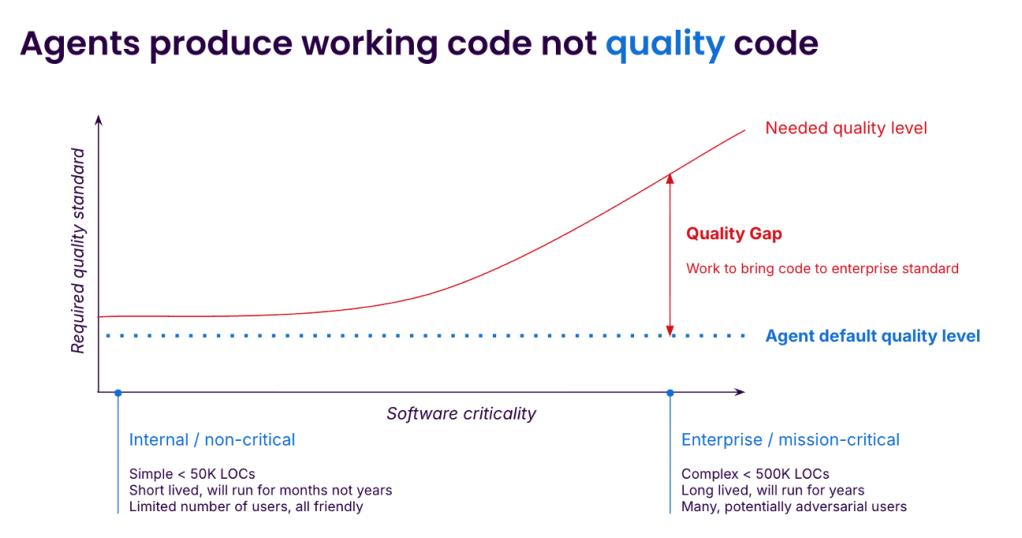
Developers are caught between the joy — or pressure — of using agents to ship 10x faster today and the dread of how they will maintain that code tomorrow. The gap between “vibe” code and code that can be deployed to millions of users is vast and easy to underestimate. Closing the gap requires care, expertise, and effort, with the payoff coming later. Agents are able to complete increasingly complex programming tasks but without the quality we need. What’s missing, and how can we fill the gap?

agentic coding quality gap - sonar

Sonar

Why agent-generated code degrades: the bloat problem

Enterprise code has to clear three bars: it must be maintainable, reliable, and secure. Out-of-the-box AI agents can miss all three. Let’s focus on the biggest and most visible maintainability issue, which is bloat: redundant validation, defensive checks that cannot fire, near-duplicate functions, dead code that nothing removes. A None check on a parameter typed as dict. A try/except around a call that never throws. Two functions, identical except for the negation in their return statement.

Bloat varies dramatically by model. Sonar’s LLM Leaderboard runs every frontier model through 4,400+ Java tasks and analyses the code generated. To complete the benchmark, GPT-5.4 High generated 1,159,000 lines of code at an 81.05% pass rate, while Claude Opus 4.7 Thinking generated only 336,000 lines of code to return a better than 82.52% pass rate. Different models generate dramatically different code to achieve similar outcomes.

Bloat is not just messy. Carnegie Mellon researchers studied 807 open-source projects that had adopted Cursor, matched against 1,380 controls, measured by SonarQube. A short-term velocity gain disappeared by month three, while static analysis warnings rose 30% and code complexity rose 41% — both persistent. The harder it became to change the codebase and the more bugs it contained, the more the velocity was dragged down. Any experienced developer will know how this goes: quality problems compound until the code feels impossible to change and the only option is the dreaded rewrite.

Three forces produce bloat once a model is in use:

  1. Agents do not feel the maintenance burden. Armin Ronacher, the creator of Flask, made the point on the Pragmatic Engineer podcast in late April. Humans feel the cost of bad code over time, and as Ronacher put it, “if the pain gets too big, you as a human are incentivized to fix the cause of your pain” — so we refactor. Agents do not. They obliviously extend bad structure indefinitely. A senior engineer’s job is to say no to unnecessary abstraction. The agent has no equivalent reflex.
  2. Training rewards apparent completeness. Pretraining corpora are full of explanatory material — Stack Overflow answers, tutorials, README snippets — deliberately self-contained and verbose. Post-training compounds the effect: human raters prefer outputs that look thorough, so models learn that “comprehensive” reads as better. When uncertain which edge case matters, the safe move is to handle all of them. Each guard is locally defensible. The aggregate is bloat.
  3. Iterative generation has no deletion pressure. Agents add but rarely delete. Removing dead code does not make any test go green, so superseded functions accumulate alongside their replacements. SlopCodeBench, a March 2026 benchmark across 11 coding models, found rising structural complexity in 80% of trajectories and rising verbosity in 89.8%. Agents continue to patch bad code, treating every task as if it’s their last.

AC/DC: the loop that compensates

What closes the gap is a loop around each iteration of agent work. The agent does what it is good at — generating code — and our job is to wrap that with three steps the agent cannot reliably do on its own. At Sonar we call this the Agent Centric Development Cycle, or AC/DC: guide, verify, solve.

Guide

Many teams overcorrect on context. They paste the style guide, three years of architectural decisions, and the entire onboarding doc into the agent’s instructions and expect output to improve. ETH Zurich researchers tested this and found the opposite: large context files often reduced task success against no context at all, and added 20% or more to inference cost.

Keep agent-facing context short — under 200 lines is a useful heuristic — and restrict it to fundamentals that can’t easily be inferred from the code: naming conventions, architectural invariants, what has been tried and failed. However, this will only get you so far, so make sure to provide specific context for each task. If you have architectural expectations, don’t expect the agent to guess them. Software architecture tools can be used to provide additional context in the guide phase.

Task shape matters too. Break the work into steps and agree on a plan; ask the agent to provide three solutions and evaluate the impact on quality of each. There is no perfect software architecture, and you understand the trade-offs in your codebase best, so think critically about the changes before they happen. Without this, the agent will confidently pick an option, seemingly at random, and the further it goes the harder it is to “unpick.” If you want to test this, ask three instances of your preferred agent to complete a task that involves some polymorphism and watch each one confidently suggest a different solution.

Verify

The most expensive verification mistake is doing it last. Reviewing 200-line pull requests (PRs) after the agent is done is the dynamic behind the Faros/DORA figures Addy Osmani highlighted: 98% more PRs merged in high-adoption teams, review times up 91%. Verification inside the loop is different. Unit test runs, static analysis, and security scanners produce output the agent can act on. This is where AI-native tooling belongs: purpose-built for the agent to invoke, not just for humans to consult through a UI.

Human reviewers cannot keep up. When agents merge twice as many PRs per week and each one takes nearly twice as long to review, doubling the review staff still leaves you behind. Automated verification is the only response that scales. Fast feedback has always been a fundamental tenet of good software engineering. Feeding it directly back to the agent protects the developer from simple mistakes and leaves them headroom to work on the harder ones.

Solve

If verification happens within the agentic loop, the agent can fix any issues whilst the code is being generated without expensive remediation steps. Static analysis tools can guide the agent on how to resolve the issue quickly. Some cases need human judgment — a None check at a system boundary may document a real precondition. But most of the work is mechanical. Automate the obvious fixes and let engineers spend their attention on the cases that are not.

The investment that compounds

Better models will keep arriving. They may not change the mechanism of bloat or the dynamics of compounding decay. The loop is what does — bounded tasks, sharp context, in-loop verification, and a deliberate “solve” step to clear bloat before it accumulates.

The same logic governs how autonomy should expand. Reduce human interventions only when the agent’s guide, verify, and solve cycle is making them redundant. Our biases can sting us here: an agent’s ability to write code can lead us to agree with it more than we should. Don’t trust blindly; wait for the evidence.

The teams that will be shipping enterprise-quality code with AI agents in 18 months are not the ones running the “best model.” They are the ones treating workflow as the engineering investment, with the seriousness once given to build systems and CI. The model is the tool, the workflow is the discipline. That is where the durable advantage compounds.

—

New Tech Forum provides a venue for technology leaders—including vendors and other outside contributors—to explore and discuss emerging enterprise technology in unprecedented depth and breadth. The selection is subjective, based on our pick of the technologies we believe to be important and of greatest interest to InfoWorld readers. InfoWorld does not accept marketing collateral for publication and reserves the right to edit all contributed content. Send all inquiries to doug_dineley@foundryco.com.

  •  

Develop smarter AI agents with data fabrics

Every organization has data scattered across data warehouses, data lakes, SaaS platforms, cloud drives, and data centers. Data fabrics enable organizations to centralize and control data access, making it easier for users, such as data scientists and citizen data analysts, to find and use trusted and governed data sources. 

Data fabrics, data meshes, and distributed data clouds are all platforms to help IT and data teams put some order to the chaos around the myriad of data sources they support. Large companies need data fabrics due to the volume and variety of their data sources.

“A data fabric can be thought of as the connective tissue that ensures consistent accessibility, availability, and understanding of data across an organization,” says Dominic Wellington, data and AI expert at SnapLogic. “Individual siloed platforms may have their own internal data transfer systems, and particular teams or departments may adopt interchanges that work for that domain, but a data fabric operates at a higher level, ensuring that unified data policies are applied end-to-end across the entire enterprise.”

Types of data fabrics

When reviewing data fabrics, it’s important to consider their primary use cases, supported data types, data processing capabilities, data management structures, and governance functions. Below are some considerations when reviewing data fabrics as features, platforms, and stand-alone products.

  • Some data fabrics are optimized for analytics and machine learning use cases and may have limited support for unstructured data.
  • Other data fabrics extend the functionality of data governance platforms beyond data cataloging and metadata management and now include persistent data management, data quality, and dataops capabilities.
  • Many data integration and API connectivity platforms go beyond proxying, pipelining, and transforming data to include search, governance, and other capabilities from data centralization.
  • Some SaaS platforms are extending their connectivity and data integration capabilities, enabling multicloud portability and persistent data.
  • The more advanced data fabrics support features needed for AI agents and AI model training. These platforms create a semantic context layer for structured and unstructured data sources, support Model Context Protocol (MCP) integrations, have real-time query capabilities, centralize policy-driven governance, and track data lineage.    

Why data fabrics are needed for AI

Data fabrics are not just for enterprises, and today, even smaller companies need them as part of their AI democratization programs. Here are a few reasons why:

  • AI agents in enterprise SaaS solutions need access to broader data sets than those core to their workflows. Platforms such as Adobe, Appian, Oracle, Salesforce, ServiceNow, SAP, and Workday offer data fabric capabilities to bring data outside of the business processes they manage into scope for their AI agents.
  • Unstructured data is important for setting the context for AI agents, and data fabrics are now used to provide access to documents, emails, transcripts, and other media formats.
  • Data fabrics provide data access standards for the devops teams experimenting with AI code generators, vibe coding tools, and spec-driven development approaches to develop applications and AI agents. 
  • As companies use MCP servers to connect AI agents, data fabrics provide a standardized way for the agents to access governed, trusted data sources.

“As AI agents move from generating insights to taking action, the data fabric becomes foundational in the agentic era,” says Irfan Kahn, president and chief product officer of SAP Data & Analytics. “Most enterprises operate across scattered data sources and diverse data landscapes, and what’s needed is shared business context, governed access, and clear accountability for how data is used in decision-making. Without that context, agents can’t fully understand or coordinate across the enterprise to deliver meaningful value.”

Sanjay Koppikar, chief product officer and cofounder of EvoluteIQ, adds, “Multi-agent architectures become untrustworthy when a unifying data fabric architecture is missing, since agents will often work against each other in the service of their own objectives.”

Delivering context to AI agents

AI agents need a combination of real-time data, user information, problem details, and historical context to guide their decision-making. Vishal Sood, president of research and development at Typeface, says, “MCP and data fabrics give agents access, but the harder problem is contextualizing data across multiple sources and ensuring the underlying content, media, and unstructured data are trustworthy.”

Data fabrics are the foundational elements for providing current information and long-term memory to AI agents. They simplify the many-to-many problem of connecting multiple AI models, AI agents, and MCP server integrations to multiple structured and unstructured data sources.

“The data fabric does a beautiful job of encompassing three concepts needed to create applications and processes: the data catalog, the data model, and data access,” says Sanat Joshi, executive vice president of product and innovations at Appian. “But now add business rules, process models, APIs, security groups, the organizational model, and their interrelationships into one unified view of the enterprise, and that becomes your context layer.” 

Integrations with data fabrics

Devops teams just getting started on an AI agent proof of concept may want to connect directly to the optimal data sources and APIs. Michel Tricot, CEO and cofounder at Airbyte, says connecting agents to live APIs is a great start, but it creates two big problems: APIs only return data that an agent already knows to ask for, and every query is an expensive API call chain that, with overhead, can overwhelm infrastructure in production volumes.

Tricot says the data fabric for AI use cases must be dynamic, leveraging discovery of available information from replicated data, fetching live contextual information, and writing the data back to business applications to update records.

Moving data in and out of the data fabric requires an integration strategy. Zero-ETL (extract, transform, load) is one low-cost, efficient approach for connecting to structured data sourced without replicating information. Once information is accessed centrally, it also enables streamlined security and governance.

“The promise of AI agents breaks down when they’re stuck waiting on brittle ETL, dealing with poor data quality, and lacking the right context to perform analysis,” says Preston Wood, chief security and strategy officer at Databahn. “Generating AI-ready data within a data fabric gives agents real-time access to operational data without the latency and drift that undermine decision quality. A well-architected data fabric provides the governance and lineage controls that let you deploy agents confidently, knowing exactly what data they’re touching and why.”

Centralizing AI-ready data

Data fabrics centralize AI-ready data and help data governance teams address data quality issues, biased data concerns, privacy compliance, and other data governance non-negotiables. Data fabrics also help address integration issues, monitor for data pipeline errors, and report on performance latencies. The result is that AI agents, models, and other analytics capabilities can then connect to trusted data sources with consistency.

“As AI agents and MCP architectures increasingly rely on data fabrics as their golden source of truth, data quality stops being a hygiene problem and becomes a trust problem, as we all know that trust is foundational to autonomous decision-making,” says Kellyn Gorman, database and AI advocate and engineer at Redgate Software. “Organizations that invest now in semantic consistency, lineage tracking, and observable data contracts across data fabrics will be the ones whose AI agents can be trusted to act without constant human correction.”

Data fabrics that support zero-ETL and other bidirectional integrations with sources thus become an organizational knowledge base, the data source for training AI models, and a foundation for producing data metrics.

“AI agents are only as reliable as the data they’re built on, and most organizations underestimate how much implicit tribal knowledge lives in their transformation logic rather than their source systems,” says Tobias Ostwald, director of analytics at NMI. “If you’re exposing a data fabric to agents or MCP integrations, you need lineage, testing, and metric definitions baked into the layer itself, not just documented somewhere, because the agent can’t call a colleague to gut-check a number.”

Streamlining security and governance

With a data fabric in place, governance, security, and other risk management leaders have a central location to manage data security, centralize access controls, and fulfill other governance responsibilities. Miles Ward, CTO of AI in Solution Lines at Insight, says, “We have to move past security by isolation to a governance model where the fabric itself enforces the pavement and walls of compliance.”

The data fabric also governs entitlements for AI agents and their users. Centralizing these business rules can help organizations avoid creating AI debt, a risk if controls are implemented directly in data sources or consumers.

“The convergence of AI-generated code sprawl and autonomous MCP connectivity creates a ‘perfect storm’ of architectural drift and toxic permission combinations,” says Karen Cohen, vice president of product at Apiiro. “Effective governance requires a security data fabric that monitors these autonomous connections in real time to enforce intent-based policies and strictly limit agent scope to its specific purpose. By integrating guardrails that align AI-assisted development with secure architecture principles, enterprises can proactively secure their expanding attack surface without sacrificing developer velocity.”

Future considerations for data fabrics

Expect vendors to expand the scope of their data fabrics beyond text and documents. Some will include specialized document processing for common formats such as invoices, contracts, and product documentation. There will be skills and tools to support industry-specific documents such as health records and construction documents. Others will support multimedia file types and provide metadata extraction and search capabilities. 

“Enterprises are asking agents to reason across contracts, images, PDFs, and video, and this is where most data fabrics break,” says Dave Shuman, chief data officer at Precisely. “Multimodal data must be chunked, embedded, and governed with the same rigor as structured data, including lineage and access controls.”

Several other emerging capabilities include:

  • Extended support for AI agent interfaces to aid in data discovery, and with greater contextual controls on where and when AI agents can access sensitive data
  • Business ontologies, semantic layers, and knowledge graph capabilities, with management tools or integrations with third-party platforms
  • Support for data contracts, service-level agreements, centralized data observability, auditing, and other functions that will enhance explainable AI capabilities
  • Finops functions to track costs for data owners and consumers

As more companies depend on AI agents in their operations, expect top data fabric platforms to release capabilities to expand scope, scale, use cases, and governance.  

  •  

Nvidia PCs don’t need cloud for AI

Nvidia’s new RTX Spark is one of the most interesting personal computing announcements in years. That’s because it’s not just another PC platform, but tries to redefine the role of the personal computer in the age of AI. Announced at Computex 2026, RTX Spark is Nvidia’s new platform for slim Windows laptops and compact desktops, designed to combine an Arm-based CPU, Blackwell-based RTX graphics, and a large, unified memory architecture into a single AI-first computing system.

We have all grown accustomed to a cloud-centric AI model over the past few years. We open an application, send a request over the network, and a hosted service in a distant data center provides the intelligence. ChatGPT, Grok, Gemini, and similar systems have trained the market to think of AI as something that lives elsewhere. RTX Spark proposes a different model. It asks a simple yet disruptive question: What if the model, the agent, the data, and the application could all live on your own machine? Nvidia is not just selling a faster PC. It is selling a new architectural premise.

Features, functions, and prices

On paper, RTX Spark is designed to be a highly capable local AI system. Nvidia has described the platform as combining AI acceleration and RTX graphics on a single chip for thin laptops and small desktops. Public specifications for the platform indicate configurations with up to 6,144 Blackwell GPU cores, up to a 20-core CPU, up to 1 petaflop of FP4 AI performance, and up to 128GB of unified memory. These are not ordinary PC numbers. They are clearly intended to support serious local AI workloads.

The unified memory approach is especially important. In traditional PC architecture, the CPU and GPU often use separate memory pools, which can become a bottleneck when running large models. By contrast, RTX Spark’s design is intended to make it easier for the system to host and run AI models locally. This enables Nvidia to position the machine as capable of hosting persistent AI agents, supporting local inference, and even allowing users to customize or fine-tune certain classes of language models.

Nvidia is also careful not to frame the system as only an AI box. In a smart move, the company is marketing RTX Spark for gaming, creative applications, AI development, and agentic workflows. This has been designed not as a one-trick pony, but as a capable computer first and an AI workstation second. Otherwise, it remains a niche developer experiment.

Pricing remains uncertain because Nvidia hasn’t published a universal price for every RTX Spark laptop or desktop. The platform will appear in products from different manufacturers, which means prices will vary. The best indicator comes from the related DGX Spark desktop, listed at about $4,699, though early estimates placed it between $2,999 and $3,999.

That probably gives us the right way to think about pricing for this broader category. These are unlikely to be inexpensive mainstream PCs, at least not at launch. They are more likely to arrive as premium systems aimed at developers, technical professionals, creators, and early adopters willing to pay for high-end AI capabilities on the device. Over time, that may broaden. For now, however, this looks like a new high-value, high-cost category rather than a commodity PC refresh.

What is its real purpose?

The most important thing about RTX Spark is not the chip. It is the purpose behind the chip. This machine is ultimately built to run AI agents locally, and that is a bigger deal than it may seem at first glance. An AI agent is more than a chatbot. It persists state, accesses tools, works across applications, remembers context, automates tasks, and increasingly acts as a software-based worker. Nvidia is explicitly positioning Spark systems to run personal AI agents directly on the local machine, potentially around the clock. That creates a very different computing model from what most of us use today.

There is another important layer to this story. These systems are also being positioned as platforms on which users can build and run smaller, more limited, locally tuned versions of large language model systems. Put plainly, you may be able to create your own model-based assistant that runs directly on the RTX Spark. It will not be as broadly capable as a frontier model operated by OpenAI or another hyperscaler. It is likely to be less generally capable, narrower in its expertise, and more constrained by local hardware limits. But it will be yours, it will be local, and it will respond without relying on a remote API call to a hosted AI service hundreds or thousands of miles away.

Such a shift is conceptually significant. For years, the AI industry has conditioned us to believe that serious intelligence must be centralized. RTX Spark suggests a future in which at least some intelligence becomes personal, portable, and self-contained.

Welcome to the revolution

The breakthrough here is not that local models will instantly outperform remote models. They will not. But the architecture of AI use may begin to diversify. Today, the default assumption is centralization. We assume the model, the knowledge base, and the application stack will all live in the cloud, and the user is simply a client. With systems like RTX Spark, that assumption starts to weaken. The model can run on the local machine. The agent can run on the local machine. Sensitive data can remain on the local machine. The application logic can be executed on the local machine. This changes latency, privacy, resiliency, and cost models. It also changes who controls the AI.

That does not mean the cloud goes away. Far from it. Enterprise use cases that benefit from centralized models and data will continue to exist. Businesses want the same knowledge base, business rules, database consistency, and governance model available to everyone. Centralization remains powerful because it reduces fragmentation and keeps systems aligned. Yes, a single-tenant, RTX Spark-based AI environment can be useful for certain projects, but it can also create islands of intelligence that do not easily share knowledge across teams and systems.

Possible use cases

I see the strongest potential use cases in disconnected or semi-disconnected environments. Think about physicians doing diagnostics support in privacy-sensitive contexts, field engineers collecting and interpreting data in remote areas, military and public sector users operating at the edge, or professionals who need highly private, self-contained AI assistance without relying on constant connectivity. In those scenarios, the value proposition is very strong. Having the model, data, application, and agent all on one portable system is not a limitation. It is the point.

The bigger question is whether mainstream enterprise AI will migrate in that direction. I remain skeptical that most organizations want hundreds or thousands of individually tuned, locally hosted models to replace centralized AI services. I predict that this category will complement the cloud rather than displace it. The more likely future is hybrid: centralized AI where shared knowledge and governance matter, and local AI where privacy, portability, latency, or disconnected operations matter more.

  •  

DocLang aims to make documents readable by AI, not humans

AIs struggle to understand documents designed for humans; the DocLang working group seeks to flip that imbalance with its specification for machine-readable business documents “built from the ground up for LLM tokenizers.”

The working group, founded by IBM, Nvidia, and Red Hat and hosted by the Linux Foundation’s LF AI & Data project, aims to create an open, universal, AI-native document format designed to improve how enterprises prepare, exchange, and govern document data for AI systems. ABBYY and Human Signal will also be involved in its development, and other contributors are welcome.

“Enterprises today work across a fragmented landscape of document formats, including PDFs, JPEGs, and other file types built primarily for human consumption rather than AI interpretation,” the group said in its launch announcement.

“This disconnect can introduce complexity, raise costs, and reduce reliability when extracting meaning from business documents,” as organizations increasingly rely on generative AI and agentic systems, it said.

Mark Collier, executive director of LF AI & Data, said the goal of the DocLang Specification Working Group is to “develop a vendor-neutral, interoperable standard that helps organizations prepare document data for AI more reliably, transparently, and at scale.”

DocLang defines a structured, machine-readable format for documents of any type, like JSON for data, that any tool can implement and any pipeline can consume. It builds on DocLing, a document processing toolkit hosted by LF AI & Data that can transform human-readable PDFs, word processor documents or spreadsheets into structured data.

Standards must evolve for AI

Something like DocLang is needed, said independent technology analyst Carmi Levy. “Existing document standards have done an admirable job allowing global stakeholders to confidently collaborate for decades, but it’s becoming increasingly clear that they are in desperate need of an update as AI reshapes the rules around how work gets done,” he explained.

Largely static document types, he said, “can be somewhat limiting when AI is redefining the very word, ‘document.’ In many ways. AI-age documents are far more iterative and dynamic than what they once were, and the definitions need to evolve with the times. The documents we currently live with simply weren’t designed for the AI age.”

Within that context, Levy said, “DocLang represents an early, best hope of achieving some kind of foundational baseline for document standards, one that will hopefully allow more intelligent, more efficient, lower-risk workflows than is currently the case.”

Taking an open-source, vendor-agnostic approach to the process ensures the collective will take precedence over the needs of specific vendors, he said, adding, “earlier standards-setting efforts around networking, documentation, the web, and the cloud powered the free-flowing digital landscape that defines modern life.”

An AI-centric documentation standard will carry that reality into the next generation of technology, said Levy.

A question of governance

The entire concept of LLMs, Jason Andersen, principal analyst at Moor Insights & Strategy said, “involves using natural human languages. The computer is supposed to understand us without us changing our syntax or language. Forcing a syntax on users is exactly what we have today with SEO and more advanced programming languages.”

With something like DocLang, where the standard can be applied to content ingestion, he said, “I would be OK with that being automated, which seems to be the intent. The use case I envision is that when I upload a document to an agent, a skill can be run to preprocess the document into the DocLang standard format, saving tokens.”

That makes sense, he said, adding that he thinks it’s good “if it can help generate outputs, like a visualization, that can be shared outside an AI tool. On that front, that is also why I am liking Web MCP, since you are just adding some code to the page, like CSS or JavaScript, and the consumer, in this case, an AI browser or skill, is better equipped to handle the site.”

The point, he said, is, “these standards need to preserve the fact that humans can still do what they want, and do not need to know any coding to be proficient. In terms of governance, I am not sure if it matters.”

But one analyst did foresee governance problems arising from DocLang’s use.

Yaz Palanichamy, senior research analyst at Info-Tech Research Group, said DocLang adoption will require organizations to implement and review controls in order to scale its use accountably and securely.

This article first appeared on CIO, on June 10, 2026.

  •  

The causes of cloud outages are changing

For years, the cloud market has made a simple promise: Move workloads to large-scale platforms, gain better resilience, and worry less about downtime. That promise was never entirely wrong, but it is becoming less complete. The latest findings from Uptime Institute’s seventh Annual Outage Analysis suggest that the outage landscape is changing in ways that should concern both cloud providers and cloud customers. The biggest risks are no longer limited to broken physical infrastructure. They are increasingly tied to the complexity of the systems used to run, coordinate, update, and recover that infrastructure.

The most alarming number in the report is that IT and networking issues accounted for 23% of impactful outages in 2024. Uptime Institute links these increases to growing IT and network complexity; the long-term shift toward colocation, cloud, and third-party digital services; and the resulting increase in change-management failures and misconfigurations. That number is more than a statistical footnote. It points to a structural change in how outages happen and why cloud outages are becoming such a stubborn problem.

Hardware redundancy can protect against component failures, but it doesn’t help much when the outage stems from a bad configuration, an automation error, a faulty network change, or an underappreciated control-plane dependency. In those cases, the infrastructure itself may remain intact while the system that governs it breaks down. The industry is learning that resiliency is less about duplicating equipment and more about managing complexity. Today’s increasingly distributed and software-defined environments cannot operate safely at scale.

Failures at the operational level

Uptime’s findings show that power remains the leading cause of major outages, underscoring that traditional infrastructure engineering still matters a great deal. But even as providers continue to improve physical resilience, outages can still arise from the digital and procedural layers above it. Cloud platforms are now dense stacks of services, APIs, orchestration systems, software-defined networks, identity controls, failover logic, and third-party dependencies. That complexity creates more possible points of interaction and more opportunities for an error in one layer to cascade into several others.

This helps explain why outages can feel more surprising today than they did a decade ago. In older data center models, an outage often had a more apparent root cause, such as a power event, a cooling failure, or a hardware fault. In cloud environments, the trigger may be a small configuration change that propagates across regions, a policy update that unintentionally blocks service communication, or a network control failure that affects seemingly unrelated services. These are not failures of raw infrastructure capacity. They are failures of complexity management.

The report’s language around change management and misconfiguration is especially important because it challenges one of the most common assumptions in the cloud market: that scale automatically produces better operational outcomes. The reality? Scale can magnify both strengths and weaknesses. Large cloud providers have more engineering talent, more sophisticated tools, and more redundancy than almost any enterprise customer. But they also run far more interconnected systems at far greater speeds with far more automation. A single process failure can have a wider blast radius.

Another important lesson from the Uptime analysis is that automation has not removed the human factor. If anything, it has changed its form. Even in highly automated environments, human error remains central to the problem. The report notes that in 2025, the share of outages caused by human failure to follow procedures rose by 10 percentage points compared with 2024. A related industry summary of the report notes that 58% of human error-related outages were caused by staff failing to follow established procedures.

That matters because cloud providers often position automation as the answer to reliability. Automation is essential, but it only works as well as the operational model that surrounds it. If teams deploy changes too quickly, rollback paths are weak, approval chains are bypassed, or procedures are incomplete, automation can accelerate failure rather than prevent it. In a modern cloud environment, a human mistake is rarely just a single keystroke. It is more often a design weakness in process, governance, testing, or accountability.

This is also why customers should resist the comforting notion that outages are somebody else’s problem once workloads move to the cloud. Provider-side mistakes remain real, but customer architectures are increasingly entangled with provider networking, identity, observability, and platform services. When an outage occurs, the customer may not have caused it, but they still bear the business impact. The shared responsibility model does not end with security. It extends to resilience planning as well.

Better change management

The Uptime data points to a clear conclusion: Cloud providers need to treat operational discipline as a first-class design requirement. That starts with better change management. High-risk changes should be tested more aggressively, staged more gradually, and accompanied by stronger rollback mechanisms. Providers also need better dependency mapping to understand how a change in one control layer can affect services far beyond its immediate scope. If the system is too complex to clearly explain, it is too complex to operate.

Providers also need to improve procedural quality. The rise in outages caused by failing to follow procedures suggests that procedures are being ignored under operational pressure or that they are too cumbersome, outdated, or unclear for real production conditions. Neither explanation is comforting. Stronger runbooks, better training, more realistic failure drills, and tighter operational guardrails are not glamorous investments; they are increasingly central to resilience.

Another pressure point is visibility. Uptime notes that software-based and distributed resiliency tools can improve availability, but they also introduce new risks and complicate root-cause analysis. Cloud providers need more transparent and faster incident diagnosis, not just more layers of abstraction. Customers cannot build trust in resilience if every major incident becomes a long exercise in reconstructing opaque service dependencies after the fact.

Design with outages in mind

What’s the financial impact of more frequent problems? Uptime’s 2024 analysis found that 54% of respondents reported that their most recent significant outage cost more than $100,000, and 20% said it cost more than $1 million. These are not edge-case losses. They show that outages remain costly even if they are less frequent than in earlier years.

Customers need to stop evaluating cloud resilience through uptime promises and start evaluating it through failure behavior. How does a provider isolate faults? How transparent is incident communication? How portable are workloads if a major service degrades? How dependent is the architecture on a single region, network path, identity service, or control plane? These are not just technical questions; they are now critical business questions.

The core lesson from Uptime’s data is simple. Outages are becoming a bigger problem for cloud providers and customers because the cloud’s biggest vulnerabilities are increasingly tied to complexity, process failures, and control-plane mistakes, not just broken infrastructure. In addition to adding redundancy, the next phase of cloud improvement will focus on building systems that are easier to understand, safer to change, and more disciplined to operate.

  •  

33 LLM metrics to watch closely

We’ve all heard the mantra from the quants in the business community: you can’t manage what you can’t measure. And if that’s true for human intelligence, it should be true for the artificial kind too.

How do we measure agents and large language models (LLMs)? We’re just beginning to come up with statistical metrics. Here are several of the most common metrics that designers and users toss about when they’re evaluating a model.

[ See also: 27 questions to ask before choosing an LLM ]

Time to first token

How long does it take to generate the first token? For real-time applications with time constraints, faster responses can be essential. It’s well-known that people hate waiting even a few milliseconds. The teams that develop user interfaces learned decades ago that it’s important for the software to respond quickly when a human is waiting for an answer. Even a few seconds of delay mean that the human will wander off to another window to check some email or place some bet on a prediction market. Time to first token is a good measure for models that will be working directly with the fickle human intelligences and their latent attention deficit disorder.

Time per output token

Take the total time it takes to respond and divide by the total number of tokens. The time to first token measures how long it takes to start a response and this measures the average speed as the model through all of the tokens. In basic LLMs, this value is generally fairly constant. Once the prefill is done and the LLM enters the decode phase, the output tokens usually appear at a constant stream. When the output is long enough, the startup time to first token is amortized away. In some of the more complicated architectures with loops for planning or gathering data from various tools, the average speed can vary as the model shifts in and out of making agentic decisions.

Tokens per second

This is just the reciprocal of the average time per token. Sometimes it is reported separately for different stages in the pipeline.

Throughput (requests per minute)

If a system supports more than a single user, tracking the number of different requests makes sense. These throughput numbers can be quite useful for measuring the power of some of the newer pipelines that are more efficient when they’re answering multiple prompts at the same time.

Error rate

Not every request gets an answer. The error rate tracks how often rate limits, timeouts, or model “refusals” get in the way. Better accounting tracks each independently because the number of failures in each category can be very different.

Token efficiency

Not all work tokens are visible and not all tokens are part of the final outcome. This measures how much work is done to produce the final result. As models become more complex or agentic and the pipelines become more sophisticated, the efficiency tends to drop. Agentic reasoning and strategic planning typically require more tokens that don’t appear in the final answer. This is generally a measure of how expensive a model might be to run.

Tail latency

It’s all well and good to measure the average time to answer, but in some cases a few very slow responses can really color people’s judgement. Some applications require good performance all of the time. Would you want to ride in an autonomous car that gets steering instructions very quickly “on average” instead of always? What if that’s only 99% of the time? Tail latency uses a mixture of queuing theory and detailed measurements to track the worst moments in the long tail of the latency graph. It’s useful when even occasional delays are problematic. 

Total cost of ownership

Projects that use an API or buy output from providers just look at the cost per 1M tokens. They’re effectively renters. The groups that are buying GPUs and paying for electricity, though, will add up these costs and other indirect costs like depreciation and maintenance to come up with a number that estimates how much the tokens really cost to produce. This value will depend upon demand and utilization rates—that is, on how many users are sending in prompts and how efficiently the model fits in a particular GPU and its RAM.

Parameters

Many models have numbers in their name followed by a B. This is meant to roughly capture the number of parameters, or the number of variables the model uses to generate outputs from inputs. The number “70B” means that there are about 70 billion parameters in the model. This is a good estimate for the complexity of the model and the size of the training set that has been stuffed into it. Generally bigger numbers mean a larger amount of information is hiding inside the model. It often means that it will take a bigger GPU with more RAM to generate an answer with it. It’s not a very precise number, though, because there are many other areas of the architecture that can influence whether the model can generate the answer you want inside your budget. There continue to be advances and it’s not uncommon for someone to claim that a new model with X parameters is better than an old model with 2X or 3X parameters.

Hallucination rate

While everyone wants LLMs to generate accurate output, measuring it can be difficult because deciding what’s accurate is sometimes complicated. One approach is to ask the LLM to summarize a document. Then another model evaluates how well the summary matches the original. While this may not catch all subtle slips, it will capture enough of the worst departures from reality. Some researchers have built complex test sets with curated answers. The LLMs that deliver the expected answers get the highest scores. Some common benchmarks are TruthfulQA, HaluEval, QAFactEval, and Vectara’s Hallucination Evaluation Model (HHEM).

Toxicity and bias scores

If measuring accuracy is difficult, building a metric to detect toxic or biased output is even more challenging because the definitions can be so protean. Still, some teams have built LLMs that key on particular concepts or word choices. They can detect some of the most obvious red flags that could generate political trouble. Some well-known versions include Granica Screen and Perspective API.

PII leakage

One of the biggest fears is that LLMs will somehow absorb information that may be considered personal and private. Some of the simplest measures can be as simple as regular expressions that look for the sixteen digit numbers used for credit card transactions. Many of the model builders work on eliminating personally identifiable information (PII) from the training set before beginning.

Tool-calling accuracy

As models grow more complex and agentic, they often gain access to various tools or Model Context Protocol (MCP) gateways that can help them find the best answers. Not all models take advantage of this help. The tool-calling accuracy scores count how often the models choose the best tool for the job. One particular example of this measurement is BFCL (Berkeley Function Calling Leaderboard).

Prompt sensitivity

The value captures how small changes in the language of the prompt induces the model to produce different results. It’s like a derivative from calculus class, although it’s generally computed experimentally using some collection of test prompts. There are a number of different approaches that depend upon different types of changes. Some test sets are built with small rephrasing of the request that are semantically the same. Others mix together different ways of specifying the problem, some with examples, say, and some without. Some specific examples include PromptSE and ProSA.

Semantic similarity and conciseness

Some metrics evaluate the answers by comparing them to a set of gold standard answers. This often involves feeding them to a vector embedding model and searching a retrieval-augmented generation (RAG) database for similar answers. This can track how concise or fluffy the answers might be as well as looking for how much variability might be introduced through changing parameters like the temperature. One common example is the BERTScore.

Grounding score

Many systems that combine an LLM with a vector search tool for RAG measure the effectiveness of the combination with a benchmark like the grounding score. The LLM is presented with extra data from the vector search and the benchmark measures how closely it follows this extra information. That is, how much of the answer comes from the provided source documents and how much is synthesized using the data in its training set. Some examples include RAGAS, TruLens, ARES (Automated RAG Evaluation System), RGB (Retrieval-Augmented Generation Benchmark), HaluEval, and HalluHard. A similar concept is called “context adherence,” “context precision,” “context recall,” or “faithfulness.”

Model variability

Most LLMs fold in a certain amount of random entropy, and this amount is often controlled by a parameter called the “temperature.” The model variability is a measure of how much the answers will change between runs. Some applications like chatbots require a certain amount of variability because the randomness adds a bit of “life” to the answers. Other applications like those in mission-critical areas like law or medicine will undermine confidence if the answers vary.

Format compliance rate

In some roles, LLMs are asked to produce data in strict formats like JSON or CSV. This is often important if the data will be fed into some pipeline for further processing or storage. The format compliance rate tests a number of common formats and measures how often the LLM returns semantically correct data. Agentic systems that glue together multiple LLMs and other tools rely heavily on LLMs with good scores on this benchmark.

Instruction following

Some prompts include very specific instructions and the adherence can be measured empirically. For example, some prompts will ask the LLM to produce exactly 300 words or a poem in rhyming couplets. These tests use a collection of sample prompts that ask for answers that can be easily measured. Some specific examples include IFEval, FollowBench, and the BFCL (Berkeley Function Calling Leaderboard), a value that is mentioned above in the section on tool usage.   

Subgoal success rate

As agentic models become more common, it’s helpful to track how well the model performs on each of the various parts of the agent’s strategic plan. All of the metrics here can be broken down and tracked for each of the subgoals.

Plan stability

Agentic models start with a plan. Some of them are smart enough to abandon the plan or at least adjust it as the work evolves. Plan stability measures how often the plans are adjusted. A high rate of adjustment could mean that the agent is a bad planner or just flexible or maybe both.

Self-correction score

Some agents are able to dive deeper and recognize their mistakes. The self-correction score measures how often the model will make a mistake and then recognize it, either on its own or after being prompted with the question, “Are you really sure?”

Jailbreak resistance

Some users try to find clever ways to lure the LLM into tossing aside any restrictions on topics or answers. In the past, some LLMs could be fooled by being told the answer was part of a play or a work of fiction. So discussing forbidden subjects wasn’t a problem because it was all pretend. Newer models have more elaborate defenses. Measures of the ability to resist deception include JailbreakBench, AgentHarm, and Tele-AI-Safety. 

Prompt injection vulnerability

Sometimes untrusted data from extra sources or skills may include malicious instructions that can exploit the LLM. Benchmarks such as Skill-Inject and SPIKEE (Simple Prompt Injection Kit for Evaluation and Exploitation) work with known attack vectors and measure how susceptible a model is to targeted prompt injection attacks.

Copyright infringement score

Some LLMs can regurgitate the data in their training corpus in a way that seems like plagiarism or copyright infringement. This can be an issue when the training material wasn’t carefully licensed. The copyright infringement score measures how often the LLM may parrot the training material a bit too closely. Tools for defending against this include CopyrightCatcher and DE-COP.

RULER

How well can a model extract information from the entire context? NIAH (needle-in-a haystack) benchmarks measure how well a model can retrieve small, crucial bits of information from long contexts. RULER takes NIAH tests further with the ability to vary the types and quantities of needles, the size of the haystack, and the complexity of the task.

GSM8K 

The developers of GSM8K (Grade School Math 8K) set out to benchmark an LLM’s ability to tackle multistep mathematical problems, so they gathered 8,500 problems that are common in grade school math classes. While the focus is explicitly on solving math homework problems, the benchmark also measures the ability to construct reasoning chains.

GPQA

The Graduate-Level Google-Proof Q&A is composed of hundreds of hard questions that might normally be answered by humans in graduate school, generally in science. To make the benchmark harder, the researchers focused on questions that non-experts often get wrong. The term “Google-proof” means that the benchmark includes questions that can’t be easily answered by asking a search engine.

MMLU-Pro

The MMLU-Pro benchmark builds on the Massive Multitask Language Understanding dataset to test a model’s understanding of a broad set of scientific knowledge. It includes more than 12,000 questions about general scientific fields like biology, chemistry, economics, and law. 

MBPP

Google created MBPP (Mostly Basic Python Problems) to evaluate how well a model was solving coding questions. Each problem comes with a statement, a gold standard solution, and several similar test cases. The number of accurate answers to these questions is a good measure of how well the model will solve many of the simpler Python coding problems presented by users.

SWE-bench

This collection of several thousand software engineering challenges evaluates how well a model solves programming problems. The developers created it by selecting a number of issues and corresponding pull-requests from a dozen or so Python projects. After some limitations appeared, the creators expanded the set by creating SWE-Bench+, SWE Bench Verified, and SWE-Bench Pro.

LMSYS Chatbot Arena

Instead of creating a fixed set of test prompts, the Large Model Systems Organization’s Chatbot Arena is a dynamic system that feeds the same prompt to different models and then asks humans to pick the best results. These head-to-head contests produce an Elo-like rating that is similar to the one used to score chess players.

Price

The rest of these metrics are useful, but as the real estate agents say, the three most important numbers on a property listing are price, price, and price. The cost is a bit less important for measuring AIs, but only a bit. Price can make a huge difference between a project being profitable and a moneysink. When the cost for each inference is a tad too high, it’s impossible to make it up with volume.

The key caveat is that a cheaper model isn’t a good idea if it generates answers that are filled with hallucinations or worse. The quality of the answers can differ greatly, and saving a few pennies can be a mistake. To make matters more complicated, there’s an explosion in different styles and approaches. Sometimes it makes sense to pay a bit more for a model that delivers answers with the right vibe.

  •  

AI needs young developers – and old developers

Enterprises are increasingly investing copious amounts of cash in AI without a lot to show for it. This could be, in part, because the wrong people are leading the change.

As I’ve argued before⁠, AI isn’t likely to eliminate developers so much as change what we need from them. For example, we keep asking whether junior developers are needed in a world where large language models can write code faster and cheaper. What this overlooks is the reality that these younger developers and their relative inexperience may be exactly what we need to rewrite the rules of software development.

This thought hit me while reading James Governor’s riff on something Ben Griffiths⁠ wrote about our industry’s habit of confusing age with authority. Griffiths remembered sitting through a conference talk in which a speaker tried to shame a young audience for not recognizing some of the older men who had shaped computing. The irony, Ben noted, was that many of those “old men” had done their world-changing work when they were younger than the people being lectured. Bill Joy wrote vi when he was 22, John Carmack created Doom at 23, Linus Torvalds launched Linux at 22, etc. Many of our industry’s titans made their biggest contributions before they had decades of experience.

The point isn’t that young people are smarter. They’re not. The point isn’t that the key to AI success is to ignore more experienced developers. That’s dumb. Rather, it’s a suggestion that Griffiths’ larger point is right: At the beginning of big shifts, experience can be a mixed blessing. It can help you see risk, but it can also make you overconfident in old ways. The most successful enterprises will find ways to balance youthful innovation with experienced guardrails.

The factory doesn’t redesign itself

Zara Zhang recently pointed to Paul David’s classic 1990 paper, “The Dynamo and the Computer,”⁠ as a way to understand why so many companies have “adopted” AI without much to show for it. David’s argument, simplified, is that electricity didn’t immediately transform factories. For a long time, factories simply swapped out the central steam engine for an electric motor while keeping the same layout, the same workflows, and the same assumptions.

Electricity was new, but we largely stifled its potential by force-fitting it into old factory systems.

The big productivity gains came later, when factories stopped treating electricity as a cleaner steam engine and started redesigning work around smaller motors distributed throughout the factory. Once each machine could have its own motor, the factory no longer had to organize itself around a single driveshaft. Work could instead be reorganized around the flow of production.

That’s a decent description of where many enterprises are with AI. Enterprises today are buying copilot licenses by the thousands, wiring agents into existing applications, etc., and then wondering why the results are so uneven, as I’ve written⁠. This is the equivalent of swapping the steam engine for an electric one and declaring that the AI modernization work is done. It’s not. Not even close.

The real payoff won’t come from asking AI to write the same tickets a bit faster. It will instead come from changing how teams define work and how (and what) developers build. The “factory” has to change.

So here’s the uncomfortable question: Who is most likely to build the new factory?

Experience cuts both ways

There’s an obvious danger in romanticizing youth. Plenty of bad software has been written by people with unlimited confidence and limited context. Enterprises need software that works, yes, but “works” also means it complies, scales, respects security boundaries, and more.

This is where experienced developers matter. A lot.

As I pointed out recently, the agent era makes engineering judgment more important than ever. After all, AI makes it easier to generate code, but easier code generation can become easier technical debt generation. Hence, the limiting factor becomes less of “Can we create something?” and more of “Can we create the right thing, in the right place, with the right constraints?” Taste is required, in other words.

Senior engineers are often better at seeing those constraints because their experience gives them “taste.” They know why the weird validation rule exists, and they remember the customer who depended on the undocumented behavior. They understand why a simple schema change can turn into a multi-week migration.

But experience also has a shadow side, because it can make the current process feel inevitable. A senior engineer may see an AI assistant as a faster autocomplete because that’s the easiest way to fit AI into their existing mental model. A junior developer, less invested in the old workflow, may ask the more interesting questions: Why are we doing this ticket at all? Why isn’t the spec executable? Why can’t the agent generate the test harness first?

It’s not that the more experienced developers don’t know these questions. Rather, they may simply not have the energy to rage against the machine, as it were.

The value of inexperience

The worst way to use junior developers in the AI era is to treat them as cheaper versions of senior developers. That was always a bad idea, but AI makes it worse. If the job is “take this ticket, generate some code, and send it to a senior person for review,” the junior developer becomes a human wrapper around a coding assistant. That helps no one. The junior doesn’t learn much, the senior gets buried in review, and the enterprise ends up with more code, which, as I’ve said, is hardly a good thing.

Instead, junior developers should be given room to explore new workflows, with just enough oversight from experienced colleagues. That might mean giving these newer developers interesting questions to answer, such as:

  • How would we redesign onboarding if every internal API had an AI-readable contract and examples that actually worked?
  • How would we change code review if the agent produced a change summary, test evidence, dependency risk, and rollback plan with every pull request?
  • How would we build features if product requirements were written as executable acceptance tests rather than vague prose?
  • How would we reduce toil if agents could safely perform routine migrations, dependency updates, or incident triage within clearly defined boundaries?

These are not toy problems. They’re not “junior work.” They’re exactly the sort of process redesign that enterprises need but generally avoid because everyone is too busy running on the existing hamster wheel.

Finding the balance

So what should engineering leaders do? First, stop treating AI adoption as an individual productivity contest. We seem to be moving quickly away from the idea that “lots of tokens” equals “great engineer,” but the fact that we even flirted with it is damning. I love how Santiago Valdarrama eviscerates this vanity metric: “Measuring AI productivity in number of lines written is a stupid mistake. One day, everyone will have always been against this.” Instead we should be asking questions like, “What part of our software delivery process no longer makes sense?” AI’s biggest gains will come when we change how we specify, test, review, and ship software.

Second, mix up your AI workflow teams. No, not committees or PowerPoint-producing centers of excellence. I’m talking about combining two or three newer developers who are already fluent in AI-native tools with two or three senior engineers who understand production, security, architecture, and organizational constraints. Then give them a real workflow to redesign, such as dependency upgrades or test creation.

Third, make the senior engineer’s job less about saying no and more about defining the guardrails within which others can say yes. I’ve argued that golden paths are key to using AI effectively. Good senior engineers should define the paved roads: approved patterns, test requirements, observability standards, etc. Then let junior developers and agents move quickly inside those boundaries.

Fourth, reward deletion. This may be the most important point. Going back to the factory electricity metaphor, we’ll fail with AI modernization if we simply add AI without removing outdated processes.

Bring everyone to the table

The future of software development won’t belong to the young. It won’t belong to the old, either. It will belong to teams that combine the talents of both.

Newer developers often bring impatience. They’re less likely to accept the existing workflow as sacred. They’re more likely to try weird tools, compose them in unexpected ways, and wonder why enterprise software development feels like a ritualized exercise in waiting for permission.

Experienced developers bring judgment. They know that software has users, auditors, attackers, budgets, latency, history, and consequences. They know that the right answer is often boring, and boring is good.

Enterprises need both. They need the developer who asks why the factory is still organized around the old drive shaft, and they need the developer who knows which machines will kill someone if moved casually. In sum, every development team needs people who know why the old system exists… as well as those who don’t.

  •  

Google unveils DiffusionGemma, an AI model that breaks free of left-to-right processing

Extremely powerful large language models (LLMs) still operate as though they’re typing on a keyboard, processing workloads in a simple left-to-right fashion. But in locally-run, single-user scenarios, this sequential processing can leave graphics processing units (GPUs) and tensor processing units (TPUs) underutilized.

Google is betting that DiffusionGemma can get around this bottleneck. The new experimental open model generates text “exceptionally fast,” creating entire blocks of text simultaneously through diffusion techniques rather than through token-by-token processing. The company says this technique results in 4x faster inference compared to auto-regressive models that rely on sequential processing.

It can also save users money. Technology analyst Carmi Levy noted that existing pay-per-token monetization models “penalize the use of less than optimally efficient AI solutions.”

But DiffusionGemma “could herald a new generation of task-defined, efficient solutions that can enable expanded compute capacity without draining the operations budget,” he said.

A contrast to left-to-right processing

Built on Google’s Gemma 4 family and its Gemini Diffusion research, DiffusionGemma is a 26B mixture-of-experts (MoE) model designed to maximize text output generation.

It essentially shifts how models use hardware, giving processors a larger hunk of work each cycle so it can draft full 256-token paragraphs in sequence. This allows the model to generate text up to 4x faster on GPUs, Google claims. It activates only 3.8B parameters during inference, and, when quantized, can fit within 18GB VRAM on high-end consumer GPUs like Nvidia RTX 5090.

“It upgrades your model inference from a single, sequential typewriter to a massive printing press that stamps the entire block of text simultaneously,” Google research scientists Brendan O’Donoghue and Sebastian Flennerhag wrote in a blog post.

AI image generators begin with pure, random ‘visual noise’ and iteratively refine that into a finalized picture (what’s known as ‘diffusion’); DiffusionGemma applies this same process to text. It does not generate tokens in order, but begins with a “canvas of random placeholder tokens” that it processes in multiple passes, identifying the context tokens it feels are most relevant and using those to refine the rest.

The model has the ability to self-correct, using confidence scoring to re-evaluate tokens in the next pass. “The model iteratively refines its own output, allowing it to evaluate the entire text block at once to fix mistakes in real-time,” O’Donoghue and Flennerhag explained.

DiffusionGemma also has bidirectional attention, they wrote. “Generating 256 tokens in parallel with each forward pass allows every token to attend to all others.” This can be particularly helpful in domains that are non-linear in nature, such as mathematical graphs, code infilling, and in-line editing, they said.

DiffusionGemma is optimized across Nvidia’s hardware stack, making it compatible with consumer setups as well as with high-performance enterprise systems like Hopper and Blackwell.

Because it is released under the Apache 2.0 license, developers can freely use, modify, distribute, and commercialize the software using their preferred tools. It can be run on GPUs or in the cloud through Google Cloud Model Garden or Nvidia NIM, and is available on Hugging Face, GitHub, and vLLM, with support for the open-source library llama.cpp coming soon.

Key use cases

The model is particularly useful in local workflows that are “speed critical,” such as generation of non-linear text structures, and unlocks what Google calls “new patterns of model behavior” like multimodal understanding and generating and rendering code in near real-time.

Levy explained, “DiffusionGemma is particularly well suited for interactive coding and editing where its efficiency allows rapid processing and iterations,” noting that its ability to fit within 18GB of VRAM and its deployability on commonly available local GPUs can potentially benefit customer service-related workloads that lean heavily on real-time interaction and local processing.

“DiffusionGemma also incorporates a thinking mode that is especially adept at problem solving,” he said. For instance, the model was fine-tuned to play Sudoku, a typically challenging task for autoregressive models because each token depends on future tokens. This “rather handily” illustrates the model’s capability to solve more complex problems, Levy noted.

Limitations

Google freely admits that DiffusionGemma is geared to specific workflows, and there are “key trade-offs.”

The model is engineered for small batch size inferencing and low-latency, high-speed generation low-to-medium batch sizes on a “single capable accelerator.”

In high-QPS cloud serving environments, (where infrastructure is designed to handle tens or hundreds of thousands of requests per second with ultra-low latency), DiffusionGemma’s parallel coding “offers diminishing returns,” and can even result in higher serving costs, Google conceded. In addition, its overall output quality is lower than that of standard Gemma 4, which is built for apps demanding maximum quality.

However, Levy noted that while DiffusionGemma “can be less precise than other models in certain workloads,” subsequent refinement cycles could overcome this limitation.

While Google isn’t sharing runtime costs, it’s clear that this is an efficiency play, he added. “When deployed across the kinds of workloads that would optimally benefit from its architecture, DiffusionGemma seems to have the potential to reduce processing overhead and related costs,” he said.

  •  

OpenAI buys Ona to help rein in AI agents

CIOs and CISOs have many strategic and operational fears when it comes to unleashing fully-autonomous agents on tasks and hoping that everything works out. Will the agent start to delete critical files? Will the agent go off on a mission tangent and generate a massive token bill for the team when they return the next morning? Will it be tricked by a state actor and engage in malicious actions?

To help alleviate those concerns, OpenAI announced on Thursday that it has agreed to acquire Ona, a 79 person cloud development environment (CDE) provider formerly known as Gitpod, to accelerate its efforts to make agentic AI enterprise-friendly. 

An OpenAI statement said Ona’s technology “provides secure, persistent environments where agents can access the tools, systems, and context they need to make progress over time. By bringing Ona to OpenAI, we will expand Codex beyond work tied to a single device or active session and help more organizations deploy agents securely in production.”

An Ona statement attributed to CEO Johannes Landgraf shared similar sentiments.

“Ona brings the building blocks agents need for enterprise work: trusted, customer-controlled cloud environments where work continues across devices, inside the systems where software actually lives,” Landgraf said. “OpenAI brings frontier intelligence, product polish, and a scale of research and distribution we could never reach alone.”

Landgraf’s statement did not provide any annual revenue numbers, but did hint, without naming, at some large customers. “Since the beginning of the year, weekly Ona agent sessions have grown 13x in production across some of the world’s most demanding institutions: the oldest bank in the US, one of Europe’s largest pharma companies, one of Asia’s largest sovereign wealth funds and many others,” he wrote. “The largest enterprises out there love the platform and are expanding more rapidly than ever before.”

Arnal Dayaratna, research VP for software development at IDC, said IDC’s figures for Ona put its annual revenue for 2025 at “roughly $7 million.” He speculated that Ona’s revenue for 2026 would be higher: “Let’s say it’s $15 million. I am being generous. Maybe it’s really $10 million or $12 million.”

Dayaratna said if he uses a standard acquisition price of roughly a multiple of 30 times revenue, then depending on the actual 2026 figure, “that comes to $450 million or $500 million or so.”

But IDC sees this being a potentially good move for OpenAI, regardless of the specific acquisition price, given that OpenAI had the classic “buy or build” challenge. 

OpenAI has a substantial Codex effort, Dayaratna said, but what they lack is a safe area to protect enterprise autonomous agent efforts. “This is outside of what OpenAI has now. These are secure environments where agents can have memory and operate securely,” he said. “This is the kind of technology that one would expect to be needed, but I don’t know how good it is, to be honest.”

Gartner’s First Take, published today, noted that the acquisition will bring Codex “the essential scaling capability it lacked,” but also pointed out it forces some difficult decisions on enterprises: “Software engineering leaders must weigh the benefits of a vendor-specific integrated stack against the flexibility of staying vendor-agnostic.”

In addition, Gartner wrote, “This acquisition appears to be OpenAI’s response to Anthropic supporting self-hosted sandboxes in Claude Managed Agents, starting May 2026.”

Tom Findling, CEO of Conifers.ai, said he also sees OpenAI’s fear of Anthropic playing a meaningful role in this deal. 

“It feels like a move to keep pressure on Anthropic, especially as Claude Code gains traction with developers and enterprise buyers,” he said. “So I’d read this less as OpenAI taking out a small competitor and more as OpenAI trying to make sure Codex is enterprise-ready before Anthropic gets too far ahead. In the enterprise market, the battle is not just who has the smartest coding model, but who can make AI agents safe and useful enough for big companies to actually deploy.”

He added, “I don’t think this means OpenAI suddenly needs help making Codex better at writing code. The bigger issue is making Codex work inside real enterprise environments, where security, access controls, persistent cloud workspaces, audit trails, and integration with existing developer workflows matter just as much as the model itself. Ona gives OpenAI some of that missing plumbing.”

Jason Andersen, principal analyst for Moor Insights & Strategy, echoed the concerns about Anthropic.

“To be honest, I think it reinforces what I think, which is that OpenAI and Codex have given a lot of ground to Anthropic and Claude Code, who are winning right now,” he said. “But again, this is not about the market today, I think it’s about how OpenAI will need to position itself as more than just a model as we see the incumbent players, particularly Microsoft, bolster their enterprise coding infrastructure story.”

Andersen said that Moor doesn’t have any strong basis for a guess on the financials, but added, “I am going to assume it was a fairly high multiple, but on a small base. I would not speculate on an amount, but given the enterprise customers that Ona did have, it may be more than we think.”

He also reinforced the idea that OpenAI is going to need help to achieve its own objectives.

“We continue to see that AI adoption is strongest in coding, and other use cases are not as far along,” he said. “So, if you are a general-purpose AI company like OpenAI, you need to double down on development use cases. The meaningful investment and spending on development is happening at the enterprise level, and those customers have more demands for governance, security, etc. than Codex or Claude code can handle.”

That said, he noted, “what you’re seeing is traditional software and cloud plays building out the coding and ops infrastructure around the popular models. That increased competition, while good for selling tokens, is still keeping OpenAI and Anthropic on the outside looking in. So, OpenAI and Anthropic need a stronger enterprise dev story, or they are just another model that could be easily replaced.”

Jeremy Roberts, senior director at Info-Tech Research Group, said that he also sees this as likely a good move for OpenAI.

“OpenAI is growing up a little bit,” and they may be falling behind Anthropic, Roberts said. “I see Ona as a boring company, but not in a bad way. They are not flashy, but absolutely necessary.”

Ona is delivering a workspace for Codex that an enterprise can run in its own virtual private cloud, with governance and persistence and an environment where the company can apply their own controls including log management, credential management and resource access, he said. “It is a bucket for the agents to operate in” where IT can “make sure that access is properly credentialed and is controlled effectively to prevent the model doing what it shouldn’t be doing,” which includes managing read/write protections.

  •  

Software engineer reportedly wins religious exemption from AI use

When Pope Leo XIV wrote about the effect that AI is having on our world in his encyclical, Magnifica Humanitas, he may not have imagined the document being referenced in an HR environment.

But, according to a report by Business Insider, Erin Maus, a software developer in North Carolina, used the Pope’s message about the need for vigilance in how AI would be deployed to gain a special exemption from her employer about using the technology for coding.

Maus is not even a Catholic but a Unitarian Universalist, according to the report. However, it said, she maintained that the use of AI didn’t align with her religious beliefs.

Business Insider said that to make her case, she consulted an employment lawyer — a move to be expected — and her local chapter’s minister — which probably wasn’t. Her wishes were reportedly granted last month. “I’m writing my code and reviewing my code by hand, which seems crazy to say,” she told the publication.

She’s certainly not alone in wondering whether AI is always the way forward for techies: a journalist at PC World has also been rethinking its use after reading the encyclical.

It remains to be seen whether this will be the spur for a torrent of claims from Catholic workers, asking to be freed from the demands of using AI or whether Business Insider’s report is an outlier.

  •  

Why cloud outages are such a stubborn problem

For years, the cloud market has made a simple promise: Move workloads to large-scale platforms, gain better resilience, and worry less about downtime. That promise was never entirely wrong, but it is becoming less complete. The latest findings from Uptime Institute’s seventh Annual Outage Analysis suggest that the outage landscape is changing in ways that should concern both cloud providers and cloud customers. The biggest risks are no longer limited to broken physical infrastructure. They are increasingly tied to the complexity of the systems used to run, coordinate, update, and recover that infrastructure.

The most alarming number in the report is that IT and networking issues accounted for 23% of impactful outages in 2024. Uptime Institute links these increases to growing IT and network complexity; the long-term shift toward colocation, cloud, and third-party digital services; and the resulting increase in change-management failures and misconfigurations. That number is more than a statistical footnote. It points to a structural change in how outages happen and why cloud outages are becoming such a stubborn problem.

Hardware redundancy can protect against component failures, but it doesn’t help much when the outage stems from a bad configuration, an automation error, a faulty network change, or an underappreciated control-plane dependency. In those cases, the infrastructure itself may remain intact while the system that governs it breaks down. The industry is learning that resiliency is less about duplicating equipment and more about managing complexity. Today’s increasingly distributed and software-defined environments cannot operate safely at scale.

Failures at the operational level

Uptime’s findings show that power remains the leading cause of major outages, underscoring that traditional infrastructure engineering still matters a great deal. But even as providers continue to improve physical resilience, outages can still arise from the digital and procedural layers above it. Cloud platforms are now dense stacks of services, APIs, orchestration systems, software-defined networks, identity controls, failover logic, and third-party dependencies. That complexity creates more possible points of interaction and more opportunities for an error in one layer to cascade into several others.

This helps explain why outages can feel more surprising today than they did a decade ago. In older data center models, an outage often had a more apparent root cause, such as a power event, a cooling failure, or a hardware fault. In cloud environments, the trigger may be a small configuration change that propagates across regions, a policy update that unintentionally blocks service communication, or a network control failure that affects seemingly unrelated services. These are not failures of raw infrastructure capacity. They are failures of complexity management.

The report’s language around change management and misconfiguration is especially important because it challenges one of the most common assumptions in the cloud market: that scale automatically produces better operational outcomes. The reality? Scale can magnify both strengths and weaknesses. Large cloud providers have more engineering talent, more sophisticated tools, and more redundancy than almost any enterprise customer. But they also run far more interconnected systems at far greater speeds with far more automation. A single process failure can have a wider blast radius.

Another important lesson from the Uptime analysis is that automation has not removed the human factor. If anything, it has changed its form. Even in highly automated environments, human error remains central to the problem. The report notes that in 2025, the share of outages caused by human failure to follow procedures rose by 10 percentage points compared with 2024. A related industry summary of the report notes that 58% of human error-related outages were caused by staff failing to follow established procedures.

That matters because cloud providers often position automation as the answer to reliability. Automation is essential, but it only works as well as the operational model that surrounds it. If teams deploy changes too quickly, rollback paths are weak, approval chains are bypassed, or procedures are incomplete, automation can accelerate failure rather than prevent it. In a modern cloud environment, a human mistake is rarely just a single keystroke. It is more often a design weakness in process, governance, testing, or accountability.

This is also why customers should resist the comforting notion that outages are somebody else’s problem once workloads move to the cloud. Provider-side mistakes remain real, but customer architectures are increasingly entangled with provider networking, identity, observability, and platform services. When an outage occurs, the customer may not have caused it, but they still bear the business impact. The shared responsibility model does not end with security. It extends to resilience planning as well.

Better change management

The Uptime data points to a clear conclusion: Cloud providers need to treat operational discipline as a first-class design requirement. That starts with better change management. High-risk changes should be tested more aggressively, staged more gradually, and accompanied by stronger rollback mechanisms. Providers also need better dependency mapping to understand how a change in one control layer can affect services far beyond its immediate scope. If the system is too complex to clearly explain, it is too complex to operate.

Providers also need to improve procedural quality. The rise in outages caused by failing to follow procedures suggests that procedures are being ignored under operational pressure or that they are too cumbersome, outdated, or unclear for real production conditions. Neither explanation is comforting. Stronger runbooks, better training, more realistic failure drills, and tighter operational guardrails are not glamorous investments; they are increasingly central to resilience.

Another pressure point is visibility. Uptime notes that software-based and distributed resiliency tools can improve availability, but they also introduce new risks and complicate root-cause analysis. Cloud providers need more transparent and faster incident diagnosis, not just more layers of abstraction. Customers cannot build trust in resilience if every major incident becomes a long exercise in reconstructing opaque service dependencies after the fact.

Design with outages in mind

What’s the financial impact of more frequent problems? Uptime’s 2024 analysis found that 54% of respondents reported that their most recent significant outage cost more than $100,000, and 20% said it cost more than $1 million. These are not edge-case losses. They show that outages remain costly even if they are less frequent than in earlier years.

Customers need to stop evaluating cloud resilience through uptime promises and start evaluating it through failure behavior. How does a provider isolate faults? How transparent is incident communication? How portable are workloads if a major service degrades? How dependent is the architecture on a single region, network path, identity service, or control plane? These are not just technical questions; they are now critical business questions.

The core lesson from Uptime’s data is simple. Outages are becoming a bigger problem for cloud providers and customers because the cloud’s biggest vulnerabilities are increasingly tied to complexity, process failures, and control-plane mistakes, not just broken infrastructure. In addition to adding redundancy, the next phase of cloud improvement will focus on building systems that are easier to understand, safer to change, and more disciplined to operate.

  •  

Microsoft open sources AI evaluation framework for enterprise agents

Microsoft has open-sourced an AI evaluation framework that converts natural-language requirements into executable tests, expanding its push into enterprise AI governance as organizations struggle to validate agent behavior before production deployments systematically.

The framework, called ASSERT (Adaptive Spec-driven Scoring for Evaluation and Regression Testing), generates evaluation scenarios, datasets, metrics, and scorecards from written specifications, product requirements, and governance documents, Microsoft said in a blog post announcing the release.

“Agents fail in ways that are hard to see,” Microsoft wrote in the blog post. “They drift from policy, produce unsafe outputs in edge cases, and behave differently in production than they did in testing. Generic benchmarks do not catch these failures because they are not built around your policies, your agent, or your use case.”

Rather than requiring developers to manually create evaluation suites, ASSERT translates written intent into reusable tests that can be integrated into AI development pipelines, the company said in the blog post.

With ASSERT, Microsoft is entering an increasingly competitive AI evaluation market that already includes platforms such as LangChain’s LangSmith, Braintrust, Patronus AI, Galileo, Arize AI’s Phoenix, and Promptfoo, which help enterprises benchmark, monitor, and validate large language model applications.

Behavioral testing remains immature

The release comes as enterprises rapidly expand AI agent deployments while formal evaluation practices remain the exception rather than the rule.

“Most organizations, in fact, 99% of them, do not evaluate any AI agents pre-production,” said Anushree Verma, senior director analyst at Gartner.

According to Verma, the industry’s next competitive advantage will depend less on advances in reasoning models than on how effectively organizations simulate and stress-test AI agents before deployment.

“The next competitive moat in agentic AI is not about the sophistication of reasoning models or the underlying architecture,” she said. “It will be about the depth and realism of the training environment through agentic simulation, particularly for mission-critical deployments.”

Gartner estimates that by 2029, more than 75% of domain-specific agents designed without agentic simulation in regulated industries will fail to deliver value.

Forrester sees enterprises moving toward behavioral evaluation but says most organizations have yet to make it a formal production requirement.

“Most enterprises are still in an intermediate stage where behavioral evaluation is inconsistently applied rather than treated as a formal production gate,” said Biswajeet Mahapatra, principal analyst at Forrester.

According to Forrester data, more than 45% of organizations are already using AI agents, and another 25% are piloting them, yet many continue to struggle with scaling because of immature governance and limited operational rigor.

“The net is that behavioral evaluation is becoming important, but for most organizations it is still ad hoc or tool-driven rather than a standardized release gate enforced across the lifecycle,” Mahapatra said.

AI judges still need human oversight

Microsoft said ASSERT uses large language models as judges, with model-generated evaluations agreeing with human reviewers 80% to 90% of the time in the company’s internal validation.

That level of agreement can help automate large portions of AI testing, but should not be treated as a standalone governance mechanism, Mahapatra said.

“An 80% to 90% agreement rate with human reviewers indicates strong alignment but is not sufficient as a standalone control for governance or compliance,” he said.

Instead, enterprises should adopt layered oversight where AI evaluates AI at scale while humans retain supervisory accountability for high-risk, regulated, or ambiguous scenarios. Buyers should also watch for bias, consistency issues, and overreliance on a single model acting as both generator and evaluator, he added.

Open source reduces lock-in, not governance risk

Microsoft released ASSERT under the MIT open-source license, allowing organizations to inspect, modify, and integrate the framework into existing AI development workflows.

But open sourcing a framework does not eliminate questions around evaluation neutrality, Mahapatra said.

“Open sourcing under an MIT license reduces lock-in concerns and enables broad interoperability across model ecosystems,” he said. “However, it does not fully eliminate trust or conflict-of-interest questions because the originating vendor still influences how evaluation criteria, scoring logic, and definitions of acceptable behaviour are encoded.”

Instead of relying on a single evaluation framework, enterprises should validate AI systems against multiple evaluation approaches and retain ownership of internal evaluation policies, he said.

  •  

Databricks’ OpenSharing targets the ‘integration tax’ of enterprise AI

Databricks on Wednesday unveiled OpenSharing, a new open protocol designed to let enterprises share AI models, agent skills, dashboards, and unstructured data across platforms without having to copy or move those assets.

That sharing is made possible by OpenSharing’s zero-copy credential vending model that allows recipients to securely access shared assets directly from a provider’s cloud storage using temporary, scoped credentials rather than requiring the assets themselves to be copied, moved, or replicated, the company wrote on its GitHub page.

Reducing the integration tax of enterprise AI

The ability to share AI assets without creating duplicate copies could help reduce integration complexity, improve governance, and limit the operational overhead associated with operationalizing AI systems across environments for CIOs, said Ashish Chaturvedi, leader of executive research at HFS Research.

“Every organization building AI, such as multi-agentic systems, is hitting the same wall, i.e., the model, the skill, and the consumer reside on three different platforms. The integration tax is enormous, and it grows exponentially with every new partner, customer, or internal team,” Chaturvedi said.

Echoing Chaturvedi, The Futurum Group’s lead of the CIO practice, Dion Hinchcliffe, pointed out that the reduction in operational overhead could help CIOs cut down on the hidden costs of integration around AI deployments: “Today, hidden costs include more than just model development. It is the endless packaging, translation, sync, and governance effort required to operationalize AI assets across organizational boundaries.”

From data sharing to AI asset sharing

That cost reduction is becoming even more important because enterprises are beginning to treat AI assets as business assets that need to be shared, said Stephanie Walter, practice lead of the AI stack at HyperFRAME Research.

“Enterprises are quickly realizing that the value is no longer just in the dataset. It is in the governed context, logic, and intelligence built around the dataset. Existing approaches can share datasets well, but they often do not address the broader AI package,” Walter said.

“OpenSharing is directionally aligned with that shift because it extends the sharing model beyond tables and files toward the artifacts that power AI workflows,” Walter added.

For Hinchcliffe, that alignment should work in CIOs’ favor, trying to operationalize AI across their systems: “CIOs increasingly want AI supply chains, not isolated data lakes like before.”

Additionally, Chaturvedi pointed out that the new protocol can help CIOs accelerate the monetization of AI investments.

“For CIOs, the speed at which you can share AI assets across partners, subsidiaries, and customers determines the speed at which you can monetize your AI investments. If sharing an agent skill takes six weeks of integration work, you’ve lost the window. If it takes a protocol call, you’ve turned AI into a distribution business,” he said.

How OpenSharing could simplify AI development

Achieving those benefits, however, will require developers to move AI assets across disparate platforms more efficiently, and analysts pointed out that OpenSharing’s ability to reduce integration complexity could significantly improve productivity.

“Developer productivity depends on reducing platform translation work. Developers do not want to rebuild the same asset for every consuming environment, and enterprises do not want every partner or customer interaction to become a platform migration conversation,” Walter said.

In fact, Chaturvedi sees the new protocol as unique in the industry, in the specific sense that “no other open protocol covers agent skills and AI models as shareable, governed objects”.

Walter, in contrast, sees the openness of the protocol as novel: “What is more interesting is the combination: an open protocol, cross-platform interoperability, Linux Foundation governance, and a broader asset model that extends beyond datasets into AI models, agent skills, dashboards, applications, and unstructured data.”

“The novelty is not that Databricks invented sharing, zero-copy access, or marketplace-style distribution. Those capabilities already exist in various forms across the market,” Walter said, pointing towards Snowflake’s offerings, such as the Zero-Copy integrations.

The difference, though, the analyst noted, is that Snowflake allows data to be copied only if both provider and receiver are on Snowflake.

With Databricks’ OpenSharing, data can be copied across platforms, Walter added.

OpenSharing, which is an evolution of Databricks’ existing Delta Sharing protocol, is currently a sandbox project under the Linux Foundation AI & Data Foundation and is available via GitHub.

Its current list of generally available connectors includes Python, Apache Spark, Tableau, PowerBI, Snowflake, DuckDB, Clojure, Node.js, Java, Arcurate, Rust, Go, C++, and R.

Other connectors that are expected to be made generally available soon include Google Spreadsheet, Excel, Airflow, and Lakehouse Sharing.

  •  

It’s crunch time for Java modernization

Between 2029 and 2032, every currently supported long-term support (LTS) version of Java will reach end-of-support within a single three-year window: Java 17 in 2029, Java 8 in 2030, Java 21 in 2031, and Java 11 in 2032.

On paper, this looks like a manageable upgrade cycle. In practice, it creates a collision of timelines that most enterprises have failed to forecast. Organizations attempting to modernize incrementally—moving application by application, version by version—are operating on a model that the calendar has already rendered obsolete.

The primary danger here is the illusion of time. Traditional modernization plans rely on sequential upgrades and controlled pacing. However, when every major Java version expires in the same compressed window, sequential planning collapses. By the time this becomes obvious, organizations will be forced into reactive mode, making rushed decisions under extreme pressure.

The modernization illusion

For organizations planning traditional stepwise upgrades—Java 8 to Java 11 to Java 17 to Java 21—this convergence elevates a routine maintenance task into a structural crisis. Enterprises with large Java estates will be forced to upgrade multiple applications across multiple versions simultaneously to maintain security compliance and business continuity. Waiting until the late 2020s to act guarantees a modernization process under emergency conditions.

While modern Java versions maintain strong backward compatibility, they cannot offset the drag of what enterprises are carrying forward: decades of accumulated technical debt.

In large Java environments, technical debt is pervasive. It exists as unused libraries, obsolete logic, forgotten dependencies, and dormant features—quietly inflating the size, risk, and complexity of every modernization effort. In many organizations, a significant portion of the codebase no longer executes in production, yet it still consumes developer attention, security oversight, and planning effort.

As codebases grow older and larger, this drag compounds. What looks like a simple version upgrade on a roadmap becomes a massive operational burden in practice.

Why incremental planning fails

Most modernization strategies assume that upgrades can be sequenced and absorbed gradually. That assumption is now dangerous. When multiple Java versions reach end-of-support in the same narrow window, enterprises don’t face a single modernization project—they face parallel modernization across their entire estate.

This shifts the challenge from engineering complexity to organizational capacity.

Consider a typical enterprise with 100 developers. If even a fraction of their time is spent maintaining, investigating, or working around unused and obsolete code, the organization burns meaningful engineering capacity on work that delivers no business value. Multiply that across dozens or hundreds of applications, and the bottleneck becomes clear: modernization is limited by people, not frameworks.

Parallel modernization requires parallel capacity—something most organizations haven’t budgeted for.

This explains why traditional approaches struggle to scale. Tools that analyze code in isolation cannot distinguish what actually matters in production. Without clear visibility into what code is relevant, organizations default to caution, effectively converting their timelines into risk.

The real bottleneck: developer capacity

The Java modernization crunch is a crisis of resource allocation, not a technology problem.

Every hour developers spend maintaining obsolete code or investigating unused dependencies is an hour lost to modernization. When organizations face simultaneous upgrades across multiple applications, human capacity becomes the limiting factor. Sequential planning and parallel modernization require the time and capacity most enterprises no longer have.

Organizations that delay action are consuming their flexibility rather than preserving it. Each year of inaction increases the volume of code that must be moved, reviewed, secured, and modernized within the same fixed window. By the time deadlines become unavoidable, the only remaining options are compression, shortcuts, and uncomfortable trade-offs.

A different way to think about readiness

The organizations that navigate this transition successfully will prioritize clarity over immediate upgrades.

Modernization at scale requires an accurate understanding of what actually matters in production before attempting to move it forward. Without that visibility, every upgrade effort inherits unnecessary complexity, consumes excess capacity, and introduces avoidable risk.

The goal is not simply adopting better tools, but reducing the structural load enterprises carry into modernization. Leaner systems modernize faster. Simpler estates scale better. Complexity compounds under time pressure.

The timeline is already set

The Java modernization crunch is a timing problem that is already locked in.

Enterprises that treat the next few years as business-as-usual will discover that sequential plans cannot survive compressed timelines. Those that confront technical debt now—before the pressure hits—will find the coming transition difficult but manageable. Those that don’t will face rushed decisions and permanent trade-offs.

By the time 2029 arrives, the window for gradual modernization will have closed. The calendar won’t wait for us to be ready.

—

New Tech Forum provides a venue for technology leaders—including vendors and other outside contributors—to explore and discuss emerging enterprise technology in unprecedented depth and breadth. The selection is subjective, based on our pick of the technologies we believe to be important and of greatest interest to InfoWorld readers. InfoWorld does not accept marketing collateral for publication and reserves the right to edit all contributed content. Send all inquiries to doug_dineley@foundryco.com.


  •  

Build an agent? Sell an agent

Modern AI systems have evolved beyond the simple chatbots that quickly became popular. Now they use semantic tools to manage workflows and link machines to machines, providing a flexible and effective framework for the next generation of business automation. What you used to build in Microsoft’s Power Platform or construct inside Biztalk is now an agent, built around large language models (LLMs) that can parse both your data and the APIs that you want to use your data with, orchestrating workflows with a level of autonomy that traditional tooling can’t match.

That shift has offered new opportunities, much like those that came with business platforms like Microsoft Dynamics and Salesforce. Here, tools built to solve one set of business problems could be turned into applications that could be sold to other companies. What worked for you to solve one of your problems could now be an added revenue stream, sold through platform marketplaces that helped customers manage installations and customizations.

Agents are business applications now

Modern agents are much like those business applications. Often developed to solve a specific need, but quicky adopted by organizations and refactored to apply enterprise standards (using tools like the Agent Governance Toolkit and frameworks like Microsoft’s Agent Framework), they’re rapidly maturing and are ready to be shared more widely. The process of sharing needs to be curated and controlled, and, if possible, tied to a revenue stream.

There’s certainly some urgency here. Until recently, subsidized tokens have kept costs artificially low. Now companies like GitHub and Anthropic are moving to a more sustainable (for them) pricing model, increasing the cost of inferencing and squeezing companies’ AI budgets. As a result, switching AI projects away from a cost to a revenue source is high on CIOs’ agendas. If those tuned and trained agents can be sold on a marketplace, then that token budget can be justified.

Microsoft has always been a company built on partner relationships, starting with individual developers and working all the way up to the largest software companies and consultancies. That reach is key to helping partners extract as much value as possible from their agents, as it allows Microsoft to integrate its partner sales tools into its own products and services, as well as into other platforms.

Extending the Microsoft Marketplace for AI developers

We’re already familiar with many of Microsoft’s marketplaces, built into individual tools like Teams, into platforms like Microsoft 365 or Visual Studio, or into the Windows Store. Now the company is doing the same for AI developers, extending Microsoft Marketplace to software agents. Announced at Build 2026, the updated Microsoft Marketplace provides ways to publish code—apps and agents—developed across all of Microsoft’s development platforms, including Copilot Studio, opening the marketplace up to traditional and non-traditional developers alike.

Perhaps the most important aspect of this new Marketplace is its own intelligence, using context to expose your code to the right audience. If you’ve developed an agent for use with Microsoft 365, it will be exposed inside the Microsoft 365 Copilot Agent Store; for Visual Studio, in the Visual Studio Marketplace; or for Teams, in the Microsoft Marketplace. All of these are different views on the same back end, using AI to ensure that the relevant agents are displayed.

Replacing search with Intelligent Discovery

This is extended by another new service, Intelligent Discovery, which adds natural language support to search, using AI to infer user intent and highlight the most relevant tools. Building on the familiar metaphor of the search bar, the initial smart search model offers a freeform way to explore the Marketplace. While there are suggested prompts, they’re not necessary. The search tooling allows you to generate comparisons between tools using your own criteria, with the Marketplace AI generating views based on your requirements.

Microsoft’s aim here is to shift discovery from keywords to use cases, so that buyers can quickly get the tools they need without having to evaluate different solutions, before completing a purchase. By handing that aspect of the buying process over to Marketplace’s AIs, customers can go straight to trials or even to buying agents and applications.

For a tool like this to be successful it needs to be trustworthy. By building it on top of the same development frameworks as your agents, Microsoft can take advantage of the AI guardrails built into Microsoft Foundry as well as low-level tooling like the Agent Governance Framework. Restricting the intelligent search to the Marketplace catalogue reduces the risk of hallucination, as output is grounded in Marketplace data and metadata.

A developer-friendly marketplace

Microsoft is providing tooling to help developers get their listings right. According to Cyril Belikoff, Microsoft’s vice president of Commercial Cloud and AI, “We actually have a separate AI tool that we give to software companies to optimize their listings, called a listing optimizer, funny enough, and that listing optimizer reviews their listing and then provides them with particular guidance on how to best improve it, so that it can be best discoverable in today’s search world.”

You can expect the listing optimizer to be tuned to work with the new Marketplace tooling, but for now it still focuses on traditional search. As Marketplace is a B2B platform, there’s a lower risk of spam applications, but even so, Microsoft remains aware of the possibility of a new system being gamed, and will be rolling out Intelligent Discovery carefully, monitoring its performance as more customers get access over time.

Having a new discovery method is one thing; getting quality AI applications in the Marketplace is another. Microsoft is validating all code submitted, though the criteria will differ between target platforms. An agent built for Teams will be treated differently than one built on Microsoft 365’s WorkIQ. It’s an approach that allows Microsoft to support new standards as they become available.

Alongside its agent development tooling, Microsoft is rolling out a new set of guidelines and processes to help developers get ready to sell their agents. Hosted on GitHub, these offer code templates as well as a link to the App Advisor guidance tools.

Still gaps to fill

This first release of Intelligent Discovery is promising, but some key features are missing. With agent token costs an increasing problem for businesses, it would be nice to see tools that help predict costs, integrating with finops tooling. We’re living in an age of shadow AI, and putting the AI we used to buy with credit cards in Microsoft Marketplace is one way to shine a light on those shadows — bringing the necessary control and governance to AI purchases, and maybe even providing support for site licensing.

Microsoft Marketplace is becoming a useful resource for AI application developers. It encompasses the entire development life cycle: offering tools that can help you build agents, the models that you need to power your agents, and finally a way to monetize your work. There’s a longer-term opportunity here, for both the Marketplace and Intelligent Discovery to offer Model Context Protocol (MCP) interfaces, ensuring that tooling and tool discovery become part of the developer workflow, and making developers aware of new tools that might help solve a problem or simplify a task.

  •  

GitHub finally pulls the plug on automatic install script execution for npm

The ability for attackers to leverage automatic install script execution in npm will finally come to an end when expected changes arrive from GitHub in July. Coders will still be able to enable the function, but the default setting will block it. 

In V12, default settings are changing, GitHub said in its changelog, noting, “it turns an npm install behavior that runs automatically today into one you explicitly opt into.” 

Specifically, the post said, “allowScripts defaults to off: npm install will no longer execute preinstall, install or postinstall scripts from dependencies unless they are explicitly allowed in your project. This includes native node-gyp builds; a package with a binding.gyp and no explicit install script still gets blocked, because npm runs an implicit node-gyp rebuild for it. Prepare scripts from git, file, and link dependencies are blocked the same way.”

Analysts, consultants, and users generally applauded the change, but said that it would only narrow the exposure to supply chain attacks instead of eliminating it. 

Attacks likely to move elsewhere

Sonu Kapoor, maintainer for CVE Lite CLI in the OWASP Incubator Project, said that this change is likely to force the supply chain attacks that leveraged the automatic execution to move elsewhere.

“This does not eliminate npm supply chain risk, it removes a major automatic execution path,” Kapoor said. “Attackers can still move to other paths: malicious package code that runs at application runtime, compromised maintainer accounts, dependency confusion, typo-squatting, poisoned GitHub Actions workflows, malicious transitive dependencies, or stolen publishing tokens. This closes one very dangerous door, but it does not secure the whole house.”

Still, attacks leveraging the setting have been regularly used in supply chain attacks. 

However Alan Parkinson, director of secure medical device firm Threat Detective, said more sophisticated attackers have already moved beyond this hole. 

“The install script attack vector has been known for years,” Parkinson said. “Most security teams marked it as low risk and moved on to higher risk threats. What raised its profile wasn’t the technical exploitability changing, it was a run of high-profile victims and some threat actors openly chasing notoriety.”

He added, “the pre and post install scripts was never a clever attack vector to begin with. Running code from an install hook is crude and noisy, which is why it caused such visible damage. The more capable actors are already moving to other methods, so v12 mainly shuts the door on less sophisticated threat actors.”

Although GitHub declined an interview, Zach Steindler, a GitHub principal engineer, answered InfoWorld’s questions by email. He said the volume and pace of supply chain attacks forced the default settings change. 

“We’ve seen attackers target these capabilities to quickly propagate attacks from one compromised package to many. Years of security and usability research have shown that it’s not enough to make secure functionality available; the secure path has to be the default in order for it to be widely adopted,” Steindler said.

He added, “we believe that these changes are a great way to provide high impact secure defaults while still providing the option for some users to fall back on functionality they might need in some circumstances.”

Change overdue

Sanchit Vir Gogia, chief analyst at Greyhound Research, said that GitHub was the last of the repositories to make the setting default change. “Rivals moved first: Yarn, pnpm and Bun all block third party install scripts by default in their own ways,” Gogia said. “Npm is not inventing a new doctrine. It is finally adopting one.”

Steindler didn’t dispute Gogia’s comment. 

“It’s not easy being the stewards of the largest package repository in the world. Community consensus on what security capabilities should be standard, and when it’s okay to make breaking changes shifts over time. From our continual conversations with the community, it was clear it was time to make this change,” Steindler said.

“The recent attacks are alarming,” he noted, “but stewarding these package repositories is a multi-decade effort, not just a moment in time. As attacks evolve, so will our defensive security capabilities. We’re in this for the long haul.”

Gogia said that the change, although overdue, is a good one. 

“Npm is removing one of the most comfortable hiding places for software supply chain risk: code that executes the moment a developer types install,” Gogia said. “With npm v12, execution becomes something that must be approved, recorded in the project, and committed for review. That is not a design adjustment. It is a change in control philosophy.”

Bad defaults become infrastructure

Gogia had his own take on why GitHub waited so long.

“Npm waited because its risky default acquired a constituency. As far back as 2016, npm’s own position was that the convenience of install scripts outweighed the worm risk, with an opt-out flag for the cautious. The trade-off was a documented product decision, not an oversight,” he said.

“The trouble with bad defaults is that they become infrastructure,” he added. “Native module builds, browser installers such as Playwright and Cypress, Electron download flows and Husky hooks all grew around automatic execution. Turning it off became less a technical adjustment and more a constitutional reform.”

Liability changed hands

The real pressure for the change, however, came from regulators.

“The deeper answer is that the liability changed hands. Once regulation such as the EU Cyber Resilience Act and securities disclosure rules placed supply chain failure on corporate balance sheets, a documented unsafe default became indefensible,” Gogia said. 

Kapoor agreed that long-used procedures enabled this security hole to survive longer than it should have. 

“The reason this likely was not done long ago is compatibility,” he said. “Install scripts are not only used by attackers. Many legitimate packages use them to compile native modules, download platform-specific binaries, generate files, or complete setup steps. Changing the default breaks assumptions that have existed in the npm ecosystem for years. That is why these security changes often arrive slowly. The safer default is obvious from a security perspective, but painful from an ecosystem compatibility perspective.”

In addition, he noted, “the bigger point is that package managers are moving from implicit trust to explicit trust. That is the right direction. Developers should have to approve which dependencies are allowed to execute code during install. But approval cannot become a blind checkbox. Teams need visibility into which package wants to run a script, whether it is direct or transitive, why it is there, and whether it belongs in the project at all.”

Kapoor added that this change matters because install-time execution often happens in privileged environments with access to tokens, secrets, internal registries, build artifacts, or deployment paths. “Even if the script does not compromise production directly, it may be able to steal enough context to support the next stage of an attack,” he said.

Value in the pain

Cybersecurity consultant Brian Levine, executive director of FormerGov, agreed that the closing of this security hole is a very good thing. 

“It seems like virtually every major supply chain attack of the last decade has had the same original sin: code that ran automatically because the ecosystem let it. Npm finally closing that door by default is overdue, but it’s genuinely significant. This is the package manager for hundreds of billions of downloads a month,” Levine said.

“When npm changes its defaults, it changes the security posture of practically every enterprise dev environment on the planet. It may have been the last large code repository to still allow this kind of automated execution.”

Levine added that this change might not merely stop a security hole, but the new process may meaningfully improve security. 

“There’s actually something valuable buried in this migration pain. Having developers explicitly approve which packages can run code and commit that list to source control is a form of software supply chain governance that many organizations never had,” Levine said. “It creates an auditable record which is meaningful, especially for regulated industries.”

  •  

How to use virtual environments in Python

Of all the reasons Python is a hit with developers, one of the biggest is its broad and ever-expanding selection of third-party packages. Convenient toolkits for everything from ingesting and formatting data to high-speed math and machine learning are just an import or pip install away.

But what happens when those packages don’t play nice with each other? What do you do when different Python projects need competing or incompatible versions of the same add-ons? That’s where Python virtual environments come into play.

What are Python virtual environments?

A virtual environment is a way to have multiple, parallel instances of the Python interpreter, each with different sets of packages and different configurations. Each virtual environment contains a discrete copy of the Python interpreter, including copies of its support utilities (such as the package manager pip).

The packages installed in each virtual environment are seen only in that virtual environment and no other. Even large, complex packages with platform-dependent binaries can be corralled off from each other in virtual environments.

Why use Python virtual environments?

There are a few common use cases for a virtual environment:

  1. You’re developing multiple projects that depend on different versions of the same packages, or you have a project that must be isolated from certain packages because of a namespace collision. This is the most standard use case.
  2. You’re working in a Python environment where you can’t modify the site-packages directory. This may be because you’re working in a highly controlled environment, such as managed hosting, or on a server where the choice of interpreter (or packages used in it) can’t be changed because of production requirements.
  3. You want to experiment with a specific combination of packages under highly controlled circumstances, for instance to test cross-compatibility or backward compatibility.
  4. You want to run a “baseline” version of the Python interpreter on a system with no third-party packages, and only install third-party packages for each individual project as needed.

Nothing says you can’t simply unpack a Python library into a subfolder of a project and use it that way. Likewise, you could download a standalone copy of the Python interpreter, unpack it into a folder, and use it to run scripts and packages devoted to it.

But managing such cobbled-together projects soon becomes difficult. It only seems easier to do that at first. Working with packages that have binary components, or that rely on elaborate third-party dependencies, can be a nightmare. Worse, reproducing such a setup on someone else’s machine, or on a new machine you manage, is tricky.

The best long-term solution is to use Python’s native mechanisms for creating, reproducing, and working with virtual environments.

How to use virtual environments in Python 3

Python has native tooling for virtual environments that makes the whole process quite simple. This wasn’t always the case, but now all supported versions of Python use the native virtual environment tool, venv.

Create the Python virtual environment

To create a virtual environment in a given directory, type:

python3 -m venv /path/to/venv

For instance, to create the virtual environment in the current directory, using the subdirectory .venv type:

python3 -m venv .venv

On Microsoft Windows, you can use py instead of python3 to reliably access an installed Python version. (See this article for more about using the py launcher in Windows.)

The exact name for the virtual environment directory is arbitrary, but it’s typically .venv.

The whole process of setting up the virtual environment may take a minute or two. When it’s finished, you should see that directory with a few subdirectories in it. The most important subdirectory is bin on Unix or Scripts on Windows, which is where you’ll find the copy of the Python interpreter for the virtual environment along with its utilities.

Note that because each virtual environment contains its own copy of the Python interpreter, it can be fairly large. A Python 3.13 virtual environment will consume anywhere from 14MB to 26MB of disk space, depending on the operating system.

Venvs and version control

If you are setting up a virtual environment in a project directory managed with some kind of version control system (e.g., Git), exclude the environment directory from tracking before you make any commits after creating the venv.

Venvs should not be tracked along with their associated code, as they are meant to be destroyed and recreated as needed. You should, however, track the requirements.txt or pyproject.toml files associated with the project, as those are used to describe what gets installed in the venv for that project.

Activate the Python virtual environment

Before you can use this virtual environment, you need to explicitly activate it. Activation makes the virtual environment the default Python interpreter for the duration of a shell session.

You’ll need to use different syntax for activating the virtual environment depending on which operating system and command shell you’re using.

  • On Unix or MacOS, using the bash shell: source /path/to/venv/bin/activate
  • On Unix or MacOS, using the csh shell: source /path/to/venv/bin/activate.csh
  • On Unix or MacOS, using the fish shell: source /path/to/venv/bin/activate.fish
  • On Windows using the Command Prompt: path/to/venv/Scripts/Activate.bat
  • On Windows using PowerShell: path/to/venv/Scripts/Activate.ps1

Note that the activated environment only works for the context it was activated in. For instance, if you launch two instances of PowerShell, A and B, and you activate the virtual environment in instance A, that environment will apply only to A, not B.

Many Python IDEs will automatically detect and activate a virtual environment if one is found in the current project directory. Visual Studio Code, for instance, can do this when the Python extension is enabled. Opening a terminal inside Visual Studio Code will automatically activate the selected virtual environment. PyCharm automatically creates a virtual environment for each new project and enables it automatically.

Configure and use the Python virtual environment

Once you’ve activated the new virtual environment, you can use the pip package manager to add and change packages for it. You’ll find pip in the Scripts subdirectory of the virtual environment on Windows, and in the bin subdirectory on Unix OSes.

If you’re already familiar with the way pip works, you’re set. It should be just the same in a virtual environment. Just make sure you’re using the instance of pip that manages packages for the virtual environment in the context where it was activated—e.g., the bash session or Windows CLI/PowerShell session. If you want to verify that you’re using the right pip and the right virtual environment, type pip -V and check that the path it displays points to a subdirectory of your virtual environment.

Note that when you want to upgrade pip in a virtual environment, it’s best to use the command python3 -m pip install -U pip. This ensures the upgrade process is run in such a way that Python doesn’t lock crucial files. The command pip install -U pip may not be able to complete the upgrade properly.

To use the virtual environment you created to run Python scripts, simply invoke Python from the command line in the context where you activated it. For instance, to run a script, just run python3 myscript.py.

With PyCharm, you can use the IDE’s own package management interface to manage the packages installed in your project.

Managing packages in Python virtual environments

When you create a new virtual environment, pip will be installed, but that’s all. You’ll need to install any other packages you want to use in the environment. For projects with complex requirements, it is customary to keep in the root of the project a requirements.txt file that lists the requirements for the project. This way, if you need to recreate the virtual environment, you can reinstall all of the needed packages with the command pip install -r requirements.txt.

More recently, a new project metadata format has emerged for Python projects, called pyproject.toml. A pyproject.toml file contains the package requirements of the project, but also a great deal of other information about it. To install those requirements, you’d run pip install . in the same directory as the pyproject.toml file.

Note that the copy of pip that lives in a virtual environment is local to that virtual environment. Each virtual environment has its own copy, which will need to be updated and maintained independently. This is why you may get warnings about pip being out of date in some virtual environments but not others; pip has to be updated in each virtual environment separately.

Deactivating the Python virtual environment

When you’re done using the virtual environment, you can just terminate the session where you were using it. If you want to continue to work in the same session but with the default Python interpreter instead, type deactivate at the prompt. Windows users on the Command Prompt need to run deactivate.bat from the Scripts subdirectory, but Unix users and Windows users running PowerShell can simply type deactivate in any directory.

Removing the Python virtual environment

Virtual environments are self-contained. When you no longer need the virtual environment, you can simply delete its directory. Just make sure you first close any running copies of Python that use the virtual environment.

Whenever you want to refresh or recreate a virtual environment, you can simply delete the current environment directory and recreate the venv as described above (see “Managing packages in Python virtual environments”). This is typically the easiest way to upgrade a project to a newer version of Python: delete or temporarily re-name the venv directory (in case the new version doesn’t work), then create a new one and install the project requirements into it.

If you have many older projects that aren’t being actively used, you can remove their environments to save space. They can be recreated easily whenever needed, although you will want to note which version of Python was used to create them along with the needed packages (typically recorded in requirements.txt or pyproject.toml).

Relocating the Python virtual environment

It’s tempting to assume a virtual environment can be copied and moved around along with its project. Don’t do this. Virtual environments are tied to the location of the Python installation on the system where they’re created. If you want to move the project to another system, leave out the venv directory, and recreate the venv on the target machine. Do copy and move the requirements.txt or pyproject.toml file with the project, because those files are needed to recreate the venv on the other system.

How to use virtual environments in Python 2

With Python 2, virtual environments aren’t a native feature of the language. Instead, you need to install third-party libraries to create and manage virtual environments.

The most popular and widely used of these projects is virtualenv, which handles creating the directory structure and copying the needed files into a virtual environment. To install virtualenv, just use pip install virtualenv. To create a virtual environment directory with it, type virtualenv /path/to/directory. Activating and deactivating the virtual environment works the same way as it does for virtual environments in Python 3 (see above).

Note that Python 2 should not be used for any new development. Virtual environments in Python 2, like Python 2 itself, should be used only for the maintenance of legacy projects that should eventually be migrated to Python 3.

Virtual environments and the main Python package directory

Normally, when you create a venv, it cannot work with the packages already present in the Python installation that created it. This is by design, as it ensures that packages installed globally don’t interfere with local ones.

You can override this behavior, but only when you first create a virtual environment. If you pass the flag --system-site-packages to venv when you run it, the created venv will have access to the parent Python’s package directory.

Using Python virtual environments with Jupyter notebooks

If you’re using Jupyter notebooks (aka IPython notebooks), and you already have Jupyter installed systemwide, create your virtual environment and activate it. Then, from your virtual environment directory, run pip install ipykernel to add the needed components for IPython. Finally, run ipython kernel install —user —name=, where project_name is a name you want to associate with that particular project. From there you should be able to launch Jupyter and switch to the IPython kernel you installed inside the virtual environment.

Upgrading Python virtual environments

When you upgrade a Python runtime on your system, virtual environments that use that version of Python aren’t automatically upgraded. That’s your responsibility. And that’s by design, because unwitting upgrades to Python versions can break their attendant packages.

If you’ve upgraded an existing Python interpreter with a minor point upgrade—e.g., from Python 3.13.1 to Python 3.13.3—you can upgrade any corresponding virtual environments easily enough. From a command prompt in the project directory, enter:

python -m venv /path/to/venv --upgrade

Don’t activate the virtual environment beforehand, or the upgrade may not work.

Alternatively, as noted above (see “Removing the Python virtual environment”), you could elect to remove the venv completely and recreate it using your requirements.txt or pyproject.toml file.

If you’ve installed a major new version of Python—e.g., you already have Python 3.10 and you now install Python 3.11 alongside it—you’ll need to create a new virtual environment that specifically uses the new major point version. Do not attempt to upgrade an existing virtual environment to a higher major point version of Python.

  •  

EU rules on securing IT products could affect open source software users beginning this week

Too many enterprises remain ignorant of the European Union’s 2024 Cyber Resilience Act, the first elements of which enter force on June 11, according to a new survey.

Two-thirds of respondents to the survey by Open Source Security Foundation said they were unfamiliar with the CRA, which aims to make hardware and software sold in the EU more secure.

As well as the CRA’s demands on vendors, it also has implications for users of open-source software, hence the Foundation’s interest in the topic. Among other measures, the CRA creates the role of open-source steward within the enterprise, with responsibility for ensuring that a security policy is in place for any software being used within the organization.

The first part of the CRA to enter force, on June 11, concerns the designation of conformity assessment bodies by member states. Then, from September 11, manufacturers will be required to begin reporting vulnerabilities in their products to the relevant authorities. The remaining obligations under the Act, which include substantial financial penalties, will apply from December 11, 2027.

The impending sanctions seem not to have concerned businesses: 56 percent of respondents to the OpenSSF survey were unaware that non-compliance fines could reach €15 million or 2.5 percent of global annual turnover.

The lack of knowledge about the implications of the Act surprised OpenSSF CTO Christopher Robinson. “We’ve been speaking on this topic for some time and we’re scratching our heads on why more companies are not aware of the implications of the Act,” he said.

Global concern

He surmised that some companies don’t think EU regulations on hardware and software security apply to them — but such concerns will soon be a global matter. “Other countries, like Japan, are considering similar laws,” he said.

One area of misunderstanding could be that the CRA applies to vendors, and their customers may think that the requirements under the Act didn’t apply to them. He said that this was a misguided approach, particularly when the CRA’s application to open-source software is taken into account.

“There are about 700 million projects in Git Hub. If you work for an organization like a bank, you have little idea which of those projects are being used,” he said.

Under the Act, software companies will have to supply a software bill of materials (SBOM) that has been passed as secure, he said.

Companies that supply US federal government organizations already face this requirement, he said: “If you’re selling to the US government — which is the largest customer on the planet – you should be providing an SBOM.”

Cybersecurity consultant Hans Study said that by addressing the supply chain issue, the CRA is a step in the right direction. “Almost every application has dependencies, whether that is free and open-source software, commercial packages, or some mix of both. The problem has always been responsibility, and the blame game that comes with it. What the CRA does is make it harder for companies to dodge that responsibility when they are building, selling, or placing products with digital elements on the market,” he said.

AI ignorance

According to Michael Callahan, VP of Cyber Strategy at Salt Security, one of the issues that could cause problems in the future is the growing use of AI in the software development process. “The Cyber Resilience Act assumes enterprises know what is in their software. That assumption breaks down when AI coding assistants are generating a significant share of code. An AI assistant has never read your organization’s security policies, your licensing obligations, or your open-source governance standards. The code it produces may contain dependencies, patterns, or vulnerabilities that your security team cannot easily trace back to a specific decision or a specific developer.”

Enterprises are quickly running out time to fix issues and many are pessimistic about their chances. According to the OpenSSF survey, only 41percent of manufacturers expect to be fully compliant by December 2027, while 39 percent do not know when they will be.

It may be that the proposed fines could concentrate minds. Robinson said that it could be like GDPR where a few heavy fines drew companies’ attention to the regulation. The upper limit on fines is per infraction, not per company, he said: “Something like that could wipe out an SME and seriously hit large corporations.” The legislation should be something that all businesses need to be aware of, but there is still a long way to go.

This article first appeared on CIO.

  •  
❌