❌

Reading view

With help from data, art museums are reframing the visitor experience

Giovanni Kanter goes to at least one art museum whenever he visits a new city. That’s on top of his regular exploration of galleries in New York, where the 25-year-old ICU nurse lives and studies. He typically discovers new artists and gallery openings through word of mouth, though he has recently started curating his social media feed to serve relevant content (he’s currently in what he terms a “surrealism phase”).

He was raised on visual art; he's the son of painter Marianne Gargour and nephew of mixed-media artist Heather Hutchison and painter-printmaker Mark Thomas Kanter. His “exposure-oriented education” featured childhood visits to galleries and shows in and around Dallas, where he grew up, and in France, where he spent time with his grandparents.

But Kanter is an exception. Many other young people have a less immersive artistic education, perhaps shaped by occasional school trips or family visits to museums. If they haven’t internalized an instinct for what Kanter calls “moving through the art and absorbing it,” the museum experience is central to how they learn about and understand art.


Read full article

Comments

  •  

Big Tech accused of stonewalling European social media researchers

In the final weeks before Romania’s presidential vote in November 2024, TikTok accounts that had previously spent years posting about manicures or fashion suddenly started promoting a little-known politician named Calin Georgescu.

His posts, espousing hard-line views on immigration and anti-Semitic tropes, were viewed 120 million times before the vote. Georgescu, who had previously been polling in the single digits, stunned observers by winning the election’s first round with 23 percent of the vote.

In the Netherlands, Adriana Iamnitchi was watching closely. As chair of computational social sciences at Maastricht University, she leads the research into disinformation campaigns. She wanted to know how pro-Georgescu content was being monetized on TikTok through hidden influencer marketing and livestreamed political content.

Read full article

Comments

© Getty Images | Photographer is my life

  •  

Wildfire forces evacuation of NASA's Deep Space Network complex in Spain

A fast-moving wildfire, one of many raging across Spain, bore down on the Madrid Deep Space Communications Complex on Friday, forcing an evacuation and temporarily suspending operations at one of NASA's most important tracking stations.

The tracking station is part of NASA's Deep Space Network, operating in concert with similar facilities in California and Australia to provide global coverage as Earth's rotation brings the planets, stars, and deep space probes in and out of view. The network supports more than 40 missions from the Moon to the edge of the Solar System, including Artemis, the James Webb Space Telescope, and NASA's twin Voyager spacecraft.

A NASA spokesperson confirmed the tracking station in Spain, located in the hills nearly 40 miles (65 kilometers) west of central Madrid, was evaluated Friday "due to ongoing wildfires in the region. Photos and video from the area showed flames and smoke plumes rising over the ground station's antenna array, anchored by a 230-foot-diameter (70-meter) radio dish and a collection of smaller 112-foot (34-meter) antennas.

Read full article

Comments

© Gabri Solera/Europa Press via Getty Images

  •  

Paramount/WBD merger delayed for months as states' lawsuit moves toward trial

Paramount Skydance agreed to a longer-term delay of its $111 billion acquisition of Warner Bros. Discovery, preventing the companies from combining until after a judge rules on the merits of a case in which a dozen states challenged the legality of the merger.

Under a stipulation filed in court today, the states and companies agreed that the merger will not be completed and the firms will not integrate their operations until "five days after the merits determination in these matters," or on June 1, 2027, whichever is earlier. The delay was also agreed to by the Writers Guild of America, which filed its own lawsuit to block the merger. If there is no merits determination by June 1, the plaintiffs could seek a preliminary injunction to keep blocking the deal.

The agreement amounts to "a months-long halt" to the merger, New York Attorney General Letitia James' office said. “Halting this merger while our case proceeds is a critical victory in our efforts to uphold the law and protect the film and television industries," James said.

Read full article

Comments

© Getty Images | NurPhoto

  •  

Canadian legislator reads out apparent LLM response in floor speech

Anyone who has used the Internet in recent years is probably used to encountering telltale signs of LLM prompting that lazy users sometimes forget to remove from their AI-generated pabulum. But a Canadian legislator took that idea to an embarrassing new level this week, reading an apparent LLM prompt instruction into the record during a floor speech.

Bill Oliver, a Progressive Conservative Party member of the legislative assembly of New Brunswick, noted in a speech last month that "One of the dangers associated with creating advocacy offices is that citizens often develop expectations that exceed the powers actually granted to those offices." He then went on to say out loud that "here’s a more natural, flowing version of that section that reads like a legislative speech rather than a series of short points," a line with all the hallmarks of an LLM presenting an alternative style option in response to a prompt.

The odd reading went more or less unnoticed at the time, but video of the remarks started spreading around social media networks like Reddit and Threads earlier this week. In Canada, the snafu is now getting mainstream attention from the likes of the Canadian Broadcasting Corporation and The Toronto Star, the latter of which called it a sign of "a growing divide in our society: between the elites, who are only too happy to delegate their duties to the Borg; and the masses, who find this objectionable."

Read full article

Comments

© Getty Images

  •  

Anthropic's Opus 5 is about token efficiency, not a capability leap

Today, Anthropic rolled out Opus 5, the newest update for the model that has recently become a popular choice for coding and other software development tasks, among other things.

While this is a noteworthy bump for Opus, it doesn't seem to be an Opus 4.5-level breakthrough in agentic coding performance.

Read full article

Comments

© Anthropic

  •  

Roku raises streaming stick prices by up to 60 percent

Roku is raising the prices for its streaming sticks and boxes by up to 60 percent.

Roku has updated its website with the new prices. Currently, it is still selling its streaming players at their old MSRPs but lists those prices as sale prices. The new prices are:

  • Roku Streaming Stick: $40 (formerly $30)
  • Roku Streaming Stick Plus: $60 (formerly $40)
  • Roku Streaming Stick 4K: $80 (formerly $50)
  • Roku Ultra: $150 (formerly $100)
  • Roku Streambar SE: $150 (formerly $100)

Roku is even upping the price for a bundle that includes a Streaming Stick Plus and a one-month subscription to Fox One. As recently as July 20, Roku listed the bundle at $60 with a sale price of $25, according to the Internet Archive’s Wayback Machine. Now, the bundle carries an $80 MSRP and $45 sale price.

Read full article

Comments

© Roku

  •  

RFK Jr.'s handpicked committee approves manufacture of peptides he uses

In a widely expected move, a committee organized by the Food and Drug Administration (FDA) has voted to endorse removing restrictions on the manufacture of peptides for human use. Thursday's panel meeting saw a sharply divided group recommend lifting limits on four peptides; votes on three additional peptides are scheduled for today. The move comes despite a continuing lack of evidence regarding their safety and effectiveness.

The move had been telegraphed months earlier as peptide enthusiast and Health and Human Services Secretary Robert F. Kennedy Jr. took steps to ensure this outcome.

Like proteins, peptides are composed of amino acids that are chemically linked into a chain. Peptides differ merely by length; they're often 10–20 amino acids long, in contrast to proteins, which can be hundreds or thousands. Some of them, such as insulin, are specifically made by targeted processing of a protein into shorter fragments, and the resulting peptide interacts with receptors that have evolved to send signals to cells based on its levels.

Read full article

Comments

© Getty | Michael M. Santiago

  •  

Judge rebuffs Trump admin demand for phone records from NYT reporters

After criticism from a federal judge, the Department of Justice yesterday withdrew demands for phone records and grand jury testimony from New York Times reporters who wrote about security concerns related to the Air Force One jet donated to Trump by Qatar.

It was a setback in the Trump administration's attempts to unmask journalists' confidential sources. US District Judge Arun Subramanian "grilled Justice Department lawyers for nearly an hour over their handling of the subpoenas" during a hearing on Thursday, The New York Times wrote.

“Either we can quash the subpoenas, or you could withdraw the subpoenas,” Subramanian reportedly told Sean Buckley, chief counsel for the US attorney in New York's southern district.

Read full article

Comments

© Getty Images | Angela Weiss

  •  

European Union grants US request to restrict satellite images of Iran War region

The European Union has begun delaying the release of satellite images showing shipping lanes near the Strait of Hormuz by 24 hours. The move comes in response to an earlier US government request and coincides with the Trump administration ramping up the war with Iran once again.

The unusual change in the free and open data policy for Europe’s Copernicus Earth observation program was revealed by Space News, which reviewed a copy of the decision made by the Council of the EU on July 13. The ordered delay applies to images taken by Sentinel-1 and Sentinel-2 satellites and covers the Gulf of Oman region that includes shipping lanes leading to and from the contested Strait of Hormuz.

The US government first requested that the European Union restrict Copernicus satellite imagery on May 26, according to the decision document seen by Space News. That request occurred during a shaky ceasefire period for the war that began on April 8 and ended on July 8, when the US military resumed a broader campaign of military strikes following an announcement by President Donald Trump.

Read full article

Comments

© European Union | Copernicus Sentinel-2

  •  

Team uses AlphaFold AI to redesign gene-editing proteins to make them safer

A couple of decades after the discovery of systems that could selectively target DNA, we're starting to see the first therapies based on gene editing. One challenge these developments have faced is safety. While we can make them pretty specific to the gene we want edited, the human genome is very large, and even rare DNA sequences can appear a couple of times by chance.

As a result, all the original gene-editing systems had known rates of what are called off-target effects, in which they simply edit the wrong sequence. This may be a low-probability event, but edit enough cells—and therapies generally have to edit many—and errors become inevitable.

A lot of effort has gone into finding ways to minimize or eliminate off-target edits. In a recent issue of Nature, researchers described modifying the AI protein-folding software AlphaFold to help identify key areas of gene-editing proteins responsible for off-target effects. Those areas were then modified to reduce the problems.

Read full article

Comments

© Anton Vierietin

  •  

This is the world's most advanced robotic servicing satellite—that we know about

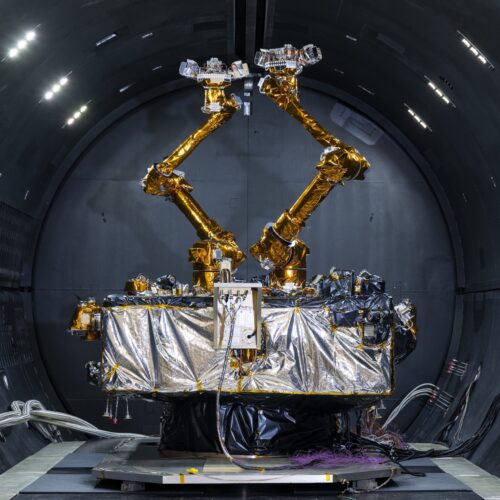
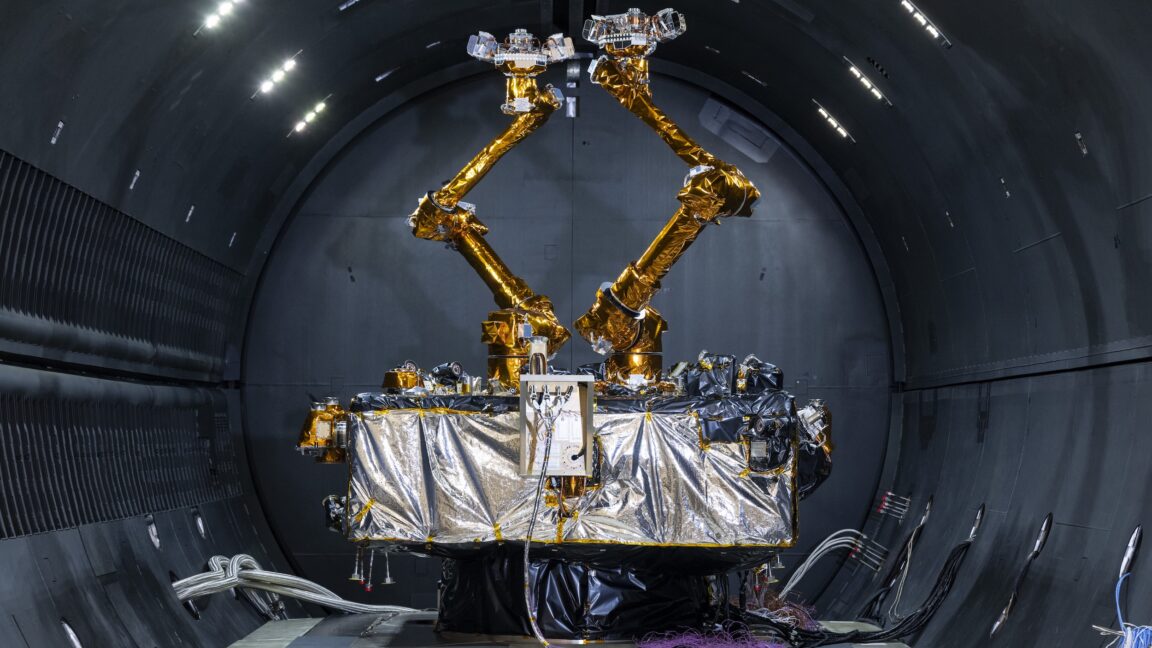
A spacecraft fitted with two flexible robotic arms is on the way to geosynchronous orbit after launching earlier this week on a SpaceX Falcon 9 rocket, kicking off a planned decade-long mission to open new frontiers in satellite servicing.

The Mission Robotic Vehicle, owned and built by Northrop Grumman, rocketed into orbit from Cape Canaveral Space Force Station in Florida on Tuesday. Three small propulsion pods, each functioning as standalone spacecraft, accompanied the MRV aboard the Falcon 9 rocket.

The Falcon 9 deployed all four payloads within about an hour of liftoff. It will take about a year for the satellites to maneuver from their initial elliptical drop-off orbit into a circular orbit more than 22,000 miles (nearly 36,000 kilometers) over the equator. At this altitude, the MRV and the three Mission Extension Pods (MEPs) will travel in lockstep with Earth's rotation, operating in the same kind of orbit as numerous civilian and military communications satellites, missile warning platforms, and a growing number of spy satellites.

Read full article

Comments

© US Navy/Sarah Peterson

  •  

Rocket Report: Lightning strikes in China; Starship launch on deck

Welcome to Edition 9.04 of the Rocket Report! We've had to wait an extra week for SpaceX to get its 13th Starship test flight off the ground. A last-second abort on July 16 led engineers to roll the booster back to its hangar in South Texas to swap out engines. Starship is now back on the launch pad. Liftoff is set for Friday evening. A flawless launch and reentry will put SpaceX on the cusp of an orbital flight later this year. Ars will have a comprehensive recap story after the completion of the test flight.

As always, we welcome reader submissions. If you don't want to miss an issue, please subscribe using the box below (the form will not appear on AMP-enabled versions of the site). Each report will include information on small-, medium-, and heavy-lift rockets, as well as a quick look ahead at the next three launches on the calendar.

India's first private rocket reaches orbit. Indian space officials celebrated the debut flight of Skyroot Aerospace’s Vikram-1 rocket, India’s first fully commercial satellite launcher, as a “grand success” Saturday after an on-target climb into a 280-mile-high orbit following liftoff from an island spaceport in the Bay of Bengal, Ars reports. The Vikram-1 lifted off from India’s primary spaceport on Sriharikota Island around midday local time. The launch was delayed more than a half-hour to resolve a last-minute technical problem. The countdown resumed, culminating in the command to ignite Vikram-1’s solid-fueled first stage booster to propel the rocket off the launch pad.

Read full article

Comments

© Zhou Quan/VCG via Getty Images

  •  

AI firms want more data centers; Trump's EPA may give neighbors less say

The Trump administration is quietly considering a rule change that could make it easier for polluters to build facilities—including certain gas plants and diesel generators that power data centers—with little to no notice to the public.

On Wednesday, the Environmental Protection Agency held a public hearing on a proposed rule change that would hand the power to states to decide how the public participates in the permitting process for certain new sources of air pollution. The proposed rollback comes as data centers face greater pushbackacross the US, with many communities using the permitting process to try to slow down development. Any changes could have major consequences for how ordinary people are given notice about new or expanded polluting facilities coming into their neighborhoods.

“As someone actively working in communities with data centers, I know this to be fundamentally true: People want to have a say,” Vanessa Lynch, a Pennsylvania organizer with Moms Clean Air Force, said at the EPA hearing.

Read full article

Comments

© Getty Images

  •  

Robot snakes searched for Venezuela earthquake survivors in collapsed buildings

Robots slithered like snakes into the rubble of collapsed buildings to search for trapped survivors in the aftermath of Venezuela’s double earthquake disaster.

The so-called snake robots represented a unique technological aid for international search and rescue efforts following two earthquakes that struck Venezuela on June 24, killing more than 5,000 people and leaving behind 16,740 injured. Rescuers from around the world used trained dogs, seismic and acoustic listening devices, video cameras on sticks, or thermal imaging cameras to search for signs of survivors—but the snakebots equipped with a video camera could squeeze through tight spaces to search deep within fallen building debris.

“The reason why snake robots are useful is they can get into tightly packed volumes that machinery and people otherwise cannot, and that's important in search and rescue because we were able to extend the visual reach of the rescue workers in a safe way,” Howie Choset, head of the Biorobotics Lab at Carnegie Mellon University in Pittsburgh, told Ars. “In a sense, you're doing minimally invasive surgery on a structure with a snake robot.”

Read full article

Comments

© Carnegie Mellon University

  •  

Microsoft responds to LG monitors installing McAfee ads on Windows

LG is reportedly pulling a McAfee pop-up ad from a controversial app that some of its monitors have stealthily installed on connected computers.

An example of the pop-up ad is seen in a still from Gamers Nexus' video. An example of the pop-up ad is seen in a still from Gamers Nexus' video. Credit: Gamers Nexus/Windows/YouTube

The app, LG Monitor App Installer, installs itself through a Windows Update alongside monitor driver updates. LG Monitor App Installer then pushes ads for a 30-day free trial for McAfee, as well as other software, via a pop-up on affected systems, multiple users have reported.

This has drawn negative attention recently, with complaints surfacing on Reddit and a subsequent video from YouTube channel Gamers Nexus. In the video, editor-in-chief Steve Burke said that the publication paid $1,200 for an LG UltraGear 3GX900A-B gaming monitor (the monitor’s price dropped to $600 two days later, Burke said) for testing and replicated the behavior “several times” across “multiple” Windows 11 systems.

Read full article

Comments

© LG

  •  

FDA reports new outbreak of explosive diarrhea with 72 cases identified

The Food and Drug Administration announced on Wednesday that it's investigating yet another outbreak of Cyclospora, the unicellular foodborne parasite behind a nationwide surge in explosive watery diarrhea illnesses. The FDA said 72 cases have been identified in this outbreak, but the agency provided no details on the situation.

This announcement marks the sixth Cyclospora outbreak investigation the FDA has opened this year. Overall, the Centers for Disease Control and Prevention has gotten reports of more than 11,500 cases (including 4,173 confirmed and over 7,400 probable) from 41 states. Among the cases, there have been 308 hospitalizations and no deaths.

This year's tally so far—just in July—greatly exceeds the normal number of cases the US sees in a whole year. In recent years, the US has reported between 2,000 and 5,000 cases in a year, according to CDC data. With a new outbreak announced, the tally of cases is likely to continue climbing. Nevertheless, when asked about the national surge in cases earlier this week, anti-vaccine Health Secretary Robert F. Kennedy Jr. said the situation was "under control."

Read full article

Comments

© CDC | Melanie Moser

  •  

Forgot your Google password? Now you can log in with a selfie.

Getting locked out of an account is no fun. Google has a few ways to help you regain access if you happen to forget your password or lose an authenticator, including recovery contacts and backup codes. Now, Google has a completely new option: your face. You can now give Google a video record of your face and sign into your account with a selfie, which sounds like something people are going to just love.

You will have to set this feature up ahead of time if you want the option of regaining account access with a selfie later on. To get started, verify your account type is supported. You won't be able to configure selfie sign-ins for Workspace accounts, child accounts, or any account enrolled in Google's Advanced Protection Program.

Configuring selfie sign-in requires you to record a video, which Google will store on its servers. Google's selfie sign-in landing page includes the typical disclaimers about privacy and data access, promising that the company will keep the video encrypted and won't use it for any other purposes unless you opt in.

Read full article

Comments

© Google

  •  

AI Kill Switch Act would let Trump admin order shutdown of rogue AI systems

A proposed law called the AI Kill Switch Act would let US government officials order the shutdown of AI systems "that can cause catastrophic harm," the bill's sponsors said today.

If approved by Congress, the bill would let the Trump administration and future administrations decide when an AI company must block user access, disable or restrict a particular capability, or shut an entire AI system down completely. The bill would require AI makers to deploy technical capabilities allowing them to throttle or shut down the systems when ordered to do so by the government.

The bill would amend the Homeland Security Act of 2002 with authority for the Secretary of the Department of Homeland Security to order the suspension or shutdown of AI systems. AI developers that refuse to shut systems down could face fines of up $20 million for each day on which a violation occurs.

Read full article

Comments

© Getty Images | NurPhoto

  •  

Tweety gets the third degree in final Coyote vs. Acme trailer

San Diego Comic-Con has kicked off strong, and we've got a couple of new trailers to show for it: the final trailer for Coyote vs. Acme, and the full trailer for director Zach Cregger's fresh take on Resident Evil. Some lucky folks were also treated to a screening of Resident Evil's first 18 minutes.

Coyote vs. Acme

We were thrilled when the first trailer for Coyote vs. Acme dropped in April. The film had been shelved for years and is finally getting the broad theatrical release it deserves thanks to Ketchup Entertainment, which acquired it from Warner Bros. The concept alone is sheer brilliance: Wile E. Coyote, after decades of ACME equipment failing him in his efforts to catch that darned Road Runner, decides to sue the corporation. It’s based on a well-known satirical piece by Ian Frazier (also titled “Coyote vs. Acme”) published in The New Yorker in 1990.

Per the official premise:

Read full article

Comments

© Ketchup Entertainment

  •  
❌