
 Login

Boeing’s bigger Ghost Bat can carry missiles internally, carry more combat load
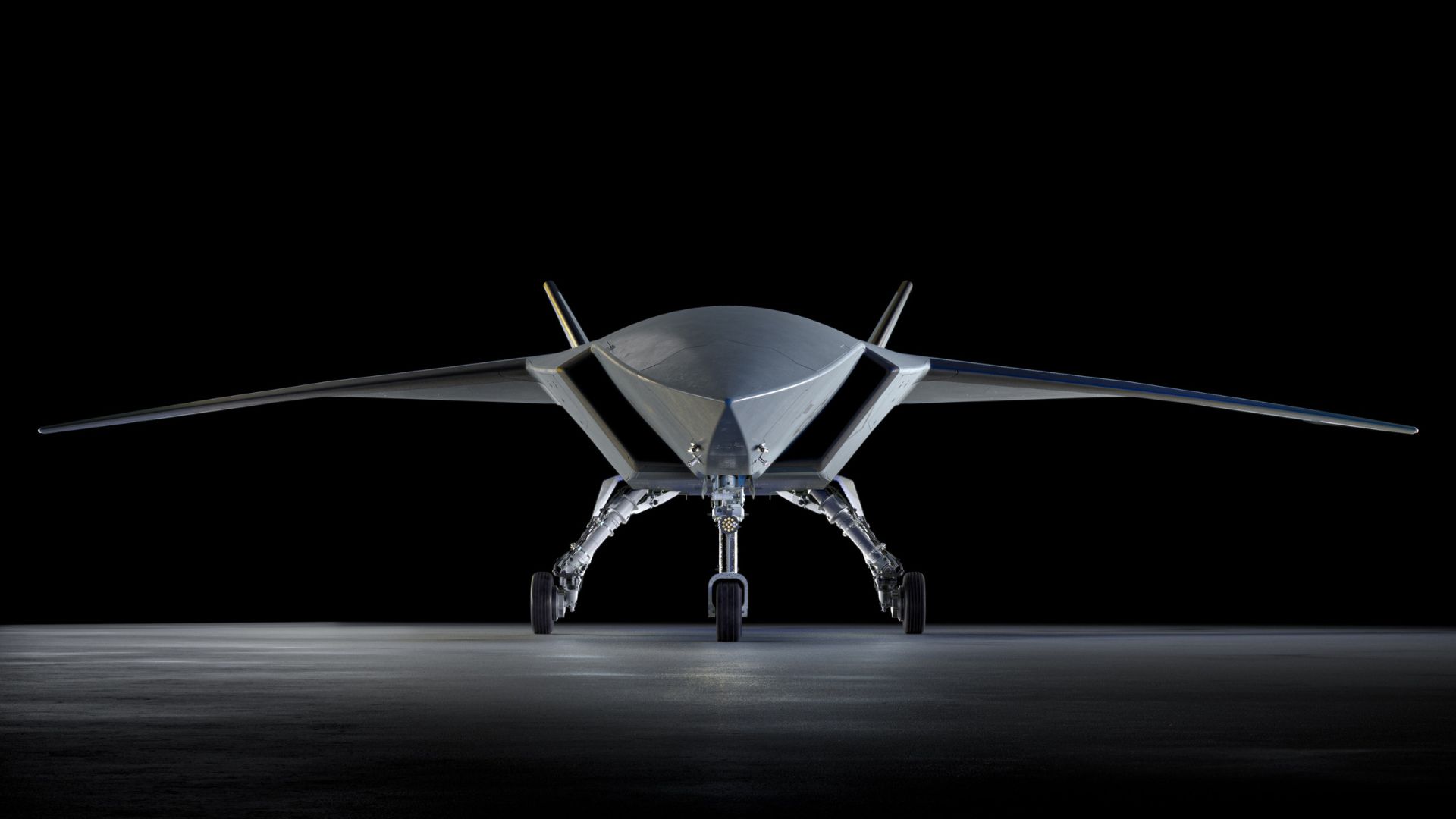
Boeing has unveiled a new version of its MQ-28 Ghost Bat drone, which offers extended combat capabilities. The new version has been showcased at the ILA Berlin Air Show in Germany.
The MQ-28 Ghost Bat is an uncrewed collaborative combat aircraft that uses smart human-machine technology to act as a force multiplier for the crewed jets. In December 2025, Boeing and the Royal Australian Air Force (RAAF) made headlines by executing a force-integrated air-to-air autonomous weapon engagement from an MQ-28 Collaborative Combat Aircraft.
The mission involved the Ghost Bat teaming with a RAAF E-7A Wedgetail and F/A-18F Super Hornet to destroy a fighter-class target drone. It was the first time an autonomous aircraft completed an air-to-air engagement with an AIM-20 missile.
The feat had established the Ghost Bat as a “mature combat capable CCA.”
Added capabilities of Boeing MQ-28 Ghost Bat Block 3
The new Block 3 Ghost Bat drone from Boeing features an increased wingspan, allowing it to carry an additional 2,000 pounds of fuel, stores, and mission payloads. Moreover, the drone can now also carry two AMRAAM missiles or four small-diameter bombs (SDBs) internally, and there is also an option to carry three external weapon stations if needed.
It also has beyond-line-of-sight (BLOS) communication links, which will enable the drone to be operated from a crewed aircraft, a ground station, or a naval vessel over nearly unlimited distances. The new design features an upgraded modular, missionized nose that provides enhanced payload configuration options and supports the insertion of third-party capabilities.
The drone now has a maximum take-off weight of 12,000 lbs, up from the 10,000 lbs in version two. It can now carry a useful load of over 4,500 lbs. It also receives significant software upgrades, enabling operators to tailor weapons, payloads, command and control, and mission autonomy to suit their operational requirements.
“That additional capacity gives operators freedom to balance payload and endurance to configure for the mission at hand, whether that means carrying extra fuel for longer-range operations, increasing weapons carriage, or any combination of both,” said Glen Ferguson, MQ-28 global program director.
Upgrades to be rolled out to the entire fleet
Boeing says the upgrades visible in the third iteration will be rolled out to the entire fleet through a spiral upgrade program. Ferguson added that the inclusion of BLOS and other features has occurred because the company has been working with Air Force units to understand their needs and the role the CCA is intended to play in a joint force operation.
It is not clear whether the turbofan engine used in earlier versions of Ghost Bat is being replaced or another engine is being added to the drone for the extra thrust.
The earlier versions of the CCA had a length of 38 feet (11.7 meters) and a height of 6.5 feet (2 meters). It had a top speed of Mach 0.9 and could fly up to 2,000 nautical miles, with a ceiling of 40,000 feet.
According to reports, the Block 3 Ghost Bat will be offered to Germany. Australia has already acquired a number of Block 1 MQ-28 drones.
At the Berlin Air Show, Boeing also welcomed two additional industry partners to expand its German MQ-28 Ghost Bat industry team. These two – namely Diehl Defense and Rohde & Schwarz – will join Rheinmetall in the program led by Boeing Defense Australia.
