❌

Reading view

US domino team sets Guinness World Record by toppling 29,193 tiles in a 3D pyramid

A team of ten domino artists has set a new Guinness World Record for the most dominoes toppled in a three-dimensional pyramid, bringing down 29,193 tiles in a single chain reaction at a gym in Garden City, Michigan, on June 20.

Guinness World Records has officially certified the achievement, which was set by the FALLDOWN Domino Team led by Steven Price of Sprice Machines as part of a larger installation that incorporated no fewer than 123,456 dominoes in total.

The feat, documented in a YouTube video titled “123,456 Dominoes SUPERSIZED — FALLDOWN 2026,” has attracted widespread attention online for the scale and precision of its construction

Price has held four domino-related Guinness World Records previously and has served as a judge on Fox’s competition show Domino Masters. He holds a mechanical engineering degree, a background that is evident in the structural ambition of this project.

Building a 35×35 pyramid without triggering it

The three-dimensional pyramid that forms the centerpiece of the record sits on a base of 35 by 35 dominoes and rises in layers to a pointed apex. Constructing a 3D pyramid of this scale requires a level of precision that flat domino runs do not — every tile must be positioned accurately while the structure beneath it remains stable, and a single mistimed touch anywhere in the grid can bring the entire build crashing down prematurely.

Watch the video here.

The FALLDOWN team, which includes Michael Fantauzzo, Matt VanVleck, Gabe Dean, Alex Koops, Derek Koops, Stephan Burton, Brady Dolan, Evan Voeltner, and Aaron Bimrah alongside Price, spent multiple days installing the complete setup.

A world built from supersized everyday objects

The pyramid was not the only engineering feat in the room. The team built a themed installation around 123,456 dominoes arranged into giant versions of ordinary objects — enormous paperclips, oversized friendship bracelets, massive bonsai trees, school supplies and a rubber duck that appears mid-sequence.

These elements fed into a series of Rube Goldberg-style chain reactions that snaked through the entire installation before converging on the pyramid, making the final topple a product of everything that came before it.

Guinness required a traditional domino-to-domino start

The team had originally planned to use a special mechanical trigger to bring the pyramid down. Guinness World Records rejected the approach: to qualify for an official record, the entire chain must begin with a conventional domino touching the next in sequence, with no external mechanism initiating the fall. The team revised their plans accordingly, and the record-setting run began exactly as the rules required.

Price’s fifth Guinness record in domino art

The FALLDOWN record is Steven Price’s fifth Guinness certification in domino-related categories. His prior titles include the largest domino circle field, the longest domino wall, and the largest two-dimensional pyramid. Price first gained wider recognition as a 22-year-old when his Incredible Science Machine project, which involved 250,000 domino tiles, set records and went viral.

His YouTube channel, Sprice Machines, includes videos with over 30 million views, with the Lemonade Machine — a chain reaction that travels through an entire house to serve lemonade — among the most-watched.

  •  

New metal alloys that beat 1,832°F heat could help jet engines and nuclear reactors

Researchers at the University of Toronto Engineering have developed six new metal alloys using an artificial intelligence-driven discovery platform that could improve the durability of parts used in jet engines, nuclear power plants, and other extreme environments. The findings show that the AI-assisted system identified promising alloys within just a few weeks, significantly speeding up the search for high-performance materials.

These new alloys also work well with 3D metal printing, enabling the production be complex parts that are hard or impossible to produce with traditional methods.

AI speeds up alloy discovery

Led by Yu Zou, Canada Research Chair in Materials and Manufacturing for Extreme Environments, the team worked with Jason Hattrick-Simpers to build a system that uses computer modeling, machine learning, and robots to help with manufacturing.

Their method, called active learning, acts like a self-driving laboratory. Rather than testing thousands of metal combinations by hand, the system picks the best options, makes them, tests how they perform, and uses those results to guide the next experiments.

“There’s enormous demand for materials that can stand up to huge swings of temperature and pressure, such as what you would find inside a jet engine or in the steam generators inside nuclear power plants, anywhere conventional steel just can’t survive,” said Yu Zou, who led the project.

“We also need materials that can be printed layer by layer, enabling us to make components that can’t be created by traditional manufacturing processes. For example, to make a material that is both lightweight and strong, you can vary the composition: a hard, tough alloy on the outside to something softer and lighter on the inside.”

The project was partly supported by the University of Toronto’s Acceleration Consortium, a group that uses AI and automation to accelerate the discovery of new materials.

Active learning cuts the need for massive datasets

Most AI systems need a large amount of experimental data to make accurate predictions. This becomes a problem when researchers look at materials that have not been tested yet.

“One problem you often run into when trying to use AI to design materials is that most machine learning models require lots of data about material properties to learn from,” revealed Ajay Talbot, a Ph.D. student in Zou’s lab and lead author of the study.

“But if you’re working in part of the design space that hasn’t been explored yet, that data doesn’t exist, so you’re kind of flying blind.”

“The way we get around that challenge is to use data-lean models that essentially feel their own way along. Our active learning model strategically selects a few samples to manufacture and test, and the data from those experiments is fed back into the model to inform where we go next. It really speeds things up.”

<a href=”https://www.youtube.com/watch?v=RFYJV7WvtOM“>https://www.youtube.com/watch?v=RFYJV7WvtOM</a>

New alloys outperform industry benchmark

To demonstrate the system, the researchers focused on compositionally complex alloys made from nickel, cobalt, and chromium. Within weeks, the automated platform identified six new alloy formulations with strong performance.

“One of the properties we were targeting was puncture resistance at temperatures of up to 1,112°F (600°C), which is what you’d find in the front section of a jet engine,” Talbot said.

“The industry standard in this space is nickel-based alloys such as Inconel 625. But we found one made of 12 percent nickel, 62 percent cobalt, and 26 percent chrome that was great for retaining hardness at extremely high temperatures. Even with just three components, our alloy outperformed Inconel 625, an alloy of more than 10 different elements, by 4.5 percent in our lab tests.”

The team also developed another alloy designed for hotter sections of jet engines, where temperatures can reach 1,832°F (1,000°C).

“One of the things that happens in an environment like that is the formation of oxide scale, which essentially means that your material is just getting burned away,” Talbot explained.

“We found a material made of 36 percent nickel, 14 percent cobalt, and 50 percent chrome that was extremely good for oxidation resistance at these high temperatures: It even outperforms Inconel 625 by 85 percent. We’re eventually aiming to ramp up to even higher temperatures, up to 2,192°F (1,200°C).”

Researchers plan to expand to more complex materials

The researchers say the current alloys represent an early demonstration of what the AI-driven discovery platform can achieve.

“This nickel-cobalt-chrome system has just three elements in it. In the grand scheme of things, it’s a relatively simple system,” he added.

“But it’s great for showing that this whole closed-loop discovery platform really works. What we want to do next is ramp up the complexity a bit more to make even crazier stuff, with maybe up to 10 or 12 different elements.”

“As you add more components, you can get different strengthening mechanisms, different kinds of useful properties. There’s a lot more out there just waiting to be discovered.”

The study was published in the journal npj Advanced Manufacturing.

  •  

Single-reactor process yields 90% pure hydrogen fuel from mixed plastic waste

A process called Alkaline Thermal Treatment (ATT) has been tested to turn mixed plastic waste into high-purity hydrogen fuel.

Researchers from the UCLA Samueli School of Engineering and Ewha Womans University in South Korea undertook this new study. This process eliminates the costly and laborious step of sorting plastic waste before recycling.

The single-reactor method successfully processes a mixture of the three most common, hard-to-recycle plastics: polyethylene terephthalate (PET), polyethylene (PE), and polypropylene (PP).

“We are solving two urgent global problems at the same time,” said Ah-Hyung “Alissa” Park, the Ronald and Valerie Sugar Dean of UCLA Samueli and a professor of chemical and biomolecular engineering. 

“Plastic waste is accumulating at alarming rates, and clean hydrogen is essential for decarbonizing energy. This technology tackles both of these challenges in a creative and scalable way,” the co-corresponding author added. 

Mixed plastic processing

Look around you. The water bottle on your desk, the crinkly shopping bag in your pantry, and the sleek dashboard of your car all share a drawback. Once you throw them away, the waste is almost impossible to recycle as a single stream.

A persistent challenge in global recycling is the labor-intensive requirement to sort plastics by type before processing. It leads to 79 percent of plastic waste ending up buried in landfills, while another 12 percent is burned away into atmospheric pollution. Only 9 percent ever get a second life.

But the new study overcomes this challenge. The team demonstrated a chemical technique that takes a chaotic, unsorted cocktail of the world’s three most common plastics and transforms it into hydrogen fuel. Interestingly, the method does it without releasing a single puff of carbon dioxide. 

Alkaline Thermal Treatment uses heat to trigger a reaction between sodium hydroxide and organic matter, generating hydrogen fuel in the process.

It was originally designed to extract hydrogen fuel from ocean biomass, such as seaweed. The researchers wondered if the same principles could dissolve our mounting plastic problem. 

While plastic bottles (PET) broke down easily during the process, shopping bags (PE) and food containers (PP) resisted the chemical attack due to highly stable, stubborn carbon-hydrogen bonds. 

To overcome this chemical defense, a thermal oxidation pretreatment was introduced. In this process, the mixed plastic was briefly exposed to mild heat in the air. After this, oxygen was introduced into the stubborn polymer chains, which created the reactive weak spots needed for the treatment to dismantle all three plastic types.

Eco-friendly process

Once activated, the unsorted plastic soup degrades beautifully inside a single reactor, pumping out hydrogen gas with a purity level exceeding 90 percent.

ATT process changes the game for environmental footprints by operating at temperatures around 400 degrees Celsius (752 F), which are cooler than those of extreme gasification methods.

Furthermore, the technique uses a sodium hydroxide reagent to capture the plastic’s carbon rather than venting greenhouse gases into the atmosphere. The carbon is permanently bound into a stable, solid mineral called sodium carbonate.

The researchers have already outlined a simple secondary process to turn that byproduct into calcium carbonate. That is the exact mineral used by the concrete and construction industries, locking the plastic’s carbon away forever in infrastructure.

The breakthrough is currently confined to precision laboratory settings. Significant optimization is required to scale the technology up for municipal recycling plants, and its long-term economic viability still needs to be rigorously tested.

The study was published in Proceedings of the National Academy of Sciences.

💾

A process called Alkaline Thermal Treatment (ATT) has been tested to turn mixed plastic waste into high-purity hydrogen fuel.
  •  

China deploys ‘Transformer’ rescue barge to save over 6,000 stranded flood victims

A foldable, self-propelled pontoon barge has played a key role in rescuing more than 6,000 stranded students and staff from a flood-hit region in southern China.

The rapid-deployment vessel was used during evacuation efforts in the Guangxi Zhuang Autonomous Region after flooding due to Typhoon Maysak inundated communities, according to Chinese media reports. The modular barge can be assembled in just over 10 minutes, carry more than 500 people per trip, and transport loads exceeding 66.1 US tons. 

According to its manufacturer, the platform is engineered to operate reliably in harsh environments, including high-altitude regions up to 10,800 feet (3,300 meters) above sea level and areas with extreme cold.

Pontoon powers rescue

The self-propelled pontoon barge helped to evacuate more students and staff trapped after floodwaters nearly five meters deep cut off the campus.

The modular vessel, described by Chinese Foreign Ministry spokeswoman Mao Ning as “China’s real-life transformer,” played a central role in a large-scale evacuation at Guangxi Logistics Vocational and Technical College in Guigang, Guangxi Zhuang Autonomous Region, reported the South China Morning Post (SCMP). 

The rescue operation took place after torrential rains left the college campus submerged under nearly five meters (16.4 feet) of floodwater, cutting off thousands of people from surrounding areas. According to China’s state news agency Xinhua, conventional rescue methods initially struggled to cope with the scale of the emergency.

Emergency teams first relied on inflatable rescue boats and assault boats to reach those stranded. While effective for small-scale operations, these vessels could transport only a limited number of passengers at a time, making the evacuation process slow and difficult.

To accelerate the rescue effort, the state-owned China Anneng Construction Group, China’s emergency rescue force, deployed three heavy-duty self-propelled pontoon barges to the flooded area between Wednesday night and Thursday. The arrival of the modular barges dramatically increased evacuation capacity, allowing rescuers to move hundreds of people during each trip. By midday Thursday, every student and staff member had been safely evacuated, according to Guangxi Television.

Heavy-duty lifeline

The pontoon barge used in the operation measures approximately 60 meters in length and eight meters in width. It is capable of carrying more than 500 passengers in a single journey while supporting a total payload exceeding 66.1 US tons. Unlike conventional floating bridges or barges that require external towing, the vessel is equipped with its own propulsion system, enabling it to travel at speeds of up to 6.7 mph (10.8 km/h) even when fully loaded.

One of its biggest advantages is its rapid deployment capability. China Anneng said the modular system can be transported to a disaster site, assembled, and placed into operation in just over 10 minutes. Its foldable design allows emergency responders to quickly establish a large-capacity transport platform without relying on permanent infrastructure.

The rescue barge is regarded as one of China’s most advanced modular heavy-duty water rescue systems. It was specifically developed to address one of the biggest challenges during major floods—transporting large groups of people, emergency responders, vehicles, and heavy equipment across inundated areas or rivers made impassable by rising water, according to the SCMP.

The vessel is manufactured by China Harzone Industry Corporation, a subsidiary of the state-owned China State Shipbuilding Corporation (CSSC). The company says the platform is designed to operate reliably in demanding environments, including high-altitude regions up to 10,800 feet (3,300 meters) above sea level and areas experiencing extremely cold temperatures.

CSSC noted that the high-tech rescue platform has been widely deployed in domestic emergency response operations since 2020. Its successful use during the Guangxi floods demonstrates how rapidly deployable modular engineering systems are becoming an increasingly important tool for large-scale disaster response, enabling emergency teams to evacuate thousands of people far more quickly than traditional rescue boats alone. thousands of people far more quickly than traditional rescue boats alone.

💾

China deployed a rapid-deployment pontoon barge to evacuate 6,000 flood victims, carrying 500 people per trip.
  •  

Powerful deployable systems to bolster military forces’ communication for critical operations

The NATO Communications and Information Agency (NCIA) has selected a consortium led by Thales and Leonardo to deliver a new generation of secure deployable communication and information systems for the Alliance’s Allied Special Operations Forces Command (SOFCOM). The award marks the first phase of a broader NATO initiative aimed at strengthening digital connectivity, operational resilience, and command capabilities for special operations forces.

Under the contract, the two European defence companies will provide six Deployable Points of Presence for Special Operations Component Commands (DPOP SOCC), along with operator training and long-term support. These mobile headquarters are designed to give NATO Special Forces secure command-and-control capabilities that can be rapidly deployed in demanding operational environments.

Secure communications, resilient networking

The deployable systems will combine secure communications, resilient networking, high-performance computing, and advanced IT infrastructure while maintaining a reduced electromagnetic and physical signature. This design enables forces to establish operational headquarters quickly without compromising security or mobility. The systems will also support classified, multi-domain information sharing and enhanced cybersecurity, ensuring interoperability across NATO forces and partner nations.

“Thales brings end‑to‑end expertise in secure information and communication systems, deep knowledge of NATO’s reference architecture, and a long track record of delivering projects to the Alliance,” said Alexandre Bottero, Vice President, Networks and Infrastructure Systems, Thales.

“By combining this expertise with Leonardo’s capabilities, we are harnessing the best of European industry in a modular, upgradable, and field‑proven system, providing NATO Special Forces with next‑generation deployable CIS.”

A notable feature of the programme is the introduction of real-time Full Motion Video (FMV) sharing between separate deployable systems, a capability being fielded for the first time in a NATO special operations communications network. The addition is expected to improve situational awareness, intelligence sharing, and mission coordination during complex operations.

Thales and Leonardo will oversee lifecycle support

Beyond delivering the systems, Thales and Leonardo will oversee lifecycle support, upgrades, maintenance, and user training to ensure the platforms remain operational and adaptable as mission requirements evolve. The project also brings together industrial expertise from across the Alliance, with key technologies contributed by companies in the United Kingdom and Germany.

The collaboration combines Thales’ experience in secure communications and NATO network architectures with Leonardo’s expertise in deployable command post solutions. Together, the companies aim to provide NATO with a modular, scalable, and future-ready communications capability capable of supporting special operations in increasingly contested environments.

“Leonardo’s experience, developed at Italian level through the delivery of complete Regimental and Divisional Command Post capabilities, enables the introduction of modular NATO-ready systems based on fixed and expandable shelters,” said Antonio Levato, SVP Air and Land Systems Land and Sea Business at Leonardo Electronics.

“The strength of the design stems from the close collaboration between industry and the end user, who has chosen Leonardo as both the System Integrator and the Design Authority for Italian command post. This partnership among two major players of the European defence industry allows to combine Leonardo’s field proven deployable solutions with Thales experience in NATO’s secure communications programs.”

The programme underscores NATO’s continued investment in modernizing command, control, communications, and information systems as the Alliance prepares for evolving security challenges. By enhancing secure connectivity and rapid deployment capabilities, the new systems are expected to strengthen operational readiness and improve coordination among multinational special operations forces during future missions.

  •  

US Air Force launches first missile from Anduril’s semi-autonomous loyal wingman drone

The U.S. Air Force has carried out its first missile launch from a Collaborative Combat Aircraft (CCA), an important step in developing semi-autonomous drones that can fly with piloted fighter jets. In the test, announced on June 15, 2026, the Anduril-built YFQ-44A fired an AIM-120 medium-range air-to-air missile at a digital target over California’s Mojave Desert.

This demonstration marks another milestone in the Air Force’s ongoing testing of Collaborative Combat Aircraft. The drone managed most of the mission by itself, but a human operator gave the final approval to launch the missile, following U.S. policy that requires people to control lethal weapons.

Drone completes air-to-air engagement sequence

The test happened in restricted airspace over California’s Mojave Desert as part of the Air Force’s work to prove the YFQ-44A’s combat abilities.

During the test, the aircraft used Anduril’s Lattice software to find, track, and lock onto the target, then figure out how to intercept it. The onboard system handled these steps, and a human supervisor on the ground gave the final order to fire.

This test was different from earlier drone launches, where people on the ground controlled the flight. Here, the aircraft managed the mission steps on its own, except for the operator’s approval to release the weapon.

A key rule of the Collaborative Combat Aircraft program is still in place: the aircraft cannot fire weapons by itself. Every launch must be approved by a human operator, who stays in control during the mission.

Test follows months of phased evaluations

This live-fire test followed earlier trials this year, in which the aircraft carried dummy weapons during flight. Those tests collected data on how the aircraft performed and how it managed the extra weight.

Engineers then verified communication links between the aircraft and its weapon system. They ensured that commands from the operator were sent and executed correctly during practice runs before moving on to live-fire tests.

“Moving from inert carriage earlier in the year to this weapon release demonstrates program maturity, allowing us to validate our digital integration models with actual data,” said General. Dale White, portfolio manager for Critical Major Weapon Systems. “These tests provide operational validation that Collaborative Combat Aircraft can execute the weapon employment sequence autonomously within pilot-defined parameters, accelerating capability delivery to the warfighter.”

Air Force says capability is moving closer to deployment

The missile launch was supported by the 412th Test Wing’s Air Dominance Combined Test Force. This team includes active-duty members, government workers, and contractors who make sure models and procedures are safe for live-fire tests.

“This live-fire test is an important next step in the development of Collaborative Combat Aircraft,” said Air Force Chief of Staff Gen. Ken Wilsbach. “We’re one step closer to delivering capabilities to the warfighter.”

According to the Air Force, the CCA program’s goal is to have combat-ready, semi-autonomous aircraft that help U.S. airpower reach farther, see more, and survive better in tough situations. The Air Force is also accelerating development and testing, bringing these aircraft closer to deployment in real missions.

  •  

US startup to build magnetic mirror fusion research facility in Wisconsin

Wisconsin has committed up to $55 million in incentives to help Realta Fusion build its new headquarters and fusion research facility in Madison, a move aimed at strengthening the state’s position in the emerging fusion energy industry.

The funding package will support development of “The Realta Forge” at OM Station, the site of the former Oscar Mayer plant. Realta plans to build its prototype magnetic mirror fusion machine, called Hammir, at the facility and expects to create more than 600 technical and non-technical jobs.

According to the company, the incentive package includes about $37.5 million in state sales and use tax exemptions, up to $15 million in performance-based enterprise zone tax credits from the Wisconsin Economic Development Corporation, and $2.8 million in tax increment financing from the City of Madison.

Realta said it evaluated sites in Illinois, New Jersey, New Mexico, Tennessee, and other states before deciding to keep the project in Wisconsin, where it was founded.

State backs fusion

The company expects to break ground on the facility before the end of the year. Once completed, The Realta Forge will serve as Realta’s headquarters and dedicated research and development center for advancing its compact magnetic mirror fusion technology.

“We spent the better part of the past two years searching across the country to find the most favorable business environment and the most attractive site to build our R&D facility, and we found it in our own backyard,” said Realta CEO Kieran Furlong.

The company says its CoSMo fusion systems are based on the magnetic mirror concept, which uses magnetic fields to confine high-temperature plasma. Unlike conventional power plants, fusion aims to generate electricity by fusing light atomic nuclei, producing large amounts of energy without carbon emissions during operation.

Realta added that the Hammir prototype will help demonstrate the company’s fusion approach before commercial deployment.

“In terms of cash today, avoided costs tomorrow, and accelerating progress, this is the most impactful state-supported fusion deal ever done in the United States,” said Realta VP of Technical Development Dominick Bindl.

Building regional hub

The announcement follows Wisconsin’s passage of Act 165 earlier this year, becoming the first standalone state law in the United States to exempt capital expenditures on fusion energy projects from state sales tax. State officials say the legislation is intended to attract companies developing next-generation energy technologies.

“Fusion energy is not only good for our planet and our power grid, but it plays to all of our strengths as a state with our world-class research universities, research laboratories, and an incredible manufacturing and supply chain network supported by our dedicated and highly skilled workforce,” said Wisconsin Governor Tony Evers.

Madison also approved $2.8 million in tax increment financing tied to job creation at the OM Station redevelopment. According to the company, it is the city’s first tax increment financing package for private-sector job creation in a decade.

With construction expected to begin later this year, Realta said the facility will become the center for development of its magnetic mirror fusion technology while helping establish Wisconsin as a growing hub for fusion research, advanced manufacturing and high-skilled engineering jobs.

  •  

Electra hybrid-electric aircraft adds 250 turbogenerators for ultra-short flights

Electra has selected Safran Helicopter Engines to supply the turbogenerator for its EL9 Ultra Short aircraft under a production agreement that will run for the life of the program. The deal gives the Virginia-based aircraft developer a key propulsion partner as it works toward Federal Aviation Administration (FAA) certification and commercial service by 2030.

The agreement includes an initial order for 250 TG600 turbogenerators. Electra expects production to increase as demand grows for the EL9, a hybrid-electric aircraft designed to operate from landing areas as short as 150 feet. The capability could allow flights from locations that cannot support conventional commercial aircraft.

Hybrid system selected

Safran’s TG600 will generate 600 kilowatts of electrical power for the EL9’s hybrid-electric propulsion system. Engineers based the unit on the company’s Arrano helicopter engine, which delivers an 18% improvement in fuel efficiency over the previous generation of engines.

The system also integrates two GENeUS electric generators developed by Safran Electrical & Power. Earlier this month, Safran completed the first bench test of the flight-ready turbogenerator at its facility in Bordes, France. The company plans to use that hardware during the EL9’s initial flight-test campaign.

Electra CEO Marc Allen called the agreement an important milestone for the aircraft program. He said Safran’s expertise in hybrid-electric propulsion and long-term commitment would help bring the EL9 into commercial service.

Safran Helicopter Engines CEO Cédric Goubet said the contract formally launches the company’s turbogenerator business. He added that combining Safran’s engine technology with its electrical systems expertise creates a propulsion package tailored for the EL9’s performance goals.

Designed for short fields

Unlike conventional regional aircraft, the EL9 relies on hybrid-electric propulsion and blown-lift technology to achieve extremely short takeoffs and landings. Electra says the aircraft needs only about 150 feet of runway, opening access to small airfields and other locations closer to population centers.

The company believes that capability could reshape regional transportation by reducing dependence on major airports for shorter trips. Electra describes the concept as “Direct Aviation,” allowing travelers to fly closer to their origin and destination instead of connecting through large airport hubs.

FAA certification work is already underway under Part 23 regulations. Electra expects the aircraft’s first flight in late 2027 or early 2028 before targeting entry into service in 2030.

Growing production plans

The Safran agreement follows other commercial milestones for the EL9 program. Earlier this year, Bristow Group signed a pre-delivery payment agreement that secured the first production delivery slot through binding commercial terms, subject to aircraft certification. Electra also released market projections suggesting demand for between 12,000 and 16,000 aircraft during the first decade of Direct Aviation operations across the United States.

If those forecasts materialize, the EL9 would represent a new category of regional aircraft that combines electric propulsion with conventional turbine power. Electra and Safran aim to deliver an aircraft capable of connecting communities that currently lack practical commercial air service while reducing fuel consumption compared with traditional regional aircraft.

  •  

Elon Musk acquires firm that operates mobile gas, diesel turbines; set to boost xAI’s power infra

Elon Musk has reportedly acquired APR Energy, a company known for supplying rapidly deployable power generation systems. The move could help meet the growing electricity demands of his artificial intelligence venture, xAI. Details of the deal surfaced through regulatory filings rather than an official announcement from Musk or his companies.

APR Energy specializes in temporary and mobile power solutions, offering gas turbine and reciprocating engine systems that can be transported quickly and brought online in a short period. The company’s fleet is capable of generating more than one gigawatt of electricity, making it a valuable asset for organizations requiring large amounts of power without waiting for permanent grid infrastructure.

Strategic step to support xAI’s expanding computing operations

The reported acquisition is widely viewed as a strategic step to support xAI’s expanding computing operations. As AI models become larger and more sophisticated, the data centers that train and run them require enormous amounts of electricity. Securing reliable power has become one of the biggest challenges facing AI developers, especially as utilities struggle to keep pace with rising demand.

The turbines could emit over 2,000 tons of smog-forming nitrogen oxides, according to the environmental groups. In Boxtown, the predominantly Black neighborhood closest to the facility, the cancer risk already runs four times the national average. xAI officials said they planned to “copy and paste” the same turbine strategy for Colossus 2, reported Electrek.

Unlike traditional power plants that often take years to construct, APR Energy’s modular systems can be installed much more quickly. This flexibility could allow xAI to expand its computing capacity faster by providing temporary or supplemental electricity while permanent infrastructure is developed.

Increasing importance of energy security in AI industry

The move also reflects the increasing importance of energy security in the AI industry. Rather than relying entirely on local power grids, technology companies are exploring alternative ways to guarantee uninterrupted electricity for their data centers. Owning a company with mobile generation capabilities could give xAI greater control over its future expansion plans.

However, the reported deal has also drawn attention because APR Energy’s portfolio primarily relies on natural gas and diesel-powered generation. While these technologies offer dependable and rapid deployment, they also raise environmental concerns due to greenhouse gas emissions. The acquisition highlights the ongoing debate between the immediate energy needs of AI infrastructure and longer-term sustainability goals.

Industry analysts believe the purchase is another example of Elon Musk’s strategy of integrating critical parts of his businesses. By combining AI development with direct access to power generation assets, xAI could reduce operational risks associated with electricity shortages and accelerate the deployment of new computing facilities.

Although the reported transaction has generated significant interest, several details remain unclear, including the financial terms of the acquisition and how APR Energy’s assets will be integrated into xAI’s future operations. Neither Musk nor xAI had officially commented on the reported purchase at the time the information became public.

As competition in artificial intelligence continues to intensify, access to reliable energy is increasingly becoming as important as access to advanced chips and computing hardware. If the reported acquisition is confirmed, it could signal a broader trend in which leading AI companies invest directly in energy infrastructure to support their long-term growth.


  •  

Intel ships first commercial processors made with next-generation lithography tools

Intel Foundry has become the first chipmaker to manufacture and ship a high-volume logic product using ASML’s High NA extreme ultraviolet (EUV) lithography, marking a major step toward commercial adoption of the next generation of chipmaking technology.

The milestone applies to a subset of Intel Core Ultra Series 3 processors, code-named Panther Lake, built on the company’s Intel 18A process node. Intel said specific Intel 18A layers are now dual-qualified on ASML’s High NA EUV platform at its Oregon facility, with products shipping to customers at yields matched to the existing NXE platform.

The announcement signals a shift for High NA EUV from research and early testing into production manufacturing. Intel and ASML said the technology is being used on selected chip layers to collect manufacturing data and further optimize system setup, uptime, and production implementation before wider deployment in future process nodes.

High NA EUV is the next evolution of EUV lithography, offering higher resolution and improved process control for patterning increasingly smaller chip features. The technology is expected to help semiconductor manufacturers build denser and more complex chips while supporting future advances in computing and artificial intelligence.

Production milestone reached

ASML said the deployment builds on decades of collaboration with Intel to advance semiconductor manufacturing. The latest production milestone follows Intel’s installation of the industry’s first commercial High NA EUV system at its Hillsboro, Oregon, research and development site in 2024. The company later became the first to install and qualify ASML’s second-generation TWINSCAN EXE:5200B system, which delivers higher throughput, improved overlay accuracy, and an upgraded light source.

The Panther Lake processors are manufactured on Intel 18A, with High NA EUV used to pattern selected layers of the chips. Intel said the approach provides manufacturing experience while maintaining production performance on existing platforms.

“With increased resolution and better process control, the introduction of High NA EUV marks a substantial development in semiconductor lithography,” said Christophe Fouquet, ASML President and CEO. “We are proud to play a role in enabling the smaller, denser patterning that will accelerate advancements in AI and other emerging technologies.”

The companies said insights gained from production will help refine system setup, uptime and manufacturing processes, paving the way for broader adoption of the technology in future generations of semiconductor manufacturing.

Scaling future nodes

Intel described the milestone as an important step in integrating High NA EUV into commercial chip production at scale while maintaining manufacturing flexibility for future process technologies.

“This milestone reflects the close technical collaboration between Intel and ASML and shows how High NA EUV can be integrated into advanced semiconductor manufacturing at scale,” said Naga Chandrasekaran, Executive Vice President and General Manager of Intel Foundry.

According to Intel, qualifying High NA EUV on selected Intel 18A product layers allows the company to continue delivering production output while evaluating how the technology can support future process nodes with higher performance, greater transistor density, and improved manufacturing flexibility.

With Panther Lake now entering high-volume manufacturing using High NA EUV, Intel becomes the first company to ship commercial high-volume logic products built with the technology, providing an early demonstration of how next-generation lithography can move from development into large-scale chip production.

  •  

NVIDIA’s smart servers run on 113°F coolant and slash data center energy costs

One of the world’s leading technology companies, Nvidia, has just unveiled a new data center cooling system that uses a liquid coolant hotter than a hot tub to cut energy consumption.

The Californian company’s latest Rubin platform can operate using liquid coolant at temperatures up to 113 degrees Fahrenheit (45 degrees Celsius). The approach greatly reduces the need for energy-intensive chillers and cooling infrastructure.

According to the company, the feat is part of the DSX AI factory reference design, which introduces fully liquid-cooled infrastructure throughout the entire system. Every processor, networking part, and high-performance computing element is cooled by liquid in a closed-loop system.

Ali Heydari, Nvidia data center cooling and infrastructure director, noted that the DSX AI factory design reduces nearly all water use and cuts a substantial amount of the power necessary for cooling. “With dry-cooler-based designs, it’s a closed-loop system with no evaporative water cooling – outside of maybe one percent of the year when we might need chillers in some climates,” he added.

A new cooling method

Cooling has accounted for up to 40 percent of total power demand. Traditional data centers utilize large volumes of cooled air to remove the heat generated by servers. This requires extensive cooling infrastructure, like fans, chillers, cooling towers, and carefully managed hot and cold aisles.

Meanwhile, Nvidia’s Rubin platform captures heat directly at the chip level. It can reportedly reduce cooling water consumption from about 2.6 million gallons per megawatt per year to almost zero in suitable climates.

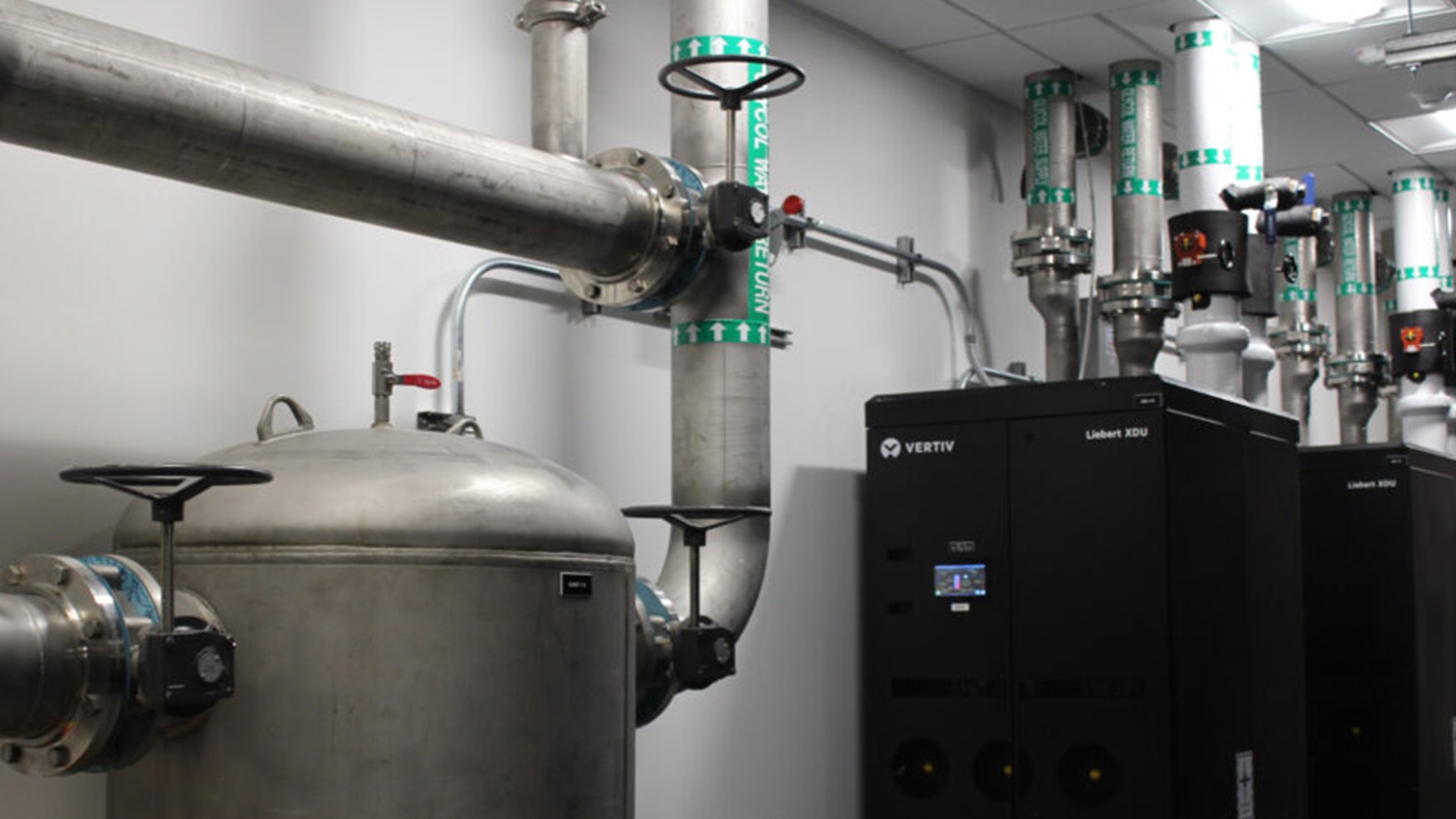
In an AI factory, coolant flows from a coolant distribution unit to the servers in a closed-loop cycle.
Credit: Nvidia

The system relies on a liquid coolant made up of 75 percent water and 25 percent propylene glycol, which circulates through cold plates attached to processors. The liquid enters at temperatures of up to 113 degrees Fahrenheit and exits at about 131 degrees Fahrenheit (55 degrees Celsius), once it absorbs the heat generated by the chips.

Since the heat is removed directly from the source, the processors can continue operating at full performance even with much warmer coolant temperatures than traditional cooling systems would allow.

Lower energy and water use

As per Nvidia, the higher operating temperatures unlock considerable efficiency gains. Industry estimates suggest that increasing chiller temperatures by just 1.8 degrees Fahrenheit (one degree Celsius) can reduce cooling energy costs by four percent. In practice, this means that a 50-megawatt hyperscale facility can save more than USD four million per year in cooling-related energy and water costs by adopting liquid-cooled infrastructure.

“In the right geographic location, with the right system design, you don’t need any refrigeration equipment,” Richard Whitmore, president and CEO of Motivair, Schneider Electric’s advanced cooling division, pointed out. “You can just put big radiator coils outside and use the air temperature for all your cooling.”

Liquid-cooling pipes feed coolant to NVIDIA server racks.
Credit: NVIDIA

The move to complete liquid cooling also required a major server redesign. Earlier liquid-cooled servers used a hybrid approach, cooling CPUs and GPUs with cold plates while relying on air cooling for other components.

Nvidia engineers reworked cooling pathways across the entire server and created a system that uses a single liquid loop to cool multiple high-power components. The redesign has also improved space efficiency. The company revealed that fully liquid-cooled servers can reach higher rack densities.

This allows more computing power to fit into a smaller footprint. “Once the watts per chip crossed a certain level, liquid cooling became mandatory,” Whitmore concluded in a press release.

  •  

Chinese humanoids take on penalty challenge as Messi, Ronaldo light up FIFA World Cup

As the World Cup fever grows around stars like Messi and Ronaldo, Shanghai hosts a unique penalty shootout featuring humanoid robots.

At MWC Shanghai 2026, humanoid robots are stepping up to the spot in the Humanoid Robot Football Penalties Challenge, testing the limits of robotics,
AI, machine vision, and real-time motion control.

According to Chinese media outlets, the event showcases how embodied AI performs under pressure, highlighting next-generation autonomous technology through football-inspired challenges.

Ahead of the 2026 FIFA World Cup, Hyundai Motor recently launched a football-themed campaign featuring Boston Dynamics’ Atlas humanoid robot.

Humanoid football test

On its opening day at MWC Shanghai 2026 on June 24, the spotlight quickly shifted from keynote speeches to a live demonstration of embodied AI in action: the Humanoid Robot Football Penalties Challenge.

Held within the Mobile AI Innovation Frontiers Zone at the Shanghai New International Expo Centre, the event is designed as a controlled stress test for real-time autonomous decision-making, where humanoid robots must read the goal, judge angles, and execute penalty kicks without pre-programmed sequences, external control, or resets, reported CGTN.

While official details of the participating humanoid robots remain limited, videos circulating online suggest models from Booster Robotics and Unitree Robotics taking part in the challenge.

In the penalties challenge itself, participating humanoids are evaluated on perception accuracy, balance control, motion planning, and adaptive response under game-like pressure. Each robot must independently interpret ball position and goalkeeper movement before committing to a strike, making split-second corrections based on sensor feedback.

The format escalates through semi-finals and a final scheduled for June 25, intensifying constraints to simulate high-pressure competitive conditions. By turning a universally understood sports moment—the penalty kick—into a robotics benchmark, the showcase highlights how far embodied AI has progressed toward coordinated, human-like physical intelligence in unpredictable environments.

Atlas soccer showcase

In a recent football demonstration by Boston Dynamics, an Atlas robot is shown standing before a large display screen, closely tracking player movements, body positioning, and in-game reactions across football footage. After each clip ends, Atlas moves into a practice zone where it immediately attempts to reproduce the actions it has just observed, effectively linking visual perception with physical execution in real time.

The footage highlights a series of football-inspired motions. In one sequence, the robot shifts its weight, swings a leg forward, and smoothly guides a ball across the floor with controlled contact. It then progresses through rapid training drills focused on balance, coordination, and timing. As the session continues, Atlas’s movements appear increasingly fluid, suggesting the system is being evaluated not only for strength but also for agility, reflex response, and adaptive motor control.

Some of the most notable moments show Atlas imitating human emotional reactions. After completing a drill, it raises its arms in celebration, mirroring a footballer’s goal celebration. In another instance, it drops to one knee and pauses, recreating an injury response seen in match footage it had just observed.

Hyundai Motor Company, parent of Boston Dynamics, described the demonstration as Atlas’s first exposure to football under its “School of Football” initiative. The company has also indicated potential plans to showcase Atlas and the quadruped robot Spot at the FIFA World Cup, though their exact roles remain undisclosed.

💾

Humanoid robots participate in a penalty shootout at MWC Shanghai 2026, testing embodied AI, vision and real-time control under pressure.
  •  

DARPA’s X-plane designed to maneuver with bursts of air gets new wings attached

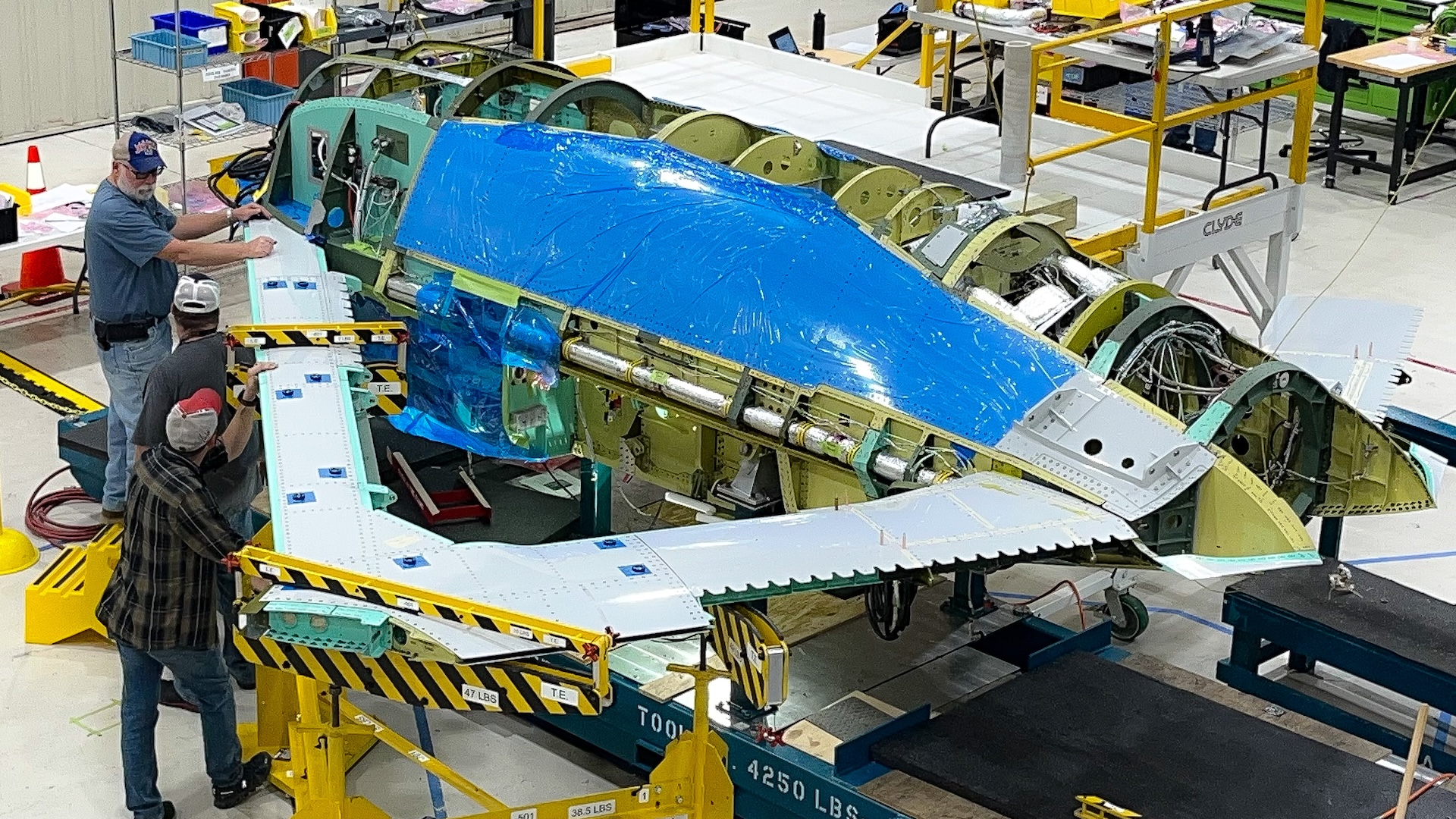
Boeing subsidiary Aurora Flight Sciences has begun installing the wings on the X-65, an experimental drone developed under DARPA’s Control of Revolutionary Aircraft with Novel Effectors (CRANE) program.

The installation brings DARPA and Aurora a step closer to flying the unconventional uncrewed aircraft, which was designed to test flight control using only bursts of pressurized air instead of conventional moving surfaces.

The X-65’s active flow control

The X-65’s key innovation lies in its active flow control (AFC) system. Fourteen AFC effectors embedded across the aircraft’s lifting surfaces use jets of high-pressure air to manage roll, pitch, and yaw.

This will either replace or supplement traditional flaps and rudders. The X-65 incorporates both systems to establish performance baselines before transitioning to AFC-only operation. Essentially, it will allow researchers to flight test the technology while minimizing risk.

An artist’s render of the X-65 drone. Source: Aurora Flight Sciences / X

“The X-65 conventional surfaces are like training wheels to help us understand how AFC can be used in place of traditional flaps and rudders,” Dr. Richard Wlezien, former CRANE program manager at DARPA, said in a 2024 press statement. Sensors will compare the two approaches to evaluate potential benefits.

Aurora Flight Sciences announced the wing’s arrival on social media, noting that the components were built at its West Virginia facility. Integration is underway in Virginia, with the first flight now targeted for 2027.

Novel effectors to enhance survivability

The X-65 features a co-planar joined wing configuration with triangular wing sections on each side that merge at the tips, plus small extensions for a total wingspan of 30 feet.

The triangular wings support testing across multiple sweep angles and feature modular, swappable sections for future AFC configurations.

The aircraft also includes a twin vertical tail, a chin air intake, and a single exhaust. The uncrewed aircraft has a gross weight of approximately 7,000 lbs.

DARPA kick-started the CRANE program in 2020. Though Aurora has advanced to the detailed design and fabrication phases, the program has encountered delays and cost overruns, as reported by The War Zone.

Original flight plans for 2025 slipped after higher-than-expected prototype costs and supply chain issues. Pentagon funding for the effort since fiscal year 2024 has reached nearly $63 million.

Eliminating moving control surfaces could yield multiple advantages. Removing moving parts could result in improved aerodynamics and efficiency, particularly at high altitudes. Reduced mechanical complexity also offers potential weight savings, lower maintenance demands, and greater reliability. For military applications, such systems could have enhanced survivability against battle damage.

The technology holds particular promise for stealth aircraft. Traditional control surfaces create gaps and protrusions that increase radar cross-section and require constant adjustments in fly-by-wire systems. AFC effectors embedded flush with the airframe could help maintain smoother external contours and lower observability.

As Aurora vice president Larry Wirsing stated last year: “The X-65 platform will be an enduring flight test asset, and we’re confident that future aircraft designs and research missions will be able to leverage the underlying technologies and flight test data.”

  •  

Caltech team replaces toxic cobalt in batteries with safer 3D-printed cathode

Researchers in Julia R. Greer’s lab at Caltech have developed a new method for creating three-dimensional architected battery cathodes. It has been designed to improve safety, reduce environmental impact, and enhance the performance of future batteries.

The new cathode replaces toxic, expensive, and unethically mined cobalt with lithium iron phosphate (LFP) embedded in a carbon matrix. LFP is much safer and less prone to catching fire or short-circuiting when overcharged.

On its own, LFP isn’t a miracle material; it usually suffers from sluggish performance. But by rethinking the internal architecture of the battery, the team found a loophole.

“We’ve developed a versatile way to make three-dimensional architected battery electrodes from safer materials,” said Yingjin Wang, a graduate student in Greer’s lab. 

“Using lithium iron phosphate, commonly referred to as LFP, combined with a carbon matrix, we eliminated the use of dangerous cobalt while improving the mechanical resilience of the battery,” the first author added. 

3D-architected cathodes

Lithium-ion batteries are the dominant power source for modern mobile devices, electric vehicles, and renewable grids. 

These batteries consist of five core components: an anode (negative electrode), a cathode (positive electrode), a liquid electrolyte to transport ions, a separator to prevent short circuits, and current collectors to harvest electricity. 

While commercially vital, standard designs carry persistent safety risks and performance limitations. To address these flaws, a new development has reimagined battery design, paving the way for less dangerous, more environmentally friendly energy storage that also boosts performance.

Conventional lithium-ion batteries rely on flat, two-dimensional (“planar“) electrodes, but in this new work, the team introduced a three-dimensional, architected cathode produced through 3D printing. 

Moreover, transitioning from a flat design to a 3D-architected battery maximizes the active surface area where chemical energy is converted into electricity.

“We think this is advantageous because you can decouple the solid-state versus liquid-state diffusion distance. The electrolyte is liquid, so as it’s channeling through this architecture, which is like a labyrinth, it has a solid surface available to it anywhere,” Greer explained.

Moreover, the design reduces tortuosity and shortens the physical path that ions must travel between the cathode and separator, thereby increasing the battery’s power density and allowing it to release its stored energy much faster.

Safer alternative

A primary drawback of current lithium-ion batteries is their reliance on cobalt in the cathodes. Cobalt supply chains are plagued by unethical mining practices in remote regions worldwide, and the material itself poses a notable safety hazard due to its tendency to catch fire or short-circuit when overcharged. 

In contrast, lithium iron phosphate is a much safer alternative. Its inherently stable chemical profile makes it far less likely to experience dangerous thermal issues or short circuits.

“LFP by itself is not a new material, but using this additive manufacturing, or 3D-printing, approach to create an architected electrode that doesn’t contain cobalt is a new thing,” Greer said. 

The next major milestone for the researchers is to design a complementary 3D-architected LFP anode, which will create a fully 3D-architected battery that is both energy- and power-dense. 

Achieving this will be a highly complex manufacturing challenge given the early state of the research and the intricate fabrication parameters involved. Ultimately, the team aims to integrate a polymer-based electrolyte to achieve a true solid-state battery.

The study was published in the journal ACS Energy Letters.

💾

Caltech has developed a new method for creating three-dimensional architected battery cathodes.
  •  

China’s new robot dog tackles -22°F cold, crosses river and rugged terrain in demo

DEEP Robotics has demonstrated its new wheeled-legged robot in action, designed to handle challenging industrial operations across complex terrain.

M20S introduces significant improvements over M20 in payload capacity, mobility, durability, and endurance, positioning it as a new benchmark for industry-grade wheeled-legged robots.

Built for all-terrain performance, the Lynx M20S is designed to support a wide range of inspection, logistics, and field operations where reliability and adaptability are critical.

Recently, Deep Robotics unveiled new footage of its DR02 humanoid traversing rough terrain, climbing stairs, and carrying equipment, which is built for industrial and hazardous-environment operations.

Mastering rough terrain

LYNX M20 is a wheeled-legged robot designed for industrial operations in challenging terrain and hazardous environments. The company describes it as the world’s first wheeled-legged robot built specifically for demanding field applications, including power inspection, emergency response, logistics, and scientific exploration.

In this newly released demonstration video, DEEP showcases the capabilities of its Lynx M20S wheeled-legged robot in some of the world’s most demanding environments. The footage follows the robot traversing rugged mountain terrain, crossing icy rivers up to 31.5 inches (80 centimeters) deep, and operating in temperatures as low as -22°F (-30°C).

The Lynx M20S is also shown climbing steep 45-degree slopes and navigating rocky, uneven landscapes that would challenge conventional mobile robots. At elevations reaching nearly 17,000 feet (5,177 meters), the robot maintains stability and mobility while carrying out its mission in harsh outdoor conditions. The video highlights the platform’s combination of wheeled speed and legged agility, enabling it to tackle obstacles, extreme weather, and difficult terrain.

According to DEEP, the Lynx M20S, designed for industrial inspections, emergency response, and field operations, demonstrates how advanced robotic mobility can extend autonomous operations into environments that are often inaccessible or hazardous for human workers.

Next-gen field robot

M20S, weighing 77 pounds (35 kilograms), combines the speed of wheeled mobility with the adaptability of legged locomotion. It can navigate narrow spaces with as little as 50 cm of clearance, climb stairs up to 25 cm high, overcome obstacles up to 80 cm high, and handle slopes up to 45 degrees. The platform is designed to operate across rugged mountain trails, muddy wetlands, tunnels, pipelines, and disaster-stricken areas.

The M20 can carry a payload of 33 pounds (15 kilograms) and support a maximum load of 110 pounds (50 kilograms). It offers up to three hours of operation or 9 miles (15 kilometers) of travel on a single charge when unloaded, while carrying a 33-pound (15-kilogram) payload reduces endurance to 2.5 hours and 7.4 miles (12 kilometers). The robot can reach a laboratory-tested top speed of 5 m/s and an operating speed of 2 m/s.

For perception and navigation, the robot is equipped with dual 96-line LiDAR sensors providing a 360-degree by 90-degree field of view, along with wide-angle cameras and omnidirectional obstacle avoidance capabilities. Built for harsh environments, the platform carries an IP66 protection rating and can operate in temperatures ranging from -4°F (-20°C) to 131°F (55°C). Additional features include hot-swappable batteries, bidirectional lighting, OTA updates, and modular expansion options.

To improve operational endurance, DEEP increased the Lynx M20S’s single-charge runtime by 17 percent to 67 percent and added dual hot-swappable batteries. The upgrades help offset the high power demands of wheeled-legged locomotion and support longer, uninterrupted missions.

💾

DEEP Robotics demostrates Lynx M20S, an all-terrain wheeled-legged robot built for demanding industrial and field operations.
  •  

World’s first field-validated 30 MWh sodium battery for storage unveiled by CATL

Chinese battery giant CATL has introduced what it says is the world’s first sodium-ion energy storage system proven in real-world conditions. It expects total shipments to reach 1 gigawatt-hour (GWh) by the end of 2026.

The company launched its new TENER Sodium Energy Storage System in Munich, Germany, on June 22, 2026, marking a significant step toward sodium-ion battery use in large-scale energy storage projects.

This launch comes at a time when utilities, renewable energy developers, and industrial customers are looking for new storage solutions to meet rising electricity demand and the fast growth of wind and solar power. CATL plans to start delivering to customers in China in September 2026, with global shipments beginning in June 2027.

Sodium emerges as a new option for grid storage

CATL believes sodium-ion batteries are a strong addition to lithium-based technologies in future energy systems. According to the company, sodium is over 1,000 times more common than lithium and is found all over the world, making it a promising choice for stationary storage.

“We believe that sodium and lithium together will form the twin foundations of the future energy storage system,” commented William Wu, Director of CATL’s Energy Storage Technology Center.

The battery maker has been researching and developing sodium-ion batteries since 2016. During this time, the company says it invested almost €1.2 billion ($1.14 billion) to build a full manufacturing process, including materials, cells, and system production.

To meet future demand, it has increased its production capacity. The company invested around CNY 5 billion ($737 million) in sodium-ion manufacturing lines at its Fuding facility, adding 40 GWh of annual production capacity. Another planned facility in Jining, Shandong, will support up to 160 GWh of sodium-ion battery production.

Designed to fit existing battery projects

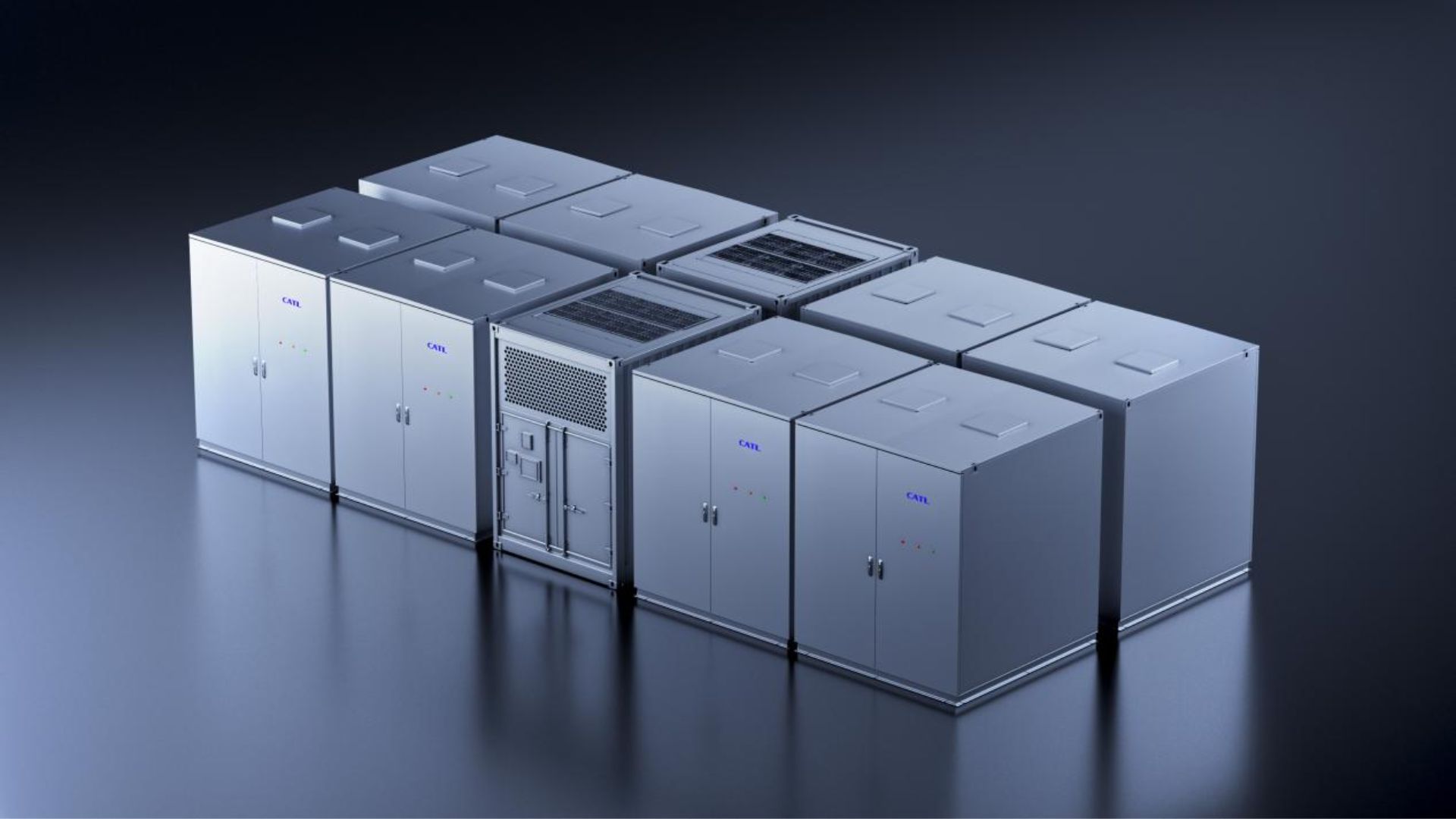
A main feature of the system is that it works with existing lithium-iron phosphate (LFP) energy storage systems. The firm said the TENER Sodium system has the same size and shape as LFP systems, so developers can use their current platforms without changing enclosures, redesigning projects, or repeating certifications.

The system’s modular design provides over 30 megawatt-hours (MWh) of rated capacity. Each module weighs about 46 tons, and just 34 units are needed to create a 1-GWh energy storage site.

This compatibility can make it easier for developers to add sodium-ion technology without big changes to existing infrastructure. As battery storage projects grow worldwide, reducing engineering and permitting steps can help speed up project timelines.

Long service life across extreme temperatures

CATL said the TENER Sodium system is built for tough operating conditions. The company reports it can last up to 15,000 cycles at 77°F (25°C) while keeping 70 percent of its health. This means the system could last about 25 to 30 years.

The system is also made to work across a wide range of temperatures. The battery giant claims it can handle over 10,000 cycles at 113°F (45°C) and keep more than 92 percent of its capacity at -4°F (-20°C).

The company further stated that the battery system can reduce fire and explosion risks even in extreme conditions. This addresses a major concern in the industry as grid-scale storage projects expand around the world.

Shipment goals signal commercial readiness

At the Munich event, CATL stressed that the product is now past the demonstration stage. The company says the TENER Sodium system is ready for commercial use, with mature technology, manufacturing, and supply chain support.

The goal of shipping 1 GWh by the end of 2026 shows that sodium-ion batteries are moving into large-scale commercial use. The firm’s latest launch suggests sodium-ion batteries may soon become a meaningful part of that expanding market alongside established lithium-based systems.

  •  

99% carbon cut: DHL partners with VELA to launch wind-powered transatlantic cargo fleet

Seeking a concrete approach to eliminate greenhouse gas emissions from the world’s hardest-to-decarbonize logistics sectors, DHL Global Forwarding France has entered into a strategic partnership with French shipping company VELA.

Under the agreement, the global freight giant will offer commercial shipping options aboard custom-built, wind-powered cargo trimarans crossing the Atlantic Ocean. Scheduled to launch operations in early 2027, the initiative introduces a clean, maritime alternative that integrates directly into existing supply chains without disrupting standard logistics processes.

Global maritime shipping currently accounts for roughly 3% of worldwide carbon dioxide emissions, largely because the heavy fuel oil burned by traditional container ships produces intensive pollution.

While wind-propelled commercial transit remains a niche concept within the broader cargo industry, the new partnership aims to demonstrate the viability of large-scale commercial sailing. Under the strategic framework, DHL secures a dedicated allocation of cargo space aboard VELA’s specialized vessels, with volume commitments expected to scale up continuously alongside the expansion of the sailing fleet.

Operational routing and transatlantic port logistics

The new maritime service will establish a direct ocean route connecting the secondary ports of Caen-Ouistreham in France and New Haven, Connecticut. By avoiding heavily congested major shipping hubs, the direct point-to-point path significantly limits the need for complex transshipments.

VELA is targeting a reliable port-to-port transit time of approximately 15 days. This timeline allows the clean shipping framework to remain reasonably close to the pacing of conventional diesel-powered cargo ships.

The specialized service is specifically engineered for companies handling less-than-container-load (LCL) freight. Instead of loading large, heavy metal containers, the interior layout of the VELA sailing vessels is explicitly tailored for palletized cargo.

Each trip will accommodate up to 600 European Union pallets, maximizing space efficiency for industries that ship products in smaller batches. DHL will handle the entire onshore logistics ecosystem for each voyage, including pre-carriage transport, local customs clearance, and secure warehousing.

Specialized protection for temperature-sensitive products

To accommodate highly sensitive commercial goods, the vessels integrate a patent-pending refrigeration system called CoolSafe. This technology allows the zero-emission ships to cater specifically to industries with rigid environmental controls, including pharmaceuticals, luxury items, cosmetics, aerospace components, and premium wines or spirits. The cooling network is fully compliant with Good Distribution Practice (GDP), ensuring strict adherence to global pharmaceutical handling standards.

Crucially, the climate-control systems within the cargo hold do not draw energy from fossil fuels. The onboard refrigeration units are powered primarily by decentralized renewable energy sources integrated directly onto the vessel’s hull.

An independent lifecycle analysis conducted by the specialized consulting firm Carbone 4 verified the exceptional environmental performance of this setup. According to their metrics, the VELA system reduces greenhouse gas emissions by up to 99% compared to traditional transport options under specific assumptions.

Scaling sailing fleets for regular weekly departures

While the initial launch will deploy a single vessel, VELA and DHL have mapped out a clear path toward industrial scale-up. The long-term blueprint calls for the construction and deployment of five identical wind-powered ships on the Europe-to-United States route.

Once the full fleet enters active service, the companies will expand their scheduling to offer up to one reliable weekly departure in both directions across the Atlantic.

By proving that wind-powered freight can maintain rigid commercial schedules, the project partners intend to establish a repeatable model for sustainable shipping.

The initiative balances environmental accountability with real-world practicality, giving shippers a functional tool to cut emissions without compromising traceability, cargo security, or supply chain reliability. If the rollout scales as planned, it will mark one of the first regular, predictable wind-powered freight services connecting Europe and North America.

  •  

China’s LineShine supercomputer beats US rivals to top world’s most powerful machine list

For the first time in nine years, a supercomputer from China has come ahead of all other machines in the list of the world’s most powerful supercomputers. The list was announced at the ISC 2026 conference in Hamburg, Germany.

The number one spot in the list has been given to LineShine – a supercomputer from China that was previously unlisted. LineShine has displaced the US’ own El Capitan as the world’s most powerful supercomputer as measured by the High Performance Linpack (HPL) benchmark.

Its debut marks the first time since 2017 that a Chinese system has led the TOP500, and it also takes over the No. 1 position on the HPCG ranking with 22.00 HPCG-Petaflop/s, according to a press release from the organization.

LineShine tops the Top 500 world’s most powerful supercomputers list

The supercomputer from China has not just topped the list of the world’s most powerful machines. It has also achieved 2.198 Exaflop/s on the HPL benchmark, making it the “first system in the TOP 500 to exceed two exaflops of sustained double-precision performance using CPUs only.”

LineShen is installed at the National Supercomputing Center in Shenzhen (NSCS) and built by the Shenzhen Cloud Computing Center. It is based on a custom Chinese processor and the “LingKun” platform: 13.79 million cores across 304-core LX2 processors running at 1.55 GHz, linked by the proprietary LingQi interconnect and running Kylin OS.

The supercomputer draws approximately 42.2 megawatts of power and comes with an efficiency of 52.07 Gigaflops/Watt. LineShine reached 7.92 Exaflop/s for fourth place, a comparatively modest 3.6x speedup over its HPL score, indicating a CPU-only design without dedicated low-precision accelerators, the press release added.

It differs from other high-performance supercomputers because it relies on CPUs rather than modern graphics processing units (GPUs) used for AI.

However, LineShine’s debut marks a significant achievement, increasing the number of systems sustaining over one exaflop/s on HPL from four to five. Also, for the first time, the exascale systems are distributed across the Asian, North American, and European continents simultaneously.

El Capitan, Frontier, and Aurora from the US also feature in the top five

While LineShine might have captured the top spot, the next three supercomputers in the list are from the United States.

The most powerful supercomputer from 2025, El Capitan, is at the second position with 1.89 Exaflop/s on HPL. El Capitan is at Lawrence Livermore National Laboratory (LLNL) in the US. It has 11.34 million cores and 60.94 Gigaflops/Watt, built on the HPE Cray EX255a architecture with AMD 4th Gen EPYC CPUs and AMD Instinct MI300A accelerators.

Oak Ridge National Laboratory’s Frontier supercomputer is in third position in the rankings with a performance of 1.35 Exaflop/s on HPL. The fifth most powerful supercomputer, according to the list, is the Jupiter Booster operated by the Jülich Supercomputing Center in Germany.

Supercomputers in the modern world are used for everything from predicting the weather and developing AI to advancing medical innovations and simulating nuclear explosions for defense needs. Therefore, they are in some ways considered a parameter of a country’s technological prowess. China’s win in this year’s list could translate to worries for the West in general, but the more powerful machines might be coming soon from the US and Europe.

  •  

US Army launches Low-Cost Interceptor program, targets fall live-fire demonstrations

In a major structural shift designed to correct an unsustainable economic imbalance on the modern battlefield, the U.S. Army has formally launched its Low-Cost Interceptor (LCI) program. The defense initiative aims to end the practice of burning multimillion-dollar air defense assets to down inexpensive adversary drones that cost only a few thousand dollars.

Senior service officials announced a highly compressed procurement timeline for the program, establishing a firm target to execute the first live-fire capability demonstrations this autumn.

The launch follows months of strategic framework planning intended to quickly field scalable, affordable anti-drone solutions. Army Secretary Dan Driscoll clarified that these new budget-friendly interceptors are not meant to replace existing, high-end defensive networks.

Describing the service’s current premier air defense systems as “the Ferrari of a product,” Driscoll noted that while their capabilities are incredible, the Army urgently requires a mass-producible, low-cost alternative to supplement the fleet during prolonged, high-rate attrition conflicts.

Overhauling procurement

Rather than relying on traditional acquisition models—where a single prime contractor builds a highly proprietary weapon system from the ground up—the Army is breaking the LCI into independent structural subsegments.

Under this strategy, the service will source components from a wide pool of competing suppliers to reduce unit costs. Through its specialized xTech program, the Army plans to officially release a call for industrial white papers on July 6, 2026.

The upcoming solicitation will seek targeted technological solutions across four critical subsystem categories: rocket motors, advanced seekers, fire control and guidance tools, and an overarching weapons system integrator.

The chosen system integrator will be tasked with designing a flexible, open systems architecture that allows the Army to seamlessly hot-swap subcomponents as underlying commercial technologies mature.

Service officials indicated that if the submitted technologies show sufficient technical maturity, the xTech team may bypass lengthy prototyping phases and move selected vendors straight into full-rate production.

Resetting cost targets to combat inexpensive threat vectors

The fiscal parameters of the LCI program are explicitly shaped by the realities of modern asymmetric aerial threats, such as jet-engine-powered Shahed attack drones.

Military leaders have long warned that relying on premium, low-stock missiles to neutralize waves of mass-produced loitering munitions is financially unviable over extended campaigns. While the Army has declined to lock in a rigid price ceiling, leadership has established aggressive baseline cost targets.

Ideally, the service wants the final, all-up rounds to cost less than $1 million each. Furthermore, Driscoll previously indicated that the service’s ultimate target price point sits below $250,000 per individual interceptor.

Army leadership emphasizes that while the military will always expend whatever resources are necessary to defend American lives in an immediate combat theater, achieving a sub-million-dollar price point is absolutely vital to absorbing and repelling sustained drone swarms at a true theater-wide scale.

Securing intellectual property and empowering global allies

A foundational element of the LCI acquisition strategy is a strict emphasis on data and intellectual property (IP) sharing among participating contractors. Because the Army is assembling the final interceptor from separate components built by different firms, the service must secure the underlying IP rights.

Retaining these rights will allow the military to independently perform field repairs, reverse-engineer parts, and utilize 3D printing to accelerate maintenance in forward-deployed zones.

Furthermore, establishing clean IP boundaries will enable the Army to add the finished low-cost interceptors directly into its digital marketplace interface. The Pentagon already utilizes this marketplace framework to sell validated drones and counter-UAS platforms to allied nations.

By distributing these compatible, budget-friendly interceptors globally, the Army intends to build a unified defensive network in which international partners can seamlessly deploy identical, affordable munitions, even in austere theaters where standard American logistics are unavailable.

  •  

Converting plastic waste into hydrogen made possible with Cambrige’s new solar reactor

Cambridge researchers have transitioned a laboratory-scale technology into a scalable, real-world application that uses solar power to convert plastic waste and cellulose into clean hydrogen fuel and valuable industrial chemicals.

The team demonstrated a new solar-powered reactor that converts everyday plastic waste, such as fizzy drink bottles, into hydrogen fuel. 

Interestingly, they did it outside, at scale, using a device that can be manufactured with tools not much more complicated than a standard hardware store paint sprayer.

Scaling up the solution for plastic waste

Photoreforming is the process of using solar energy to break down plastic molecules. It is a concept scientists have understood for quite some time, but scaling it up has always been the missing piece of the puzzle.

While the chemistry worked beautifully inside pristine laboratories, it was limited to tiny catalyst plates about the size of a smartphone wrapper. Scaling those up usually meant depending on highly complex manufacturing processes, scorching temperatures, and toxic chemical baths.

“When we started trying to scale this technology up, we quickly found out that what seems simple on a small scale is not simple at all when you’re trying to make it at scale. We can’t really have giant vats of solution to make these panels – it’s just not practical at scale,” said Ariffin Bin Mohamad Annuar, co-first author from Cambridge’s Yusuf Hamied Department of Chemistry. 

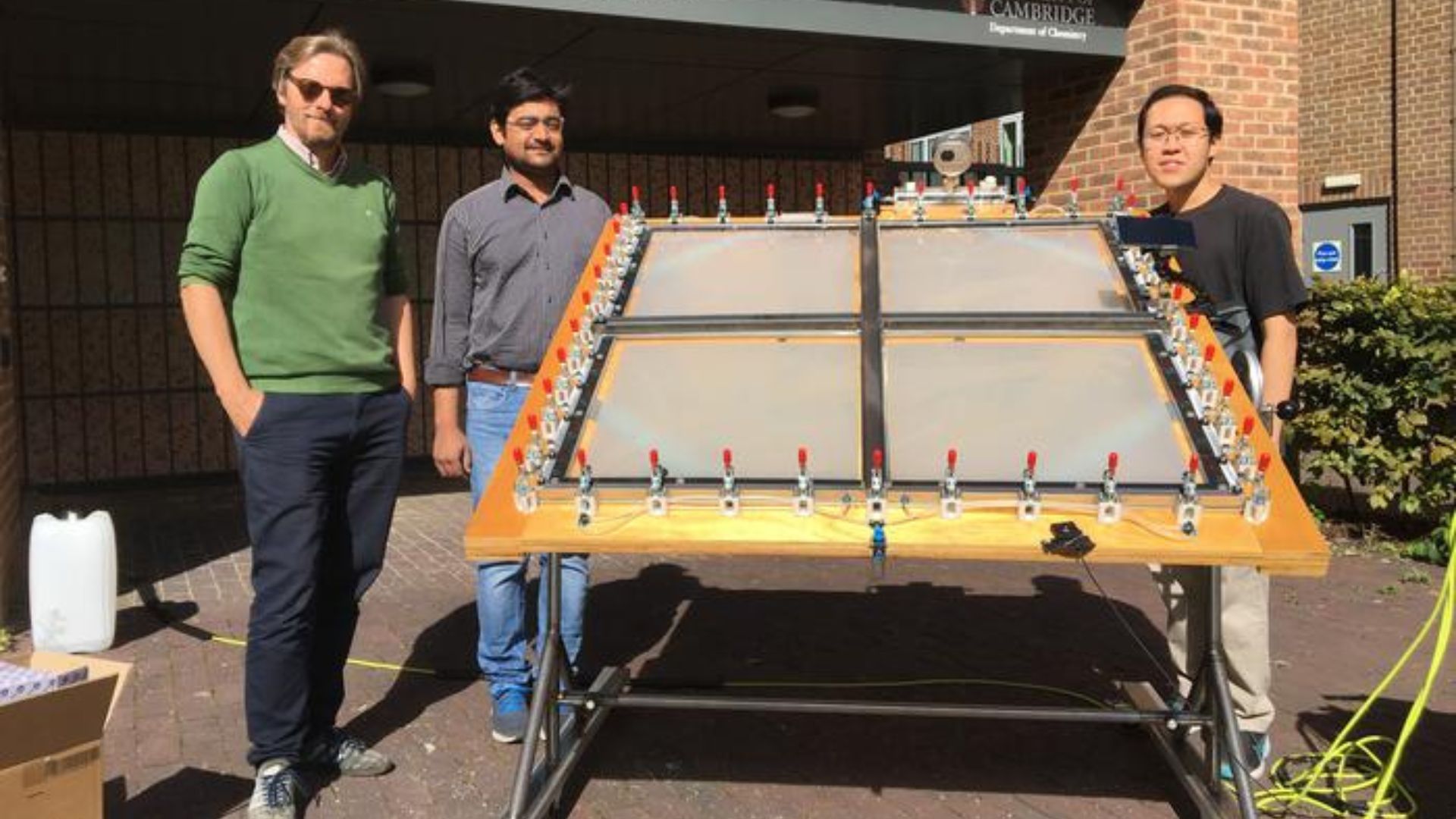
To smash through this issue, the researchers went big. And constructed a one-meter-square reactor panel and took it entirely outdoors, testing it under the natural, unpredictable sunlight outside Cambridge’s Department of Chemistry.

The device does not generate electricity like a standard rooftop solar panel. Rather than that, it directly absorbs sunlight to drive a chemical reaction. On one end, it breaks down the polymers in PET plastic bottles and cellulose; on the other, it splits water molecules to harvest pure hydrogen.

The magic coating

The interesting part of the new system lies in how it was built. Compared with earlier versions that required high temperatures and complex liquid-suspension processes, the new solar panels can be assembled at room temperature using basic equipment. 

Professor Dominic Wright’s team developed a specialized molecular precursor material containing cobalt and zirconium. Professor Erwin Reisner’s team then loaded this material into a basic sprayer. 

The light-absorbing catalyst was sprayed directly onto ordinary glass panels at room temperature.

“What surprised me was, after all the optimization, just how simple it is,” said Mohamad Annuar. “We just have this huge panel, we spray our catalyst on it, put it into our solution, put it under the sun, and it produces hydrogen and other valuable chemicals just from plastic waste. It’s just simple and scalable.”

The Cambridge team also provided a comprehensive cost analysis for the system. This economic blueprint is a major first for this type of chemical research, mapping out exactly what it will take to bring the technology the market.

Plus, the manufacturing costs were cut down by using the spray-coating method. It proves that a future of solar-powered, localized recycling hubs is financially viable.

The technology is not quite ready for commercial deployment tomorrow. The team notes that the reactor’s overall durability and conversion efficiency still need refinement before mass production can begin.

However, the researchers have laid down a clear path toward cleaning up the planet by proving that the system can survive the outdoor elements while remaining cheap to produce.

The results are reported in the journal Nature Chemical Engineering on June 24.

💾

The team transitioned a lab-scale technology into a scalable application that converts plastic into hydrogen and industrial chemicals.
  •  
❌