❌

Reading view

BMW’s Neue Klasse EVs become home power hubs with smart solar energy ecosystem

Global car giant BMW and German clean-energy firm Solarwatt have just unveiled a home energy solution that will turn the upcoming Neue Klasse electric vehicles (EVs) into household energy storage units.

The companies presented their joint offering ahead of The smarter E / Intersolar Europe 2026 trade fair, which will take place in Munich München from June 23-25. The new announcement followed the expansion of their partnership in smart energy and home charging solutions, which the firms revealed on May 18.

As part of the effort, BMW intends to integrate its Neue Klasse vehicles and the bidirectional Wallbox Professional DC home charging station into Solarwatt’s home energy management system (HEMS), also called the Solarwatt Manager.

Instead of functioning solely as cars, the Neue Klasse EVs will also serve as mobile energy storage units. They will provide electricity to households through Vehicle-to-Home (V2H) technology.

A smarter energy hub

The system is set to link photovoltaic panels, stationary home batteries, electric vehicles, and household appliances through the Solarwatt Manager platform. The software controls energy production and usage to determine where the available power should be directed.

BMW said the integrated system will coordinate all energy assets simultaneously. This will reportedly allow homeowners to maximize the usage of self-generated solar power and minimize reliance on grid energy.

The PV system, battery, EV, and other consumers are intelligently coordinated and controlled as a whole. Credit: BMW Group

The platform will also incorporate weather and solar forecasts to predict future energy production. During winter and other periods of reduced solar production, the system will take advantage of dynamic electricity tariffs by charging batteries and vehicles when electricity prices are low.

The stored energy could then be utilized later. “This not only increases the self-consumption of solar power but also significantly reduces the energy costs of the entire household – unlike Vehicle-to-Grid (V2G), the electricity is used within the household and not fed back into the public grid,” BMW officials pointed out.

Power when needed

The system requires three essential components, including a Neue Klasse vehicle, BMW’s Wallbox Professional, and the Solarwatt Manager energy management system. Homeowners will be able to configure the settings via the My BMW App. They will have the option to optimize the household energy priorities through the Solarwatt Home app.

“In the Solarwatt Home app, customers can define household priorities – for example, for appliances and storage systems,” BMW representatives continued in a press release. “This ensures that energy is distributed intelligently, reduces the need for manual control, and makes the best possible use of solar power.”

The Vehicle-to-Home package is set to cut household energy costs.
Credit: BMW Group

Yet another advantage is that the system works with a wide range of third-party components. Existing solar panel systems and home batteries can be connected to the platform. This will enable homeowners to upgrade their current setups instead of simply replacing them from scratch.

“For many homeowners, the prospect of expanding an existing home battery storage system with an electric car is highly attractive,” Peter Bachmann, Solarwatt CEO, concluded in a statement. “This significantly increases the benefits of one’s own PV system, lowers electricity costs, and makes the home even less dependent on purchasing electricity from the grid.”

The two firms plan to launch the system in Germany, Austria, and the Netherlands in late 2026. Customers will also be able to order the BMW Wallbox Professional directly through Solarwatt. The first deliveries are expected to start in the final quarter of the year.


  •  

US scientists create highest-resolution 3D map yet of a particle shaping matter

Scientists in the US have utilized the Polaris supercomputer to generate the most detailed three-dimensional (3D) images of the pion, the lightest particle made of quarks.

The study, which helped reveal the internal structure of a pion in unprecedented detail, was conducted by a research team at the US Department of Energy’s (DOE) Argonne National Laboratory (ANL).

Pions are subatomic particles that play a significant role in holding atomic nuclei together. “Pions mediate the strong force that binds nucleons, that is, the protons and neutrons that account for an atom’s mass,” Yong Zhao, PHD, an ANL physicist and principal investigator of the project, said.

According to the Zhao and the team, the findings reveal not only how quarks are arranged within the particle, but also offer new clues on how visible matter forms from fundamental particles. The latter is considered one of the biggest mysteries in physics.

Mapping the pion

Pions are among the lightest and simplest subatomic particles. They are governed by the strong force, which binds protons and neutrons together inside the atomic nuclei. This force accounts for 98 percent of the mass of the visible universe.

They’re also composed of a quark and an antiquark. Yet, despite their importance, scientists have struggled to examine their internal structure because experimental data remains limited. To overcome this challenge, ANL and Brookhaven National Laboratory researchers turned to large-scale computer simulations.

Graphic showing the transverse motion of a quark (green sphere) inside a proton whose spin is aligned to its direction of motion (large yellow arrow).
Graphic showing the transverse motion of a quark (green sphere) inside a proton whose spin is aligned with its direction of motion (large yellow arrow).
Credit: Valerie Lentz / Brookhaven National Laboratory.

The team combined advanced theoretical models with the computing power of Polaris. This reportedly recreated the pion’s internal structure in remarkable detail.

Zhao pointed out that examining the pion’s multidimensional structure provides a deeper insight into the particle’s fundamental properties. “By probing the pion’s internal structure, we gain a deeper understanding of how quarks and gluons are confined to create visible matter,” he said.

The simulations generated high-resolution 3D images that showed how quarks are distributed throughout the particle. Understanding this structure is essential for explaining how quarks and gluons combine to create the visible matter that makes up the universe.

A new perspective

For the project, the group simulated hundreds of snapshots of four-dimensional (4D) spacetime with lattice quantum chromodynamics. This is a technique that places particles and fields on a vast computational grid.

“This is a task possible only with large-scale parallel computing power like that of ALCF supercomputers,” Zhao said in a statement. “We thereby obtained high-resolution images of the quark structure in a moving pion.” The images showed how quarks carrying different fractions of the pion’s momentum are distributed across the particle.

The team modeled how quarks move both along the pion’s direction of motion and across it. The simulations relied on lattices with millions of grid points. “The simulation captures hundreds of snapshots of our 4D spacetime, represented on a lattice with millions of grid points,” Zhao added.

The calculations revealed the quark generalized parton distribution (GPD) of the pion. This is a mathematical framework that describes how quarks are distributed in both momentum and space. The resulting maps provided a detailed 3D picture of the particle.

As per Zhao, one notable finding was that the pion’s transverse size decreases as its momentum increases. The team also found that the pion appears smaller than the proton at moderate momentum values.

“Our next step is to use the ALCF’s Aurora supercomputer to map the proton in three dimensions,” Zhao concluded. “Protons, together with neutrons, make up all the atomic nuclei that compose the visible matter in our universe.”

The study has been published in the Journal of High Energy Physics.

💾

Researchers in the US have used the Polaris supercomputer to create the most detailed 3D images yet of a particle known as a pion.

Graphic showing the transverse motion of a quark (green sphere) inside a proton whose spin is aligned to its direction of motion (large yellow arrow).
  •  

Four-legged robot dog spots hazardous toxins before firefighters enter danger zones

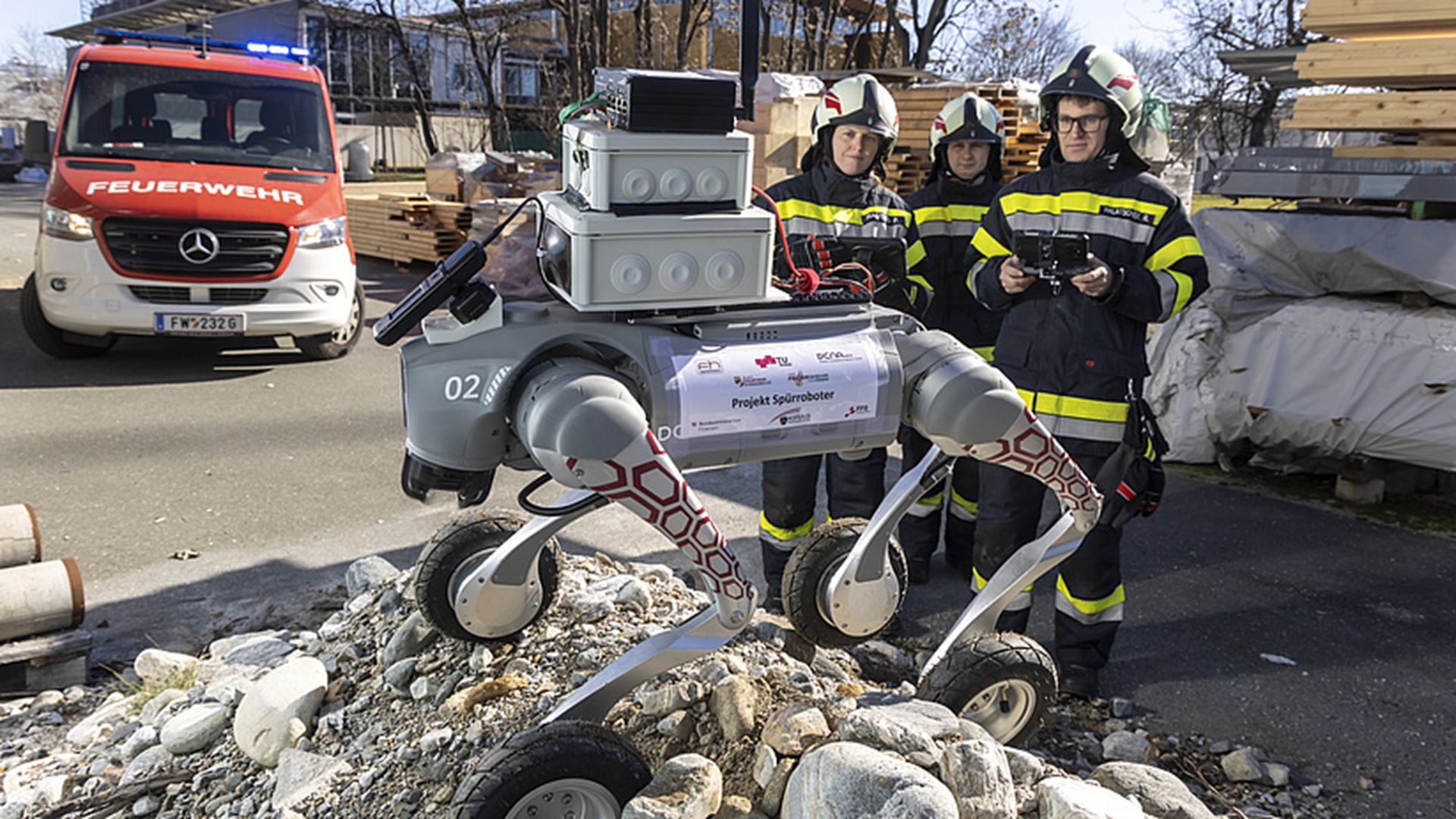
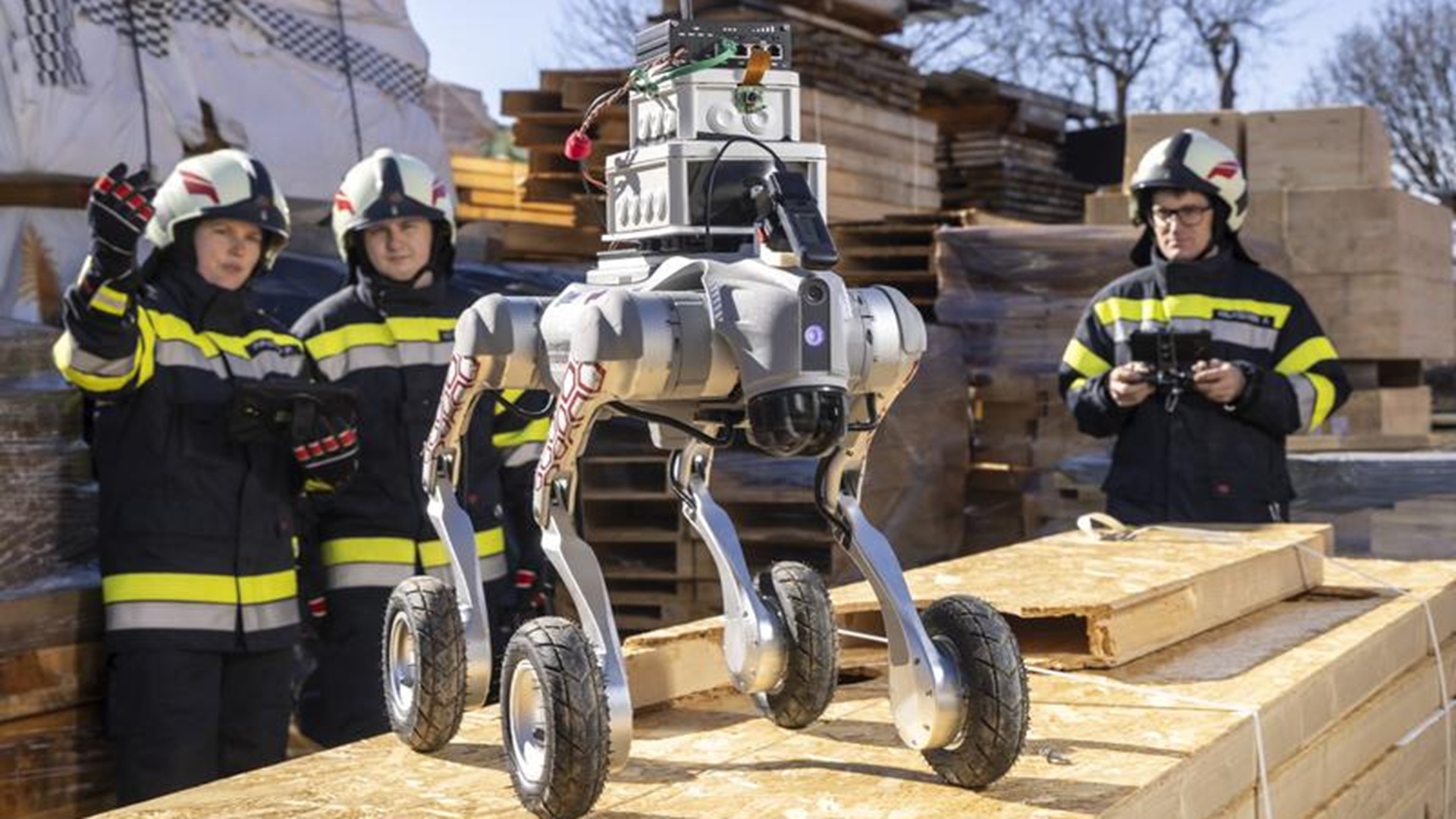
A four-legged robot dog designed to detect toxic substances could soon become the first responder sent into dangerous areas and help firefighting crews assess the damage without risking their own safety.

The remote-controlled detection robot was developed by researchers at the Graz University of Technology (TU Graz) in Austria. It is a compact, quadruped system that also incorporates measurement devices already used by fire services.

According to the research team, the detection robot has already been extensively tested by emergency services as part of large-scale pollutant drills. It has proved its ability to provide real-time data from danger zones.

Gerald Steinbauer-Wagner, PhD, an associate professor and robotics researcher at TU Graz, revealed that the dog can be deployed on missions ahead of firefighting crews. “It measures pollutant concentrations and delivers the data together with a camera image in real time from the danger zone,” Steinbauer-Wagner explained.

First into danger

In chemical accidents, emergency crews need to identify hazardous substances quickly while operating under dangerous conditions. Firefighters must typically don bulky protective suits, such as a Level A or B Hazmat suit, prior to entering contaminated areas to take measurements.

Although necessary to ensure total isolation from hazardous environments, the process can consume valuable time during an emergency. To address this issue, the team turned to robotics.

The robot gathers critical information while firefighters put on protective gear.
Credit: Lunghammer – TU Graz

As per the researchers, the robotic dog can be sent in before firefighters to collect critical information from the scene. “This allows the emergency services to assess the situation without having to enter the danger zone themselves,” Steinbauer-Wagner continued.

The technology reduces firefighting teams’ direct exposure to toxic substances. It could significantly improve their safety during industrial accidents and hazardous materials incidents.

“Based on a comprehensive requirements analysis, we developed an appropriate robotic strategy and integrated it into existing standard operational procedures,” Steinbauer-Wagner added. “This should ensure seamless collaboration between man and machine during the operation.”

A safer perspective

Instead of creating a new system, the team made it compatible with existing fire-service procedures. The researchers conducted an extensive requirements analysis before integrating it into established hazardous materials response protocols. The robot relies on commercially available parts for mobility, sensing, data processing, communication, and visualization.

“The results of the field tests were extremely promising in terms of mobility, user-friendliness and effectiveness,” Steinbauer-Wagner reported. Meanwhile, a recent potential analysis supported by the Austrian Research Promotion Agency (FFG) highlighted several advantages of the technology.

Gerald Czech of the Austrian Federal Fire Service Association emphasized that, in the event of a real incident, he would send the robot dog into the contaminated area before the firefighters go in. “For the fire service, every minute counts during a hazardous materials operation,” he said in a statement.

Czech further said receiving measurement data and images from the danger zone while crews are still putting on protective gear could save valuable time during an emergency. “This increases the safety of the crew and improves operational command,” he concluded.

Experts from the Styrian and Upper Austrian fire service associations, TU Graz, the University of Applied Sciences Upper Austria, as well as the Disaster Competence Network Austria, support the use of detection robots. They propose making them a permanent part of fire departments’ hazardous materials response teams.

💾

This four-legged robot dog that could detect hazardous substances and send real-time data to firefighters from danger zones.
  •  

US firms to make non-lithium grid batteries that deliver 99% uptime without active cooling

US energy storage startup Peak Energy has recently joined forces with leading car manufacturer General Motors (GM) to develop sodium-ion batteries designed for grid storage.

The Colorado-based energy storage company announced the new partnership on June 9. The project will bring together its proprietary passively cooled battery and GM’s sodium-ion cells.

Under the novel agreement, General Motors will design and develop the sodium-ion cells at its battery laboratories in the state of Michigan. It will moreover retain exclusive manufacturing rights. Peak Energy will integrate the cells into its energy storage systems.

“In grid-scale stationary storage systems, if we can make the cell safer and more robust, we can remove complexity elsewhere in the system,” GM reported. “That can translate into a quieter, simpler, lower-maintenance ESS for the customer.”

Sodium-ion storage push

According to both companies, the technology could provide a cheap alternative to today’s dominant lithium-iron phosphate (LFP) battery systems. It could also improve reliability and reduce energy waste.

“Lowering the cost of energy is one of the most important issues facing America today,” Landon Mossburg, Peak Energy CEO and co-founder, said. He added that the firm aims to deliver a safer, lower-cost, and faster-to-deploy energy storage system that can meet the growing US power demand without raising consumer costs.

Peak Energy teamed up with General Motors (GM) to develop sodium-ion battery cells for grid storage.
Credit: Peak Energy

Peak Energy has developed a proprietary passively cooled battery energy storage system. In essence, this means that it does not rely on active cooling to maintain safe operating temperatures. The firm argued that eliminating cooling equipment reduces both upfront costs and operational complexity.

The sodium-ion system can reportedly reduce energy storage costs by around 20 percent compared with conventional solutions. It can furthermore deliver over 99 percent uptime.

Mossburg stressed the significance of the project. “The future of grid storage will be defined by affordability, reliability and American innovation,” he noted. “We’re thrilled to partner with GM to bring a better solution to the American energy economy.”

A strategic partnership

Replacing conventional LFP-based storage systems with Peak Energy’s passively cooled technology could potentially cut annual battery storage energy waste in the US by up to two terawatt-hours (TWh). That amount of electricity would be enough to power a mid-sized city for an entire year.

“At GM, we know that the application should determine the battery, and for grid-scale stationary storage, sodium-ion is the right solution,” Kurt Kelty, GM’s VP of battery and sustainability, said in a press statement.

According to GM, eliminating active cooling can significantly improve energy storage systems. Active cooling relies on additional equipment, leads to higher energy losses, requires more maintenance, and increases the risk of component failures. All of this can drive costs higher over time. The firm is certain that Peak Energy’s platform will deliver lower costs, greater reliability, and less maintenance.

“Peak is already demonstrating the value of sodium-ion through their innovative energy storage platform, and together we’re working to push those benefits even further with our next-generation cell – helping deliver more reliable, lower-cost energy storage at scale for the US grid,” Kelty concluded.

💾

Peak Energy and GM will develop sodium-ion batteries that promise 99 percent uptime and 20 percent lower grid storage costs.
  •  

World’s first electric TaxiBot tows Airbus A320 jets at 26 mph in the Netherlands

An airport in the Netherlands has started operating the world’s first fully electric TaxiBot, which is designed to tow passenger aircraft from the gate to the runway while keeping their engines switched off.

Amsterdam Airport Schiphol, also known as Schiphol Airport, unveiled the system in May 2026, together with easyJet, Airbus, ground-handling company Menzies Aviation, and supplier Smart Airport Systems.

The electric TaxiBot is now transporting Airbus A320 aircraft to the Polderbaan Runway. This is the airport’s longest and newest runway, measuring 2.36 miles (3.8 kilometers). It is also the most distant runway and the one with the longest taxi times.

“By deploying the TaxiBot, we’re taking another practical step towards reduced emissions and noise on the apron,” Esmé Valk, Royal Schiphol Group people and transformation chief, revealed. This is how we’re creating a healthier and cleaner workplace, and an ever more sustainable and modern airport that is ready for the future.”

How TaxiBot works

The TaxiBot is a specialized tow vehicle that connects to an aircraft’s nose wheel and transports it across the airport at speeds of up to 23 knots (about 26 miles per hour, or 42 kilometers per hour). It can reduce fuel use by up to 65 percent before takeoff, while lowering emissions and noise.

In contrast to conventional airport tugs, the electric TaxiBot is controlled directly by the pilot from the cockpit. Meanwhile, aircraft engines remain off during the journey from the gate to the runway. They are once again started shortly before departure.

The TaxiBot at Amsterdam Airport Schiphol, in the Netherlands.
Credit: Amsterdam Airport Schiphol

Once the aircraft reaches the runway, the TaxiBot disconnects. An operator drives the vehicle back to the terminal area to assist the next flight. “With TaxiBot, we are taking a tangible step towards making our operations at Schiphol more efficient,” William Vet, easyJet’s director for the Netherlands and Scandinavia, pointed out.

Schiphol selected the Polderbaan Runway for the rollout because it’s the runway with the longest taxi time. This can reduce fuel consumption by up to 65 percent. At the same time, lower fuel use also cuts carbon dioxide (CO2), nitrogen oxides (NOx), and (ultra)fine particle emissions.

Cleaner airport operations

Still, the aircraft tug does far more than just slash emissions. Reduced engine use means cleaner air for the employees working on the apron and lower exposure to pollutants generated by aircraft during ground operations. It additionally reduces noise levels and creates a more comfortable working environment around aircraft stands and service areas.

The electric TaxiBot joins two hybrid TaxiBots that have been towing KLM Boeing 737 aircraft to the same runway since 2022. It is being deployed on four of the Airbus A320neo aircraft, allowing engine-off taxiing to the runway.

“This immediately leads to lower fuel consumption, emissions, and ground noise,” Vet concluded in a press release. “This is only possible thanks to the commitment of our partners, and in particular the Menzies Aviation team, who play a crucial role in our ground operations.”

Schiphol currently runs the world’s only electric TaxiBot. The airport expects three additional electric units to arrive later this year. The expansion will allow the technology to support more aircraft types. Schiphol is also working with KLM Cityhopper and industry partners to certify the system for Embraer aircraft, while Transavia plans to participate with its Boeing 737 fleet.

💾

Amsterdam Airport Schiphol has launched the world's first electric TaxiBot to help aircraft cut fuel use by up to 65 percent before takeoff.
  •  

World’s largest dam to get giant water staircase to let 11,000-ton ships pass faster

China has officially started construction on a massive new ship lock system at the Three Gorges Dam, the world’s largest hydropower dam, which is set to nearly double cargo capacity along the Yangtze River.

Valued at USD 11.4 billion (CNY 77.2 billion), the project is considered the biggest infrastructure investment on the world’s third-longest river in decades. It includes the construction of a new five-stage ship lock system, often described as a “water staircase” or “water elevator.”

It will allow larger vessels to pass through the Three Gorges Dam more efficiently. The groundbreaking ceremony took place on Monday, June 8. The construction effort will take a total of 112 months, or about 9.3 years.

“The project will significantly improve efficiency for the implementation of the Yangtze River Economic Belt development strategy and support domestic economic circulation,” Liu Weiping, Three Gorges Group president and dam and future locks operator, said.

Expanding Yangtze capacity

The system will have a 22,000-foot-long (6,680-meter) two-way lock channel with five consecutive stages. It will moreover allow 11,000-US-ton (10,000-tonne) class vessels to pass through the dam more quickly and efficiently than before.

According to the South China Morning Post (SCMP), the initiative will also include wider approach channels upstream and downstream, along with new navigation facilities. Once completed, the novel facilities will raise annual cargo capacity at the Three Gorges Dam to 370 million US tons (336 million tonnes). That is nearly twice its current capacity.

The expansion is set to reduce transportation costs and boost logistics efficiency across the Yangtze River Economic Belt, the backbone of the nation’s economy. It generates more than 40 percent of the country’s total economic output. Spanning 11 provinces and municipalities, the river corridor supports almost 50 percent of the nation’s population.

“The old Three Gorges locks and ship lift have become a chokepoint,” Ministry of Transport representatives pointed out. “Even the boldest planning [decades ago] failed to anticipate the huge rise in passengers and cargo flows along the Yangtze today.”

Modernizing river transport infrastructure

The project has been included in the nation’s 15th Five-Year Plan (2026-2030). It forms part of a broader strategy to strengthen domestic transportation networks and support economic growth.

The Yangtze River has become increasingly important for manufacturers moving raw materials, industrial components, and finished goods between China’s coastal regions and inland provinces. However, rising river cruise traffic has placed extra strain on the existing navigation infrastructure.

Cargo volume passing through the existing locks first exceeded their 110 million-US-ton (100 million-tonne) design capacity in 2011. By 2025, annual throughput at the dam had climbed to 191 million US tons (173 million tonnes).

The new project represents the largest infrastructure effort on the Yangtze River in decades. It surpasses the scale of any major work undertaken since the Three Gorges Dam began operating in 2003.

Officials said the expansion has become necessary as growing shipping demand continues to strain the existing facilities. The development aims to strengthen the Yangtze River’s role as a crucial transport route.

💾

China will expand the Three Gorges Dam with massive new ship locks and boost its cargo capacity to 370 million US tons a year.
  •  

China’s 82-foot electromagnetic sensor could hunt nuclear submarines underwater

China has successfully tested a huge airborne electromagnetic detection system that could locate hidden nuclear submarines operating deep beneath the ocean surface.

The technology, called Airborne Transient Electromagnetic (Atem) detection, is reportedly made up of a helicopter towing a giant array of coils. The coils emit strong electromagnetic signals into the ground or water.

It is mainly intended to map underground and underwater structures for civilian applications, such as mineral exploration, groundwater mapping, and geological surveys. Previous studies, however, suggest the same approach could have great military potential.

Led by Fu Jingcheng, PhD, an associate professor at Beihang University and the Chinese Academy of Sciences’ Institute of Geology and Geophysics, the research team carried out a seven-minute helicopter test. During the trial, onboard sensors confirmed that the coil array could maintain the near-level stability required for precision detection.

A new detection tool

The South China Morning Post (SCMP) pointed out that the detection system is a towering structure that consists of three giant dodecagonal (12-sided) coils. Each of them measures roughly 82 feet (25 meters) across. These coils serve as the transmitter, compensation unit, and receiver.

They are suspended under a helicopter using a network of cables. The technology sends a powerful pulse of electricity through the transmitter coil. This generates a brief electromagnetic field.

Once the pulse ends, conductive materials below the surface produce secondary electromagnetic signals that are captured by the receiver coil. By analyzing how these signals decay, scientists can identify buried or submerged objects and also estimate their depth and composition.

However, maintaining stability during flight is one of the greatest limitations of airborne electromagnetic systems. Large suspended coil arrays can tilt and swing due to wind, helicopter rotor wash, and aircraft maneuvers. These movements can affect the accuracy of the collected data. Even moderate helicopter acceleration caused the massive structure to pitch by more than 20 degrees.

Overcoming the challenges

To overcome these issues, Jingcheng and his team developed a computer model that calculated the ideal cable lengths and tensions throughout the system. They then identified a flight configuration that kept the coils level during surveys.

What’s more, the researchers also attached a flexible aerodynamic film to the rear portion of the main transmitter coil. This film works as a passive stabilizer. It can suppress violent oscillations by exerting a restoring force.

A seven-minute flight confirmed the design’s ability to maintain the near-level orientation required for precision measurements. The trial also showed that rapid acceleration and sharp turns can cause the suspended load to swing violently, placing heavy strain on the cable.

The researchers noted that the detection system performs best when flown slowly and smoothly. Pilots should reduce speed before a turn, make the turn gradually, and only speed up afterward.

A 2012 study by researchers from Chang’an University and Shandong University proposed combining Atem systems with synthetic aperture imaging techniques to detect submerged submarines. Simulation experiments reportedly succeeded in identifying a scaled submarine model submerged in salt water.

The study has been published in the journal Acta Aeronautica et Astronautica Sinica on April 25.

💾

Researchers in China have successfully tested a huge airborne coil array that could detect hidden nuclear submarines beneath the sea.
  •  
❌