❌

Reading view

New study finds hominids used fire 700,000 years earlier than previously recorded

The elusive and ancient Wonderwerk Cave has attracted scientific attention for decades for its early human use, but a new study found even older traces of fire in this location.

As the lead author stated from the National Museum of Natural Sciences in Madrid, “this is a study of great interest to global prehistory, as it addresses one of the most significant topics for humanity: fire.”

In a new study published in PLOS, researchers analyzed 161 fossils with a new rapid and non-destructive protocol, based on stimulating the bone remains with an external energy source, called luminescence.

Science Media Centre continues that study authors applied this new methodology to the bones of small animals that were part of pellets, or “the undigested and regurgitated remains of prey of nocturnal birds of prey.”

These bones mixed in with these pellets, 1.8 million years old, exhibited signs of having been burned, so the team behind the study is proposing that these pellets were used to make fire inside the Wonderwerk Café, at deeper layers (meaning time) than they thought.

The oldest burnt bones ever

The fossils came from small mammals that researchers recovered from two Early Pleistocene layers, or 30 meters deep. Because this material was found at such profound layers, researchers had to hypothesize that accidental burning would have been impossible.

These animals purportedly wandered into the cave through “barn owl activity,” which refers to owl pellets, which, over thousands of years, piled up. They showed signs of burning.

The novel analytical technique detected any changes in the bones, caused by heat, and cross-examined the results with modern bones as well as Bronze Age material from another site, and they were able to determine that these fossil bones were burned, according to Archaeology News.

Not only were they burnt, but the pattern indicated that the act of burning occurred over time, at specific parts of the cave, so there was some localized event happening again and again. Furthermore, the material in question sat beside tools and other animal remains, with Homo erectus being the early humans working with fire.

But when did humans learn to control fire? Ah, the question

This study touches a pivotal moment in human history, if not the dawn of civilization, technology. The use of fire, as per Heritage Daily, sparked much more than the flame, but advanced human development with new fuel. At this time in history, researchers have failed to find any evidence that humans could make fire themselves.

Traditionally, the oldest fires are believed to be the result of exploiting natural fires. But this new proposal adds a new behavior into the mix, by suggesting this wasn’t a passive act, but deliberate. They didn’t appear to ignite these fires in the cave, but rather they brought them into the cave from outside, on torches. Because, how else would they have transported the flames?

And, for the moment, though this study presents even more thrilling evidence that perhaps humans, at this time, were able to control fire? “Before this article, no fires involving human activity of such antiquity had been recognized,” as per Science Media Center.

However, Heritage Daily concludes, when humans first learned to control fires is still one of the “most fiercely argued questions…” Until then, it seems we were working with fire even earlier in time than we ever even knew.

💾

Researchers analyzed 161 fossils with a new rapid and non-destructive protocol, based on stimulating the bone remains with an external energy source, called luminescence.
  •  

Star suspected of eating its own planets in nearby system as astronomers find evidence

Astronomers believe they may have found evidence that one star in a faraway binary system may have eaten its own planets in the past. If true, this may well violate the generally accepted rules governing the formation of binary star systems.

The star system in question, HD 81809, lies in the constellation Hydra and is roughly 90 to 101 light-years from Earth. It consists of one main primary star, HD 81809A, which is now in its twilight years, having spent its hydrogen fuel.

The second, HD 81809B, is still a main-sequence star, but also has a noticeably different composition from its larger twin. Under “normal” circumstances, at least as far as we believe, binary stars typically form together from the same gas cloud. They also tend to form at roughly the same time.

According to researchers from the Technical University of Denmark, studying it, it has significantly more lithium, and the iron content appears different between them, too. In fact, the difference is about 3.7 times (0.57 dex in technical speak).

A case of hungry, hungry stars

While some variance would be expected, the research team believes that the differences are too large to be ignored. Something else has happened in the past, but what?

Well, the only logical answer seems to be that the “metal-rich” star must have swallowed planets or other planetary material sometime in the past. Likely candidates would be rocky planets (like our own Earth), which tend to be rich in iron, silicon, magnesium, etc.

If a star consumes them, its outer layers become chemically enriched, which can be detected from afar. This hypothesis is also supported by other evidence, such as what appears to be a debris disk around the star.

What likely happened, the team explains, is that the planet spiraled inwards towards the star, became orbitally unstable, and was eventually absorbed. All well and good, but the high levels of lithium may point to a very recent event.

Lithium usually doesn’t survive very long inside stars and may point to very fresh planetary materials being introduced. However, computer modeling suggests that the star would have needed to eat huge amounts of planetary material, roughly between 25 and 75 Earth-like bodies.

Planet-munching star caught red-handed?

But if this were the case, the level of lithium should be much higher than observed. “The models predict that such a metal-rich accretion would over-enrich lithium at the surface; matching the observed lithium instead requires accreting less than 6 M⊕,” the team writes in the paper.

“This tension highlights the need for precise knowledge of the accreted material’s chemical composition,” they added.

While they cannot be entirely sure, the team believes that engulfment was likely recent and may have involved “unusual” composition planets. Either that, or only certain kinds of planets or materials were actually absorbed by the star.

Likely, we may never know, but whatever is going on with HD 81809B certainly deserves further research.

You can view the study for yourself in the journal arXiv.

💾

Astronomers believe one star froma binary system may have swallowed its own planets, leaving behind strange chemical clues.
  •  

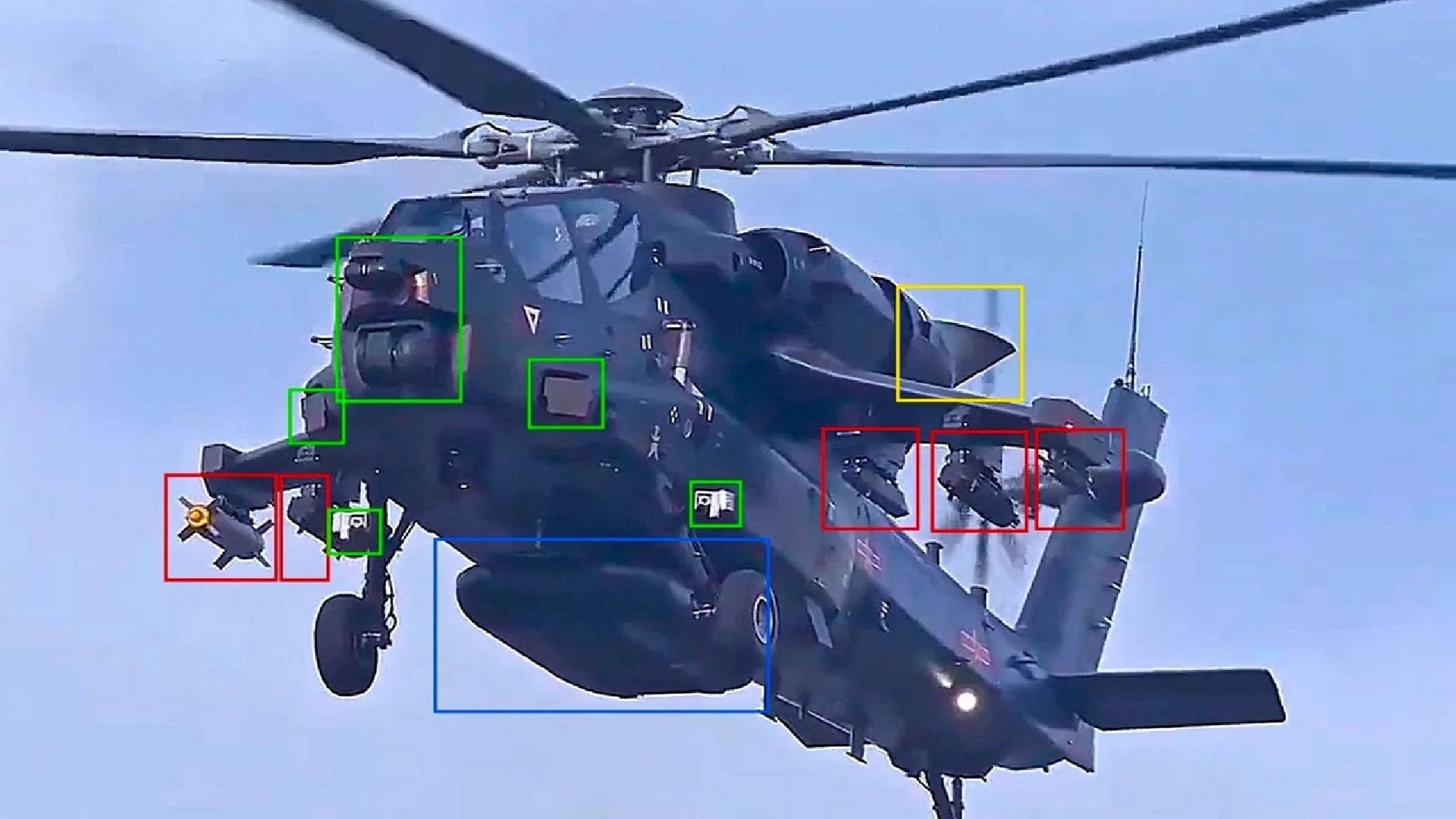
China’s Z-21 heavy attack helicopter takes aim at U.S. AH-64E Apache dominance

China has unveiled the Z-21, a heavy attack helicopter that military analysts are comparing directly to the Boeing AH-64E Apache Guardian, the United States Army’s primary rotary-wing strike platform. The aircraft’s emergence marks a concrete step in China’s effort to field a domestically produced heavy attack helicopter capable of operating in high-intensity contested environments.

Airframe design and propulsion

The Z-21 follows a tandem-seat, twin-engine configuration consistent with modern dedicated attack helicopter doctrine. Its airframe geometry — including stub wings for weapon pylons and a narrow fuselage cross-section — mirrors the layout optimized for survivability and aerodynamic performance in nap-of-the-earth flight.

The helicopter is reported to be powered by turboshaft engines developed domestically, a departure from earlier Chinese rotorcraft programs that relied heavily on foreign powerplant technology. Precise engine designation and shaft horsepower output have not been officially confirmed by the People’s Liberation Army (PLA).

Weapons and sensor suite

The Z-21 is equipped with a chin-mounted cannon and provisions for air-to-ground missiles, anti-tank guided munitions, and unguided rocket pods across four hardpoints on its stub wings. Reports indicate integration of a millimeter-wave fire control radar — analogous to the Longbow radar mast system on the AH-64E — enabling over-the-horizon target acquisition and engagement in degraded visibility conditions.

A multi-spectral targeting system mounted in a nose turret is expected to provide infrared and day/TV imaging for precision engagement. These are capabilities the AH-64E has carried operationally for over a decade, meaning the Z-21 would be entering the field at a level of sensor maturity the Apache already surpasses in software and network integration.

How it stacks up against the AH-64E Apache

The AH-64E Apache operates with Link 16 datalink compatibility, manned-unmanned teaming (MUM-T) with reconnaissance drones such as the MQ-1C Gray Eagle, and a target handoff system that allows crews to pass fire missions across platforms in near-real time.

Whether the Z-21 has achieved comparable network interoperability within PLA joint-force architecture remains unclear from available information.

On gross weight and payload, the Z-21 appears to fall in a similar class to the Apache’s roughly 10,400 lb (4,717 kg) maximum takeoff weight, though official Chinese specifications have not been released. This matters operationally: payload capacity directly constrains the missile and fuel load carried on a given mission profile, affecting both range and lethality.

Survivability features

The AH-64E incorporates radar-absorbent materials, infrared suppression on exhaust outlets, and a ballistically tolerant rotor system designed to sustain hits from 23 mm projectiles. It is not yet established whether the Z-21 meets comparable protection standards.

Engine reliability and maintenance logistics for domestically produced Chinese turboshafts also carry uncertainties, given the historical difficulties PLA aviation programs have faced in achieving consistent turbine performance at scale.

For readers interested in how rotary-wing platforms fit into broader strike architectures, the US Army’s Future Attack Reconnaissance Aircraft program offers relevant context on next-generation attack helicopter requirements being pursued in parallel.

Strategic context for PLA rotary aviation

The Z-21’s development fits within a wider PLA modernization effort that has prioritized closing capability gaps in close air support and anti-armor warfare. Taiwan Strait contingency planning, as well as high-altitude operations along the Sino-Indian border where the Z-10 medium attack helicopter has already deployed, likely informed the Z-21’s design requirements.

A heavier, more capable platform extends the PLA’s ability to conduct sustained attack helicopter operations in mountainous or fortified terrain where ordnance load matters.

Until the Z-21 completes operational testing and enters confirmed PLA service, claims about its combat effectiveness relative to the AH-64E remain speculative. The gap between a prototype photograph and a battle-ready weapons system in serial production is one that Chinese aerospace programs have historically taken years to close.

💾

China's new Z-21 heavy attack helicopter prototype is emerging as a direct capability competitor to the U.S. AH-64E Apache Guardian.
  •  
❌