❌

Reading view

Japan’s 4,800-ton hydrogen tanker: How its engine, batteries and motors work

Japan has demonstrated a coastal tanker using a hydrogen-fired, four-stroke, high-speed engine in what the project describes as a world first.

The 4,800-dwt vessel sailed approximately 20 miles in Osaka Bay during a roughly two-hour demonstration on September 25. The Nippon Foundation reported that the voyage reduced carbon dioxide emissions by approximately 1.2 tons compared with conventional fossil fuels.

The demonstration forms part of a foundation-sponsored research program supporting the decarbonization of shipping. The tanker combines a hydrogen engine, electric propulsion motors and lithium-ion batteries.

How the tanker’s propulsion system works

The tanker uses electricity generated by a hydrogen engine housed in a container mounted on deck which powers two electric propulsion motors connected to two shafts.

The vessel also carries a hybrid generator and lithium-ion batteries. The batteries smooth the load and help optimize fuel consumption.

In this configuration, the hydrogen engine generates electrical power rather than driving the propeller shafts directly. The electric motors provide propulsion through the vessel’s two shafts.

Yanmar Power Solutions designed the engine used in the project. Its first bench tests were completed in October 2024, when it successfully operated at a rated output of approximately 500 kilowatts.

During those initial tests, the engine used a small amount of diesel oil as a pilot ignition source to burn a premixed combination of hydrogen and air. Subsequent testing worked toward using hydrotreated vegetable oil, known as HVO, for pilot ignition.

The supplied account does not identify which pilot ignition fuel was used during the September demonstration.

The project called for a tanker specifically designed for hydrogen propulsion. Fukuoka Shipbuilding, a member of the project coalition, launched the vessel at its Nagasaki yard on February 14, 2025.

Measuring approximately 344 feet (105 m), the tanker was delivered to Uyeno TransTec in October 2025.

What the demonstration covered

The September 25 voyage tested the tanker’s hydrogen-fired engine while sailing in Osaka Bay. The Nippon Foundation described it as a carbon-neutral demonstration and estimated the carbon dioxide reduction at about 1.2 tons compared with conventional fossil fuels.

Beyond the engine, the project’s scope included developing the fuel supply system and hull design to obtain Approval in Principle from the classification society ClassNK.

The team also developed training and an operating manual for hydrogen-fueled vessels.

According to the foundation and the operator, the demonstration produced experience and knowledge to support hydrogen adoption in domestic coastal shipping. The project’s stated goal is to develop a model and pathway for that adoption.

“This demonstration represents a significant step towards the practical application of hydrogen-fueled zero-emission ships and is expected to contribute to the promotion of decarbonization in Japan’s shipping sector,” said Kazuma Kashiwagi, Director of the Environmental Bureau for Kobe City.

Japan has committed to achieving carbon neutrality in its domestic shipping sector by 2050.

The wider hydrogen vessel program

The Nippon Foundation launched the project in 2022. In June 2023, it assigned three consortia to develop separate demonstrations under its Zero Emission Ship 2050 program.

Alongside the tanker, one team focused on demonstrating a hydrogen fuel cell aboard an offshore wind turbine work vessel. Another worked on a hydrogen-fueled engine for the tugboat “Ten-Oh.”

The program’s first hydrogen fuel-cell demonstration took place in April 2024 aboard the 238-gross-ton passenger vessel Hanaria. Additional demonstrations were scheduled for 2026, alongside work on hydrogen stations to supply fuel.

Other hydrogen shipping projects include Norway’s liquid-hydrogen-fueled ferry MF Hydra and inland barges in Europe.

Cruise operators have also begun testing fuel cells and hydrogen systems to supply electricity for hotel operations and reduce emissions in port.

  •  

US B-52 bombers to get new equipment to carry Air Force’s next-gen cruise missile

V2X, a U.S. defense technology company, will help integrate the Air Force’s next-generation Long Range Standoff (LRSO) cruise missile with B-52 bombers under a $46 million order.

Announced on September 15, the work involves producing carriage equipment that will support the deployment of the new weapon from the B-52 Stratofortress. 

The LRSO will replace the Air-Launched Cruise Missile the service currently uses, helping maintain its long-range strike capability against evolving threats.

Based in Reston, Virginia, V2X provides integrated mission solutions across the air, land, sea, space, and cyber domains. Its work includes engineering, manufacturing, sustainment, and mission support for defense customers.

Preparing B-52s for the LRSO missile

V2X was awarded a position on the delivery order through the Enterprise-Wide Agile Acquisition Contract, an Indefinite Delivery/Indefinite Quantity contract.

Under the order, the company will produce the carriage equipment needed to support the integration of the LRSO weapon system with the B-52. 

The equipment will help prepare the bomber to carry the new cruise missile as the Air Force advances the wider modernization program.

The LRSO is designed for deployment from the B-52 and will replace the Air-Launched Cruise Missile currently in service. According to V2X, the transition will ensure that the Air Force retains an effective long-range strike capability for decades to come.

Strengthening the US strategic deterrent

The U.S. Air Force considers the LRSO program a critical modernization effort and an essential part of the country’s strategic deterrent.

V2X said its role in the program reinforces the company’s involvement in advancing next-generation defense capabilities. The carriage equipment will support mission readiness while enabling the Air Force to integrate its new weapon with the existing bomber platform.

“Supporting the modernization of the B-52 and our nation’s strategic deterrent is a responsibility we take seriously,” said Jeremy C. Wensinger, President and Chief Executive Officer of V2X. 

“This award reflects the trust our customer places in V2X to deliver high-quality solutions that enable mission success and support one of the Air Force’s highest modernization priorities,” he added.

Supporting complex defense missions

V2X develops solutions that combine physical and digital environments by aligning people, actions, and technology. The company works across different stages of a critical mission’s lifecycle to improve readiness, strengthen security, and optimize resource management.

Its experience in engineering, manufacturing, sustainment, and mission support enables it to help customers address complex defense challenges and evolving operational requirements.

The LRSO assignment expands that work by placing V2X within a major Air Force modernization program. Its production responsibilities will directly support the equipment required to integrate the cruise missile with the B-52.

Through the effort, V2X will help prepare the bomber fleet for a new generation of long-range weapons as the Air Force moves to replace its currently fielded Air-Launched Cruise Missile.

  •  

US researchers target compact quantum sensing for navigating contested environments

Nitride Global, a US developer of advanced thermal-management, dielectric, and semiconductor materials, will study a centimeter-scale quantum sensor designed to support navigation when GPS signals are unavailable.

The Wichita-based company announced on September 14 that it had received an AFWERX Small Business Innovation Research Phase I contract supporting the Department of the Air Force.

The project will assess the feasibility of a microwave atom-chip quantum sensor for precision navigation and remote-sensing gravimetry.

Known as the Atom-Interferometer Microwave Atom Chip, or A-MAC, the proposed device will be evaluated using Nitride Global’s aluminum oxynitride platform.

Navigation without satellite signals

The project addresses a challenge faced by Airmen and Guardians operating in environments where GPS signals may be jammed, spoofed, or completely unavailable.

Conventional inertial navigation systems accumulate errors over time. Without periodic satellite updates, those errors cause positional uncertainty to increase, restricting how long and how far a platform can operate independently.

Atom interferometers offer a potential alternative because they measure acceleration and rotation against the wavelength of a matter wave. Nitride Global said these systems are among the most stable inertial sensors demonstrated so far.

However, most leading systems still occupy a meter or more of laboratory bench space. According to the company, the principal obstacle to miniaturization is the packaging surrounding the sensor rather than its underlying physics.

Compact microwave atom chips continue to rely on distributed radio-frequency hardware. The resulting heat and phase drift can degrade measurements, making the technology difficult to deploy outside controlled laboratory environments.

Bringing microwave hardware onto one board

Nitride Global’s A-MAC architecture is intended to consolidate the distributed microwave chain onto a single integrated board.

Its thin, conformal AlON dielectric material would allow microwave routing, coupling structures, and trap geometry to be positioned within the same stack. Heat would move outward through metal instead of passing through a bulk ceramic substrate.

The aim is to create a centimeter-scale architecture suitable for platforms with strict size, weight, and power requirements.

Nitride Global will work with Dr. Seth Aubin, associate professor of physics at William & Mary.

Aubin’s atomic physics group will participate as a subcontractor and research partner, bringing more than a decade of work on microwave atom-chip traps and related trapping physics.

During the initial phase, the partners will model the architecture’s thermal behavior, microwave insertion loss, coupling, and possible trap geometries. The work will conclude with a decision gate and technical roadmap for a potential second phase.

From laboratories to contested environments

The technology could eventually support satellite-independent positioning, navigation, and timing across hypersonic vehicles, unmanned aircraft, orbital systems, submerged platforms, autonomous ground vehicles, and UAV interceptors.

Commercial applications could include resource exploration, infrastructure monitoring, and subsurface mapping.

“Quantum inertial sensing has been constrained for the same reason power electronics were constrained a decade ago: the limit is set by the package, not by the physics. If microwave routing and thermal management can be carried on the same material system, the instrument becomes small enough to fly,” said Mahyar Khosravi, CEO of Nitride Global.

The company is now seeking input from aerospace and defense integrators to define the sensor’s form factor, environmental requirements, and performance thresholds.

  •  

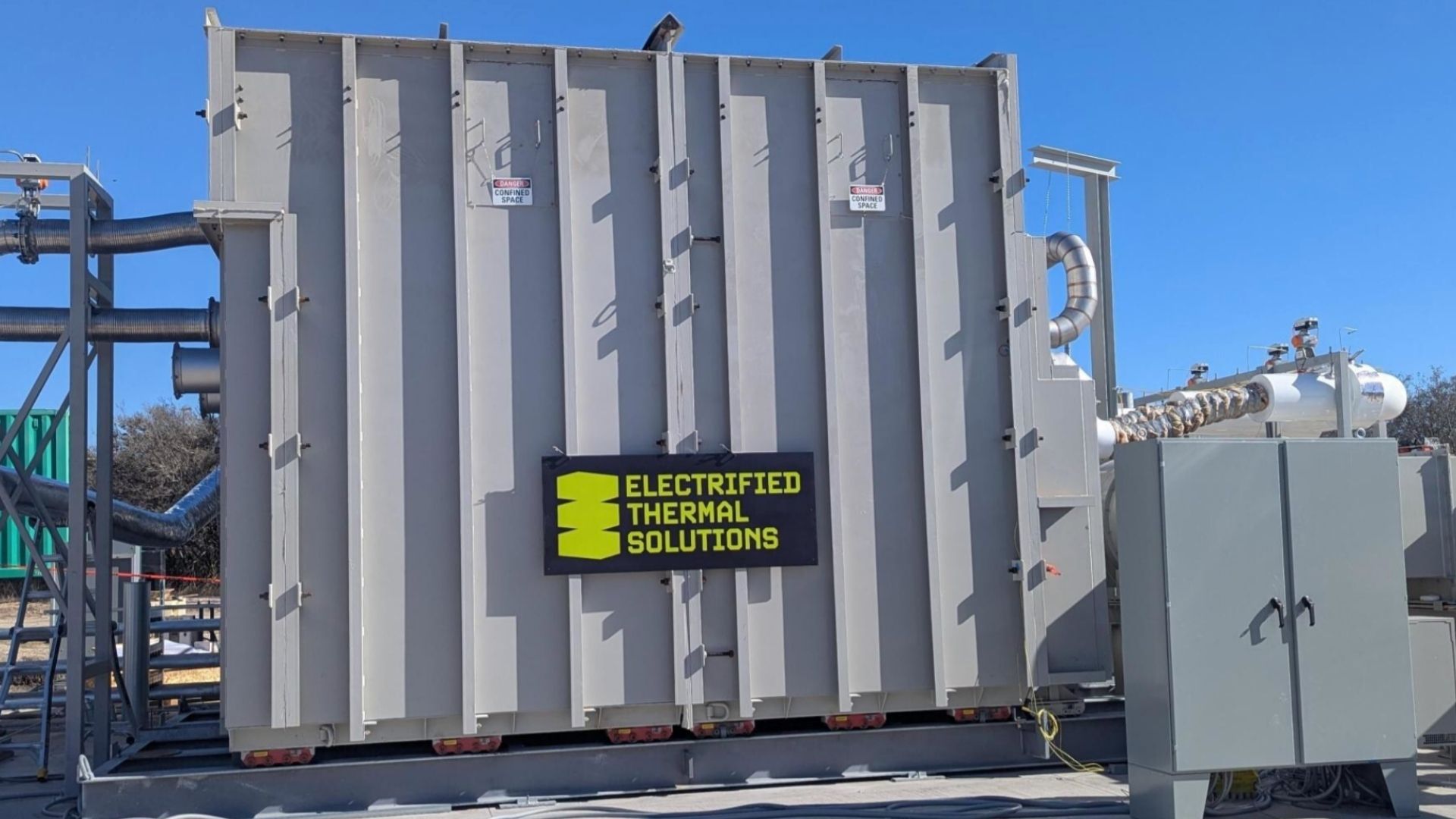
US firm’s brick battery can discharge energy at 3,275°F for industrial heat

Holcim, a global building materials and solutions company, has agreed to deploy two Joule Hive Thermal Battery units developed by Boston-based Electrified Thermal Solutions as part of its industrial electrification roadmap.

Announced on September 15, the agreement will allow the building materials company to evaluate electric heating technology for its high-temperature cement operations.

The batteries will store clean electricity as heat inside electrically and thermally conductive bricks.

That energy can then be discharged on demand at temperatures reaching 3,275°F, offering Holcim a potential route to reduce its reliance on combustion for industrial heat.

Electrifying one of industry’s hardest processes

Cement production requires process temperatures that regularly exceed the capabilities of conventional electric heating systems. As a result, combustion has remained the default means of generating heat across much of the sector.

Electrified Thermal’s technology is designed to address this limitation by converting electricity into heat and retaining it inside specially developed bricks. The stored thermal energy can later be supplied to an industrial process when required.

The initial deployment will include two Joule Hive Thermal Battery units. However, the companies did not disclose where the systems will be installed or when they are expected to begin operating.

“Electrifying high-temperature industrial heat is one of the advanced technologies we are incorporating in our decarbonization strategy, and this deployment allows us to evaluate its potential,” said Ram Muthu, Head of Operational Excellence at Holcim.

“Working with Electrified Thermal gives us a path to accelerate decarbonization as part of our industry-shaping sustainability roadmap,” he added.

From clean electricity to extreme heat

Industrial heat accounts for roughly one-fifth of global energy consumption. The processes requiring the highest temperatures, including those used in cement, steel and chemical production, have largely remained beyond the reach of existing electric alternatives.

By delivering temperatures of up to 3,275°F, the Joule Hive system is intended to bring electrification into this particularly difficult segment. The Holcim agreement also gives Electrified Thermal its third global industrial partner across the cement, steel and chemical sectors.

“Holcim’s decision to deploy our technology validates years of work to bring electrified heat to high-temperature industrial-scale applications that no other technology or company can achieve,” said Daniel Stack, CEO and co-founder of Electrified Thermal Solutions.

“This agreement follows the recent turn-on and successful 1,000+ hours of operation of our commercial demonstration system and shows that global industrial producers are ready to move this technology from demonstration to deployment. We look forward to expanding this relationship with Holcim over time,” he added.

Moving beyond the demonstration stage

The agreement builds on an existing relationship between the companies, with Holcim also participating as an investor in Electrified Thermal Solutions.

It follows the commissioning of Electrified Thermal’s commercial demonstration system in San Antonio, Texas, earlier in 2026. The megawatt-scale installation has completed more than 1,000 hours of operation, according to the company.

The Holcim deployment will now take the technology from demonstration toward use by a major industrial producer. Both companies are also evaluating further opportunities to deploy the thermal battery across Holcim’s operations.

  •  

Rare-earth-free US magnets gain Honda backing for next-gen electric propulsion

Honda Motor has invested in Niron Magnetics, a US company commercializing rare-earth-free Iron Nitride permanent magnets.

Announced on September 9, the investment will support the continued commercialization of Niron’s technology and help scale its manufacturing operations.

The move reflects Honda’s interest in next-generation magnetic materials that could reduce reliance on rare-earth elements in electrified systems.

Reducing reliance on rare-earth materials

Permanent magnets are used in electric propulsion motors and several other technologies. However, many conventional high-performance magnets depend on rare-earth metals that face resource constraints and changing market conditions.

Niron’s Iron Nitride technology offers an alternative that does not require rare-earth materials. It is intended to support performance, cost stability, and sustainability goals while reducing reliance on constrained global supply chains.

“This investment reflects the increasing focus on rare-earth-free magnet technology as manufacturers look for more resilient solutions,” said Jonathan Rowntree, CEO of Niron Magnetics.

“Following investment from Honda, we are encouraged by their confidence in our technology and vision for scaling rare-earth-free permanent magnets across a broad range of applications. The investment adds to growing industry momentum as manufacturers increasingly direct resources to alternatives to rare-earth-based magnets,” he added.

The technology can be used across automotive systems, robotics, industrial automation and emerging mobility platforms. Other potential applications include artificial intelligence and data center infrastructure, as well as consumer electronics.

Honda sees potential for electric propulsion

Most electric propulsion motors currently use permanent magnets made from rare-earth metals. Honda expects Niron’s technology to help address some of the supply and market challenges associated with these materials.

“Niron Magnetics has an innovative permanent magnet technology that does not require rare earth materials. Most electric propulsion motors today use permanent magnets made from rare earth metals, which are subject to resource constraints and fluctuations in market conditions,” said Mahito Shikama, Director, Executive Officer of Honda Motor Co., Ltd.

“Niron Magnetics is addressing these challenges, and Honda has high hopes for its potential,” he added.

The investment further supports Niron’s effort to establish Iron Nitride as a new category of permanent magnetic material. It will also help the company expand the technology’s adoption across a growing range of products and applications.

Honda’s backing adds to the resources being directed toward alternatives to rare-earth-based permanent magnets. For Niron, it supports the transition from commercializing its technology to producing the magnets at a larger scale.

US facility to scale magnet production

Niron recently announced a new 287,000-square-foot facility in Sartell, Minnesota, for magnet manufacturing. The plant is scheduled to begin operating in 2027.

Once operational, the facility is expected to produce up to 1,500 tons of rare-earth-free Iron Nitride permanent magnets annually. This output will serve the company’s targeted automotive, industrial and advanced technology applications.

The facility forms a central part of Niron’s manufacturing expansion. Honda’s investment will support the company as it works to scale production and broaden the use of Iron Nitride magnets across electrified systems.

  •  

New compact radar gives weapon stations faster tracking of hard-to-spot drones

Norwegian defense company KONGSBERG has selected Echodyne’s MESA radar platform for multiple air and surface applications, starting with its PROTECTOR remote weapon stations. The compact radar has already been integrated into the PROTECTOR RS4 and RS6 systems.

The collaboration brings together KONGSBERG’s weapon-station architecture and Collaborative Fire Control capabilities with Echodyne’s solid-state radar. It is designed for static, crewed, and uncrewed platforms. 

The system helps them detect, track, and engage fast-moving drones. It also requires less space, weight, and power than traditional high-performance electronically scanned array radars.

Compact radar strengthens weapon stations

The integration provides the PROTECTOR systems with the precise radar data required to operate as counter-unmanned aircraft system effectors. MESA delivers range, range-rate, bearing, and movement data while maintaining stable tracks on agile targets with low radar signatures.

This data allows the radar to direct and stabilize the weapon station’s optical fire-control system on a target.  According to Echodyne, the combination can help the system sustain its target lock, reduce the time between detection and engagement, and increase its chances of hitting a drone.

“KONGSBERG has set the standard for remote weapon systems through decades of field experience, disciplined engineering and close collaboration with operators,” said Eben Frankenberg, CEO of Echodyne. 

“Integrating MESA radar gives the PROTECTOR family the precise, stable and persistent tracks needed to cue the fire-control system, sustain target lock and act decisively against fast-moving, low-signature drone threats,” he added. 

“Just as important, MESA delivers that performance in a compact, software-defined package that can scale across a large installed base and adapt as the threat evolves,” he continued.

Radar supports precise airburst timing

Accurate radar measurements become particularly important when PROTECTOR weapon stations use programmable airburst ammunition. Range and range-rate information helps the fire-control system time the munition so that its effect occurs at the intended point along a drone’s flight path.

MESA can also operate as part of a wider network of sensors and weapon systems. A cooperative search radar or another sensor can initially detect a threat and send its track to a radar-equipped PROTECTOR station. The local radar can then refine the incoming information, maintain the track and provide the data needed for fire control. 

This process enables distributed systems to share an air picture, allocate targets and rapidly switch their attention as individual threats are addressed.

Companies explore wider radar applications

Echodyne and KONGSBERG spent several years integrating, testing and demonstrating the radar-enabled system in field conditions. The work reflects KONGSBERG’s approach of validating new capabilities through practical testing before broader deployment.

Beyond the RS4 and RS6 integrations, the companies are examining how high-performance radar could support other air and surface missions across KONGSBERG’s portfolio. Their continued technical work will focus on resilient sensing, networked fire control and protection that can scale as threats evolve.

Both companies are exhibiting at the International Defense Industry Exhibition in Kielce, Poland, from September 8 to 11, 2026.

  •  

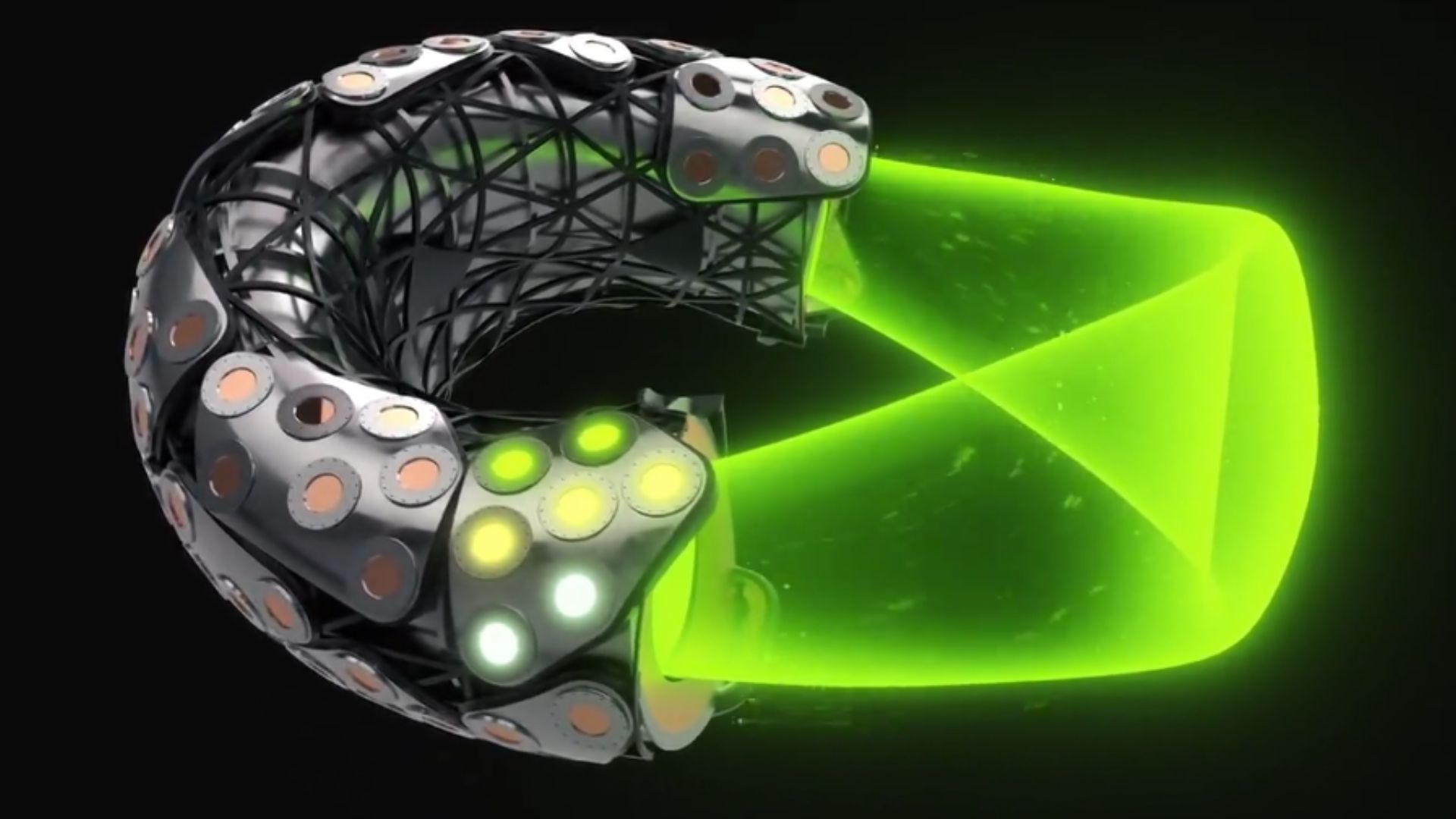
US firm unveils compact stellarator design to supply 400 MW nuclear energy to grid

Fusion power company Thea Energy has detailed a fusion power plant designed to continuously supply approximately 400 megawatts of electricity to the grid.

The New Jersey-based company unveiled the Helios architecture on September 9 through a collection of 16 peer-reviewed papers published in a special issue of Fusion Engineering and Design.

The proposed US stellarator combines adaptable software-controlled magnets, a continuous exhaust system and a sector-based maintenance approach.

Together, these technologies are intended to make fusion power reliable, cost-competitive and suitable for commercial operation.

Planar coils simplify stellarator engineering

Stellarators use magnetic fields to confine the extremely hot plasma required for fusion.

Although decades of research have established the concept as a mature fusion system, the complicated three-dimensional coils traditionally used by stellarators have created major engineering challenges.

Helios replaces those complex modular coils with an arrangement of planar magnets controlled through software. This configuration is designed to remain operational despite manufacturing deviations and wear that develops during extended operation.

“The Helios power plant is technically viable, robust, and requires no scientific miracles to commercialize,” said David Gates, co-founder and chief technology officer of Thea Energy.

According to the company, the quasi-axisymmetric design also allows Helios to be more compact than other proposed optimized stellarator power plants.

The system has a major radius of eight meters, helping reduce both its physical footprint and projected cost.

Continuous system targets reliable grid power

Unlike fusion concepts that operate in pulses, Helios is designed to run continuously. The company says the plant could provide roughly 400 MW of electrical power without the risk of plasma disruptions, supporting its intended role as a source of baseload energy.

Its architecture includes an X-point divertor, which continuously removes exhaust from the stellarator during fusion operations. The design also divides the plant into maintainable sectors, allowing equipment to be accessed and serviced over its operating life.

“The papers introduce several innovative concepts aimed at reducing risks that have traditionally been associated with stellarator-based fusion power plant designs,” said Benedikt Geiger, associate professor at the University of Wisconsin–Madison and co-guest editor of the special issue.

The published research covers several systems needed to turn the fusion concept into an operational power plant.

These include remote handling, cryogenics, heat transfer, power supplies, diagnostics, instrumentation, and planar-coil magnet engineering.

Helios follows DOE-certified milestone

The US Department of Energy previously certified Helios’ preconceptual design during the first phase of its Milestone-Based Fusion Development Program.

Thea Energy became the first participating company to receive certification for its plant-design milestone following an independent expert review.

Before operating Helios, the company plans to develop Eos, its first large-scale integrated stellarator. Eos uses the same planar-coil architecture and is intended to demonstrate fusion performance relevant to a commercial power plant.

Thea Energy says Helios remains on track to begin operating in the 2030s.

The newly published papers now provide the wider fusion community with a detailed, multidisciplinary account of the physics and engineering behind that commercial objective.

  •  

How spacecraft survive the trip back to Earth after leaving the planet

Most rocket launches are watched on the way up. Engines ignite, the vehicle climbs through the atmosphere, and its stages separate as it heads toward space.

But for reusable rockets and spacecraft, reaching space is only one part of the mission. They must also find a way back to Earth.

The return is far more complicated than simply falling from the sky. The vehicle has to reduce its speed, survive the heat of re-entry, and remain stable as it descends. 

Depending on its design, it may then use engines, parachutes, or wings to complete the landing. That journey begins by establishing a controlled path back toward the planet.

Slowing down to return to Earth

A spacecraft remains in orbit not because it has escaped Earth’s gravity, but because it is moving sideways fast enough to keep falling around the planet. To come home, it must first slow down.

The spacecraft performs a deorbit burn by firing its engines against its direction of travel. This slows it enough to lower its orbit and enter the upper atmosphere, where drag further reduces its speed.

Reusable rocket boosters follow a different path because they usually separate from the vehicle before reaching orbit. 

After separation, a booster may perform a boost-back burn to reverse part of its trajectory and head toward land. Alternatively, it can continue downrange toward a landing platform at sea.

The booster then fires its engines again during its descent. These burns help control its speed and position it for the final approach.

Every maneuver must be precisely timed. Even a small error in the vehicle’s angle, speed, or orientation could cause it to miss its landing zone.

Surviving atmospheric re-entry

Entering Earth’s atmosphere at high speed creates extreme heat. As the spacecraft strikes the air, the gas in front of it compresses rapidly and heats up. This can produce a layer of intensely hot plasma around the vehicle.

Spacecraft use heat shields to survive these conditions. Capsules commonly carry ablative shields made from materials designed to char and gradually wear away. 

As the outer material is removed, it carries heat away and prevents the extreme temperatures from reaching the cabin.

The angle of entry is also critical. A spacecraft entering too steeply could experience excessive heating and deceleration. 

One approaching at an angle that is too shallow could travel beyond its planned landing area or briefly skip back out of the atmosphere.

The vehicle must also remain stable during this phase. Capsules adjust their orientation to produce limited lift and control their path. Reusable boosters use grid fins, which interact with the surrounding airflow to steer the descending rocket toward its target.

Completing the landing

Once atmospheric drag has removed most of the spacecraft’s speed, its landing system takes over. The method used depends on the vehicle’s design and mission.

Crew and cargo capsules generally deploy parachutes during the final stage of descent. The parachutes open in a sequence, gradually reducing the capsule’s speed. 

Some capsules splash down in the ocean and are collected by recovery teams, while others return to designated landing areas on land.

Reusable boosters rely on powered landings. Grid fins guide the rocket during descent before one or more engines restart for the final landing burn. This burn rapidly reduces the booster’s speed as its landing legs deploy.

Onboard computers continuously calculate the booster’s altitude, orientation, and velocity. They make rapid adjustments to engine thrust and steering, allowing the rocket to land vertically on a pad or a platform at sea.

Spaceplanes use another method. After re-entry, they glide through the atmosphere using wings and aerodynamic control surfaces before landing horizontally on a runway.

Returning to Earth is therefore not one action but a carefully coordinated sequence. Engines place the vehicle on the correct path, heat shields protect it during re-entry, and guidance systems control the descent. 

Parachutes, landing engines, or wings then complete the journey, bringing the spacecraft back to Earth intact and, in some cases, ready to fly again.

Launching a rocket requires enough power to break free from the ground, but returning one demands precise control at every stage. It is this combination of speed, heat management, and split-second navigation that turns a fall from space into a safe landing.

  •  

Lockheed’s new defense hub to take missile sensors from sketch to test in months

Lockheed Martin has launched a new family of modular radio-frequency sensors, missile datalinks, and seeker technologies designed to help the United States and its allies respond faster to evolving battlefield threats.

Announced on August 10 in Orlando, Florida, the Strigo family uses common hardware and software architectures that can be rapidly reconfigured for air defense, missile defense, and air-to-surface engagements.

Lockheed has invested $250 million in a dedicated product center intended to move new technologies from initial concepts to tested systems in months rather than years.

Modular missile sensor tech for multiple missions

The Strigo portfolio is built around a common technical baseline, allowing Lockheed Martin to adapt individual solutions without developing every system from scratch.

This approach could shorten integration timelines while reducing development, lifecycle, and long-term sustainment costs.

Its technologies include RF sensors that detect and track targets, datalinks that allow missiles to receive updated information during flight, and seekers that guide weapons toward their targets.

Because these components are modular, they can be tailored to different weapons and operational requirements.

The architecture is intended to support a broad range of missions, including intercepting aircraft and missiles or striking targets on the ground.

It could also allow existing munitions to receive upgraded sensing and communications capabilities as new threats emerge.

Developing missile systems before formal demand

Lockheed Martin established the dedicated product center less than two years ago to accelerate the journey from concept to operational capability.

The facility functions as a storefront of ready and near-ready technologies that can be adapted to meet specific customer requirements.

Instead of waiting for the US military to formalize a requirement, engineers at the center conduct proactive research and build hardware around anticipated battlefield needs.

Lockheed said several concepts have already progressed from early design to successful testing.

Technologies developed through the modular family have also informed aspects of the seeker package for the Precision Strike Missile Increment 2.

The weapon is being developed to provide the US Army with a longer-range capability against moving maritime targets and other threats.

“By putting proactive research and development at the forefront, the Strigo Product Center lets us test and deploy new solutions at unprecedented speed. That’s how we turn ‘what if’ into ‘what’s next’ faster than ever before,” said Stacy Kubicek, vice president and general manager at Lockheed Martin Sensors and Global Sustainment.

Preparing for rapidly evolving threats

The $250 million investment reflects a wider defense-industry effort to increase missile production and accelerate the introduction of new capabilities.

Conflicts are demonstrating how quickly electronic warfare, countermeasures, and target profiles can change, placing pressure on traditional development cycles.

“Leveraging our deep expertise in advanced sensor and missile technologies, this long-term investment reshapes the way we develop and deliver next-generation, mission-ready capabilities, ensuring our warfighters have the solutions they need the moment threats evolve,” Kubicek added.

Lockheed plans to continue investing in RF sensors, missile seekers and datalinks.

The company says the technologies will support current efforts to accelerate munitions development while creating a foundation for future US military capabilities.

  •  

US submarine warfare capabilities advance with $43 million in new contracts

Graham Corporation has secured two US defense contracts worth more than $43 million to supply equipment for the MK48 Mod 7 heavyweight torpedo and the country’s submarine fleet.

The New York-based manufacturer announced the awards on August 7.

The contracts cover alternators and regulators for the torpedo program and new MK19 Mod 2 air turbine pump assemblies for submarine spares, supporting the US Navy’s undersea warfare capabilities and fleet readiness.

Power systems for the MK48 torpedo

The first award exercises the fourth option year of an existing contract supporting the MK48 Mod 7 Heavyweight Torpedo program. It was awarded during Graham’s first quarter of fiscal 2027, which ended June 30, 2026.

Under the option, Graham will continue supplying alternators and regulators used within the torpedo system. Alternators generate electrical power, while regulators manage the resulting voltage and current to help onboard electronics operate reliably.

These components are particularly important in a heavyweight torpedo, where propulsion, guidance, sensing and control systems must function under demanding underwater conditions.

Reliable power management can support target acquisition and navigation while helping the weapon maintain performance throughout its mission.

The MK48 is launched from submarines and is designed to engage hostile submarines and surface ships.

Continued component orders also indicate that the US is sustaining and upgrading an established weapon as undersea competition becomes increasingly important.

Submarine pumps to arrive from 2028

Graham received the second contract during its fiscal 2027 second quarter, which ends September 30, 2026. The company will manufacture new-build MK19 Mod 2 air turbine pump assemblies for the submarine fleet’s spare-parts inventory.

Deliveries are scheduled to begin in 2028 and continue through 2030. The extended delivery period could help the Navy maintain a dependable supply of replacement hardware for submarines already in service.

Air turbine pumps convert energy from pressurized air into mechanical pumping power.

On submarines, equipment of this kind can support essential fluid-handling functions in environments where compact construction, dependable operation and tight performance tolerances are critical.

Maintaining spare assemblies also reduces the risk of a component shortage keeping a submarine out of service for longer than necessary.

The contract therefore supports not only equipment production but also maintenance planning and operational availability.

$43 million added to defense backlog

Revenue from the MK48 Mod 7 and MK19 Mod 2 awards will be recorded in Graham’s fiscal 2027 first- and second-quarter backlog. The deals extend the company’s role as a supplier of specialized technologies for US defense platforms.

“These awards reflect the continued demand we’re seeing across our defense platforms, and demonstrate the durability of our customer relationships built over years of consistent execution,” said Matthew Malone, President and CEO of Graham Corporation.

“Our mission-critical applications remain vital in helping our customers meet high-level performance requirements. We’re proud to continue supporting the MK48 and submarine programs and look forward to building on this momentum,” he added.

Beyond defense, Graham develops fluid, power, heat-transfer, vacuum and advanced mixing technologies for the space, energy and process industries.

The latest awards reinforce how those engineering capabilities are being applied to torpedo reliability, submarine maintenance and the long-term readiness of America’s undersea fleet.

  •  

10 futuristic VTOL aircraft transforming urban mobility, combat & cargo operations

Helicopters are no longer the only aircraft capable of taking off vertically. Electric motors, autonomous flight systems and lightweight materials are giving rise to machines that lift like helicopters but fly more like conventional airplanes.

Some are designed to carry passengers over congested cities, while others could transport soldiers, deliver cargo or give individuals their own personal aircraft. Here are 10 futuristic VTOL aircraft attempting to change how people and goods move through the sky.

1. Joby Aviation air taxi

Joby Aviation

Joby Aviation has developed one of the most mature electric vertical takeoff and landing aircraft in the industry. Its air taxi uses six tilting electric propellers to rise vertically before transitioning into forward flight.

The aircraft is designed to carry a pilot and four passengers at speeds of up to 200 mph, with a range of up to 100 miles. Joby reported that its aircraft had completed more than 2,600 flights and covered over 50,000 miles by December 2025.

2. Archer Midnight

Archer Midnight

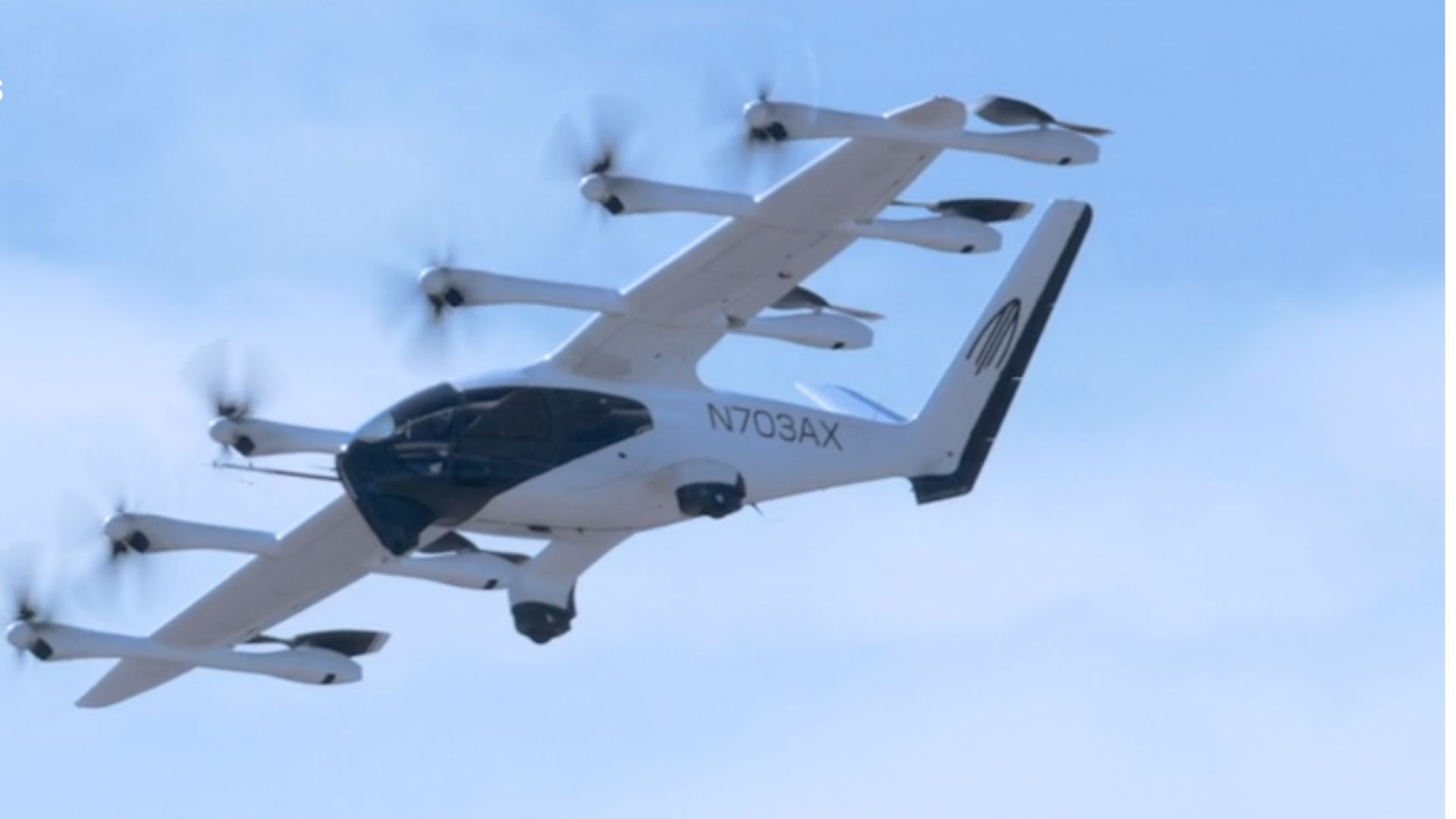
Archer Aviation’s Midnight is built for short, repeated journeys across crowded cities. The aircraft has 12 electric motors and propellers, providing additional redundancy if one propulsion unit fails.

Midnight can carry four passengers and a pilot at speeds of up to 150 mph. Although its claimed range reaches 100 miles, it is optimized for consecutive journeys of around 20 to 50 miles. A piloted aircraft completed a 55-mile flight in 31 minutes in August 2025.

3. BETA ALIA VTOL

Wikimedia Commons

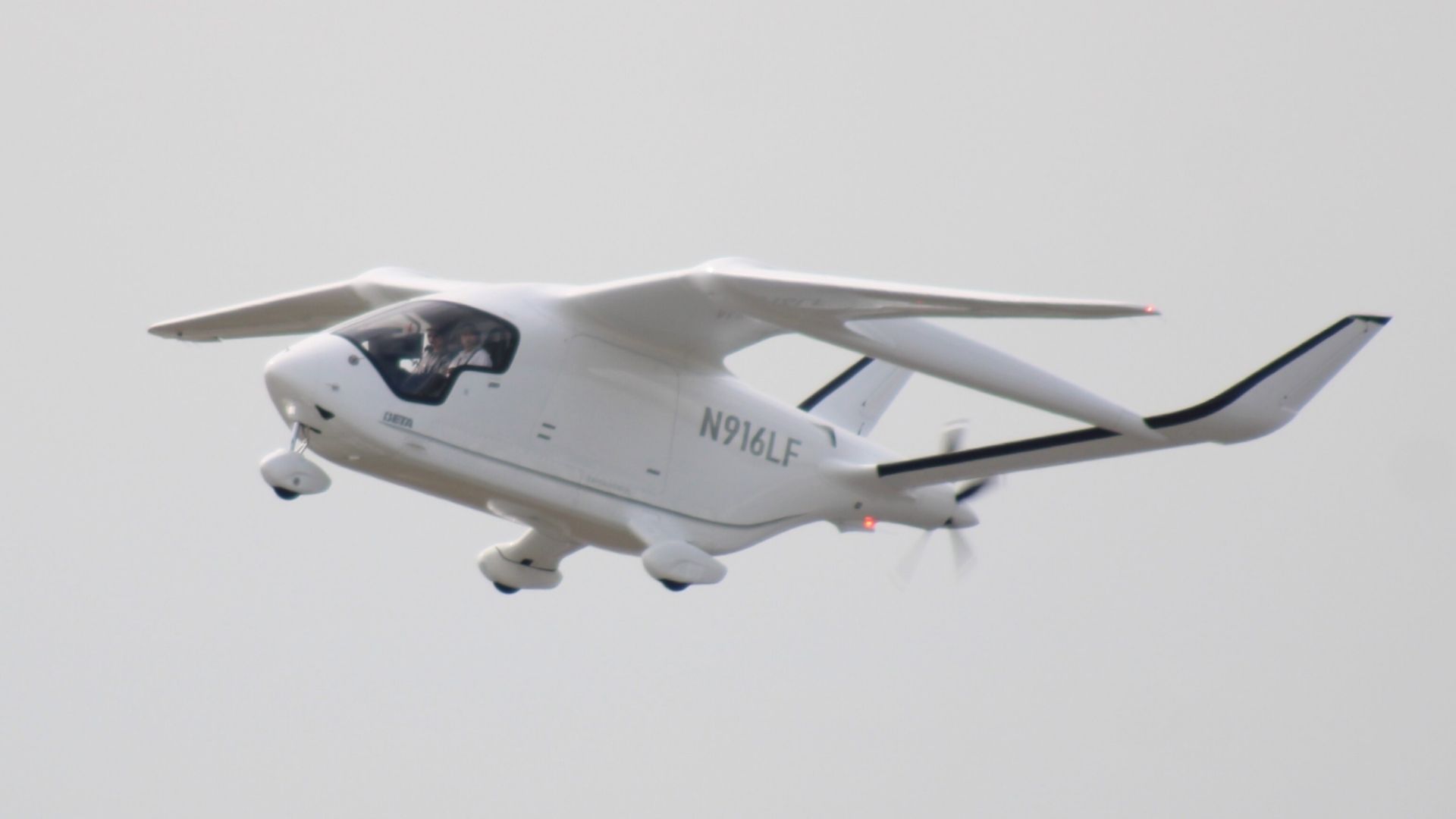
BETA Technologies has taken a relatively straightforward approach with its ALIA VTOL. Four horizontal propellers provide vertical lift, while a separate propeller at the rear drives the aircraft during forward flight.

ALIA is designed to carry five passengers or around 200 cubic feet of cargo. It has a listed maximum speed of 153 knots, equivalent to approximately 176 mph.

BETA is targeting passenger transport, medical missions, logistics and military operations with the platform.

4. AutoFlight Prosperity I

AutoFlight

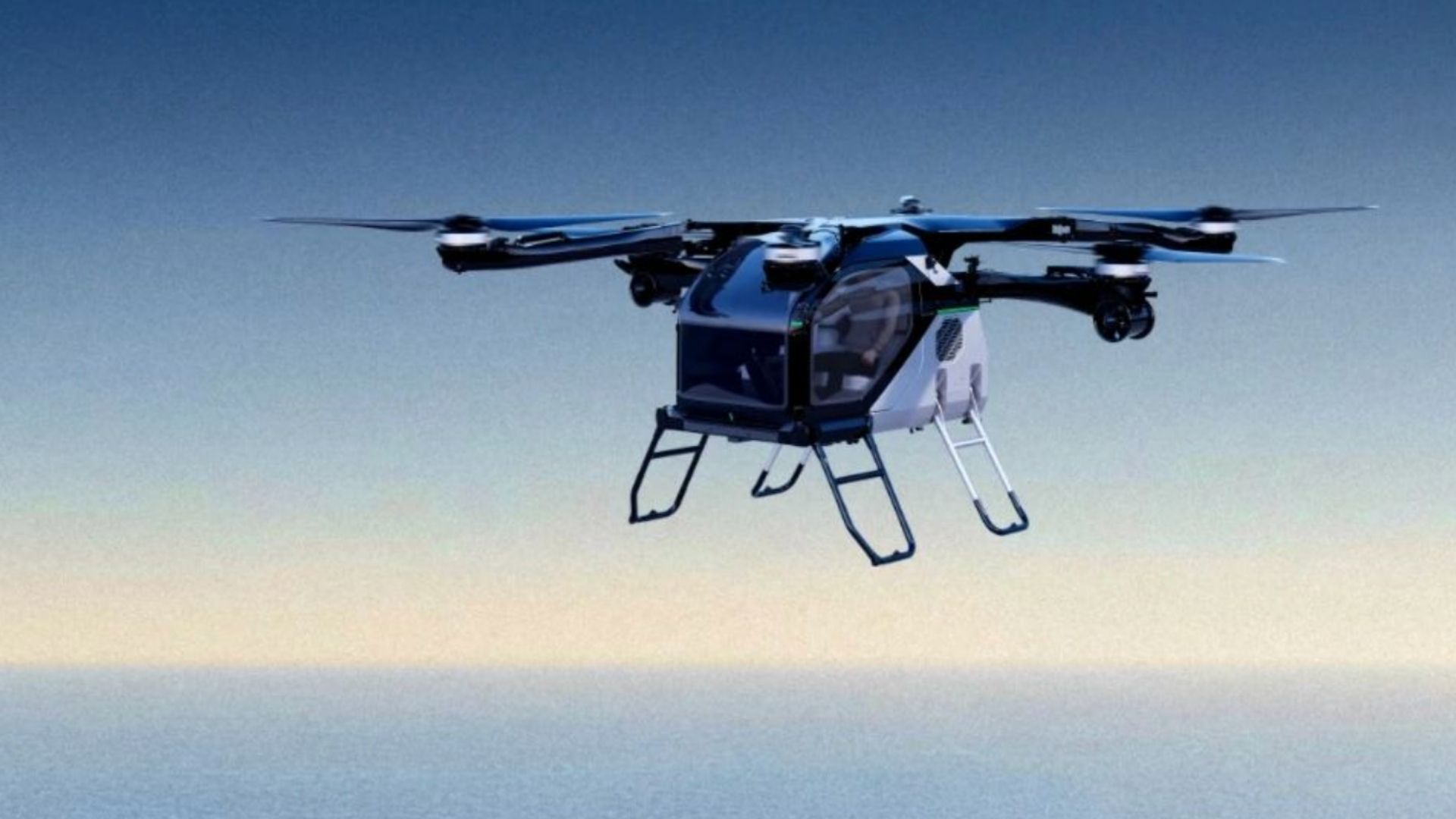
China’s AutoFlight is developing Prosperity I for longer passenger journeys between cities and transport hubs. Its unusual propulsion system includes 10 lifting propellers and three propellers for forward flight.

The aircraft has five seats, including one for the pilot, and a typical payload capacity of 350 kilograms. AutoFlight claims a range exceeding 250 kilometres and a cruise speed above 200 kilometres per hour.

The passenger aircraft is currently progressing through airworthiness certification.

5. Vertical Aerospace Valo

Valo is the latest electric aircraft being developed by Britain’s Vertical Aerospace. It uses eight tilt-shift propellers and a carbon-composite airframe to carry four passengers and one pilot.

The all-electric aircraft is designed to travel up to 100 miles at speeds reaching 150 mph. Vertical is also planning a hybrid-electric version with a significantly more ambitious range of up to 1,000 miles.

The company is targeting entry into service after regulatory approval, currently expected in 2028.

6. Horizon Cavorite X7

Hysky

Instead of placing its lift propellers outside the aircraft, Horizon Aircraft has hidden them inside the wings. Panels open to expose 12 electric fans during vertical takeoff and close once the Cavorite X7 transitions into forward flight.

The Canadian hybrid-electric aircraft is being developed to carry six passengers and one pilot. Horizon is targeting a range of approximately 500 miles and a maximum speed of around 280 mph.

Its proposed missions include regional transport, defence and emergency response.

7. Jetson ONE

Jetson ONE

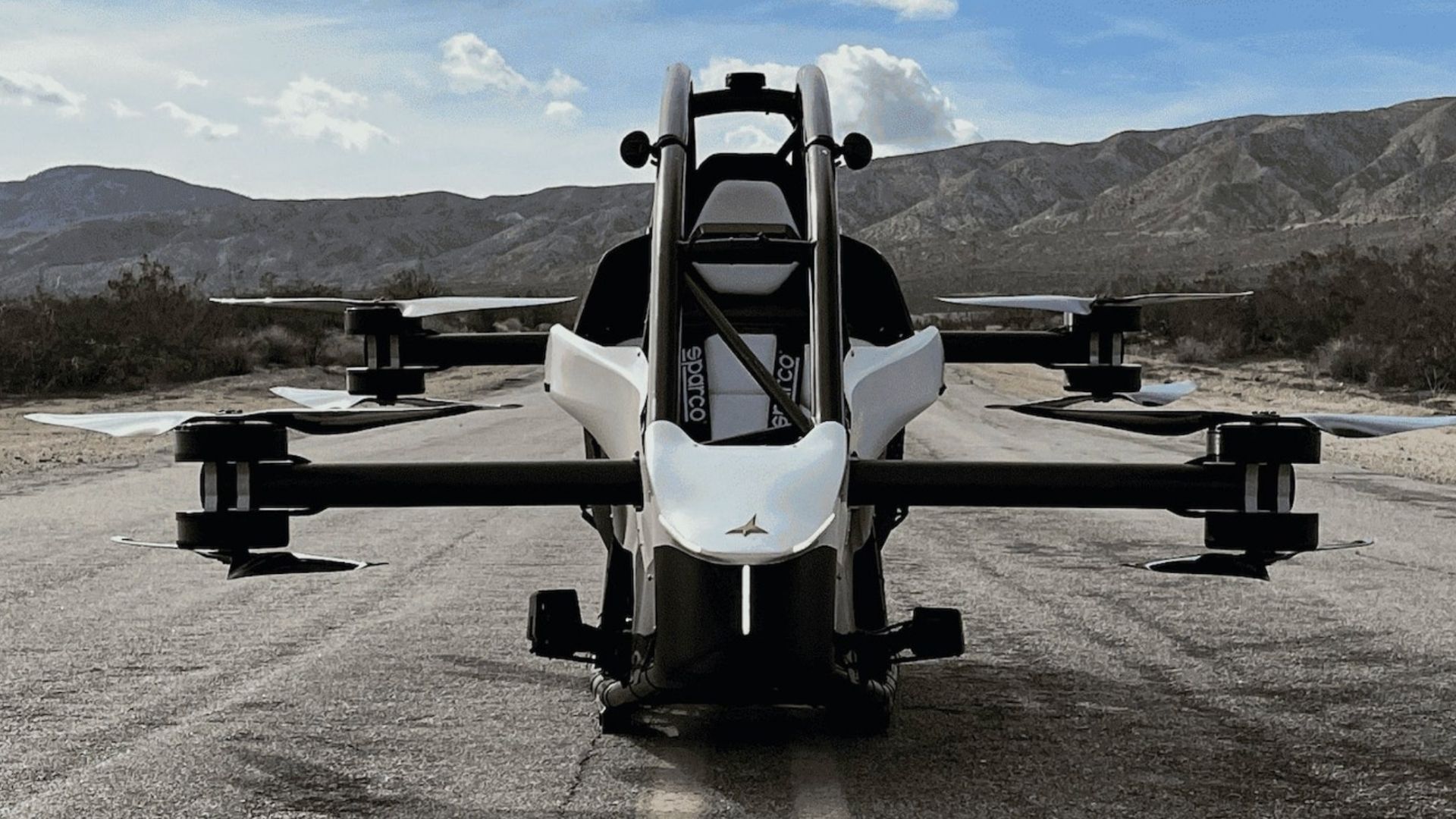
The Jetson ONE resembles a cross between an open-wheel racing car and an oversized drone. Its lightweight aluminium-and-carbon-fibre frame carries a single pilot above eight electrically powered propellers.

The aircraft offers approximately 20 minutes of flight and has a software-limited maximum speed of 63 mph.

It is controlled using a four-axis joystick and includes automatic landing, motor redundancy and a ballistic parachute. Unlike many proposed personal eVTOLs, early Jetson ONE aircraft have already reached customers.

8. ARIDGE Land Aircraft Carrier

Aridge

ARIDGE’s Land Aircraft Carrier approaches the flying-car problem by separating driving and flying. The system consists of a six-wheeled ground vehicle carrying a detachable two-seat electric aircraft inside its rear compartment.

Once the vehicle reaches a suitable location, the aerial module can be released and prepared for vertical flight. This modular architecture avoids forcing one machine to operate effectively both on public roads and in the air.

9. Sikorsky Nomad

Lockheed Martin

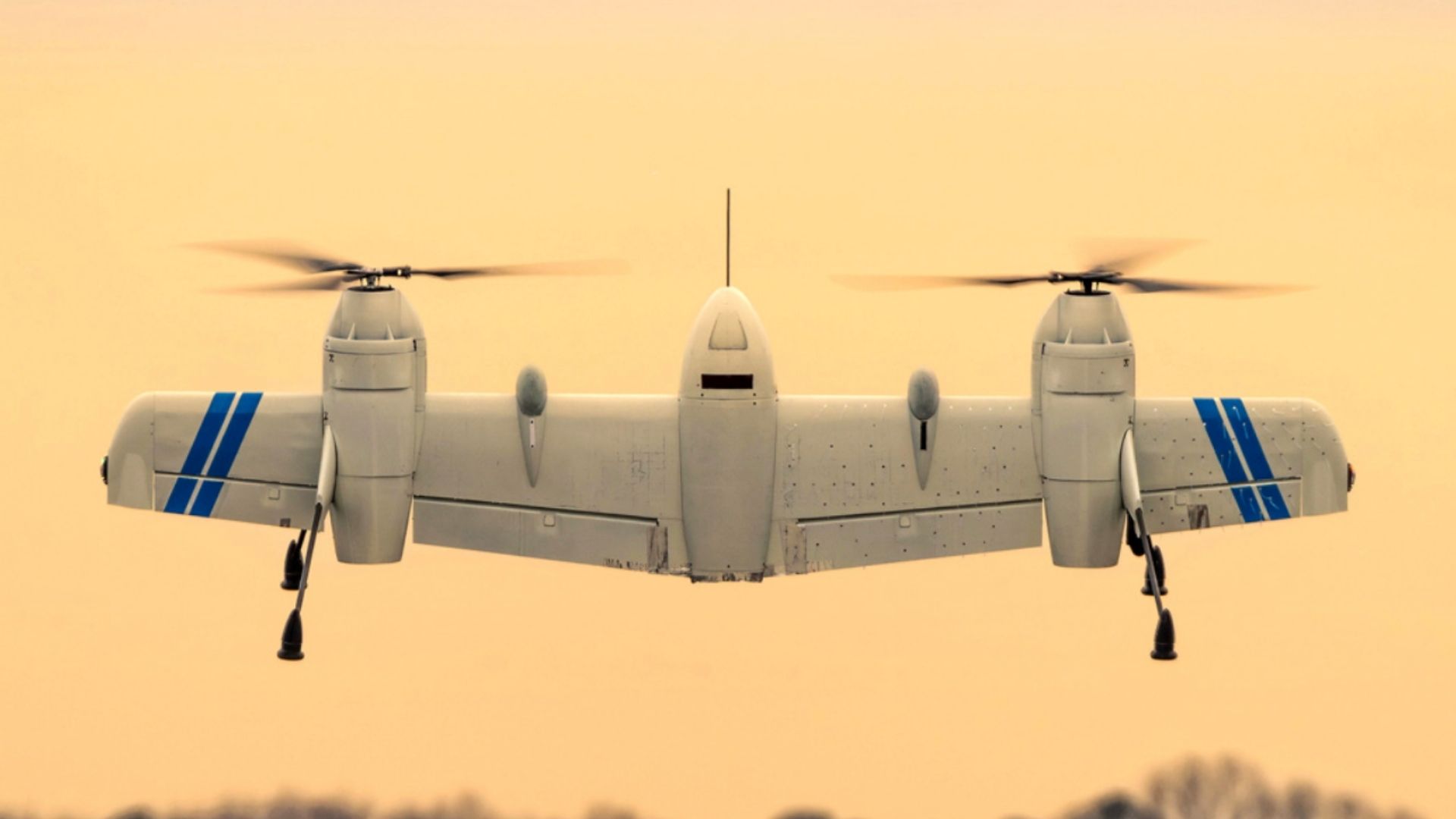
Sikorsky’s Nomad is a family of autonomous aircraft built around a rotor-blown-wing design. Two large propellers generate airflow over the wing, allowing the aircraft to hover before transitioning into efficient horizontal flight.

A 10.3-foot-wing prototype completed more than 40 takeoffs and landings, including 30 transitions between helicopter and airplane modes.

The larger Nomad aircraft could eventually perform reconnaissance, light-attack and contested-logistics missions without putting a crew onboard.

10. Bell MV-75 Cheyenne II

Bell MV

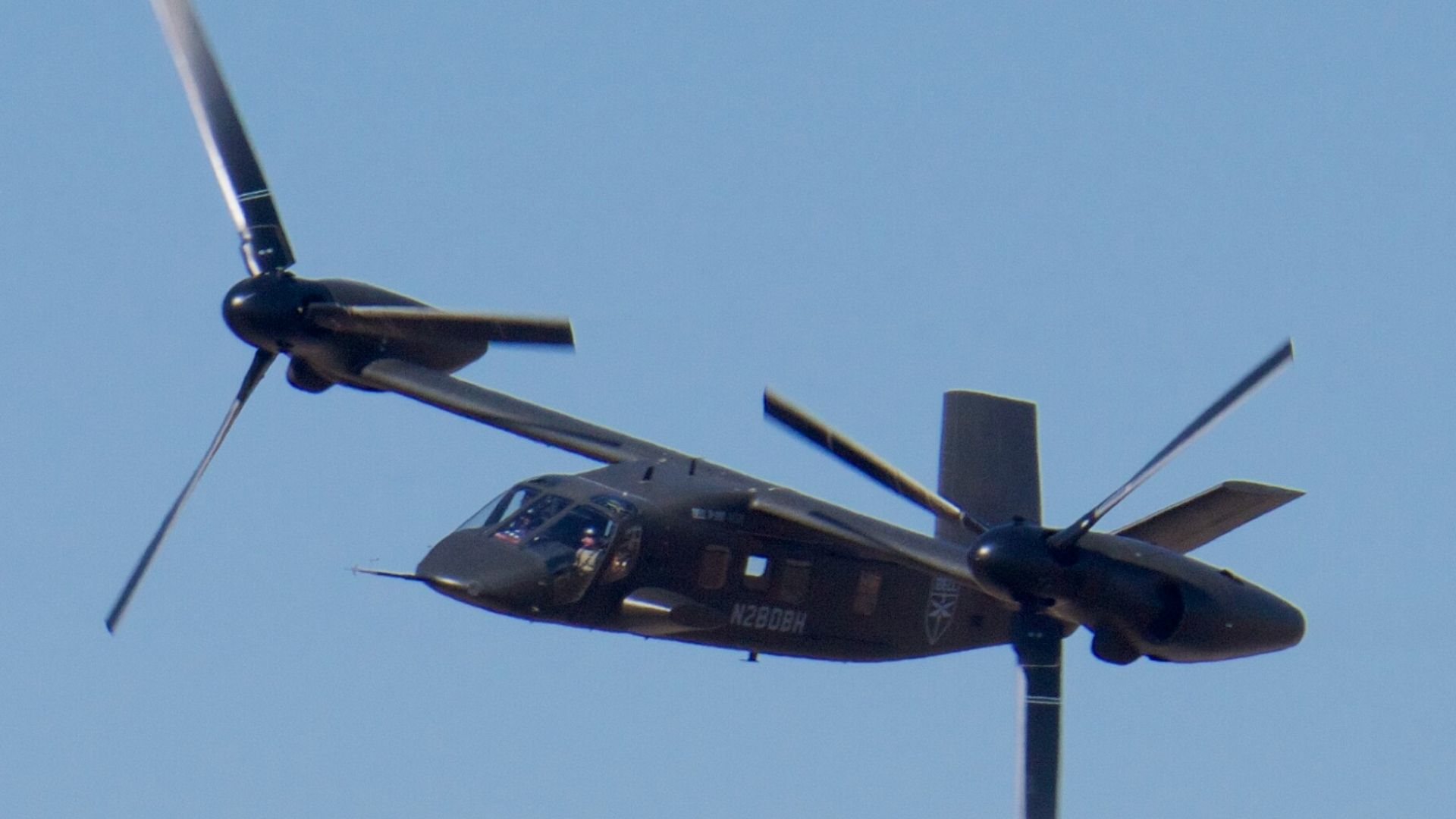
Bell’s MV-75 Cheyenne II is being developed as the U.S. Army’s next-generation long-range assault aircraft. Derived from the V-280 Valor demonstrator, it uses tilting rotors to combine helicopter-like vertical flight with turboprop-like speed.

The Army expects the MV-75 to fly more than twice as far and twice as fast as parts of its current helicopter fleet. It could eventually conduct air assault, medical evacuation, resupply and disaster-relief missions while replacing the UH-60 Black Hawk in certain roles.

Conclusion

These aircraft show there is no single solution to the vertical-flight problem. Companies are experimenting with tilting propellers, dedicated lift rotors, concealed fans, hybrid engines and autonomous flight systems.

However, flying prototypes are only part of the challenge. Certification, infrastructure, battery life, noise and operating costs will ultimately decide which of these futuristic VTOL aircraft become everyday machines—and which remain captivating visions of aviation’s future.

  •  

US neighbour could gain domestic engine overhaul capability for future fighters

GE Aerospace and Magellan Aerospace have signed a memorandum of understanding to establish maintenance, repair, and overhaul capabilities in Canada for the F414-GE-39E engine that powers Saab’s JAS 39 Gripen E fighter.

The agreement, announced on July 22, would move forward only if the Canadian government selects the Gripen E for the Royal Canadian Air Force’s fighter fleet.

Under the proposed arrangement, GE Aerospace would train Magellan personnel and license the company as Canada’s domestic center of excellence for F414 engine sustainment. The work would be carried out at Magellan’s facility in Mississauga, Ontario.

Domestic engine support

“Today’s MOU signing builds on a six-decade relationship between GE Aerospace and Magellan that spans both military and commercial engines and will ensure the Royal Canadian Air Force has access to engine sustainment services in country to ensure readiness of the F414 engines,” said Paul Ferraro, Vice President of Defense Engines & Services at GE Aerospace.

The companies said the capability would support aircraft readiness, engine availability, and long-term fleet performance while giving Canada more control over fighter maintenance.

The proposed center would also extend Magellan’s role in military engine support by developing specialized infrastructure, technical expertise, and a skilled workforce within the country.

If implemented, the project would fit with Canada’s push to strengthen its domestic defense industrial base and retain more high-value aerospace work at home.

Sovereign aerospace capability

“This MOU reflects our shared intent to build enduring sovereign aerospace capabilities in Canada,” said Haydn Martin, Magellan’s Vice President in Business Development, Marketing, and Contracts.

“Should the Saab JAS 39 Gripen E aircraft be selected, Magellan Aerospace will be ready to provide world-class engine maintenance, repair and overhaul services that enhance operational readiness for the Royal Canadian Air Force while maintaining highly skilled Canadian jobs, developing advanced technical expertise, and strengthening Canada’s long-term defence industrial capacity,” he said.

For the Royal Canadian Air Force, having an in-country engine sustainment option could reduce dependence on foreign maintenance networks and improve access to repair capacity during periods of higher operational demand.

The planned capability would also support the development and retention of personnel trained to work on fighter propulsion systems.

F414 engine track record

The Gripen E uses the F414-GE-39E, part of GE Aerospace’s F414 engine family. According to GE Aerospace, the F414 has accumulated more than five million flight hours, while more than 1,600 engines have been delivered to eight nations.

The engine features a six-module architecture intended to simplify maintenance and allow components to be replaced or interchanged.

GE Aerospace also says the F414 operates without scheduled overhauls, relying instead on on-condition maintenance designed to maximize engine availability and reduce life-cycle costs.

The engine is built to provide rapid throttle response and unrestricted performance.

However, the Canadian sustainment plan remains tied to Ottawa’s fighter procurement decision. The proposed Mississauga operation would proceed only if Canada chooses the Gripen E, making the MOU both an industrial commitment and a potential element of Saab’s bid for Canada’s future air combat requirements.

  •  

Surface-to-air missiles vs interceptor drones: Which is better for modern air defense?

Air defense used to revolve around one basic problem: stopping enemy aircraft and missiles before they reached their targets. The rapid spread of drones has complicated that equation.

Cheap one-way attack drones, small reconnaissance UAVs, and larger strike platforms can now threaten military bases, infrastructure, and frontline units without requiring an adversary to risk an expensive crewed aircraft.

Traditional surface-to-air missiles, or SAMs, remain among the most powerful tools available for defending airspace. But using costly missiles against inexpensive drones can create an unfavorable exchange.

That has pushed militaries toward another option: drone interceptors designed specifically to hunt and destroy hostile UAVs. Here is how the two approaches compare across six key areas.

Cost per interception

The biggest difference is economics.

Modern surface-to-air missiles can be extremely expensive because they require sophisticated seekers, propulsion systems, guidance electronics, and warheads capable of destroying fast and highly maneuverable targets.

That makes sense when the incoming threat is a fighter jet, helicopter, or cruise missile. The calculation changes when the target is a relatively inexpensive drone.

Drone interceptors can potentially offer a lower-cost response. Many are built around simpler airframes, compact sensors, and reusable or comparatively inexpensive components. Some destroy targets by collision, while others carry small warheads or other defeat mechanisms.

The objective is simple: avoid spending a high-value interceptor on a low-value threat whenever possible.

Speed and target types

Surface-to-air missiles maintain a major advantage when speed matters.

SAM systems are designed to engage targets traveling at high subsonic, supersonic, and, in some cases, even greater speeds. That makes them suitable for threats such as combat aircraft and cruise missiles, depending on the system.

Drone interceptors generally operate against slower targets. They are particularly suited to small UAVs whose flight speeds and maneuverability allow another drone to pursue them.

Against a fast jet or missile, however, most interceptor drones would struggle to match the speed and engagement envelope of a dedicated SAM.

Range and coverage

SAM systems are built to defend large areas.

Long-range batteries can monitor and engage threats tens or even hundreds of kilometers away, depending on the weapon. This allows defenders to create layered protective bubbles around cities, bases, and strategic infrastructure.

Drone interceptors usually operate over much smaller areas. They may be launched once radars, electro-optical sensors, or other systems detect an incoming UAV.

Their shorter range makes them better suited to local defense rather than wide-area airspace control.

Ammunition and sustainability

Another important difference is how quickly each system can be replenished. A missile launcher carries a limited number of ready-to-fire interceptors. Once those missiles are used, the system must be reloaded, creating potential vulnerability during large or sustained attacks.

Drone interceptors could offer greater flexibility if they can be manufactured cheaply and stored in larger numbers.

That becomes particularly important during swarm attacks, where dozens of drones may arrive within a short period. The challenge is ensuring that interceptor drones can launch, coordinate, identify targets, and engage quickly enough to deal with multiple threats.

Guidance and autonomy

Surface-to-air missiles rely on highly mature guidance systems.

Depending on the weapon, they may use radar guidance, infrared seekers, command guidance, or combinations of several methods. Drone interceptors increasingly depend on autonomy.

Computer vision, artificial intelligence, onboard navigation, and target recognition can allow an interceptor to pursue another drone with limited human involvement.

That could make them useful against large numbers of small targets, but it also places significant importance on reliable detection, identification, communications, and autonomous decision-making.

Complementary weapons, not replacements

Drone interceptors are unlikely to make surface-to-air missiles obsolete. Instead, they are becoming another layer in increasingly complex air-defense networks.

SAMs remain essential when the threat is fast, long-range, heavily armed, or capable of operating at high altitude. Drone interceptors can fill the gap at the lower end of the threat spectrum, particularly against inexpensive UAVs that may not justify the use of an advanced missile.

The future of air defense will therefore probably not come down to choosing between missiles and interceptor drones. It will depend on using the right weapon against the right target.

As aerial threats become cheaper, more numerous, and more diverse, the most effective defenses will likely combine long-range missiles, guns, electronic warfare, directed-energy systems, and interceptor drones into a layered network capable of responding without exhausting its most expensive weapons.

  •  

Energy resilience: US Army and Air Force eye smart micro grids in a 10-year deal

The US Army and Air Force have signed 10-year Intergovernmental Support Agreements with Arizona State University to expand energy services across military installations in the continental United States.

Signed on July 7, the agreements allow installations to request support for utility monitoring, energy assessments, data integration, resilience planning, and workforce development.

The arrangement is intended to help bases strengthen energy resilience, improve infrastructure management, and prepare for operational disruptions.

Expanding access to energy expertise

Under the agreements, Army and Air Force installations can seek a broad range of technical services from Arizona State University.

These include utility metering and billing analysis, energy and water assessments, building automation, distribution network modernization, on-site generation, microgrid development, independent project reviews, energy readiness exercises, and workforce training.

“Intergovernmental Support Agreements give installations an important mechanism to access support services that can improve readiness and resilience,” said Jordan Gillis, assistant secretary of the Army for installations, energy and environment.

“This effort reflects the Army’s continued focus on strengthening infrastructure, improving efficiency and supporting mission requirements across our installations,” he continued.

The US Army said the partnership can also help installations better understand existing utility systems and identify where modernization or efficiency improvements are needed.

Managing aging utility systems

A major focus of the Army agreement is the condition and performance of utility infrastructure at military installations.

“Through this agreement, Arizona State University will provide the monitoring, analysis and technical support needed to help Army installations better understand and manage aging utility systems,” said David Dentino, deputy assistant secretary of the Army for installations, housing and partnerships.

“This partnership is about improving readiness, increasing resilience, reducing costs and ensuring our installations have the reliable infrastructure needed to support the mission,” he continued.

For the Air Force, the agreement similarly creates a route for installations to obtain services linked to infrastructure, energy efficiency, and mission assurance.

“National security requires energy and water surety,” said Nancy J. Balkus, deputy assistant secretary of the Air Force for infrastructure, energy and environment.

“Every one of our installations is not just a base; it is a power projection platform to assure lethality whenever called upon. Without energy and water security, our missions cannot test, launch, sustain or succeed,” he said.

Supporting long-term installation resilience

Intergovernmental Support Agreements allow military installations to obtain support services from eligible state and local government entities.

For the Army and Air Force, the new ASU agreements provide a framework through which bases can request energy-related expertise without creating separate arrangements for every service.

The broader goal is to improve the reliability of installation infrastructure while giving military facilities more options for monitoring, planning, training, and resilience projects.

By covering services ranging from metering and automation to microgrids and energy readiness exercises, the agreements give installations access to tools that can support infrastructure modernization and long-term operational preparedness.

The initiative also aligns with wider efforts to ensure military installations can continue meeting mission requirements as energy systems, infrastructure demands, and operating environments evolve.

  •  

MIT: Building renewables in the wrong places could raise blackout risks by 2050

MIT researchers have developed a new framework that could help energy planners decide where to build renewable energy projects as climate change puts growing pressure on power grids.

The study combines fine-scale meteorology with detailed simulations of energy infrastructure. Researchers found that where new energy projects are built could significantly affect whether future power systems can meet demand reliably.

The team applied the framework to decarbonized energy systems in New England and Texas. Their analysis found that systems designed around historic climate conditions could experience up to a fivefold increase in energy shortfalls by 2050.

By incorporating future climate conditions into energy planning, however, the researchers found that both regions could improve grid resilience at little or no additional cost.

“As we mitigate climate change with renewables, we can also adapt to climate change by using future weather projections in our power system planning, and the extra costs of that adaptation are, at least in this study, not much,” said senior author Michael Howland, an MIT professor.

Climate change adds new risks to power grids

Electricity systems are already changing rapidly as demand rises from trends such as artificial intelligence and transportation electrification, while falling costs drive greater adoption of wind and solar power.

But renewable generation and electricity demand are both affected by weather, creating new challenges as climate conditions change.

“This study explores the joint, simultaneous impacts on multiple components of the energy system, similar to compound events studied in climate science,” Howland explained.

“An extreme weather event can impact wind and solar generation and electricity demand all at the same time. Our hypothesis is that’s likely to be the biggest impact we’ll see from climate change on energy systems,” he added.

The study found that climate change could increase energy failures by as much as 500% by 2050 if future climate conditions are not considered when siting and designing energy infrastructure.

Where wind and solar are built matters

The researchers found that locations best suited for renewable projects under future climate conditions can differ meaningfully from those identified using historic weather data.

“We are telling people where you put your wind and solar matters a lot for your ability to deliver energy when you need it,” Qiu explained.

“We need to think more about the when and where of adding renewables rather than only focusing on adding overall capacity,” he added.

In New England, climate-related disruptions increased the need for solar capacity and transmission lines close to major demand centers.

In Texas, risks were primarily driven by transmission constraints. Climate-informed designs prioritized wind farms in West Texas to better align renewable generation with future demand patterns.

Researchers seek faster planning tools

The current framework relies on expensive, high-resolution models, making it impractical for grid operators to use routinely today.

The researchers hope to develop faster models that could make climate-informed planning easier to apply.

“This study shows the opportunity and the need,” Howland says. “There are risks to not adapting our system, but if we do adapt our system, there could be big opportunities that are not costly.”

The study was published in Natural Energy.

  •  

US: 80% import reliance of power transformers delays hydropower infra upgrades

The United States is facing nine major supply chain challenges that could delay the rehabilitation of its hydropower infrastructure, according to a new report from the National Laboratory of the Rockies (NLR).

The report has examined the difficulties hydropower operators encounter when upgrading or replacing large power transformers (LPTs).

These custom-built devices raise the voltage of electricity generated by hydropower turbines, allowing it to travel efficiently across long-distance transmission networks.

Their importance extends beyond hydropower, as more than 90% of the electricity consumed in the United States passes through high-voltage transformers at some stage.

Transformer deliveries can take five years

One of the most serious challenges identified in the report is the time required to procure new transformers.

A typical LPT rated at 100 megavolt-amperes takes approximately 2.5 to three years to acquire. Lead times for extra-high-voltage units can extend to five years because only a limited number of facilities worldwide can manufacture them.

Transformer prices sharply increased by approximately 80% in 2025 compared with 2021 levels, according to the report. A single unit can now cost as much as $10 million.

These pressures come as demand rises across the power sector. Although domestic manufacturing and assembly capacity has expanded in recent years, the report found that it has not grown quickly enough to meet current requirements.

US manufacturers also depend heavily on international suppliers. Approximately 80% of the raw materials used in domestic LPT production, including grain-oriented electrical steel and refined copper, are imported.

Changing trade conditions could further increase the baseline costs of copper and steel, adding uncertainty to transformer procurement.

Remote dams create transportation problems

Delivering an LPT to a hydropower facility presents another layer of difficulty. Many dams are located in isolated regions surrounded by rugged terrain, making them considerably harder to reach than conventional power facilities.

Transformers require specialized vehicles and heavy-duty trailers capable of carrying oversized loads. However, the United States has a limited domestic fleet of such equipment. Transportation routes must also be planned carefully and require special permits.

Permitting and regulatory procedures can produce additional delays, particularly when an operator must remove an existing transformer before installing its replacement.

Federal contracting rules and domestic-content requirements could also create near-term bottlenecks while US production capacity remains limited.

Report could guide domestic investment

The NLR study builds on the US Department of Energy’s broader Hydropower Supply Chain Gap Analysis, which previously identified five gaps affecting the domestic industry.

DOE’s Hydropower and Hydrokinetic Office funded the follow-on study to provide a closer examination of the LPT supply chain. Researchers used feedback from hydropower industry participants to define the nine challenges.

The findings could help shape federal policies, incentives, lending programs, workforce initiatives and investments intended to expand US transformer production.

Strengthening the domestic supply chain will be important for new construction as well as upgrades, refurbishments and relicensing work at existing facilities.

Hydropower currently provides more than 6% of total US electricity generation, making the availability of critical transformers essential to its continued contribution to the grid.

The report is titled as Large Power Transformer Supply Chain Gap Analysis and Domestic Content Strategies for Hydropower Rehabilitation.

  •  

US firm unveils sensors to track military personnel and supplies at tactical edge

Rune Technologies has unveiled TyrSense, a new line of ruggedized sensors designed to help military units track personnel, casualties, and supplies in contested environments where conventional communications may be unavailable.

The hardware marks the company’s first expansion beyond software, extending its TyrOS logistics platform directly to personnel operating at the tactical edge.

The initial TyrSense products use small, durable NFC tags that can be attached to personnel or cargo. When scanned during a handoff, the system records the location and status of the individual or pallet in TyrOS.

Unlike conventional tracking systems, the location is determined by the node where the scan takes place rather than through GPS.

The tags can also operate without an active cloud connection or satellite signal, allowing units to continue recording movements in denied, degraded, intermittent, or low-bandwidth environments.

Once connectivity returns, the collected information can synchronize with TyrOS.

Aim to replace manual military tracking

Military units continue to rely heavily on manual processes to account for personnel and supplies, according to Rune.

Information about available resources is often maintained through whiteboards, paper manifests, and manually compiled reports. These systems can become difficult to maintain when units relocate or lose network connectivity.

TyrSense is initially designed around three military workflows that commonly depend on manual reporting: personnel accountability, medical operations, and cargo tracking.

For personnel, scanning a tag allows units to update an individual’s duty status, reducing the need for the daily manual process of compiling accountability information.

In medical operations, the system can record each transfer of a casualty as the individual moves from the point of injury through successive levels of care.

For logistics, tags attached to pallets can register shipments as they move through different nodes across a military supply network.

Built to operate when battlefield networks fail

Rune has designed the sensors around conditions where military personnel may have limited or no communications access.

Because individual scans can be registered locally at the tactical edge, units can continue collecting information even during network disruptions.

“A tag has to work in a vehicle and with no signal, because that’s where these counts happen,” said Peter Goldsborough, Co-Founder and Chief Technology Officer of Rune Technologies.

“We built TyrSense so the scan registers at the edge and reaches TyrOS the moment a connection is there. The hardware is deliberately simple. The value is what TyrOS does with the data,” he added.

The approach allows TyrOS to receive updated information once connectivity becomes available rather than requiring personnel to maintain continuous access to remote infrastructure.

Rune plans sensors for fuel and water

TyrSense builds on the company’s deployment of TyrOS with operational military units over the past year.

During Balikatan 26 in the Philippines, the software provided tactical commanders with information on food, water, fuel, and personnel supporting thousands of troops across a Joint Task Force, according to the company.

Rune is also the sole logistics provider for the US Marine Corps’ Project Dynamis and is the only application selected by both prime contractor teams participating in the US Army’s Next Generation Command and Control program.

The company now plans to expand the TyrSense hardware portfolio beyond NFC-based tracking.

  •  

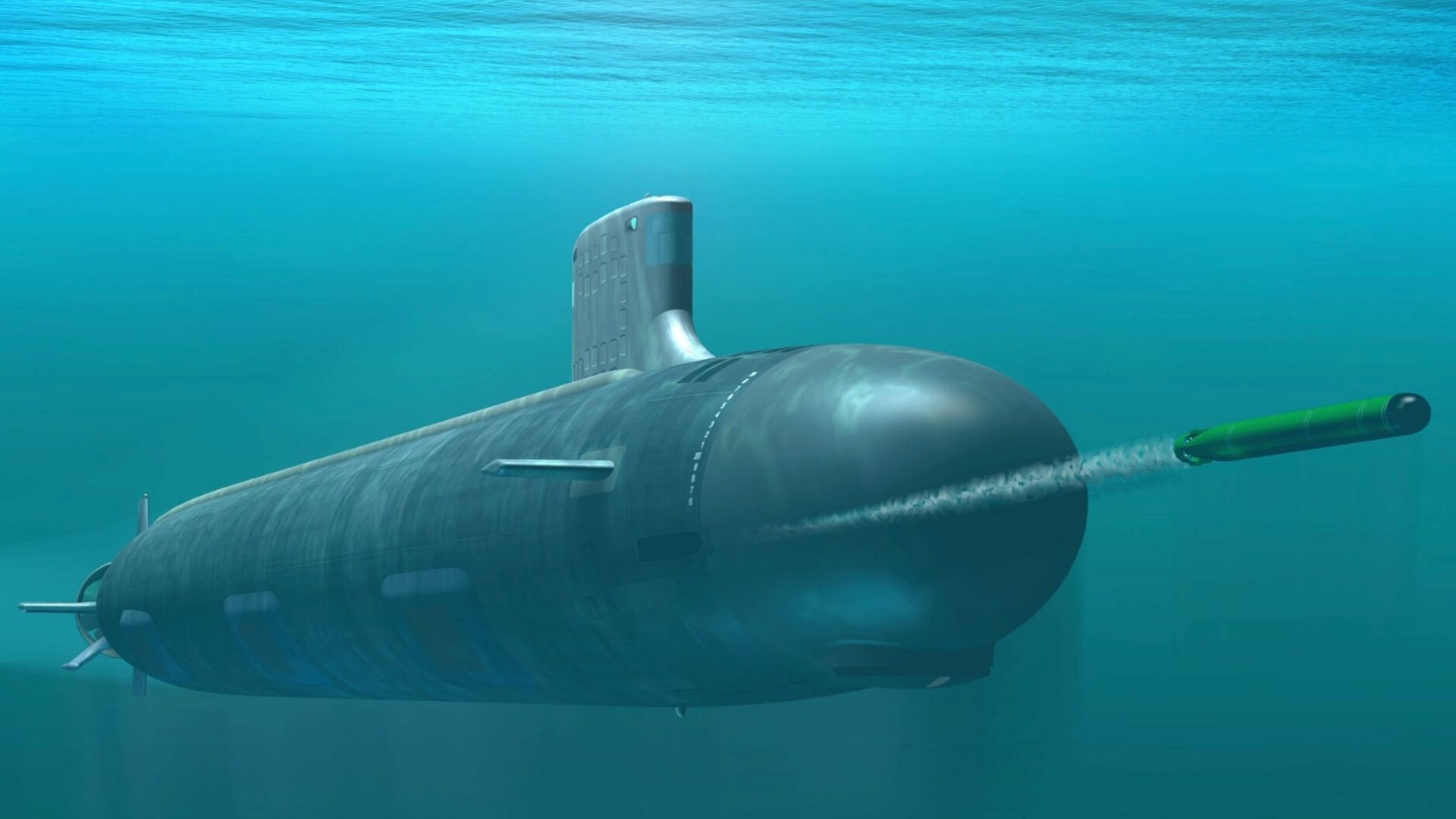
Yasen-class vs Virginia-class: The nuclear submarines built for the next undersea war

Russia’s Yasen-class and America’s Virginia-class submarines are among the most advanced nuclear-powered attack submarines in service today.

Both are designed to hunt enemy submarines, strike surface ships, gather intelligence, and launch cruise missiles against land targets. But they reflect very different naval priorities.

The Virginia class is built around numbers, flexibility, and long-term modernization. The Yasen class is built around heavy firepower and strategic intimidation.

In simple terms, the Virginia is a quieter, networked hunter; the Yasen is a heavily armed predator designed to threaten targets at sea and on land.

Two submarines, two naval doctrines

The Virginia class was developed after the Cold War as a more affordable successor to the extremely capable Seawolf class.

Instead of building a small number of very expensive submarines, the United States focused on producing a larger fleet of advanced boats that could be upgraded over time.

Virginia-class submarines are used for anti-submarine warfare, intelligence gathering, special operations support, and precision land attack.

Russia’s Yasen class, also known as Project 885, had a longer and more difficult birth. Its design roots go back to the Soviet period, but the first boat, Severodvinsk, entered service only in the 2010s.

The upgraded Yasen-M version is smaller, more modern, and believed to be quieter than the original. Russia does not have as many Yasen-class submarines as the US has Virginias, so each Yasen is treated as a high-value strategic asset.

That difference matters. The US Navy can deploy Virginia-class boats across multiple theatres at once. Russia uses the Yasen class more selectively, often as a way to project power into the North Atlantic, Arctic, Mediterranean, or near US waters.

Stealth and sensors

Submarine warfare is not mainly about speed or size. It is about who detects whom first. On that front, the Virginia class is widely regarded as one of the quietest attack submarines in the world.

Its design emphasizes acoustic stealth, advanced sonar, and the ability to work with other US naval assets. It also benefits from decades of American experience in undersea surveillance.

The Yasen class is also considered a major leap over older Russian submarines. It uses a large spherical sonar array, flank arrays, and a towed array, giving it strong detection capability.

Western officials have repeatedly treated the Yasen-M as a serious tracking challenge, especially because it can carry long-range cruise missiles while remaining difficult to locate.

Still, most open-source assessments give the Virginia class an edge in quietness and undersea networking. The Yasen is dangerous not because it is necessarily quieter, but because it combines stealth with a large missile load.

Firepower and mission profile

This is where the Yasen class stands out. It can carry a mix of Kalibr land-attack cruise missiles, Oniks anti-ship missiles, and newer Zircon hypersonic missiles on some boats.

That gives it the ability to threaten warships, naval bases, command centers, and infrastructure from long distances.

The Virginia class also carries Tomahawk cruise missiles and heavyweight torpedoes. Earlier Virginia boats have 12 vertical launch tubes, while Block V submarines add the Virginia Payload Module, significantly increasing missile capacity.

This makes newer Virginias more powerful land-attack platforms while keeping their traditional hunter-killer role.

So, who wins?

The Virginia class has the overall edge.

The Yasen class is extremely dangerous, especially because of its heavy missile load and ability to threaten ships, bases, and land targets from long range.

A single Yasen-M submarine can force NATO navies to spend major effort tracking it, which shows how serious the threat is.

But the Virginia class is the better all-round attack submarine. It is widely regarded as quieter, benefits from stronger undersea sensor networks, and is deeply integrated with the wider US Navy.

It is also being built in larger numbers and continuously upgraded, especially with newer Block V boats adding more missile capacity.

That gives the Virginia class an advantage not just in a one-on-one fight, but in real-world naval operations. Submarine warfare depends on stealth, detection, crew training, logistics, and fleet support, not just the number of missiles carried.

The Yasen class may be the more heavily armed submarine, but the Virginia class is the more complete weapon system. If one side has to be picked, America’s Virginia-class comes out ahead.

  •  

China’s neighbor tests 2-layer ballistic missile defense shield for nuclear threats

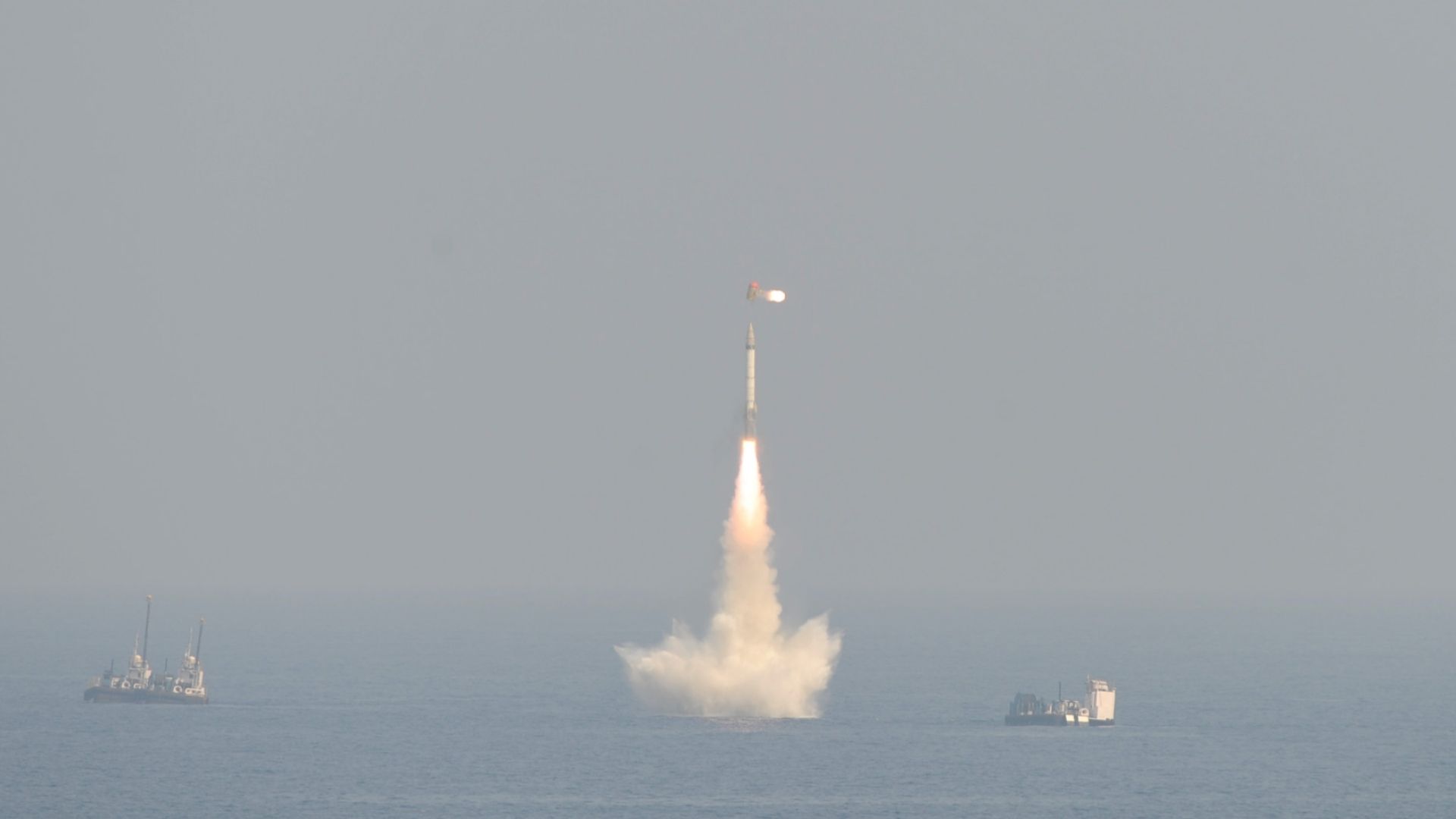
India’s Defence Research and Development Organisation (DRDO) has completed three back-to-back flight tests of its Phase 2 Ballistic Missile Defence (BMD) system, marking a major step in the country’s effort to build a credible multi-layered missile shield.

The trials were carried out on June 10 and 11 and saw interceptors destroy targets in both the endo-atmospheric and exo-atmospheric regions.

In simpler terms, the system demonstrated its ability to engage incoming missile threats both within Earth’s atmosphere and outside it.

The Phase 2 shield is designed to counter faster and longer-range ballistic missiles than the earlier version of the program. It is also expected to eventually scale up toward intercepting intercontinental ballistic missile threats.

“The interceptors successfully engaged their respective targets. The systems are designed and developed with the latest technologies to address the emerging missile threats,” the ministry stated.

“These tests have put the country in the elite group of nations having BMD capability to engage up to Intercontinental Ballistic Missiles.”

Designed for longer-range threats

The Phase 2 system includes two interceptors, AD-1 and AD-2, which are meant to destroy ballistic missile threats during different phases of flight. The system is network-centric, relying on launchers, long-range radars, launch control centers, and a mission control center.

While the Ministry of Defense said the system can engage threats up to the ICBM class, the latest demonstrations reportedly involved targets in the 2,000 to 5,000-kilometer range.

Missiles in this range are generally classified as intermediate-range ballistic missiles, while ICBMs are usually defined as missiles with ranges above 5,500 kilometers.

The trials still represent a significant step up from the earlier Phase 1 system, which was developed to defend against shorter-range ballistic missile threats.

Two decades in the making

India’s BMD program began in the late 1990s, after Pakistan’s 1998 nuclear tests. Its first major success came in 2006, when a Prithvi-II ballistic missile target was intercepted in an endo-atmospheric test at an altitude of around 48 kilometers.

Phase 1 of the missile shield was completed in 2019 and was designed to protect key cities such as Delhi and Mumbai.

It used the Prithvi Defense Vehicle for high-altitude interception and the Advanced Air Defense interceptor for lower-altitude engagements.

Phase 3 eyes hypersonic weapons

DRDO is already working on the next stage of the program. Phase 3 is expected to focus on more complex threats, including hypersonic glide vehicles and missiles carrying Multiple Independently Targetable Re-entry Vehicles, or MIRVs.

Hypersonic glide vehicles are especially difficult to intercept because they travel above Mach 5 and can maneuver during flight. MIRV-equipped missiles pose another challenge because a single missile can release multiple warheads aimed at different targets.

The next-generation interceptors, reportedly designated AD-AH and AD-AM, are still at an early conceptual stage, with flight testing yet to begin.

The latest BMD trials come as China continues to field advanced missile systems and Pakistan develops longer-range and MIRV-capable weapons. For New Delhi, the tests mark another step toward a more advanced defensive shield against evolving missile threats.

  •  

New Archimedes laser weapon system for low-cost drone kill trialed for Pentagon

US firm Aurelius Systems has completed live testing of its Archimedes autonomous directed-energy system for the Pentagon, demonstrating the laser weapon’s ability to counter unmanned aerial system threats in a live exercise.

The test was held at Camp Atterbury in Indiana and formed part of a broader evaluation effort involving nearly 60 platforms being assessed for their potential to improve warfighter protection, operational effectiveness, and next-generation defense capabilities.

During the exercise, Archimedes engaged more than 20 quadcopter drones and five U.S. Army-supplied unmanned aerial systems. According to the company, the event marked the first time the system was tested against military-provided targets.

Laser tested against army drones

The California-based defense firm said Archimedes successfully neutralized the simulated aerial threats during the demonstration.

The result, it said, validated the system’s readiness as a counter-drone tool at a time when small unmanned aircraft are becoming a growing concern for military bases, frontline units, and critical infrastructure.

The live test also showed the system’s ability to autonomously detect, identify, track, and defeat drone threats without relying on traditional missile-based interceptors.

“Archimedes proved that autonomous directed energy systems are ready to play a meaningful role in modern air defense operations,” said Michael LaFramboise, CEO of Aurelius Systems.

Built for Group 1 and 2 UAS

Archimedes is designed to counter Group 1 and Group 2 unmanned aerial systems.

These include smaller drones and UAS platforms weighing up to 1,320 pounds (599 kilograms), with speeds of up to 250 knots, or around 288 miles per hour (463 kilometers per hour).

The system combines high-energy laser output with advanced sensing technology, allowing it to repeatedly engage targets at ranges beyond 1,000 meters, or about 3,281 feet.

Unlike missile interceptors, which can be expensive and limited by magazine depth, directed-energy systems offer a different approach.

They use concentrated energy to disable or destroy threats and can potentially deliver multiple shots at a much lower cost per engagement.

That cost advantage is becoming increasingly important as relatively cheap drones are being used in large numbers across modern battlefields.

Low-cost air defense option

Aurelius Systems has positioned Archimedes as a compact, scalable counter-UAS system that can support force protection missions.

The company says the platform offers low size, weight, power, and cost characteristics, making it easier to deploy than larger air defense systems.

“The ability to autonomously acquire, identify, track, and defeat aerial threats in a compact, [low size, weight, power, and cost] platform at a significantly lower cost than traditional systems provides America with a powerful new option for protecting military forces,” La Framboise said.

The demonstration comes as the Pentagon continues to search for faster, cheaper, and more sustainable ways to defeat drones.

Small UAS threats can be difficult to detect and expensive to counter with conventional weapons, especially when launched in swarms or used repeatedly.

With its latest live test, Archimedes has now shown that it can operate against both commercial-style quadcopters and Army-supplied targets, giving Aurelius Systems a stronger case for the laser weapon’s role in future layered air defense.

  •  
❌