The Corps of Discovery Expedition set out in 1804, directed by President Thomas Jefferson to survey the United States’ newly acquired Louisiana Purchase. The exploration forms a core piece of early U.S. history. Picture a scene from the journey: It’s a cool morning, the silence punctuated by birdsong and the rustle of the breeze through the cottonwood trees. To one side, Commander William Clark, his rifle leaning against a plum tree and his rucksack nearby, squats over a latrine pit, unceremoniously heeding the call of nature.
The Louisiana Purchase constituted a territory of around 828,000 square miles, which the U.S. had bought from France in 1803. This was, it is worth noting, largely without the consent of the Indigenous groups who had lived there for millennia. The purpose of the expedition was threefold: to find a practical trade route westward to the Pacific coast, to explore and document the territory, and to stake a claim to the area before any other European powers butted in. Led by Meriwether Lewis and William Clark, the 40-man team, plus their guide Sacagawea, spent more than two years trekking westward.
Believe it or not, the holes that were used as toilets along the march to the Pacific have been invaluable for archaeologists and historians. This is thanks especially to a type of treatment included in the expedition’s medical kit.
How Lewis and Clark went to the bathroom
Everybody poops—it’s a universal human need. But most accounts of the Corps of Discovery’s journey leave out the details of how the Corps members dealt with bathroom business.
Each of the campsites where the expedition spent time had an accompanying latrine pit, situated well away from camp for sanitary (and privacy) reasons. The latrines would have seen a lot of use, because the Corps of Discovery’s diet wasn’t the best for gut health.
American artist Charles Marion Russell painted this piece entitled “Lewis and Clark on the Lower Columbia” in 1905. Image: Public Domain
While the expedition members relied heavily on foraged and hunted food, they also carried backup rations. These included nearly 14,000 pounds of dry goods, including flour, salt, coffee, dried pork, and lard. All told, each member of the Corps ate around nine pounds of meat per day. All of that protein without lots and lots of fiber added up to frequent constipation. The untreated water they drank from rivers and creeks they encountered probably didn’t help their circumstances. Enter…Dr. Rush’s Bilious Pills.
The mercury constipation pills known as “thunderclappers”
In 1803, as preparation for the upcoming expedition, William Clark traveled to Philadelphia for a two-week medical crash course with Dr. Benjamin Rush. Rush was a prominent physician in his day, and a Founding Father of the United States. His signature is one of the 56 on the Declaration of Independence.
Rush taught Clark some basic field skills, such as bone-setting and wound treatment. Clark left Philadelphia with new skills and a well-stocked medical kit that included 50 dozen of Doctor Rush’s Bilious Pills. These were compounded tablets about the size of a raisin, composed of powerful laxative ingredients. The pills were nicknamed “thunderclappers” because of the speed with which they took effect. The main ingredient of the thunderclappers was calomel, or mercury chloride.
Mercury, historically also called quicksilver, has been thought to have curative effects for centuries. It’s a metal that is liquid at room temperature, which seems miraculous in and of itself.
It was also a popular treatment for syphilis. This is not to say it was an effective treatment for syphilis. When it was administered for that disease, slowly in low doses, patients were more likely to die from mercury poisoning than from the STI.
This drug jar for mercury pills was made in Italy sometime between 1731 and 1770, several decades before Meriwether Lewis and William Clark set out on their historic expedition. Image: Science & Society Picture Library / Contributor / Getty Images Jaron Chubb
When taken in larger doses, though, as in the thunderclapper pills, it prompted a quick evacuation, the body’s way of ejecting poison. The men of the Lewis and Clark expedition used these pills freely as a way to compensate for their high-protein and low-fiber diet. As a result, all the latrine pits they used between the Midwest and the Pacific coast were laced with high concentrations of mercury.
Lewis and Clark pooped mercury. Today archaeologists use it to map their route.
As many an environmentalist will caution, mercury does not decompose when it’s in the ground. It stays put, and is detectable through modern soil testing techniques. The 600-plus latrines dug and used by the Corps of Discovery form a trail of their own, marked by mercury.
The expedition was a government-sanctioned military expedition, so Lewis and Clark both kept copious notes on every aspect of their travels. Historians have tried to pinpoint the locations of these camps based on the expedition journals, with minimal success.
The only campsite that archaeologists have been able to confirm so far is the Traveler’s Rest camp, just outside of Missoula, Montana. This is all thanks to the remains of Dr. Rush’s Bilious Pills, which left enough mercury in the ground to differentiate the remains of a latrine pit (or “sink” as they were called in the 1800s) from animal burrows or agricultural ditches.
Archaeology is all about reconstructing the lives of people in the past, and it’s worth remembering that this means all aspects of life. Our own bodily functions remind us that we all share complex and interwoven histories, and that even the most mundane parts of our lives can be important in the future.
In That Time When, Popular Science tells the weirdest, surprising, and little-known stories that shaped science, engineering, and innovation.
The 2025 Fat Bear Week champion is back and ready to rumble (or at least eat a lot of fish). Bear #32, better known as Chunk, returned to view this week on the explore.org live cameras stationed throughout Katmai National Park in Alaska. With the kickoff of Fat Bear Week 2026 slated for Friday, his timing couldn’t be better.
Chunk reigned supreme in 2025, racking up 96,350 votes—30,000 more than second place finisher, Bear 856. Chunk is a fan favorite for his hefty size (estimated at more than 1,200 pounds) and distinct look. In addition to his narrow-set eyes, dark brown fur, large muzzle scar, and prominent brow ridge, Chunk also has misaligned the jaw. In 2025, he emerged from slumber and made an appearance at Brooks River with a noticeably broken jaw that rangers guessed was a result of a fight with another bear.
“Chunk proved immediately adaptable,” explore.org explained. “He adjusted his behavior to avoid most direct confrontations with other large male bears. He quickly learned to eat salmon without the full use of his mandible. Additionally, his large body size still gave him easy access to many productive fishing spots. He remains one of the largest bears at Brooks River.”
Despite the potential challenges of chomping on salmon with a broken jaw, Chunk persevered. Cameras first spotted him this season all the way back in April. Bears are not seen as frequently during the spring, so the early glimpse of Chunk walking across a patch of ice was exciting. Typically, Katmai bears emerge in June when the salmon run begins at Brooks River.
Chunk, a large boar brown bear in Katmai National Park, attacks one of Grazer’s spring cubs at Brooks falls in 2024. Image: Getty Images Annalise Kaylor
Chunk wasn’t always a fan favorite though. In 2024, he lost the Fat Bear Week crown for the second year in a row to mama bear Grazer. The two bears had been involved in an incident in which two of Grazer’s 2024 cubs were attacked by Chunk after falling over a waterfall. Grazer put up a fight against Chunk to defend her cubs, but one cub died after the encounter.
Tune in Friday, September 18, for the Fat Bear Week 2026 bracket reveal to see if Chunk will have the chance to defend his title. And you can always tune in to explore.org live cameras to see what our favorite chunky bears are up to.
Photographs comparing the bears from earlier in the summer and later in the summer will be shown, so voters can get an idea of just how much weight the bears put on during their salmon fest. An adult male bear can go from roughly 700 pounds in the early summer to over 1,200 pounds by fall.
Voters are also encouraged to get familiar with each bear’s life history and the unique challenges they face to survive.
Which bears are competing this year?
The 2026 Fat Bear Week Bracket will be released on Friday, September 18.
Donations can be made to Katmai Conservancy’s Otis Fund. The Otis Fund is named after Bear #480 (Otis), who won four Fat Bear Week titles before his death around 2024. All donations made between September 22 and October 3 will be matched by explore.org.
What happened with the bears this summer?
This year’s livestream featured an example of how wild (and upsetting to humans) nature can be. On Tuesday, July 28, cameras captured a young brown bear cub being killed and eaten by an unrelated mother bear (Bear #806).
On Sunday, August 2, one of Bear #335’s (Jolly) cubs died, after following three unrelated cubs up a tree. The mother of the cubs already in the tree attacked Bear #335’s cub, who did not survive the encounter. The identity of the mother bear who killed the spring cub was not confirmed.
Following the first cub’s death, naturalist Mike Fitz and park rangers Christine Loberg and Sarah Bruce said this likely the first documented case occurring at Brooks River. While there is no one answer as to why mother bears are killing cubs, some experts suspect bear adoption, food scarcity, and fights for dominance all play a role.
Many of the world’s greatest scientific minds remain in startling disagreement with one another about the nature of reality itself. After conducting what is likely the largest survey of its kind, researchers reported that a vast majority of physicists suspect the big bang doesn’t necessarily mark the beginning of time. And as their additional responses indicate, scientists diverge even more when it comes to other hot-button cosmological topics.
In 2025, researchers put out an international open call for their Big Mysteries in Physics survey. Anyone could partake in the questionnaire, but responses from self-identifying physicists were later separated and reviewed to identify any particularly striking areas of agreement or disagreement. After reviewing answers from over 1,600 physicists, the questionnaire’s authors published their key takeaways earlier this year in Physics Magazine.
The results? Physicists are very divided on explanations for some of the universe’s fundamental operations.
The most dramatic relates to the big-bang theory (technically known as the Lambda Cold Dark Matter theory). About 68 percent of respondents said they don’t think the famous moment necessarily marks the beginning of time. Some of this has to do with how the big bang is presented in popular culture—contrary to many depictions, the theory specifically explains how the universe expanded from a single extremely hot, dense prior state of existence. This means it technically may have very little to do with the beginning of time.
The only other majority opinion pertains to the immediate moments following the big bang. Only 51 percent of physicists agreed that the immediate moments following the big bang involved an incomprehensibly fast period of expansion commonly known as inflation.
Subjects got far more contentious from there, although some of it was understandable. Given how much remains to still learn about dark matter, 17 percent of survey takers think the mysterious material is composed of an undiscovered particle or particles. Around 12 percent argued it could be explained by tweaking the theory of gravity. At best, barely 21 percent of physicists hypothesized it may be some combination of these and other answers.
Quantum physics continues the chaos. Nearly 19 percent of scientists think string theory is likely the best way to integrate gravity into quantum physics, while only 12 percent offered loop quantum gravity as an alternative. Meanwhile, 18 percent lean towards the suspicion that gravity can’t be integrated in any way.
If the survey presents one clear takeaway, it’s that these diverse theories are in no way an indictment of the present-day state of physics. These aren’t amateurs—they’re researchers who base their arguments on volumes’ worth of data, calculations, and scientific testing.
“Consensus, or its absence, tells us where the evidence feels settled and where researchers still see room for radically different ideas,” Niayesh Afshordi, a University of Waterloo physicist and study co-author, explained in a statement. “In this sense, lack of consensus can be a clue. It marks places where better data, sharper theory, or new connections between subfields may be needed”
Afshordi noted that unlike other polls, scientific reality isn’t settled by a majority vote. It’s supported by clear, demonstrable evidence.
“The interesting point is not that physicists are confused. It is that the frontier is genuinely alive,” he added.
Despite major strides in education and conservation efforts, rabies remains a serious public health issue. The Center for Disease Control (CDC) estimates around 90 percent of cases occur in wildlife, but their consequences still reverberate across ecosystems and routinely endanger humans. Combating the viral disease costs the United States over $300 million every year, but the hefty price tag is justified. Contracting one of the oldest known diseases invariably causes severe symptoms like abnormal sensations, violent movements, hydrophobia, and loss of consciousness. Rabies is fatal in virtually every documented case, and still kills around 59,000 people around the world each year.
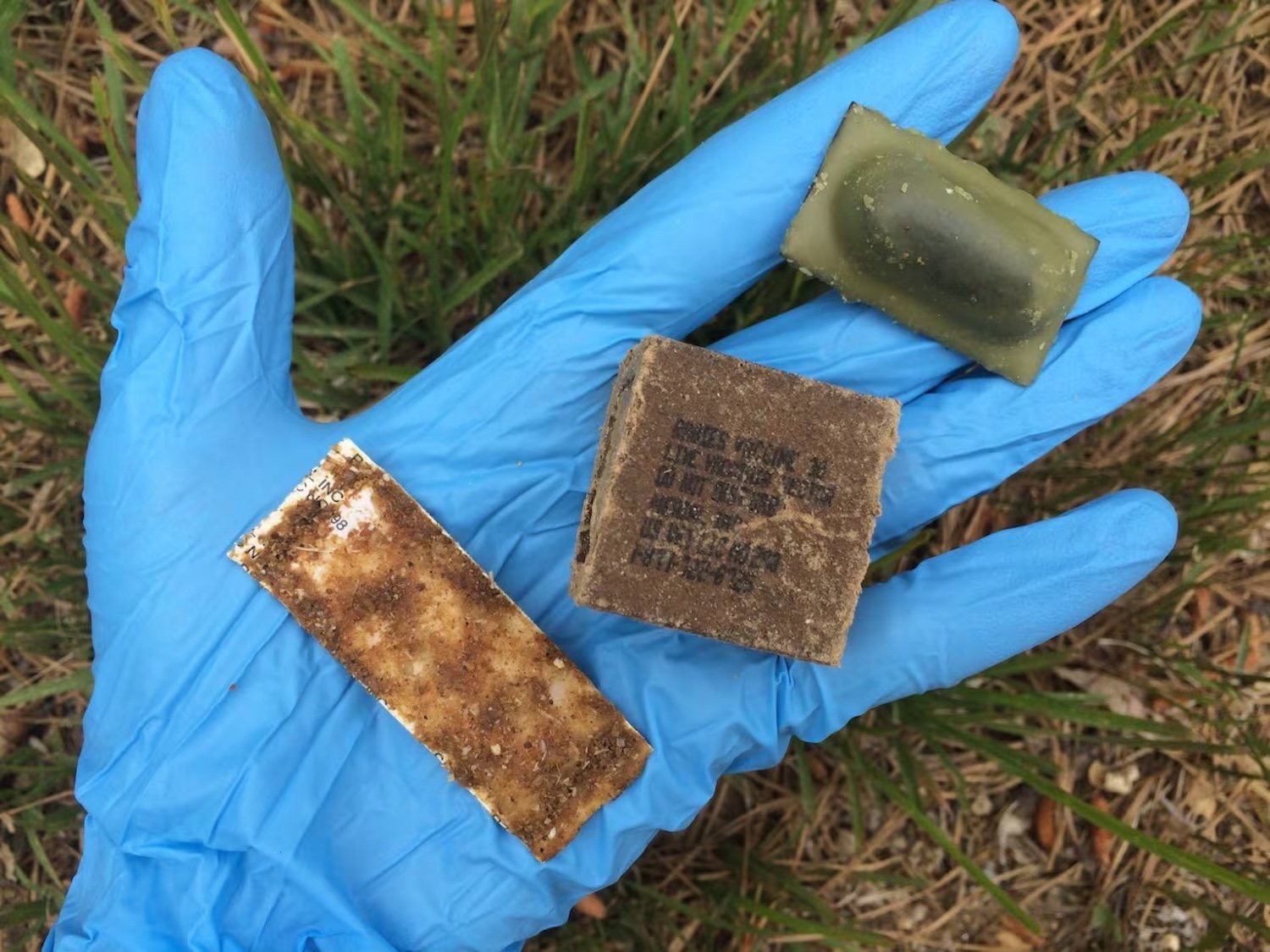
Once primarily associated with dogs, rabies has since spread to wildlife such as raccoons, skunks, bats, and foxes—making the issue much more difficult to track and control. Since 1995, the United States Department of Agriculture (USDA) has overseen a National Rabies Management Program in cooperation with state and federal departments, university researchers, and other organizations. After over 30 years of work, one of the most preferred mitigation methods is regularly placing oral rabies vaccine (ORV) bait in strategically selected wildlife areas. The easiest way to spread millions of bait blocks across thousands of square miles? Airdrops.
The bait isn’t toxic, but the USDA recommends using gloves to handle it. Credit: USDA
Next month, the USDA will once again begin tossing fishmeal-coated ORV packets from planes throughout the Southeastern states of Virginia, North Carolina, Tennessee, Georgia, and Alabama. These tiny edibles are specifically crafted to target the most prominent rabies variants seen in raccoons, coyotes, and gray foxes.
“The goal is to prevent westward spread of raccoon rabies by creating a continuous vaccine barrier that stays in front of rabies occurrence on the landscape,” a USDA spokesperson recently told FOX Carolina News. The representative added that although the distribution’s scope doesn’t currently include South Carolina, they are “very close to establishing an ORV area in South Carolina counties bordering North Carolina and Georgia in the next few years.”
If all goes as planned, the National Rabies Management Program’s geographic scope will shrink over time as the disease is regionally eliminated. Until then, anyone who accidentally comes into contact with an ORV bait brick shouldn’t worry about contracting the disease. The vaccine inside each brick is proven safe for over 60 animal species, including cats and dogs. If you happen to locate one in a residential area, the USDA recommends to either simply leave it alone, or use gloves to move it to a more remote location for its intended recipients. Always wash your hands thoroughly after handling ORV bait—and try to ignore the pungent odor of fishmeal.
It’s common to find things among the sand while strolling along a beach: shells, seaglass, bits of and seaweed. But in Essex, England, a beachgoer found something quite different on the coast of Southend-On-Sea: a World War II explosive.
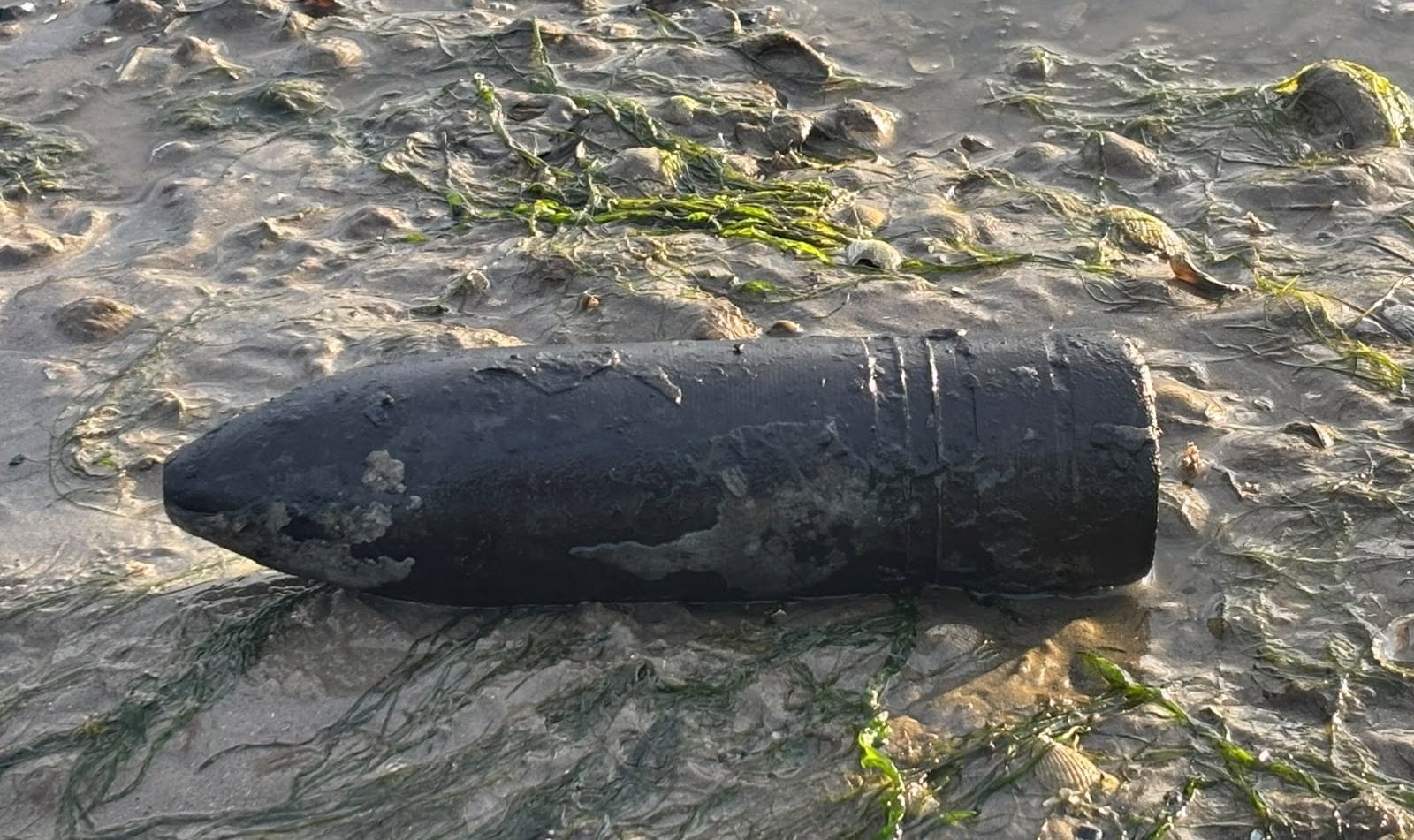
Southend-On-Sea’s HM Coastguard intervened over the weekend after someone reported a “shell-shaped object” less than half a mile south of a local monument called “The Crowstone.” The team first showed up early in the morning to locate the object and send pictures to the Army Explosive Ordnance Disposal teams.
The Explosive Ordnance Disposal teams decided that disposal officers should remain on the scene, but that everyone should go back at low tide to identify the object and execute a plan. When they returned that evening, Southend Coastguard Rescue Officers accompanied Explosive Ordnance Disposal officers to the suspected explosive.
“It was confirmed to be an old WWII shell that was approximately six inches in diameter,” HM Coastguard Southend On Sea explained in the social media post. “The decision was made to detonate it in situ, where it posed no risk to passing members of [the] public.”
The video in the Facebook post showcases a significant explosion in the distance, shooting a cloud of debris into the air. It’s not the first time this year that the violence of World War II makes itself known again. In the spring, experts safely detonated a 250 kilogram German explosive in Plymouth, UK. But possibly another World War II find in Indonesia had a drastically less fortunate outcome. A suspected shell killed five people when it detonated in a fishing village.
“As these items can be so dangerous, if you ever see something suspicious or out of place on the beach or in the sea, do not touch it, move it or take it home,” the post continued. “Let the experts decide if it is safe.”
Diplodocus is a famous genus of giant sauropod dinosaurs with small heads and long, whip-like tails that lived in the Late Jurassic period (155 to 145 million years ago). Since its discovery in 1878, all confirmed Diplodocus remains have been unearthed from the Morrison Formation fossil hotspot in the western United States. Now, however, paleontologists have identified Diplodocus remains in Spain.
The remains came to light in the El Castellar municipality of the Spanish city of Teruel, and represent the first evidence of Diplodocus beyond the borders of North America. They consist of 14 well-preserved tail vertebrae and several chevron bones (bony arches in the tail). Through traditional anatomical comparisons and advanced phylogenetic analyses, the researchers confidently categorized them as Diplodocus and a close cousin of Diplodocus hallorum.
“As we looked more closely at the anatomy, we began to identify a combination of features characteristic of Diplodocus species. Then, as we carried out different evolutionary analyses, they kept pointing in the same direction,” Sergio Sánchez Fenollosa, lead author of the Journal of Vertebrate Paleontology study and a graduate student in biodiversity and evolutionary biology at the Joint Paleontology Foundation Teruel-Dinópolis research foundation, said in a statement. “With each new result, the picture became clearer: we were looking at a Diplodocus.” Dinópolis is a huge paleontological museum and theme park in Teruel, about 200 miles east of Madrid.
This particular individual dates back to around 150 million years ago. Its place of death indicates that during the Late Jurassic, dinosaurs could migrate from between North America and Europe, probably making use of temporary land bridges that sometimes emerged in the proto-North Atlantic Ocean. During the Jurassic (201.4 to 145 million years ago), the ancient supercontinent Pangea started pulling apart into the Laurasia and Gondwana landmasses, and the Atlantic Ocean also started forming.
Diplodocus are a subgroup of sauropods, which were among the longest land animals to ever walk the Earth. The recent finding sheds light on Iberian Mesozoic (252 to 66 million years ago) ecosystems and sauropod dinosaur diversity in the European Jurassic, Fenollosa explained.
“The Diplodocus from El Castellar was approximately 25 meters long [82 feet] (comparable in size to its North American relatives), making it another of the giant sauropods of the Spanish Jurassic,” said Alberto Cobos, co-author of the study and managing director of the Joint Paleontology Foundation Teruel-Dinópolis. Its remains are now on display at the Aragones Museum of Paleontology at Dinópolis.
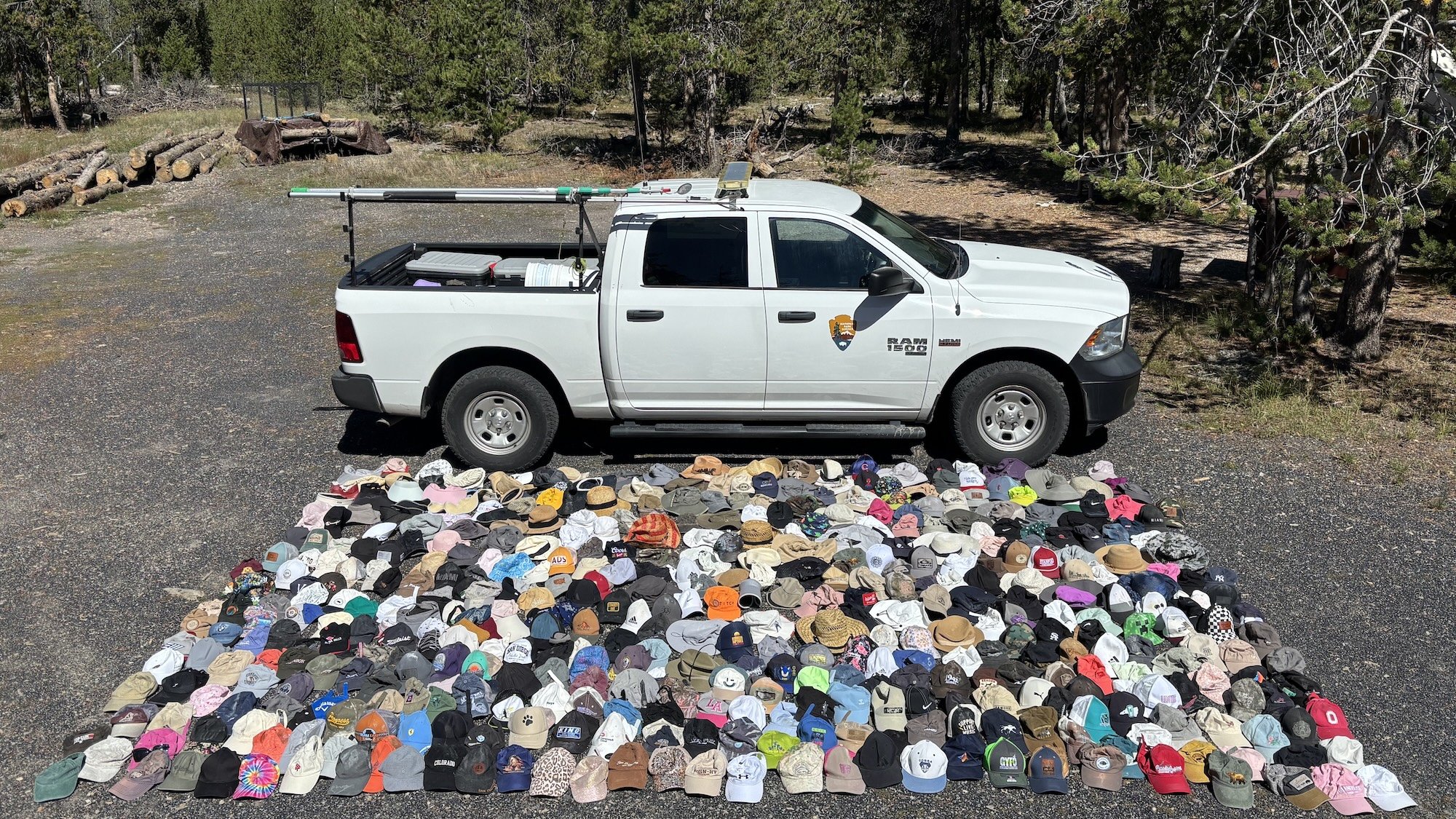
Yellowstone National Park attracts more than 4.5 million visitors from around the world every year. Many sightseers arrive well prepared to admire the hotsprings, geysers, scenic lookouts, and wildlife, but there is only so much anyone can do about life’s little unexpected accidents. Each season, Yellowstone’s gusty winds are responsible for blowing away hundreds of hats, maps, and even sunglasses from the heads and hands of onlookers. And every season, park workers scour the grounds to gather up any lost items that landed far from the walkways and trails.
While the tally so far isn’t quite as large as last year’s haul, Yellowstone officials still impressively retrieved more than 280 hats from the hydrothermal areas. Workers cited standouts including a FIFA 2026 Men’s World Cup souvenir and a baseball cap ironically emblazoned with “Cowboy Hat.” But just because they aren’t suited for floating around roiling geysers doesn’t mean they’re destined for a landfill. Once the 2026 season draws to a close, all of the collected hats will be cleaned and donated to local clothing organizations.
Yellowstone officials recommend storing items deep in your pockets and always throwing litter into trash bins. Credit: Yellowstone National Park
Caps are only one type of lost item located amid the hunts. Workers scooped up more than $18 in coins from around the world during the summer search. Canadian dollars, euros, pesos, and yen were scattered among the U.S. change, many apparently tossed into hot springs and geysers as if they were wishing wells. Yellowstone officials took the occasion to remind everyone that hydrothermal formations are not made to receive wished-upon coins. Not only will your dream remain unfulfilled—the foreign additions often introduce destructive algae and bacteria into the delicate ecosystems.
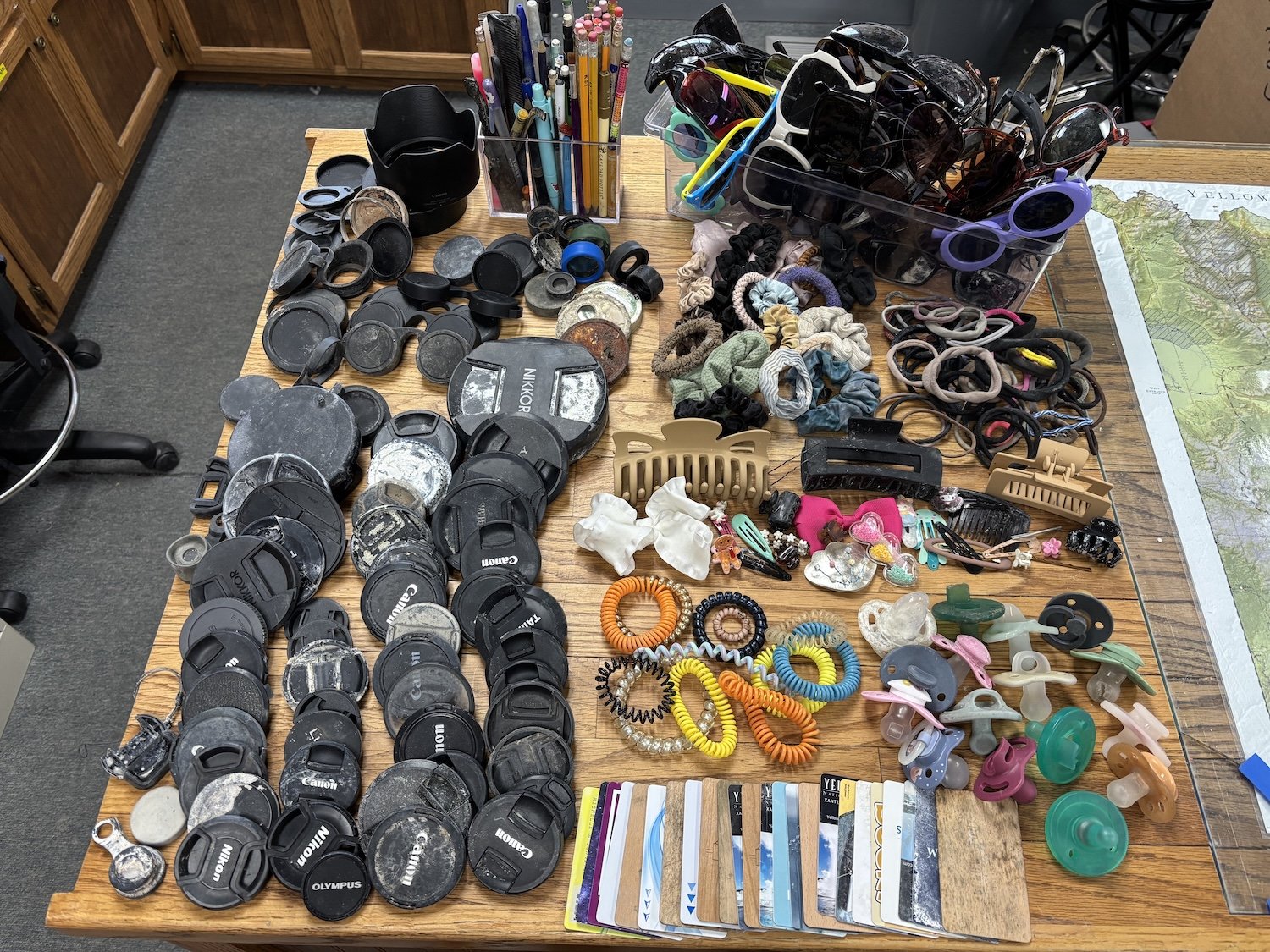
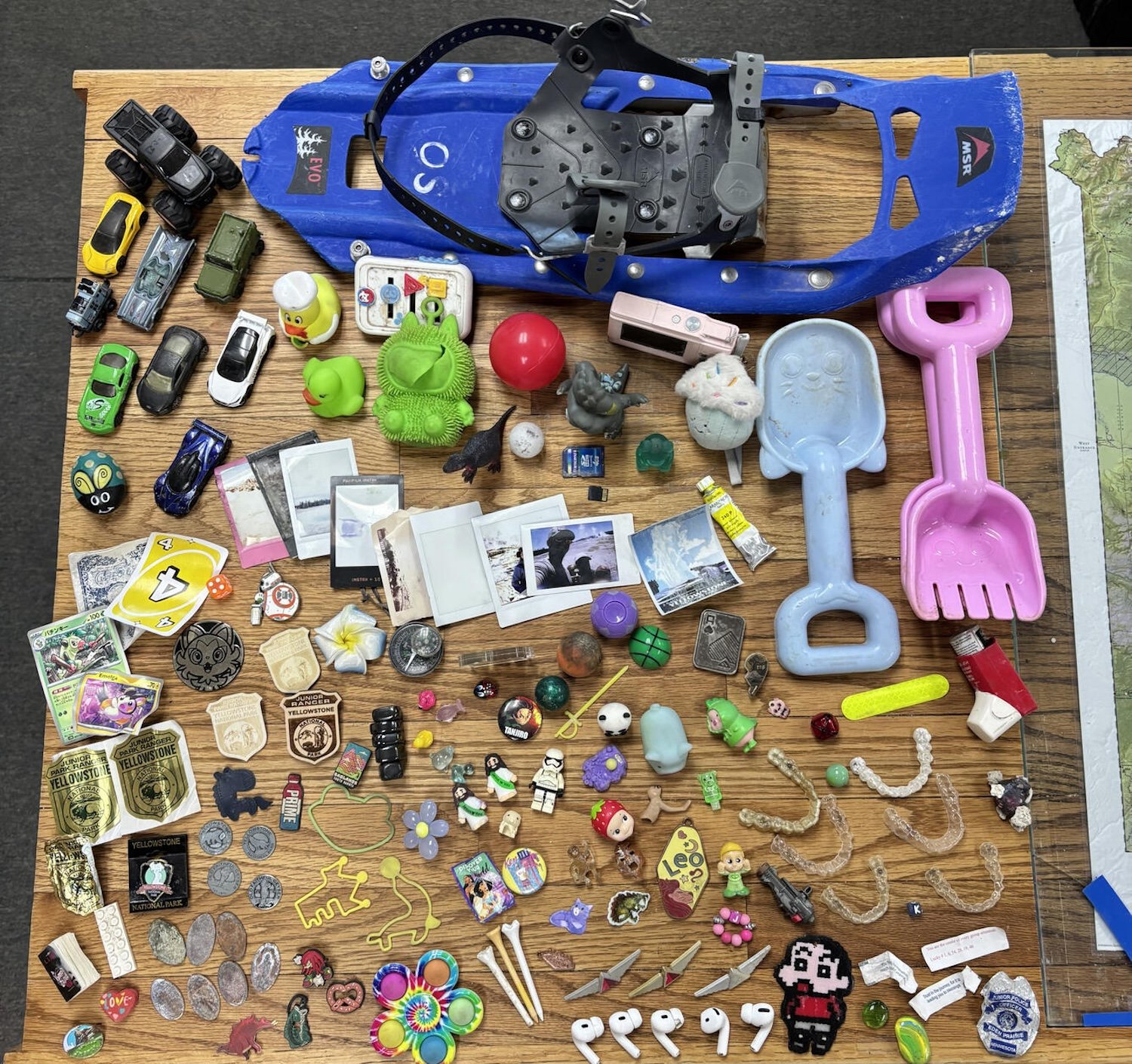
Other common detritus in the haul included plenty of paper and plastic trash, hair ties, hotel key cards, children’s toys, eyewear, and camera lens caps. Standout oddities such as AirPods, an inhaler, and even a single Uno card also made the list of finds.
A single Uno card was also among the fines. Credit: Yellowstone National Park
As always, Yellowstone workers reminded everyone that the seasonal roundup also serves as an excellent reminder to “stash your trash.” Visitors are encouraged to place any litter or lightweight items deep in their pockets or bags until they reach a trash can. And although headwear is always important protection from the sun, people may want to consider temporarily removing their hats while trekking through especially windy areas of the park.
I stepped outside this morning into the Upstate New York air and it had a distinctly fall feel. Those warm summer mornings are over and hoodie weather is finally here. Right now, Backcountry has a massive hoodie sale happening right now with hundreds of hoodies and jackets up to 40 percent off. But, not all deals are created equal. I read the size run off all 110 product pages worth checking, and 79 hoodies still have four or more sizes in stock at the sale price. Every pick below names the colorway that carries the discount, because the color on sale is frequently not the color in the photo, and where a run has a hole in it I have flagged it.
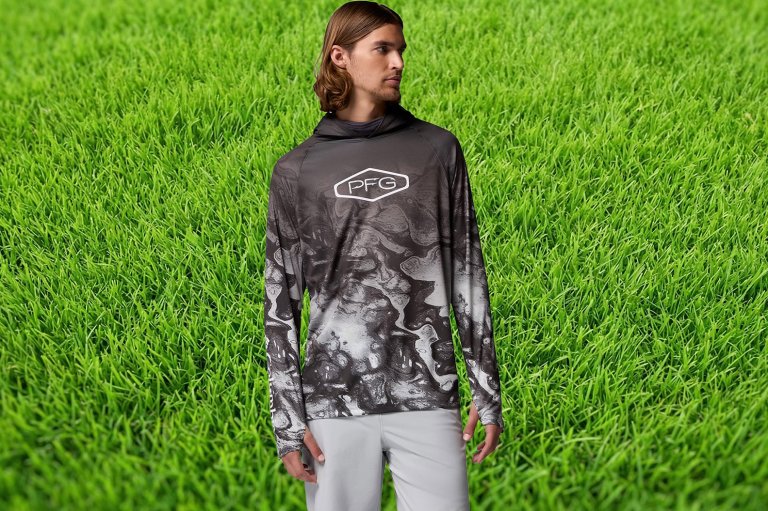
Columbia Super Terminal Tackle Vent Hoodie $31.50 (was $70)
Four colorways at $31.50 and 18 color and size combinations in stock at that price, the most of any hoodie I checked
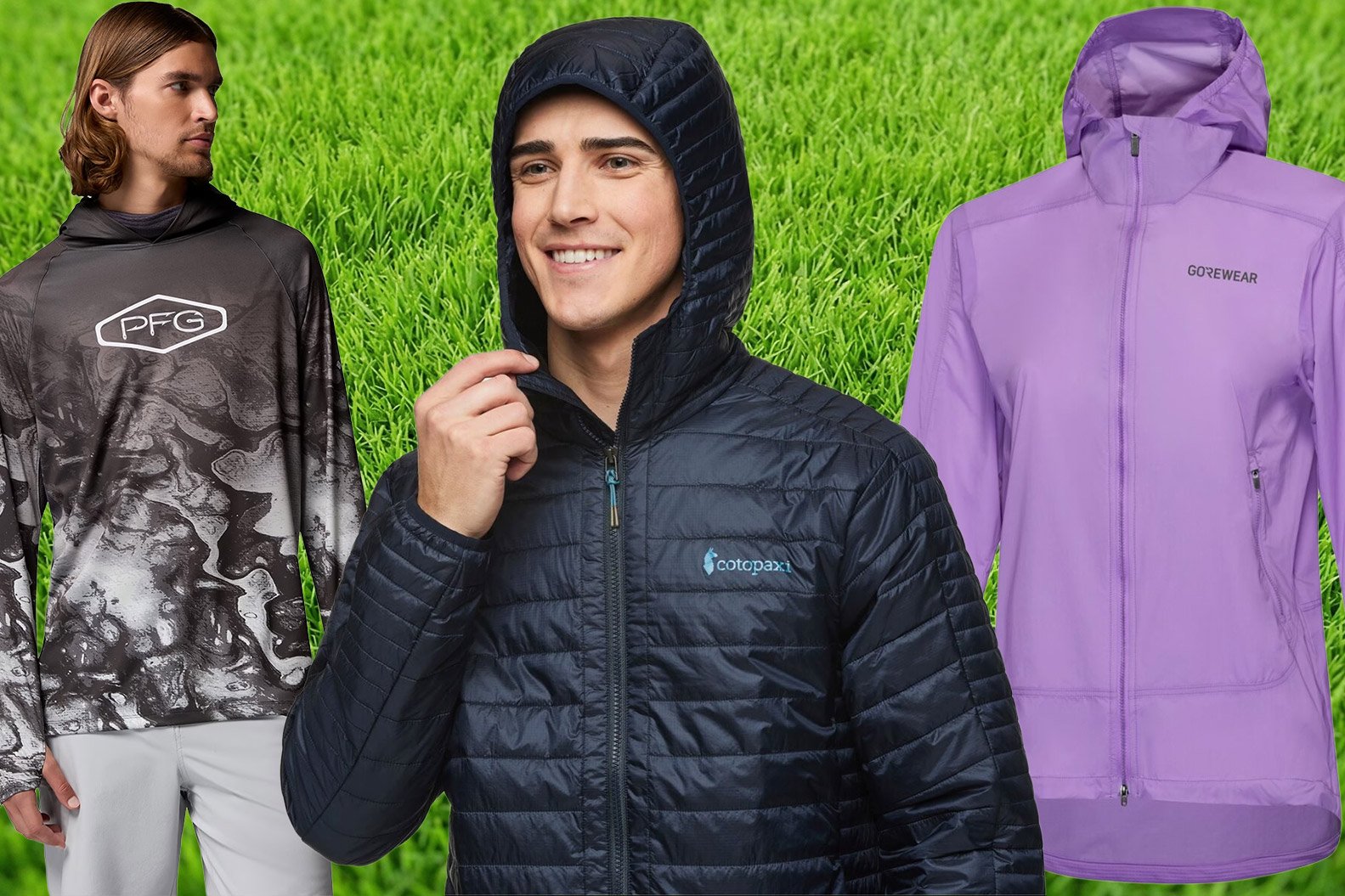
The Columbia Super Terminal Tackle Vent Hoodie at $31.50 is meant for fishing (PFG stands for Pro Fishing Gear), but it’s a great all-around outdoor garment. Four colorways sit at that same $31.50, and Dark Stone Currents Fade covers XS through XXL with three to 12 units in every size. Columbia builds it as a fishing shirt, with mesh back and side panels for ventilation, Omni-Wick fabric and UPF 50 sun protection, so it works as a hot-weather shirt now and a light layer once the mornings turn.
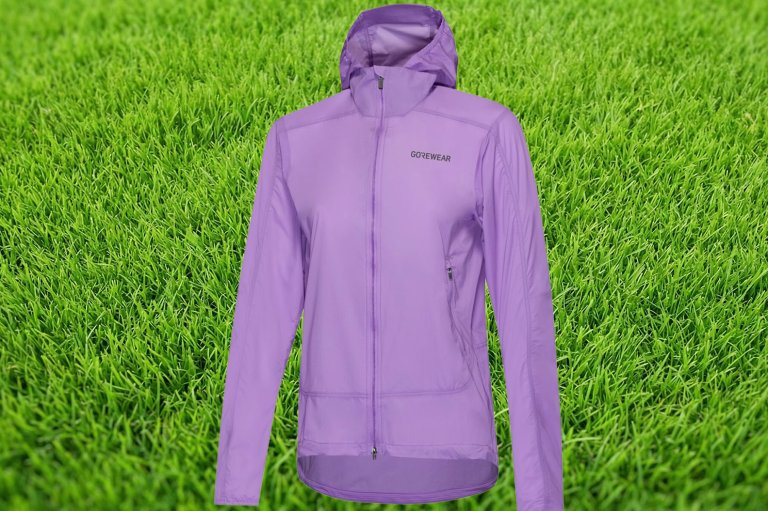
The women’s GOREWEAR Fernflow Hooded Windbreaker at $45.50 is the deepest discount in this sale with a complete size run behind it. Tech Beige runs XS through XL with 28 to 50 units in every size. GOREWEAR made it for spring and fall trail rides, so the DWR-treated recycled nylon blocks wind and light rain, the hood is cut to fit under a helmet, and there are two zippered pockets plus reflective detailing. Lab Graphite and Black are $65 in the same XS through XL run if beige is not your color.
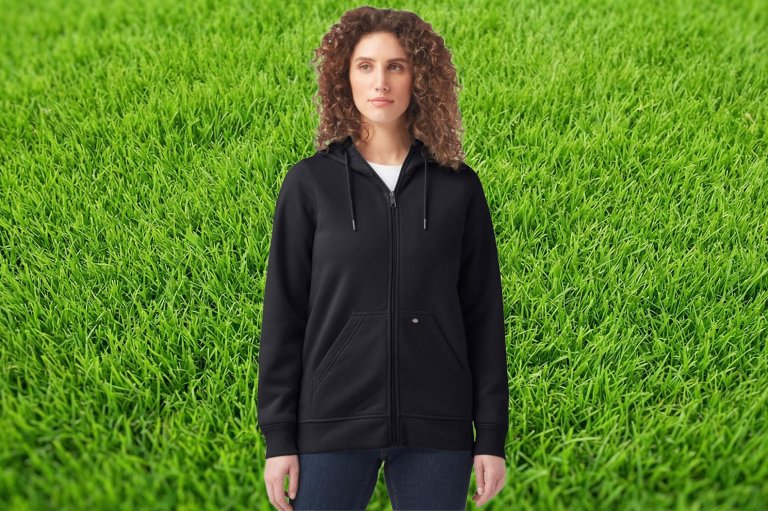
No hoodie takes a beating quite like a Dickie’s and this is the classic style. Knit Black carries S through XL with 19 to 44 units per size, and Heather Gray is the same $22 with a lighter run. It’s a midweight cotton-blend fleece with a DWR finish, ribbed cuffs and hem, and a kangaroo pocket with a phone pocket hidden inside it. Sizing stops at XL in both colors.
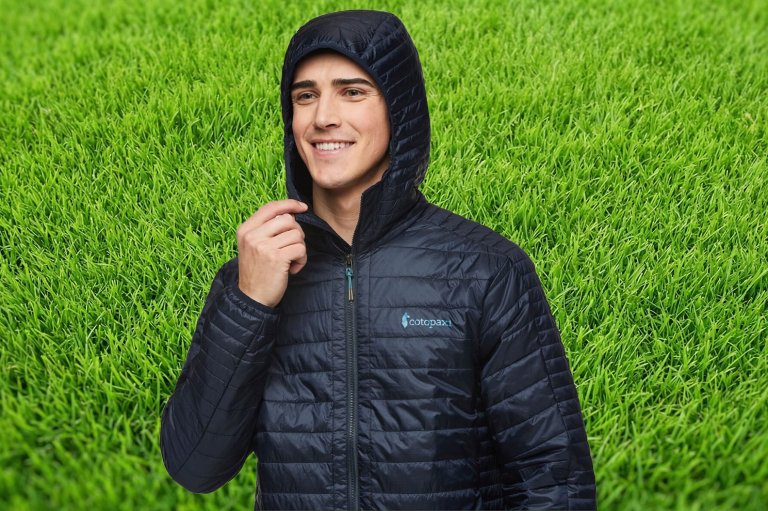
The men’s Cotopaxi Capa Insulated Hooded Jacket at $112.50 is the one puffy worth interrupting a hoodie list for. Dune is the colorway to click, with S through XXL in stock and nine to 20 units per size. Charcoal shows the same 45 percent tier at $137.50 but is down to one unit each in S and M. The Capa uses PrimaLoft Gold, which keeps insulating when it gets wet, under a recycled 100 percent nylon shell with a DWR coating and a scuba-style hood. That combination handles a damp 40-degree morning better than down at this price does.
Best hoodie deals for men under $50
The Columbia Terminal Tackle Pullover Hoodie at $22.50 is the cheapest men’s hoodie in this sale, and the catch is that L is gone, leaving S, M, XL and XXL at that price. The Columbia Wild Cast Sun Hoodie at $35 has a cleaner spread, with S through XXL in Bright Nectar and three more colorways in the $38.50 to $42 range. The GOREWEAR Everyday Tech Hoodie at $37.50 is the odd one here, since GOREWEAR labels its sizes in US and EU together, so the US medium reads as “US M/EU L” on the page.
The Dickies Heavyweight Logo Sleeve Pullover at $17.50 is the lowest price on any adult hoodie in the sale, with XS through M well stocked in Orange Glow and Coronet Blue, though L is down to a single unit. The North Face Evolution Sketch Logo Half Dome Graphic Hoodie at $29.25 is the pick if you want a name on the chest, with S through XL in White Dune and eight to 25 units per size. The North Face Chabot Hoodie at $48 has the widest run in this section, XS through XXL in the Space colorway.
The Outdoor Research Polartec 200 Hoodie at $69.47 is the standout, a Polartec 200 fleece with 15 to 49 units per size in Dark Navy Heather, while the other two colorways sit at 35 percent off. The North Face Terra Peak Hoodie at $120 is half off a $240 fleece with S through XXL in Smoked Pearl. The two Patagonia Uprisal hoodies, 95 Oval Logo and Trailcheck, are both $57 and run two to eight units per size, so they won’t last.
Only two kids’ hoodies cleared the size check, and both are North Face. The Evolution Box NSE Pullover Graphic Hoodie at $16.44 is 63 percent off, with M, L and XL well stocked in White Dune and S down to three units. The Canyonlands Full-Zip Hoodie at $44 is the better buy if you want it to last more than one growth spurt, since TNF Dark Grey Heather covers XS through XXL with six to 14 units in each size.
A centuries’ old “witness tree” that survived not only the Revolutionary War but a direct hit from lightning is facing yet another existential threat. Ironically, the famous oak in Eutaw Springs, South Carolina, is struggling to survive due to the strategies conservationists first used when attempting to preserve it decades ago.
The nearly 300-year-old tree was already nearing its semicentennial on September 8, 1781, when around 2,000 British and 2,500 American troops met at the Battle of Eutaw Springs. Believed to be the American Revolution’s last open-field engagement, the vicious combat was later remembered by colonial Maj. Gen. Nathanael Greene as “by far, the hottest action I ever saw, and the most bloody for the numbers engaged.” Records indicate 1,461 troops were killed, wounded, captured, or missing by the end of the conflict—although both sides claimed victory.
“That tree probably took a few lead balls itself,” arborist Aron Landsaw recently said in an Associated Press profile.
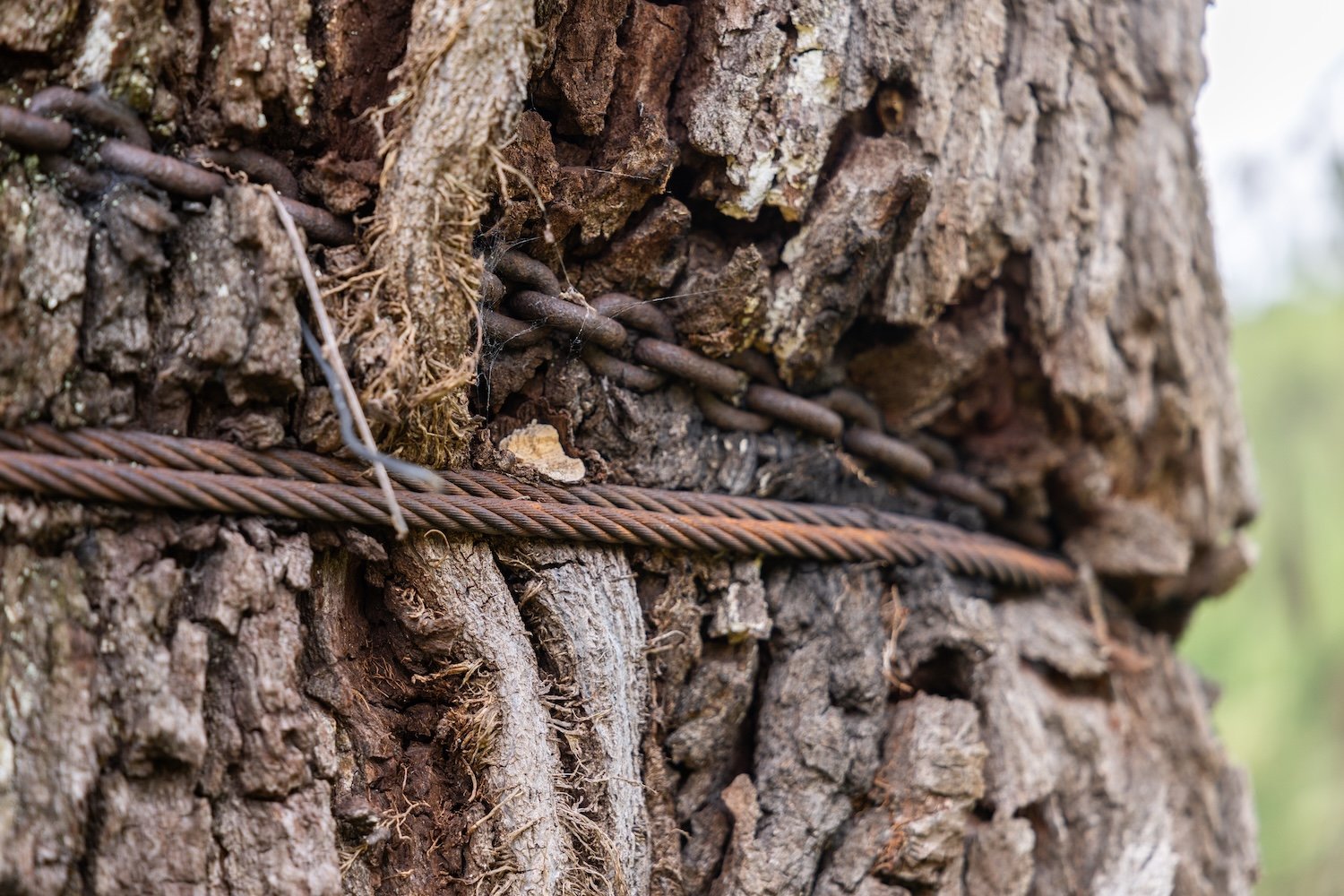
The original support chains had begun to suffocate the tree itself. Credit: SavATree KRIS MEADE
Landsaw and other conservationists are working to preserve the 45-foot-tall tree from succumbing to lingering injuries. About 50 years ago, lightning struck its base and almost split the oak in half. In an attempt to save the tree, workers at the time wrapped its splintered branches in a series of steel chains and cables. Although the strategy successfully granted the oak a reprieve, it grew so much over the last five decades that those metal lashes are cutting into the tree itself. In some areas, the cabling is now completely encased in bark.
“The chains and cables are actually choking it out. It can’t nutrients up from the soil,” explained Landsaw.
As part of the nation’s 250th anniversary, South Carolina partnered with the American Battlefield Trust and New York state-based arborists to once again bring the oak tree back from the brink of death. This time, the strategy is more high-tech than metal chains. Using specialized equipment to generate supersonic air, workers have essentially loosened all the heavily compacted earth around the tree’s roots. From there, they added a nutrient-rich kelp concoction into the dirt to further bolster the oak’s health.
The new accessories will divert any future lightning strikes away from the tree. Credit: SavATree KRIS MEADE
Other additions were tapped directly into the tree’s primary branches. These small, strategically placed lightning rods embedded into the oak are strung together with copper cables that all connect to a primary grounded copper rod located about 10 feet away from the tree. The odd-looking accessories are intended to prevent a repeat of the incident from 50 years ago.
“If lightning does hit it, it’ll run down the copper cables and dissipate into the ground,” said Landsaw.
The last phase will involve connecting a new set of reinforcement cables into the branches before carefully getting rid of the old chainwork. The replacement cables will all connect in the center so that the tree will remain flexible during wind gusts. No tree lives forever, but with the extra TLC and a little luck, the historic oak could easily bear witness to another 100 years of history.
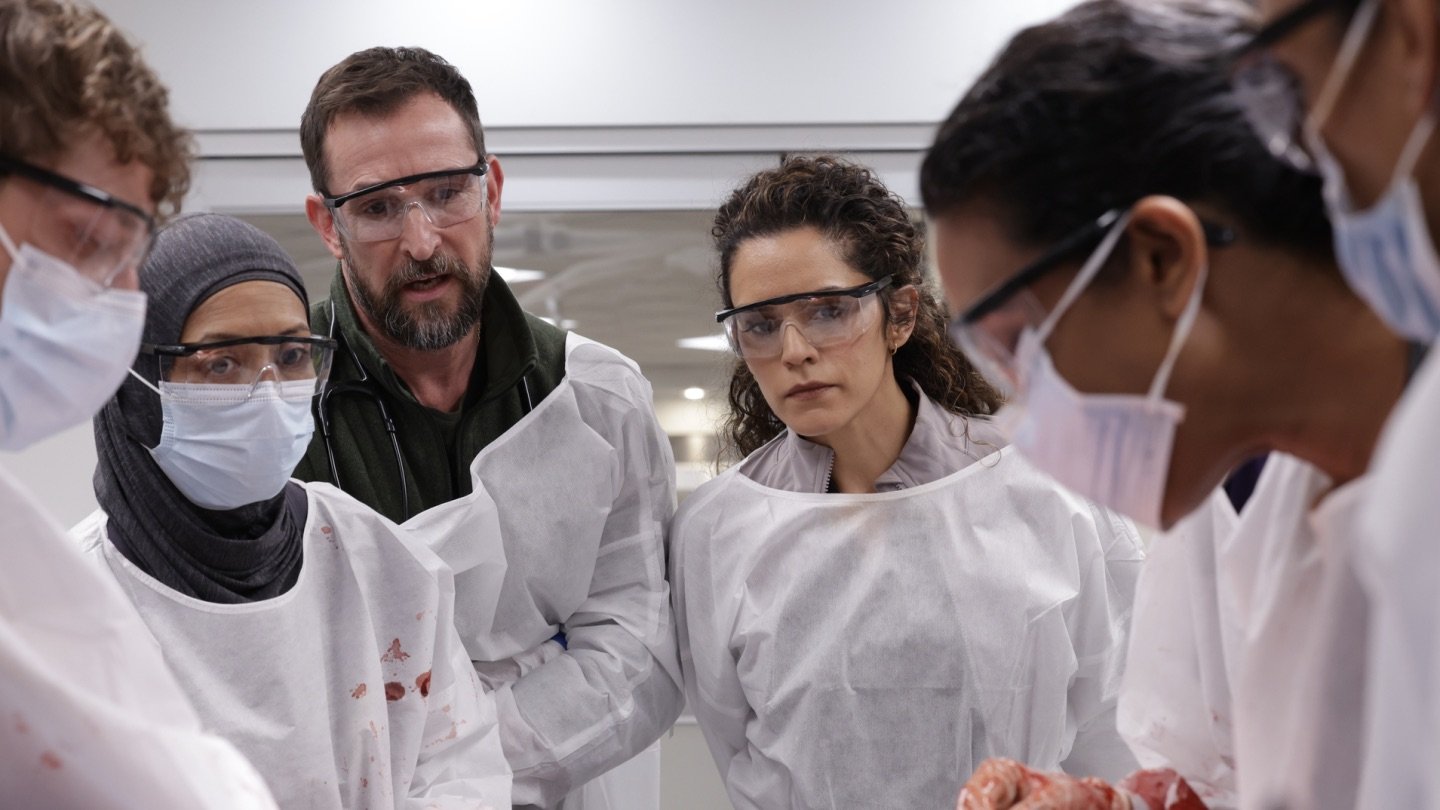
Just two seasons into its run, The Pitt has fast become one of the most celebrated television shows of the 21st century, combining the hour-to-hour intensity of 24, the procedural probity of ER, and an IV drip of Scrubs to take the edge off the constant chaos and carnage in the emergency department at the Pittsburgh Trauma Medical Center.
The series has won Emmys for Outstanding Drama, Lead Actor, and Supporting Actor and Actress, but The Pitt may be best known for its hyper-realistic portrayals of degloved flesh, dismemberment, electrocution, priapism, impalement, botched cosmetic injection, fecal disimpaction, cutaneous maggot infestation, and childbirth.
Even anatomical pros marvel at the show’s veritable snuff-film visuals.
“It’s kind of like shadowing in the ER for a day,” says Josh Johnson, Ph.D, director of the Doctor of Anatomical Sciences Program at the University of Idaho, on watching an episode. “Like, oh, my god—this is what you’re doing here? You’re literally cutting this person’s chest open and squeezing their heart for them.”
It’s a level of realism not previously seen on screen. Thanks to a unit of in-house and external effects and makeup practitioners who have advanced the craft light years with the help of new techniques and technologies that they are, in many cases, pioneering. We asked The Pitt’s pros as well as the heads of anatomy at two major medical schools to explain advances in the hospital horrors from which we are powerless to look away.
How the prosthetic sausage is made
The order of operations on The Pitt is unlike almost any other production, according to head of makeup Myriam Arougheti, who says patients are often cast before a story is even plotted.
1. The cases
It all starts with writer and executive producer Dr. Joe Sachs, who sends Arougheti all of the medical interventions that will appear in an episode so she can get them modeled.
“Depending on the procedure, it can vary between two and nine weeks to build,” Arougheti says. “This is why it’s so important for Dr. Joe to give me in advance as much as possible, because they have to cast these actors ASAP to get their body lifecast so we can start building.”
2. Casting (actor and body)
A lifecast is a three-dimensional mold of an actor’s body from which the effects houses create scrupulous, lifelike arms, legs, chests… collapsible faces—Dr. Joe hasn’t been able to stump ’em yet. Once the actor playing the patient is chosen, they’re immediately sent in for cloning.
3. Prosthetic prognosis
Meanwhile, Arougheti and her team strategize how the procedures will be recreated. Once they think they have a plan for portraying an American flag protruding from a thorax, a lung being hand-rotated in an open chest cavity, or something as simple as a severed trachea getting mended, they place their orders with one of several special effects houses.
4. Sculpting
Taking the scalpel from here, the craftsfolk at studios like LA’s Autonomous F/X hammer out the methods and materials that will make the most convincing organs, appendages, and anatomical functions.
“It’s a whole new trick you have to figure out that you’re like, ‘What we did last time isn’t going to work this time,’” says Autonomous F/X CEO Jason Collins, who has worked previously on medical dramas like House, M.D., Resident, and Grey’s Anatomy. “So we have to reinvent the wheel each time.”
5. Follow-up
Even with a vigorous ongoing back-and-forth between the teams, it would be expecting a lot to get the wheel right on the first try. So, once the builds are complete, Arougheti presents them to Dr. Joe for final approval in the rare case that something’s amiss.
“We’re in prep and I misunderstood one little element that the doctor told me,” Arougheti says of one such review. “And the way the sculpture was built, he was like, ‘Yeah, if the bone is like that, the patient’s dead,’ That’s why there’s constant communication between the effects houses, myself, and Dr. Joe.”
Dr. Joe Sachs on the importance of prosthetic bodies on TV.
The 5 active ingredients that make The Pitt so (too?!) realistic
For decades, wound simulation—or moulage—relied on heavy layers of spirit gum, cotton, collodion, and rigid modeling waxes. Much later came foam latex, but it all melted easily under hot studio lights and was shot for standard definition TVs that wouldn’t meet “standard” today.
But what modern technology disrupts, modern technology can un-rupt, so when high-definition imaging exposed the limitations of pre-millennial moulage, new practices and materials—some developed for entertainment, others for education—emerged to close the realism gap.
“We look at things more like magic tricks than as technological advances,” Collins says. “You’ve got your science and you’ve got your art [that] you have to combine together to fool the eye. Once we lose the art to the technology, I don’t know if we’re storytelling anymore.”
Silicone’s supremacy
It wasn’t that long ago that moulage meant raiding the produce aisle, at least academically.
“When I was a kid, we learned in diabetes class how to give insulin injections by doing it into the skin of an orange, because that approximately was the feeling of human skin,” says James Lipshaw, assistant director, instructional design and media center for medical simulation at Harvard Medical School. “That was simulation in 1996.”
Today, silicone lies, plies, stretches, and jiggles like real flesh thanks to breakthroughs in just the last few years:
In the late aughts, chemists began mixing in plasticizers, or “deadeners,” oily liquids that weaken silicone’s elasticity. This made it less rubbery and bouncy, allowing for more accurate emulation of loose skin.
Around a decade ago, fabricators began layering that deadened silicone on materials like liquidized PVC and paraffin to match composite human structures of skin over fat over muscle. Everything on the bone now looked and behaved more true to life.
In just the last couple of years, researchers refined manufacturing techniques that engrave microscopic lines onto silicone to mimic collagen geometry, enhancing the texture and directional stretching of sim skin.
The result is “flesh” that gapes, lacerates, stitches, and amputates just like the real thing.
Fake blood mats are more realistic and less messy than regular fake blood.
3D scanning & printing
Historically, artists sculpted prosthetics entirely by hand using oil-based clay. It was time consuming, one-of-one, and while convincing for its time, imprecise.
3D scanning and digital sculpting software in the last decade has revolutionized this workflow, allowing artists to accurately reproduce anatomy, tweak with impunity, and print multiple molds from digital files all in a fraction of the time.
“Looking at how things have changed since the days of House M.D., where all of those things were a guess on our part,” Collins posits, “let’s say it’s a gasket in a heart. Now we can 3D-print that, know that it’s going to fit exactly into our heart, and it’s 99.9% accurate to what would be produced in the real world… That technology is within the last five years.”
The lifecast they take of each “patient” immediately after they’re chosen for the role is the same process writ human. They’ll scan the actor, print an anatomical clone, and then sculpt on that to create custom appliances like a hematoma or heart nail.
Drone technology
Drones aren’t just for imperiling commercial aircraft anymore. Adopting technology that powered the boom in whirring quadcopters the last decade, special effects pros have developed tiny, unobtrusive animatronics to mimic complex phenomena like aliens, dinosaurs, and… childbirth.
“We can now pack a lot into one or two remote controls and actually be pushing the baby out via mechanics behind the monitor or three doors down,” Collins says. “And I don’t believe the drone technology really got going until about 10 years ago. It used to be big controls that people would be flying remote control helicopters or airplanes, now it’s all condensed down essentially to the size of an iPhone.”
Don’t tell Harvard’s Lipshaw.
“Back in the old days when we ran a clinical labor and delivery course, I used to be the person who had to lube up and then reload our rocket spring–propelled baby that would come out of the delivery model,” he recalls. “You have to grease it back up, put it back in its blood sac, and get it back inside of the mannequin.”
The relatively recent crossover between aerospace robotics (UAVs) and animatronics allows SFX operators to maintain a lag-free wireless connection without interrupting the actors or cluttering the set with spring-loaded babies.
A house of MDs
The Pitt’s secret sauce is a cadre of clinicians versed in trauma care who approve every procedure, implement, and anatomical outcome before cameras roll.
“They’re assigned a certain amount of episodes, so anytime we do anything—any cut, any bruise, any stitching—they are there at all times,” Arougheti says. They’re unyielding, but rather than feeling burdened by that exactitude, the crew feel a collective commitment to authenticity.
“[The consultants] really are the mothers and fathers of that authenticity,” Collins says. “With The Pitt, it’s not like they’re going to slather a bunch of blood on it and say, ‘Bob’s your uncle.’ It’s going to be very, very down to a science.”
Time & money
Warner Bros. Discovery shareholder value be damned, Arougheti and her team get what they need when they need it from their HBO Max benefactors. That includes the budget and sometimes the months necessary to perfect a sculpt or build.
“They really give us what we need as far as time and budget. Things are not rushed,” says Arougheti, who is Emmy-nominated for the second year in a row, and previously won for HBO’s Westworld. “It all starts in the sculpture and in the amount of detail—skin lines, pores, all that happens in the sculpture. And so when you have the time to do that, you can really create something magical.”
The most impressive science fiction stories emphasize “science” over spectacle. The Star Trek franchise has featured plenty of examples since the original series premiered 60 years ago this month, but one of its most famous sci-fi moments may prove even more fascinating than fans realized. At Brazil’s Federal University of ABC, physicist Níckolas de Aguiar Alves determined that an early episode of Star Trek: The Next Generation demonstrates an aspect to the theory of relativity even better than its creators likely anticipated.
Season One’s ninth episode, “The Battle,” introduces a bit of backstory to Jean-Luc Picard’s illustrious career in the Federation. Years before he became captain of the USS Enterprise, Picard oversaw a ship called the Stargazer when it came under fire from an unknown assailant. Picard needed to navigate closer to the mystery attacker before responding, but the Enterprise’s shields were down.
The captain then quickly improvised what later became known as the “Picard Maneuver.” He ordered his crew to rush their foe at warp speed (faster than the speed of light) then quickly halt and begin firing. Relativistic physics dictated that if Stargazer traveled faster than visible light, it would technically generate two images of the ship from their attacker’s point of view—one Stargazer at the location just prior to warp speed, then a Stargazer where it halted. The operation was risky, but it gave Picard and his crew a 50/50 chance that the enemy would continue firing on an afterimage of Stargazer.
Traveling faster than lightspeed is widely considered impossible, but the underlying principles of Picard’s Maneuver don’t only hold up to expert scrutiny—its depiction in Star Trek is hypothetically less accurate than it should be. According to de Aguiar Alves, Picard’s odds technically would be even higher in such a scenario. But while a fan of the series, the physicist wasn’t intentionally trying to stress test the episode’s logic. Instead, de Aguiar Alves was working on an actual particle physics problem that involved a slower light speed. At one point, he began sketching out the scenario to double check his work.
“And after I drew one or two diagrams, I started noticing, ‘Hey, I think I’ve thought about something like this before,’” de Aguiar Alves said in a recent interview with Ars Technica.
In actuality, Picard’s Maneuver wouldn’t result in two Stargazer ships; it would make three of them. This is because Picard’s crew didn’t travel at a constant speed during the gambit–they first sped up, then stopped closer to their opponent. That means Stargazer technically accelerated not once, but twice. This makes all the difference.
The physicist doesn’t hold it against the episode’s writers. If anything, the overall conceit is an excellent scenario to ponder while studying theoretical physics.
“The main thing they got perfectly, and I think it is a great illustration,” he said.
A brown bear cub learns a lot in its first year of life—how to fish, how to steer clear of trouble. Two curious cubs recently learned a valuable (and wet) lesson about the strength of currents.
At Alaska’s Katmai National Park and Preserve, home to Fat Bear Week, Bear #224 took her cubs on a journey near Brooks Falls. Early in summer, Brooks Falls is a hot spot for salmon munching by the park’s resident brown bears. By September, most bears move to the lower Brooks River to eat the dead and dying salmon near the river’s mouth.
As Bear #224 navigated the upper part of the falls with her two spring cubs, the young bears toddled up a rock and each hopped off. The strength of the current pulled the bears over the waterfall, despite their best efforts to paddle upstream. No other bears were present at the falls during the incident and mama bear eventually made her way down to join her cubs and move down river to calmer waters.
Brown bears are strong swimmers, moving up to 5mph in the water, according to the Alaska Wildlife Conservation Center. They use all four legs to paddle and their body fat helps provide buoyancy. They also shake like dogs to remove excess water after a swim.
Fat Bear Week kicks off September 22. Votes may be cast from noon to 9 p.m. EDT (9 a.m. to 6 p.m. PDT and 8 a.m. to 5 p.m. ADT) from September 22 and 29 at fatbearweek.org.
Driverless cars, once a distant techno-optimist’s dream, are making their way into more cities, racking up miles and attracting a loyal fan base. They’re also increasingly racking up tickets and driving in ways that would land a human driver in hot water.
During July Fourth celebrations this year, several Waymo autonomous robotaxis operating near San Francisco’s Golden Gate Bridge reportedly hit technical trouble that led to at least one vehicle driving over an exploding firework with two passengers inside. The riders (who luckily escaped harm) said they smelled smoke coming out of the vehicle and promptly bolted at the next intersection.
A couple of months earlier, a California driver claimed a pair of Waymos cut her off and blocked her from moving forward for nearly 50 minutes, causing a traffic pile-up and frantic 911 call. Halfway across the country, as many as five Waymos in Austin blocked police and emergency crews responding to an active shooting that left four people dead and a dozen injured.
“The question is not if this is going to turn into a deadly situation for someone, but when,” Austin City Council member Paige Ellis said at a meeting following that incident.
Human drivers in any of these situations would likely face a confrontation with police and the real possibility of a citation—or worse. But that calculus changes when there’s no one behind the wheel. Across the country, cities and states are still figuring out how to sanction a driverless vehicle that breaks the law, even as the well-financed companies operating them rack up thousands of dollars in parking tickets with seemingly few consequences.
To call the situation a work in progress is an understatement. Many localities that allow these vehicles on public roads still lack clear legal mechanisms for issuing moving violations. Where laws do exist, enforcement remains light-handed. Experts in autonomous vehicle (AV) policy tell Popular Science that this seemingly basic question, “what happens when a driverless car breaks the law?”, is still surprisingly complicated to answer.
“In principle, AVs are licensed drivers and someone owns and operates them,” University of Southern California Gould School of Law professor Gregory Keating tells Popular Science. “They should be treated like any other licensed driver.”
Despite spending years studying this very issue, Keating says the path forward remains hazy.
“In practice, I don’t know what’s going on,” he adds.
Driverless cars are racking up parking tickets
Cars breaking laws, whether driven by humans or algorithms, fall broadly into two categories: traffic violations and moving violations. Anyone who’s gotten a parking ticket is familiar with the former, and increasingly, so are driverless cars. In 2024, Waymo, by far the most common robotaxi operating today, accrued over 589 parking tickets in San Francisco and $65,065 in fines, according to The Washington Post. The Post reported another 75 tickets further south in Los Angeles. In Austin, where the company more recently started commercial operations, Waymo has reportedly received 20 parking-related citations as of June 23. Zoox, another robotaxi firm backed by Amazon, also received a citation for parking in a tow-away zone.
Cops issuing those tickets basically approach it the same way as they would a car with a human driver. Matthew Raifman, autonomous vehicle and traffic lead at UC Berkeley’s SafeTREC, tells Popular Science that in these cases, it’s the vehicle, not any individual behind the wheel, that’s on the hook–the same as it would be for a human-driven car. Parking tickets already work this way: If you borrow a friend’s car and get a ticket, it’s the car’s registered owner who pays, not the friend who parked it. Since an AV’s registered owner is the company that operates it, that same logic extends easily to driverless cars. A traffic cop who comes across an empty, illegally parked driverless car can simply print a ticket and place it on the windshield. At the end of the day, perhaps after picking up more passengers, the AV returns to a depot where a human employee collects the ticket and sends it up the chain for payment.
How cops are supposed to arrest a car with no driver
Ticketing driverless cars for more serious moving violations gets more complicated. Most municipalities still don’t have clear mechanisms for citing these vehicles when they block traffic, make illegal U-turns, or commit other mistakes that would normally lead to tense conversations with police. The core issue is confusion over who is held responsible when no human is actually making the mistake.
If a police officer observes an AV committing a moving violation, they generally flash their lights to signal the vehicle to pull over. Robotaxis are programmed to use their onboard sensors to detect police flashers, though some vehicles have struggled to do so in the past. If the AV pulls over, the officer must determine who the rogue car belongs to. Today, with only a handful of robotaxi firms operating, that detective work is pretty simple. But it could get much trickier in the near future as more AV companies enter the market, or if individuals begin owning and operating their own autonomous vehicles.
“Just because robotaxis are dominant right now doesn’t mean that robo taxis will dominate in the future,” University of South Carolina law professor and AV policy expert Bryant Walker Smith tells Popular Science. “We could have one company that develops the automated driving system, another company that puts it on a vehicle, another company that buys the vehicles.”
A clear example of how this confusion can play out occurred late last year in Northern California. San Bruno police, conducting a DUI operation, say they spotted a driverless Waymo make an illegal U-turn in front of them. Officers pulled the wayward Waymo over and contacted a human representative through the car’s speakers to report a “glitch.” But because there was nobody behind the wheel, no ticket or citation was issued the way it would have been if a human driver were involved.
“Since there was no human driver, a ticket couldn’t be issued (our citation books don’t have a box for ‘robot’),” a San Bruno Police Department Facebook post explained following the incident reads.
“That’s right… no driver, no hands, no clue.”
“I’ve been in a Waymo but, being a mere passenger, I’ve never poked around in the glove compartment to see if they carry their ‘papers’ around approximately the way that human beings do,” Keating says.
Worries about AVs breaking the law aren’t hypothetical. A recent CNN analysis of federal government records and social media footage found hundreds of driverless cars running red lights, driving into oncoming traffic, ignoring emergency road closures, and executing other potentially dangerous maneuvers. Around that same time, Waymo temporarily pulled its vehicles from highways following reports from the National Highway Traffic Safety Administration (NHTSA) of at least 13 instances where they drove into active construction zones. The company has since started resuming highway routes.
Waymo and independent supporters of AV rollouts generally have repeatedly claimed that, even when taking these issues into account, autonomous systems get into fewer crashes and drive safer than humans. Recent research lends credence to that argument in certain cases, but AVs are still limited in where and how they can operate.
“No technology is perfect, but while human drivers can only learn from their individual experiences, Waymo takes community feedback and applies those safety learnings to our entire fleet,” a Waymo spokesperson told CNN in June.
A new type of ‘ticket’ for autonomous vehicles
Regulators hope some creative new legislation can help clear up the confusion. California enacted a law allowing police to issue a “notice of noncompliance” to AVs. The whole point of these notices, and why they mark an important step forward, is to create an official record for when an AV makes a mistake, Raifman notes. Those notices are then updated in the California DMV’s system within 72 hours. Prior to this, police didn’t have a clear way to document when an AV violated the law, creating a gap that contributed to uncertainty about how well the technology works in the real world.
Still, actually punishing human drivers and AVs isn’t a one-to-one comparison. When humans make mistakes, they receive points on their driver’s license. Rack up enough points, and a driver risks losing their license altogether. As Raifman points out, notices of noncompliance attempt to apply a similar deterrent for AV companies. The notices are recorded, added up, and factored into whether state regulators continue granting those companies permits to operate autonomously. Too many violations, especially those causing major traffic issues or injuries, could lead to a company’s permit being revoked. But unlike humans, AV makers don’t have to worry about individual monetary fines for these moving violations.
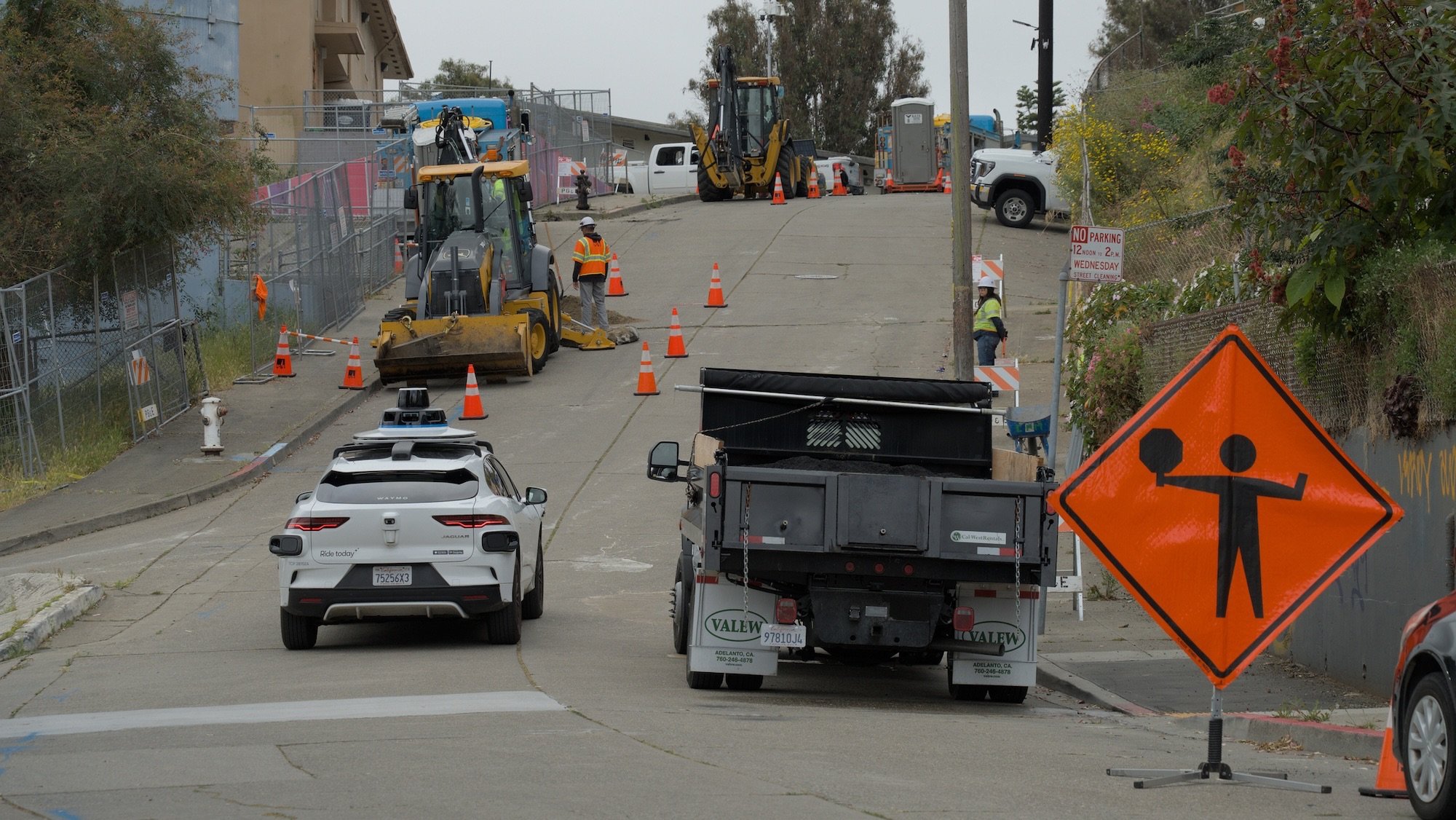
An autonomous Waymo car drives into the blocked off Potrero Annex construction site while a construction worker watches. Image: Getty Images Thomas Hunter II/Alamy Live News
“It’s an indirect mechanism to enforcement, but it is not enforcement through money and points,” Walker Smith said.
Raifman compares this enforcement method to how regulators manage pollution from power plants. Local governments often grant permits allowing a facility to emit certain pollutants, but only up to a specified amount. If a plant exceeds that or otherwise violates its permit, regulators can issue a notice of violation, which, depending on its severity, can lead to a permit suspension or even cause operation to shut down.
That’s a different process than the one facing an individual resident who pollutes their own backyard. In that case, they’d likely just receive a citation. In both the power plant case and now with AVs, enforcement relies on an ongoing back-and-forth between corporations and regulators, rather than a single punishment to an individual.
That may make sense on paper, but it’s also frustrating for everyday drivers, many of whom are just now seeing AVs spring up in their towns and on their roads without their input. The frustration shows up in comment sections and forums, with some describing what can seem like two separate rules or laws–one for humans and another for robots and their owners.
“They pay the fine and just keep doing what they are doing,” one Reddit post on the topic reads. “This is the corporate reality we live in, where corporations are supposedly people, but have none of the responsibilities or need to deal with things like following the law that the rest of us do.”
Raifman believes enforcement and accountability for driverless cars are broadly improving, but he also empathizes with annoyed drivers who feel the status quo is unfair. One major issue contributing to that frustration, he notes, is that the “pain” felt by a human driver and an AV company violating the same law isn’t equal. A robotaxi company accruing hundreds of thousands of dollars in parking tickets can simply shrug it off as a cost of doing business. For a human driver living on a budget, however, just a few tickets can severely impact their finances.
“I think that’s where there’s an asymmetric relationship compared to humans, and I think that’s a source of frustration,” Raifman says.
Autonomous vehicles are a physical manifestation of growing AI anxiety
That pent-up frustration stems, in part, from a familiar pattern in tech: innovations move fast, maybe breaking some things along the way, and regulators end up playing catch-up. Right now, cities with the most exposure to driverless cars (San Francisco, Los Angeles, Phoenix, and Austin) have just begun to sort out what fair and consistent enforcement looks like, even as the technology keeps expanding well ahead of it.
In just the last year, Waymo has nearly quintupled its fleet, from around 700 vehicles to nearly 4,000, according to The New York Times. Zoox and Tesla are both preparing significant robotaxi launches in multiple cities, and changes to federal rules mean many of these vehicles won’t even have visible steering wheels or pedals. Driverless 18-wheelers are already barreling across Texas highways, and the prospect of individual car owners swapping on true hand-off, eyes-off driving features in their own vehicles gets closer every day.
And even if the AV supporters are right that the technology is ultimately safer than humans, sheer scale means more and more people will end up watching these vehicles behave badly. In a climate where public trust in automation and AI broadly is souring, driverless carmakers may have more incentive than ever to keep their cars from running afoul of the law, not just to satisfy regulators, but because the cars themselves have become a material stand-in for how people feel about AI writ large.
“I think people are going to put a lot of their hopes and fears about AI generally disproportionately on automated vehicles because they’re so visceral and physical and real and obvious,” Walker Smith said.
In Ask Us Anything, Popular Science answers your most outlandish, mind-burning questions, from the everyday things you’ve always wondered to the bizarre things you never thought to ask. Have something you’ve always wanted to know? Ask us.
There’s nothing better than sinking your teeth into a sweet, creamy chocolate bar. Rats think so, too—and they may announce their chocolate-infused joy to the world at ultrasonic frequencies.
Researchers have previously linked ultrasonic rat vocalizations with different emotional and motivational states in the animals, such as in reaction to rewarding stimuli. For example, the rodents vocalize in this way when eating something sweet.
Now, a team of researchers in Japan have discovered that rats emit a particular ultrasonic vocalization while eating chocolate. Their findings are detailed in a study recently published in the journal eNeuro.
To come to this conclusion, the researchers compared ultrasonic vocalizations that rats emitted when they had access to chocolate, with those they made when they didn’t have access to the candy. The team also compared them with a chocolate-free control group of rats. Researchers then used AI to analyze the vocalizations’ acoustic features, identifying a distinct ultrasonic vocalization—officially 40 kHz inverted-U—strongly associated with chocolate snacking.
“When rats eat something delicious such as chocolate, they emit a distinct ultrasonic call that humans cannot hear,” Koshi Murata, a study co-author and researcher at the University of Fukui, said in a statement. “This call drops sharply when the brain’s opioid ‘pleasure’ system is blocked. This suggests that rats may be vocally expressing the enjoyment of eating, offering a new window into whether animals experience pleasure as we do.”
To see if this distinct vocalization was related to the tastiness of food or just eating in general, Murata and colleagues compared chocolate-eating vocalizations with the sounds the rats produced while eating regular food. And while the rats ate similar amounts of both, they emitted significantly more 40 kHz inverted-U USVs while eating chocolate.
In a separate food-choice test, the rats also demonstrated an obvious preference for chocolate: 15 out of 16 rats picked chocolate over the regular food (and can we blame them?). In two experiments, researchers also found that the vast majority of 40 kHz inverted-U USVs were emitted within one second of a feeding event.
“Our discovery suggests that animal vocalizations could serve as a real-time, non-invasive readout of internal emotional states—specifically, how much an animal is enjoying its food,” said Murata. “Such a tool would allow researchers to measure ‘pleasure’ more directly than current methods permit, and could accelerate research into the brain mechanisms that generate positive emotions.”
Understanding more about how the brain processes rewarding experiences could shed light on behaviors like overeating, as well as conditions like anhedonia, or the inability to feel pleasure and a common symptom of depression.
Whenever the time comes around to upgrade your phone, tablet, or laptop, you don’t necessarily have to go for the latest (and most expensive) model. You can take the refurbished route instead.
Refurbished tech sits somewhere between brand new and used, although the exact definition depends on where you’re buying from. Typically, these devices will have been returned after a certain period of use, though the length of that period and the extent of the use can vary from gadget to gadget.
What you always get with refurbished devices is a guarantee that they’ve been professionally inspected, cleaned up, and (where necessary) repaired. They’ll come with a warranty of sorts too, so you can be confident they’re not going to fail out of the box. They are often a year or two (at least) behind the latest gadget releases as well.
Crucially, these items will cost you significantly less than buying new, and there’s a good chance they’ll last almost as long too. At the very least, it’s worth looking around to check out current models and prices—here’s how to do it.
The best refurbished tech you can buy
Phones are pretty much the perfect gadget if you’re wanting to take the refurbished route. A constant, annual cycle of new models hitting the market means old models being sold on, and lots of different places to buy from. Any refurbished marketplace you come across will likely have a phones section. You can throw in tablets here too, which are again regularly updated and widely available.
What’s more, year-on-year phone and tablet upgrades are more iterative than they used to be. You’re not really missing out too much by having a phone design or a tablet spec that’s a year or two old—these devices are well supported with software updates for many years by Apple, Google, Samsung, and other manufacturers. That means you don’t need to worry about your refurbished bargain becoming obsolete soon after you’ve bought it.
Laptops are another product category well suited to being refurbished. There’s an even greater choice than with phones and tablets when it comes to specs, designs, and screen sizes, which means you’re likely to be able to find something that fits your requirements without too much searching.
Apple will sell you refurbished iPhones directly. Screenshot: Apple
Games consoles can be bought refurbished too. Here the refresh cycle is much slower—there were seven years between the PS4 and the PS5, and we’re still waiting for the PS6—so you’re not really buying outdated tech, just pre-owned. Older consoles often show up on refurb portals as well, if you want to do some retro gaming.
The tricks to finding a good refurbished gadget deal are all common sense: Buy from a reputable outlet (see below), look particularly closely at the details given for the item condition and the included warranty, and shop around several sites for the best deal.
Give some thought to timing as well. Phones in particular are usually released on a predictable schedule—Google, Samsung, Apple, and others all tend to launch new handsets at the same time each year. So if you’re hearing rumors about product refreshes, you might want to wait until they’ve arrived. It’s always going to have a knock-on effect on the refurbished market, and you might be able to get a later model.
Where to find the best refurbished tech
There are plenty of places to find refurbished tech online, which tells you that plenty of shoppers see the appeal—and gives you the chance to compare prices and save as much money as you can. To begin with, Apple, Google, and Samsung all have official stores for refurbished tech, with one-year warranties as standard.
If you’re looking at third-party refurbished tech stores, BackMarket has one of the widest range of gadgets. You’ll find phones, tablets, laptops, consoles, speakers, headphones, smartwatches and more here, and some significant discounts too. As well as a one-year warranty as standard, the site also has a free 30-day returns policy, in case you change your mind about what you’ve bought.
Don’t discount eBay from your searches either. Yes, there are lots of individuals selling old tech here that’s way past its best, but there are also real manufacturers and reliable third-party stores selling refurbished kit through the portal too, covering every category you can imagine—one way to get started on your refurb search is to click the Brand Outlet link at the top, though you can also run a general search.
BackMarket offers a wide range of refurbished tech. Screenshot: Backmarket
Then there’s Swappa, which is another well-respected source of refurbished gadgets. It has a mix of used and refurbished items, and a mix of individuals and professional tech sellers, so be sure to read the listings carefully to know what you’re getting. Reassuringly, all the listings are reviewed by Swappa staff, and the condition of gadgets (plus details of any warranty) have to be clearly stated.
Also worth a look is Amazon Renewed, especially if you’re already used to the Amazon shopping experience, because everything works in the same way. The condition of items and the warranties attached to them can vary, but everything comes with a 90-day guarantee window for returning items if you need to.
Ideally, it’s best to be checking multiple different sites in your search for the best refurbished tech—there isn’t the same consistency of pricing as you’ll find on something that’s brand new, so you can compare different offers against each other (just be sure to check on what else you get for the price, in terms of returns policies and extras).
Staff at St. Louis Zoo in St. Louis, Missouri recently opened up a very special delivery in the mail: an overnight shipment of 500 adult Partula snails.
Their journey began at the Detroit Zoo in Royal Oak, Michigan, and it’s not quite over yet. The small invertebrates’ final destination is Tahiti, where they will be released into the wild as part of an international effort to reestablish wild populations of Partula snails.
“The snails are sent ‘priority overnight’ via either FedEx or UPS. The snails are carefully packed using insulating materials and special ‘phase change’ packs to stabilize the temperature inside,” Mark Vassallo, Curator of Amphibians at the Detroit Zoological Society, tells Popular Science. “Currently the Detroit Zoological Society bred snails are taking a pit-stop at St. Louis Zoo where they will be fed a special diet in order to prepare them for the wild.”
Partula snails are small, tree-dwelling native to islands in French Polynesia. In Polynesian cultural heritage, each unique Partula snail shell represents an island. When humans introduced the predatory rosy wolf snail to the region to manage another invasive snail species, it wrecked Partula snail populations.
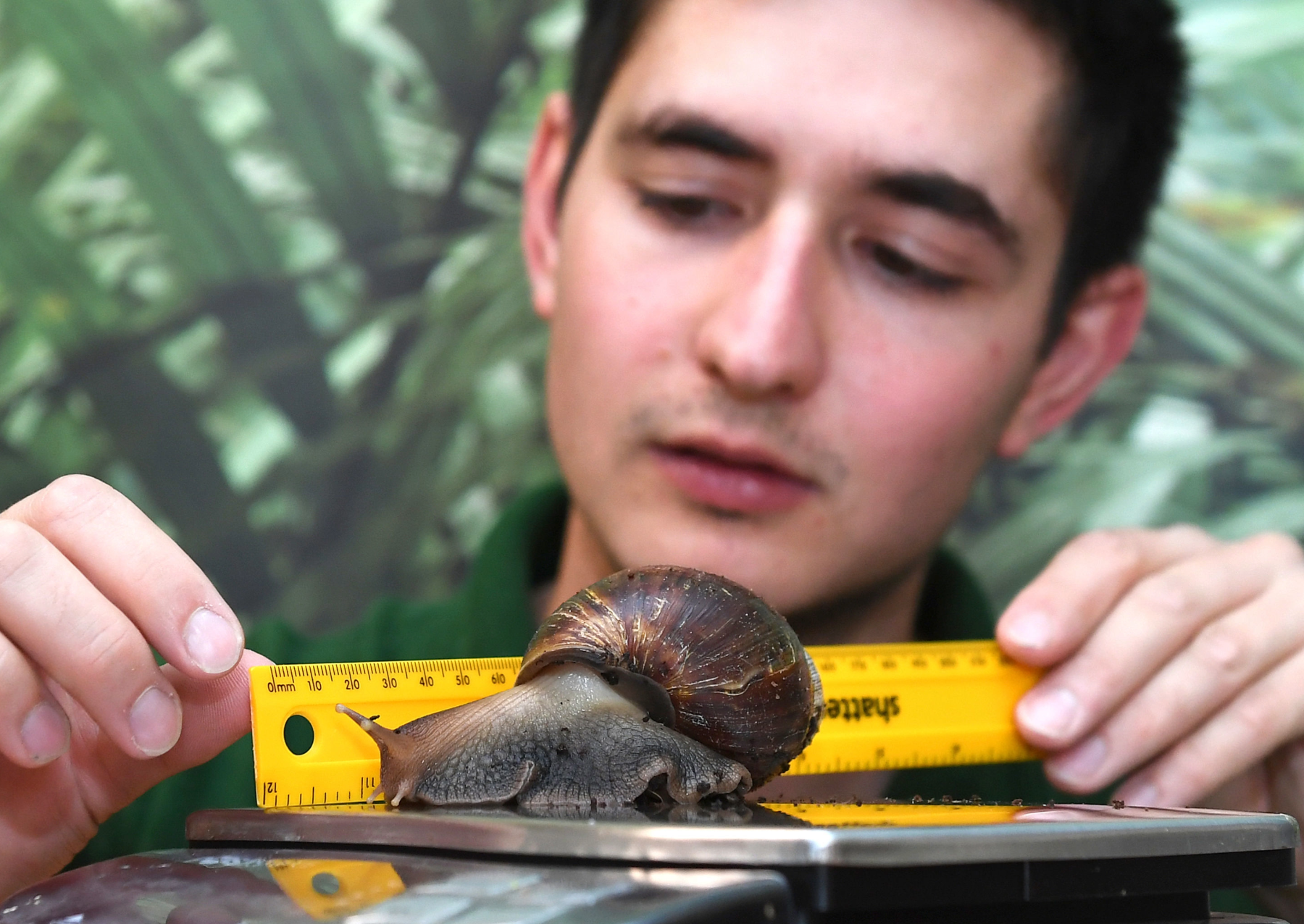
A Partula snail is weighed and measured by keeper Tom Maunders, during the annual weigh-in at Whipsnade Zoo in England. Image: Joe Giddens/PA Images via Getty Images.
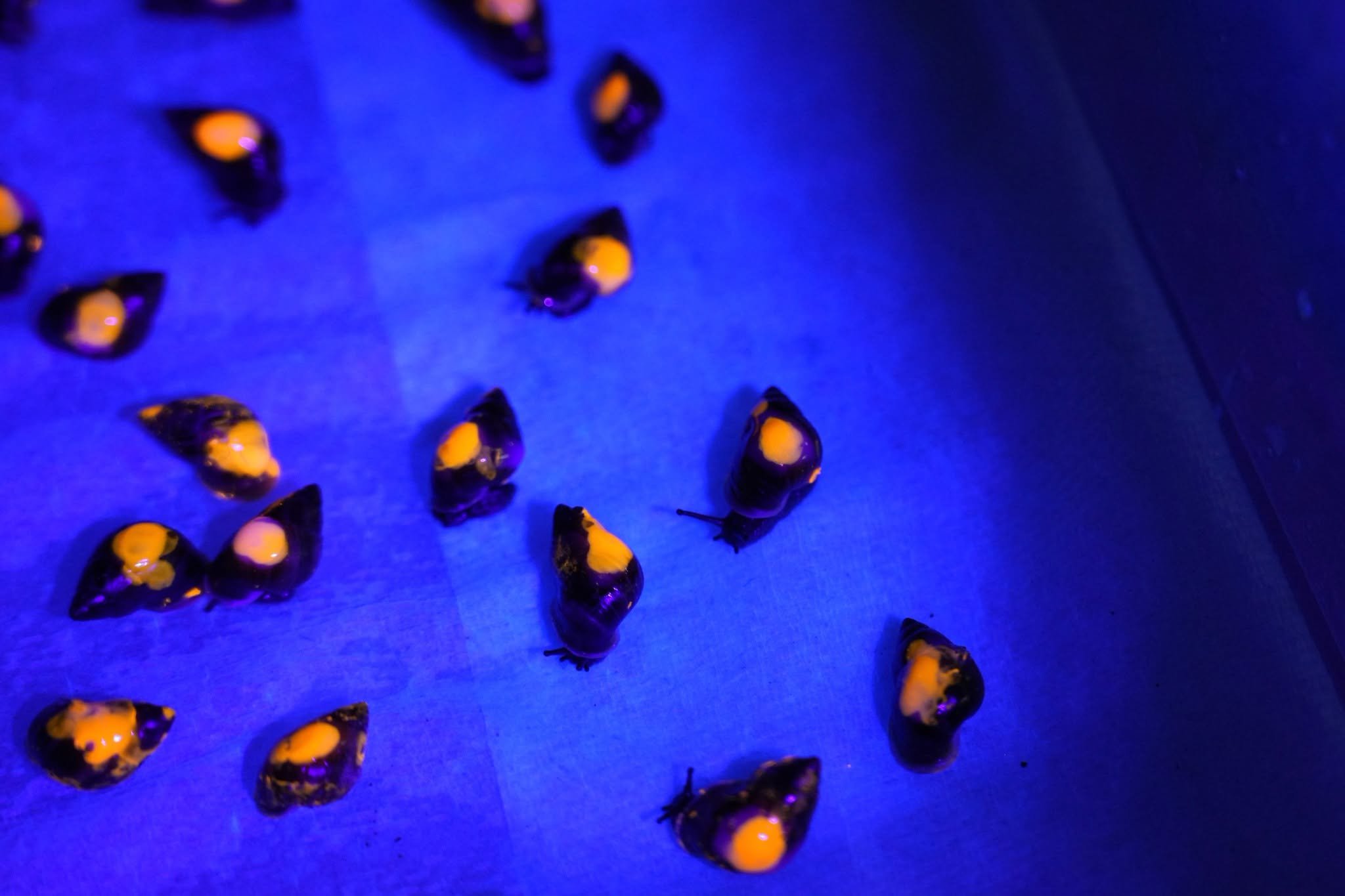
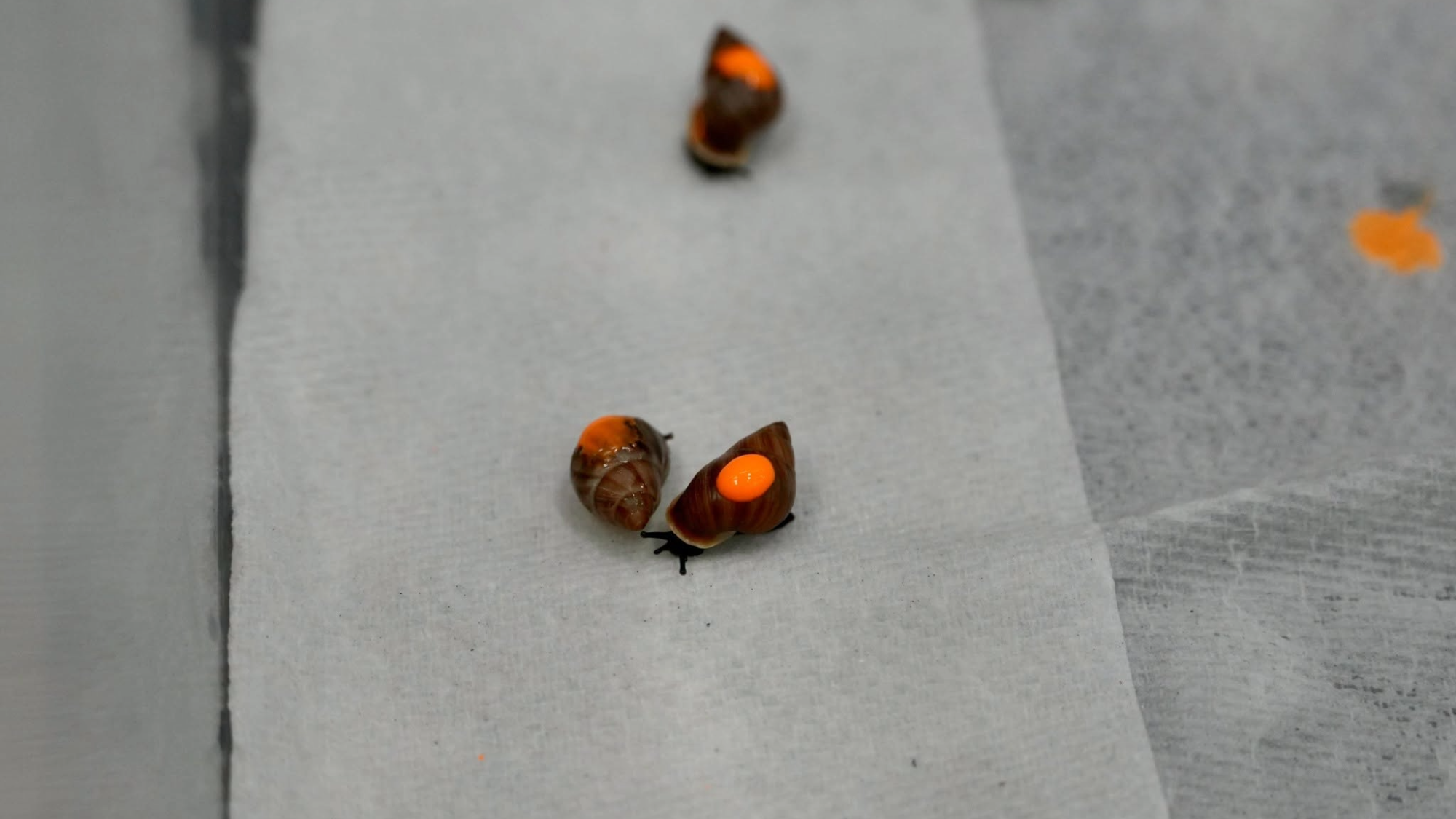
For decades, the Detroit Zoo has been breeding and raising Partulasnails and helping return them to their native habitat by the thousands in Tahiti. In fact, the 500 en route right now were all bred at the zoo. Each of their shells features an orange dot of animal-safe paint that glows in UV light, which identifies them as one of the snails released in 2026. Each year has a different color, and the dots also allow conservationists to easily monitor them in their natural habitat.
This upcoming release is part of an international recovery program that has returned 11 different Partula species formerly deemed extinct in the wild to their native environments, consisting of over 17,000 individual snails. The Audubon Nature Institute in New Orleans, Louisiana, also recently sent 200 Partula snails to Tahiti.
Orange markings on Partula nodosa snails bred at the Detroit Zoo glow under ultraviolet light. The markings will help researchers identify and monitor the 2026 release group after the snails are returned to the wild in Tahiti. Image: Detroit Zoo.
When asked what “success” looks like, Vassallo explains that, “Success for a conservation project can be defined in stages but ultimately, a self-sustaining population with consistent reproduction and very importantly, proper habitat that is protected to sustain that species to allow long term recovery and stabilization of that population.”
Some species of Partula snails are already extinct in the wild, such as Partula nodosa. In the wake of reintroductions of the species, however, experts were excited to observe offspring born in the wild.
Imagine this: You’re at the doctor’s office, and instead of one quick tap with the reflex hammer—the kind that makes your leg kick out without you meaning to—they just…keep going. Tap, tap, tap, right on that same spot below your knee, for a solid two minutes straight. It wouldn’t hurt you. But after a while, you’d probably start feeling pretty strongly about wanting it to stop—and if they didn’t, you might start wanting to kick someone on purpose.
Now imagine you’re a dog, and someone finds your “sweet spot”—that one particular patch of skin on the side or back—and won’t quit scratching it. Suddenly, your back leg is kicking without your permission, over and over, like it’s got somewhere better to be. As adorable as it looks from the outside, it’s probably not exactly a party for you.
“It’s an annoyance,” says Nancy Thomas, DVM, a veterinarian with Telavets, an online veterinary expert consultation service. “It doesn’t do any good to continue doing it. The spinal cord is trying to say ‘get off of me.’”
So what is the mechanism behind your pup’s leg acting on autopilot?
Your dog’s leg has a mind of its own
So it might look like your dog is practicing to bend it like Beckham, or maybe is angling for a spot with the Rockettes, but what is really happening is entirely out of your pet’s control. It’s something called the pruritic scratch reflex.
It’s a reflex arc, a shortcut in the nervous system that bypasses the brain altogether to allow for an instant response. When something (your hand, a flea, a burr caught in the fur) touches the skin in that spot, sensory nerves pick up on it and send a signal straight to the spinal cord. The spinal cord doesn’t pause to think it over, according to Thomas; it’s the same shortcut your body uses when you touch a hot stove, although your dog’s involuntary kicks do not involve pain.
“You touch a stove, and the signal goes from the sensory nerves up to the spinal cord, and the spinal cord immediately sends a message back to your finger to get off the stove,” Thomas says. “It’s a millisecond kind of a deal.”
When dogs twitch during pets, it’s not because they like it. Video: That’s the Spot, @TheDogRufferee
The reason dogs have the pruritic scratch reflex basically comes down to pest control: that particular area along your dog’s flank is prime real estate for fleas, ticks, mites, and burrs—the kind of small, easy-to-miss irritants that can burrow in or bite before a dog even notices. Rather than relying on conscious awareness to catch the pest, dogs’ built in a shortcut: If something touches down in that zone, the leg kicks automatically on the off chance it’s actually a threat trying to dig in.
It’s the same basic reflex that makes a horse’s skin twitch to shake off a fly, says Thomas, who also created an emergency medical ID tag for horses and their riders.
“It’s a mechanism designed to keep nefarious things off the body,” Thomas says.
It’s not the same as tickling
A very common misunderstanding around the pruritic scratch response is that it is a form of tickling, and it’s easy to see why: your dog is responding in a riotous, involuntary, and rather comical way to a physical trigger.
But as gleeful as it looks when your dog breaks into those rapid-fire leg kicks, the experience is probably neutral at best for your dog. By continuing to do it, you could be “perpetuating the annoyance,” according to Thomas. Even tickling isn’t universally and unequivocally loved.
To be clear, this doesn’t mean your dog is necessarily having a miserable time every time you find that spot. In general, the reflexive leg kick is just proof that your dog’s built-in protective wiring is working exactly the way it’s supposed to. But there’s one pattern worth keeping an eye on. If your dog reacts almost anywhere you touch them, or seems unusually sensitive even on their belly (which is normally a calmer, less reactive area due to its lack of contact with the ground), that’s worth mentioning to your vet.
“That’s a possible red flag for atopy,” Thomas says, referring to allergies or skin inflammation that leaves the whole body more sensitive. It’s similar to how a patch of poison ivy makes even light touch uncomfortable.
“That might be a bit of a sign,” Thomas says. “These dogs might be a little extra sensitive, due to a skin condition.”
To make bonding with your dog more enjoyable for both of you, Thomas advises sticking to areas not commonly associated with the pruritic scratch reflex, such as the belly. She also recommends watching your dog’s body language to ensure they’re having as much fun as you. It’s a much better way to ‘get your kicks’ without turning your dog into a full-on kickboxer.
“If you’re rubbing their belly, and they’re all spread out and relaxed-looking, that’s a sign you’re on the right track,” she says.
In Ask Us Anything, Popular Science answers your most outlandish, mind-burning questions, from the everyday things you’ve always wondered to the bizarre things you never thought to ask. Have something you’ve always wanted to know? Ask us.
Everyone complains about the weather, the old line goes, but nobody ever does anything about it. But it’s not exactly true, is it? People have always done something about the weather—mostly by trying to predict it, then arranging our lives around the forecast.
It makes sense, then, that we’ve picked up a few ideas about outside conditions that don’t quite hold up. From cold weather making you sick to red skies in the morning, here are some common beliefs about the weather that aren’t entirely true.
Cold weather doesn’t cause colds
You’ve heard someone say it, or maybe you’ve said it yourself: “Put on a jacket—you’ll catch a cold.” The problem is that cold weather doesn’t cause colds—at least, not directly.
Manal Mohammed, a Senior Lecturer in Medical Microbiology at the University of Westminster, wrote about this for The Conversation. “Cold temperatures do not cause infections by themselves,” she concludes. “Instead, they shape the biological, environmental and social conditions that allow respiratory viruses to thrive.”
For example: People spend more time inside during cold weather, which can help viruses spread. These indoor spaces tend to be heated, meaning the humidity is low, meaning nasal passages are dry. This makes it more likely that you’ll catch a virus. And, according to Johns Hopkins Medicine, the fact that school is in session during the winter is also a factor.
There are physiological factors as well, according to Mohammed. “Breathing in cold air lowers the temperature inside the nose and airways, which can trigger vasoconstriction,” she writes. She adds that this can weaken the local immune defenses in the lining of your nose and airways. But that’s not the same as a direct causal link.
So, while it’s true that you’re more likely to catch a cold or the flu during the winter, that isn’t directly caused by your failure to wear a jacket. It’s the viruses, not the temperature, that make you sick.
Lightning can strike the same place twice
“Lightning hitting the same place twice” is a cultural shorthand for something unlikely happening. But is it accurate? Kind of. It’s true that, all things being equal, it’s unlikely for lightning to strike the same place twice. But all things aren’t equal.
Lightning tends to hit the highest nearby object, which is why it’s a bad idea to go under a tree during a lightning storm. In big cities this means the largest buildings are hit frequently. New York City’s Empire State Building is hit, on average, 25 times per year, according to New York City Emergency Management. The CN Tower, north of the border in Toronto, is hit three times as often—75 times per year according to the tower’s website. This isn’t to say these buildings are unsafe—both have lightning rods, which give the current a safe path to the ground. It’s just that they’re hit multiple times a year.
Lightning over New York City. Image: Getty Images BradNYC
So lightning not only can hit the same place twice, but does so pretty often. Although, according to NOAA, it doesn’t always hit the highest point—so there’s truth to the idea that lightning is hard to predict.
Red skies really can predict the weather
You’ve heard it: “Red sky at night, sailor’s delight; red sky in the morning, sailors take warning.” The idea that the color of the sky can predict the weather is really old—it’s referred to in the Bible (Matthew 16:2-3, if you want to look it up). But is there any science behind this?
Yes, it turns out, but it doesn’t work everywhere. To understand why, we need to explain a few things. First: What causes red skies? “A red sky appears when dust and small particles are trapped in the atmosphere by high pressure,” according to the UK Met Office. “This scatters blue light leaving only red light to give the sky its notable appearance.”
A red sky means there’s high pressure between you and the direction of the sun. The sun sets in the west and rises in the east. So, a red sky at night generally means there’s high pressure to your west; a red sky in the morning means there’s high pressure to the east of you.
Red skies can predict the weather…in some places. Image: Getty Images Richard Newstead
But why does that predict the weather? Because, in the mid-latitudes, the wind generally blows from the west—this is called the prevailing westerlies. High pressure means stable, dry weather. A red sky at night means the high pressure is to your west, which the westerlies will bring to you; a red sky in the morning means the high pressure is to your east, and the wind will blow it away from you.
But, again, that only works in the mid-latitudes, where the prevailing westerlies are the norm. This region is between 30 and 60 degrees in both the southern and northern hemispheres, a region that includes most of Europe, the continental United States, southern Australia, and Japan, among other places. So, if you’re in one of those places, a red sky in the morning actually does point to a change in the weather. If you’re in the tropics, though, the weather tends to build up locally rather than arriving from somewhere upwind, meaning the colors at sunrise and sunset aren’t as useful for predicting it.
So this isn’t entirely a myth—there’s truth to the saying. It just doesn’t work everywhere on Earth.
If you want to find the most innovative and coolest new tech of the moment, you shouldn’t always automatically turn to familiar names like Apple, Google, and Samsung. You’ll find a whole host of smaller companies and start-ups testing out their ideas and prototypes—and looking to raise funds for the projects at the same time—over on Kickstarter and Indiegogo.
These two sites work similarly. Creators pitch their ideas and show you how far they’ve got in terms of prototyping and development. If you’re interested, you put down some money—usually less than you’ll pay if you wait until the finished product goes on sale—and this collected cash is then used to fund production.
While there are no guarantees that these projects will actually turn into finished products, a good number of them do, and you can usually spot the ones that are less likely to succeed (as we’ll cover below). In the ideal scenario, you get yourself a new gadget you find useful, and save money at the same time by being an early backer.
Find the coolest tech being crowdfunded right now
Once you land on the Kickstarter or Indiegogo home pages, it’s not difficult to start browsing around for gadgets that might interest you: These platforms are built to make discovery as straightforward as possible, and you’ll immediately see some recommended crowdfunding projects on the front page that are proving popular with other people.
As well as highlighted listings, you get category links. These cover not just tech, but all sorts of other areas as well, including art, film, photography, education, design, journalism, travel, fashion, and community—so when you’ve exhausted all the cool hardware on these sites, there’s plenty more to look at.
If you’re looking for something specific, use the search function. Maybe you’re after a travel adaptor that doubles up as a USB hub, or a robot that can keep your pet company, or a smart suitcase designed to carry laptops, tablets, and cameras. Whatever you’re after, chances are someone is trying to get it crowdfunded on Kickstarter or Indiegogo.
You’ll find thousands of projects running at any one time. Davie Nield
Click through to any of the project listings, and you’ll get a massive amount of extra information about what’s involved. Creators know that the more detail there is, the more likely they are to attract enough funding, and you’ll typically find product photos, videos, specs, and a schedule for bringing it to market.
There should also be details about the company making the product. Often these will be smaller start-ups (or even individuals), but you do occasionally see larger tech companies take the crowdfunding route as well: The Ultrahuman Ring Pro was recently crowdfunded on Kickstarter, for example.
The all-important financial information will be included here too: How much money has been raised so far, what the target is, and the various tiers at which you can contribute. As well as getting a discount on the finished product, backing a project usually means you’ll be able to access certain rewards, such as bundled accessories or even a say in how the product is developed going forward.
What to look out for on project listings
Both Kickstarter and Indiegogo have similar rules when it comes to backing projects: If the product doesn’t actually get funded, you don’t lose anything. However, if the funding goal is reached, your money is taken—and the responsibility shifts to the project creator rather than the crowdfunding platforms. If the gadget never materializes, that’s on the creator, not Kickstarter or Indiegogo.
At that stage you may get a refund or you may not, or you may get something different for your money. With that in mind, be careful about the projects you decide to back. As per figures quoted by Kickstarter, around 1 in 10 crowdfunded projects fail completely, so the vast majority succeed—but it’s still best to be wary.
To start with, look at the people behind the project. What’s their track record with launching products? Have they dealt with hardware manufacturing before? Has the company made any devices previously? Does it have a portfolio of other products you can check out and actually buy?
Pay close attention to the listing details before pledging any money. Davie Niel
Then there’s the project itself: You should weigh up how realistic the project’s aims are, especially if nothing similar is on the market. Look for evidence of prototype gadgets that have already been tested and reviewed, as well as details on how the product will be made and how its parts will be sourced.
Rewards are something else to look at—do these seem reasonable and practical, or are the creators overreaching and promising too much? A crowdfunded project’s success isn’t solely down to the main product, since rewards that get too complicated or too costly can cause problems too.
There’s no magic formula for predicting whether a Kickstarter or Indiegogo project will be successful or not, but those pointers should give you a good idea. There’s also the question of the price contributors are being asked to pay: Don’t give more than you can afford, and if you have doubts, maybe wait until it’s actually on sale to everyone.
Wild condor parents usually make a great parenting team. But when one female California condor (Gymnogyps californianus) in Pinnacles National Park in Central California found herself in the role of a single mother, park biologists stepped in to help.
The condor mother wasn’t able to provide sufficient care and food for her chick while on her own. Field biologists realized that when hunting for food, she returned to the nest less frequently. The chick needed more nutrition to grow and develop appropriately.
“Based on her behavior, she had largely abandoned the nest, and the chick was unlikely to survive without intervention,” a spokesperson for the San Diego Zoo Wildlife Alliance tells Popular Science.
Pinnacles National Park biologists took the chick when it was around one month old and sent him to the San Diego Zoo Safari Park’s California condor breeding facility. There, he’s receiving care in a specialized puppet-rearing program.
“The puppet-rearing program is a specialized care method used to raise young California condor chicks without allowing them to see or bond with human caretakers,” says the spokesperson. “Wildlife care specialists use hand-crafted puppets that resemble adult California condors and completely cover the caretaker’s hands and arms. Caretakers use the puppet’s beak to deliver food directly to the chick, mimicking the way an adult condor parent would feed its young in the nest.”
The chick was named Cayic (pronounced Chai-eech), meaning “strong” in the Mutsun language of the Indigenous people of California’s Central Coast. Thankfully, Cayic is demonstrating normal growth and development, and experts plan on returning him to the wild next fall.California condors are still considered critically endangered, after nearly going extinct.
As for the chick’s father, he had stopped returning to the nest and eventually died while receiving treatment for suspected lead poisoning. Lead poisoning is the greatest cause of death for California condors and a severe obstacle in the species’ recovery. The species is also threatened by the consumption of microtrash.
California condors, or “thunderbirds” for Native Americans, are North America’s largest flying birds. Their wingspan is almost ten feet long, but their mighty reach didn’t keep them from reaching the brink of extinction. During the 1980s, there were fewer than two dozen of them in the wild. In 1986, the U.S. Fish and Wildlife Service put them all in a captive breeding and release program, including at the San Diego Zoo Safari Park. Six years later, the program had bred enough chicks to return the first condors to the wild.
As of the end of 2025, there are 607 California condors in the world, 392 of which are in the wild. One of them is Cayic’s mom.
“The mother may go on to pair with another male, and we hope she will have another opportunity to breed during a future breeding season,” says the spokesperson.

 Login