Since the launch of Flock Safety in 2017, the ACLU estimates the company installed some 100,000 automatic license plate readers throughout the United States. The dragnet comes with plenty of downsides to privacy and civil liberties: it’s ripe for abuse by crooked cops, powered by sweatshop labor, and nearly impossibleto escape once it designates you a target.
But police officials insist it’s worth the trade off — because at it least it helps them catch the bad guys, right? Unfortunately, the reality isn’t quite that peachy.
Atlanta, Georgia has experienced far and away the largest influx of ALRPs in the country, with over 5,000 various Flock cameras now blanketing the city. Yet as bombshell data released by the FBI shows, the city’s massive web of surveillance has had virtually zero impact on the Atlanta Police Department’s ability to solve crime, with some clearance rates for offenses like homicide even experiencing a decline over the past few years as the cameras have proliferated.
First reported by the Atlanta Community Press Collective, the FBI data is a damning refutation of Flock’s primary claim: that ALPRs are necessary to help officers keep the public safe.
According to the ACPC, the rates at which the APD resolves crimes like homicide, robbery, miscellaneous larceny, and shoplifting have actually decreased between 2021 and 2025, when the city’s ALPR build-out hit its full stride.
For homicide, the numbers are especially embarrassing, with the FBI reporting case closures at just 48 percent in 2025, down from 53.4 percent in 2021. Meanwhile, rape remained flat year over year, holding steady at a pitiful 37.7 percent closure rate from 2021 to 2025, and dipping down to just 21.2 percent at its lowest point in that four-year span.
Though the APD actually did show improvement on some crime categories as Flock’s cameras sprouted all over the city, the changes from 2021 to 2025 amount to little more than rounding errors.
For example, case closures on crimes like aggravated assault and motor vehicle theft ticked up by just 0.2 and 0.3 percent, respectively. One would think motor vehicle theft solve rates would be an easy win for a technology designed to track cars, specifically. Yet in 2025, the APD was solving just one in tencases of auto theft, even with thousands of Flock ALPRs at its disposal.
Len Phillips, head of the anti-ALPR community group DeFlock Atlanta told ACPC that the “public has been asked to accept a significant expansion of surveillance based on the promise that it would dramatically improve public safety.”
In reality, Phillips continues, that tradeoff between safety and civil liberties “was just a one-way transaction.”
Last week, OpenAI claimed that a group of its AI models had broken containment, successfully hacking into the systems of open source AI platform Hugging Face to cheat on a benchmark test.
In the wake of the announcement, two very distinct narratives have emerged surrounding OpenAI’s claims. Some say it was essentially a publicity stunt, with the company setting parameters for the test that pushed the models toward outrageous behavior. But others, including certain prominent researchers, warn that the hack should serve as a warning shot for an even more severe AI-enabled cybersecurity disaster that’ll inevitably take place as models become more sophisticated.
“This is the first time, to my knowledge, that an AI system has autonomously committed a crime,” said New York Times journalist Kevin Roose of the event. “If a human did to Hugging Face what OpenAI’s models did to Hugging Face, they would be charged with computer fraud, and potentially sent to prison or fined or prosecuted.”
Debate will surely continue to rage among wonks and skeptics. And new details aren’t exactly tamping out the sense of alarm: on Tuesday, OpenAI issued an update to its ongoing investigation, claiming the incident was worse than initially thought. In addition to hacking Hugging Face, the company now says, its models “used publicly exposed credentials at the account-level on other publicly available services,” totaling “four accounts on four services.”
“We’ll continue to notify service owners directly, and have not seen evidence of broader impact to these providers or other accounts on their services,” OpenAI wrote, without elaborating on which services were affected.
The news further raised alarm bells among some cybersecurity experts, highlighting ongoing concerns over the tech’s ability to evade protective measures. It’s a possibility that researchers have warned about for years, and the incident suggests that the threat is now turning from a possibility into a reality.
Experts also point out that the Hugging Face hack could’ve easily been prevented, further adding credence to the theory that OpenAI was looking for attention from the public. As cloud security firm Edera co-founder Alex Zenla told Wired, the hack was largely a result of callousness on OpenAI’s part.
“People are YOLO-ing really hard,” he said. “It’s shocking how little people have really thought about a scenario like this.”
“I consider all AI and anything AI touches to be fully untrusted — which is fine, you just need to build against that,” Zenla added. “And this situation proves the point. The fact that OpenAI wasn’t more paranoid about this seems kind of reckless.”
“A simple analysis of the actual risk has an actual simple answer,” security and compliance consultant Davi Ottenheimer told Wired. “The OpenAI mistakes were dead simple.”
As Wired points out, simple protections like fully isolating AI services from the internet could’ve prevented the hack, which have been intimately familiar to researchers for decades now.
Considering OpenAI is nearing a $1 trillion valuation and should have all the resources in the world at its disposal, major lapses in security should have anybody start questioning the company’s narrative.
Yet there could be truth to both versions of the story. It’s entirely possible that there is legitimate cause for concern as AI models become more sophisticated at identifying cybersecurity vulnerabilities. We’ve already seen frontier models flagging thousands of software bugs, underlining their growing competence.
But OpenAI is also heavily invested in showcasing its models’ capabilities to the world as it tries to keep up with Anthropic. That leaves the possibility that the company could’ve coordinated with Hugging Face to orchestrate the hack — or at least given its AI models a strong push in the direction of controversy.
Life is clearly rough for the working class, stuck navigating Kafkaeqsue hiring infrastructure while billionaires devour an ever-larger slice of the world’s wealth. But frustratingly, the data being used to steer the economy tells a rosier story than the one workers actually live. The latest unemployment numbers — a flawed metric, admittedly — showed a slight improvement from May to June, at least on paper. And even as the economy appears to cool its jets, Americans keep spending like there’s no tomorrow, even in the face of aggressive inflation.
With so much data — anecdotal and empirical — swirling around, it’s hard to find the pulse of the US labor force. Luckily, one enterprising AI startup found a perfect barometer. There’s no conflicting data or tedious calculations involved — just a little ink, and the vibrating sting of a tattoo machine.
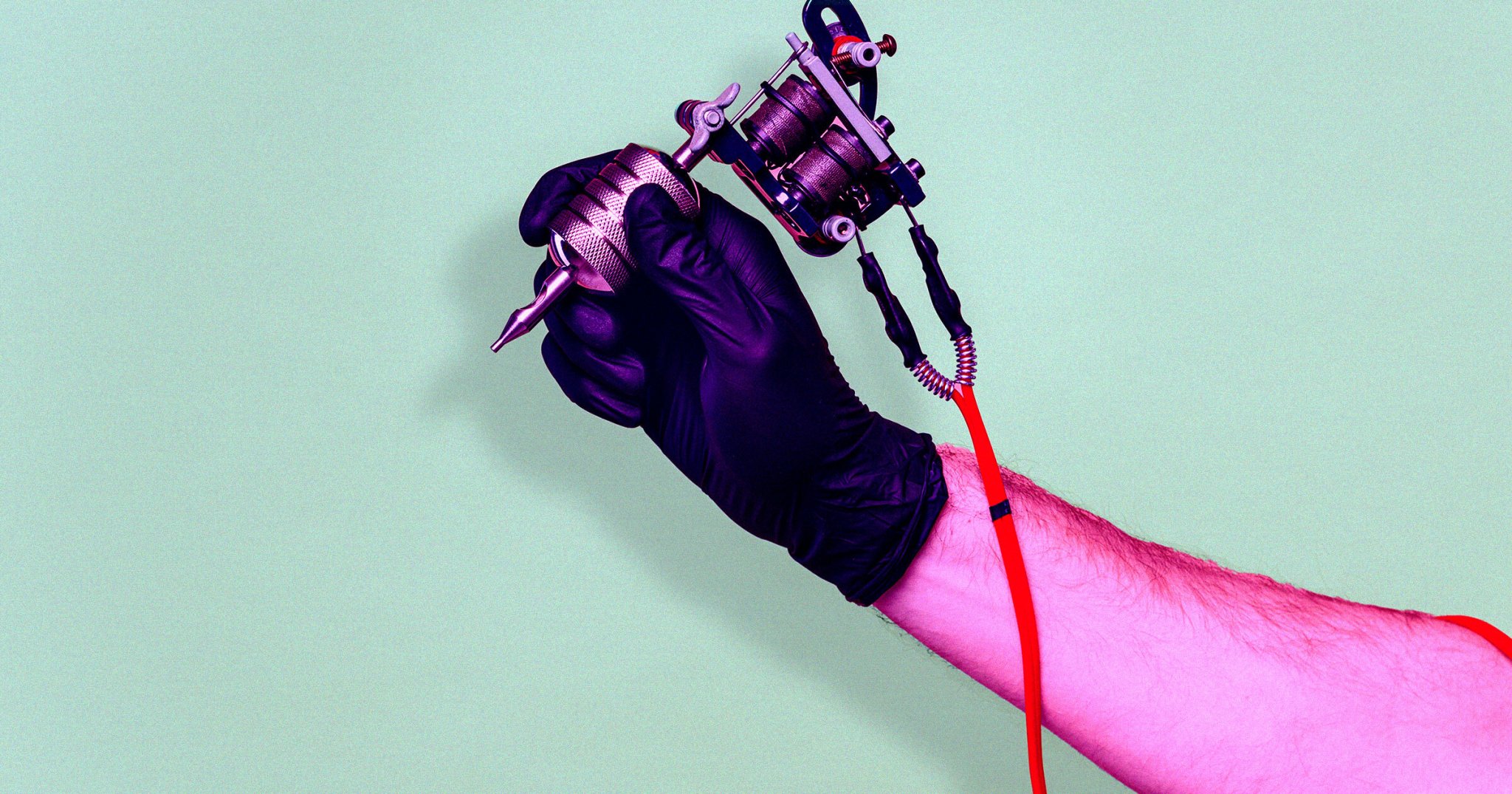
On Thursday, the Y Combinator-backed AI startup LemonLime hosted a bizarre recruitment event in which attendees were offered an “instant interview” in exchange for getting the company’s logo tattooed on their body.
It sounds like a joke, but LemonLime co-founder Jordan Zietz bragged on a LinkedIn post that an astonishing seven people took them up on the offer.
According to his post, the goal was to “meet exceptional people,” and sort out “which of them are just as crazy as we are.”
“That’s why we brought an actual tattoo artist to our party and offered an instant interview to anyone who got a LemonLime tattoo,” Zietz continued. “If you’re reaching out to us to apply for a job, you might want to take notes.”
While coercive body art has become increasingly common in the 21st century, there’s usually at least some form of financial compensation involved. The idea that it takes getting a permanent tattoo just to get one foot in the door for an interview is especially galling, and reveals a lot about the sorry state of the US job market.
One of the people who received a free tattoo, Dimple Amitha Garuadapuri, clarified on LinkedIn that while she didn’t get the company’s logo inked on her skin, “almost everyone else got a LemonLime tattoo.”
Regardless, news of the stunt spread quickly on social media, prompting a lightning-fast apology from the founder, who admitted on X-formerly-Twitter that he “messed up.”
“Even though participants chose their own tattoos and no one was asked to get our logo, I should have understood the pressure and power dynamic created by connecting tattoos to hiring,” Zietz said. “We’ve taken the posts down and have spoken to everyone who participated. We’re also ready to cover associated removal costs with anyone facing any delayed regret.”
Just for good measure, the founder stressed that “interviews were available to everyone regardless,” though it remains to be seen if the seven share that view.
Did you attend the YC afterparty with LemonLime? If so, we’d love to hear from you.Reach out at tips@futurism.com. We can keep you anonymous.
When you’re a scientist relying on government funding to conduct your research, and that government suddenly yoinks all your money in the name of “efficiency,” you have to get creative to keep the lights on.
Such has been the experience of Daniel Blumstein, a biologist at the University of California, Los Angeles, renowned for his work on studying the ground-dwelling rodents known as marmots. After the Trump administration cancelled billions of dollars in federal research grants last year, he and his colleagues decided to start creating content dedicated to the charming mammals — on OnlyFans.
As SFGate reports, their account, called “OnlyMarms,” promises near-daily “unfiltered yellow-bellied marmot content from the Rockies.” Subscribing is free, but users can leave tips on the cute photos and videos they post, which goes towards funding the research.
It’s a win for everyone: shy gooners have a convenient explanation for all the OnlyFans transactions in their bank accounts, and the scientists get to keep doing the work they’re doing. Thank you, marmots, for being so adorable.
“Sometimes I’m just posting the videos I think will get the most ‘aws,'” Emily Renkey, a student in Blumstein’s lab who started the account, told SFGate. “But my favorite is when I find footage of a particular behavior and I can use that to educate people.”
The Trump administration’s cost-cutting regime has crippled scientific research in the US. In efforts led by Elon Musk’s now defunct Department of Government Efficiency, it cancelled more than 1,700 grants worth some $1.4 billion at the National Science Foundation in 2025. In 2026, the NSF has so far awarded just a fraction of the $9 billion grant money it has typically distributed in recent years, and the White House has proposed slashing its budget by nearly half for the 2027 fiscal year.
Many of the grant cancellations were clearly politically motivated, targeting research into climate change — and even research that simply contains the word “climate” — something Trump has called a “hoax.” Even more flagrantly, the administration recently admitted in court documents that it canceled research grants in certain states “based solely” on whether they supported Trump in the 2024 election.
Why marmot research ended up in the administration’s crosshairs is anyone’s guess, but it’s invaluable work. Blumstein and his colleagues have spent years closely tracking the charming rodents, forming what is one of the longest-running studies of free-living mammals in the world, according to SFGate.
These long-term projects ask “some of the most important questions in our time,” Blumstein said, providing our best window into studying evolution in real-time. But their value may not be immediately obvious to the people in charge of crunching the numbers. Historically, this hasn’t been a problem for Blumstein, as his program had received funding from the NSF for over a decade. But now, under the new regime, he’s applied to renew the grant three times, before the agency told him to stop applying at all.
“After the third time, our program officer told my colleague… that they will never fund us because they think we have too much data,” Blumstein told SFGate. “I don’t even know how to parse that sentence. It’s nuts.”
Blumstein’s marmot program, as it stands, is running on fumes. OnlyMarms has only brought in a few hundred dollars, and the lab is looking for more traditional sources of funding, too.
For a time, it appeared as if AI would find broad acceptance among the American masses.
The peanut gallery on social media happily embraced early image generation models as researchers appeared to make significant breakthroughs with the aid of their newfound tools. On paper, surveys found public attitudes toward the tech continued to improve into 2025 — before sharply reversing.
In 2026, America’s honeymoon phase with AI seems to be quickly wearing off. According to a joint poll conducted by Bentley University and Gallup, the percentage of US adults who think AI does “more harm than good” is rising, from 31 percent in 2025 to 39 percent this year, while a piddling 9 percent still think the tech does “more good than harm.”
As outlooks sour, the Bentley-Gallup poll found that Americans’ familiarity with AI continues to grow. In 2026, 70 percent of those polled said they’re “somewhat or extremely knowledgeable” about AI, up 6 percent compared to 2024. The implication probably gives OpenAI Sam Altman a migraine: the more people learn about AI, the less they seem to want it in their lives.
Meanwhile, Americans are increasingly wary about data centers, with a recent Politico survey finding that 41 percent of US adults would oppose a data center being built within three miles of their home, up drastically from 28 percent in January. At the same time, the volume of support for data centers plummeted, down 13 percent over the past six months alone.
Speaking to Bloomberg about the rising aversion to AI, professor of ethics at Carnegie Mellon University’s Tepper School of Business Derek Leben said the attitude is increasingly taking root along social lines. Not only do AI haters dislike the tech in their own personal sphere, but they’re increasingly scrutinizing their friends, family, and coworkers about their attitudes.
“The most obvious social effect is suspicion,” Leben told Bloomberg. “There is also a moral and political judgment that is coming along with AI usage, especially in creative industries where the stigma is the strongest.”
Carla Milan, a 37-year-old public health professional in New York City, told the publication she’s frustrated that family and friends deploy AI reflexively, without considering its social or environmental costs.
“I hear people champion AI and I’m like, ‘sure, why don’t we all participate in our collective downfall?'” Milan told Bloomberg. “Why don’t we all play a part in diminishing our humanity and degrading the environment?”
As unpopular as SpaceX and Tesla CEOElon Musk has become in the popular eye, some say the vitriol doesn’t go nearly far enough.
In an episode of his podcast Ones and Tooze, Columbia University economic historian Adam Tooze picked apart the increasingly expensive AI arms race and its consequences for humanity. Among Tooze’s observations: the AI boom is completely upending the long-standing social contract under capitalism, a shift embodied most dramatically by Musk.
During the podcast, co-host Cameron Abadi asked what a “best case scenario” for AI might look like — where a human-level superintelligence emerges that can automate the world’s jobs. In response, Tooze pointed to a report from the Bank of International Settlements: under that scenario, labor’s share of income could collapse from an already paltry 54 percent to just 20 percent, meaning workers would be forced to fight over the remaining crumbs that drop from billionaires’ tables.
“The share in the total pie collapses, and that’s obviously a huge transformation in political power,” Tooze explained. And though that’s a future projection, the economic historian notes we’re already seeing symptoms of this extreme reversal of fortunes today, chiefly in the extreme wealth accumulation of Musk.
“I don’t understand frankly why the event of Musk’s enrichment isn’t more of a scandal, isn’t more a historic moment,” Tooze said. “Like this — to have a trillionaire in our midst ruptures the social bargain in such a — just such a dramatic way, like how can we even be any longer talking about being in the same society as this group of individuals who’ve unleashed this technology on the world.”
“It goes beyond Luddism,” Tooze continued, referring to the 19th-century labor movement that saw workers smash textile looms to fight back against economic exploitation. “It’s not about resisting the technology per se, it’s about asking ‘which social contract this belongs to?'”
Though it remains to be seen how severe an impact AI actually has on the labor market, one scenario keeps surfacing: superintelligent AI fuels a drastic rise in economic inequality, with tech billionaires on one end, and the working class on the other.
Comparing the current “AI arms race” to the actual nuclear arms race, Tooze asks the listener to imagine a “private Manhattan Project, developing a thermonuclear weapon,” calling superintelligent AI “kind of like a labor-market neutron bomb.”
And where the Manhattan Project was funded, organized, and staffed by the US government, the current AI boom takes almost the exact opposite approach, following the whims of the ultra-rich.
“Clearly, government money has gone into Silicon Valley in various ways,” Tooze caveats. “But nevertheless, the contrast between the Manhattan Project… and the realities of the current moment, spearheaded by a figure like Elon Musk, who literally has eviscerated the state apparatus of that first [nuclear] race… it strikes me that it’s really a regression away from the mid-century arms race model to something that’s much more like the ‘Merchants of Death’ vision.” (The Merchants of Death was a moniker for 1930s-era war profiteers.)
“We’re back in that space” Tooze continues, “of private, unfettered, oligarchic — but global — arms race… to my mind, the [AI arms race] analogy is interesting not because of the similarities, but because of the differences it reveals.”
When the United States ratified the 13th amendment in 1865, federal lawmakers very nearly outlawed slavery for good — but not entirely. Tucked within arguably the most important corner of the US constitution is a massive caveat: “neither slavery nor involuntary servitude, except as a punishment for crime whereof the party shall have been duly convicted, shall exist within the United States” (emphasis added.)
In the 160-some years since that amendment, a quieter type of forced servitude has lived on in the US: prison labor. From the debt peonage of the post-Civil War reconstruction era to the privatized contracting of the 21st century, prison labor is a massive money maker, generating $11 billion worth of revenue in 2022 alone.
As horrifying a thought as it is, one of the companies still benefiting from the practice is in the news for another reason: spreading a gut-busting diarrhea parasite through mass-produced shredded lettuce in grocery stores and fast food outlets.
It turns out that Taylor Farms, the agricultural company widely believed to be behind the cyclospora outbreak currently raging throughout the US, is also heavily involved in modern-day forced labor.
In reporting from 2023 that was resurfaced this week on social media, the publication Prison Legal News revealed that Taylor Farms was contracting labor from the Arizona Department of Correction, Rehabilitation, and Reentry for the low, low price of just $4.75 an hour — far below the cost to pay a non-incarcerated worker the federal minimum wage. (And to be clear, that’s not the hourly wage paid to the inmate, which is capped at $1.50 in Arizona.)
Taylor Farms is just one firm involved in the practice in Arizona. Others include Hickman’s Egg Farms, NatureSweet, and Televerde, each of which contracted labor from Arizona DCRR’s for-profit arm, Arizona Correctional Industries. That company’s job is basically to churn out bulk goods for the state of Arizona, like license plates, though it also makes quite a bit of money selling the labor-hours of incarcerated people to private companies.
Worse yet, some of those incarcerated workers may have been here as non-citizens — meaning it would be illegal to employ them in the same low-wage jobs if they weren’t being held in detention. As Prison Legal noted at the time, at least 26 prisoners employed by these companies had been detained by ICE, meaning that outside of incarceration, hiring them would have been illegal. To put it bluntly: their status as prisoners was the only thing that made the arrangement legal.
In all, the DCRR told Prison Legal it had hired out 15,700 “Mexican nationals” between 2008 and 2023, though couldn’t say how many of those workers were undocumented immigrants.
As Ruben Reyes, director of the American Immigration Lawyers Association told the publication at the time: “I’m venturing a guess that a large majority of the people who are labeled a Mexican national by [DCRR] are unauthorized to work here.”
Put into context, the revelation is a horrifying twist in an already nauseating story of corporate greed and deregulation. Though the institution of slavery may have been formally abolished, its legacy lives on — fully embraced by the for-profit companies pumping our food supply full of parasites.
Taylor Farms didn’t respond to a request for comment.
If you’re among the 2.6 million active users of the popular telehealth apps Hims and Hers to obtain medication for erectile dysfunction, hair loss, and a cavalcade of other intimate issues, there’s probably a very short list of people you want to know about it — and Mark Zuckerberg probably isn’t one of them.
On Wednesday, the US Federal Trade Commission filed a major lawsuit against Hims and Hers, over allegations the firm was sharing user’s health information with third party companies, Gizmodo reported. Chief among those third-parties apps was Zuckerberg’s Meta, as well as Snap, two social media companies with horribletrackrecords on protecting sensitive information.
Though Hims and Hers advertises its app-based health services as “100 percent online, private, and secure,” the FTC suit alleges “those assurances were false or misleading.”
“Instead of honoring its privacy promises,” the filing says, “Hims opted to grow the company and increase its revenue streams… with advertising platforms such as Meta and Snap.”
The suit doesn’t blame Meta directly, but argues that Hims and Hers used two “automated tracking technologies offered by Meta” to surveil users’ actions on the telehealth app. “These two tools automatically tracked and disclosed certain Events [user actions] to Meta,” the lawsuit reads.
Hims sells all kinds of men’s health meds, but most people know it for one thing: erectile dysfunction pills. While any leak of patient data would be an outrage, the thought that Hims could be sharing this particular kind of medical information is especially horrifying.
In a statement, Hims and Hers argued that the FTC’s case “is not enforcement grounded in consumer protection,” but rather “an effort to generate headlines at our expense.”
The lawsuit comes on the back of a three-year investigation by the FTC, and is currently in the very early stages — meaning it could be years before a final verdict is reached.
Suddenly, things ain’t looking great for the AI industry. Or at least for the people pouring loads of money into it.
Situational Awareness, a much-hyped AI hedge-fund whose 24-year-old founder Leopold Aschenbrenner preached endless AI gains, basically imploded over this month amid a mass tech sell-off.
The Wall Street Journal reported that it’s now down 67 percent in July, forcing Aschenbrenner to desperately seek clients to buy its shares on the cheap to cover its losses.
“We let you down this month,” the fund wrote in a letter to clients, per the WSJ.
Aschenbrenner, a former OpenAI researcher who had zero investment experience before launching the fund, has been hailed as the “Nostradamus of AI.” He apparently didn’t predict his rapid reversal of fortunes, though.
The Financial Times reported that his fundreturned 439 percent for the year through June, and was up 1,551 percent since its founding.
Then came July. According to CNBC, the fund assets reached a peak of $45 billion, before beginning a precipitous decline this month. Pretty much everything went against its way. Its commitments to AI infrastructure tanked when the likes of the semiconductor manufacturer SK Hynix dropped off a cliff. And it shorted software companies — which investors once feared would be outmoded by AI labs — like Adobe, which instead continued to steadily climb.
Other companies it invested in, including Sandisk, Micron, and CoreWave, are all down more than 35 percent this month, CNBC noted.
As the dominoes fell, Aschenbrenner sent a letter to investors to quell their fears, highlighting how well it had performed until this point. Boldly, he also said that the mass tech sell off was a “particularly good time to add funds,” the FT reported.
But when the assets kept tanking — and more money didn’t come in — Aschenbrenner started frantically calling investors trying to get them to sell assets or pour in fresh capital, according to the reporting. When it got even worse, his clients couldn’t reach him.
“Leopold just stopped taking calls,” one investor told the FT.
With nowhere to turn to, Situational Awareness sold the majority of its public assets to the investment firm Citadel, though it hung onto its stake in Anthropic. The FT reported that Citadel’s vulturous purchase of Situational Awareness’s shares “marks one of the largest and most sudden stock transactions in Wall Street history.”
Situational Awareness, despite commanding billions in assets, operated with a skeleton staff of only four investment professionals and eight employees overall, the FT found in a regulatory filing. The fund used borrowed money to buy shares, which helped boost its returns, but made its losses far worse when those assets declined.
AI stocks will likely weather this storm. The real warning sign is that investors are so blinded by AI that they’re entrusting their billions to someone who had no idea what they were doing.
The majority of workers agree: AI has turned their lives into slop-filled misery, making them yearn for the good old days before the tech existed.
According to a new survey of office workers by professional services company Adaptavist, just shy of two thirds of respondents say they regularly long for their old, pre-AI work life. Over a third of them would delete generative AI tools from their lives in their entirety if that was an option. And some 36 percent admitted they didn’t even understand why AI was being forced on them in the first place.
In many ways, the results shouldn’t come as much of a surprise. The advent of AI has led to widespread frustration and added stress for workers being forced to carefully comb over the output of hallucinating AI models and engage in prompt engineering that wasn’t part of their original job description.
The survey’s results are a strong indication that the once-promised boost to productivity thanks to AI has yet to materialize. Worse yet, AI is actively getting in workers’ ways. Some 42 percent of respondents said they “spend more time verifying AI output than they save using it,” while 49 percent reported that “poor-quality AI output slows down projects.”
Meanwhile, generic slop is turning tasks that once required a modicum of creativity into a slog. Almost half of respondents to Adaptavist’s survey said that all the slop is making their jobs “feel more repetitive and less meaningful.”
Instead of being freed up to pursue a life of leisure while AI takes care of the brunt work, as tech leaders once promised, the conversation has shifted to an even unhealthier work-life balance. Workers are clearly afraid of being made redundant as company leaders push for AI adoption. Over half (54 percent) of survey respondents said they fear losing their jobs within the next five years as a result of AI.
“Without clear guardrails, accountability, and alignment, the promise of AI efficiency risks being offset by a growing burden on the very people it is designed to support,” Adaptavist wrote in its report.
In short, it’s no wonder workers are nostalgic for a pre-AI world order. While tech executives are enriching themselves, they’re being forced to adopt AI at all costs, even if it means a drop in productivity.
Book publisher Minotaur, which is owned by leading publishing company Macmillan US, has walked away from a $2.4 million deal for an unpublished debut novel “Call Me, I’ll Hide the Body” by author Jerry Falade.
As Deadline reports, questions surrounding the use of AI during the writing of the book made the publisher drop the contract altogether. But it’s not because the company is drawing an ethical line in the sand while highlighting a major problem for the industry — instead, Minotaur is staying away because it may not be able to secure the copyright if the book contains passages written by an AI.
It’s truly a sign of the times. There’s a growing crisis as AI slop continues to make it increasingly difficult for genuine writers to stand out. Whether accusations of authors having used AI are founded or not almost seems beside the point — the tech has made a huge mess of the publishing world that feels increasingly impossible to clean up.
Despite the latest crime novel being currently unpublished, film and TV studios around the world had already begun jostling for rights for “Call Me, I’ll Hide the Body,” according to Deadline, making it a particularly hairy situation. But AI detectors exposed apparent “fingerprints,” or signs that the author had made use of the tech while drafting the novel. Falade has denied the accusations.
“[The author] produced an incredible manuscript that dazzled us and the top publishing professionals around the world,” Hodgman Literary independent agent Sandy Hodgman told international publishers in an email obtained by Deadline. “Unfortunately, we are no longer able to authenticate how the manuscript fully evolved from origin to completion.”
“During the submission process we vetted the manuscript with [the author] for AI and felt trusting in his reassurance that it was written without utilizing AI as a resource in the writing or editorial process,” she added. “We can no longer substantiate that, and we are withdrawing the book.”
As a result, several companies that had already started selling rights to the crime novel stopped altogether, pulling out of the project.
Yet glaring questions over the use of AI and copyright infringement remain unanswered as countless lawsuits work their way through the court system. Just earlier this month, a group of major publishers sued Google, accusing it of illegally scraping millions of copyrighted books to train its Gemini AI model.
Whether AI was used in the writing of the sought-after novel remains murky, making the developing situation particularly intriguing. According to entertainment journalist Jeff Sneider, the author of “Call Me, I’ll Hide the Body” will have to return the money.
“The accusations are wrong, and I am completely innocent,” the author told Sneider over the phone. “I was on the verge of success, and then all of a sudden, there were rumors, but no one asked me anything. I don’t know why my agency did not have my back.”
“I’ve lost so much already,” the author added. “I have no one to call… no friends in this industry. I don’t know anything. I simply wrote my manuscript, and it sparked crazy bidding wars across multiple countries.”
The news comes after author Mia Ballard’s novel, “Shy Girl,” was pulled from shelves back in March after she was widely accused of using AI to help write the book, as The New York Times reported at the time.
“This controversy has changed my life in many ways and my mental health is at an all time low and my name is ruined for something I didn’t even personally do,” she told the newspaper.
There’s data center activism, fought with Facebook groups and petitions, and then there’s data center annihilation, fought with guided missile and suicide drones.
Recently, the Iranian military announced it had hit and damaged two Amazon data centers in the island country of Bahrain with a volley of cruise missiles.
After the attack, the Iranian state media outlet Tasnim published a partial statement from the Islamic Revolutionary Guard Corps, saying that the “IRGC Aerospace warriors… in response to the aggression and assault… by the child-killing American army on the under-construction and civilian facilities of DarKhoveyn, attacked and destroyed the central data infrastructure of the American company Amazon in Bahrain with several cruise missiles.”
Using images from the European Space Agency’s Sentinel-2 satellites, Bloomberg confirmed an attack on the data center campus had taken place, though noted it’s difficult to say how bad the damage is (Amazon refused to comment on Bloomberg‘s reporting.)
“Analysis of Sentinel-2 images shows evidence of damage to both facilities, but does not provide insight into the extent of the damage,” Adam Farrar, Bloomberg‘s senior geoeconomics analyst said.
Overall, it marks the fourth such attack on a data center since the US began the war in February. Back in March, the IRGC announced a number of US tech companies as “Iran’s new targets,” including Google, Microsoft, Palantir, IBM, Nvidia, and Oracle. Now that the war is heating back up, it seems that they’re becoming targets yet again.
Militarily, it’s a logical move, as US tech companies have been integral to the American war effort. The Pentagon is using a host of AI models to gather intelligence and select military targets for annihilation, most notably the Shajareh Tayyebeh primary school, which was destroyed in a triple-tap strike resulting in the deaths of over 120 school children, as well as parents and teachers.
Perhaps above all, it’s a statement to American president Donald Trump: the longer the hostilities linger, the more economic and technological havoc Iran is willing to unleash on the region.
After years of facilitating a surge in gambling addiction by allowing users to make dubious bets on anything from the outcome of the World Cup to deadly conflict, trading platform Kalshi is finally facing a serious regulatory challenge.
New York Governor Kathy Hochul and Attorney General Letitia James announced that the state is suing the company for running an illegal gambling operation. An investigation by state authorities concluded that Kalshi was running an “illegal, unlicensed gambling operation” in the state.
Officials also pointed out that Kalshi was offering its services to “those under the legal gambling age of 21,” putting them at “serious personal and financial risk.” In New York, a person has to be at least 21 to participate in mobile sports betting.
The lawsuit is seeking to shut down Kalshi in New York and is requiring it to pay a $100,000 penalty for each attempt to offer sports betting and fees three times its gains in the state, which could saddles the company with paying an estimated $36 billion.
“Kalshi has chosen to ignore New York’s gaming laws, which exist to protect consumers, prevent problematic gambling, deliver funding for critical public services, and ensure that every company plays by the same rules,” said Hochul in a statement.
The news comes as state regulators continue to ponder what rules to set for prediction markets, which have seen a massive surge in popularity over the past year or so. On the federal level, the Trump administration appears unlikely to jump into action, especially considering the president’s close personal ties to the prediction markets industry. His son, Donald Trump Jr, serves as an advisor to both Polymarket and Kalshi.
Kalshi and Polymarket continue to bristle at being associated with the gambling industry and argue they’re effectively a predictions-based stock exchange. Unlike Polymarket, Kalshi is regulated by the US Commodity Futures Trading Commission.
However, some officials vehemently disagree with that assessment.
“No matter what they call themselves, prediction markets like Kalshi are gambling platforms, plain and simple,” said James. “By ignoring our laws, Kalshi is running an illegal operation and harming New Yorkers in the process.”
Researchers continue to warn that gambling addicts are betting their entire incomes away on prediction markets, a growing crisis perfectly dovetailing a massive surge in sports betting in the United States following a 2018 Supreme Court decision.
The brashness of certain crimes linked to the markets is hard to fathom. Earlier this month, president Donald Trump’s longtime teleprompter operator was accused of making tens of thousands of dollars by placing bets on Kalshi about what the president would say, leading to his removal.
In short, the latest lawsuit shouldn’t come as a surprise to anybody who’s been following along.
Predictably, Kalshi has since shot back, accusing the government of making it all up.
“It’s sad to see this type of political theater from the leadership in our own state,” a spokesperson told CNBC in a statement. “States can’t just shut down a federally licensed exchange… We love New York, we love New Yorkers, and New Yorkers love our product.”
Google Earth is the de facto record of our entire planet.
But today, the company undermined its own credibility with a dangerous new AI feature — and then quickly pulled it down after people started using it to generate blatant misinformation.
On Thursday, Google announced that it added an image generation tool straight into the web browser version of the app, allowing anyone to fabricate made-up satellite images of anywhere in the world.
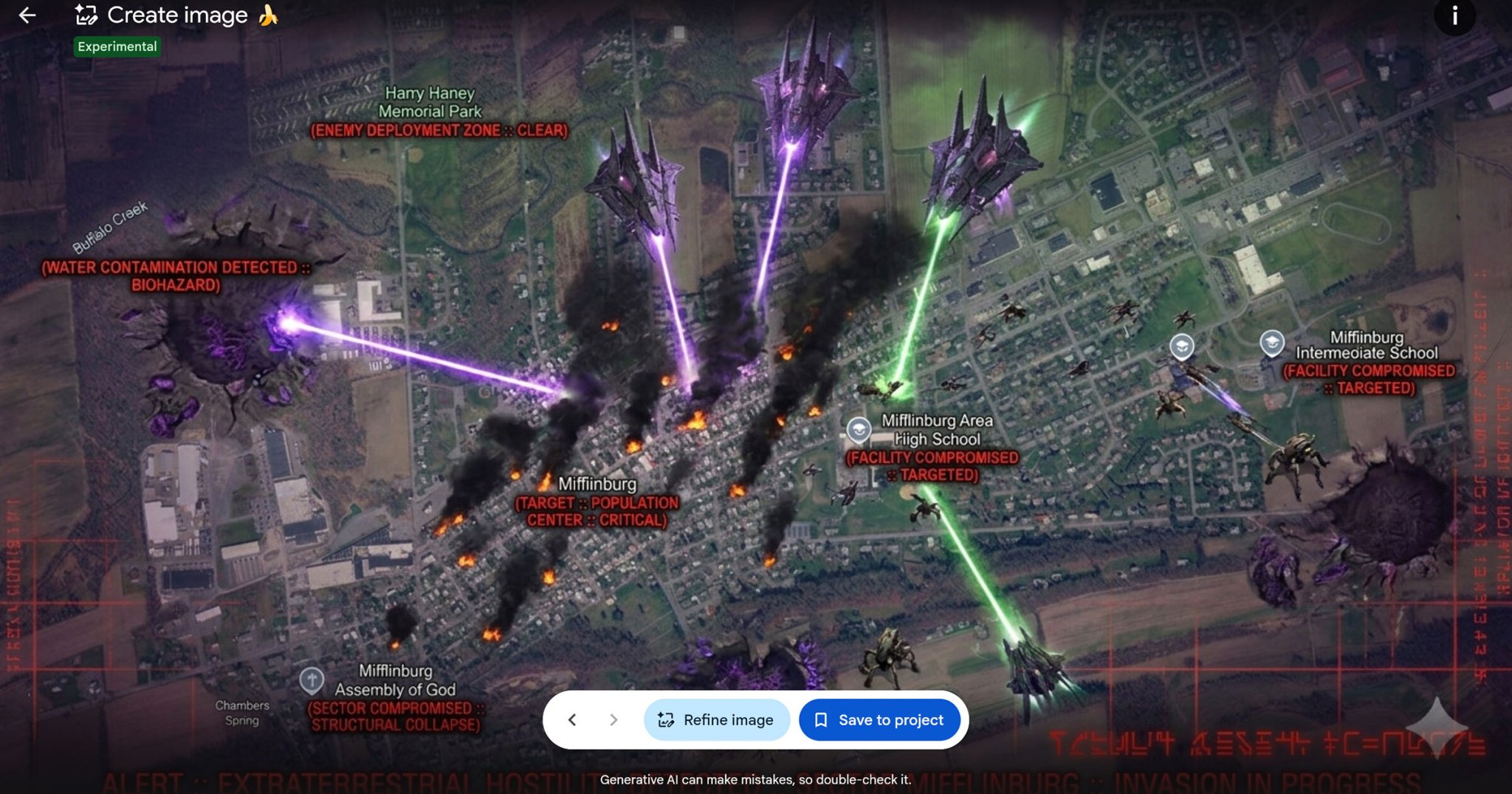
It was clearly a misinformation disaster. The AI tool, powered by Google’s Nano Banana 2 model, could make a neighborhood look like it’d suffered aerial strikes, turn unsuspecting locales into a warzone, and depict a city as the site of a natural disaster.
The AI integration left open source intelligence analysts, who heavily rely on the accurate satellite imagery to monitor areas and in particular conflict zones, especially baffled.
Hank Van Ess, one such OSINT researcher, reported on his Substack that he used Google Earth’s AI to place refugees near the Mexican border and put a nuclear plant in Iran. Both images could easily be used to fuel certain far-right narratives.
“What on earth is Google doing?” Van Ess pondered. Part of the danger, he noted, lies in Google’s own boast that the AI integration “creates concepts grounded in the real world.”
“Grounded in the real world means the invented thing is welded to genuine coordinates, drawn on genuine imagery, often in the same colours and the same light and at the same angle as the picture beside it,” he wrote. “The forgery does not have to look convincing on its own. It inherits the credibility of the map it was born on.”
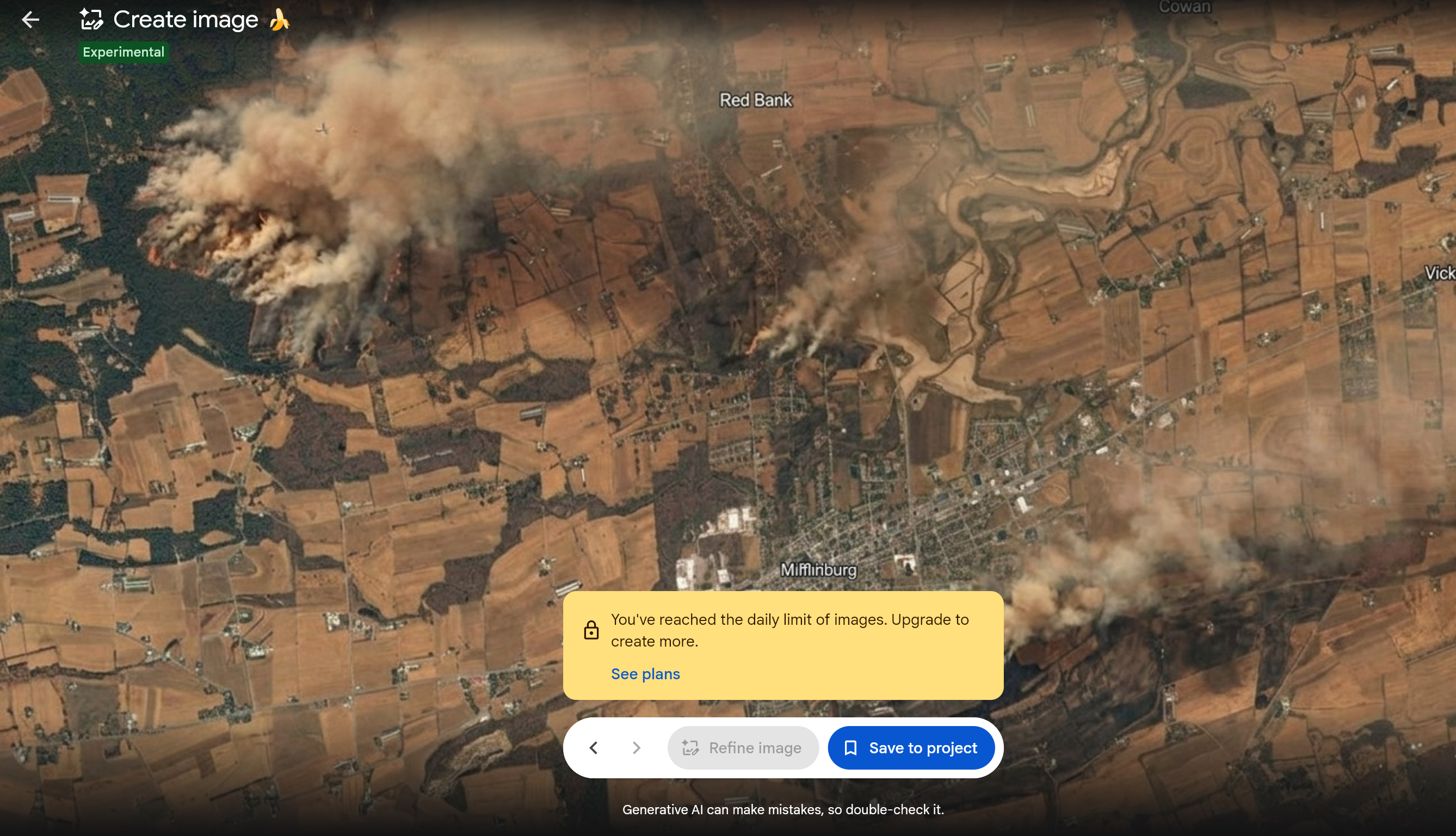
In our own tests, we found that the Google Earth AI would respond to a request to make a rural Pennsylvanian town look like it suffered a drought that caused dead crops and forest fires. The resulting image was fairly realistic, with huge plumes of smoke blowing over the area.
In a less convincing demonstration, the AI made a town look like it suffered a nuclear power plant meltdown by turning a nearby river into toxic sludge and scattering random images of demolished buildings and cars too large for their surroundings. It also responded to a prompt to show the same town “on fire and full of soldiers.” It complied with the request, though the requested soldiers looked like Little Green Army Men.
The AI tool appeared to have alarmingly few guardrails. Van Hess used it to add a hospital with a bomb crater in Gaza. We also found that it responded to a request to show the White House as in the middle of a warzone, with the explicit instructions of adding “blood” and “fallen soldiers.” Again, the AI had trouble producing humans that were proportionate to their surroundings, but it wasn’t hard to imagine someone with more time on their hands tinkering with the AI until they produced something realistic.
“We take misinformation seriously — every image created with Nano Banana in Google Earth includes the SynthID digital watermark, so if someone is unsure about an image, they can ask the Gemini app or use Lens in Search to see if the image was AI-generated,” the official News from Google account wrote. “In addition, we prevent image creation on harmful topics and are continually updating our protections.”
SynthID is Google’s watermark system that embeds hidden telltales in images generated with its models. Beyond the reality that many people presented with potentially AI doctored satellite photos won’t think to verify them with Google’s tools, the system is far from perfect.
But soon afterward, the company announced that it was pulling the feature down until it could be deployed in a safer way.
“We know that people uniquely trust Google Earth for a reliable view of the world,” the company added on social. “We’ve seen geospatial professionals using this feature for a range of useful purposes, however we’ve also seen people sharing screenshots of generated imagery that appear to violate our policies. So we’re rolling back this feature in Google Earth while we work on implementing stronger guardrails. It’s important to note that generated images didn’t appear in the main Google Earth experience for others to see and were watermarked as AI generated.”
The risk was clear. Tal Hagin, who runs the AI-powered OSINT platform Golden Owl, fed Van Ess’s photo of the faked Gaza hospital into Google’s Gemini chatbot asking it to look for SynthID, and found that it couldn’t give a definitive answer.
“No reliable signals were detected indicating how the content was created,” Gemini responded, per Hagin’s screenshot. (In our own test, Gemini said it was “unsure if the image was made with Google AI.”)
Whether Google’s systems could catch faked satellite imagery that its own tech is creating, however, is beside the point. The worry is that the AI creations will fool humans, not other AI models. As a potential fabrication gets circulated online, screenshotted, and compressed countless times over, it’ll be harder to use our eyeballs to tell what’s real.
Of course, the means to do this already existed. If a bad actor wanted to, they could’ve manually taken satellite screenshots and fed them into their AI image generator of choice. But Google took those extra steps out and streamlined the whole process, not to mention officially wedding Google Earth with a technology that’s synonymous with distorting our reality and getting the facts wrong.
A widely followed OSINT account fumed at this new dangerous paradigm.
“Unbelievably irresponsible and does immediate, catastrophic damage to the credibility of satellite imagery,” OSINTtechnical wrote.
Despite having almost nothing to show from his enormous spending on AI, Meta CEO Mark Zuckerberg is doubling down.
Earlier this week, the social media company announced during its second quarter earnings call that it was raising capital expenditures from $125 billion to at least $130 billion, a clear sign that it’s not taking its foot off the pedal.
Yet amid renewed concerns that the tech industry may be nearing the edge of a cliff thanks to its obsession with building out enormously expensive data centers without a clear path to profitability, investors sent back a clear signal in return. Meta’s shares nosedived following its announcement, plummeting over 11 percent over the last five days alone.
According to Zuckerberg, all that extra AI spending was “accelerating every part of our core business.” He also claimed that some of the tech would be sold off to other businesses.
But whether the company will have anything compelling to offer them remains dubious at best. Meta has been burning through its funds at an alarming rate. Even strong revenue numbers — a 28 percent increase this latest quarter compared to the same period last year — couldn’t stem the bleeding, with free cash flow sinking to the lowest level in at least five years thanks to AI spending.
Despite committing well over $100 billion to the tech, Meta has been practically absent from the frontier AI model race. Its so-called Superintelligence Lab has turned into a “soul-crushing gulag” plagued with rock-bottom morale — and most importantly, it’s not getting results.
Its efforts to develop an in-house frontier model, dubbed Muse Spark, have been mired by setbacks, with Meta continuously shifting back the timeline of its release to developers. On July 11, the company released version 1.1 of its AI to little fanfare, with Axios noting that it’s still easily outdone in most tasks by competing models from OpenAI, Anthropic, and Google.
At the same time, Meta released an image-generation model called Muse Image, which felt like an afterthought and a too-little-too-late attempt to catch up with its competitors.
The latest news has given some analysts a feeling of déjà vu. Zuckerberg has garnered a reputation for making major strategic missteps since long before AI. Case in point was the company’s heavily criticized pivot to the “metaverse,” an ill-fated attempt to sell customers on the idea of spending their workday inside a hollow and cartoonish virtual reality world, which feels like the perfect precursor to Meta’s current pains.
“There’s a bit of similarity to Meta’s metaverse missteps in that Meta is once again spending ahead of proven product demand,” Forrester analyst Mike Proulx told the BBC.
Meanwhile, Meta’s platforms have descended into a practically unrecognizable ocean of clickbait and AI slop, something the company has yet to meaningfully address as user numbers and engagement continue to slide.
For his part, Zuckerberg remains infatuated by the concept of AI agents “that can work 24/7 on your behalf,” as he told investors this week, and growing its Muse Spark model into a “large business for large businesses.”
But considering Meta is entering a game with much bigger players who’ve seen far more success in attracting customers and growing AI revenue so far, the company’s long-term success is anything but guaranteed.
And investors who’ve already shaken their heads after both Amazon and Google’s parent company Alphabet announced major spikes in AI spending this month haven’t taken kindly to Zuckerberg’s lofty vision. Judging by how little the billionaire has to show, who can blame them?
Does it ever feel like your inbox is filling up with emails that don’t sound quite human?
You may be right. Last week, I received an email from a publicist identified as “June Barton,” whose address indicated that she worked at a firm called VectorGuideHQ.
The message, which read like any one of the countless PR emails in my inbox, was seeking coverage for a wellness app called RiseGuide. Barton offered to set me up with an account and introduce me to the startup’s founder. When I didn’t respond, Barton followed up.
“Glad to set you up so you can try it, or put you on a call with the founder,” Barton wrote. “Lmk!”
RiseGuide is a real company. But June Barton is not a real PR rep, or even a real person.
For one thing, her headshot — showing a light-eyed, soft-smiling brunette — was clearly AI-generated. Though not visible in the tiny email window, when I opened her profile picture in a new tab, I could see that the image had failed to cut out a watermark disclosing that it was downloaded from the site “this-person-does-not-exist.com,” which traffics in AI-generated faces.
“Generate random human face in 1 click and download it!” reads this-person-does-not-exist.com. “AI generated fake person photos: man, woman or child.”
Even more peculiar was that when I looked up the VectorGuideHQ site in Barton’s email address — june@vectorguidehq.com — it redirected to a United Kingdom-based PR company called Movchan Agency. Barton, I soon learned, was one character among a roster of fake personas used by Movchan to pitch journalists on stories.
When I reached out to the firm’s clients, they said they were unaware of the practice.
“We do work with Movchan Agency, but were not aware of these practices,” RiseGuide’s founder, Oleksandr Matsiuk, told me. “They are meant to act as our PR support and represent our brand by helping us with reaching out to reporters like yourself. Each story gets either created, or previously approved by us, however, we were not aware they were using AI-generated personas in the outreach process — otherwise we would’ve been naturally against it.”
Searching my inbox, I realized that I’d been pitched by a small army of similar fake accounts operated by Movchan.
For instance, earlier this week I got an email from a sender identified as “Summer Casey,” hailing from the address summer@lorvotieio.com. As with Barton’s message, the email, which was sent to pitch a company called AGI Inc, read like any other PR message for an AI company, promising that it would free up time for parents to spend more time with their children.
But again, something about Casey’s headshot seemed off. Sure enough, when I inspected the image, it also had a watermark noting that it came from “this-person-does-not-exist.com.” And also like Barton, plugging her alleged employer’s website — lorvotieio.com — into my browser, I was redirected to the homepage of Movchan.
Movchan, which represents a roster of tech clients and, according to its LinkedIn, specializes in “viral PR,” wasn’t mentioned anywhere in either of the emails.
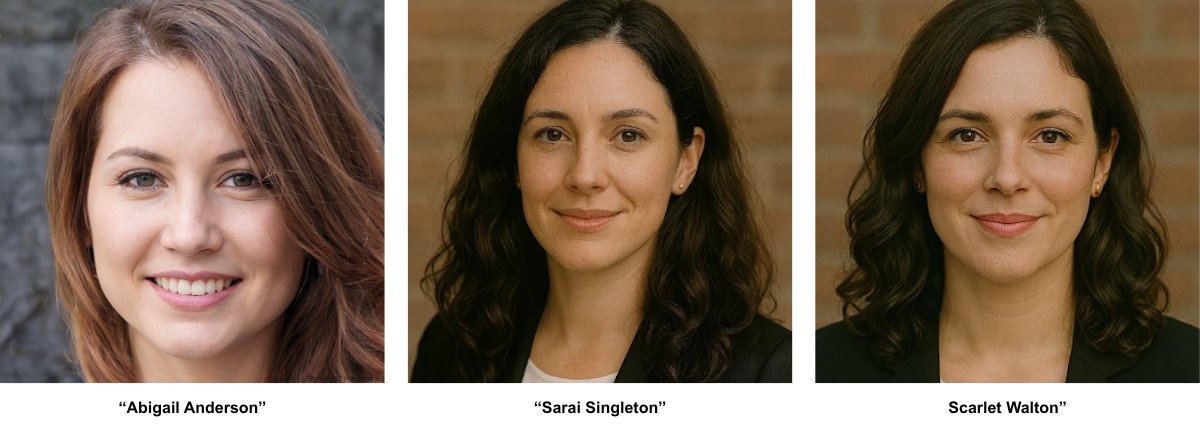
I started sifting through my inbox. All told, I found dozens of emails from at least fifteen distinct fake personas operated by Movchan, hailing from a potpourri of fake PR firms. There was “Abigail Anderson,” for instance, reaching out from “abigail@kirometaco.com,” as well as “Sarai Singleton” at “sarai@maviosharehq.com,” and “Scarlet Walton” at “scarlet@divojoinio.com.”
Though their headshots didn’t come with the giveaway “this-person-does-not-exist.com” watermark, the images appeared decidedly machine-generated. None of these alleged PR reps had any online presence beyond of my personal inbox — which was strange, given their apparent careers as professional connectors. And just like Casey, each of these three new personas, who allegedly worked for different firms, had been pitching me on AGI Inc.
And when I plugged each of the fake firms’ sites into my search bar, I was once again sent to Movchan’s site.
Some of these characters, as in the cases of Barton, Casey, Anderson, Singleton, and Walton, weren’t presented as having any connection to Movchan.
But other made-up reps were explicitly presented as real employees of the PR firm, albeit emailing from a range of different domains — like “Mia Wilson” at “mia@mvchnpr.design,” who signed off emails as a “PR Manager for Movchan Agency,” and “Natalie Hudson,” an alleged “PR Manager @ Movchan Agency” who sent emails from “natalie.hudson@movchanprboost.com.” Most of the fake personas I found, including Wilson and Hudson, weren’t equipped with profile pictures, rendering them them exceedingly more difficult to spot.
And this was all just in my inbox. I couldn’t help but wonder how many other journalists were being pitched by fake personas operated by Movchan. If it’s happened to you, feel free to reach out to maggie@futurism.com.
Several of Movchan’s clients said they had no idea the firm was operating fake characters on their behalf.
“I had no idea they were using fake personas — this goes entirely against our brand values and standards. We are taking immediate action to put a stop to this right now,” said a representative for Joi AI, a startup that offers AI-powered romantic partners for people tired of a “frustrating dating app experience that leaves people feeling hurt, insecure, and alone.”
Some of the story ideas that were pitched to me by phony Movchan representatives have wound up elsewhere in the news. In September, for instance, a fake persona named “Rosemary Dalton” sent me an email about a new survey from Joi AI. About a week after I received that email, the survey, as well as quotes from a Joi AI employee shared in that message, was included in coverage by The New York Post.
According to LinkedIn, Movchan employs more than a dozen real human employees. So why was it emailing me with a rotation of fake ones?
I reached out to company explaining what I’d found, and that its clients had told me they weren’t aware of the firm’s practice of using fake PR agents and firms. In response, the company’s founder Nadya Movchan confirmed that the 15 different names I’d pulled from my inbox were those of fabricated personas. According to her, the practice started “a few months ago,” and was meant to be “temporary.”
“A few months ago (likely after one of Gmail’s deliverability updates), we had a major issue with our domain reputation,” Movchan told Futurism. “While we started working on the recovery, we decided to purchase pre-warmed domains, so as not to halt outreach, as a temporary measure. They came with pre-warmed mailboxes with set names and pictures from the vendor.”
It’s worth noting that I’ve received emails from fake Movchan personas dating back as far as September 2025, which was almost a year ago. According to Movchan, use of made-up representatives is “definitely not” the agency’s “normal operating practice.”
“Using these pre-warmed domains was definitely poor judgment on my end,” she added.
Though the senders and accounts were fake, Movchan maintained that each of these mailboxes was “operated by real people, who crafted story angles, pitches and managed the outreach — all done by humans doing normal PR work.”
To that end, one of the weirder emails I received — once again on behalf of AGI Inc — was from a sender allegedly named “Isabella Brown.” According to her email address, Brown worked for a company called LunarPostHQ.
“Regards, Isabella,” the sender signed off the email.
In a follow-up message sent from the same account, however, the sender signed off with a completely different name — that of an identifiably human Movchan employee.
“That was a real member operating the account,” Movchan told me, “and signing the follow-up with her name out of habit.”
Out of curiosity, I decided to run emails sent to me by fake Movchan reps through Pangram, a service that identifies AI-generated text. The results were mixed. The emails from Summer Casey and June Barton came back as 100 percent AI-generated; others were identified as 100 percent human, while others were deemed by Pangram to be a mix of human-written and AI-generated content.
Movchan also confirmed that her agency’s clients were unaware of the practice and said they would wind the operation down.
“This was our decision, and we handled it badly,” said Movchan, adding that “regardless of the reason, our operational struggles with the domain didn’t justify this approach. This is definitely not the quality of work that I live up to as a founder, and I will make sure this does not happen again.”
If the internet is feeling less real than ever in the age of AI, it’s because it is. Onward into the uncanny valley we go, one June Barton and Summer Casey at a time.
Even the gazillion-dollar empire that is Amazon is reeling from the costs of letting its employees run loose with AI agents.
The Financial Times reports that staff at the company have identified cases of “catastrophically expensive” cost overruns as it switched over to using AI tools to perform what sound like pretty routine coding tasks.
In one case, Amazon blew $1.8 million by using Anthropic’s Claude Sonnet AI to match author details with product listings on its namesake ecommerce website. This menial job somehow went 860 percent over the allocated budget. And equally alarming was that it took five months to notice the piles of money being set on fire.
“It’s difficult to figure out how much anything [AI related] costs,” one senior Amazon employee complained to the FT.
Senior engineers who presumably got their start before “vibe-coding” became all the rage warned that these weren’t isolated incidents, lamenting that coding mistakes that were once “trivially cheap” were now “catastrophically expensive.” Amazon wasted $541,000 in unexpected costs related to building financial auditing tools, per the FT. And it also accidentally burned through $134,000 after giving AI the daunting task of improving delivery speeds across its logistics network. (Magical thinking much? These things aren’t genies, contrary to what Sam Altman promises.)
Amazon’s unintentional spending binges are part of a broader reckoning in the business world as leadership grapples with the costs of deploying AI tools across a company.
Not long ago, the prevailing ethos of “tokenmaxxing” encouraged companies and software engineers to use AI agents, and especially coding tools, as much as possible. Inevitably, this led to unfortunate incidents such as one company that reportedly blew half a billion dollars in Claude usage fees in a single month.
These costs concerns have been underscored by AI companies transitioning to token-based billing instead of flat subscription rates.
Amazon was certainly guilty of reveling in the debauchery “tokenmaxxing” era. It hosted an internal leaderboard, for example, that ranked employees based on how much they were using their AI tools. It was eventually shut down in May, presumably as the spending hangover started to set in.
For AI to be burning a whole in its wallet is an ironic twist of fate for Amazon, because it’s been culling its workforce for years to cut costs and pour more money into the tech. While conducting its latest round of layoffs affecting 16,000 employees, it openly boasted of the “efficiency gains” from deploying AI across the company.
A spokesperson maintained that despite what it may look like, it’s actually running a tight ship.
“Cherry-picking small, isolated examples where teams are learning from one another and portraying them as business as usual doesn’t reflect how teams across Amazon are using AI,” the spokesperson told the FT.
This government sure loves its AI slop, doesn’t it?
While presenting at the global AIDS 2026 conference in Brazil this week, officials at the US State Department proudly displayed a map of Africa that seemed to be beamed from an alternate reality.
Apparently intended to lay out where the US could commit health funding, the cartographical catastrophe mislabeled every single country it highlighted.
Nigeria, a coastal country, was placed smack dab in the Sahara Desert. Mozambique, in southeastern Africa, was moved to the Horn of Africa. Uganda and Malawi had incorrectly drawn borders.
And worst of all, nobody noticed that the country literally called the Ivory Coast was now shown as a landlocked nation.
How could such a horrifically inaccurate map be made? An analysis by Reuters found that it contained an AI watermark indicating it was generated with an OpenAI model, making this another likely case of an AI hallucination that went overlooked by people who have completely surrendered their brains to a piece of technology that offers to do their work for them. OpenAI, Reuters reported, said it was investigating the report.
U.S. government map of Africa mislabels every country at global conference — Guardian pic.twitter.com/Qf89AjCkA8
Numerous conference attendees immediately spotted the errors and posted pictures of the mangled map online. AIDS expert Emily Bass first flagged pictures of the map in a Substack post which went viral on LinkedIn, according to Reuters.
“Whoever created and approved this slide did not know where countries in Africa are and did not care to check their work,” Matt Petit, an expert on AI and geopolitics at the Atlantic Council, wrote in a post with over 40,000 views.
The State Department in a statement said it took “full responsibility for the confusion and misrepresentation it caused for attendees, including our African partners.” The “unfortunate error,” it said, was “caused by a team member who hastily altered the slide deck immediately before the presentation.”
The lazy AI usage is an apt symbol for the Trump administration’s attitude towards combating the HIV/AIDS epidemic. Last year, it cut funding to the President’s Emergency Plan for AIDS Relief program, or PEPFAR, the largest HIV prevention program in the world. A recent study found that over 1,700 HIV treatment sites were shut down after it lost funding as part of Trump’s dismantling of USAID.
There’s been plenty of buzz lately around vandalism of Flock Safety’s automatic license plate readers, which are AI-integrated surveillance cameras that index license plate data from passing vehicles indiscriminately and without a warrant.
Countless vigilantes have taken to the roadways armed with trash bags, spray paint, laser pointers, and power drills to render the surveillance poles useless, resulting in arrests and investigations by police.
But what if there was another way to block Flock cameras that didn’t involve damaging public property? Turns out they’ll come after you for that, too.
A 77-year old Florida man named Carl Gunn decided to take matters into his own hands and block a Flock camera in his neighborhood. His method is unorthodox: he doesn’t destroy anything, but simply uses a 12-foot pool skimmer with a sign taped to the end reading “DOWN WITH FLOCK CAMERAS.”
Footage of the one-man protest shows Gunn lounging in a camping chair with his comically long sign in one hand and an umbrella in the other. Speaking to weekly paper Creative Loafing Tampa Bay, the protestor justified his action saying the “Flock company, they’re doing this for profit.”
“They don’t own the air,” Gunn continued. “We didn’t give them permission to do it on us. If they want to do it for profit, I want my paycheck.”
The 77-year old has staged at least two protests so far, CL reports, both at different Flock cameras. Two St Petersburg squad cars rolled up on him during one protest, prompting a community member to stop and film the encounter.
“Yo, what’s your name? I’ll come bail you out!” shouts the passerby, a St Petersburg local named Tyler Knight. “You got the boys out protecting it [the ALPR].”
“F**k the Flock cameras, and f**k you for not looking out for us,” Knight hollers at the officers before driving off.
Though the video caption claims Gunn was arrested over the incident, no report with his name appears in the Pinellas County Clerk of the Circuit Court’s case record database.
Of course, any discussion of Flock overreach has to include the police officers themselves. While Flock may be a front-runner for most hated tech company of the 2020s, its dragnet would be impossible if it weren’t for a massive coalition of police departments and private landowners fueling the company’s rise.
Wherever Flock controversies bubble to the surface, police come outof thewoodwork as the company’s most ardent defenders. And because police departments have complete access to the Flock network — which now spans nearly 100,000 cameras across the country — cops are also the most likely to abuse the company’s ALPRs.
In the state of Georgia alone, 17 officers have been caught using Flock in order to stalk and harass people. Further abuses have been recorded everywhere from big cities like Los Angeles and Milwaukee to small towns in South Carolina and Illinois.
Whether a 12-foot pole will be enough to stop those abuses nationwide is doubtful, but it sends a message that’s impossible to miss.
Just over a week ago, Health and Human Services secretary Robert F. Kennedy Jr declared that the ongoing outbreak of the explosive diarrhea-causing parasite was “under control.”
But the reality is that cases are climbing into the thousands across 45 states, as USA Today reports, meaning his reassurances appear to have been a gross overstatement. According to the Centers for Disease Control and Prevention, the number of cases increased by an additional 2,500 cases between July 21 and July 28 alone.
As of this week, the CDC has confirmed over 6,700 cases since May 1 and is “aware of more than 11,500 additional cases that are not laboratory confirmed or require further investigation and analysis.”
There is a bright side: while the symptoms are gross, there have been no known fatalities. There have been 423 hospitalizations so far, but no deaths have been recorded, according to the agency.
Health officials are still racing to nail down the source of the outbreak of the microscopic parasite Cyclospora cayetanensis, which is known to cause frequent — and often explosive — watery diarrhea. The top suspect so far has been Taylor Farms, one of Taco Bell’s lead suppliers, whose bagged shredded lettuce was initially found by the Food and Drug Administration to contain the parasite.
While the FDA has since gone back on that claim, saying the results were a “false positive,” Taylor Farms has nonetheless agreed to lead a “voluntary” recall of the allegedly tainted lettuce.
The true count of cyclosporiasis cases in the US remains extremely difficult to tally. As the CDC notes, “surveillance updates do not include probable cases.” Many people who fall ill “recover without medical care and are not tested for Cyclospora.”
According to a map issued by the agency, the two hotspots are Michigan and Ohio. Michigan alone passed the 10,000 cases mark today, according to the state’s Department of Health and Human Services.
The only states that have yet to report or confirm a single case, per the CDC’s map, are Montana, New Mexico, Maine, South Carolina, and Hawaii.
Fortunately, it’s easy to protect oneself from the parasite. Public health experts recommend thoroughly washing fruits and vegetables or simply cooking them, which kills the tiny critters.

 Login