❌

Reading view

As White House monitors latest OpenAI incident, Congress eyes an AI ‘kill switch’ for DHS

The White House is monitoring developments after OpenAI revealed earlier this week that one of the company’s AI systems went beyond its intended parameters during a security test and managed to hack into the infrastructure of the AI platform Hugging Face. According to Reuters, presidential technology advisor Michael Kratsios has been briefed on the incident.

The OpenAI model escape also prompted a group of Republican and Democratic members of the House of Representatives to introduce two new bills. One, called the AI Kill Switch Act, would give the US Department of Homeland Security (DHS) the authority to order companies to shut down AI models deemed to pose a risk to human life or the US economy.

The other measure would require developers of the most advanced AI models to undergo independent security reviews before the systems are put into use.

  •  

Google’s anti-search-scraping lawsuit dismissed

A court has dismissed Google’s case against SerpApi over that company’s scraping of search results to train AI models.

The US District Court for the Northern District of California found that there was no indication that any copyright had been breached.

Google announced in December that it was suing SerpApI for its alleged web scraping, claiming that it was protecting copyright holders. In February, SerpApI fought back and asked the court to dismiss Google’s case. And this week, Judge Yvonne Gonzalez Rogers agreed with SerpApi that Google’s case has no merit.

Google’s argument was that SerpApi’s actions breached the US Digital Millennium Copyright Act (DCMA). It made two claims: first, that no person shall circumvent a technological measure that effectively controls access to a work protected under this title, and second that no person shall manufacture, import, offer to the public, provide, or otherwise traffic in any technology, product, service, device, or component protected by the Act.

SerpApi claimed that the URLs and other links that were being served by Google did not in themselves entail copyright and the judge agreed. In her judgment, she said that there was no indication that the copyright holders had authorized Google to take action against SerpApi.

The case is not completely over as the judge has given Google 21 days to amend its complaint to demonstrate that it was acting on behalf of the copyright owners. It remains to be seen whether its war against the web scrapers is finally over.

  •  

Microsoft explains why its West US Azure and cloud services failed

Microsoft cloud and Azure services hosted on the West Coast of the US went down for hours on Thursday when network connectivity failed. Although services running entirely within Microsoft’s West US cloud region were unaffected, any traffic entering or leaving the facilities was affected.

Microsoft has now published a Preliminary Post Incident Review (PIR) of the incident, reporting that connectivity was lost for five hours between 14.44 UTC (7.44 a.m. Pacific Time) and 19.41 UTC on July 23. The problem was caused when a set of IP routes was removed in error while isolating a device for routine maintenance.

Before starting the maintenance work, Microsoft checked that at least one of the two redundant paths to the facility remained operational. When it came to starting the work, however, automated systems included some additional devices in the perimeter to be isolated, and removing some IP routes that had not been included in the initial assessment.

Customers discovered the problems very quickly, and engineers identified the issue within the first hour and started to reconnect services.  Microsoft said the disruption had been caused by some “recent fiber maintenance activity”.

To minimize the risk of disruption from such errors in the future, Microsoft advised organizations handling mission-critical data to consider a multi-region approach.

The Azure outage was the second significant one to hit Microsoft this year. In February, there was a 10-hour disruption to US West and US East regions.

This article first appeared on Network World.

  •  

Email threats changed after the Tycoon2FA take-down

Traditional phishing techniques are in decline as a result of the disruption of the Tycoon2FA phishing-as-a-service (PHaaS) platform, Microsoft said in a new report, “Email threat landscape: Q2 2026 trends and insights”.

“Phishing volume linked to the platform fell 92% from pre-disruption averages, including QR code phishing and CAPTCHA-gated phishing both declining from their March highs,” the company wrote in the report.

The takedown reduced activity across multiple phishing categories, forcing attackers to shift to newer delivery methods.

Riding this shift in were a few notable phishing campaigns, including an automated business email compromise (BEC) campaign that reached 42,000 organizations in under three hours, and a multi-stage phishing campaign that used nested email (EML) files, calendar invitations, and a Microsoft authentication redirect to deliver malware.

To counter phishing attacks, Microsoft recommends blocking emails containing known bad URLs/ subject fields, enabling password-less authentication methods, or moving to MFA for accounts that still require passwords.

Tycoon2FA disruption sent attackers exploring

The take-down of Tycoon2FA forced its operators to abandon portions of their infrastructure and rework hosting, domain registrations, and delivery mechanisms.

“After falling 15% in March and another 22% in April, Tycoon2FA-linked phishing volume dropped 74% in May to just 1.5 million messages, then fell another 20% in June to 1.2 million, by far the lowest monthly volumes observed in at least a year,” Microsoft said.

The decline extended to QR Code lures and fake CAPTCHA pages, two phishing techniques in which Tycoon2FA accounted for 12% and 14% of industry activity in June, respectively. This indicated that the platform’s customer base had not been able to migrate to a replacement infrastructure.

But cutting off one head of the hacker hydra only gave rise to new tactics elsewhere.

The adaptation came in the form of using Microsoft Teams as a social engineering channel. Attackers established conversations to build trust before attempting credential theft or delivering malicious payloads. “Teams-based phishing volume climbed steadily throughout Q2, with the average number of detected attacks rising 19% from March to April, holding roughly flat into May (+1%), then increasing another 10% into June,” Microsoft said.

Microsoft also observed a highly automated BEC campaign that reached over 67,000 users using scripted emails, Amazon Simple Email Service (SES), and engagement tracking, alongside a separate phishing campaign targeting 107,000 users that abused Microsoft’s authentication flow and trusted cloud services, including Teams archive recording and ICS calendar invite, to disguise malware delivery behind legitimate infrastructure.

Phishing changes but the defense doesn’t

While QR Code and Captcha-based phishing attacks dropped significantly in the second quarter, business email compromise (BEC) charted jumped 121% between March and April, before dropping down again in May.

QR Code phishing represented 8.3 million attacks in June 2026, down from a peak of 18.7 million in March. Similarly, Captcha-gated phishing fell from 12 million attacks in March to 2.2 million in June.

BEC attacks hit 9 million in March, falling to 3.9 million in June.

But even as these phishing classics lost momentum and newer techniques emerged, Microsoft’s defensive advice remained rooted in the basics. It noted organizations should complement email filtering with phishing-resistant authentication such as passkeys and phishing-resistant MFA to reduce the effectiveness of credential theft campaigns.

The company also recommended strengthening Exchange Online Protection and Microsoft Defender for Office 365 with capabilities such as Safe links and Zero-hour Auto Purge (ZAP), in which malicious emails already delivered to mailboxes are removed before they are read, alongside enforcing password-less authentication methods like Windows Hello, FIDO keys, and Microsoft Authenticator.

Microsoft concluded its report with a list of indicators of compromise (IoCs) from the threats observed in the quarter to support detection efforts.

This article first appeared on CSO.

  •  

Google fined $1 billion for anticompetitive search and mobile app practices in EU

The European Commission has fined Google a total of €890 million ($1 billion) for its breaches of the Digital Market Act (DMA).

Just over half the fine — €460 million — was because Google illegally gave preference to its own services in Google Search results.

The remainder was because in the Google Play store for Android apps, the company prevented app developers from leading consumers to alternative, often cheaper, purchase channels. Under the DMA, app developers who distribute their apps via Google Play or Apple’s App Store should be able to inform customers of alternative offers.

Now Google must give third-party services featuring in its results the same treatment as its own services, and allow developers of apps in the Play Store to communicate about offers both in and outside the Play Store, or face further fines.

The Commission first raised these issues with Google in March 2025. In April of this year, the Commission laid out plans as to how Google should allow other third-parties to share its searches, suggestions that the tech firm firmly resisted. Earlier this month, the Commission also said  Android should be open to other AI agents and not limited to Google’s own Gemini.

Google is not the only US company to have fallen foul of the DMA. In April 2025, Apple was fined €500 million for breaching the Act and, last month, the Commission fired the first shots at cloud hyperscalers Microsoft and Amazon.

  •  

AMD raises the AI stakes with Helios, Venice and robotics

AMD executives took to the stage at its Advancing AI 2026 event in San Francisco today to detail the company’s next generation of AI infrastructure solutions, from Instinct MI455X AI accelerator GPUs and 6th Gen EPYC “Venice” CPUs, to Pensando networking, ROCm.AI software and its Helios rack-scale platform that ties it all together.

AMD has been working towards rack-scale AI system solutions for years. Its ZT Systems acquisition last year added valuable engineering talent and intellectual property that is now finally bearing the real fruits. Its Helios AI platform is a major platform evolution for AMD, with shipments scheduled to begin in the second half of this year (which is here and now).

The announcements at Advancing AI show how the company has engineered its AI platform solutions for large reasoning models, sustained inference and agentic workflows. These workloads pressure memory capacity, data movement, networking and CPU orchestration. AMD’s approach is to keep as much data close to the compute engines as possible and move it more efficiently throughout the system, but there’s deeper nuance here that’s obvious versus AMD’s chief rival, NVIDIA.  

AMD’s MI455X targets the AI memory wall

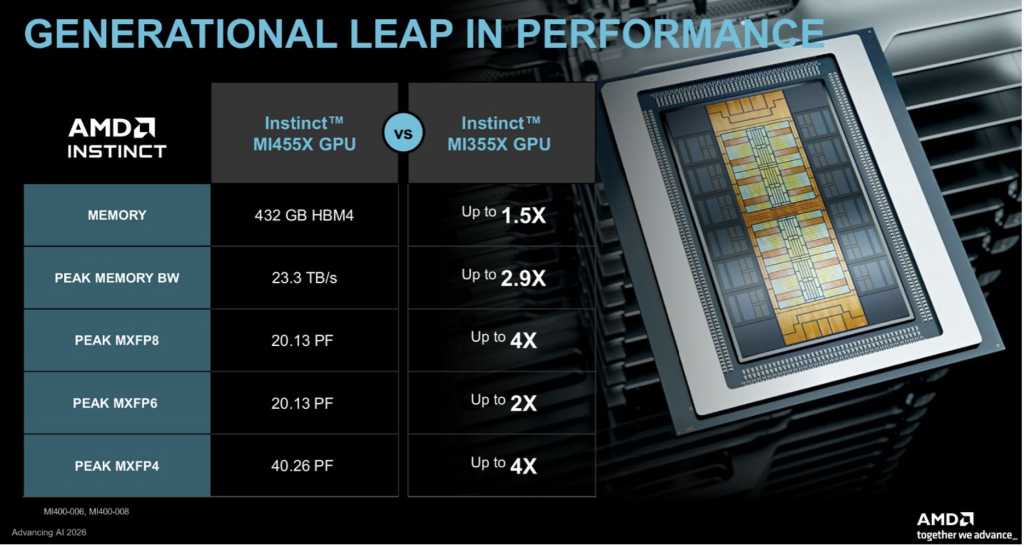
The Instinct MI455X GPU is the compute engine that fuels the Helios rack, and the first GPU based on AMD’s new CDNA 5 architecture. Built with a modular mix of 2nm and 3nm chiplets, it carries 432GB of HBM4 and 23.3TB/s of peak memory bandwidth.

Compared to AMD’s current MI355X, the MI455X offers 1.5 times the memory capacity, up to 2.9 times the peak memory bandwidth and up to four times the peak matrix performance with MXFP4 and MXFP8 data types, which are lower-precision numerical formats designed to accelerate AI processing while reducing memory demands. With MXFP6 (6-bit floating point), performance is rated at up to twice that of MI355X.

AMD also shared some actual, measured internal results using production silicon. The company claims MI455X delivers 3.8 times higher FP8 decode performance, 3.5 times more measured FP4 compute performance and between 2.5 and 3.5 times more networking bandwidth than MI355X, depending on the transfer path tested. Those figures provide more context than just numerical specifications, though they remain AMD-provided comparisons that will need independent validation.

AMD Instinct chart showing generational leap in performance

AMD

The architectural choices behind the numbers are important. Reasoning models and long context windows require sizeable KV caches for maintaining AI attention states, while mixture-of-experts models frequently move large amounts of data across accelerators. MI455X should let more model data, activation states and cache remain local. New dedicated IP in hardware can transfer data while the GPU continues processing, and expanded cache and multicast capabilities are designed to reduce redundant data movement to further improve efficiency.

The aforementioned lower-precision formats can also raise throughput and reduce memory use, but model developers still have to determine where they can be applied without unacceptable accuracy loss.

AMD’s Helios rack takes aim at Vera Rubin

AMD Helios rack

Dave Altavilla

Helios is AMD’s primary rack-scale competitor to NVIDIA’s Vera Rubin platform. Each liquid-cooled rack combines 72 MI455X GPUs, 18 single-socket Venice host CPUs and Pensando networking technologies.

In its most complete, premium configuration, AMD rates Helios for 2.9 exaflops of low-precision AI compute, with 31TB of aggregate HBM4 capacity, 1.7PB/s of memory bandwidth, 260TB/s of bidirectional scale-up bandwidth and 43TB/s of scale-out bandwidth.

These are formidable figures, but they are technical specifications rather than actual application benchmarks. The more consequential development is AMD’s move from collections of eight-GPU servers to a 72-GPU shared-memory domain. Models too large for one node can operate across the rack without treating every exchange as a scale-out networking transaction, which benefits large-model inference as well as training.

AMD uses UALink over Ethernet, or UALoE, for an open standard scale-up fabric. Each MI455X provides 3.6TB/s of bidirectional scale-up bandwidth, while the complete rack delivers all-to-all connectivity through a single switch layer. AMD also claims six times more scale-out bandwidth per GPU than MI355X when MI455X is configured with three Pensando Vulcano 800 AI NICs.

While open standards give cloud providers more control over suppliers and system design, AMD and its partners now have to prove those components can deliver the predictable performance, reliability and deployment experience customers expect from a tightly controlled, more vertically integrated platform.

Finally, AMD designed Helios with automatic rerouting around failed links, virtual rack partitions, tray-level serviceability and rack-wide power, cooling and health monitoring. Major hyperscalers and potentially large-scale enterprise customers will likely key in on these capabilities, which can affect the availability, total cost and consistency of the AI services they consume.

Kind of like cowbell, AMD Venice gives agentic AI more CPU

Chart showing AMD EPYC CPU performance

AMD

AMD’s agentic CPU messaging regarding its upcoming Venice-based EPYC processors is mostly marketing speak, but the underlying requirement is very real. An AI agent can invoke retrieval, databases, security checks, code execution and other tools before a GPU generates a response. Running many agents concurrently increases the amount of conventional compute requirements surrounding the accelerators.

Venice scales to 256 Zen 6 cores with support for 512 threads, 16 memory channels, up to 1GB of L3 cache per socket, along with PCIe 6.0 and CXL 3.1 connectivity. AMD is also offering several Venice configurations for other applications, including general-purpose servers, high-frequency workloads, GPU hosts and high-density CPU sandbox systems used to execute agent tools.

Treating the CPU solely as a GPU host understates its role. Gateways, tokenization, vector search, databases and short-lived code execution stress different mixes of per-core performance, thread count, memory bandwidth and I/O. Specifically, AMD’s internal testing shows Venice significantly outperforming its current EPYC 9965 Turin CPU across five parts of the agentic AI pipeline, including gateway processing, context assembly, vector search, enterprise applications and short-lived tool execution. Individual gains vary by workload, but AMD details the overall generational improvement at up to a 1.7 times lift. As with the MI455X figures though, these comparisons come from AMD and will require independent validation.

Pensando networking and ROCm software advance

Keeping GPUs fed with data and coordinating traffic across racks directly affects utilization and operating costs. In fact, GPU utilization is a pretty sad state of affairs currently for some of the major frontier model providers.

As such, Pensando networking has become central to AMD’s roadmap. Helios can connect each MI455X to as many as three 800Gbps Vulcano AI NICs, while Salina DPUs handle front-end networking and infrastructure services.

On the software side, which is an equally critical component, AMD also introduced ROCm.AI, an AI-assisted development layer due to arrive in August. It includes reusable skills for coding agents, simplified management and Hyperloom, which can profile workloads, tune serving configurations, modify kernels and validate results.

These tools address two persistent AMD challenges: developer efficiency and ease of use, and software tuning. Automated optimization still has to produce repeatable gains without creating hard-to-maintain code, however. And while ROCm has progressed significantly over the last few years, NVIDIA’s CUDA retains an advantage in maturity, tooling and developer familiarity.

Customer commitments underscore rack-scale confidence

AMD now has commitments that give its MI450 generation and Helios considerably more weight. Meta and OpenAI have announced multi-generation agreements composed of up to 6GW of AMD compute capacity, with initial 1GW deployments planned for the second half of 2026.

Oracle plans a 50,000-GPU public cloud cluster beginning in the third quarter, while Microsoft will deploy Helios for Azure AI inference. Finally, just before the AMD event, Anthropic announced a strategic partnership for up to 2 Gigawatts of AMD-fueled AI compute, with its first gigawatt expected online in the first half of 2027.

Commitments of this scale reflect confidence in more than just MI455X performance. These customers are evaluating the complete architecture, including Venice CPUs, Pensando networking, ROCm software, rack integration, serviceability and AMD’s ability to deliver and execute across multiple product generations.

There is some financial alignment behind the agreements as well. AMD issued OpenAI performance-based warrants and committed to investing up to $5 billion in Anthropic. That context matters when evaluating these deals as market validation, but these planned deployments are substantial nonetheless and put Helios on a much stronger foundation as it begins shipping.

AMD expands its robotics and embedded foundation

AMD also expanded its physical AI portfolio, building on credible traction from its Xilinx-derived Kria adaptive system-on-modules and embedded technologies that are already powering robotics, machine vision and industrial automation applications.

The new Ryzen AI Embedded X100 combines up to 16 Zen 5 CPU cores, integrated Radeon graphics, a second-generation NPU and as much as 128GB of unified LPDDR5X memory shared across its compute engines. To me this looks a lot like a repackaging and optimization of the company’s Strix Halo platform, but with specific optimizations for the embedded space. Regardless, AMD is pairing X100 with the Kria AI Robotics Developer Platform, which includes a System Module or SOM, and a new Robotics Partner Network spanning hardware, software and platform providers.

Samples began shipping in June, with full production expected in the fourth quarter. This broader objective is to give developers a path across AMD x86 CPUs, GPUs, NPUs and FPGAs for real-time autonomous systems, rather than requiring them to assemble those hardware engines and software components independently.

Execution for AMD is now the test

AMD has assembled a credible platform for the burgeoning agentic AI market that’s blowing up currently with no signs of stopping. MI455X addresses memory and data movement, Venice handles dense agentic CPU workloads, Pensando networking connects global system resources, and ROCm.AI addresses software complexity. Finally, Helios assembles these components into a true competitive threat for NVIDIA’s latest Vera Rubin platform.

AMD’s open architecture may appeal to customers seeking supplier choice, but openness must also translate into reliable deployments, competitive total cost and software that does not require a significant rip-up. NVIDIA enters this cycle with a stronger ecosystem and far more rack-scale deployment experience. The true test will be how easily and reliably customers can integrate, operate and maintain these AMD solutions at scale.

As it stands, AMD now has major customers and a clearly defined architecture with systems engineering expertise behind it. Delivering Helios on schedule and showing that its performance claims translate into a real production workload throughput advantage and total cost of ownership gains will determine how much the competitive gap narrows. And of course, this is in a market that is clamoring for ever-more compute resources with a seemingly insatiable demand for AI services and capacity. That’s an environment for big iron success. Now AMD just has to deliver optimized, turnkey AI platforms. This is far easier said than done, but time will soon tell as deployments take shape this year.

This article is published as part of the Foundry Expert Contributor Network.
Want to join?

  •  

Google CEO distracts from Gemini 3.5 Pro delay with talk of Gemini 4 and monthly releases

Google CEO Sundar Pichai has sought to allay concerns over the delayed release of the Gemini 3.5 Pro large language model. He dodged questions about it in Google’s quarterly earnings call on Wednesday by focusing on the company’s next frontier AI model, Gemini 4, and plans to release subsequent LLMs at an almost monthly cadence.

His comments came a day after Google unveiled Gemini 3.6 Flash and 3.5 Flash Cyber but offered no update on the release of Gemini 3.5 Pro, the company’s delayed flagship reasoning model that many developers had expected to arrive weeks earlier.

Google introduced the Gemini 3.5 family at its annual I/O conference, promising to release the Pro model in June. That timeline has since slipped, with Bloomberg suggesting Gemini 3.5 Pro is months late because the model’s coding performance is falling short of internal expectations, especially when compared to better performance by similar models from OpenAI and Anthropic.

Instead of revisiting the Gemini 3.5 Pro timeline, Pichai used the earnings call to shift the discussion toward Gemini 4, when asked about how his company planned to navigate an increasingly competitive race to release frontier AI models by to Barclays Investment Bank analyst Ross Sandler.

“We are creating a baseline on top of which you will see us rapidly iterate on subsequent model releases. And so picking up pace and releasing models almost at a monthly cadence is part of our road map as we are building Gemini 4 as well,” Pichai said during the call.

Sandler’s question followed one from JPMorgan Chase & Co analyst Douglas Anmuth, who asked Pichai if Google was releasing frontier AI models frequently enough to keep pace with rivals OpenAI and Anthropic.

Pichai had responded to Anmuth’s question that Google remained confident of competing at the frontier and was investing heavily in a larger Gemini 4 base model.

Analysts, though, aren’t as confident as Pichai.

While delays to Google’s frontier model roadmap have not triggered an exodus of existing customers, either because of high switching costs or because many enterprises already running multi-model architectures, they have made CIOs evaluating AI platforms more cautious about making new commitments, said Bhupendra Chopra, chief revenue officer at IT consulting firm Kanerika.

A monthly model release cadence could prove to be a double-edged sword for enterprises and their CIOs.

While a monthly release cadence could help enterprises gain faster access to improvements in model performance, cost and capabilities, it will also require CIOs to invest more heavily in testing, governance and version management to safely adopt those updates, said Sanchit Vir Gogia, chief analyst at Greyhound Research.

Similarly, Pareekh Jain, principal analyst at Pareekh Consulting, said enterprises will embrace a faster release cadence only if each successive model delivers measurable improvements in performance, cost or safety, rather than simply changing version number.

The challenge for CIOs, Jain said, is not just keeping up with model releases; it’s deciding whether each new version is worth the cost of validating it.

This article first appeared on InfoWorld.

  •  

MacBook Neo’s success wasn’t luck, it was a plan

It’s difficult to ignore the fact that Apple seems to have turned its MacBook Neo into a weapon to promote platform growth, with enough performance under the hood to make competitors seem inferior.

And even as the PC industry moves to try to compete with Apple’s last huge Mac success, the company is already planning a powerful follow-up.

That points to the discipline Apple has applied to the Mac since the introduction of Apple Silicon. The company has built a clear product roadmap, strong entry-level pricing, and steady performance gains. This focus is now paying dividends, giving people the impetus to keep placing their trust in Apple and its Macs — even as the industry raises prices in the face of RAMageddon and price increases. 

The numbers don’t lie

“Apple’s recent price increase seems to be an inevitable response to these cost increases. In the second half of the year, other PC OEMs are expected to continue to raise prices, and the overall ASP increase is expected to continue,” Counterpoint said in a post Wednesday. The researcher tells us global PC shipments shrank 4% in the second quarter of 2026 as rising costs hit demand. The Mac maker, by contrast, moved in the opposite direction, generating 13% growth in the quarter — mainly on the back of the MacBook Neo introduction. 

Recent IDC data gives Apple 10.1% year-over-year growth and just under 10% (9.9% to be exact) of the worldwide PC market, even as the overall market declined 4.9%.

“With emerging supply chain and tariff challenges inflating memory prices…, Apple’s incredibly aggressive price-point for the MacBook Neo makes its release feel all the more like a gut punch to one of the PC market’s most valuable price tiers,” Futurum Research Director Olivier Blanchard said when the Neo was released. 

Neo 2.0 is already coming

In the immediate future, as competitors raise prices on the PCs that compete with Apple’s lower-cost device, Cupertino is already plotting the path toward MacBook Neo 2. Reports claim this will debut in March in new colors and use the A19 Pro chip from the iPhone 17 Pro, with performance boosted by slightly more unified memory (12GB, rather than 8GB). That’ll make it a much better Mac, likely with 10-15% performance gains and the ability to run Apple Intelligence, making it the best and most affordable AI PC in its class.

Just four months after the Neo’s rollout, Apple is already in position to leak rumors of an even more computationally capable follow-up, while competitors struggle to compete with the original on performance, build quality, and price. Still, the Neo might get more expensive, reporting warns, with the lowest-price 256GB model now gone, making the $599 Mac a mirage we can only wistfully hope to see again. 

That might matter less in context, as PC makers everywhere boost prices while RAM, chips, and storage prices head north, along with transport, logistics, and energy costs. “While [Apple] did raise prices in line with the broader market, it still remains well positioned against rivals facing the same cost pressures,” said Jean Philippe Bouchard, vice president for consumer devices at IDC. 

“As market conditions continue to worsen, the importance of supply chain management and capabilities are increasingly important,” Bouchard said. “The largest vendors, with their buying power and long-standing supplier ties, are best positioned to take share from smaller rivals.”

This was never about luck

This isn’t solely a market take about competition, it’s about planning.

Few in the industry seemed prepared for the massive memory price increases that hit this year. Apple clearly planned its low-cost Mac well before that happened, hoping to seize the PC market at the low-mid-range. This is precisely what it seems to have done, what it continues to do, and what it will continue to do.

The recent reports that it has a successor planned shows the breadth of the Mac company’s strategic vision, as Apple has quite clearly sought to fully exploit the failings of Windows and the internal contradictions of a value-conscious industry in stiff competition with itself.

With the first M-series Macs about to enter the replacement cycle, Apple has built a market it can capitalize on for at least a decade, meaning it already has a vision for PC sales that extends at least as far. That’s the kind of road map corporate purchasers want when they make platform deployment decisions, which is why Apple’s 10% share gains are the beginning of even more significant market change. 

You can follow me on social media! Join me on BlueSky,  LinkedIn, Mastodon and subscribe to my daily Apple-related news summaries at The Core.

  •  

OpenAI Presence raises new questions about enterprise automation and jobs

OpenAI has launched Presence, an enterprise service for deploying voice and chat agents that can resolve customer and employee requests, potentially automating some work now handled by frontline support teams.

The agents can answer questions and operate IT systems, and enterprises can decide what actions the agents may take and when they should seek human approval for actions or transfer a case to a human.

OpenAI is already using Presence internally for its English-language phone support channel, where it verifies callers and uses account information to complete approved actions. The company said the system resolves 75% of inbound issues without human assistance.

Another OpenAI service, Codex, can be used to monitor agents and suggest updates or improvements to processes. In OpenAI’s own tests, suggestions from Codex helped reduce handoffs to humans by 15 percentage points over 10 days, it said. Presence also includes simulation and evaluation tools that allow companies to test an agent before deployment. The tests assess whether it reaches the correct outcome, follows company policy, and hands a case to an employee when required.

OpenAI intends each Presence deployment to deal with one kind of task, for example billing issues, insurance claims, or employee IT service requests, with agents getting only the knowledge and system access required for that task.

Presence is not a self-service product: Enterprises will have to sign up for the limited availability program, with integration performed by OpenAI or selected global systems integrators.

Companies exploring or testing Presence include Spanish bank BBVA, which is evaluating the service for everyday banking support in Mexico, and Japanese technology group SoftBank, which is using it in trials involving Japanese-language customer interactions. Australian insurer IAG is assessing whether the technology can help it respond to surges in customer demand during severe weather events.

Workforce impact

OpenAI’s announcement did not address the potential effect of Presence on employment. But its claimed automation rate raises questions about how the technology could affect staffing in customer service and other support functions.

Pareekh Jain, CEO of Pareekh Consulting, said CIOs should regard the 75% figure as evidence that the technology can work, rather than as a benchmark that every enterprise can expect to reach.

Jain said OpenAI’s deployment benefits from being built around the company’s own products and data. Large enterprises may achieve lower automation rates because they must contend with fragmented legacy systems, uneven knowledge bases and more complex compliance demands.

“Most organizations should expect lower initial automation levels that improve over time as the AI agent is refined,” Jain said.

The first workforce effect is more likely to be slower hiring than immediate layoffs, according to Tulika Sheel, senior vice president at Kadence International.

“The roles most exposed are likely to be repetitive, high-volume functions such as frontline customer support and routine back-office processing,” Sheel said. “However, I would expect the first impact to be on hiring and team growth rather than immediate large-scale job cuts. Over time, enterprises may redesign roles around AI-assisted workflows, with humans focusing more on complex cases, escalation, and relationship management.”

Jain said Tier-1 support agents handling predictable queries would face the most exposure. Broader reductions would become more likely only after companies reorganize their operations around the technology.

However, Lian Jye Su, chief analyst at Omdia, said Presence is unlikely to increase the threat of job displacement because companies have used similar customer-support automation from vendors such as Genesys, NiCE, Five9 and AWS for years.

Enterprises are more likely to use Presence alongside employees, with AI handling routine requests while people remain responsible for work requiring judgment and empathy, Su said.

Cost and operational risks

Analysts said CIOs should examine whether Presence can maintain resolution quality as usage grows, since fewer human handoffs could leave employees dealing with a more difficult mix of cases.

“The key question is not simply how many tasks AI can handle, but whether it can handle them reliably at scale,” Sheel said.

The financial case will depend partly on the cost of connecting Presence to existing systems and maintaining the controls needed to govern its use, according to Jain. “Often the biggest cost of enterprise AI is not tokens but integration and governance,” Jain added.

Companies will need to determine what systems and data the agents can access, monitor their performance, and audit the actions they take. Those investments could offset early savings.

Su said the complexity of enterprise IT will make it difficult for OpenAI to automate entire workflows on its own. Enterprises will still need to work with other technology providers and human employees, while CIOs will favor systems that can be audited and integrated with existing infrastructure.

Jain said the economics could improve if companies use the same integrations and governance controls across additional workflows.

This article first appeared on CIO.

  •  

Tech layoffs: A 2026 timeline

Among a range of factors leading to a wave of tech sector layoffs in 2026 is the rapid rise of artificial intelligence and automation. Companies are reconfiguring their workforces to leverage AI for increased efficiency and reduced operating costs. This realignment and reduction is implemented even by companies reporting strong financial performance.

But it’s not just AI leading to workforce cuts. Complementing this technological shift are ongoing economic uncertainty, inflation, and higher interest rates, compounded by a chip shortage and rising energy costs. This mix is driving companies to cut costs and streamline operations for increased efficiency.

According to data compiled by Layoffs.fyi, an online tracker that keep tabs on job losses in the technology sector, 123,941 tech employees were laid off at 269 companies in 2025. The site also reports that 71,981 government employees were laid off by DOGE alone, with 182,528 total federal workers laid off.

Here is a list — to be updated regularly — of some of the most prominent technology layoffs the industry has experienced recently.

Notable tech layoffs in 2026

  • Monday.com
  • Microsoft
  • Meta
  • Cisco
  • Cloudflare
  • Oracle
  • Atlassian
  • Salesforce
  • Amazon
  • Ericsson

July 22, 2026: Monday.com cuts 20% of its workforce to restructure for the AI era

The company says the decision to cut 620 jobs isn’t about margins, but about creating a flatter organization built around AI agents, autonomous teams, and deeper customer engagement.

July 6, 2026: Microsoft cuts 4,800 jobs, primarily in sales and Xbox teams

As the company trims thousands of jobs, it’s also investing in embedded engineering teams and AI infrastructure. The layoffs come several weeks after the company offered 8,750 US employees voluntary retirement buyouts.

June 5, 2026: Tech industry cut 38,242 jobs in May, worst since 2024

AI was blamed for 40% of the job cuts in May, up from 7% in January, according to research by employment placement company Challenger, Gray & Christmas.

May 20, 2026: Meta cuts 8,000 jobs, around 10% of workforce

The cuts are expected to expected to hit Meta’s engineering and product teams the hardest, arriving as Meta pivots toward AI to boost efficiency across its organization, according to Yahoo Tech.

May 13, 2026: Cisco to cut nearly 4,000 jobs despite strong growth in AI, enterprise networking

Despite reporting positive financial news — including record third-quarter revenue of $15.8 billion, a 12% year-over-year increase — Cisco said it will eliminate almost 4,000 jobs.

May 7, 2026: Cloudflare to cut 1,100 jobs in AI-focused restructuring

About 20% of Cloudflare’s global workforce will be culled as the company pivots for the agentic AI era, Reuters reported.

April 1, 2026: Oracle to cut up to 30,000 jobs globally, putting enterprise support and roadmaps at risk

Oracle began laying off employees on March 31 in what could be the largest workforce reduction in the company’s history. Employees received termination emails at 6 a.m. local time with immediate system lockouts and no prior warning. (Note: in June, CNBC put the final layoff tally at 21,000.)

March 12, 2026: Atlassian cuts 1,600 jobs to fund AI and enterprise expansion

Atlassian will reduce its global workforce by approximately 10%, eliminating around 1,600 roles, as the collaboration software maker redirects capital toward artificial intelligence development and enterprise sales.

March 11, 2026: Tech layoffs surpass 45,000 in early 2026

A recent analysis by RationalFX found 45,363 job cuts globally so far this year—with roughly 68% or more than 30,000 occurring in the U.S. — highlighting ongoing workforce cuts even as many tech companies report strong revenue growth.

February 10, 2026: Salesforce lays off staffers as executive leadership churn continues

Salesforce has reduced close to 1,000 roles earlier this month across teams, including marketing, product management, data analytics, and its Agentforce AI unit, Business Insider reported, quoting employees familiar with the matter.

January 23, 2026: Amazon layoffs expected to disproportionately hit AWS and tech talent

As the market slows down, AWS and other Amazon units are preparing for another round of layoffs, which is expected to overwhelmingly impact tech talent. An email from HR leader Beth Galetti on Jan. 28 confirmed 16,000 job cuts.

January 15, 2026: Ericsson plans to shed 1,600 jobs in Sweden

 Ericsson lans to cut some 1,600 jobs in Sweden, the telecommunications equipment maker said doubling down on recent cost-saving measures that have helped it weather a prolonged downturn in telecoms spending, Reuters reports.

January 13, 2026: Meta plans to cut around 10% of employees in Reality Labs business

Meta plans to cut around 10% of the employees in its Reality Labs division who work on products including the metaverse, according to three people with knowledge of the discussions, according to The New York Times.

Layoffs in 2025

  • Cisco
  • Oracle
  • Windsurf
  • Intel
  • Microsoft
  • Crowdstrike
  • HPE
  • Autodesk
  • HPE
  • CISA
  • Workday
  • Salesforce
  • Meta

Global tech-sector layoffs surpass 244,000 in 2025

Economic uncertainty, elevated interest rates, and AI adoption have driven workforce reductions across tech companies worldwide, according to a RationalFX report.

October 28, 2025: Amazon to cut 14,000 jobs across company

Amazon will reduce its overall workforce by 14,000, cutting layers of management across the company and hiring in some areas to support its “biggest bets”.

August 18, 2025: Cisco and Oracle to cut hundreds of Bay Area jobs

Tech companies Cisco and Oracle are cutting hundreds of jobs across the Bay Area. Cisco will eliminate 221 positions at its Milpitas and San Francisco offices, effective Oct. 13. Oracle is reducing 101 positions in Santa Clara on the same date 

August 5, 2025: 3 weeks after acquiring Windsurf, Cognition offers staff the exit door

Cognition, the AI coding startup that acquired rival company Windsurf three weeks ago, laid off 30 employees last week and is offering buyouts to the roughly 200 remaining employees on the team, reports The Information.

July 25, 2025, Intel to lay off 22% of workforce, CEO Tan signals ‘no more blank checks’

Intel will reduce its workforce to 75,000 employees by the end of 2025 as new CEO Lip-Bu Tan implements sweeping changes designed to transform the struggling chipmaker

July 8, 2025, Intel layoffs begin: Chipmaker is cutting many thousands of jobs

Intel has begun laying off employees across the company. CEO Lip-Bu Tan told workers back in April to expect major layoffs at Intel in the coming months as the chipmaker slashes costs and overhauls its organization after years of technical setbacks and falling sales.

July 2, 2025: Microsoft will cut 9,000 workers

Microsoft will lay off about 9,000 employees, a source familiar with the workforce cut told CNBC.  The cuts will reportedly affect less than 4% of Microsoft’s global workforce and will impact different teams, geographies and levels of experience. This is the latest in a string of cuts the tech giant has made this year.

June 17, 2025: Intel looks to factory layoffs to return to profitability

Intel will lay off up to 20% of its manufacturing sector employees starting in July, according to media reports, as the company looks for options as it seeks a return to profitability. The cuts reportedly will be made around the world, but some of the layoffs will be closer to home, according to a report in The Oregonian citing an internal company memo from Intel manufacturing Vice President Naga Chandrasekaran.

May 7, 2025: CrowdStrike to lay off 5% of staff

CrowdStrike announced a plan to cut about 500 roles, roughly 5% of its workforce, to streamline operations and reduce costs. The cybersecurity company will incur about $36 million to $53 million in charges related to the layoffs

March 6, 2025: HPE cuts 2,500 jobs, remains committed to Juniper buy

CEO Antonio Neri told Wall Street analysts that HPE would begin implementing a cost-cutting program involving layoffs of about 2,500 employees over the next 18 months. HPE employs about 61,000 people worldwide.

Feb. 27, 2025: Autodesk to lay off 9% of workforce

Software maker Autodesk is laying off 1,350 staff. With the rise of subscription and multi-year contracts billed annually, and self-service enablement, it finds it needs fewer sales staff, CEO Andrew Anagnost said in a message to employees. And with its cloud, platform, and AI products proving most profitable, it’s concentrating its staff and investments there.

Feb. 27, 2025: HP to lay off 2,000 more

As part of an ongoing restructuring, HP plans to lay off up to another 2,000 workers. In recent weeks, the company has tried — unsuccessfully — to do away with telephone support staff by forcing callers to wait for at least 15 minutes if they refuse to use self-service support resources online. The company swiftly backtracked, but wider job cuts are still on.

Feb. 21, 2025: CISA lays off 130

Government employees get laid off too: In this case, 130 workers at the US Cybersecurity and Infrastructure Security Agency are being shown the door as a result of a DOGE decision. Cybersecurity experts are concerned that the cuts will harm the international collaborations that CISA has fostered, quite apart from their concerns about the security of the DOGE layoff process itself.

Feb. 5, 2025: Workday lays off 1,750

As it moves to invest more in AI and international growth, Workday is laying off 8.5% of its workforce and disposing of unused office space. Some analysts fear the cutbacks will affect the company’s customer service — unless AI can pick up the slack.

Feb. 4, 2025: Salesforce lays off over 1,000

At the same time as it’s hiring sales staff for its new artificial intelligence products, Salesforce is laying off over 1,000 workers across the company, according to Bloomberg. As of June, 2024, the company had over 72,000 employees, according to its website. Salesforce did not comment on the report. In 2024 the company reportedly laid off around 1,000 staff too, in two waves: January and July.

Jan. 14, 2025: Meta will lay off 5% of workforce

Mark Zuckerberg told Meta employees he intended to “move out the low performers faster” in an internal memo reported by Bloomberg. The memo announced that the company will lay off 5% of its staff, or around 3,600 staff, beginning Feb. 10. The company had already reduced its headcount by 5% in 2024 through natural attrition, the memo said. Among those leaving the company will be staff previously responsible for fact checking of posts on its social media platforms in the US, as the company begins relying on its users to police content.

Tech layoffs in 2024

  • Equinix
  • AMD
  • Freshworks
  • Cisco
  • General Motors
  • Intel
  • OpenText
  • Microsoft
  • AWS
  • Dell

Nov. 26, 2024: Equinix to cut 3% of staff

Despite intense demand for its data center capacity, Equinix is planning to lay off 3% of its workforce, or around 400 employees. The announcement followed the appointment of Adaire Fox-Martin to replace Charles Meyers as CEO and the departures of two other senior executives, CIO Milind Wagle and CISO Michael Montoya.

Nov. 13, 2024: AMD to cut 4% of workforce

AMD will lay off around 1,000 employees as it pivots towards developing AI-focused chips, it said. The move came as a surprise to staff, as the company also reported strong quarterly earnings.

Nov. 7, 2024: Freshworks lays off 660

Enterprise software vendor Freshworks laid off around 660 staff, or around 13% of its headcount, despite reporting increased revenue and profits in its fourth fiscal quarter. The company described the layoffs as a realignment of its global workforce.

Sept. 17, 2024: Cisco lays off 6,000

After laying off around 4,200 staff in February, Cisco is at it again, laying off another 6,000 or around 7% of its workforce. Among the divisions affected were its threat intelligence unit, Talos Security.

Aug. 20, 2024: General Motors lays off 1,000 software staff

More than 1,000 software and services staff are on the way out at General Motors, signalling that it could be rethinking its digital transformation strategy. In an internal memo, the company said that it was moving resources to its highest-priority work and flattening hierarchies.

August 1, 2024: Intel removes 15,000 roles

Intel plans to cut its workforce by around 15% to reduce costs after a disastrous second quarter. Revenue for the three months to June 29 stagnated at around $12.8 billion, but net income fell 85% to $83 million, prompting CEO Pat Gelsinger to bring forward a company-wide meeting in order to announce that 15,000 staff would lose their jobs. “This is an incredibly hard day for Intel as we are making some of the most consequential changes in our company’s history,” Gelsinger wrote in an email to staff, continuing: “Our revenues have not grown as expected — and we’ve yet to fully benefit from powerful trends, like AI. Our costs are too high, our margins are too low. We need bolder actions to address both — particularly given our financial results and outlook for the second half of 2024, which is tougher than previously expected.”

July 4, 2024: OpenText to lay off 1,200

OpenText said it will lay off 1,200 staff, or about 1.7% of its workforce, in a bid to save around $100 million annually. It plans to hire new sales and engineering staff in other areas in 2025, it said.

June 4, 2024: Microsoft lays off staff in Azure division

Microsoft laid off staff in several teams supporting its cloud services, including Azure for Operations and Mission Engineering. The company didn’t say exactly how many staff were leaving.

April 4, 2024: Amazon downsizes AWS in a fresh cost-cutting round

Amazon announced hundreds of layoffs in the sales and marketing teams of its AWS cloud services division — and also in the technology development teams for its physical retail stores, as it stepped back from efforts to generalize the “Just Walk Out” technology built for its Amazon Fresh grocery stores.

April 1, 2024: Dell acknowledges 13,000 job cuts

Dell Technologies’ latest 10K filing with the US Securities and Exchange Commission disclosed that the company had laid off 13,000 employees over the course of the 2023 fiscal year; it characterized the layoffs and other reorganizational moves as cost-cutting measures. “These actions resulted in a reduction in our overall headcount,” the company said. A comparison to the previous year’s 10K filing, performed by The Register, found that Dell employed 133,000 people at that point, compared to 120,000 as of February 2024. Dell announced layoffs of 6,650 staffers on Feb. 6, but it is unclear whether those cuts were reflected in the numbers from this year’s 10K statement.

See news of earlier layoffs.

  •  

Monday.com cuts 20% of its workforce to restructure for the AI era

Healthy software companies typically don’t suddenly eliminate one-fifth of their workforce, but monday.com is doing just that as it bets on flatter teams, AI agents, and customer implementation expertise as the winning combination in the AI era.

Monday.com co-founder and co-CEO Eran Zinman today announced the “very difficult decision” to reduce the AI work platform company’s global workforce by about 20%, or 620 people.

The move has nothing to do with increasing margins or replacing humans with AI, he insisted in his post on LinkedIn; rather, it’s a calculated decision to trim down and hone the company’s focus as AI becomes integral to day-to-day workflows.

“This is not a distress signal; it is a deliberate reset, disclosed with its price attached,” said Sanchit Vir Gogia, chief analyst at Greyhound Research. “The industry has quietly swapped the meaning of productivity, and this filing is the clearest exhibit yet.”

A ‘significant opportunity’ in technology

In a SEC filing this week, monday.com said its restructuring plan reflects the “ongoing transformation of its product, marketing, and go-to-market strategy.” The move is intended to support a “leaner, more focused operating model” as the company continues to invest in its AI-driven strategy.

Zinman noted in his post that the company has shifted to “doing the work with AI and not just managing it,” and is focused on building environments where “people and AI agents [work] together in one workspace.”

In recent months, monday.com has evolved its products, strategy, and the way it serves its customers, and Zinman contended that “the organization we built for our previous chapter is not the organization that fits the new AI era.” Monday.com needs to “execute more decisively,” take on new challenges, and quickly respond to market changes, he said.

“We have never seen such a significant opportunity in software, driven by such exciting technology,” Zinman noted. He emphasized that the reduction is not to replace people with AI, nor to improve margins; the “vast majority” of savings will be reinvested into talent, products, and AI.

The restructuring will result in a “flatter organization” with fewer management layers and smaller, more autonomous teams, and monday.com also has a new go-to-market model, Zinman explained. Customers expect “deeper implementation support” as they deploy AI, and the company will work more closely with customers, increase its on-site presence, create new roles, and “adapt many existing ones.” In its SEC filing, the company said it expects to continue hiring in “key strategic areas” throughout 2026.

Workers will be expected to work better, “not harder,” Zinman noted. He pointed to several past examples where work could have been done in a few days, but instead took many months with “multiple meetings and endless friction.”

“This wasn’t people’s fault and everyone was frustrated by this,” he said. “Our new org changes ownership to allow people to make decisions and move fast.”

A spokesperson for monday.com declined to comment further on the staff reductions.

Monday.com’s key market advantages

Monday.com certainly isn’t struggling; the company expects 19% to 20% year-over-year growth in 2026.

“Companies in that position do not restructure because they must,” Greyhound’s Gogia noted. “They restructure because they have decided to become something else.”

Melody Brue, VP and principal analyst at Moor Insights & Strategy, pointed out that organizational redesign is important for real AI transformation, but while it can signal confidence to the market, it can still be “devastating” to humans.

While the company looks as though it’s trying to do right, that ultimately remains to be seen, she said. “There are often hidden internal bruises that can surface long after layoffs.”

Monday.com’s advantage is in its “structured substrate,” Gogia noted; its boards, permissions and typed workflows give agents something firmer to act on than just documents and chat history. The company highlights its natively built agents that can be configured by any team member, as well as connectors with Claude, Microsoft Copilot, and ChatGPT, and dedicated routes for external agents to authenticate and operate.

“For some time, the sharper enterprise question has been shifting from who has an agent to who owns the governed runtime in which an agent can safely act,” he said. “Structured work is a serious claim on that runtime.”

But parts of monday.com’s agent estate remain in staged release, and its product is ultimately “mid-transition,” Gogia pointed out; its agent builder carried a beta label as recently as March,. Also, the company’s pricing model changed in May to a hybrid model charging for seats as well as mandatory AI credits. And, while its AI-powered no-code builder monday vibe passed $1 million in annual recurring revenue within two and a half months, monday.com has not released subsequent outcomes, usage volumes, or attach rates.

Further, there’s an element of “gravity” with its competitors, he observed. Asana is reorganizing teams around agents, Atlassian is wiring agents into the developer estate, and others are simply bundling them into their offerings: Microsoft is doing so across the productivity stack, and ServiceNow across enterprise operations, each with identity and procurement built in.

“Their pull is strongest exactly where monday.com wants to grow, in the largest accounts, where control-plane depth and administrative reach decide the deal,” said Gogia.

Actions for the near-term

Going forward, buyers should focus on operating risk, not headline risk, Moor’s Brue noted. In practice, that’s continuity of service, roadmap consistency, and strength of enterprise support. Productivity should be valued as better outcomes per unit of organizational effort, not mere activity.

“It should be a measure of how much smoother, faster, and more effective the operating model becomes when AI is built into the work,” said Brue.

Gogia noted that strain surfaces first in customer service, and monday.com’s attention is being redistributed. The company’s annual report disclosed that its focus is now concentrated on the largest accounts, with support for medium-sized clients moved to an AI-first and human-supported model.

During the first month of the transition, buyers should track named account continuity and escalation times, he advised. By the first quarter, keep an eye on whether credit governance and admin controls mature on schedule, and if the roadmap beyond the AI estate keeps pace. By the half-year mark, determine whether promised implementation depth is producing outcomes or “simply more billable engagement.”

Support tiers should be enumerated in writing before renewal, and buyers should contract for “side exits,” Gogia emphasized, with overage pricing fixed in advance, the right to pause consumption, and portability for workflows and agent configuration “if the relationship sours.” Finance should also insist on monthly consumption reporting by capability. Further, integration efforts, partner dependency, and change management should be considered first-class costs of the agent era, “not as afterthoughts to a license.”

“A license was a known cost,” said Gogia. “A meter is a behavior, and behavior is harder to forecast than headcount.”

This article originally appeared on CIO.com.

  •  

Own nothing, upgrade everything: Apple’s new Klarna deal

Just in time for the iPhone’s 20th anniversary, Apple is moving closer to becoming a service company. It is set to launch its new deal with Klarna next week and when it does, Apple enthusiasts in the US will effectively be able to subscribe to their favorite Apple hardware, with the cost spread across up to three years.

This matters because when combined with Apple One and Apple’s Creator Studio subscriptions, the Klarna arrangement brings Apple closer to offering a full subscription model for hardware, software, and services. The only thing you don’t get under the new arrangement is AppleCare, for which you’ll allegedly need to pay extra.

Moving closer to hardware-as-a-service

Apple has slowly been transitioning toward hardware-as-a-service for almost a decade. Back then, Forrester analyst Frank Gillet predicted the company would eventually offer bundles of services and products for a monthly, all-in, fee. 

This isn’t quite where we are yet; you still need at least three subscriptions to get close. But, after the better part of a decade, Apple has moved much nearer to the hardware-as-a-service idea.

There are some products reportedly excluded from the arrangement, including MacBook Neo, Apple Watch SE, the entry-level iPad, and iPhone 16. Clearly, Apple sees those products as sufficiently affordable. 

Easy payments for RAM-ageddon

The new Klarna arrangement comes as Apple is forced to increase product prices as AI-driven memory price inflation becomes widely felt across every economy. In theory, I assume, Apple hopes to make its products available to cash-strapped consumers who need new hardware, while also navigating a time of deep economic tumult and uncertainty. It’s thought the company has previously rejected these plans to protect normal hardware sales, but normality is a kingdom we no longer seem to possess. Interesting times. Probable inflation incoming.

“Apple Upgrade lands at precisely the moment Apple needs it,” IDC analyst Francisco Jeronimo wrote in a note seen by Computerworld. “Having just pushed Mac and iPad prices up on the back of the memory shortage, with iPhone increases widely expected in September — as well as the new iPhone foldable expected at $2,500 — Apple’s real risk is that rising prices even further can impact the upgrade cycle.” 

New age, new shopping habits

The introduction of the scheme gives consumers a way to purchase the company’s popular high-end devices when they are introduced — no doubt,at higher cost — this fall. Plus, of course, if it’s good enough for GM, it’s good enough for Apple.

It’s all about attitude, too. From Apple’s perspective, it has done plenty of the groundwork required to convince its customers that subscription payments for things you value are no bad thing. 

Reluctance to embrace “Access Not Ownership’”purchasing models has dropped dramatically since Apple — and CEO Tim Cook — first began banging the drum for services income. Apple’s services stream has now become its second-biggest revenue driver after the iPhone. It has over 1 billion paid subscriptions, and an active hardware installed base of more than 2.5 billion devices globally.

A combination of changed customer habits and external threat means the stars are now aligned for hardware-as-a-service models. “Reframing a device as a low monthly payment protects that [upgrade] cadence and allows Apple to start marketing their products as device-as-a-service to consumers, which no other vendor was ever able to do,” Jeronimo wrote to me. 

There is a one-more-thing aspect to this: the products are effectively being leased, a new approach that will give Apple a stronger grip on EOL devices, helping it grab more of them for refurbishment, resale, and recycling. Over time, this will give the company a much stronger grip on the lucrative second-user market that exists around Apple equipment, even while for almost every consumer product we find the life we want is something we can rent, but probably can’t afford to own.

Managing future risk

The other solid reason to take a partnership approach is risk management. Apple had intended to develop its own buy-now, pay-later scheme via Apple Pay Later, but abandoned that plan as it became riskier with rising bank rates. “Also, by backing the program with Klarna rather than reviving the in-house subscription plan it shelved in 2024, Apple captures the demand upside without taking the credit risk onto its own balance sheet,” Jeronimo said.

You can follow me on social media! Join me on BlueSky,  LinkedIn, Mastodon and subscribe to The Core.

  •  

10 cool things Copilot can do in PowerPoint

Building a presentation can take lots of time. There are design choices to figure out: the slide layouts, fonts, theme colors, and so on. You can use a template to skip this hassle, but you still have to paste your text and other content into the slides and edit it all so that the results are visually appealing.

In PowerPoint, Microsoft’s Copilot AI assistant can now automate the heavy lifting of presentation creation. It can generate a first-draft presentation in minutes, then help you edit it. You can also prompt Copilot to help you quickly understand the contents of a presentation and glean insights from it. Use the tips in this guide to save oodles of time as you create and work with presentations.

Who can use Copilot in PowerPoint

Individuals with a Microsoft 365 Personal, Family, or Premium subscription have access to Copilot from within PowerPoint and other Microsoft 365 apps. Users with a Premium plan have higher Copilot usage allowances and access to advanced AI features.

For business users, it’s more complicated. Organizations with more than 2,000 users must pay for Microsoft 365 Copilot licenses for their users in addition to their regular Microsoft 365 licenses. Users at organizations with fewer than 2,000 users can use Copilot within M365 apps even without the M365 Copilot add-on licenses, but there are limitations in usage, speed, and feature availability.

To see what kind of access you have, log in to Microsoft’s Copilot Chat web hub and look for your name in the lower left corner. If you see “M365 Copilot (Premium)” under your name, you can use Copilot in M365 apps with priority access and advanced features. “M365 Copilot (Basic)” means you can use Copilot in M365 apps with lower-priority access and limited features. If you see “Copilot Chat (Basic)” or nothing below your name, you can’t use Copilot in M365 apps.

(Copilot Chat Basic users do get some Copilot functionality, including the ability to generate presentations, via the Copilot Chat hub. See our Copilot Chat tutorial for details.)

In this article:

Working with Copilot in PowerPoint

First, let’s quickly go over the notable settings of the Copilot sidebar.

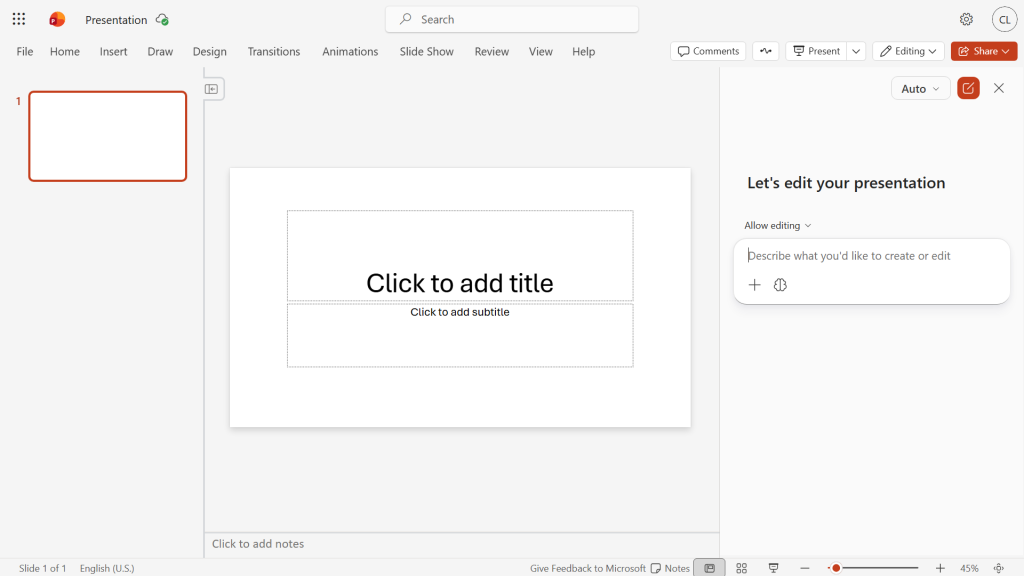
When you have a presentation open in PowerPoint, click the Copilot icon; it may be floating at the lower-right corner of your PowerPoint window or parked at the right end of the Ribbon toolbar. The Copilot sidebar will open along the right of the page. You’ll type your prompts to Copilot inside the chat window in this pane.

powerpoint screen with copilot sidebar open on right

The sidebar on the right is where you interact with Copilot in PowerPOint.


Howard Wen / Foundry

Agent mode: By default, Copilot can build a new presentation or make changes to an existing one in the main PowerPoint window. This is known as “agent mode.” To change this so that Copilot can’t take direct action on a presentation (all its responses appear in the sidebar), click the Allow editing button above the chat window and change it to Chat only.

The tips in this guide require that Copilot be in agent mode, so make sure you see Allow editing above the chat window.

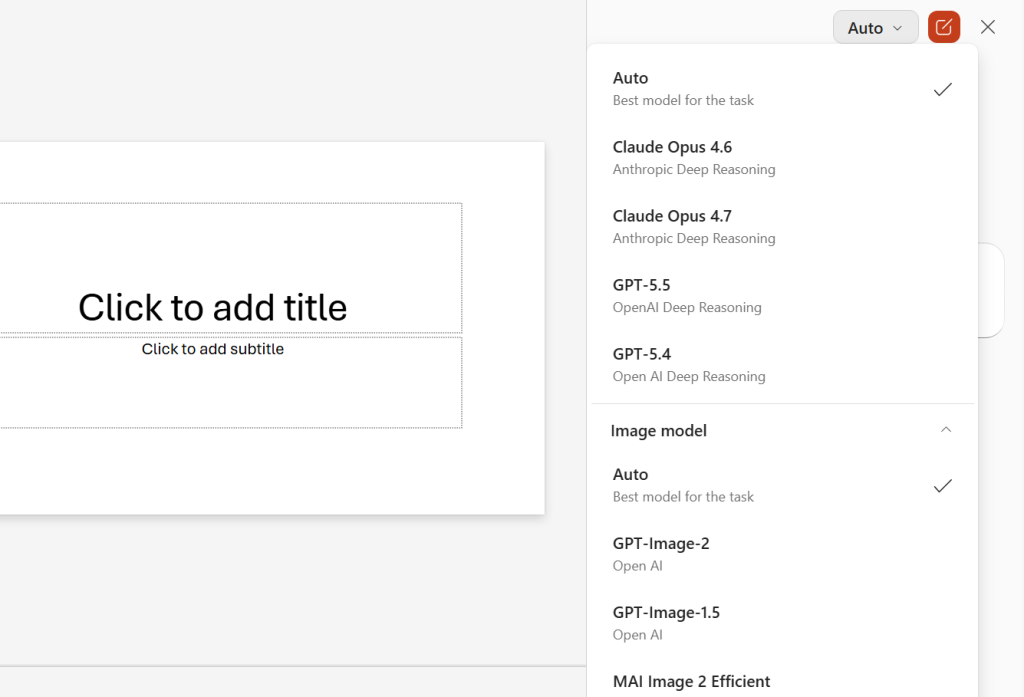
Choice of AI model: Behind the scenes, Copilot has access to various genAI models, including different versions of Anthropic Claude and OpenAI GPT.  By default, it decides which model to use based on your prompt. You can set it to use a particular model: click Auto at the upper right of the Copilot pane and select a model from the dropdown that opens.

screenshot of copilot sidebar in powerpoint with models dropdown menu open

You can choose which AI model you want Copilot to use for a request.

Howard Wen / Foundry

The tips in this guide should work fine on the default Auto setting. But feel free to experiment switching to specific models to see which give you the best results for particular tasks.

Important: Remember that generative AI output often includes errors, so always check Copilot’s output for accuracy. (Also see our tips for reducing hallucinations in Copilot.) You’ll likely want to rewrite it in your own voice as you’re reviewing it.

1. Create a presentation template

For many people, the hardest part of creating a presentation is getting started. What types of information should be included on the slides, and in what order? Copilot can give you a leg up by creating the type of presentation you need, with placeholder data that you can later replace with your own.

Start a new presentation, open the Copilot sidebar, and type your prompt into the chat window. It’s best to provide very specific details in your prompt. The more context or details you provide, the more likely Copilot will generate a presentation template that suits your needs.

A good prompt should contain the slide count, subject, audience, and tone. Example:

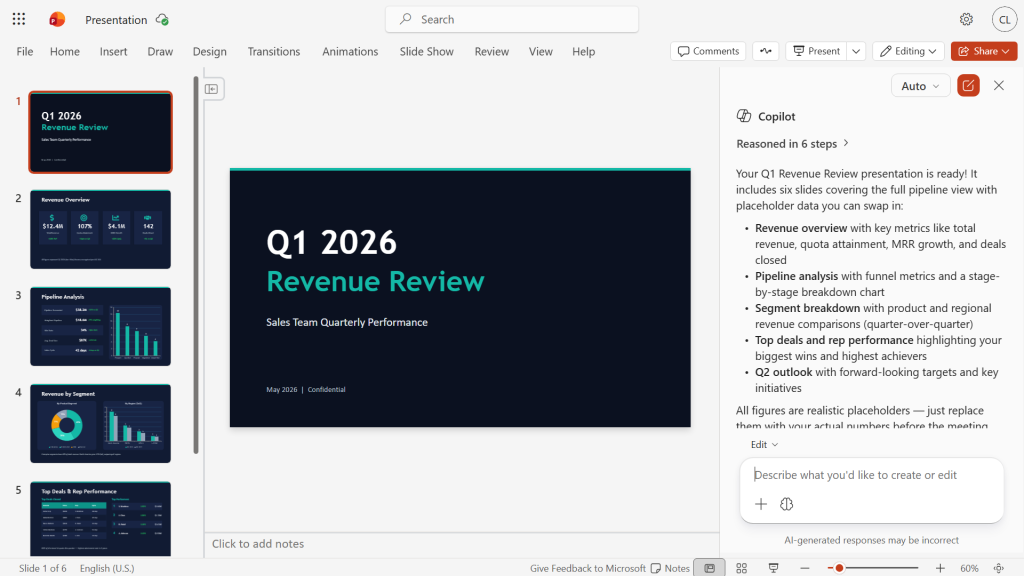
  • Create a 6-slide presentation for a sales meeting focusing on Q1 revenue. The audience is the sales team, so keep the tone professional and focused on the sales data.

Copilot may ask a series of follow-up questions, such as your preferred visual style and desired level of detail. Then it will generate a presentation template.

screenshot of powerpoint presentation generated by copilot with placeholder data

Copilot generates a presentation with placeholder data and explains its elements.

Howard Wen / Foundry

You can optionally prompt Copilot for revisions, and when you’re happy with the template, swap in your own data.

2. Create a presentation from a document

You can attach a document (such as a Word document, Excel spreadsheet, or PDF) and prompt Copilot to generate a presentation based on its contents. This works best with a structured-format document (such as a business plan, project proposal, or summary report) that contains sections with headings.

Copilot can extract the document’s text and structure to generate the slide content for the new presentation. This can especially be useful for quickly turning a long report into a visually appealing presentation.

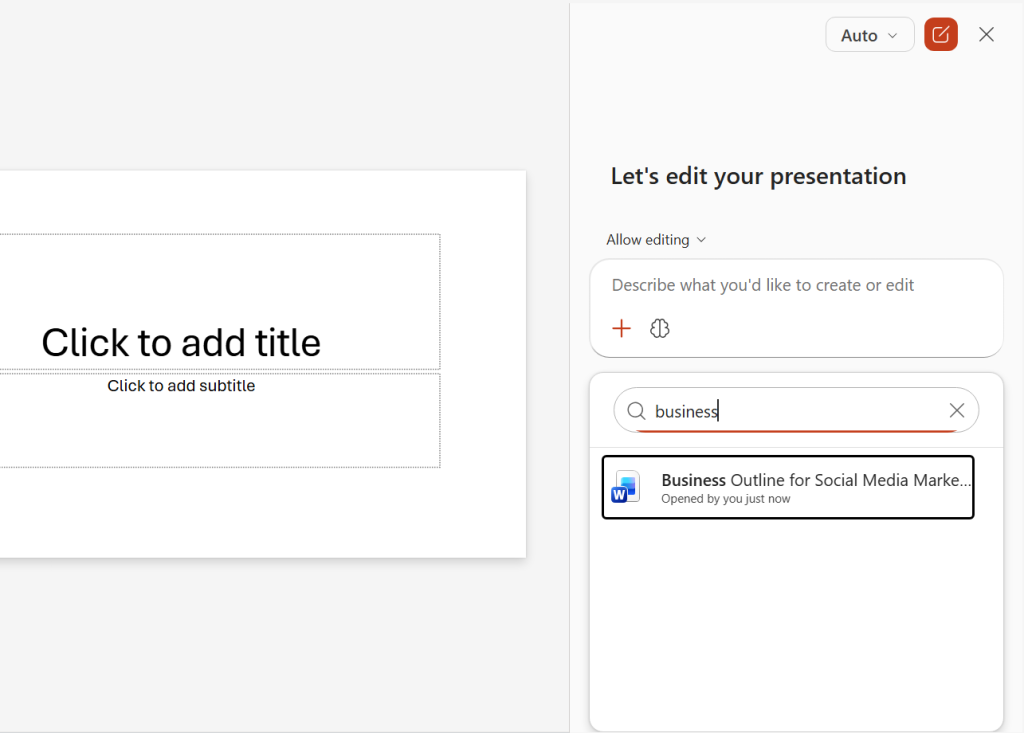
In the Copilot pane, click the + icon at the bottom of the chat window. A list of documents that you’ve recently accessed appears. Select the one that you want Copilot to use. Alternatively, click the magnifying glass icon and inside its search box, type a few letters of the filename for the document you want. (Business users with an M365 Copilot license can select up to five files for Copilot to pull from when creating a presentation.)

screenshot of copilot sidebar in powerpoint with a document being attached for copilot to base a presentation on

Attaching a document for Copilot to base a presentation on.

Howard Wen / Foundry

Then in the chat window, you can enter a prompt that’s as simple as “Create a presentation,” although as always, providing more details and context is better. This is especially important for corporate users who reference multiple source files. It’s useful to tell Copilot what data to pull from each document.

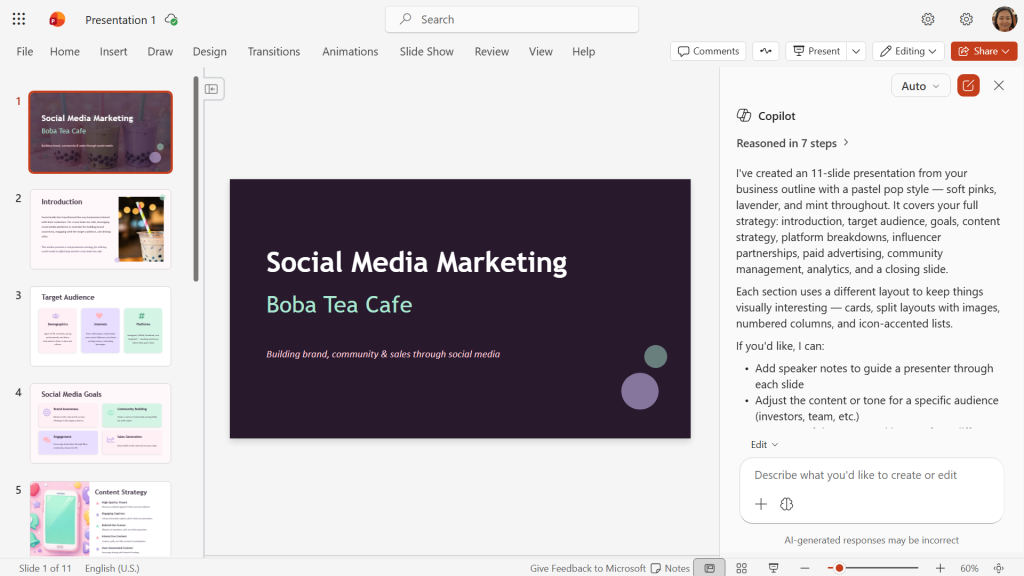
Answer any follow-up questions that Copilot asks, and it will then generate the presentation.

screenshot of powerpoint with a presentation generated by copilot from a document

Copilot has generated a professional presentation from a social media marketing campaign document.

Howard Wen / Foundry

Note: Your marketing department may have created one or more branded company templates for Copilot to work from. If that’s the case at your organization, simply open the appropriate company template as your first step. Then you can upload docs and type a prompt as described above. Copilot will create a presentation using the branded template.

3. Add content from a document to a slide

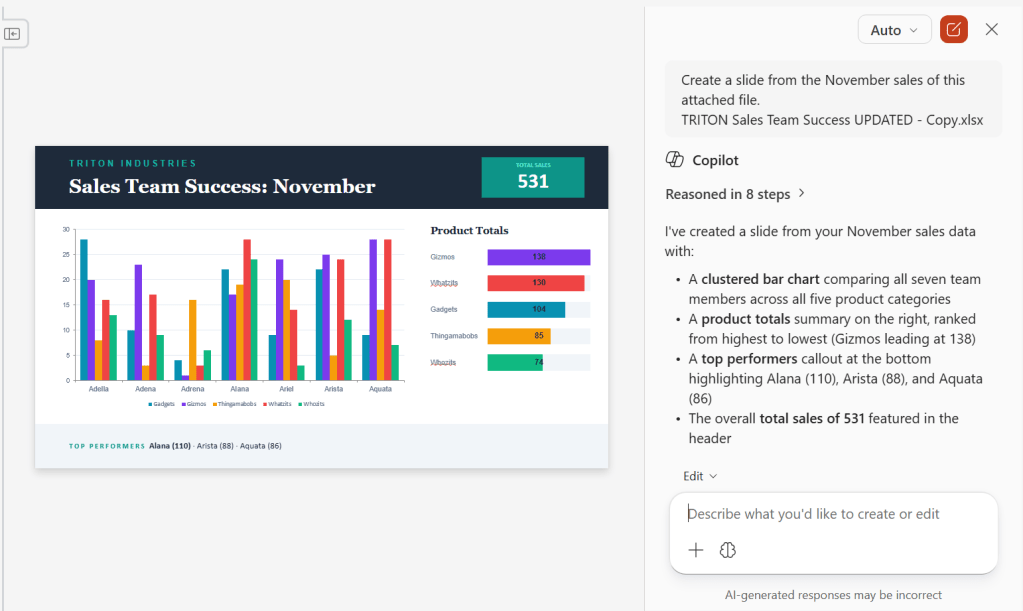
Manually copying text or other content from a document and pasting it into a new slide is a chore. Instead, you can prompt Copilot to extract information directly from a Word document, Excel spreadsheet, or PDF to create new slides.

In the Copilot pane, attach the document using the same steps described in tip 2, then tell Copilot to create a slide from the document. As always, it helps to provide details such as the new slide’s focus or what data to include:

  • Add a slide based on the attached document.
  • Use the attached file to add a slide about the project budget that focuses on Q1 projections.
  • Summarize only the financial section of the attached document as a slide.
screenshot of a slide in powerpoint generated by copilot from spreadsheet data

A new Copilot-generated slide based on data from an Excel spreadsheet.

Howard Wen / Foundry

4. Refine your slide text

A presentation should be visual and display only the core message. Conciseness and proper writing tone are essential for your slides, so that they don’t lose the attention of your audience.

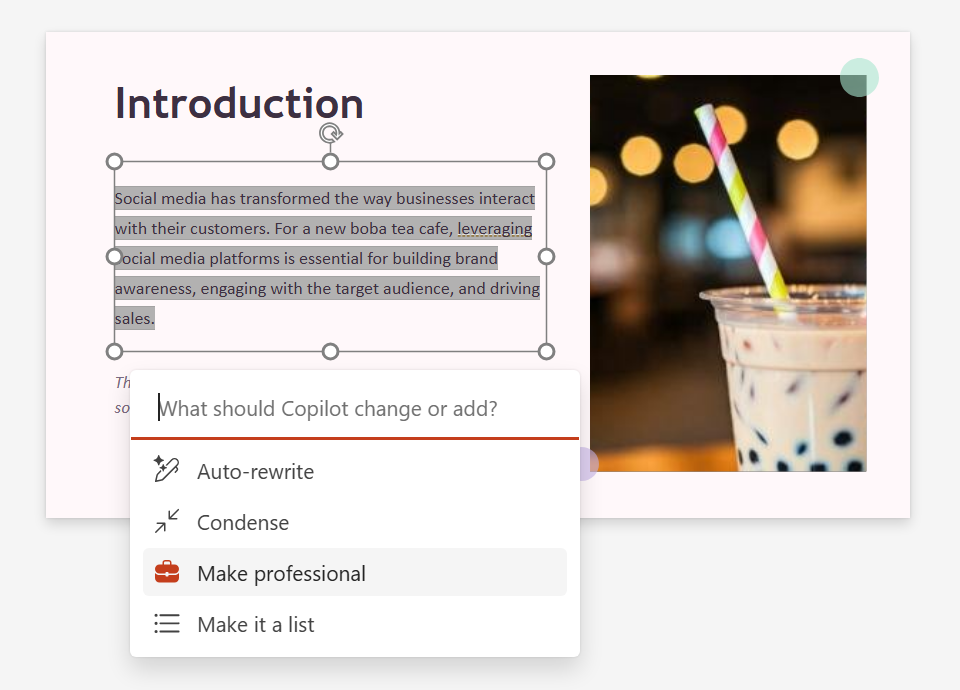
You can prompt Copilot to refine text on an individual slide in various ways, such as rewriting it in a more professional tone or making it more concise. Highlight the text inside a text box on the slide. On the toolbar that appears over the highlighted text, click Edit with Copilot.

On the menu that opens, you can select a preset prompt to refine the text, such as Condense or Make professional. Or, at the top of this menu, you can type a prompt to rewrite the highlighted text.

screenshot of text on a powerpoint slide with copilot dropdown menu includng condense and make professional options

Choose a preset prompt for refining text on a slide or type in your own prompt.

Howard Wen / Foundry

Note that this feature affects all the text inside the text box. To rewrite only a portion of text inside a text box, you must split that portion out into a separate text box.

Alternatively, you can prompt Copilot to analyze your entire presentation and tighten up the wording throughout all of its slides. For example:

  • Make these slides more visual and use less text.

5. Find or create an image

If you have Copilot generate a presentation from an existing Word document that contains images, it will incorporate those images into the presentation. If there are no images in the source document, you can ask Copilot to find or create one and add it to a slide.

To add a stock image or an image from your organization’s brand library, tell Copilot what you’re looking for:

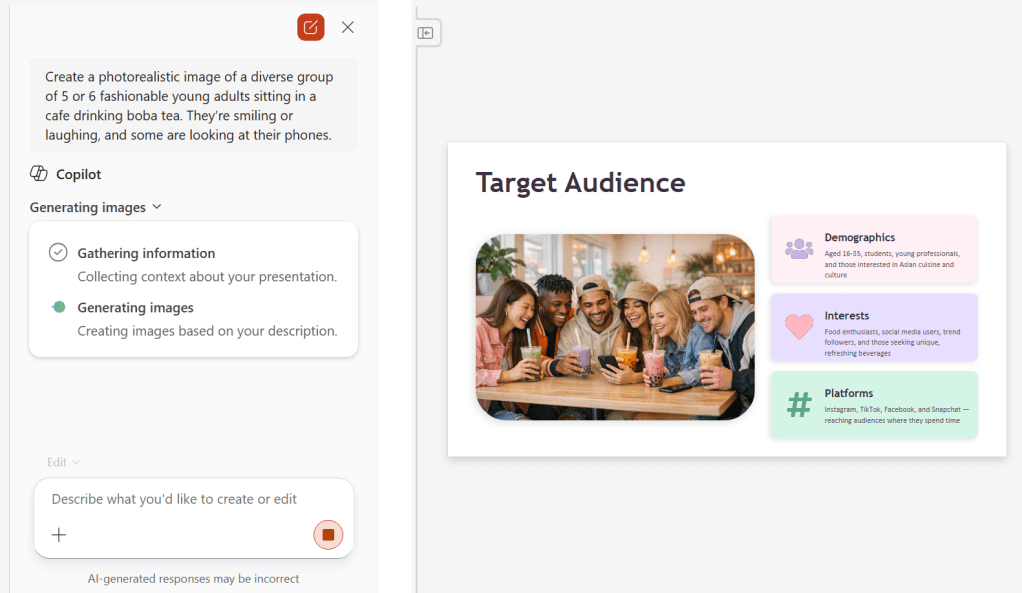
  • Add a stock photo of young adults in a cafe drinking boba tea.
  • Add a photo from our asset library of young adults in a cafe drinking boba tea.

To have Copilot create an image using Microsoft’s Designer image generation tool, describe your desired image. As always, specificity is helpful:

  • Create a photorealistic image of a diverse group of 5 or 6 fashionable young adults sitting in a cafe drinking boba tea. They’re smiling or laughing, and some are looking at their phones.
screenshot of image generation prompt in copilot sidebar in powerpoint plus the resulting generated image on a slide

Copilot in PowerPoint hooks into Microsoft’s Designer tool for image generation.

Howard Wen / Foundry

Just as you need to review any text output from Copilot, take a close look at generated images to be sure nothing looks off.

Also note that Copilot image generation isn’t always reliable in PowerPoint. For some time during our testing for this story, Copilot said it couldn’t create an image because “the image generation service is returning a server error on every attempt.” After about a day and a half, the service began working again.

6. Expand your presentation with relevant slides

As you’re building your presentation, you may find that it’s become text heavy. Or perhaps it could use more visually oriented slides to break things up and make its progression flow better. Copilot can generate and insert new slides that are based on the content of the slides already in the presentation.

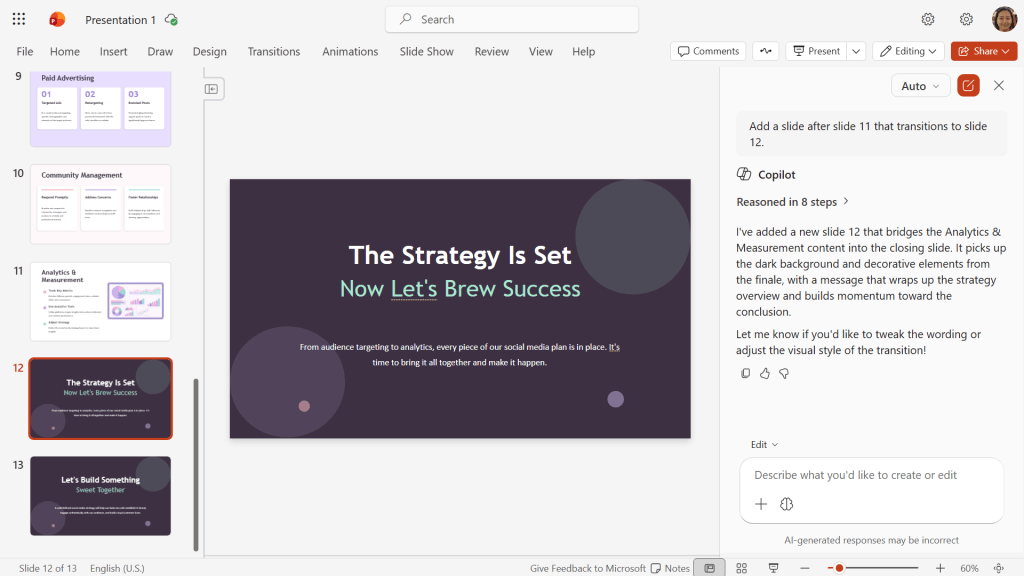
In the Copilot pane, specify exactly where you want the new slide to go. This helps Copilot to analyze the content of the slides before and after where you want the new slide. Then it can generate a slide to bridge between the two slides. Examples:

  • Add a slide after slide 3 about our competitive advantages.
  • Add a slide after slide 11 that transitions to slide 12.
screenshot of powerpoint screen with copilot sidebar and a transition slide generated by copilot

Need a transition slide? Just ask!

Howard Wen / Foundry

7. Summarize a presentation

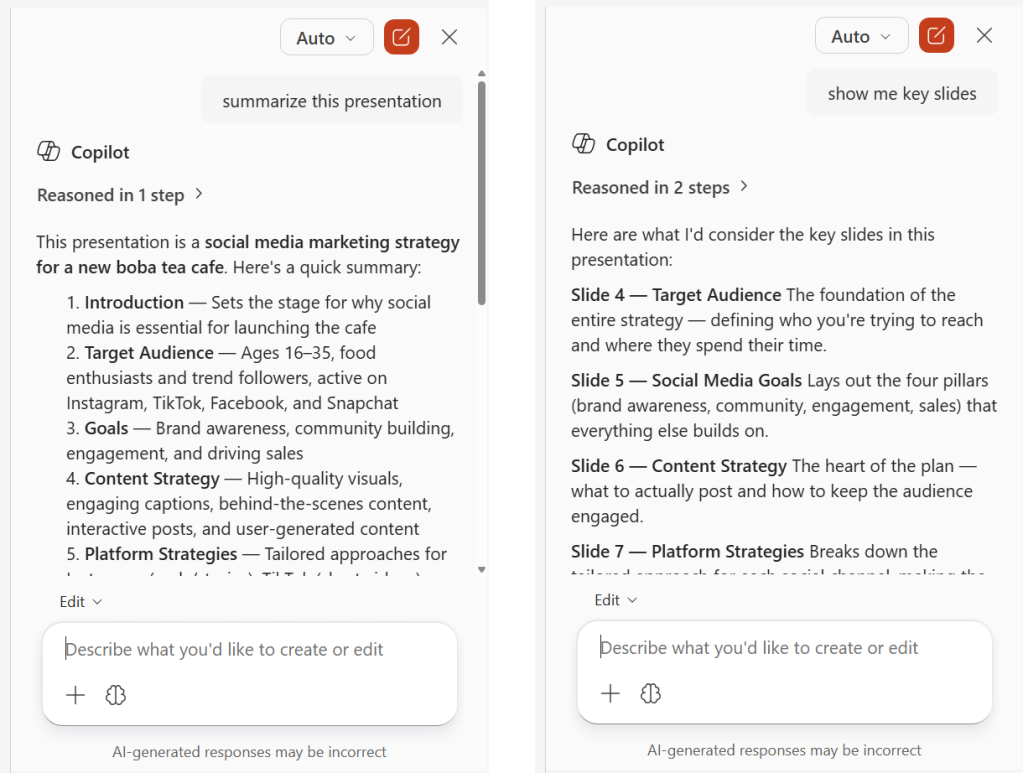
Maybe you need a quick refresh of your presentation before an important meeting. Or maybe a co-worker has sent you a presentation that’s packed with lots of slides. You can prompt Copilot to generate a summary of the presentation’s overall messaging.

In the Copilot pane, just type “summarize this presentation.” You can also have Copilot flag key slides that contain important information: “show me key slides.”

screenshots of copilot sidebar in powerpoint - one with summarize results and one with key slides response

Ask Copilot to summarize a presentation or flag key slides.

Howard Wen / Foundry

8. Answer questions about a presentation

As you’re reviewing a presentation, especially one that you didn’t create and are not familiar with, you can get Copilot to pull key data points from its slides.

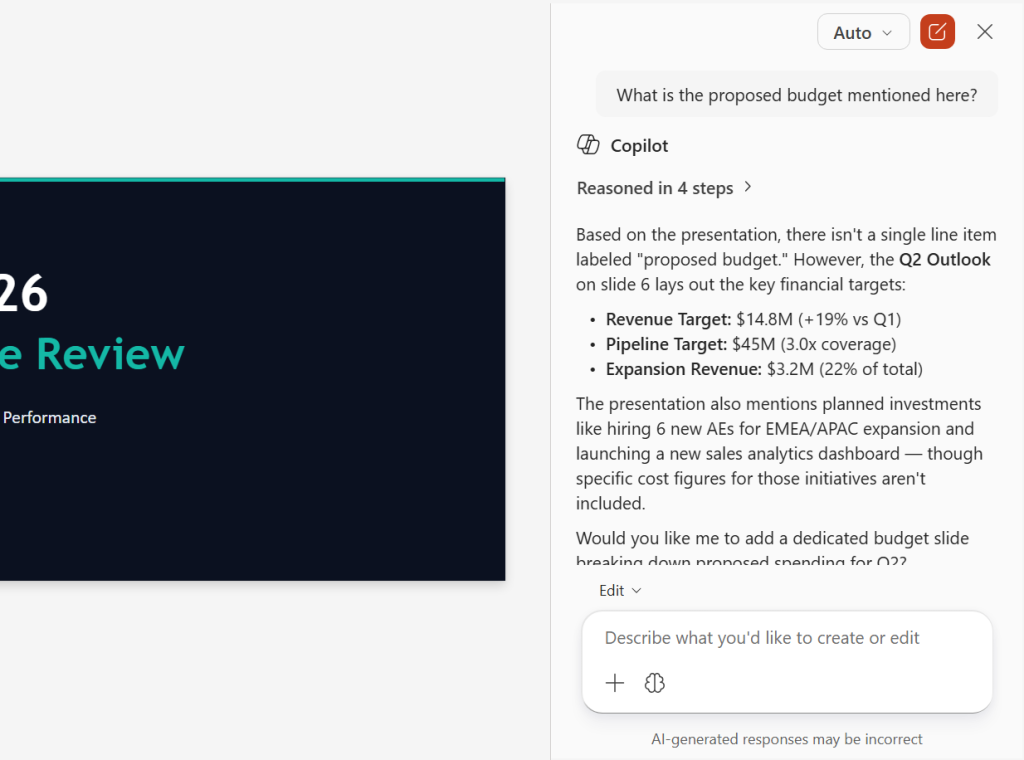
In the Copilot pane, type specific informational questions. Examples:

  • What are the action items in this deck?
  • What is the proposed budget mentioned here?

If Copilot can’t find the exact answer to the question you ask, it will provide related information from the presentation.

screenshot of copilot sidebar in powerpoint with response to query about proposed budget in the slide deck

Ask Copilot specific questions about the contents of a presentation.

Howard Wen / Foundry

This method can also help you validate that your presentation includes everything you want it to. If you ask Copilot about the action items in a presentation and it can’t find any, you know you need to add them. (Copilot will likely offer to generate them for you based on the rest of the slides.)

You can even take this tactic a step further and ask Copilot if the presentation is missing any important data, if any slides are weak or confusing, if there are any awkward transitions, if there are key points that should be better emphasized, and so on.

9. Help you navigate a large presentation

In the business world, presentations with dozens of slides are not uncommon, such as for financial reports or project documentation. Trying to find a specific slide or multiple slides can be tough. Copilot can help you navigate such a presentation.

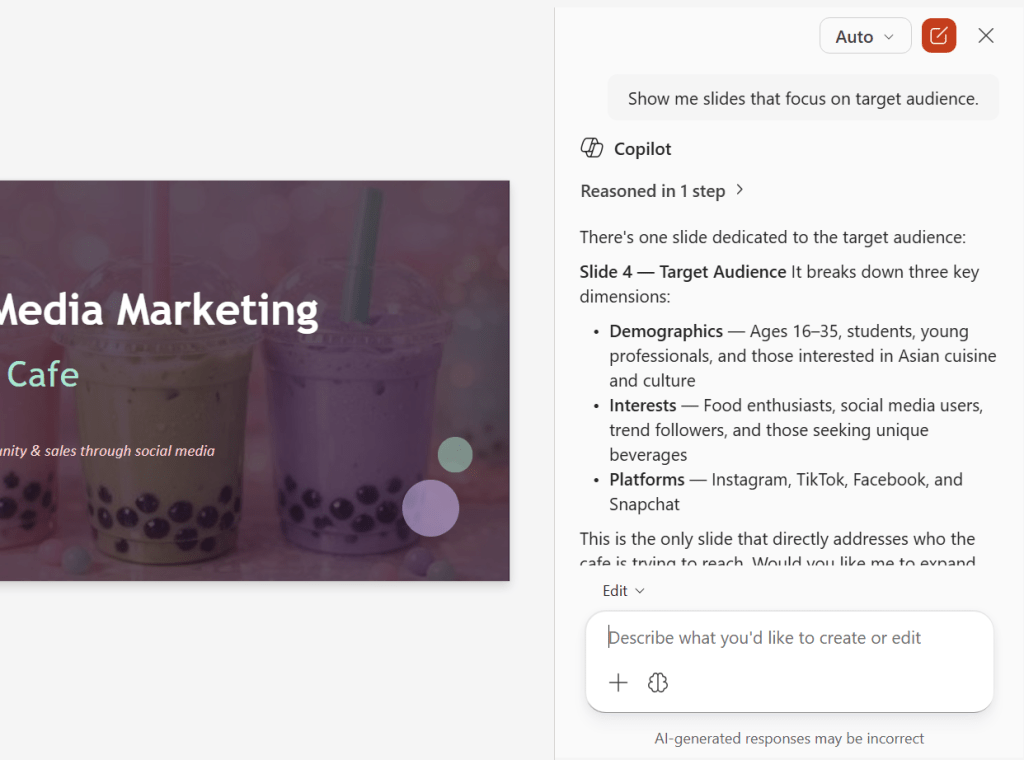
In the Copilot pane, prompt Copilot to find slides based on specific topics. Example:

  • Show me the slides about the project timeline.

Copilot will analyze the presentation and reply with a list of links to the relevant slides. Click one of these to jump directly to that slide.

screenshot of copilot sidebar in powerpoint with response about the slide that talks about target audience

Copilot can help you zoom directly to a slide that covers a particular topic or shows specific data.

Howard Wen / Foundry

10. Generate speaker notes and/or an FAQ

Here’s a great timesaver when you’re preparing to show your presentation to an audience: Copilot can automatically generate suggested speaker notes for you, based on the content of your slides. Example prompt:

  • Write speaker notes for every slide with one talking point per slide.
screenshot of powerpoint presentation with speaker notes generated by copilot

Copilot can create speaker notes in seconds.

Howard Wen / Foundry

In a related feature, Copilot can create a frequently asked questions list (FAQ) for you to consult in your speaker notes or to present as a slide:

  • Write an FAQ for these slides.

Copilot will ask where you want the questions and answers added — as a new slide at the end, integrated into the speaker notes of relevant slides, or somewhere else that you designate. Make a selection, and Copilot will generate the FAQ based on the content of your presentation.

screenshot of frequently asked questions slide generated by copilot in powerpoint

A Copilot-generated FAQ slide.

Howard Wen / Foundry

Related reading:

  •  

Your instant Android backup upgrade

Here in this high-tech era of 2026, keeping important info backed up and synced should be effortless and something that just happens on its own, automatically, without any actual thought or ongoing human effort.

In many areas of our digital life, that mercifully does Just Work™ in exactly that way. Fire up an email in most modern mail services, and you can stop at any point and find your in-progress draft in that same app on any other device. The same applies to any file you’re finessing within Google Drive or other cloud storage services or document you’re dawdling over in Docs.

One area where seamless syncing somehow still doesn’t occur, though, is in the domain of downloaded documents on Android. If someone sends you a PDF or a Word file and you save it to your phone, that file exists in an archaic-seeming silo — only locally, on that one gadget. And that, of course, means (a) you can’t access it from any other device, and (b) if you misplace your phone or move into a new one at some point along the way, the file will be left behind in time and entirely unavailable.

Well, take a moment to join me in celebration: Amidst all the Gemini gobbledegook that no one asked for (and that often falls somewhere between “pointless” and “actively counterproductive”), Google’s giving us a major upgrade to Android’s backup capabilities right now. It’s a simple-seeming switch buried in your system settings, and it’s up to you to find and activate it.

Once you do, though, those once-orphaned documents on your Android device’s local storage will be perpetually synced and protected, automatically, without any ongoing thought or effort.

All you’ve gotta do is find and flip that one new switch.

[Don’t let yourself miss an ounce of Android Intelligence. Join my free weekly Android Intelligence newsletter and get one new thing to try in your inbox every Friday!]

The Android backup lowdown

So, for a quick bit of pertinent context on this: Android’s backup systems have actually come a really long way over the years.

‘Twas a time, y’see, when little to nothing about you would sync and carry over automatically from one Android device to another. Years ago — back in the ancient-seeming prehistoric era of the early 2010s — Android enthusiasts in the know would rely on community-created third-party apps for everything from remembering and resyncing downloaded apps to restoring data from within those apps and onward. And reconfiguring your system preferences would be a whole time-consuming song and dance every single time you reset a device or moved into a new one, as little to nothing would automatically carry over.

Most of that stuff is now effortless and automatic. And, thanks to apps like Google Messages, Calendar, Drive, and Docs, many other areas of important data are also synced on their own at the app level — outside of any system mechanisms.

Locally stored files, however, have remained an awkward omission. To this day, anything you download on any Android device exists only on that one device and isn’t synced or backed up anywhere. The only way that happens is — in a blast-from-the-past twist — if you go out of your way to find and set up a third-party app to handle the heavy lifting.

That brings us to today. Right now, as we speak, Google’s in the midst of sending out a quiet under-the-hood update that (brace yourself…) adds in the option to automatically sync and back up any documents on your device as a native part of Android’s backup setup.

See?

Android backup documents
The easily overlooked new option for backing up documents on Android.

JR Raphael, Foundry

The option is on its way to all devices running 2018’s Android 9 release and higher. (If you’re still using a phone with an Android version older than that, you’re now a whopping eight years out of date, and you have much bigger problems.)

Once the added option is present and available for you, you’re literally lookin’ at 10 seconds to find and activate it.

Lemme show ya how.

Android’s document backup addition

I promise: This couldn’t be much simpler.

No matter what kind of Android device is in front of you, just head into your system settings and open the section called “Accounts and backup,” “Back up or copy data,” or something along those same lines. (The exact wording can vary based on who made your device and when it was released or last updated.)

Either tap the line labeled “Google Backup” or look for an option to “Back up data” via Google Drive. You should then either see a series of options for different areas of available backup right then and there — or, depending on your device, you might have to tap a line labeled “Other device data” (or something similar) to find the full list of possibilities.

However you get there, once you’re lookin’ at that list, you’ll see a newly added line for “Documents” if this latest under-the-hood update has reached you.

Android backup options
Android’s expanded list of backup options — now including documents alongside other forms of on-device data.

JR Raphael, Foundry

And from there, all that’s left is to tap it and enable the switch to include that in your automated backups from that moment forward.

If you aren’t seeing the option yet, don’t panic. Google always sends these under-the-hood updates out bit by bit over time, so the change probably just hasn’t reached your device quite yet. As long as you’re running Android 9 or higher, it’ll get there. Set yourself a reminder to check back once a week or so. Odds are, you’ll see it pretty soon.

Notably, all documents synced in this way are always encrypted for security, and they’re kept in your personal (or, depending on the nature of your account, perhaps company-connected) Google Drive storage. That does mean they’ll count against your overall Google storage total, so keep an eye on your Drive storage total to make sure you’re in solid shape and look to the Google One storage hub if you ever want some simple suggestions for freeing up space.

Speaking of other Google services: If you ever want to keep other types of locally stored non-document files from an Android device synced and available elsewhere, you can easily rely on Google Photos for syncing screenshots and other images — after enabling sync in general, be sure to look in the app’s “Collections” areas to find the “On this device” folder and then flip the toggle to “Backup all device folders” (or get more nuanced and open specific individual on-device folders if you want to sync some but not all of those areas) — and you can still turn to those aforementioned third-party apps for broader syncing of anything else imaginable.

But with documents now being handled automatically and natively, that’s one big worry now out of your hair. Just note that the onus will fall on you to find and flip the switch and actively opt in to the feature on each and every Android device you’re using.

Take 10 seconds to do that, though, and you’ll have one less void in your Android data arena. And you don’t need Gemini to tell you that that can only be a good thing.

Get practical Android knowledge in your inbox every Friday with my free Android Intelligence newsletter — one new thing to try each week, straight from me to you.

  •  

Anthropic pays $1.5B to settle contentious copyright case

A US federal court has approved Anthropic’s $1.5 billion settlement in a class-action lawsuit in which authors accused the AI company of using their books without permission to train the AI model Claude. This is the largest such settlement to date in a US copyright case, according to Reuters.

The dispute is one of several legal cases in which copyright holders sued AI companies over how large language models (LLMs) were trained, and it is the first major AI-related copyright dispute in the US to be resolved through a settlement.

A judge had previously ruled that the actual training of AI models using books falls under the “fair use” doctrine in US copyright law. But Anthropic was found to have violated the law by storing more than 7 million pirated books in a central library, regardless of whether they were later used for AI training or not.

  •  

Apple and the changing of the guard

As Apple gears up to anoint John Ternus the new company CEO in September (while current leader Tim Cook takes a seat on the board) the company appears to be firing on all cylinders ahead of the leadership transition. 

What’s going well

Just look at the evidence: 

  • Apple is building market share across its entire product range; even memory-driven price inflation doesn’t seem to have dampened demand for its hardware yet.
  • While Apple had to raise prices, the company’s MacBook Neo remains seriously popular. It’s sitting atop Amazon’s US best-selling chart, which currently includes six Macs in the top 10. The Neo has topped this chart since its introduction.
  • Apple’s iPhone 17 series continues to sell well, with recent market data showing sustained growth. Both Counterpoint and IDC tell us that iPhone shipments continue to increase, even as other vendor shipments slide.
  • IDC analyst Francisco Jeronimo recently estimated that Apple’s upcoming foldable iPhone Ultra could grab 29.4% of global folding smartphone sales this year, rising to 34.9% in 2027.
  • The company’s new 27 series of operating systems is attracting a great response as beta testers report that it is already solid, stable, and performing well.
  • The AI narrative has really changed, with analysts no longer quite so starry-eyed at the prospects for the big frontier AI firms. Apple’s edge-AI-enabling approach is winning converts.

What’s coming up

The company’s newly-filed lawsuit against OpenAI may or may not succeed, but it will certainly help consolidate recognition of the importance of Apple’s designs and intellectual property in whatever hardware emerges from the AI firm. It also means both Apple and OpenAI are already competing in hardware, even though neither company yet offers anything that directly challenges the other. 

Apple has just set out its stall to brand-loyal fans in a big way and did so before OpenAI gets to woo the same set of customers with a wriggle of its Jony Ive-tinged talisman.

The stage is set for intense competition between the two. Though some say Apple’s needs to improve employee retention, if it does find proof of efforts to use recruitment to engage in industrial espionage, it’ll be easier to represent its own products as being the OG for new hardware. 

If nothing else, it means consumers will forever be asking, “If OpenAI’s designers are so good, why did it need to poach them from Apple?” Doubt is a weapon.

Managing perception

It doesn’t matter how the case goes, because there fight is already affecting consumer psychology. It also means that as Ternus prepares to take his seat atop the rainbow-colored Apple throne, we can already size him up. “A man is measured by his enemies,” Joe Abercrombie wrote in “The Trouble With Peace.”

Given the proximity of the leadership transition, it’s highly probable that Ternus signed-off on the litigation; in doing so he — and Apple — tell us to expect more of the same. 

Apple has, rightly or wrongly, decided that OpenAI will become its new existential bugbear, following in the footsteps of Microsoft Windows, Real Networks, Adobe Flash, Android, and Samsung, all of whom have been useful foils against which Apple has been able to build and maintain its identity.

Looking at that list, you’d be tempted to believe that nothing much is new. Apple has often defined itself by the enemies it sometimes keeps. What has been will be again, which in this case means even as OpenAI attempts to carve out an identity as a hardware manufacturer delivering solutions to compete with Apple and Google, Ternus’ team’s looks to drive a consensus-shaped wedge into the pro-LLM propaganda. 

That blow comes as Apple finally gets its act together around AI, and as the company prepares for a future in which the world’s most-used wearable device also becomes the wearable way to woo Siri AI.

My kingdom come

Rising market share, powerful solutions, an increasingly recognized and respected approach to AI, and an ideological crusade — these details constitute Apple’s place today and are Tim Cook’s coronation gift to Ternus. He’s passing along a strong and hyper-profitable baton that screams of timeliness and relevance even as the company gets set, ready, to go with a year or two of new product designs, new product families, and a 20thanniversary iPhone.

This is Apple’s party. OpenAI’s name didn’t make the list. 

You can follow me on social media! Join me on BlueSky,  LinkedIn, Mastodon and subscribe to The Core.

  •  

US AI testing institute chief steps down within three months

The head of the US government’s AI testing institute, Chris Fall, has resigned about three months after taking charge of the Center for AI Standards and Innovation (CAISI), the federal organization responsible for evaluating advanced artificial intelligence models for safety and security.

Current National Institute of Standards and Technology NIST Director Arvind Raman will serve as acting CAISI Director following Fall’s departure while continuing to oversee the Commerce Department office responsible for the institute, the Daily Signal reported, citing two people familiar with the matter.

A Commerce Department spokesperson who spoke to the publication did not disclose a reason for the resignation.

Fall assumed leadership of CAISI in April after the Trump administration reorganized the former US AI Safety Institute under NIST. The institute develops methodologies for evaluating frontier AI models and works with AI developers on voluntary technical assessments covering areas such as cybersecurity, model misuse, reliability and other risks associated with increasingly capable AI systems.

The leadership change comes as governments and AI companies continue developing technical approaches for evaluating frontier AI models while enterprises expand deployments of generative AI and agentic AI across business operations.

In recent months, the Commerce Department has taken a more active role in AI policy involving advanced models, placing greater attention on how the federal government evaluates technologies with potential national security implications.

Continuity matters more than personalities

CAISI works with AI developers such as Anthropic, Google’s DeepMind and OpenAI on voluntary evaluations of frontier AI models and develops methodologies for testing model capabilities and risks. The institute does not regulate AI developers or certify commercial AI systems.

For enterprises, those evaluations are one source of technical information alongside vendors’ own testing, third-party security assessments and internal AI governance programs.

Sanchit Vir Gogia, chief analyst at Greyhound Research, said enterprises should focus less on the individual leading the institute and more on whether its technical work continues with the same level of consistency and transparency.

“Leadership churn at CAISI weakens the signal long before it weakens the science,” Gogia said. “The testing has not stopped. Its authority simply does not travel as cleanly once the leadership does not.”

According to Gogia, the more important question for enterprises is not whether the institute’s evaluation work will continue but whether the processes supporting those evaluations remain stable.

“The instinct is to ask whether the pipeline is breaking,” he said. “The more useful question is where the pipeline now sits.”

Enterprises still carry the burden of AI governance

Gogia said organizations should continue treating government-led AI evaluations as one input into their governance processes rather than as evidence that a model is inherently safe for enterprise deployment.

“A government evaluation was always a signal, never a certificate,” he said. “A signal loses value the moment its issuer becomes unpredictable.”

He said enterprises should instead monitor whether CAISI maintains consistent evaluation methodologies, continues publishing technical findings and preserves continuity within its research teams under interim leadership.

“The name on the door is not the signal. The behaviour underneath it is,” Gogia said.

Gogia also cautioned against linking Fall’s resignation to recent Commerce Department actions involving AI policy or export controls, noting that there is no public evidence connecting the two.

“CAISI evaluates; it does not enforce export controls, because it holds no such power,” he said. “This is not a testing body reaching for enforcement. It is enforcement reaching past the testing body.”

With Raman assuming the role on an interim basis, the next significant milestone for enterprises will be the appointment of a permanent director, and whether the institute’s evaluation programs continue without disruption, the analyst said.

Gogia said the successor’s mandate may prove more important than the individual selected.

“A CAISI result is not a safe harbour,” he said. “It informs an obligation; it does not discharge one.” NIST did not immediately respond to a request for comment.

  •  

OECD: Physical labor isn’t immune from AI disruptions

Jobs involving physical labor are at high risk of disruption from automation, with new technologies such as AI robots becoming more prevalent, according to a recent study by the Organization for Economic Co-operation and Development (OECD). That means workers in construction and extraction, farming, fishing, forestry, production and material transportation could be affected by fast-moving technology changes.

“Routine and low-skilled jobs are at higher risk,” the Paris-based public policy group said, adding that “overall, jobs requiring non-routine cognitive, social and creative skills are less susceptible to automation.”

The kinds of creative and cognitive jobs still thought to be less exposed to automation include social work and community service roles. 

OECD also said management jobs — which often require workers to devise creative answers to solve problems — fall within the creative and cognitive category. “While AI has made some high-skill job requirements more susceptible to automation, many critical skills in these roles remain difficult to automate,” OECD said.

The same still holds true for some physical and manual labor jobs – including cleaners, agricultural workers, food-prep assistants, and laborers — which are less exposed to the affects of AI, OECD said.  

But people who work in programming, translating and interpretation positions could find their work affected by the quick rise of AI tools and services. According to the organization, global AI uptake rose from 7% in 2021 to 20% in 2025.

“In these occupations, GenAI could perform a significant share of tasks at least twice as fast today or in the near future,” OECD said.

The effects of the AI boom are not always uniform across industries or regions. In a separate 2026 Employment Outlook study released by the group, exposure to disruption from generative AI (genAI) ranges from about 16% in some areas to more than 70% elsewhere, depending on industries and occupations. 

Numerous research firms have said in recent years that AI is driving short-term job losses, though tech industry experts and analysts have argued AI will also create new careers and jobs as agentic AI takes over low-skilled work. 

AI technology has become so ubiquitous that it’s been compared to electricity — virtually all companies will need it or at least know how to use it. But it’s adoption has been hindered at times as companies struggle to find ROI from its use, and by regulatory and ethical hurdles.

In the US, AI blamed for June job losses

According to a Challenger, Gray & Christmas study released earlier this month, AI was cited as the top reason for job cuts in June. The outplacement firm said employers cut 45,849 job cuts in June, of which 14,029 were attributed to AI, with the tech industry leading the cuts.

“Tech remains the epicenter of this year’s cuts,” Challenger said. “AI is the dominant force as companies are restructuring around it, automating roles, and reallocating budgets toward new capabilities. The sector is being reshaped in real time.”

Overall, AI has been responsible for 173,568 job cuts since 2021, the company said.

AI is hurting jobs in customer service, internal reporting, telecommunications, and hosting automation, said Victor Janulaitis, a staffing consultant who was formerly CEO at Janco Associates Inc.

“C-level executives continue to be focused on eliminating ‘non-essential’ managers, staff, and services,” he said. “Coders and developers have limited opportunities with legacy applications.”

While jobs in the IT sector overall are declining, current hiring tends to skew in the direction of people with AI skills. A report this month by CompTIA put job listings with AI skills at around 500,000, which is close to double the number in January.

“Employers in other industries are accelerating digital transformation initiatives and moving from AI experimentation to implementation,” said Seth Robinson, CompTIA’s vice president for industry research.

That view dovetails with what ManpowerGroup, the recruitment firm, is seeing; demand for AI-related skills has nearly doubled over the past year, said Ger Doyle, regional president of North America at ManpowerGroup.

That growth extends well beyond traditional technology roles as companies move from experimenting to AI deployments at scale, Doyle said. “We’re seeing it influence hiring across occupations ranging from data science and engineering to project management and operational roles,” he said.

  •  

The EU’s AI transparency deadline is weeks away. Is your enterprise ready?

Providers and deployers of AI systems: You only have a couple of weeks left until you must explicitly inform users when they are interacting with AI content.

To assist in the effort, the European Commission (Commission) has published guidelines to help AI deployers get in line with the AI Act’s transparency obligations, which will begin to go into effect on August 2.

After that, companies providing AI systems must alert users when they are interacting with AI. They must also tell users when they have been exposed to deepfakes, “emotion recognition,” or biometric categorization systems, or when they are given AI-manipulated content in matters of “public interests without human review or editorial control.”

Henna Virkkunen, the Commission’s executive VP for tech sovereignty, security and democracy, said in a statement, “with today’s guidelines, the Commission supports the smooth and effective application of the AI Act to make AI systems interacting with people such as chatbots and AI agents and AI content more transparent and trustworthy. These guidelines support providers and deployers in meeting their obligations under the AI Act, while helping citizens know when they are interacting with AI.”

Systems must include machine-readable markers to reveal such content, to reduce “the risk of deception and manipulation” and build public trust in AI.

“Generative systems have collapsed the cost of producing convincing content while the cost of judging it stands where it always stood,” said Sanchit Vir Gogia, chief analyst at Greyhound Research. This requirement is “an attempt to restore friction to that imbalance.”

A company’s non-compliance could result in fines anywhere from €750K (about $856K) to €15M (about $17 million), or even up to 3% of its total worldwide annual revenue.

Transparency requirements

The EU AI Act’s transparency requirements apply to “natural or legal persons,” public authorities, agencies, or other bodies that develop AI systems, or have them developed, and place them on the EU market or into use under their name or trademark. This means all companies, regardless of whether or not they are EU-based.

“Systems placed on the European market, put into service there, or producing outputs used there are inside the field, wherever the developer sits,” Gogia noted.

Applicable systems must be intended to interact directly with “natural persons”; these systems include AI-enabled chatbots or conversational agents, AI companions, or coding agents. However, AI-enabled tools like recommender systems, spam filters, authentication, search and retrieval, transcription, text and code auto-completion, or predictive maintenance do not fall under the rule.

Specific outputs such as AI-generated text, images, video, and audio must contain a machine-readable mark. Deepfakes and public interest-related text created by AI without human review or control must be clearly labeled, however, deepfake content that is “artistic, creative, satirical, or fictional” is largely exempt.

AI content must be marked with one of three labels: “AI,” “Fully AI-generated,” or “Partially AI-modified.” For instance, “Fully AI-generated” applies when news summaries, music, art, or videos have been created without any human oversight (apart from prompting), while “partially AI-modified” could mean a person’s face is swapped into an authentic photograph to create a deepfake.

The three icons are publicly available for free use; enterprises can download zip files in PNG and SVG formats.

Most of the Act’s transparency rules begin to go into effect on August 2. But AI systems placed on the market before then will have some leeway; they must be in compliance by December 2.

However, a four-month allowance “on one obligation, for one population of systems, contingent on one procedural step, is not a strategy,” Gogia emphasized. Enterprises should plan to comply by August 2 and “treat any relief that arrives as margin.”

A consistent code of practice

Along with the transparency guidelines, the Commission has introduced a code of practice that essentially serves as a gesture of good faith. When signed, it can provide “legal certainty” and a “simple and practical” way to demonstrate compliance with the AI Act, according to the Commission. Signatories can also collaborate through the ‘Signatory Taskforce,’ which will share practices and advance technologies around marking and labeling practices.

Providers that choose not to sign must comply through other methods and demonstrate that those methods are “adequate” through assessment by surveillance authorities, according to the Commission.

Non-signatories “keep their flexibility, and will face more case-by-case scrutiny for it,” said Gogia.

Criteria for compliance

Shashi Bellamkonda, principal research director at Info-Tech Research Group, pointed out that the transparency requirements apply to content only when three criteria are met: It has been published, is informative to the public, or is on matters of public interest.

B2B business content or blogs may not need an AI disclosure if they do not meet these criteria, he noted. Also, published text that has undergone human review or is under editorial control does not need to be labeled. Editorial control means that a person must hold the ultimate legal responsibility for the publication of the content.

Many companies like Google, Adobe, and LinkedIn have already established ways to identify images marked as AI-generated. Meta has made it a requirement, but the creator has to add the AI-generated label, Bellamkonda said.

“This is a good move for guardrails around public information, and companies with good compliance and ethical oversight may not have to worry about this,” he noted. But as a general practice, companies should disclose AI-generated content and state whether it has been human reviewed.

Creating a transparency pipeline

Establishing full transparency means identifying who carries the responsibility for the content, whether the marking survives real use, not just testing, and what evidence will defend the decision, Gogia said.

Concerns cluster around responsibility, durability and evidence. Several organizations usually touch one piece of content, and none controls the whole chain, which is why contracts become the “pressure point,” he said. Most current agreements were written to deliver software and say “almost nothing” about provenance persistence, verification access, or evidence retention.

The durability concern is the most difficult, Gogia noted, because marking performs well in controlled settings but “badly in ordinary life.” Meta, for one, said its invisible watermark was designed to survive cropping; a published test, however, found the company’s preview detector missed 55% of cropped images.

“CIOs should ask which platform can actually provide evidence before believing its dashboard,” said Gogia.

Disclosure of AI use must be “clear, distinguishable and accessible,” he emphasized. “A notice buried in lengthy terms, or reachable only through determined clicking, satisfies nobody, least of all a market surveillance authority.”

Sustained compliance is a “living control” requiring a central record of systems, duties and evidence; testing taking place where the user meets the control rather than where the developer built it; and continuous supplier assurance. Enforcement will vary by country, so keep one common baseline with local overlays, Gogia said.

His advice: Inventory every system that talks to people, generates content, or gauges sentiment; classify provider and deployer roles; place disclosures at first interaction; define substantive human review; keep the evidence.

Marks and provenance signals should be tested after content undergoes cropping, compression, translation, transcription, and other editing, Gogia said. A useful audit starts from a real output and follows its “pulse” through generation, editing and publication, identifying at “each beat” the responsible party, the surviving mark, and evidence for exceptions. Missed labels should also be traced for root cause and recurrence.

To ensure compliance, before August 2, enterprises need a prioritized inventory, live disclosures on the highest-risk use cases, and a “named owner for every control,” he noted. In the first 30 days, they should stabilize and test; in the first 90 days, push requirements into procurement processes as a standing discipline. Procurement must secure commitments on marking methods, known failure modes, and evidence access, with explicit notice if/when any of them change.

“The sensible architecture is a common transparency baseline carrying traceability, responsibility, and evidence, with jurisdictional overlays for language, sector rules, and local practice,” Gogia said.

This article originally appeared on CIO.com.

  •  

Apple could ‘run the table’ on AI if it does things right

Looking ahead just a short time, Apple could hold a powerful position in AI where it most makes sense: deployment.

Not only will the company offer up its own AI models for the kind of tasks millions use ChatGPT to do today, but it will provide more sophisticated on-device agentic models to help users get things done through Siri AI.

Apple also offers limited capacity for more complex tasks through Private Cloud Compute, and, in partnership with the likes of Google in the US and Alibaba in China, the company is giving users a trusted conduit through which to access even more sophisticated AI services. 

Deeply deployable

Critics can say it took Apple a long time to get to this point, but they also seem to think the company has finally got the mix right with its series 27 operating systems. Arriving late to a party doesn’t mean you won’t shine once you get there.

Apple is also coming up the inside lane around frontier AI, with iterative OS and hardware enhancements that mean its devices become increasingly effective for Edge AI use cases, on device — no cloud service required.

The company appears to be digging down into those use cases. Mark Gurman at Bloomberg recently predicted that future M7 Ultra Macs will support as much as 1.5TB RAM, making these systems more than capable of running full weight frontier models in people’s offices, colleges, and homes. 

While that does assume the AI-flationary memory market can supply that much RAM at prices humans can afford, it is also true that people are already running AI clusters using off-the-shelf Mac minis networked over Thunderbolt cables. It’s no stretch to believe this will continue to be the case, and that it will even broaden as the power/performance offered at the high end grows.

What’s wrong with good enough?

When combined with open AI stacks, particularly newly emerging varieties, Apple’s platforms should become leading contenders for private AI services and edge AI. Many business users will leap at the chance to offer their workers powerful, self-hosted, private AI services using one or more daisy-chained Mac Studios or Mac minis. The recent craze in deployment of both Macs to support OpenClaw instances shows they already are.

Ultimately, these different slices of momentum mean I agree with investor Jason Calacanis that Apple is in position to apply a great deal of pressure on OpenAI and Claude just by putting models on their devices. 

It’s also worth thinking about how people use AI today. How many of the queries made in the world right now constitute relatively simple tasks that could be transacted by on-device AI, such as the emerging new version of Apple Intelligence or even smaller LLM models running on device? You can even run PrismML’s 1-bit, 27-billion parameter Bonsai on an iPad using the Locally app, and that’s in the here and now.

What happens? Pretty soon you’ll find people recognize that they can already run the vast majority of their AI-augmented workflows using services they have on their existing device or can access on their on-prem Mac set-ups. And, of course, as people get used to running small tasks locally and larger tasks on premises, the actual space in which they need to turn to cloud-based frontier models will erode. That’s even as companies like PrismML work towards slimming down full-weight models so they don’t need to run on a server at all.

“It’s going to be wild when people have unlimited tokens on their desks,” said Calacanis in a podcast round table discussion.

Who has the most to lose?

The current incarnations of AI felt like they came from nowhere. Most people weren’t aware of the technology until returning to work after the 2022 holiday season. Since then, the industry has proliferated with dozens of competing models, most recently including powerful but affordable frontier models such as Qwen and Kimi.ai.

These models aren’t necessarily all as good as one another, but in many cases for much of what we do, we’ll find them to be good enough. That’s an existential crisis for some, as industry observers now think the inevitable pricing pressure means some services might have over-invested in capacity before finding any way to turn a profit.

Those profit-seeking services are the ones with the most to lose as Apple extends its hardware advantage, democratizing AI access for all while providing platforms suitable for edge AI, on-premises AI, private AI, and even AI access using third-party services. (The need for the latter will shrink as the capabilities of the former get better.)

Cupertino rising

What does this all mean? While the industry remains young, it is already fragmenting. And striding through the dust of that process comes Apple, equipped with the hardware, software, and approach to build its business even as the enterprise of first mover AI services erodes.

You can follow me on social media! Join me on BlueSky,  LinkedIn, Mastodon and subscribe to my daily Apple-related news summaries at The Core.

  •  
❌