❌

Reading view

Amazon’s TP-Link router deals include a WiFi 7 model for less than $100

Top TP-Link Wi-Fi deals on Amazon

Most home Wi-Fi complaints trace back to the same two culprits: an old router doing its best from inside a closet, and a dead zone in the room where everyone wants to stream. TP-Link has marked down a big chunk of its Amazon store, including Wi-Fi 7 routers, Deco mesh kits, travel routers, range extenders, and the small adapters that pull an aging desktop PC into the present. Several of them are at the lowest prices camelcamelcamel has on record. If family is coming for the holidays, fix the network before they show up with phones, tablets, and a game console apiece. We checked 48 TP-Link deals on Amazon Tuesday morning, October 20, and every one is sold by Amazon.

TP-Link Archer BE260 Wi-Fi 7 Router: $98.99 (was $124.99)

TP-Link Archer BE260 Wi-Fi 7 Router $98.99 (was $124.99)

Wi-Fi 7 and two 2.5-gig ports for under $100

See It

If your router is older than your last two phones, the TP-Link Archer BE260 is an inexpensive way to catch up. It costs $98.99, the lowest price camelcamelcamel has recorded since it started tracking the router in August 2025. TP-Link rates it for up to 2,400 square feet and 80 devices. It has a 2.5-gig WAN port and a 2.5-gig LAN port, so it can keep up with an internet plan faster than a gigabit. It skips the 6 GHz band, which makes it a straight upgrade from an aging Wi-Fi 5 or Wi-Fi 6 router rather than a showpiece.

TP-Link Deco X55 AX3000 Wi-Fi 6 Mesh System (3-Pack): $149.96 (was $195.29)

TP-Link Deco X55 AX3000 Wi-Fi 6 Mesh System (3-Pack) $149.96 (was $195.29)

Three mesh units for about $50 apiece

See It

Plaster walls, long ranch houses, and finished basements are where a single router gives up, and the TP-Link Deco X55 3-pack spreads the signal around instead. It costs $149.96 for three units. TP-Link rates the set for up to 6,500 square feet and 150 devices. Each unit has three gigabit Ethernet ports, so the one by the TV can also hard-wire a console or streaming box. It dipped to $132.98 last November, according to camelcamelcamel, and this price sits about $12 under its average there. Our guide to the best mesh Wi-Fi systems covers what to look for if you want to step up to Wi-Fi 6E or Wi-Fi 7.

TP-Link Roam 7 BE3600 Wi-Fi 7 Travel Router: $89.98 (was $129.99)

TP-Link Roam 7 BE3600 Wi-Fi 7 Travel Router $89.98 (was $129.99)

One hotel Wi-Fi login covers every gadget you packed

See It

Hotel Wi-Fi that caps you at two devices, or makes every gadget click through its own login page, is a good reason to pack the TP-Link Roam 7. It costs $89.98, the lowest price camelcamelcamel has recorded since it started tracking the travel router in August 2025. You sign the Roam 7 into the hotel or rental network once, and your laptop, phone, and streaming stick connect to the Roam 7 instead. It supports OpenVPN and WireGuard, and its 2.5-gig WAN port works with rooms that still have a live Ethernet jack. Toss it in your carry-on before Thanksgiving travel.

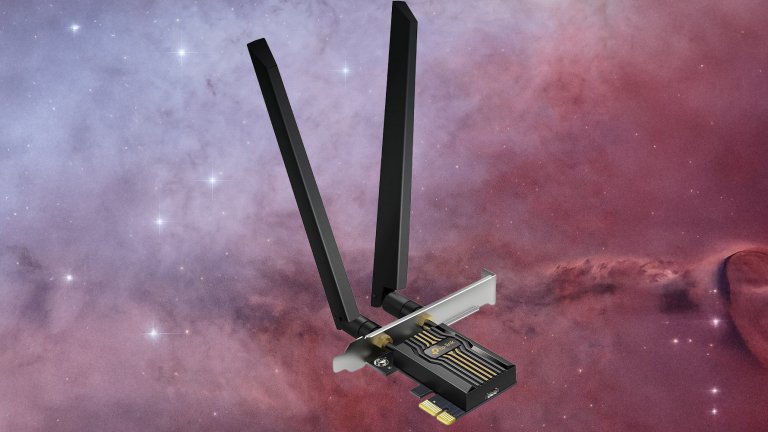
TP-Link Archer TBE552E BE9300 PCIe Wi-Fi 7 Card: $49.99 (was $69.99)

TP-Link Archer TBE552E BE9300 PCIe Wi-Fi 7 Card $49.99 (was $69.99)

Wi-Fi 7 and Bluetooth 5.4 for a desktop PC
See It

A new router won’t help much if your desktop PC is still talking to it through an old Wi-Fi card. The TP-Link Archer TBE552E costs $49.99, which ties the lowest price camelcamelcamel has on record for it. It slots into a PCIe port and supports 320MHz channels on the 6 GHz band, as long as your router is a tri-band Wi-Fi 7 model. The Archer BE550 Pro further down qualifies. The card also adds Bluetooth 5.4, so wireless controllers and headphones can connect straight to the tower.

Best TP-Link Wi-Fi 7 router deals

The Archer BE260 is covered above. The Archer BE770 costs $299.99, about $20 less than the lowest price camelcamelcamel had on record for it, and the Archer BE700 is within a dime of its camelcamelcamel low. Our guide to the best Wi-Fi routers explains which of these features are worth paying for.

Best TP-Link Deco mesh Wi-Fi deals

The Deco X55 3-pack is covered above. If you want mesh with Wi-Fi 7, the Deco 7 BE25 3-pack costs $208.73. The Deco X50-Outdoor adds a weatherproof node to an existing Deco network, which helps when the signal dies somewhere between the house and the garage.

Best TP-Link Wi-Fi 6 router, travel router, and access point deals under $100

The Roam 7 is covered above. The Roam 6 AX1500 costs $44.99 and the Roam 6 AX3000 costs $69.99, and both match the lowest prices camelcamelcamel has recorded for them. The Omada EAP650 ceiling-mount access point is at its camelcamelcamel low too.

Best TP-Link Wi-Fi extender and powerline deals from $13

An extender is the inexpensive fix when one bedroom or the back porch keeps dropping off, and the RE220 costs $13.49. The RE223BE Wi-Fi 7 extender costs $84.99, the lowest price camelcamelcamel has logged for it. Our guide to the best Wi-Fi extenders explains when an extender makes more sense than mesh.

Best TP-Link PC Wi-Fi adapter, network card, and USB deals under $70

The Archer TBE552E is covered above. For a laptop, or a desktop you’d rather not open up, the Archer TX50U USB Wi-Fi 6 adapter costs $39.99. The Archer TX55E PCIe card costs $22.43, which matches the lowest price camelcamelcamel has on record for it.

The post Amazon’s TP-Link router deals include a WiFi 7 model for less than $100 appeared first on Popular Science.


  •  

For the first time, artificial intelligence is a top 10 fear in the U.S.

It’s official—artificial intelligence is one of the top 10 fears in the United States. Well, it’s technically two of the top 10 fears, according to the 12th annual Chapman University Survey of American Fears.

First conducted in 2014, the recurring questionnaire tracks yearly anxiety trends that often range from everyday concerns to existential terrors. This year, 61.1 percent of over 1,200 respondents once again cited “corrupt government officials” as their biggest fear—the same subject was last year’s number one entrant as well as its 11th year on the list. After that, it’s the fear of another world war (51.9 percent). However, “AI harming the political process” wasn’t too far behind for third place at 51.9 percent. The technocentric worry is now essentially tied with the fear of loved ones becoming gravely ill (51.8 percent).

Illustration of 2026 fear survey results listing the top ten answers. Corrupt government officials is first place, followed by the US entering World War III, then AI harming political process
Government corruption is once again at the top of the list. Credit: Chapman University

That said, the survey’s own plus or minus 3.79 percentage point margin of error complicates the results a bit. Taking the margin of error into consideration, it’s a tossup when trying to definitively rank the list’s third through tenth fears. Regardless, about 49.7 percent survey takers are also anxious about AI negatively impacting the economy—a double dose of AI-centric woes for the first time in the survey’s history. It’s also the first year researchers at Chapman University in California included questions about AI, but they made it clear it likely won’t be the last.

“As artificial intelligence becomes more integrated into everyday life, understanding these fears will be increasingly important,” said Chapman University sociologist and survey creator Christopher Bader. “We expect concerns about AI to remain a significant part of the national conversation in the years ahead.”

It’s understandable why AI currently vexes so many people. The blanket term now encompasses everything from photorealistic fake images, to dubious search engine chatbots, to nebulous doomsday warnings. Despite these worries, the AI industry’s biggest threats arguably remain the rampant spread of misinformation, coupled with a lack of meaningful regulations or oversight.

But no matter your top technological fear, survey organizers still believe the annual report highlights a very relatable human emotion.

“What I’m seeing more and more over time is that our fear about our loved ones is going to always be there, no matter what’s going on in the world,” said sociologist Ashley Kranjac, director of Chapman University’s Earl Babbie Research Center.

The post For the first time, artificial intelligence is a top 10 fear in the U.S. appeared first on Popular Science.

  •  

This robot exists solely to bounce ping-pong balls

In a world where tech leaders are racing to build autonomous machines that can do almost anything, one hobbyist is going the complete opposite route: an over-engineered  robot that does exactly one thing and one thing only. 

T-Kuhn’s Hexa-Bouncer only bounces a ping-pong ball, but looks like it’s capable of far more. The six-armed, metal machine was first designed  in a simulated environment and then brought to life with a CNC milling machine. Custom-built joints let it rise, fall, and tilt, and even bob up and down while tracing a circle. A pair of cameras, set 120 degrees apart, track the ball’s position and send that data to a computer over USB. The computer then builds a 3D picture of the scene, then calculates when the paddle should strike the ball and at what angle. All of this happens in a fraction of a second.

Hexa-Bouncer keeps balls in the air remarkably well. In a video, Kuhn holds a ping-pong ball above his creation, and the machine moves up and down in sync with his hand. When he drops the ball, the robot immediately reacts, striking it back into the air and keeping it aloft bounce after bounce, all the while making small adjustments. After a few more bounces, the device eases off its swing and the ball starts bouncing lower and lower. It’s unclear exactly how long Hexa-Bouncer can keep the ball in the air, it never misses—at least in the video posted online.. 

Kuhn describes his ball juggler as the latest in a series of, “useless but mildly interesting ball bouncing machines.” Prior to this, he released his Octo-Bouncer, a similar design that keeps a ping-pong ball bouncing in the air using a four-sided flat plate. Some might say all this over-engineered ball bouncing is unnecessary, but Kuhn would disagree. For him, solving the design puzzle is a journey in itself. 

“Building a thing like this is like bashing your way through a jungle,” he said. “It’s an adventure. You’re not completely sure if you can make it through or not, and that’s exactly why you do it.”

The post This robot exists solely to bounce ping-pong balls appeared first on Popular Science.

  •  

New comet accidentally discovered by space telescope

Launched in 2023, the European Space Agency’s (ESA) Euclid space telescope observes some of the most distant regions of the visible universe for signs of dark matter and dark energy. But even while focused on the “big picture,” Euclid’s onboard equipment is surprising astronomers by capturing tiny photobombers like errant comets.

Its recent portraits of one specific dusty space rock are especially impressive, however. Euclid spotted a never-before-seen comet sailing through space more than 807.7 million miles from Earth. The telescope isn’t designed to automatically flag an image interloper. Instead, the bright blemish seen in multiple images was spotted by a moving object detection program designed by Mikko Pöntinen, an astronomer at the University of Helsinki in Finland.

“I was excited to see my software flag a ‘streak’ smeared across several images—the result of a fast-moving object,” said Pöntinen. “Further inspection revealed that it had a fuzzy cloud around it, indicative of an active object like a comet that is shedding dust and gas.”

A black-and-white Euclid image shows a sky field filled with bright points and faint fuzzy light sources on a dark background. A boxed region is enlarged in an inset, where comet C/2026 S1 (Euclid) is marked by an arrow. The comet appears as a bright elongated streak surrounded by a diffuse cloud of light. Lines connect the inset to the comet’s location in the wider image.
Comet C/2026 S1 (Euclid) seen in a wide VIS image for context (left), with a zoom in (right). Credit: ESA/Euclid/Euclid Consortium/NASA, M. Pöntinen et al. 2026

Pöntinen quickly relayed his findings to the International Astronomical Union’s Minor Planet Center (MPC), which then passed the news along to researchers around the world. On October 8, the MPC confirmed the newly discovered comet, which is now classified C/2026 S1 (Euclid).

C/2026 S1 was seen from five different fields of view over multiple days in the Euclid Deep Field North region of the telescope’s scans. Astronomers now know the comet’s trajectory isn’t located on the same horizontal plane as the planets. Instead, its path is technically taking it over the solar system along a multi-thousand-year orbit.

Euclid’s discovery is particularly striking because the telescope’s six-year mission is specifically mapped to avoid areas of the sky that are laden with comets and asteroids.

“Very few comets are expected to be discovered by Euclid, so it was a happy coincidence,” added Euclid archive scientist Bruno Altieri.

The post New comet accidentally discovered by space telescope appeared first on Popular Science.

  •  

The Mystery of the “Five Foolish Virgins”: These Giant Stones Have Marked a Roman-Era Grave in Norway for 1,700 Years

At the narrowest point of the Karmsundet, the channel that separates the island of Karmøy from the mainland on Norway’s west coast, five stones stand upright on a hillside. Some are more than five metres (16 ft) tall. They were raised inside a cairn, a mound of piled stones, laid out in the shape of […]

  •  

El misterio de las Cinco Vírgenes Necias, las piedras gigantes que marcan una tumba de época romana en Noruega desde hace 1700 años

En el punto más estrecho del Karmsundet, el canal que separa la isla de Karmøy del continente en la costa occidental de Noruega, se alzan cinco piedras hincadas en vertical, algunas de más de cinco metros de altura. Se levantaron dentro de un túmulo de piedras con forma de estrella de tres brazos, y bajo […]

  •  

Bat Beauty Contest returns October 24

With Alaska’s fat bears done packing on their winter weight and spooky season in full swing, it’s time to turn our collective animal-loving attention to a smaller mammal—bats. The Bureau of Land Management’s (BOEM) annual Bat Beauty Contest returns on October 24 and promises “plenty of batty puns.”

Beginning Saturday, October 24, BOEM will post photos of the competitors to their Facebook and Instagram accounts and ask you to vote for the best-looking one. All of the competing bats are part of wild populations that live on land managed by the public agency and are photographed by wildlife technicians. The winner will be announced (appropriately) on Saturday, October 31.

The bats in this competition are known for their squishy faces and clever names. In 2024, a hoary bat (Lasiurus cinereus) from Oregon named Hoary Potter took the crown. Other contestants included a long-eared myotis (Myotis evotis) named Honey Bunches of MyOtis, a myotis bat (Myotis myotis) named Robert Battinson, and western small-footed bats (Myotis ciliolabrum) named Batt Damon and Batlor Swift. The contest was not held in 2025 due to the 43-day-long federal government shutdown. 

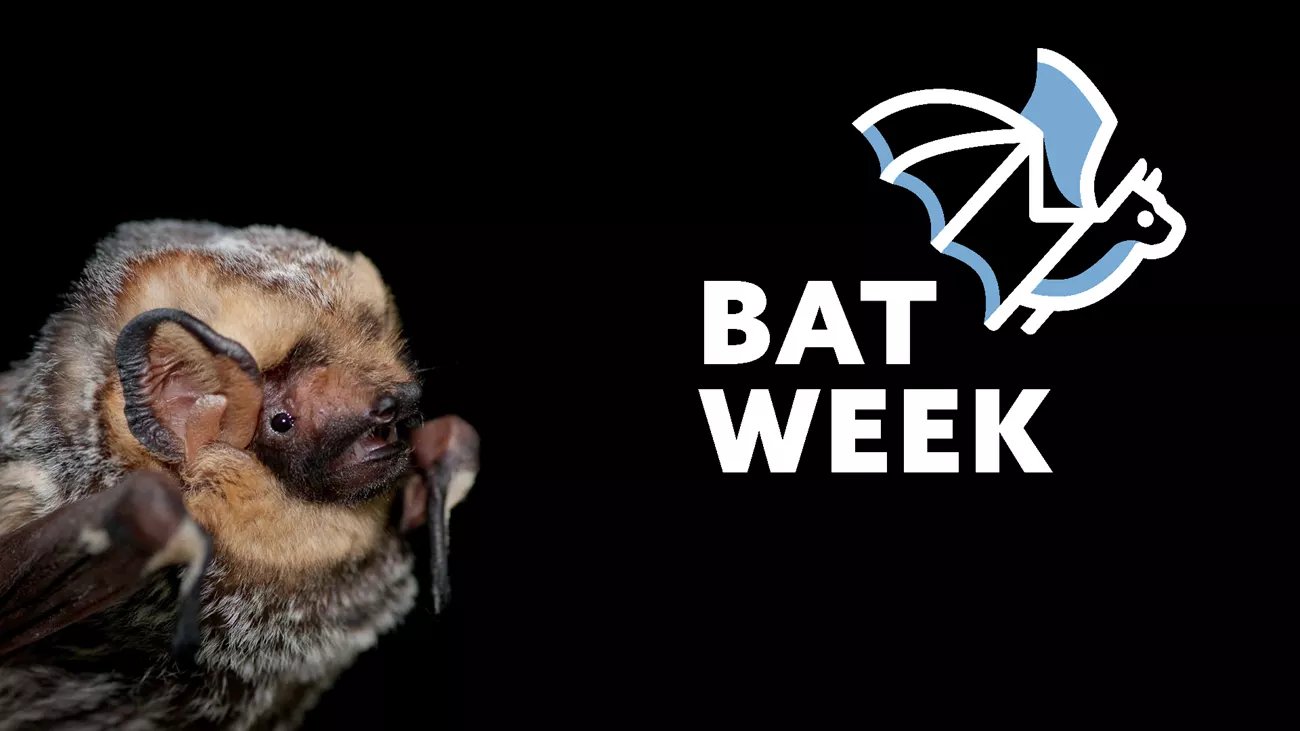
a bat next to a logo that says bat week
A hoary bat at Isle Royale National Park in Michigan. Image: NPS Photo/Bat Conservation International.

The contest is not all bat puns and a way to keep the spirit of Fat Bear Week alive. It falls during Bat Week (October 24-31). Bat Week raises awareness about the Earth’s only flying mammal. More than just a Halloween symbol, bats play a critical ecological role as plant pollinators and through eating insects that can threaten crops and forests around the world. According to Bat Week, one bat can eat up to its body weight in insects every night. Only three species of bats eat animal blood, with two specializing in bird blood. Female lesser long-nosed bats even make tequila possible. Every spring, they migrate from south-central Mexico up to the southwestern United States, following “nectar corridors” of columnar cacti and agave plants. They pollinate agave plants, which are then used to make tequila and mezcal. When they feed on cactus fruits and nectar, they may also help disperse cacti seeds. Other bats eat pollen, nectar, or fruit.

Bats are increasingly threatened due to habitat loss, light pollution, and diseases like white-nose syndrome. This fungal disease infects the skin of the muzzle, ears, and wings of hibernating bats. In about 20 years, it has killed millions of bats across North America and affects about half of the species on the continent. Bats also are often misunderstood as carriers of diseases such as rabies. 

The planet is home to over 1,400 species of bats, and they make up almost 20 percent of all mammal species. Bats also can be found almost everywhere on Earth, even in desert and polar regions. To look up which bat species live near you, you can use Bat Week’s state bat database.

Stay tuned for more Bat Week updates!

The post Bat Beauty Contest returns October 24 appeared first on Popular Science.

  •  

AnySignal to Deliver Space-to-Earth Communications for Three Reflect Orbital Missions

LOS ANGELES — October 20, 2026 AnySignal, a leading provider of software-defined radios and space-based networking, today announced an agreement with Reflect Orbital to deliver space-to-earth communications for Reflect Orbital’s inaugural […]

The post AnySignal to Deliver Space-to-Earth Communications for Three Reflect Orbital Missions appeared first on SpaceNews.

  •  

Directed assembly of cathode interlayers enables efficient binary organic solar cells

Nature Energy, Published online: 20 October 2026; doi:10.1038/s41560-026-02148-w

Cathode interlayers play a pivotal role in improving the performance of organic solar cells. Yao, Zhang, Zhang, Wang et al. show a stepwise solvent treatment to achieve a vertically aligned cathode interlayer, enabling a certified efficiency of 20.65% in binary organic solar cells.
  •  

UARX Space troubleshoots anomalies on maiden OTV Flight

SAN FRANCISCO –Spanish startup UARX Space is remedying anomalies identified during the maiden flight of OSSIE-D, an orbital transfer vehicle (OTV) launched Oct. 1 aboard SpaceX’s Transporter-18 mission. At least […]

The post UARX Space troubleshoots anomalies on maiden OTV Flight appeared first on SpaceNews.

  •  

Agile Space Industries Expands to Seattle Area with New Bellevue Office

agile space industries logo

BELLEVUE, Wash., Oct. 15, 2026 — Agile Space Industries, a leading provider of in-space chemical propulsion solutions, has expanded into the Seattle metropolitan area with the opening of a new […]

The post Agile Space Industries Expands to Seattle Area with New Bellevue Office appeared first on SpaceNews.

  •  

How mini-constellations could more quickly bring new tech to Europe, and to orbit

Space Inventor sponsored image

When the European thermal-imagery company constellr began working with Space Inventor on its next generation of satellites, some of the most important details of the spacecraft had yet to be […]

The post How mini-constellations could more quickly bring new tech to Europe, and to orbit appeared first on SpaceNews.

  •  

Jena-Optronik is proud to partner with MDA Space for its first ASTRO HP mission.

MDA Space, a global leader in communications satellites, Earth and space observation, space exploration and infrastructure, will utilize Jena-Optronik’s ASTRO HP star sensor on a LEO mission. This milestone underscores […]

The post Jena-Optronik is proud to partner with MDA Space for its first ASTRO HP mission. appeared first on SpaceNews.

  •  
❌