Tough times can fuel innovation, and battle-hardened Ukraine has demonstrated that fact of life more than most places in recent years. Since Russia’s invasion in February 2022, the country has utilized drones and robotics in ways not before seen in large-scale warfare. More recently, Ukraine has introduced a variety of remotely controlled ground vehicles tasked with entering contested territory and resupplying areas or even evacuating wounded troops. But while those wheeled robots help keep soldiers off the front lines, they are also vulnerable. Their air-filled tires are particularly vulnerable, since they can be shot at or break when rolling over barbed wire, shrapnel or even rugged debris. To solve that issue, engineers from a pair of Ukrainian companies developed a new type of 3D-printable tire that doesn’t require any air at all. And it’s already being deployed on front lines.
The airless wheel is the result of a collaboration between two Print&Live UA, and iSCALE 3D. Their design is proposed to be built for Uncrewed Ground Vehicles (UGV) that come in various shapes and sizes depending on their task. Instead of a rubber casing filled with pressurized air, these new wheels are 3D printed around a lightweight internal lattice made from durable elastomers and composite polymers. The lattice flexes and springs back over rough terrain, essentially doing the cushioning work that air pressure does in conventional tires, but without the risk of a sudden debilitating puncture.
The tires also feature a rounded tread and enclosed sidewalls which are meant to keep mud, stones and ice from packing in. According to Print&Live UA and iSCALE 3D, the result is a wheel set far lighter than Western airless alternatives and that keeps working even after taking some damage. Fewer blown out tires, they say, could mean more lives saved.
“The most important mission of a UGV is not spectacular—it is bringing a wounded person back, or water, medicine and supplies forward,” the companies write on their websites. “Every immobilized vehicle puts people at risk. That is the real purpose of this development.”
“One puncture and the mission ends where the machine stops,” they add.
The wheels are designed with enclosed sidewalls to keep mud, snow, or debris from sneaking in and causing damage. Image: Print&Live UA, and iSCALE 3D
No tire factory? No problem
In addition to the airless design, the 3D printing process makes the new wheels more adaptable. Each set can be tinkered with and adjusted to best suit the type of vehicle they will be equipped on, as well as for the specific mission type they might engage in. Stiffness, shock absorption, and overall geometry can all be tweaked on a computer. The process requires large, industrial-scale printers most hobbyists won’t have in their garage, but it’s still a much smaller, nimbler approach than an entire factory built to roll out one specific product.
“Because the geometry is digital, stiffness and damping are programmed for each UGV type and payload, and a design upgrade is nothing more than a new file,” the companies write.
The engineers also designed these wheels with the chaos of a battlefield in mind. Each two-piece rim set lets soldiers swap out a damaged tire without the tire-changing machines or presses a conventional repair would need. That flexibility means soldiers can repair or swap tires with simple hand tools in battlefield areas where full workshops aren’t available.
A new R&D hub for defense tech
Airless UGV wheels are just the latest in a growing list of creative fixes forced by the Russia-Ukraine war. The constant need for better drones and robots has turbocharged the country’s tech sector, which has grown from a handful of defense companies before the invasion to hundreds today. Most of the companies building out the new hardware are Ukrainian, but the war has also attracted a number of American defense startups that have set up shop there, drawn in by the change to their designs in the real world. The country’s capital city has attracted so much tech sector interest that some have even ascribed it the moniker: “Mil-Tech Valley.”
Artificial intelligence is undeniably good at playing games, regardless of its larger societal and environmental impact. In 1997, IBM’s supercomputer Deep Blue famously beat chess grandmaster Garry Kasparov, and nearly two decades later, Google’s AlphaGo managed to defeat a human champion at the much more complex game Go. Since then, another AI seems to beat humans at incredibly complex video games like StarCraft or Dota 2 every few months. Impressive as these feats are, AI has mostly outperformed humans by making us play on its home turf, as in, simulated and structured environments. But now, a team of engineers at the Micro Air Vehicle Lab at the Delft University of Technology in the Netherlands has built a lightweight smart drone that’s fundamentally altering that dynamic.
The team entered its AI-powered quadcopter in a high-profile drone race in Abu Dhabi that pitted AI-piloted drones against human-piloted ones. The niche sport, known as first-person-view (FPV) drone racing, has pilots steer remote-controlled drones through a series of small gates at blistering speeds of 60 to 100 miles per hour. They control the drone by using goggles that give a direct feed into a camera attached to the drone’s front. From a human’s perspective, it’s as if they’re flying through the sky.
The team didn’t just fish the race. They took first place, besting several human FPV champions along the way. It marked the first time an AI-controlled drone beat a human pilot in an international racing competition. Another team from the University of Zurich built an AI-controlled drone that won a race against humans three years earlier, but only in a controlled lab setting. This more recent example showed that a simply trained machine, with minimal onboard sensors and hardware, could be inserted onto a non-controlled test track meant for human operators and still come out on top.
The team won this race in November 2025 but new details about the science behind this achievement are published today in the journal Science Robotics.
“Instead of giving the robot increasingly powerful sensors and computers, we wanted to find out how much intelligence we could extract from very limited resources,” Delft University aerospace engineer and study co-author Christophe De Wagter said in a statement. “Drone racing provided an extreme environment in which to test these ideas outside the laboratory. It pushed us to develop AI that was not only fast but also robust, and able to adapt when external reference measurements were unavailable.”
Drone racing: a sport built on human-machine connectivity
FPV drone racing isn’t for the faint of heart—or, more accurately, for those with a weak stomach. Footage of drones flipping and somersaulting at extreme speeds can make even spectators feel sick. Pilots fly using a pair of joysticks that control the drone’s throttle, roll, pitch, and yaw. That human-and-machine team has to fly through several small race gates that make up a lap. The drone finishing with the fastest lap times wins. It’s an extreme sport where even a microsecond of a mistake can lead to a violent crash.
Though it’s not quite as popular as it was at its peak in the late 2010s, the sport still draws a considerable online audience. That’s pretty impressive, for a sport that only became possible thanks to simultaneous advances in several technologies. Namely lightweight batteries, miniaturized cameras, and the goggles and wireless video links that let pilots see what their drones see all had to come together for this extreme form of racing.
The fact that drone racing requires interacting with machines already equipped with sensors makes it a particularly interesting test bed for robotics and AI researchers. In 2022, the University of Zurich outfitted a drone with an AI model appropriately called Swift. That AI system collected real-time data pulled from the drone camera to “see” what it was seeing and to locate gates and avoid obstacles. An onboard neural network then parsed through all that in real time, making split-second decisions on the best routes to fly. Swift beat champion human pilots, a major feat at the time, but it did so on an indoor track measuring roughly 82-by-82-feet that the team had designed and trained the system for. When a condition even as subtle as the lighting changed, Swift’s performance suffered as a result.
Inspired by those results, the Delft team set out to build an AI racing drone that could better adapt to its environment. Like Swift, their machine called MonoRace uses a powerful AI model that interprets a video stream captured by the drone’s camera in real time. MonoRace also draws on an onboard inertial measurement unit (IMU), a sensor that tracks the drone’s acceleration and rotation. This IMU pulls data from onboard sensors as well as the camera, and helps the AI system better understand where the drone is position-wise on the track.
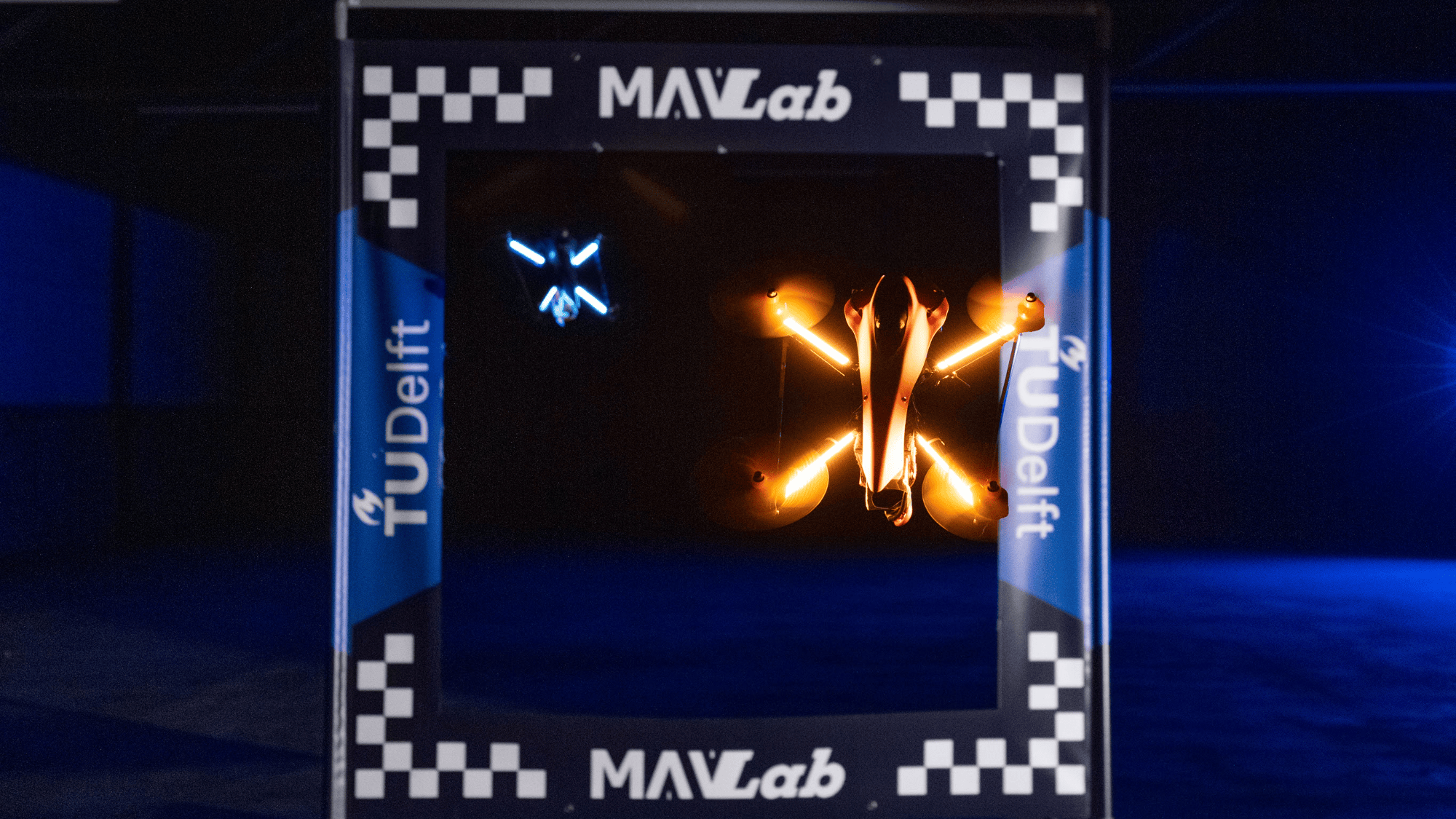
Timelapse image of the autonomous MonoRace racing drone flying through the final racing gate at Abu Dhabi in 2025. Image: Micro Air Vehicles Lab/Delft University of Technology.
That understanding of place makes it more equipped to fly without crashing even in less familiar environments. It also improves the drone’s perception over a solely camera-based approach, which can struggle when camera data is less than stellar. Remember, all of this is happening very, very fast.
“Flying at very high speed with only one camera is challenging because the images are blurry, deformed, and the AI system has very little time to precisely determine where the drone is,” Delft University robotics researcher and study co-author Stavrow Bahnam said in a statement. “We developed a robust way of combining what the camera sees with the drone’s own motion information, allowing it to navigate the track at high speed without GPS.”
What sets MonoRace apart from complex AI systems running on larger vehicles or humanoid robots is how stripped down it is. The entire system has to run on a tiny computer on the drone, light enough not to slow the drone down and efficient enough not to introduce lag. And yet, it’s still quite powerful, with the AI issuing an estimated 500 commands every second. Rather than train the model on one specific track, they trained it to learn how to adapt using a reinforcement learning approach. After many attempts of trial and error in a simulated environment, MonoRace figured out the best ways to quickly solve navigation problems and then apply that in the real world.
“Instead of first planning a desired flight path and conventional commands, our neural network learns to directly control the motors,” study co-author and Delft University Aerospace Engineering PhD candidate Robin Ferede added in a statement.
Putting MonoRace to the test
The team put MonoRace to the real test last November at the Abu Dhabi Autonomous Racing League, a major competition where some of the best human pilots battle to out. During its flights, MonoRace topped speeds of roughly 62 miles per hour as it looped, dove, and zipped through gates. It managed to beat out every other AI racing team in the competition, and also boasted a better time than three former human world champion pilots.
According to the team, these results make MonoRace the first AI-piloted drone to beat human pilots in an international racing competition, and could have an impact on drone racing and physical AI more broadly. With self-driving vehicles and even some humanoid robots entering larger-scale production, there’s an increasingly high demand to build AI systems that better grasp how to move about the physical world without barreling into everything around it. A drone that can do that while performing acrobatics at more than 60 miles per hour suggests that engineers are, at minimum, heading in the right direction.
So far, that hasn’t resulted in larger robots suddenly superseding humans at sports. The fastest robot sprinters, though admittedly quick in short bursts, also tend to crash into walls and burst into flames.
In exactly a month, on November 13, 2026, the world will end. Fittingly, our impending apocalypse falls on Friday the 13th.
At least, that was the prediction made by University of Illinois physicist Heinz von Foerster in a highly cited Science paper published in 1960. Though talks of supposed doomsday have renewed in recent months thanks to hyperbolic anxieties over runaway, sentient artificial intelligence, von Foerster had a much different calamity in mind.
For more than a century, the prevailing fear, dating back to English economist Thomas Malthus who lived between 1766 to 1834, was of a booming population outrunning its food supply. Famine would ensue. But Von Foerster broke from that view. He assumed (correctly, as it turns out) that human ingenuity would keep the world mostly fed. The problem, he argued, was that the population would keep accelerating, toward “infinity.”
In a now infamous quote, von Foerster predicted, “Our great—great—grandchildren will not starve to death,” von Foerster and his co-authors wrote. “They will be squeezed to death.” Homo sapiens’ last gasping breath, they predicted, would peter out in the fall of 2026.
It’s pretty clear that von Foerster’s estimate was dead wrong. Not only is the global population (around 8.3 billion people) not expanding near the rate it was when he was writing, but there are actually concerns it’s moving in the opposite direction. In dozens of countries around the world, from South Korea and Japan to much of Western Europe, the concern among demographers has shifted from worries about overpopulation to decliningbirth rates.
So how was a prediction so wrong and still so influential? Human population experts speaking with Popular Science say von Foerster and his contemporaries based their prediction on real trends from the past while utterly failing to see the world changing right before their eyes. Though they may have accurately measured growth rates up to that point, that only tells part of the story.
“He got the picture right just as that picture ceased to be right,” Rockefeller University and Columbia University professor and mathematical biologist Joel Cohen tells Popular Science. Cohen has studied human population changes for years and published the influential 1995 book How Many People Can the Earth Support?
“Von Foerster didn’t know at the time, and in fact, nobody knew” that the all-time population growth had already happened, Cohen adds. “The all-time peak happened in the early 1960s.”
Factory employees work at the Stepney Wheel Factory building tires for early automobiles in Wales during the Industrial Revolution. Image: Heritage Images / Contributor / Getty Images Heritage Images
Why did experts think the world would end on Friday the 13th?
Von Foerster and his colleagues published their “Doomsday” paper on November 4, 1960. The dramatic pronouncement hinges on an equation that projects the human population into the future based on past trends.
The team gathered 24 estimates of world population dating back 2,000 years. The key assumption underpinning their logic was that humans differ from other animals because of our unique ability to cooperate and innovate.
Fruit flies in a jar eventually level off as crowding and competition take their toll. Humans, on the other hand, the authors argue, work the other way. The more of us there are, the better we get at cooperating. And the better we get at cooperation, the faster our population grows.
Follow that curve forward, and the population doesn’t just grow; it rockets toward infinity, hitting the so-called mathematical wall on November 13, 2026, give or take five years.
Von Foerster wasn’t alone in sounding the alarm either. Eight years later, biologist Paul R. Ehrlich would publish The Population Bomb, arguably the most influential single text fueling overpopulation fears.
“Both of those guys were right looking backward, but wrong looking forward,” Cohen says.
At a glance, thinking the future will resemble the past seems pretty reasonable. The human population grew steadily but slowly over much of our roughly 300,000 years of humanity. But that changed radically with the onset of globalization, colonization, and the Industrial Revolution.
How fast is the human population growing?
As Darrell Bricker and John Ibbitson note in their 2020 book Empty Planet: The Shock of Global Population Decline, human population passed the one billion mark somewhere around 1800. That doubled to two billion by 1927. Then doubled again just less than 50 years later in 1974. It would then only take another 13 years to cross the five billion mark. And in 2022, we surpassed eight billion.
That remarkable explosion had many causes, Cohen says, but among the most important was the spread of cheap, calorie-dense crops like potatoes and corn from the Americas.
The proliferation of cheap, calorie-dense crops like potatoes and corn from the Americas helped fuel a population boom in the 20th century. Image: FPG / Staff / Getty Images FPG
Crucially, though, humans weren’t necessarily having way more kids. They were just far better at keeping them alive.
Human population booms weren’t because people were having more kids
“Humanity got better at keeping the people who were born alive through simple, but important innovations like the germ theory of disease, sanitation, nutrition,” University of Texas Associate professor and economic demographer Dean Spears tells Popular Science.
Demographers like Spears study human populations and how they change over time. He published a book on the topic titled After the Spike, earlier this year. Advances in nutrition and medicine “caused early life mortality rates to fall, so more of the humans who were born survived and that caused the population to grow.”
Factoring in longer life expectancy and reductions in child mortality around the world blows a huge hole in Von Foerster’s calculations. Death rates can only fall so far, and once most children survive, families tend to have fewer of them.
The population boom was a one time explosion, not an ever-accelerating loop.
Overpopulation fears are actually based on a misunderstanding
Von Foerster’s assumption of endlessly accelerating growth, Spears says, was “based on a misunderstanding of where population growth comes from.”
Experts specializing in human population studies at the time actually knew that was the case, Spears notes.
Neither von Foerster’s nor Ehrlich (who wrote The Population Bomb) were human population experts. Von Foerster’s background was in physics and philosophy. Ehrlich was a biologist. But they were both great at getting attention.
Cambridge-educated Malayan medical doctor Wu Lien Teh was among the first to start using medical face masks during a deadly outbreak of the Manchurian plague in 1910. Image: Public Domain
“There was never, even at that time, any reason to think that it would keep growing fast like that.” Spears says. “Paul Ehrlich was a biologist who studied butterflies, not human demography.”
Why people are worried about declining birth rates now
In the later 20th century, population growth actually started declining quite rapidly thanks to a convergence of a variety of factors.
The “Green Revolution” in farming meant that more food could be grown on the same plot of land, which extinguished fears of humanity suddenly starving itself. The first birth control pill, approved by the Federal Drug Administration (FDA) in the U.S. in 1957, also gave women more autonomy to decide when and how many children to have.
These trends, along with global population shifts away from rural areas and towards more urban areas, would eventually shift concerns away from overpopulation and towards declining birth rates.
Although demographers and policy experts debate how much people should worry about declining birth rates, it is generallyagreed that an older population that significantly outnumbers younger people can lead to long-term strains on the country’s economy and social services.
With fewer workers needed in the field, more and more people moved to cities. Historically, families living on farms or agricultural communities tend to have more children than those in urban areas because those children could work the land and, in a purely economic sense, provide more labor and, hopefully, make the family more money. In more urban areas, another child meant another mouth to feed rather than an extra pair of hands.
In the later part of the 20th century, women in many parts of the world gained far more autonomy through education, work, and access to contraception, which demographers agree is among the biggest drivers of demographic change over the past half century.
Some governments went further. China’s one-child policy (introduced in 1979) and India’s forced sterilization campaigns (between 1975-1977) were heavy-handed responses fuelled by overpopulation panic. What makes those coercive policies all the more tragic, Spears notes, is that birth rates likely would have fallen without them.
“What we’re seeing now, a world of low and falling birth rates, is actually nothing new, but just the latest moment in a decades-long or longer trajectory of falling global birth rates on average happening essentially everywhere,” Sears says.
“I would say that the coercive [state-sanctioned] school [of thought] was counterproductive,” Cohen adds. He went on to say he believes similar government-led initiatives encouraging families to have more children today, like the Trump administration’s proposed baby medal, are “counterproductive.” Real, meaningful generational changes in population, Cohen notes, are more often the product of society-level macro trends beyond the scope of any one politician or party.
Today, about a month shy of von Foerster’s doomsday, around 55 percent of the world’s countries, home to more than two-thirds of its people, have fertility rates below replacement level. That’s the rate (about 2.1 children per woman) demographers use to denote where a population replaces itself from one generation to the next.
In other words, not only is the human population not hurtling towards infinity, but in much of the world, it’s actually on track to eventually shrink. Experts largely agree birth rates are falling. Whether that’s a problem to be solved is less clear-cut.
At the family level, having fewer children can mean more money, resources, and personal attention invested in each one. It can also mean more independence, opportunity, and choice for those who decided parenthood just isn’t for them.
Stabilizing birth rates isn’t a fix all
At the broader economic or societal level, though, Spears argues there are good reasons to want birth rates to stabilize rather than keep falling. Pay-as-you-go social programs like Social Security depend on young workers to fund older people’s retirements. Fewer people also means fewer shared resources and services for everyone else.
“If you want to go out and eat lunch at a taco truck, but you’re the only person nearby who wants it, then the taco truck’s not going to be there,” Spears says. “And if you’re a school child wanting to go to school, there might not be enough other children for there to be a classroom nearby that’s suitable for you.”
Those are legitimate concerns, though Cohen warns that focusing too much on abstract numbers and trends can blur a more immediate issue directly in front of us. Globally, children are still regularly going underfed, so much so that the World Health Organization estimates around 22 percent of children under the age of five experience stunted growth from malnutrition.
“We are doing so poorly by the children we have that I can’t understand why the emphasis is on making more children,” Cohen says. “We’re talking about having more children when we don’t take care of the children we have. What the heck is that?”
But even for those who do worry about falling birth rates, Spears cautions against politicians promising quick fixes. This isn’t a short-term emergency, he says, but a “generational challenge.” One thing is clear though: Neither Spears nor Cohen are losing sleep over von Foerster’s November 13 death date.
“I’m sure not acting as if I’m too concerned about it,” Cohen says. “I’m still paying my bills. I’m still paying my taxes.”
In Ask Us Anything, Popular Science answers your most outlandish, mind-burning questions, from the everyday things you’ve always wondered to the bizarre things you never thought to ask. Have something you’ve always wanted to know? Ask us.
As residents on the northern Gulf Coast brace for quickly strengthening Hurricane Isaias (a Category 3 storm as of Friday afternoon), many are likely eyeing their roofs and walls with nervous anticipation. The Congressional Budget Office estimates hurricane force winds and storm-related flooding collectively cost households in the United States some $34 billion every year. And while rounded corners, sloped walls and reinforced construction can help mitigate some wind damage, these additions are often expensive or impractical for developers looking to cut costs. Engineers at Florida A&M University and Florida State University think they’ve found a resourceful alternative, and it involves embracing the ocean’s own wavy aesthetic.
For a study recently published in the journal Engineering Structures, the team built 3D-printed models of several low-rise buildings with wave shaped walls and roofs and tested them in a wind tunnel. The designs with the deepest waves, (in this case 10 percent of the building’s overall height) cut peak wind pressure near roof and wall corner by up to 60 percent. Those corners and edges are where damaging forces typically concentrate. Surprisingly simple designs like these could become increasingly attractive to develop in the coming years, as more and more communities brace themselves to endure stronger and more frequently occurring storms.
“These nonconventional building shapes reduce the damage from worst-case severe weather scenarios,” Pedro Fernández-Cabán, a study co-author and Florida State University civil engineer, said in a statement. “It’s another tool for engineers and designers to protect against wind damage.”
Bigger waves means better protection
To test their idea, Fernández-Cabán and his colleagues started by 3D printing various models of low-rise buildings. Some of the buildings had wavy walls and roofs, while others were built with a more conventional baseline model with flat, straight surfaces. They made three wavy versions, with wave amplitudes of 5 percent, 7.5 percent, and 10 percent. The amplitude measures the wave’s size in proportion to the building’s overall height in feet. So, for a 20-foot-tall building, a 10 percent amplitude would mean waves that extend about 2 feet.
Once the models were printed, the team then put them into a wind tunnel at the university. They measured wind pressure data on their surfaces as wind pelted the modelers from various directions. All of the wave-roofed models experienced reduced wind load compared to the flat version. The deepest wave model performed the best, reducing peak wind pressure near roof and wall corners by between 40 and 60 percent compared to the flat version. At least in theory, that means a building with that design could see significantly less damage when exposed to hurricane-force winds.
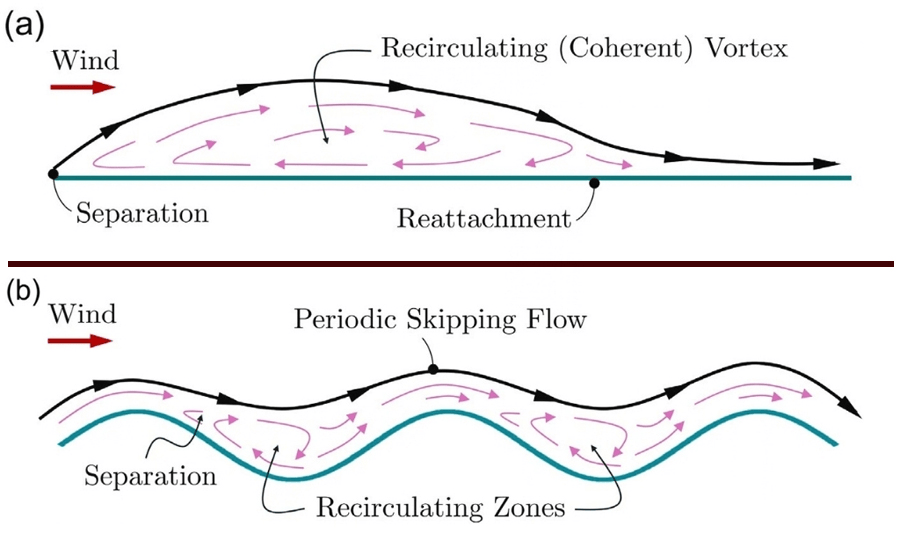
The diagram shows how curving structures can help prevent more destructing vortices from forming. Image: Pedro Fernández-Cabán.
The paper includes a useful diagram (above) that breaks down why this wavy design works. When wind flows over a flat surface like a roof, it separates at the leading edge and from a single large, swirling vortex. That creates a zone of low pressure, while higher pressure underneath the building pushes out against the surface. That leads to a suction like effect that, in extreme scenarios, can peel roofs off of a building. Over a wavy surface, the wind skips along like a stone across a lake, forming a series of smaller swirls instead of one big one. That disruption to the wind can prevent high-suction picks from forming. The result is a building that with less exposure to the strongest, points many damaging wind forces than a flat one.
“Changing a building’s shape can significantly reduce the intensity of wind forces it has to withstand,” Fernández-Cabán said.
The researchers caution that this study focused specifically on wind pressure on the model’s surfaces. They’re now running additional experiments to better understand how wind flows around the wavy structures and plan to use computer modeling to fine-tune the wave patterns and test other shapes. If that work bears out similar to the early results, it could make wavy walls and rooms all the more attractive to architects and engineers looking for simple solutions to protect buildings in storm prone areas.
Just over 40 years ago, what began as a routine safety test at the Chernobyl nuclear power plant (or Chornobyl in Ukrainian) in Soviet Ukraine spiraled into one of the most recognizable disasters of the 20th century. The reactor exploded and burned, spewing chunks of nuclear debris into the sky. Among that toxic litter were countless tiny “hot particles,” fragments of nuclear fuel smaller than the width of a human hair (somewhere between 8 and 50 micrometers across). Those particles are called hot because they’re highly radioactive, and still are four decades later. Today, scientists entering the areas of the Chernobyl Exclusion Zone where the hot particles are located are required to wear a full protective suit.
But after decades of study, scientists still know surprisingly little about what their particles are made of at the molecular level. A team of researchers from Germany recently set out to change that by analyzing six particles collected from two sites in the Exclusion Zone using synchrotron X-ray diffraction. Surprisingly, they discovered the particles remained far more chemically stable than they had expected. Their crystal structures were largely intact, suggesting they changed little since forming during the disaster and its aftermath.
The hot particles thrown out of the Chernobyl plant fall into three general categories. The first is fuel that remains chemically and physically similar to the reactor’s original uranium dioxide. The second type consists of fuel that melted during the explosion and fused to its zirconium-alloy protective casing. The third type is fire-damaged fuel.
As the reactor’s graphite burned for 10 days after the explosion, the intense heat oxidized some of the fuel into other uranium compounds.
Particles, crystals…and dogs
For this particular study, the team sourced their six samples from two areas in the exclusion zone, and all three hot particle categories were represented. Two came from asphalt in Pripyat, roughly 2 miles from the reactor, while the other four came from farm soil samples in Kopachi, about 3 miles away.
With the samples selected, the researchers isolated individual particles pulled from the soil, mounted each type to a tiny tungsten electrode, and then sent them to the European Synchrotron Radiation Facility in Grenoble, France. There, a team analyzed the particles using intense X-rays produced by a synchrotron, a circular particle accelerator. The researchers rotated each particle in an X-ray beam, measuring it from roughly 2,000 different angles. Watching how the x-rays bounced off all that material revealed how its atoms were arranged, showing which compounds each particle was made of and, most importantly for this study, how intact its crystal structure remained.
Hot particle from the 1986 reactor accident: The nuclear fuel particle is partially fused with zirconium oxide. Image: Laura Stalmann.
They expected to see particles that had been broken down by years of exposure to the elements. Instead, the crystal structures were still largely intact. That surprising finding suggests the particles are far more chemically stable than previously assumed, holding their radioactive contents locked inside their crystal structures.
Though some of the particles showed more oxidation (of a loss of electrons when they interact with other chemicals) than others, two showed virtually none at all. Importantly, two of the particles pulled from the same soil near Kopachi included both a sample heavily oxidized and one that was largely untouched. The authors suggest that if weathering from the environment were the cause of the oxidation, then both particles sitting side by side should look similar. Instead, they say the oxidation likely happened during the disaster itself, when the reactor fire baked some of the fuel for days.
That timeline is potentially good news for the areas around the power plant. If the particles are indeed holding onto that radioactive material and not oxidizing, that could mean less harmful material is making its way into the soil and, in turn, the surrounding ecosystem. Still, the researchers quickly caveat any broad claims. These were just six samples, after all. Making any wider claim about the soil in the region generally would require more research.
Though it’s still too early to say with any certainty, that lack of leaching dangerous material into the environment could partly help explain why the exclusion zone has become home to an ever-growing neighborhood of furry mammals in recent years. In fact, the area’s lack of humans has made it a thriving ecosystem for foxes, bears, and bison. It’s a modern, albeit a little unorthodox, example of rewilding. Of course, even in this new frontier, the consequences of a nuclear disaster aren’t totally absent. A recent study of roaming dogs living in the Chernobyl Exclusion Zone, many believed to be descendants of dogs left by their owners during the 1986 evacuation, show distinct genetic differences from dogs in an area just 10 miles away.
Timekeeping has officially entered its nuclear age. Two independent teams, one in Vienna, Austria and another in Beijing, China have built working thorium-229 nuclear clock prototypes. Rather than track changes in an atom’s electrons the way that current atomic clocks do, these nuclear versions use a laser that’s tuned to the frequency where a thorium nucleus flips between two energy states for potentially even more accurate time keeping. Scientists believe this new approach could one day make the clocks far more reliable than any existing atomic timekeeper.
To put that in perspective, current atomic clocks can keep time with an uncertainty of 1 second every 300 million years. Scientists predict that more advanced nuclear clocks could move that metric into the billions of years. That could open the door to probing some of the universe’s hardest-to-measure phenomena, like notoriously elusive dark matter. The Chinese clock and Austrian clock were detailed in a pair of studies published this week in the journal Nature.
“The great advantage of the new nuclear clock in Vienna is that, if you use atomic nuclei rather than atoms, much higher precision is possible in principle,” Thorsten Schumm, a study co-author and professor at the Vienna University of Technology, said in a statement.
The thorium crystal and the laser beam. Image: TU Wien.
How nuclear clocks work
The world’s network of atomic clocks is already mind-bogglingly accurate. They also underpin a slew of modern necessities, from GPS to internet communication. Atomic clocks work by tuning a laser to the exact frequency of light that makes an atom’s electron jump between two levels.
Nuclear clocks, as the name suggests, go even deeper. They target jumps inside of an atom’s nucleus. Lasers focus on vibrations from a single nucleus rather than the whole atom. For those who weren’t paying all that much attention in chemistry class, a nucleus is tens of thousands of times smaller than the atom surrounding it.
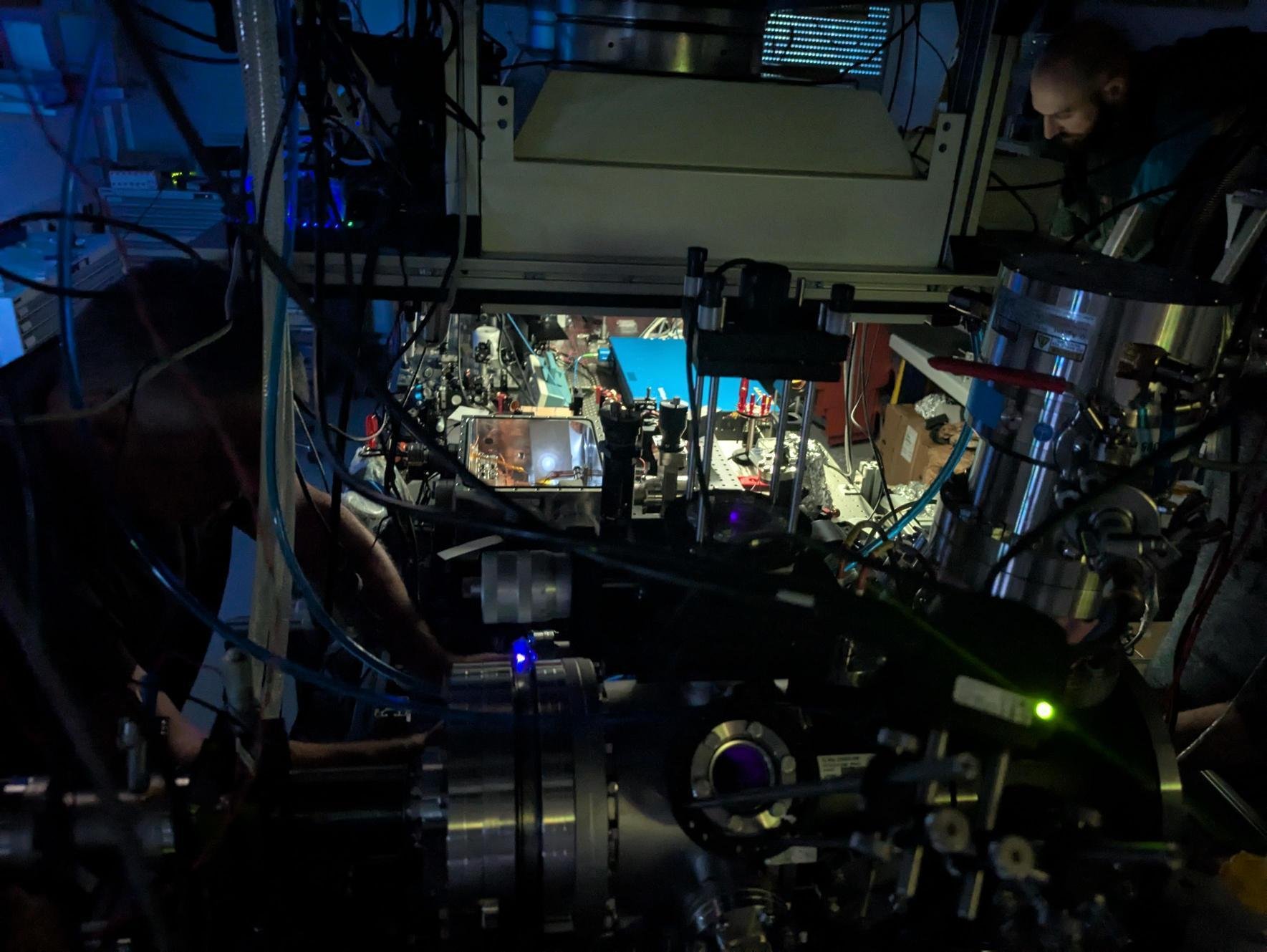
Luca Toscani de Col (top right) working on the nuclear clock in the Vienna lab. Image:Matthias Heisler, TU Wien.
Keeping time in a nuclear clock requires keeping the laser tuned to the nucleus as it switches between states. This process is sometimes colloquially referred to as “squishing” the nucleus. Squishing atomic nuclei usually requires an enormous amount of energy. However, the isotope Thorium-229, is a rare exception, which is why both teams at Vienna University of Technology and Tsinghua University in Beijing built their clocks around it.
“The basic idea is simple: you have a laser and you have thorium,” Schumm added. “The laser changes the energy state of the thorium nuclei, and the thorium nuclei are used to stabilize the frequency of the laser.”
Nuclear is still catching up to atomic
These two prototype clocks are many years in the making. The thorium crystal used for both was grown separately, but around the same time. So far, testing reportedly shows the version in China is about six times as stable than the clock in Vienna. The Vienna prototype, meanwhile, is reportedly the first nuclear clock that stabilizes itself the way atomic clocks do. Schumm recently told the South China Morning Post this parallel development has led to a “fierce but friendly global competition.”
Nuclear clocks may eventually far surpass their atomic forebears, but they aren’t there yet. Researchers estimate the new prototype may drift by about one second every 30 million years. That’s roughly 10 times worse than the cesium clocks that currently define the official second.
Still, researchers expect that stronger, more efficient lasers and better thorium crystals will make each new generation of nuclear clocks ever more accurate, until they eventually surpass atomic clocks altogether. Who manages to get their first remains to be determined.

 Login