❌

Reading view

Mysterious Roman tablet with Egyptian curse written by slave found in military settlement
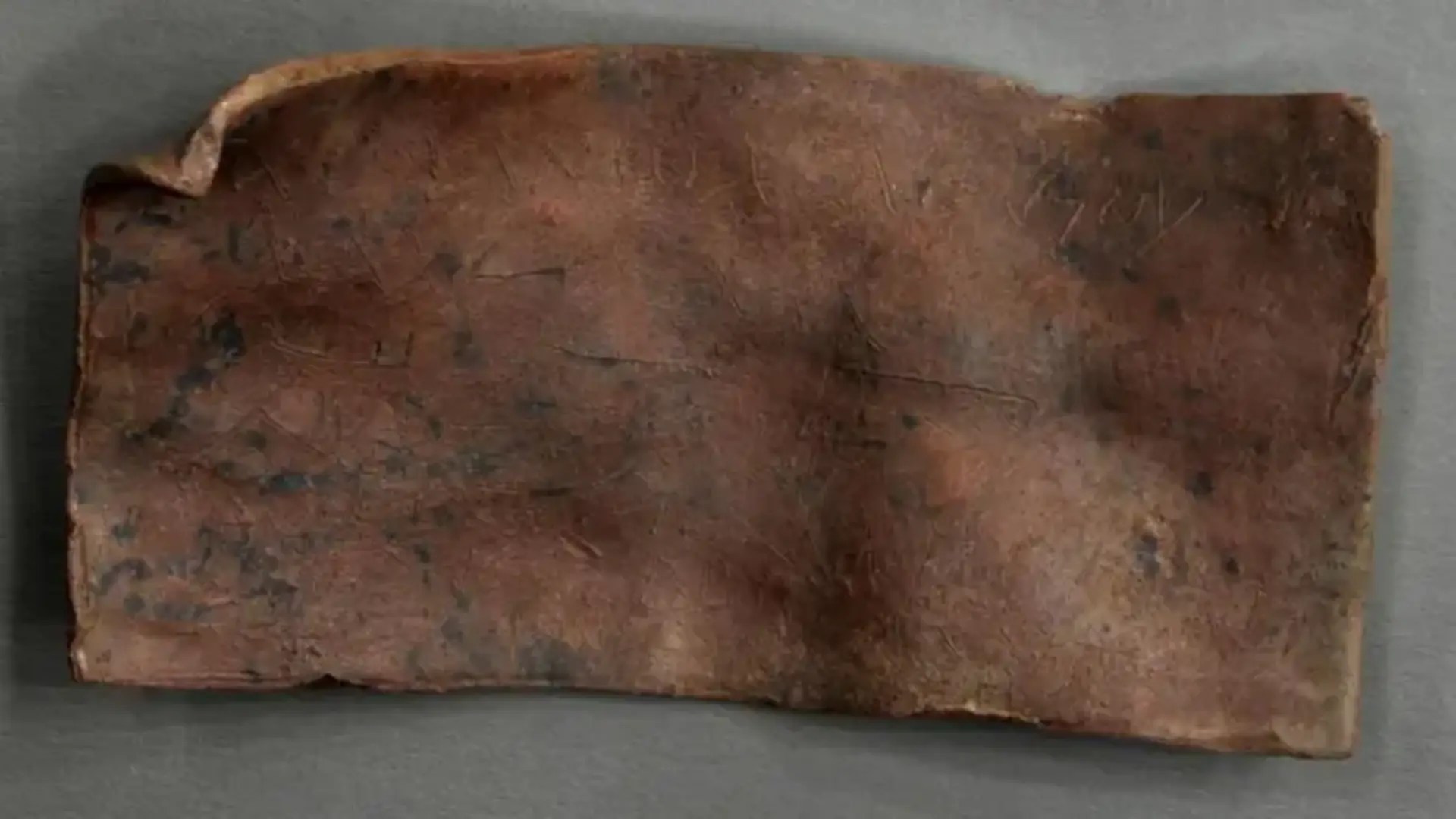
In an interesting twist of fate, researchers from the Institute of Papyrology at Heidelberg University discovered “curse tablets” from the Roman era, a fascinating look at the more superstitious side of a triumphant empire.

Found in a pit in the Town Square in Heerlen, the curse tablet measuring about 3.7 by 1.9 inches had been laid to rest at a former Roman military settlement of Coriovallum in Lower Germania.

Whoever left it there had a vendetta against her own, or someone else, as researchers suspect that a slave had written the curse either against the four slaves named, or an unknown person.

Known as a defixione or katadesmoi, these curse tablets made of lead were marked with spells and then buried in places associated with supernatural forces, showing that we, humans, have always had a desire to invoke the gods to act in our favor.

This is a rare sighting from Roman Egypt that revealed the role that magic played in that society, at a time when cultures and belief systems were mixing and spreading throughout the empire.

Someone was mad

Researchers had an arduous task before them, as time damaged the inscription. They employed reflectance transformation imaging, which allowed them to penetrate the tablet deeper than their eyes could, picking up more of the inscription lost, their wish perhaps answered by the gods.

Upon the profane/sacred tablet, they found references to Egyptian divinities, which, according to researchers, surprised them as a rare sighting in Germany. Most in Northern Europe follow a similar format: Latin and Roman. Not Egyptian.

And the plot thickens… as it was buried, interestingly, in a former Roman military settlement, and typically, these were buried in locations infused with the supernatural. Below three magical symbols, the author wrote the names of four enslaved people. The men held Latin names. The women, Greek.

As the inscription had been damaged, researchers couldn’t decipher whether this tablet had cursed four slaves or whether four slaves had cried out to the Egyptian gods and demi-heroes, who knows? To wrath. To wreak havoc on an unknown person.

“The tablet served either as a curse against these four slaves or as a curse in their name against an unnamed person,” as the Heidelberg papyrologist told Phys.

Hoping to “work a little magic”

Already, the curse tablet stands alone among the others that researchers have found, because the author etched the message in Greek rather than Latin. These thin sheets of lead containing scratches of supernatural desires were used to sway a court case, target a rival, or even a lover, as per Archaeology News.

“It cannot be ruled out that one of the two women was the author of the inscription and had brought the supposed ability to communicate with divine powers through such curses with her from Roman Egypt,” says Dr. Julia Lougovaya, research associate at the Institute for Papyrology in Phys.

That might suggest that she wrote it for someone, on behalf of four slaves. This author might have originated from Roman Egypt because of the references used. Along the Nile, magic played a fundamental role in society. But interestingly, more so related to protection and healing, as per Phys.

But this was a curse. And these tablets were Roman. So, did a former slave flip the concept? The significance of the tablet rests on its cultural mix.

In the far north of the Roman Empire, this Egyptian-meets-Greek artifact was found, exhibiting just how far the mélange of cultures traveled. Perhaps, it might even inspire ideas as to who might have wanted to curse someone at some Roman camp, because of the slave names written across the tablet.

💾

Known as a defixione or katadesmoi, these curse tablets made of lead were marked with spells and then buried in places associated with supernatural forces.
  •  

Massive 2,000-year-old luxurious Roman bathhouse uncovered in the Netherlands

The largest Roman bathhouse complex ever discovered in the Netherlands has surfaced, shedding new light on the wealth and importance of the ancient Roman city of Ulpia Noviomagus.

Researchers from the archaeological firms RAAP and BAAC were conducting routine investigations in Nijmegen’s Waalfront district, a site slated for new residential development. The excavation, which began in September of last year and will conclude in July, uncovered a public bathhouse, residential blocks, luxury townhouses, streets, and a tower dating back nearly 2,000 years.

“For years, the traces of the Roman past at this location were invisible, hidden deep underground. Now that we are realizing a new living environment here, the past has become visible,” said Joost Mulder, BPD’s Regional Director for the North-East & Central region, in a press release.

The bathhouse complex, or thermae, covered at least 4,900 square meters, making it the second-largest excavated Roman public bath complex in the Netherlands. Despite centuries of stone removal and reuse following the Roman period, parts of the structure remain exceptionally well-preserved.

Roman history unearthed

The size of the complex reflects the importance of Ulpia Noviomagus—the Roman city that once stood here—which is believed to have received its official status from Emperor Trajan around 100 AD. The discoveries suggest that this area of the city remained active well into the third century AD.

The bathhouse was richly decorated. Its interior walls were clad in marble. The floors were laid with black-and-white limestone tiles. Other rooms featured colorful, painted plaster. Decorative limestone and sandstone moldings adorned the building’s facades, while columns made from the same materials enhanced its splendor.

Archaeologists also uncovered extensive drainage systems, flooring, and a hypocaust—a sophisticated Roman underfloor heating system supported by brick pillars. This technology circulated hot air beneath a raised floor, as per Archaeology News. Two stone foundations survive to a height of nearly two meters, making them some of the best-preserved examples of Roman masonry in Nijmegen.

Tens of thousands of artifacts recovered from the site point to the affluent lifestyle that residents enjoyed during the second and third centuries AD.

Among the discoveries are bronze statue fragments, signet rings, a necklace with a gold clasp, coins, and hundreds of bone hairpins used in elaborate Roman hairstyles. Notably, two of the hairpins featured remarkable carvings of cats—one seated and one standing.

However, a bronze bust depicting Bacchus, the Roman god of wine, stood out the most to archaeologists. They believe the object originally formed part of a pitcher or a piece of furniture before later being adapted for use on a weighing scale.

Archaeologists also recovered numerous coins from the reign of Emperor Postumus, who ruled between 260 and 269 AD, providing rare evidence of continued occupation during a relatively poorly documented period.

Integrating the past into the future

Developers and city officials plan to integrate the site’s Roman heritage into the future neighborhood, added Archaeology News.

“The link to the past will remain visible in the future as well. For instance, a number of residential buildings will feature a covered walking area with rows of columns. A colonnade just like in Roman times. And developers plan to call the green square in the heart of the area, inspired by the floor plan of the bathhouse complex, Thermenplein. A direct reference to the Roman meeting place that was here some 2,000 years ago,” concludes the press release.

Several artifacts from the excavation will go on display at Nijmegen City Hall beginning June 29, offering residents a glimpse into the city’s rich Roman history and its status as one of the most important Roman centers in the Netherlands.

💾

A routine excavation at Nijmegen’s Waalfront district has revealed a 4,900-square-meter Roman thermae complex.
  •  
❌