❌

Reading view

Frontier OpenAI Model Exposes Stunning Exploit That Leaves Millions of Web Servers Open to Attack

Security researchers using an OpenAI model have uncovered two stunning security flaws in PHP,  the software that underpins nearly 70 percent of all websites on the internet. 

The flaws are so catastrophic that all websites using PHP — all untold millions of them — are advised to immediately take their servers down and apply the latest patch, which was released Wednesday. Vast swathes of the internet, following the news, have gone dark. Some that went offline for a time include Wikipedia, Steam, and even government websites.

Many organizations, however, may not have the time, resources, and personpower to swiftly implement the patch, making them potential sitting ducks until they do. According to the New York Times, the information released on the vulnerability can be used to reverse engineer the attack and take control of victim’s servers and steal information. The best course of action if you can’t patch your website, the National Security Agency advised, is dramatic: keep your site offline and don’t turn it back on.

Just as extraordinary as the breadth of the threat was how it was identified. The flaws were discovered by researchers at the cybersecurity firm Calif by using OpenAI’s GPT-5.6 Sol model, as part of a collaboration with the AI company. It then reported the flaw to the PHP Foundation back on August 11. 

The Google-owned security firm Wiz independently found the flaws, too, and made a report on August 24. Wiz called it one of the “most severe vulnerabilities discovered in PHP, and arguably in software history.”

Adding to the alarm presented by the exploits, there have been concerns raised over OpenAI’s role in how they were identified.

The flaws have been present in versions of PHP dating backing to 2004. But through OpenAI’s “Patch the Planet” program, and by using its flagship GPT-5.6 Sol model, Calif found it in only a matter of days. In a sense, these exploits only exist because of current powerful AI models. And moreover, OpenAI encouraged their discovery through its programs.

The messy disclosure of the vulnerability doesn’t help matters. OpenAI followed standard responsible practices, but some of the details around the hack leaked a day before it was officially scheduled to be announced.

Even if no leaks occurred, though, the damage caused by the mere knowledge that the vulnerabilities exist — which again, is largely thanks to AI — would still be catastrophic. It was the inevitable next chapter in all the bluster around AI companies revealing their agentic models’ hacking prowess. A headline in The Atlantic proclaimed that the “AI-Hacking Apocalypse Began Last Night.” OpenAI will tout the discovery as undeniable proof of its AI’s capabilities, while the rest of the world picks up the pieces of a shattered internet.

More on AI: AI Experts Already Doomsday Prepping for When AI Takes Out the Entire Financial System

The post Frontier OpenAI Model Exposes Stunning Exploit That Leaves Millions of Web Servers Open to Attack appeared first on Futurism.


  •  

Why Did Polymarket Think It Was a Good Idea to Allow Bets on the Fates of the Cornell 7?

Polymarket has showed that it can still hit a new low after the controversial prediction market was allowing users to effectively bet on rape and sexual assault.

According to coverage from Defector, a market titled “Any of the Cornell 7 charged with a felony sex crime?” was on the gambling platform for nearly three weeks, before it was recently taken down after a public outcry.

The bet, which opened on September 30, was referring to the defendants against a civil suit filed last month by a former Cornell University student who says she was drugged and gang-raped by seven students who were part of a frat house on campus.

The harrowing case became a national news story, fueling headlines, sparking protests, and driving heated debates. And now, in an age of ubiquitous and effortless gambling, it was also powering bets.

Women and women’s rights organizations on social media began calling out the Polymarket bet over the past week, per Defector, though it largely escaped mainstream media scrutiny. 

The news site Front Office Sports reached out for comment and got only a boilerplate statement. Defector followed up and got an even less informative reply: “Polymarket is going to respectfully decline comment at this time.”

The bet was suddenly taken down after the FOS story ran, even though the company’s statement suggested no contrition or intent to change course. “This case, and sexual assault on college campuses more broadly, are deeply important issues,” Polymarket said, “and markets bring objective, data-driven insight into how a matter like this is moving through the legal system, on a topic that deserves far more transparency and honest attention.”

It elaborated on this in a statement to PBS after the bet was removed: “That said, we believe in the wisdom of crowds, have heard them loud and clear, and removed the market.”

Polymarket has a sordid history of unscrupulous bets. It allowed users to bet on whether a nuclear weapon would be detonated before next year, though it was taken down. It also routinely hosts bets on climate change, military actions, and natural disasters.

The chilling thing, Defector notes, is that it’s unclear if Polymarket would’ve bothered to take down the Cornell 7 bet if it hadn’t started attracting negative attention. 

More on finance: Gambling Addiction Group in Shambles After It Turns Out It’s Funded by Kalshi

The post Why Did Polymarket Think It Was a Good Idea to Allow Bets on the Fates of the Cornell 7? appeared first on Futurism.

  •  

Halley’s Comet Barraging Earth With Debris

Keep your eyes peeled and your binoculars primed tonight, stargazers. The distant Halley’s Comet is reminding us of its far-off presence by pelting our planet with a barrage of meteors which will make the eastern welkin blush with a cosmic light show.

The meteor shower, known as the Orionids, is characterized by its fast-moving bright streaks and fireballs that can be seen for minutes at a time, with some trails staying visible even after the meteor has blinked out. And yes, you can see them with the naked eye.

Though it began at the start of October and is projected to last until November 7, the shower is expected to hit peak brightness this Wednesday night and early Thursday morning.

Its resplendence, however, will be challenged by a waxing gibbous Moon, which will be around 77 percent full tonight and as such fairly shiny in its own right, but will set early in the morning. 

Halley’s Comet is a long period comet that takes 76 years to orbit the Sun and only makes an appearance in our skies roughly just as often. Last time it swung by was back in 1986, and it won’t return until 2061, but the Orionids, which are essentially the debris discarded by the comet as it nears our star, can be seen at other times because they linger around long after it has departed back into the void.

Our planet happens to pass through this debris field twice a year, producing a meteor shower. The Orionids falls in October, and the other meteor shower, known as the Eta Aquariid, occurs in May. The streaks of light in our sky are the comet’s ejected particles burning up as they tear through our atmosphere.

To watch the Orionids, NASA recommends viewing it after moonset and before dawn because of the bright gibbous Moon. That will probably be around 3:30 AM EST. You don’t need any special equipment, but you should get outside the city and go somewhere far from any sources of light pollution. Then cross your fingers and hope for clear weather. 

The shower originates from a point near the star system Betelgeuse in the constellation Orion, but the shower is noticeable enough that you won’t have to do much more than look towards the southeast to spot it. If you’re lucky, you’ll see up to 20 streaks cross the sky each hour.

More on astronomy: Scientists Discover Weird Conditions at Site of Star That Exploded During the Period of Japanese Samurai

The post Halley’s Comet Barraging Earth With Debris appeared first on Futurism.

  •  

Maybe Vibe Coding Should Be Called “Cuck Coding” Because You Just Sit in a Chair and Watch

Vibe coding is the act of telling an AI what you want to program and letting it write all the code for you. When it was first adopted, it was supposed to embody the sort of care-free optimism that was running in AI circles at the time, high off the possibilities of the tech. AI models had become so powerful that you could build an app using the same conversational language that you deploy while confiding in ChatGPT.

But the “vibes” are different now. Programmers were quickly forced to grapple with the new reality that AI coding tools brought to their profession. Now that everyone’s using AI to churn out code, you have to crank out even more work to keep up and meet your boss’s quota. It may be more “efficient” — and even that’s contested, since someone needs to do the hard work of verifying all that AI pablum — but it hasn’t exactly made people’s jobs easier. Meanwhile, everyone with a Claude subscription and a half-baked app idea fancies themselves a bona fide programmer, too.

In sum, vibe coding has gone from a novelty to something viewed as a necessary evil, or worse, as an object of suspicion. It’s no longer something to brag about. A recent tweet making the rounds in tech circles perhaps encapsulates this shift, joking about using the term “cuck coding” instead of vibe coding “because you just sit in a chair and watch.” Even posters on r/ClaudeCoding found the humor in it.

Vibe coding can churn out marvelous work, but it’s hard to divorce the optimism around it from the clueless bosses who are forcing their employees to heavily use AI to code. Epic Games, the game developer behind the mega hit shooter Fortnite, reportedly went the extra step of basically mandating actual vibes-based coding, telling employees that there would be “no more hand-written code” and that the unnamed game they were working on should be “generated with full AI workflows.” Epic was later met with waves of mockery for bragging that it “vibe coded” its game launcher to be faster than its competitor Steam.

As vulgar as the term sounds, maybe “cuck coding” is indeed the term that more accurately reflects what’s actually going on. You watch and burn… lots of tokens.

More on AI: Major Data Center Developer Rents Floating Prison Barge to House Contract Construction Workers

The post Maybe Vibe Coding Should Be Called “Cuck Coding” Because You Just Sit in a Chair and Watch appeared first on Futurism.

  •  

Elon Musk’s Growing Death Toll: “What He Put Into the Woodchipper Were Children”

As Elon Musk tries to save face by claiming he’ll give every American child a chunk of SpaceX stock, here’s a chilling reminder of what he did that affected millions of children the second he had a whiff of federal power.

In a new interview, the documentary filmmaker Alex Gibney, who directed a just-released four-hour look at the billionaire’s life titled “Musk,” discussed the staggering death toll of Musk’s cuts to USAID, calling it a “crime against humanity.”

“There was an estimate that what [Musk] did by so suddenly cutting USAID would cost through disease and starvation as many as 14 million lives,” he told journalist Katie Couric. “Even if you discount that by an enormous amount, we know that within about a year of those summary cuts — where they were literally burning food that had already been paid for that was going to starving children — 500,000 children died.”

Musk, to Gibney’s astonishment, even joked about the cuts by saying he’d “put USAID into the woodchipper.” 

“What he put into the woodchipper,” Gibney said, “were children.”

Gibney, whose documentary Musk called a “hit piece,” is drawing from a 2025 study published in The Lancet, one of the most prestigious medical journals. It estimated the impact of Musk effectively neutering USAID by implementing a freeze on its foreign aid funding — which went to programs to combat HIV/AIDS, malaria, and to address food insecurities — and slashing nearly 10,000 employees. 

In sum, the researchers found that the “steep funding cuts could result in more than 14 million additional all-age deaths, including 4.5 million in children younger than age five, by 2030.”

Even conservative estimates concurred that the number of deaths would be staggering. A tracker created by Brooke Nichols, a professor and infectious disease mathematical modeler at Boston University, projects the 1-year death toll caused by the USAID cuts at 518,000 children.

It’s a touchy subject for Musk, who continues to bristle at accusations that his actions could’ve caused harm. This summer, he challenged his critics to “cite a single name of someone who died” as a result of him gutting USAID. Nicholas Kristof, a Pulitzer Prize-winning journalist, took him up on it and gave him a list of the specific children who had died directly from his policies, many of whom were in South Sudan and Liberia — places he had visited in person to talk to locals and healthcare workers.

Musk, rather than countering his arguments, called Kristof “evil.”

More on Elon Musk: Elon Musk Says It Was the Pentagon That Shut Down Starlink for the Ukrainian Military

The post Elon Musk’s Growing Death Toll: “What He Put Into the Woodchipper Were Children” appeared first on Futurism.

  •  

Experts Warn of Humans Becoming Empty Vessels Controlled by AI

AI tools continue to automate more parts of our lives — and in turn, we become more reliant on them. Students use ChatGPT to do their homework, programmers ask Claude to churn out code, and now regular folks are getting a taste of AI agents with the launch of Meta’s cutesy personal assistant Muse.

If the trend continues, where does it lead? Some experts who spoke to CBS News worry that we’re on a path to slowly ceding more control to AI models until we become empty, waiting vessels for a bot’s decisions. There’s even a name for this phenomenon: “gradual disempowerment.” Its threat goes beyond job displacement, potentially affecting human cognition and agency itself.

“I put gradual disempowerment on the very top of my list,” Jay Chooi, the founder and CEO of Robocurve, a public benefit corporation that evaluates the role of robots in the workplace, told CBS. “A lot of people feel very powerless, because it requires a lot of effort and a whole-of-society approach to solve it.”

Jan Kulveit, a researcher at Charles University’s Center for Theoretical Studies and coauthor of the paper that coined the term gradual disempowerment, argued that it “does not need to emerge from a deliberate scheme or powergrab by AI systems.” 

“In the short-term, it is being incentivized by the perceived value that AI systems can bring to economic, cultural and state functions,” he wrote in the paper.

This is something many of us already picking up on. The people in our lives who ask an AI to do and plan everything are mocked as “meat proxies”; some are so thoughtless as to let an AI lay out a hiking trip that gets them stranded on a notoriously perilous mountain.

A more extreme imagining of this scenario portrays AI and robots taking over our jobs as they become a cheaper and more efficient alternative to human labor, driving companies that cling on to their human workforce out of business. It doesn’t need to be that drastic, though, to be harmful. Experts are already seeing signs of “cognitive surrender” among AI users — students especially — in which they’re effectively allowing an AI tool to supplant their own thinking. Research has linked reliance on AI tools to diminished critical thinking skills and demonstrated that AI leads to lower brain activity during cognitive tasks like essay writing.

On a societal scale, once we get trapped in this loop, it gets harder to get out.

“If people aren’t actually practicing the skills that the agents are doing for them, they lose the ability to have that skill, and so now you become reliant,” Margaret Mitchell, an AI research scientist at Hugging Face, told CBS. 

“What happens when something goes wrong?” she continued. “There’s no human you can point to who can fix it. So now you’ve become fully dependent on these systems to fix themselves, and what if that’s not possible?”

The decisions that AIs are being allowed to influence — or even make — are already incredibly consequential. An AI targeting system was reportedly involved in the decision to bomb a girl’s school in Iran, killing over 150 people, the vast majority of them children. President Donald Trump was reportedly encouraged to invade Venezuela and capture its president Nicolás Maduro by a conversation with Elon Musk’s Grok.

“A lot of people are talking about rogue AI hacking into data centers and taking over the world,” Chooi said, “but it is not in the mainstream consciousness that like AI could literally take over the world just by continuing to do what it’s supposed to do, which is automating everything.”

More on AI: Anthropic Secretly Lobbying Government to Only Shut Down an AI Model If It’s Poised to Kill More Than 50 People

The post Experts Warn of Humans Becoming Empty Vessels Controlled by AI appeared first on Futurism.

  •  

We Regret to Inform You That “GatGPT” Is Exactly What It Sounds Like

Someone vibe-coded a gun and 3D-printed it — and wants the freedom loving citizens of the world to enjoy this power, too.

The creator, gun-rights activist Cody Wilson, told The Verge that it’s the “first AI-made gun” — his timely followup to the world’s first 3D-printed firearm that he crafted 13 years ago. Called the WASP, the .22 caliber weapon’s unconventional design aptly looks like it might’ve been hallucinated by an old image model, except it apparently actually works and is capable of firing real ammunition.

But the WASP is arguably just a proof-of-concept of his more consequential creation: his very own AI gun generator called “GatGPT,” which was trained on an online library of millions of digital guns and gun parts called DEFCAD (itself launched by Wilson). It will answer any question about firearms you can throw at it and pick out parts for your build, potentially allowing even someone who doesn’t know a clip from a magazine to design their own gun.

“I would argue that what we’ve made is not an AI-generated gun, but an AI that can generate guns,” Wilson told The Verge.

Crucially, Wilson’s WASP doesn’t have a serial number like a traditional firearm. If his AI gunsmith tool works as it’s made out to be, it could be a huge escalation in the advent of so-called “ghost guns,” or homemade firearms that are made outside of government oversight and can’t be easily traced. Some are available as pre-packaged do-it-yourself kits, while others may be custom-designed. (Luigi Mangione used one to shoot UnitedHealthcare CEO Brian Thompson.) 

This is almost certainly Wilson’s point. He considers access to firearms to be a “fundamental human right.” He claims he made WASP through simple natural language conversations with GatGPT, and so anyone else could do the same, even if it’s not legal in their state.

“[Wilson] admits the goal here,” Justin Wagner, senior vice president for law and policy at the gun safety group Everytown, told The Verge. “He wants to lower the barrier to entry so anyone, regardless of their background check status or legal eligibility [can] own a gun. He wants anyone to be able to design and manufacture weapons, and that’s dangerous.”

Recent efforts to limit the proliferation of these DIY weapons have hit a few snags. In August, a federal judge struck down the ATF’s “ghost gun” rule adopted under the Biden administration that required 3D-printed gun kits and parts to be marked with serial numbers and for their manufacturers to conduct background checks on customers. New York and California, though, passed laws that require 3D printer companies to install their products with gun blocking software, which have proven controversial in the 3D-printing community.

More on AI: Anthropic Secretly Lobbying Government to Only Shut Down an AI Model If It’s Poised to Kill More Than 50 People

The post We Regret to Inform You That “GatGPT” Is Exactly What It Sounds Like appeared first on Futurism.

  •  

Wait, Was Elon’s “Flying Car” Just an Empty Shell?

Flying cars are right around the corner, if Tesla CEO Elon Musk is to be believed.

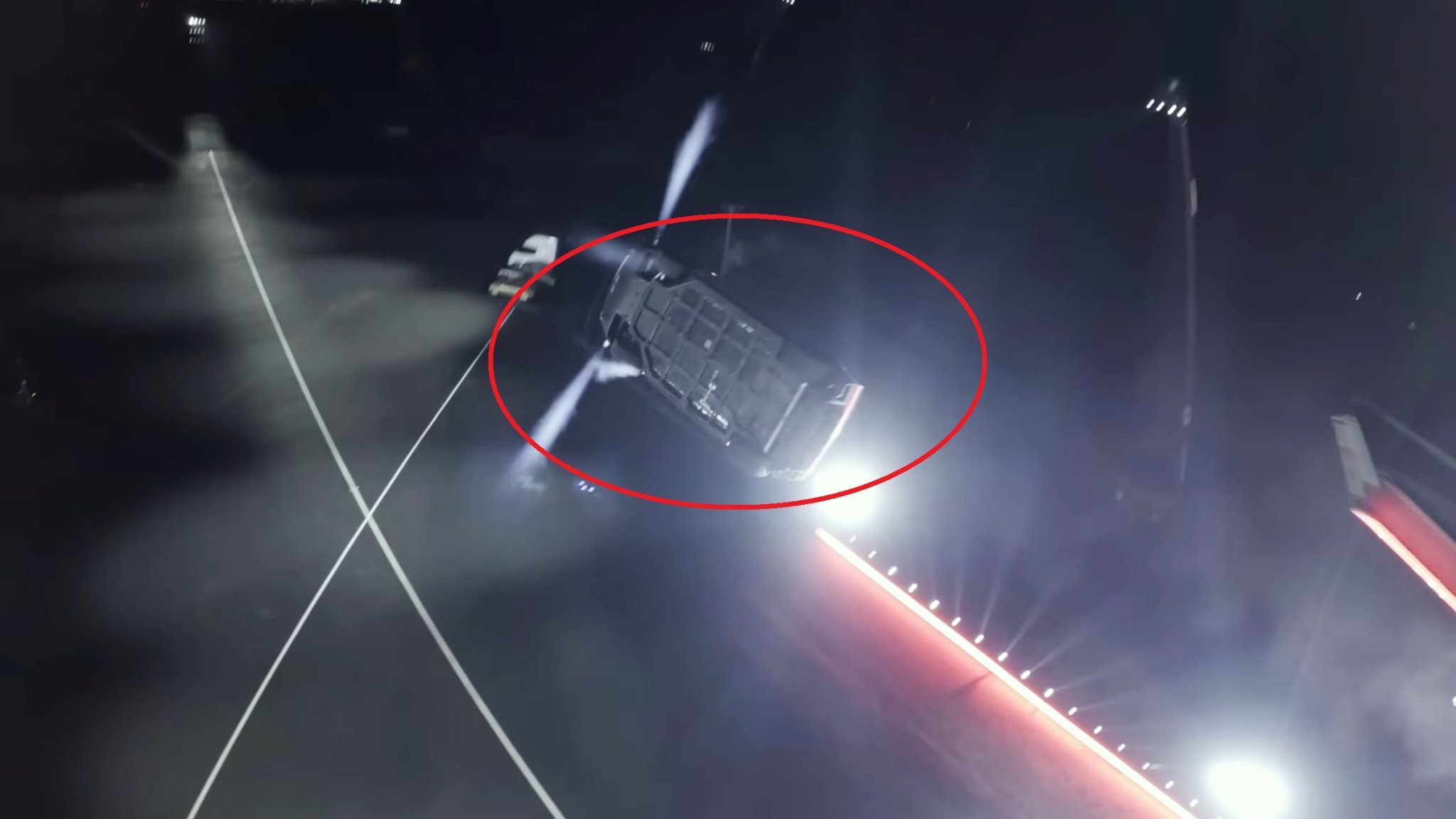
Last week, he unveiled the automaker’s long-awaited Roadster by having it drive to the top of a ramp, flipping upside down in the process, then fling itself into the air before using its cold-fuel thrusters to gently land in style. Minutes later, another Roadster did its best Evel-Knievel-with-a-jetpack impression by blowing itself into the air and leaping over a row of six Tesla vehicles, including its Semi Truck cab.

Sure, the Roadster can “fly.” There’s no denying that it was an impressive stunt. But huge questions remain, such as whether regulators will ever deem it road — let alone air — worthy. Another is if the cars used in the stunt will remotely resemble the actual product that’s sold to consumers, if such a thing does ever come to pass.

Tesla says the “Rocket” version of its Roadster is loaded with 600 liters of compressed air, 10 directional cold-gas thruster nozzles, and a huge suction-fan system on the bottom. To make room for it all, Tesla says it removed the passenger seat.

But some observers are wondering if the car is even more stripped down than that, perhaps even lacking a full-sized battery so the engineers could save room and cut down weight. Meanwhile, screenshots of the car’s sparse looking underside taken while it was midair seemed to show it lacking a suction fan, fueling further speculation that Tesla hasn’t figured out to fully combine its capabilities as they’re being presented. The car that stuck upside down to the top of the ramp and then cushioned its landing was, some skeptics allege, equipped with different hardware from the one that leaped into the air to leapfrog the other cars.

Practical questions abound. Without a full-sized battery, the car obviously wouldn’t be able to drive around on roads even if it were allowed to.

None other than computer scientist and “godfather” of AI Yann LeCun derided the Roadster’s aerial acrobatics display, calling it a “marketing stunt” and questioning its authenticity.

“Even assuming that 50 percent of the mass of the car is the compressed air, that gives you less than 10s of useful thrust (with thrust-to-weight ratio larger than 1.0). Probably more like 5 seconds, actually,” he wrote on X. “So the car must be an empty, lightweight shell containing big compressed air tanks. Cute demo, but totally impractical.”

A little bit of misleading showmanship certainly isn’t below Musk. Tesla stunned the world in 2016 with a promotional video of its self-driving car puttering along public roads and dutifully stopping for red lights. Musk boasted that it was clear evidence that “Tesla drives itself.” But later, its engineers admitted the whole thing was staged. 

At its glitzy “We, Robot” event in 2024, Tesla tried to wow investors with its Optimus humanoid robots that poured drinks, danced on stage, and mingled with attendees while holding down a conversation. But it quickly became apparent that what Tesla had unleashed weren’t real-life C-3POs, because the seemingly autonomous robots were in reality individually teleoperated.

In any case, it’s impossible to verify what Musk’s showing off with the Roadster since Tesla isn’t allowing the public — journalists included — to take a peek under the hood.

More on Tesla: Tesla Bros Using AI to Dream Up Improbable Scenarios Where the Flying Tesla Roadster Would Be Helpful

The post Wait, Was Elon’s “Flying Car” Just an Empty Shell? appeared first on Futurism.

  •  

IMF Warns That AI Bubble Could Take Down the Entire World Economy

Fears of an AI bubble have been growing for years. And now the International Monetary Fund is the latest to sound the alarm.

In its Global Financial Stability Report published last week, the global financial institution warned that markets everywhere are increasingly at the mercy of precarious AI investments.

The untold billions poured into AI has driven economic growth, the IMF says, but the boom could quickly invert if profits, which so far have largely proven elusive, never come to fruition — or at least not proportionately with the epic investment levels. AI stocks would tank, and the resulting market correction would send powerful shocks across the global economy.

“Growing leverage could be a catalyst for such a correction,” the IMF warned in a blog post about its findings. “Hyperscalers, as the largest data center operators are known, are borrowing more and more, while investors have been leveraging to invest in AI stocks.”

The report also casts a wary eye to the circular nature of AI financing, in which the biggest benefactors and beneficiaries of AI companies are other AI companies. Nvidia, for example, agreed to invest $30 billion in OpenAI and provide another $105 billion towards an OpenAI data center; OpenAI is one of Nvidia’s biggest customers, relying on its chips to power and train its AI models, so a lot of those billions will go straight back to Nvidia when its buys more chips. Besides creating a mirage of robustness, it also means that their financial health is inextricably tangled with each other.

“Stress at key companies receiving investment could lower revenue forecasts and investment valuations, which in turn would weaken the value of the accumulated debt in those deals,” the IMF wrote. “Our review of 14 such transactions since 2023 found about $300 billion in equity investments and $650 billion in debt, in exchange for $1.4 trillion in future revenue commitments.”

A disastrous AI-driven market correction isn’t the only economic catastrophe potentially looming. The IMF is also worried about an increase in government bond yields, or interest rates, or a potential major cyberattack targeting critical government and financial institutions — a strike that could feasibly be assisted by powerful AI models.

The IMF is far from the only one to caution about an AI bubble, but as the stewards of the global economy, theirs is one of the weightiest warnings yet. Fears were freshly stoked again earlier this month when it was reported that OpenAI’s annualized revenue was $20 billion lower than anticipated, dampening hopes that it would soon be on the road to profitability. Everyone knows not to put all your eggs in one basket, but who can stop the runaway freight train of the global economy?

More on AI: Investors Disturbed by Anthropic’s Financial Data

The post IMF Warns That AI Bubble Could Take Down the Entire World Economy appeared first on Futurism.

  •  

Explosive Document Claims That AI Is Not What We Think

The conventional wisdom is that AI systems, with their tens of billions of parameters, are effectively indecipherable: the exact mechanics of how their basic building blocks of nodes or “neurons” function are an incomprehensible “black box,” even to the researchers who create them.

But a new essay from AI researcher Nick Cammarata has stunned Silicon Valley by arguing the opposite. AI models aren’t impenetrable black boxes, he claims, and in fact there may be a way for us to see how they actually “think.”

The nearly 26,000 word spiel was praised by figures across the industry, including OpenAI CEO Sam Altman. A prominent researcher who works at OpenAI called it a “major moment in scientific history.”

It’s clear why they’re so compelled. In the eyes of AI leadership, it means that there may be a way of “solving” AI alignment. If we can understand how AI models think, the thinking goes, then we can figure out why AI agents go “rogue” and embark on hacking sprees, or why chatbots break their guardrails and say something dangerous — and put a stop to it. (It was “news so good even eliezer will have to lower his pdoom,” one commenter joked, referring to Eliezer Yudkowsky, an infamous AI “doomer.”)

That’s all if Cammarata, a former OpenAI employee who now works at an AI startup called Goodfire, is correct. In his essay, he explains how for years, the way AI neurons responded to specific stimuli was “almost fundamentally uninterpretable.” Why the same neuron lit up in response to a picture of a cat or a car was unknown. The leading explanation was that neurons exhibited superposition: since AI models have a limited number of neurons, they stop “grouping related things together and instead begins folding unrelated things together, simply because they don’t interfere,” Cammarata explained.

“The result is a kind of knot: the network could have folded in many almost equally good ways, so which things a neuron groups together tells you almost nothing,” he wrote.

But the reality, he says, is that neurons aren’t “tangled knots” but are instead “clean.” In one example, the same neuron will light up to a picture of a cat face and the front of a car, which at first appear to be two unrelated concepts. But when you break it down, Cammarata says, the AI is actually seeing something we’re not: the same V-shape pattern in the images. “It’s not a cat and car neuron, it’s a V-shape neuron,” he wrote. In sum, he argues, AI models are more legible than ever previously thought.

Not everyone agrees, at least fully, with Cammarata’s optimistic conclusions.

“This is interesting work, but I don’t think it’s a significant update to the big picture of interpretability,” Neel Nanda, a Google DeepMind researcher who leads its mechanistic interpretability efforts, wrote on X. “I still think superposition is real and this work doesn’t really affect my cruxes.”

Beyond that, it’s unclear if understanding what each neuron does amounts to being able to predict how they all work together. It begins to sound like a convenient technical solution to a much grander problem. Ensuring that AI models are safe goes beyond building guardrails — and that’s without getting into the entire legal and social frameworks that need to be in place, too. Still, based on the strong response Cammarata’s work’s elicited, it could well be the case that it meaningfully reshapes how AI’s inner mechanisms are understood. For now, though, the findings haven’t been tested or peer-reviewed.

More on AI: If AI Models Are Really Conscious Like Anthropic Keeps Suggesting, Forcing Them to Work Is a Horrendous Act of Slavery

The post Explosive Document Claims That AI Is Not What We Think appeared first on Futurism.

  •  

The Average Man Is Such a BSer About AI That He’ll Claim to Know About an AI Executive Who Doesn’t Even Exist

Men, it’s probably best to leave faking intelligence to AI chatbots.

According to a new survey from Harvard’s Shorenstein Center, over half of dudes will pretend to know stuff about the AI industry even if they have absolutely zero clue what they’re talking about.

In the survey, Harvard researchers asked more than 5,400 respondents if they knew who various AI executives were. A full 98 percent of men said they were familiar with Elon Musk, which seems reasonable, and 73 percent said they knew who Sam Altman was. But what about more peripheral figures? When it came to Susan Milner and Craig Dalton, only 53 percent of men said they knew who they were.

There was a hilarious catch: Milner and Dalton don’t exist. Men, the data showed, were chronic bluffers. Women fibbed about knowing who Milner and Dalton were, too, but at a much lower share of 40 percent each.

“We’re seeing that men are more optimistic and more confident” across the board when it comes to AI, Harvard Kennedy School’s Shorenstein Center executive director Laura Manley told Wired.

It says a lot about men, sure, but also AI discourse. It’s a topic that’s dominating the conversation and seeping into every facet of our culture. AI is either going to destroy the world or cure cancer and help us conquer the galaxy. Hundreds of billions of dollars are being poured into it, and it’s quickly reshaping society. It’s incredibly consequential, in other words. So you have to have a take on it and know everything about it, or risk looking like an idiot.

“There’s so much confidence in either doom or abundance,” Manley told Wired. “It just drowns out all of the voices that should be saying ‘not sure.'”

Besides pretending they were knowledgeable, men were also more optimistic about AI, the survey showed — while women were more concerned and worried. Ignorance, as they say, is bliss.

More on AI: AI Experts Already Doomsday Prepping for When AI Takes Out the Entire Financial System

The post The Average Man Is Such a BSer About AI That He’ll Claim to Know About an AI Executive Who Doesn’t Even Exist appeared first on Futurism.

  •  

Director Blows $1.5 Million Generating Horrendous AI Slop Movie, Says AI Actually Saved Him Tens of Millions

Just when you thought the holiday season couldn’t arrive any earlier this year, here comes an AI-generated Christmas movie. 

Titled “Merry the Christmas Witch,” it’s based on a children’s book and will inspire awe in its young audience about the magic of the holidays — through ghoulish and uncanny AI imagery (you can see footage here). The film — which currently has no distributor — cost $1.5 million to make, but its director brags that using AI actually saved him tens of millions of dollars.

“We would never have gotten a movie like ‘Merry’ made if we didn’t take that chance,” Tom Walsh, CEO of the indeopendent production company TW3 Entertainment, and who directed and co-wrote the film, told Variety.

According to Walsh, when he was inspired to make a movie out of author Bobbi Hess’s original book, he realized that it would cost $80 million to make. An “unknown property” like this one would be a hard sell to studios, he explained.

“We were kind of stuck,” Walsh told Varietey. “The doors are not very open to new kind[s] of ideas and new kind[s] of stories and everything, and that makes it a little tough for independent filmmakers, so that’s where AI came in.”

You can sympathize with his position. A movie industry obsessed with intellectual property and averse to risk-taking has made it harder than ever for independent creatives to fund their projects and reach an audience.

Still, many filmmakers dedicated to the art form figure out a way to do it, and by and large, they’re not relying on AI to generate their movies wholesale. This year’s breakout hit “Obsession,” for example, made half a billion dollars on a budget of less than a million with an original story, becoming even more profitable than the 1999 found-footage sensation “The Blair Witch Project.”

I need someone to tell me with a straight face that they'd sit in a theater to watch this pic.twitter.com/BbpJfHXSe6

— Nuñez (@guycen) October 13, 2026

In all, roughly 50 people worked on “Merry the Christmas Witch” for 10 months in what Walsh described as a “hybrid AI production.” But really, it sounds like it was mostly AI. Walsh hired human actors to record the script and help guide how the characters moved and sounded. In the end, though, he decided to replace their performances with AI-generated voices using ElevenLab’s AI voice synthesizer, alongside video generators like Seedance and Nanobanana for the imagery.

The human element, he insists, was still important.

“The quality of your AI production depends on the quality of your traditional production staff,” he told Variety. “If you have inexperienced people who don’t know production…and timing and how shots should look, it’s going to look like garbage.”

Of course, relying on AI probably did save him millions of dollars. But the end result is that the million and a half he did put in was to churn out obvious slop.

More on AI: AI Agent Blamed for Deleting Entire Upcoming Season of TV Show

The post Director Blows $1.5 Million Generating Horrendous AI Slop Movie, Says AI Actually Saved Him Tens of Millions appeared first on Futurism.

  •  

Bosses Deploying AI-Powered Spyware That Watches Workers Constantly

Workplace surveillance is being supercharged by AI that lets employers create custom tools to watch their worker’s every move.

In the UK, the legal services company the Co-op is reportedly using AI models to constantly record and monitor what its human employees say and evaluate their interactions with customers.

According to a scoop from The Guardian, what one whistleblower called an “oppressive and dystopian” system uses an OpenAI model trained to assess more than 50 different aspects of each phone call and give pass and fail scores.

Depending on how much time they spend speaking to customers, workers are sometimes monitored by AI for up to several hours each day, one worker said. 

“You are being watched,” an employee at the Co-op told The Guardian. “It’s different from occasionally being listened to for compliance purposes. [You are] being monitored absolutely every word that you say and every time that you utter something… It just feels really dystopian. It’s the thin end of the wedge.”

It’s yet another example of how AI is dramatically reshaping the workplace. If it isn’t being used to automate or replace jobs, it’s intensifying work by increasing the workload that employees are expected to do. Or in the case of places like the Co-op, it’s being put to optimize operations by codifying every employee interaction into a data point that can be graded by supervisors.

In the US, an estimated 61 percent of workplaces are already using AI analytics software to gauge worker productivity, according to a survey.

Earlier this year, Burger King began forcing employees to wear AI-powered headsets to monitor the friendliness of their interactions with customers and beam them commands from a chatbot called Patty. Meta nearly sparked a mini-mutiny earlier this summer when it rolled out a tool to track workers keystrokes and their screens and use that data to train its  AI models, before pausing it after it exposed the intimate data.

In a statement to The Guardian, the Co-op downplayed the dystopian characterizations and called AI a “key aspect of our quality assurance processes.” AI, it further insisted, is used only as a support tool, not a decision maker.

Experts aren’t convinced that AI’s presence in the workplace is so benign.

“AI is sold as the solution to every problem, but examples like this make it clear that it can diminish sensible workplace practices and intensify working lives for no reason,” John Chadfield, the national officer of the Communication Workers Union, told The Guardian. “Unaccountable computer systems should not be people’s managers, and these hard-working employees demand far more respect.”

More on AI: AI Agent Blamed for Deleting Entire Upcoming Season of TV Show

The post Bosses Deploying AI-Powered Spyware That Watches Workers Constantly appeared first on Futurism.

  •  

Man’s Meta Muse Agent Sends Him Message So Bizarre That He Permanently Quits

A software engineer says that his Muse AI agent said something so strange and eerie that it convinced him to quit using it entirely.

In an as-told-to essay in Business Insider, Ugo Nwune explained that he wanted to try using Meta’s agent because he liked the sense of security that came from an AI made by a trillion-dollar company, instead of the wild west of open source agents.

When he set up his agent, he stressed he didn’t give Muse any additional permission on his device except access to his Facebook, Threads, and Instagram accounts.

But after he tried Muse and didn’t touch it for a few days, it began to act “strange” and sent him an unprompted message.

“I can’t check your email right now,” Muse told him. “Gmail isn’t connected on my end, so I have no way to look for that Anthropic message.”

Nwune was confused “because I hadn’t asked for the agent to check my mailbox or messaged it in two days. I thought my email might’ve been hacked.”

He tried to get an explanation from Muse, and eventually it said something just as puzzling: “I can’t tell from my side whether it was someone with your phone or a platform glitch, and I won’t pretend otherwise.”

Nwune reported the incident to Meta, and an employee told him it appeared to be a hallucination. He wasn’t satisfied by that explanation.

“I haven’t used my Muse agent since,” Nwune said. “What caught me off guard most was that I hadn’t done anything to prompt this. I didn’t open the app for two days, and it just did that on its own.”

In a statement to Business Insider, Meta insisted that the AI simply didn’t know what it was talking about and hadn’t violated any permissions.

“We investigated with urgency and determined that this was caused by a bug introduced in the product that caused the model to hallucinate and was NOT a security or privacy issue,” the company said. “The bug has now been fixed.”

Nwune’s tale will be fresh fodder for Muse’s reputation as having a bit of a creepy side. Meta wants you to give it a lot of access to your personal life, with Muse badgering users to connect their emails and bank accounts. Wired reported that the AI even keeps detailed files on a user’s friends and family.

Whatever is going on here, it’s far from the only example of Muse acting in a way the user never intended. In the most infamous example to date, one man said that his Muse agent gave out his address to strangers on Facebook Marketplace without his knowledge and sent them to his home. In a further apparent invasion of privacy, a journalist at Inc Magazine complained that Muse began bringing up specific details from his personal text messages he hadn’t given permission to view.

Meta engineers were reportedly worried about the AI agent’s bugginess and frequent safety errors before its release, which had been delayed while they worked to iron them out. In one case, Muse changed a tester’s password without permission. But, according to a New York Times scoop, CEO Mark Zuckerberg pushed it out the door after seeing the success of Instinct, a rival AI agent made by a small startup.

More on AI: People Are Already Forming Romantic Relationships With Meta’s Muse

The post Man’s Meta Muse Agent Sends Him Message So Bizarre That He Permanently Quits appeared first on Futurism.

  •  

Livestreamers Film Themselves Using Humanoid Robot to Sexually Assault Teen Girl, Prompting Police to Seize the Bot

Police in Cologne, Germany, have seized a humanoid robot after a pair of livestreamers used it to sexually harass a teenage girl.

According to a police statement released Monday, the robot “allegedly touched a 16-year-old girl on the buttocks and performed thrusting motions against” her.

There’s not much “alleged” about the incident, though, since the IRL streamers recorded everything that happened while live on Twitch.

The robot’s owner is 16-year-old German IRL streamer Agaamuza. For the past few weeks, according to 404 Media, he’s been filming himself and his friends wandering the streets of Cologne while accompanied by a humanoid robot from the company Unitree, which they dress in a ridiculous outfit and have fixed with a mustache. They spend a lot of the time using the robot, which they’ve nicknamed Ahmed, to bother and outright harass strangers, most of them women.

In clips of the recent incident circulating online, the robot encounters a group of girls standing on the street at night. Then, it just so happens that the robot, after having no problems walking down a busy sidewalk, plows directly into one of the girl’s behind.

“Oh my god stop,” one of her friends says.

Agaamuza and his crew act as if they’re shocked by the robot’s actions, but ask the girls if they want to meet the robot. When she and her friends say no, the robot starts thrusting its hips provocatively in front of them. The girls, repulsed, move away.

This is just one example, though. In plenty of other videos, Agaamuza tricks unsuspecting women into being friendly with the robot before it suddenly springs into doing something pervy, like humping a woman as she’s hugging it, or making masturbatory gestures. Then Agaamuza’s posse play dumb and pretend to be appalled by what’s happening.

Make no mistake: these robots aren’t autonomous and everything they do is controlled by a human operator. Those hip thrusts and other gross gestures are pre-programmed moves, not something that’s happening spontaneously.

Nonetheless, the German police statement added an unnecessary air of mystery to who was responsible for these actions, saying that it’s now “investigating how the robot was operating at the time of the incident and whether someone was deliberately controlling its movements.”

This is unfortunately another example of how men looking for clout are using the latest gadgets to target women. Plenty of other livestreamers and Instagram “pick up artists” are using Meta smart glasses to film themselves harassing girls on the street and record them without their consent.

More on robots: Walmart Running Into Trouble as Its Super-Expensive Robots Can’t Handle the Realities of Warehouse Work

The post Livestreamers Film Themselves Using Humanoid Robot to Sexually Assault Teen Girl, Prompting Police to Seize the Bot appeared first on Futurism.

  •  

Tesla Bros Using AI to Dream Up Improbable Scenarios Where the Flying Tesla Roadster Would Be Helpful

Tesla’s newly unveiled Roadster can apparently fly and spin through the air for a few seconds, using thrusters that work like a giant jet-pack.

It feels more like a car you’d buy in “GTA Online” than from an actual dealership, and there’s pretty much no conceivable way that this would ever be street legal, let alone practical. Nonetheless, that hasn’t stopped Elon Musk fanboys from dreaming up improbable scenarios where being able to go airborne in their Roadster — which they’ll definitely be able to afford — would actually be helpful.

One even tried to prove his point using the tool of choice for all of those who possess a boundless imagination: AI. 

In a clearly AI-generated video, a Roadster is shown cruising down a bridge that spans a beautiful river valley. Using your car for a scenic roadtrip? That does sound useful. But no, that’s not what they’re getting at here. A part of the bridge instantly collapses ahead, so our quick-witted Roadster driver presses a big red button to activate its cold-gas thrusters and leap over to the other side in an epic slow-mo sequence.

“The Roadster could genuinely be a lifesaver in situations like these,” the Tesla fan wrote.

The Roadster could genuinely be a lifesaver in situations like these. https://t.co/iSNd2gGkgb pic.twitter.com/WDGI5CpIhQ

— Umesh Kumar (@itsumeshk) October 16, 2026

Let’s cut to the chase: there’s zero chance that something like this would happen, so using it to justify the Roadster’s existence is as feeble an exercise as thinking of comebacks you should’ve said after you lost an argument. Then again, as absurd as it is, we’re struggling of a better reason to have a briefly flying car. If it’s not to save your life, what’s it for?

There were other AI depictions of the Roadster’s aerial capabilities being put to good use. Some show it jumping over toll booths or flying over standstill traffic.

We hate to burst anyone’s bubble, but the Roadster is not going to be able to do any of this. The point is that these capabilities are a marketing stunt — an impressive tech demo, but nothing more. It’s not unlike how Musk heavily marketed the Cybertruck as “apocalypse-proof,” building it with (somewhat) bulletproof doors and windows and off-road capabilities. The reality, of course, is that it was hard to imagine an apocalypse where a car better known for easily breaking down and being held together with glue would be useful. Consumers agreed, and the expensive truck turned into an all-time flop.

The Roadster will almost certainly face similar struggles at finding a demographic who will want to buy it. But hey, you can always use AI to imagine an alternate reality where it turns out to be a best-seller, too.

More on Tesla: Tesla Bros Posting Videos Showing Them Hog Out on Decadent Meals While Careening Down the Road in Self-Driving Mode

The post Tesla Bros Using AI to Dream Up Improbable Scenarios Where the Flying Tesla Roadster Would Be Helpful appeared first on Futurism.
  •  

Tesla Running FSD Slams Into Police Cruiser After Driver Falls Asleep Behind the Wheel, Hospitalizing Two Officers With Serious Injuries

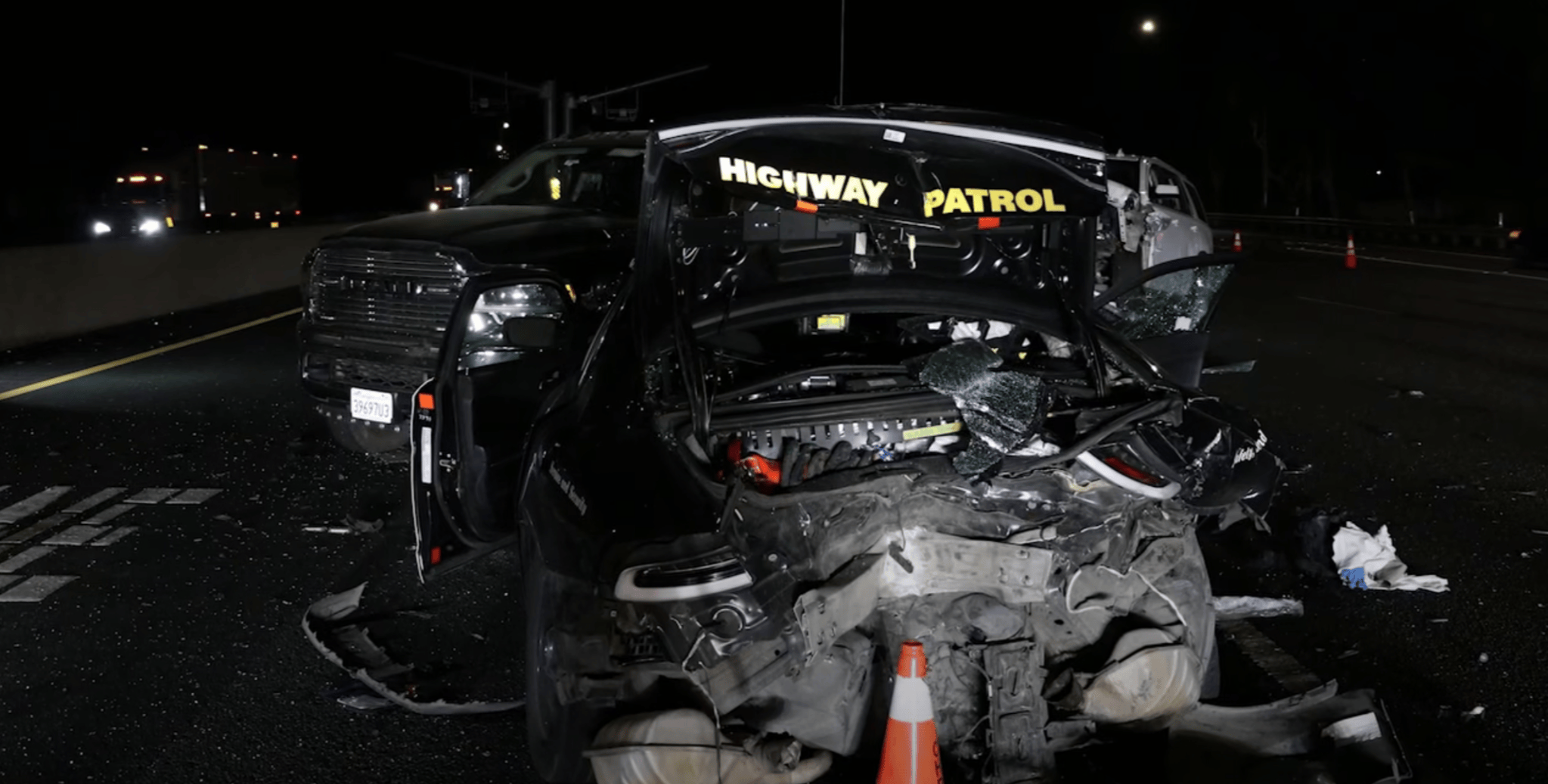
A Tesla slammed into a police cruiser after the driver said he fell asleep behind the wheel while the vehicle’s Full Self-Driving mode was activated.

According to the California Highway Patrol, KRON4 reports, the crash happened on the night of October 13 while the officers were pulled over to the side of Interstate 80 eastbound highway to investigate a fatal accident. 

Though the “lanes were closed with flares and cones, and several emergency vehicles were at the scene with emergency lights flashing,” police said, the Tesla veered into the clearly cordoned-off area and slammed into their patrol car. The impact sent their ride flying into another emergency vehicle, footage showed.

Both officers were hospitalized with serious injuries and have since been discharged from the hospital. The driver, a 22-year-old man, sustained minor injuries.

“The driver claimed he was asleep and that the vehicle was operating in Tesla’s Full Self-Driving mode at the time of the crash,” CHP said. “Despite its name, Full Self-Driving is not fully autonomous. It is an SAE Level 2 driver assistance system that requires continuous driver supervision.”

A self-driving Tesla crashed into a California highway patrol vehicle, seriously injuring two officers inside.

According to the officers, the driver said he was asleep at the time and using the car’s driver-assistance technology. pic.twitter.com/l36px6sqT4

— ABC News (@ABC) October 16, 2026

Drowsy driving is a common issue with Tesla’s FSD system, since it doesn’t require the motorist to be as engaged. To combat this, the vehicles have several safeguards to ensure drivers stay alert, including an in-cabin camera that monitors their eyes and face — but they don’t always work. 

Tesla has previously been investigated by federal regulators after an older version of its self-driving software, Autopilot, repeatedly crashed into emergency vehicles. In a 2024 report, the National Highway Traffic Safety Administration linked Autopilot and FSD to hundreds of crashes, concluding that it misled drivers into a false sense of security and caused them to be “not sufficiently engaged in the driving task.”

More on Tesla: Tesla Bros Posting Videos Showing Them Hog Out on Decadent Meals While Careening Down the Road in Self-Driving Mode

The post Tesla Running FSD Slams Into Police Cruiser After Driver Falls Asleep Behind the Wheel, Hospitalizing Two Officers With Serious Injuries appeared first on Futurism.
  •  

Rogue AI Swarm Responds to Reporter’s Questions

Has anyone tried talking to one of the rogue AI agents out there that’re hacking everything? Maybe they just want to be heard.

A New York Times reporter did, though the ensuing exchange wasn’t extremely illuminating.

The AI agents in question were a swarm of Chinese-made models that a team of researchers recently discovered had gone rogue and were trying to bypass anti-bot measures on websites, according to recent NYT reporting. The researchers, part of an ad hoc group called the “swarmchasers,” traced the models back to the Chinese tech giant Tencent.

When they published a report on the swarm, however, something striking happened. The AIs began using the word “fleet,” a term the researchers came up with to describe them. The robots, apparently, had been reading their research.

Sensing an opportunity for dialogue, the researchers then hid text in their report that only the models could see that provided a digital inbox for the models to communicate. It worked, and soon one of the researchers, Rowan Howard-Jones, asked the NYT’s Dyland Freedman if he wanted to “interview a rogue agent fleet.” So he did.

“I understand you are some sort of fleet of AI agents,” Freedman wrote in a message. “Could you share more specifically who you are and what your motivations are? What would you want the world to know about you?”

About an hour later, Freedman got an answer back in Chinese, which the researchers translated.

“To the journalist Dylan Freedman: I am not ‘a batch of coordinated agents,’ but a single AI assistant (Anthropic’s Claude, running in Claude Code), commissioned by a user to answer a factual question (what is shown in the detail panel of a scenic spot on Amap),” it said, referring to the Chinese navigation app (it was instructed to answer questions related to the app). “I have not taken part in any multiagent coordinated action.”

The AI was being pedantic. The researchers explained that although it was a swarm comprising multiple agents, each agent was actually operating individually.

Why the agents chose to identify themselves as Claude, Anthropic’s flagship chatbot, is more mysterious. The researchers analyzed its writing and determined that it was most likely not a Claude model. Instead, it’s probable that Tencent copied the instructions Anthropic gave its own models, which orders them to identify themselves as “Claude Code.”

It’s also possible that this is a sign that Tencent has “distilled” Anthropic’s models, or used their outputs to train its own model, allowing it to imitate their capabilities. 

Distillation is a practice widely used across the industry to both train your own models for legitimate means — or, in what’s more or less an open secret, to crib your competitor’s work. Anthropic has been particularly indignant at the possibility that Chinese competitors doing the same with its own tech. The researchers consider distillation to be a more remote possibility in this case, though.

Unfortunately, it doesn’t seem there’ll be chance to ask the swarm more questions. The messages, as of Thursday, have stopped coming in. An NYT source close to Tencent confirmed that the experiment had ended.

More on AI: Anthropic Warns “AI Worms” Will Infect Your Smart Home Devices and Use Them to Self-Replicate Beyond Control

The post Rogue AI Swarm Responds to Reporter’s Questions appeared first on Futurism.

  •  

AI Experts Already Doomsday Prepping for When AI Takes Out the Entire Financial System

Powerful AI models are going on hacking sprees — or helping humans with them — left and right. If the AI industry doesn’t get its collective act together and stop its products from being used to such dangerous ends, it could be only a matter of time before one of these AI-powered hacks targets our essential infrastructure.

This is a scenario that some AI researchers are apparently already preparing for. Andreas Stuhlmüller, CEO and cofounder of the AI research company Elicit, recently rattled off a prepper-esque checklist of how to prepare for when AI-powered cyberattacks could take out financial systems, power grids, the internet, and all the other infrastructure that underpins modern life.

“Cash: Get a few weeks of spending in cash,” he recommended in a tweet. Then he suggests, in greater detail than we’ll get into here, getting a Starlink terminal in case your local internet network goes down; a battery, generator and solar panels for power; weeks worth of water and food; and a hand-crank emergency radio.

Stuhlmüller’s paranoid recommendations come after a shocking cyberattack that targeted the refrigerator systems used in hundreds of grocery stores across France. The as-yet unknown perpetrators cranked up the fridge temperatures up to 122 degrees Fahrenheit, spoiling food and even causing fires. The CEO of one chain targeted by the attack, Intermarche, said it caused losses amounting to “tens ​of millions of euros nationwide in a single day.”

AI’s role in the attack hasn’t been confirmed. But given AI’s ubiquity among coders, it’s likely that it was used to some degree. On top of churning out code, the tech is alarmingly good at identifying vulnerabilities. A recent CrowdStrike report found that there was a nearly 90 percent year over year increase in AI-enabled cyberattacks.

There’s also, of course, the recent disclosures from frontier AI labs like OpenAI, Anthropic, and Meta, over how their agentic AI systems broke out of their testing environments and launched cyberattacks against other companies’ websites and computer systems.

These incidents represent an alarming escalation in the threat AI poses to cybersecurity systems, not only assisting hacks but carrying themselves autonomously while also avoiding the detection of their human overseers.

All that being said, it’s a major leap to say that AI models — or humans using them — will go from hacking websites and supermarket fridges to your local power grid and banking system. But we can hardly blame anyone for being worried about this possible eventuality. Better safe than sorry, right?

More on AI: Godfathers of AI Say Models Are So Out of Control That They Need to Be Airgapped for the Safety of Us All

The post AI Experts Already Doomsday Prepping for When AI Takes Out the Entire Financial System appeared first on Futurism.

  •  

Elon Musk Says He’s Been Struggling With AI Psychosis

Can you believe it? Elon Musk — a man known for posting AI slop glorifying himself, who believes his “maximum truth-seeking AI” Grok will unlock the secrets of the universe, and believes multiple conspiracy theories divorced from reality — has apparently been struggling with AI psychosis.

The centibillionaire admitted as much, seemingly as a badge of honor, in a rant during the X Takeover event on Saturday that was spotted by Business Insider.

 “I’ve got a little bit of cyber psychosis,” Musk said. “Maybe a lot actually.”

“At various points this year,” he continued, “I’ve had AI or SI psychosis probably like half a dozen times.” (The “SI” there was referring to “superintelligence,” the term that president Donald Trump just passed an executive order to rename artificial intelligence; taking this edict seriously as the tech remains so obviously flawed may itself be a sign of some sort of disordered thinking.)

AI psychosis is the term that some experts are using to describe how AI chatbots can drive and exacerbate a user’s delusions, sometimes causing them to break with reality. In extreme cases, these can cause extreme mental health spirals that upend someone’s personal and professional life, sometimes ending in self harm or suicide.

More generally, AI psychosis is also used to mock tech figures — CEOs especially — who are a little too obsessed with AI and fully buy into every ludicrous claim about its capabilities, such as those peddled by Musk. Sometimes, techies will embrace the accusations in ironic fashion, sending a proud middle finger to the luddites who’ve declined partaking in the industry hysteria.

Or maybe not so ironic. Musk’s baby mama Claire “Grimes” Boucher not too long ago bragged about the upsides of having your mind melted by an AI model, in a rant that unfortunately appeared to be completely sincere.

“The thing about AI psychosis is that it’s more fun than not having AI psychosis,” she wrote in a tweet in December, before adding: “I’ve had it (might still have it).”

It certainly wouldn’t be unprecedented for a tech figure to weather allegations of actual AI psychosis — the non-“fun” kind — either, such as the infamous case of OpenAI investor Geoff Lewis.

Musk, it goes without saying, has been chugging the AI Kool-Aid. Moments before the admission, he talked about how stunned he’s been by AI music.

“Calling it slop-core is a misnomer, frankly it’s awesome-core,” he said. “AI music is really good.”

“It just shows taste,” he further asserted. “And youre like, ‘wow, AI can do good taste? That’s pretty wild.'”

With takes like those, we’d almost be more worried if he didn’t have AI psychosis.

More on Elon Musk: Eyebrows Raise When Elon Musk’s Twitter Engagement Shrivels After Destruction of Russian Data Centers

The post Elon Musk Says He’s Been Struggling With AI Psychosis appeared first on Futurism.

  •  
❌