❌

Normal view

AMD brings official Ryzen overclocking to Linux with AOD driver support

21 October 2026 at 15:52

While Windows overclockers have spent years lazily sliding UI controls to adjust frequency curves and tweak voltages inside Ryzen Master, Linux users have largely had to treat their CPU tuning like an archaeological dig into the opaque veil of UEFI/BIOS firmware. Well, rejoice, Linux users, as AMD has officially published a fresh set of patches for the Linux kernel introducing AOD (AMD Overclocking Driver) support for Ryzen processors, Phoronix reports.

Instead of forcing developers to reverse-engineer closed-source firmware hooks or rely on messy, machine-specific ACPI workarounds, this new kernel driver is a direct pipeline to AMD's platform adjustments. By exposing core tuning capabilities straight through the standard sysfs interface, AMD is laying down an official, upstreamed foundation for software-level CPU management.

Right out of the gate, the driver handles platform-level SMT toggling, memory clock visibility, and power tunables. That's right: you can now toggle Simultaneous Multithreading (SMT) dynamically through this driver interface. That works through the CPU hotplugging mechanism and acts as a clean alternative to passing the old 'nosmt' boot parameter to the kernel. The new driver also allows real-time monitoring of memory clocks, and initial power controls are being wired up, too.

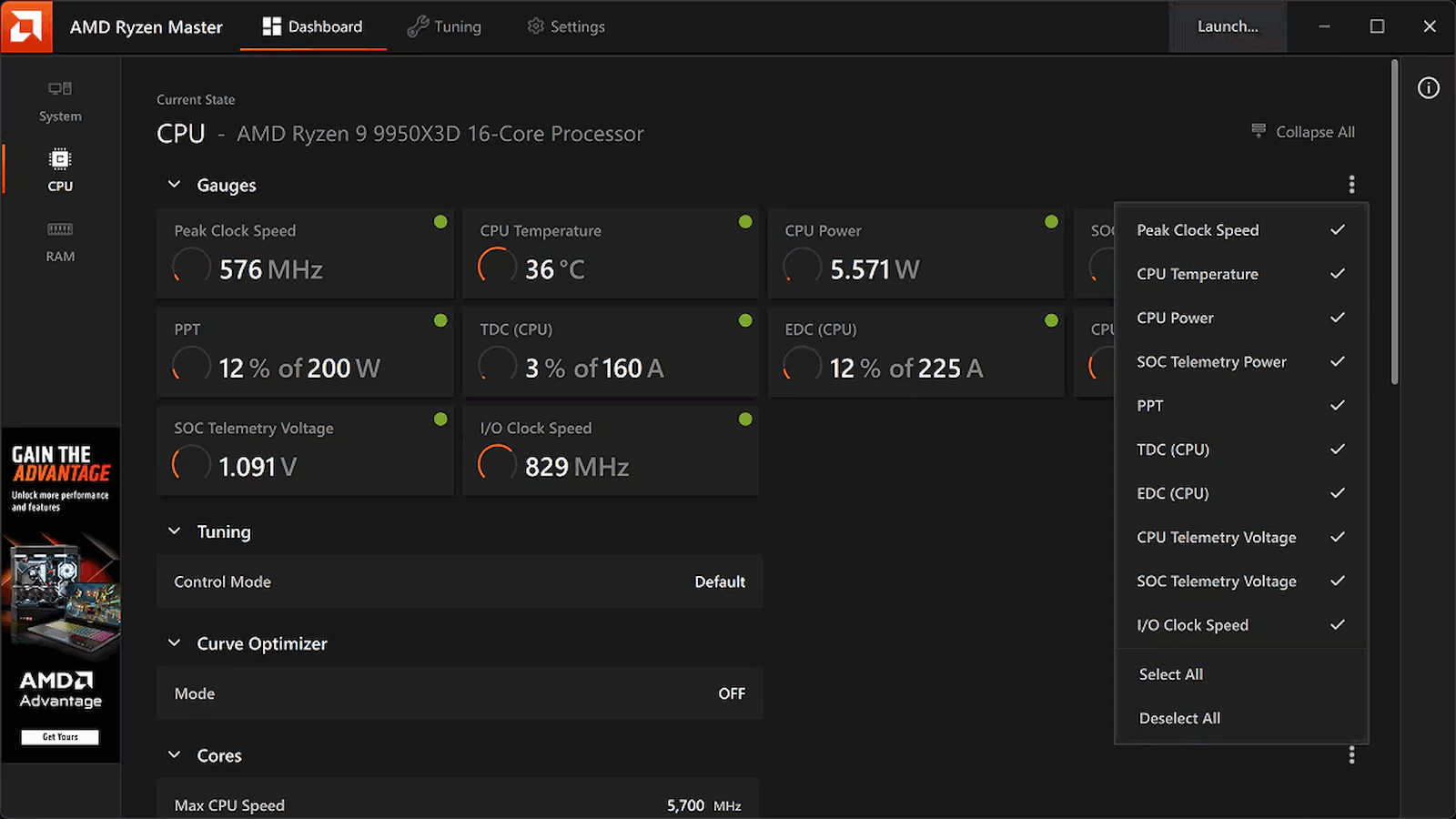
A screenshot of AMD's Ryzen Master CPU tuning tool.

This tool isn't available on Linux, and may never be, but at least its functions will be soon. (Image credit: AMD)

Now, if you're expecting a polished, one-click official AMD application equivalent to Ryzen Master for Linux, just pump the brakes. AMD is following its open-source amdgpu graphics driver playbook here, building the kernel plumbing and then leaving the user-space presentation layer entirely up to the community. That means you're going to have to wait for utilities like CoreCtrl to build out interfaces for this new driver, but it shouldn't be long now before that work gets underway in earnest.

This approach is arguably a better fit for the Linux philosophy anyway. Because the controls are being exposed via clean kernel sysfs nodes, it won't be long before independent developers integrate these knobs into powerhouse open-source monitoring and tuning suites, or even write dedicated desktop environment extensions specifically for the purpose of tweaking Ryzen processors.

The new patches are currently winding their way through review on the mailing lists, meaning mainstream kernel integration is on the horizon. For a DIY enthusiast who loves squeezing every last MHz out of silicon while maintaining a fully open-source software stack, this is easily the most exciting hardware-enablement milestone I've seen in a long time.

Attestation News

15 October 2026 at 18:55

TheLastProject (Hacker News):

In the [EU age verification] README, the following is listed:

App and device verification based on Google Play Integrity API and Apple App Attestation

I would like to strongly urge to abandon this plan. Requiring a dependency on American tech giants for age verification further deepens the EU’s dependency on America and the USA’s control over the internet.

Bobby Borisov (Hacker News):

The European Union’s open-source age-verification project has drawn criticism after a maintainer confirmed that hardware-bound attestation is a mandatory architectural requirement, raising concerns about Linux, custom Android ROMs, and independently compiled applications.

[…]

The solution lets users prove they are over a certain age without revealing their name, exact birth date, or full identity document. To prevent credentials from being copied, cloned, or reused by modified clients, the project relies on keys stored in protected hardware like Android TEE, StrongBox, or Apple’s Secure Enclave.

However, critics claim that this approach endangers the system by making it dependent on a small number of approved devices, operating systems, and attestation providers.

Positiveblue (Hacker News):

Cloudflare’s new “signed agents” pitch sounds like safety but it’s a wolf in sheep’s clothing. They’ve built an allowlist for the open web and told builders to apply for permission. That’s not how the internet works. An application form is not a standard.

GrapheneOS:

Apple and Google are gradually expanding their use of hardware-based attestation. They’re convincing a growing number of services to adopt it. Google’s Play Integrity API and Apple’s App Attest API are very similar. Apple brought it to the web via Privacy Pass, which Google intends on doing too.

Google’s Play Integrity API requires hardware attestation for the strong integrity level and is gradually phasing in requiring it for the more commonly used device integrity level. Apple already has it as a requirement. Over the long term, this will increasingly lock out hardware and OS competition.

The purpose of these systems is disallowing people from using hardware and software not approved by Apple or Google. This is wrongly presented as being a security feature. Banks and government services are the main ones adopting it but Apple and Google are encouraging every service to use it.

German National EUDI Wallet Architecture Documentation (Hacker News):

When issuing the PID, the WB confirms to the PP (via OpenID4VCI Key Attestation) that the keys to which a PID is to be bound are controlled by an authentication means that meets certain security requirements with regard to resistance against attackers with a certain attack potential (see ISO/IEC 18045).

Simon B. Støvring:

It’s great that App Attest is coming to Mac with macOS 27. It means I can ship Canvases’ intelligence and sharing features with much more confidence, knowing I can protect the endpoints with App Attest.

Previously:

Projeto adapta o iOS 16 para rodar em… smartphones Android

21 October 2026 at 20:01

A ideia de rodar o iOS em um smartphone Android parece absurda, mas se tornou realidade com o projeto Hackios.

A proposta é do usuário do GitHub ios-sweet, que substituiu o kernel Linux dos smartphones Android pelo XNU, desenvolvido pela Apple para iOS, iPadOS, macOS, watchOS, tvOS e visionOS.

Quando o dispositivo Android é inicializado, o sistema reconhece o celular como um iPhone X — dispositivo que foi escolhido por não ter o código de autenticação de ponteiros (Pointer Authentication Code, ou PAC), assim como o Redmi Note 10 Pro, da Xiaomi, usado na adaptação inicial.

Já circulam vídeos do sistema adaptado ao Redmi Note 12 Pro, ainda com dificuldades notáveis de desempenho:

Embora o código do iOS permaneça fechado, o XNU do macOS foi liberado pela Apple. Pelos indícios nos documentos incluídos nos arquivos do projeto, o iOS foi adaptado com o auxílio de inteligência artificial (IA).

Depois de ligado, o celular carrega uma imagem intermediária no bootloader, que inicia o XNU em uma partição formatada para simular o armazenamento do iPhone X, com uma cópia do iOS 16.7 — a versão mais recente do sistema disponibilizada ao aparelho.

Alguns apps nativos são carregados junto com a Tela de Início, e os toques e gestos para alternar entre eles (além dos botões de volume e de liga/desliga) são reconhecidos, mas o celular não consegue ativar as câmeras, o som e a GPU 1Graphics processing unit, ou unidade de processamento gráfico., nem usar dados móveis, Bluetooth e Wi-Fi.

Além do Redmi Note 10 Pro, a adaptação já tem versões para o Redmi Note 12 Pro e o LG V60, enquanto outros aparelhos (como OnePlus 7T, Redmi 5 Plus e Galaxy S23 Ultra) foram listados, mas ainda não têm versões disponíveis para download.

Para quem tem um aparelho compatível e quiser se aventurar, vale conferir o site do projeto, que disponibiliza o download na página do desenvolvedor no GitHub.

via Android Authority

Notas de rodapé

  • 1
    Graphics processing unit, ou unidade de processamento gráfico.

Projeto LinPad permite executar um ambiente Linux diretamente no iPad

21 October 2026 at 13:00

Com um sistema operacional bastante fechado (derivado do iOS, como bem sabemos), o iPad muitas vezes não tem todo o seu potencial aproveitado — principalmente quando falamos naqueles modelos que contam com chips da série M, os mesmos presentes nos Macs.

Agora, porém, é possível executar um sistema operacional completo nos tablets da Maçã, graças ao LinPad, um projeto de código aberto que permite rodar um ambiente Linux (o LinPad OS) diretamente no iPad — com direito a janelas, terminal e gerenciador de arquivos.

Com isso, usuários que não têm um Mac ou que estão com apenas o iPad à disposição conseguem realizar atividades que geralmente só são possíveis em um computador, principalmente quem trabalha com desenvolvimento.

Com um sistema de arquivos próprio, o LinPad OS permite personalizar o ambiente e até instalar aplicativos de terceiros como o Visual Studio Code e o Mozilla Firefox. O app prepara o ambiente na primeira execução e mantém tudo preservado para sessões posteriores.

Para usá-lo, é necessário um iPad com chip M1 ou posterior que rode, no mínimo, o iPadOS 17. O maior desafio é a instalação, já que é preciso configurar o app via sideloading tradicional — pelo próprio computador ou usando ferramentas de terceiros, descritas nessa página.

via OS X Daily

❌