To ask Siri AI a question on a Mac running macOS 27, press Command-Space bar to open Spotlight, type your question or request, and press Return. Once Siri AI (Beta) is turned on, Apple’s Mac User Guide says Spotlight “becomes the place where you start a conversation with Siri.” From that one window, Apple says, […]
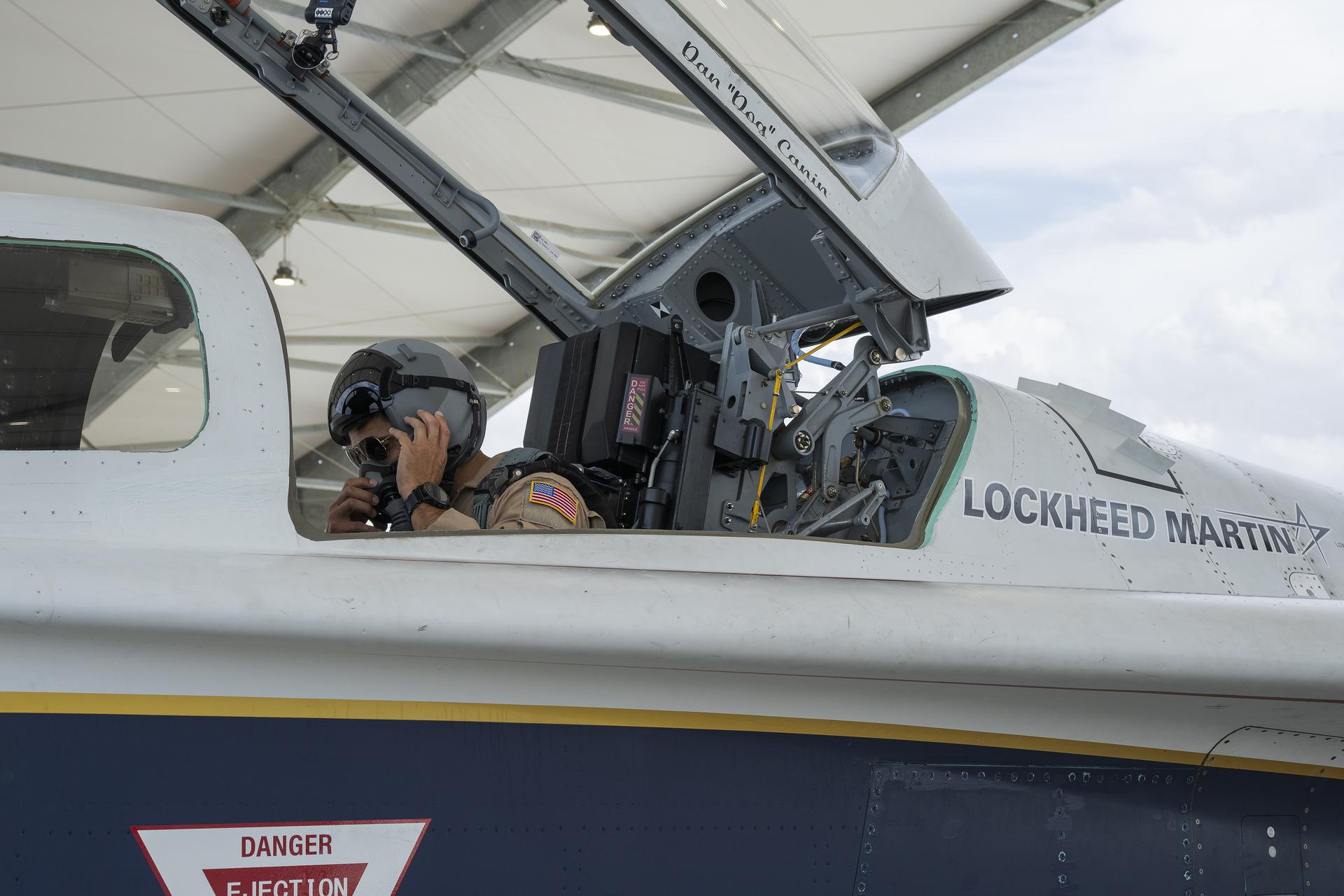
Mike Lippert, one of NASA’s X‑59 test pilots, sits in the cockpit of the agency’s X‑59 quiet supersonic research aircraft for the first time during an engine run at NASA’s Armstrong Flight Research Center in Edwards, California, on Thursday, Aug. 27, 2026. Lippert is the third X‑59 pilot supporting NASA’s Quesst mission, which will demonstrate quiet supersonic flight over U.S. communities and gather public feedback on the aircraft’s quieter sonic “thump.”
NASA/Carla Escamilla
This summer, NASA test pilot Mike Lippert powered up the X‑59 cockpit for the first time, running the aircraft’s engines on the ground during a key step in his months of preparation and training to fly the experimental aircraft.
“Getting into the cockpit of the X‑59 felt very comfortable,” said Lippert, the newest X-59 test pilot for NASA’s Quesst mission. “The whole team has done a tremendous job of making sure I am trained and prepared.”
Lippert’s first powered interaction with the aircraft demonstrated how mentorship works in NASA’s test pilot community. The X‑59’s two established pilots, Nils Larson and Jim “Clue” Less, guided him throughout the test. Larson monitored Lippert’s coordination with the control room, while Less answered questions and provided coaching.
Their feedback, along with insights from experienced engineers, turned the startup sequence into a detailed training exercise to strengthen Lippert’s understanding of the X‑59’s systems and the pace of test operations.
The X-59 is a revolutionary design, shaped to create a quiet thump instead of a sonic boom when flying faster than the speed of sound. The test pilots’ experience and skill will allow NASA to safely test the aircraft, then eventually fly it over U.S. communities to gather data on how the public perceives the sounds it makes.
The engine run also introduced Lippert to the X‑59’s maintenance crew. As the test progressed, Lippert saw how the cockpit and control room work together during critical operations. Watching the real-time rhythm, he said, provided a better understanding of how NASA’s flight test teams align to ensure safety and precision.
Lippert credited the test team’s operating practices and leadership for helping him prepare for flight. He spent extensive time in the X-59’s high-fidelity simulator — designed to match the aircraft’s cockpit — for training, aircraft familiarization, and mission rehearsal. The simulation team’s members are absolute experts on the aircraft and have been key contributors to his training and the program as a whole, Lippert said.
Lippert said he felt energized after powering on the aircraft’s systems for the first time, adding the milestone left him feeling ready for upcoming test flights. The X-59 will continue to progress through envelope expansion and test its performance under various flight conditions. In the coming months, it will advance toward acoustic validation flight tests to study the sonic thumps it is designed to make.
In a groundbreaking announcement, the U.S. Space Force stated publicly on Monday, Sept. 14, that it currently has on-orbit weapons in space. Department of the Air Force Secretary Troy Meink’s keynote address at the 2026 Air and Space Cyber Conference focused on plans to modernize the Air Force against AI-powered weapons and capabilities wielded byContinue reading "U.S. confirms it has weapons in orbit"
Pending regulatory approval, SpaceX said today it intends to launch its 14th Starship mission as early as September 22. This flight is notable, as it will be the first time that SpaceX attempts to launch the experimental vehicle into orbit.
The company set a target liftoff time of 7:15 am local in Texas (12:15 UTC), with a 75-minute launch window. Sunrise in Brownsville, Texas, is 7:17 am CT, so the launch could make for some striking imagery.
The super heavy lift rocket will be carrying 26 of the larger V3 Starlink satellites into an orbit 275 km above the Earth. In an update on its website, SpaceX said the Starship upper stage will seek to complete six orbits around the Earth before completing its mission after about 10 hours.
Just as I was heading into the final stretch of reviewseason, TestFlight was updated to reverse an update I wrote about in July. That update added search, which was one of my longstanding wishes for TestFlight. However, for some users, the update also changed the sorting of betas from reverse chronological order to alphabetical, including active betas alongside expired ones. As someone who reviews a lot of apps, that made TestFlight barely usable.
With the latest update, I’m happy to report that the sorting order has been restored to reverse chronological order. The most recently updated betas appear at the top of the list, and when you want to find something older, search is a great option. Returning to reverse chronological order may seem like a small thing, but it’s made a world of difference in keeping up with the apps I test.
Search was near the top of my list of TestFlight wishes for years, and its addition made a meaningful difference to the app’s usability. But I’ve had a lot of TestFlight wishes over the years that are scattered across multiple articles, so I thought I’d share what else I’d like Apple to tackle with TestFlight:
Performance. I test a lot of apps, which slows TestFlight down on every Apple platform. The issue isn’t as severe today as it was when I wrote about it in 2023, but the slowness is still bad enough to make the app hard to use. Whatever the issue is, I’d love to see the list loading time reduced and scrolling through a list of apps become as smooth as it is in the App Store.
Add filtering, sorting, and folders. Search is a step in the right direction, but allow me to sort by date, developer, category, and other metadata. I’d also like to be able to filter by installation status, so I can just see the betas I’ve installed or haven’t installed yet. User-defined folders for organization would be a nice bonus too.
Hide inactive and expired betas. I’ve thought about TestFlight’s expired betas section a lot and can’t think of a single reason it exists from a tester’s perspective. Let me hide or exclude expired and withdrawn betas.
Fix TestFlight emails and automatic updates. TestFlight email notifications can only be turned on or off on a per-beta basis. Adding a global switch would help a lot with managing these messages. Also, automatic updates of betas have never worked on my iPhone, and I’ve talked to others who have the same problem.
Restore usable betas after a device migration. Apple’s migration from one device to another has gotten much better over the years, but it still does not migrate TestFlight betas, leaving me with a bunch of broken apps on my iPhone every fall.
Indicate when a beta has been released on the App Store. This strikes me as easy to request, though I’m sure is difficult to implement, but I’d love to know when a beta has been superseded by an App Store version, so I can grab the stable release if I want and know I can publish a review about an app without having to check the App Store repeatedly myself.
The bottom line is that while TestFlight is once again usable, it could be much better. I recognize that TestFlight isn’t an app used by most people, but like Apple’s own OS beta testing program, TestFlight betas are an important part of developers’ workflow. They provide QA feedback and a promotional channel that the friction encountered by TestFlight users undermines.
I’m glad TestFlight continues to get meaningful updates. I just hope it gets more attention going forward.
After over 7,000 days in space, the Cassini mission ended on Sept. 15, 2017. Since its Oct. 15, 1997 launch, the spacecraft had returned a wealth of new knowledge and images of Saturn and its moons. Thanks to Cassini’s observations, researchers discovered liquid methane lakes on Titan, the potential habitability of Enceladus and the geysersContinue reading "Sept. 15, 2017, Cassini’s Grand Finale"
Rocket launches this week On Monday, Sept. 14 at 9:21 p.m. EST, Avio — a publicly traded Italian aerospace company headquartered near Rome — is set to launch a Vega C rocket from the Guiana Space Centre in French Guiana, carrying two Earth-observation satellites for the European Space Agency (ESA). The first, Sentinel-3C, is theContinue reading "Europe launches two Earth-observation satellites amidst a busy week for China"
Defense aviation company Hermeus has announced the development of Ramjet-X, its next-generation ramjet propulsion test vehicle capable of carrying test payloads to high Mach speeds.
The company said Ramjet-X, designed to launch mid-flight from a carrier aircraft, offers the key advantages of competitive high-Mach test platforms while keeping costs low enough for a wider range of mission profiles.
Pre-flight testing of Ramjet-X is already underway, with its first official prototype test flights expected in 2027.
Ramjet-X Will Launch Mid-Flight from Quarterhorse
Most conventional jet engines can’t achieve supersonic speeds without dumping raw fuel into an afterburner and literally rocketing past the sound barrier. To travel at high Mach speeds without relying on rocket-style propulsion, engineers have turned to ramjet engines.
While ramjets are effective, they rely on the high-speed influx of air to operate. This limitation means aircraft equipped with this type of propulsion must be propelled to higher speeds by another craft or booster rocket before they can engage.
High-Mach Ramjet propulsion requires rapid air influx to enable combustion. Image Credit: Hermeus
In an email to The Debrief, a Hermeus spokesperson explained that current options often rely on “large and expensive” boosters that are discarded after each test. Conversely, Ramjet-X relies on the company’s reusable aircraft to reach launch velocity.
“Ramjet-X is designed to be carried by Quarterhorse, which provides the speed and altitude required for deployment,” the company told The Debrief.
Ramjet-X is launched by Quarterhorse mid-flight. Image Credit: Hermeus
The company could not disclose what speed Quarterhorse must achieve before it can launch Ramjet-X. However, the spokesperson did note that the launch craft is designed to return to home base for future missions.
When asked about Ramjet-X’s specific operating velocity once it disengages from Quarterhorse and engages its ramjet propulsion system, the company could only say the vehicle will operate at “High-Mach speeds.”
Conventional ramjets use a combination of high-velocity air and fuel to achieve extreme velocities. Hermeus said they cannot disclose specifics about Rocket-X’s fuel requirements.
Mission Profiles and Repeatable Architecture
Because of the sensitive nature of potential future missions, Hermeus was cautious about sharing specifics of any planned missions. The company also couldn’t provide technical details on what a typical mission profile might look like.
However, a Hermeus spokesperson told The Debrief, the vehicle’s architecture “allows customers and partners to integrate payloads, sensors, communications and computer systems, autonomy, material samples, propulsion technologies, and other experimental hardware and software onto Ramjet-X for testing in representative sustained high-Mach conditions.”
Ramjet-X will enable “high-Mach” tests. Image Credit: Hermeus
Hermeus also highlighted the potential cost savings of a “repeatable platform, launch architecture, and flight-test infrastructure,” designed to dramatically lower costs without sacrificing versatility or reliability.
“Instead of relying on a large dedicated expendable booster to accelerate the test vehicle into its ramjet operating regime, the launch aircraft provides much of that energy and then returns to fly again,” the company told The Debrief. “This architecture allows Hermeus to fly more by reducing the cost of expendable launch hardware.”
“High-speed flight testing is extremely expensive, and you don’t get many shots at it,” Hermeus CEO Zach Shore explained.
“Another Order of Magnitude Reduction”
Hermeus said specific unit costs are not currently available. However, they said a projected cost per minute of high-Mach test time “is in the low $100k’s per minute.” For comparison, the company highlighted the historic and current costs of high-Mach flight testing.
“Most of the below comparisons are rocket-based but will give you an idea how costly high-Mach tests are and why Ramjet-X will fundamentally change the equation,” Hermeus told The Debrief.
Older examples include NASA’s X-43, which achieved around 21 seconds of high-Mach flight, and the Air Force’s X-51, which achieved around 350 seconds. Hermeus said both multi-year efforts cost around $450 million each in today’s dollars.
Current options include rocket-powered test flights aboard Rocket Lab’s HASTE, which Hermeus said run $10-20 million each, “not including the expendable cruise or glide vehicles.” The company also pointed to Stratolaunch Talon-A missions.
“Even though fully reusable, (they) are $10-12m per flight for a few min of on-condition time,” the company told The Debrief.
Conversely, Hermeus said its current projections of less than a million per minute offer potential customers “another order of magnitude reduction in the problem that matters most.”
“Ramjet-X is being designed around simplified manufacturing, rapid production, and expendability in meaningful quantities rather than the traditional model of building a small number of highly bespoke high-speed test articles as was done in other high-speed airbreathing flight test programs like X-43 and X-51,” the company told The Debrief.
Development of Ramjet-X is already well underway
When detailing the newly announced Ramjet-X’s benefits, Shore noted that their system gives them a way to place new systems into sustained high-Mach environments “without building an expensive one-off test program every time.”
“Bringing speed, sustained flight, and scalability all into one system lowers the barriers to gathering extremely valuable data from these conditions and accelerates programs for both us and our customers,” the Hermeus CEO explained.
When announcing Ramjet-X, Hermeus said the vehicle’s ramjet engine is already undergoing extensive testing at its Florida-based HEAT facility. Future tests will occur at the company’s California headquarters, with the first flight tests planned for 2027.
Christopher Plain has spent the last six years as Associate News Editor and Head Science Reporter at The Debrief. Follow and connect with him on X, learn about his novels at plainfiction.com, or email him at christopher@thedebrief.org.
Frank Culbertson had a birds-eye view of one of the most memorable and tragic events in American history.
The NASA astronaut was the only American off of Earth on Sept. 11, 2001. He was circling the planet aboard the International Space Station (ISS) when terrorists flew commercial jets into the twin towers of the World Trade Center in New York City, killing more than 2,700 people.
The ISS passed over New York shortly after the attacks took place, so Culbertson saw the devastation from an eerie remove. He shared his thoughts with Mission Control at NASA's Johnson Space Center in real time, chronicling the tragedy like no one else could.
The aftermath of the 9/11 attacks on the World Trace Center in New York City, as seen by the astronauts onboard the International Space Station on Sept. 11, 2001. (Image credit: NASA)
"We could see New York City and the smoke from the fires," Culbertson said. "Our prayers and thoughts go out to all the people there and everywhere else here — I'm looking up and down the East Coast to see if I can see anything else — and to the people in Washington."
Terrorists hijacked four commercial planes on 9/11, flying two of them into the World Trade Center and one into the Pentagon in Washington, D.C. Passengers on the fourth plane overpowered the hijackers, forcing it to crash in a field in Pennsylvania rather than hit the terrorists' intended target, which was likely the U.S. Capitol building or the White House.
"I hope that the people responsible are caught and brought to justice as soon as possible," Culbertson added. "But first, our prayers and condolences to all involved. And I just wanted the folks to know that their city still looks very beautiful from space. I know it's very difficult for everybody in America right now, and I know folks are struggling very hard to to deal with this and recover from it. But the country still looks good, and, for New Yorkers, your city still looks great from up here."
Culbertson gave a more complete accounting of his thoughts in an open letter, which he published a day after the attacks.
"The world changed today. What I say or do is very minor compared to the significance of what happened to our country today when it was attacked," he wrote.
"It's horrible to see smoke pouring from wounds in your own country from such a fantastic vantage point," Culbertson added. "The dichotomy of being on a spacecraft dedicated to improving life on the Earth and watching life being destroyed by such willful, terrible acts is jolting to the psyche, no matter who you are."
NASA astronaut and ISS commander Frank Culbertson on Sept. 17, 2001 aboard the International Space Station. (Image credit: NASA)
Culbertson arrived at the ISS on Aug. 12, 2001 aboard the space shuttle Discovery along with cosmonauts Vladimir Dezhurov and Mikhail Tyurin. The trio comprised Expedition 3, the third-ever crewed mission to the orbiting lab, which ran through December of that year.
We're now up to Expedition 75, and there have been no breaks: The ISS has been continuously staffed by rotating astronaut crews since November 2000.
Expedition 3 was Culbertson's third and final spaceflight. He retired from NASA in August 2002 and went to work in the private sector. Among other roles, he led human spaceflight efforts at Orbital Sciences Corp., which built the Cygnus ISS resupply spacecraft. Cygnus still flies today, for the aerospace giant Northrop Grumman, which bought Orbital Sciences in 2018.
Culbertson, 77, retired from Northrop Grumman in 2018. He currently serves on the board of directors of the nonprofit Space Foundation, among other roles.
NASA astronauts Mark Kelly (left) and Dan Tani hold a bag of American flags on the flight deck of the space shuttle Endeavour. The flags carried on the shuttle included 6,000 small U.S. flags, one U.S. flag that was recovered from the debris of the World Trade Center, a Marine Corps flag that was retrieved from the Pentagon, and an American flag from the State of Pennsylvania. (Image credit: NASA)
You can read more about Culbertson's experiences on NASA's dedicated 9/11 page. That page also outlines how the agency helped emergency managers assess the damage in New York City just after the attacks and discusses some of the ways NASA has honored 9/11 victims and their families over the years.
For example, NASA flew nearly 6,000 small American flags on the STS-108 mission of the space shuttle Endeavour, which launched on Dec. 5, 2001 and landed 12 days later.
"Students working out of Johnson Space Center in Houston assembled commemorative packages that included the space‑flown flags, which were then presented to victims' families," NASA officials wrote about the project. "Distribution began on June 14, 2002 — National Flag Day — during a ceremony at the American Museum of Natural History’s Rose Center for Earth and Space in New York."

 Login