❌

Normal view

Dust Deal with It

15 September 2026 at 17:00

zodiacal light

Editor’s Note: Astrobites is a graduate-student-run organization that digests astrophysical literature for undergraduate students. As part of the partnership between the AAS and astrobites, we occasionally repost astrobites content here at AAS Nova. We hope you enjoy this post from astrobites; the original can be viewed at astrobites.org.

Title: The Exozodi Spectral Effect: Residual Habitable Zone Dust May Bias exoEarth Characterization
Authors: Miles H. Currie et al.
First Author’s Institution: NASA Goddard Space Flight Center
Status: Published in AJ
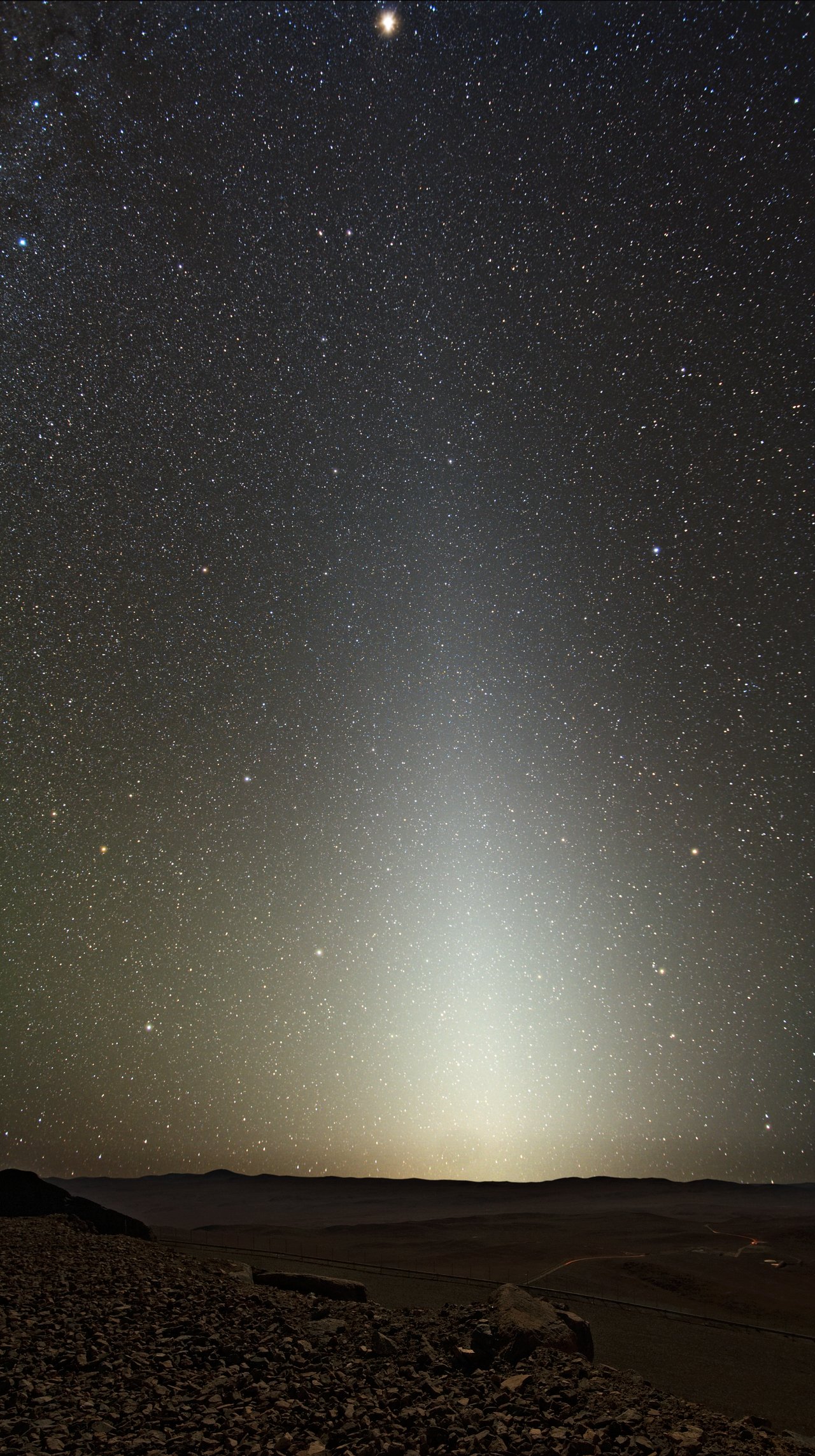
Figure 1: Zodiacal light as seen from Cerro Paranal. [ESO/Y. Beletsky; CC BY 4.0]

We have dust in our solar system — a huge cloud of it that permeates every corner. The dust itself is thought to be the product of many different processes including comet tails, collisions between asteroids, leftover debris from planetary formation, and gravitational collisions induced by planets. It’s small (on the order of 10–100 microns), made up of different silicates, and creates a noticeable triangle-shaped light that can be seen on the darkest nights (see Fig.1). This zodiacal dust is aptly named since the scattered light from the dust grains follows the line of the zodiac, or the ecliptic plane, across the sky. Its structure is quite complicated, with dust rings and trails and clumps near larger planetary bodies. For more information on the solar system’s zodiacal dust, you can read these bites here and here!

This zodiacal dust is not exclusive to the solar system. Other star systems, such as Tau Ceti and Vega, have been found to host similar clouds of interplanetary dust. This means planets imaged in these systems will also have emission from this dust mixed into the light that we observe from the planets. The Habitable Worlds Observatory (HWO) is a future space telescope mission under development by NASA. One of its primary science goals is to directly image 25 Earth-like planets in the habitable zones of nearby stars and look for signs of life (or biosignatures) in these planets’ atmospheres. Exozodiacal dust (aka exozodi) represents the biggest source of astrophysical noise that will need to be subtracted out from HWO observations of exoEarths. The authors of today’s article look at the potential impact of exozodi emission on the spectra of exoEarth atmospheres.
exozodiacal dust models

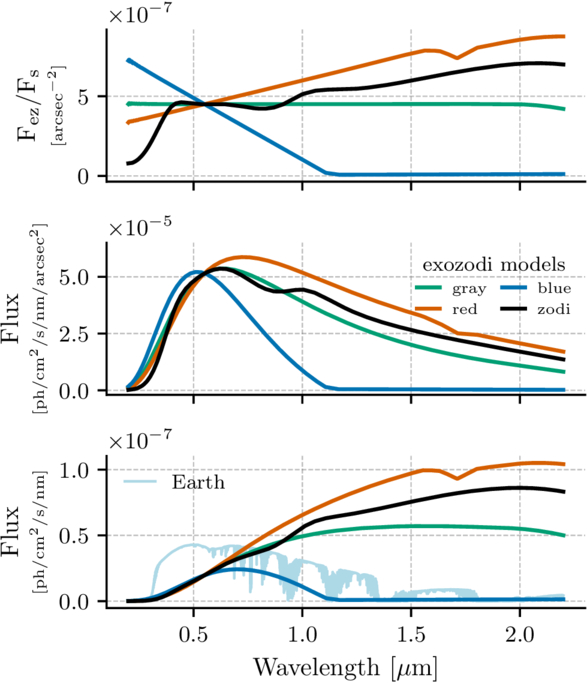
Figure 2: Different models of three “zodis” of dust observed at an inclination of 60 degrees plotted across HWO’s potential wavelength range. The gray scattering model is shown in green, the solar system’s model is shown in black, with the red and blue debris disk models shown in their respective colors. The top panel shows the flux contrast between the dust and the star. The middle panel shows the flux per area. The bottom panel shows the total flux captured with a 7.2-meter HWO with the thin blue line representing the spectrum of an Earth twin 10 parsecs (33 light-years) away for comparison. [Currie et al. 2026]

Show Me the Zodi

The authors first assume four different models of exozodi dust and how the dust’s emission changes with wavelength. The first model assumes a dust cloud that acts as a gray scatterer, meaning the particles scatter all wavelengths of light with no preference, and the second model’s dust acts just like the solar system’s does. However, it’s unknown whether the composition of exozodi will be the same as the solar system’s. Therefore, they adopt two more models of exozodi that act just like debris disks that have different compositions. One model is bluer in color because it is made up of smaller particles that preferentially scatter blue light, and the other model is redder in color because it is made up of bigger dust particles or different chemical compositions. Each of these models over HWO’s wavelength range can be seen in Figure 2. The authors then simulate a modern Earth atmosphere (both clear and 50% cloudy) as well as an Archean Earth atmosphere to understand how different exozodi models will affect observations of different exoplanet atmosphere conditions and compositions.

There’s Dust in My Spectra

In general, the effect that zodiacal dust has on the spectra of Earth-like planets can be broken down into two categories: its effect on the continuum and on the spectral features. The continuum is the object’s light emitted over all wavelengths and uninterrupted by spectral features. Spectral features are absorption and emission lines. These create either a dip or peak in the spectrum where atoms have either absorbed or emitted light at that particular wavelength. Lines at specific wavelengths tell us that a certain material is there, providing a list of possible chemicals that could be present in the planet’s atmosphere. For a brief summary of spectroscopy more generally, see here.

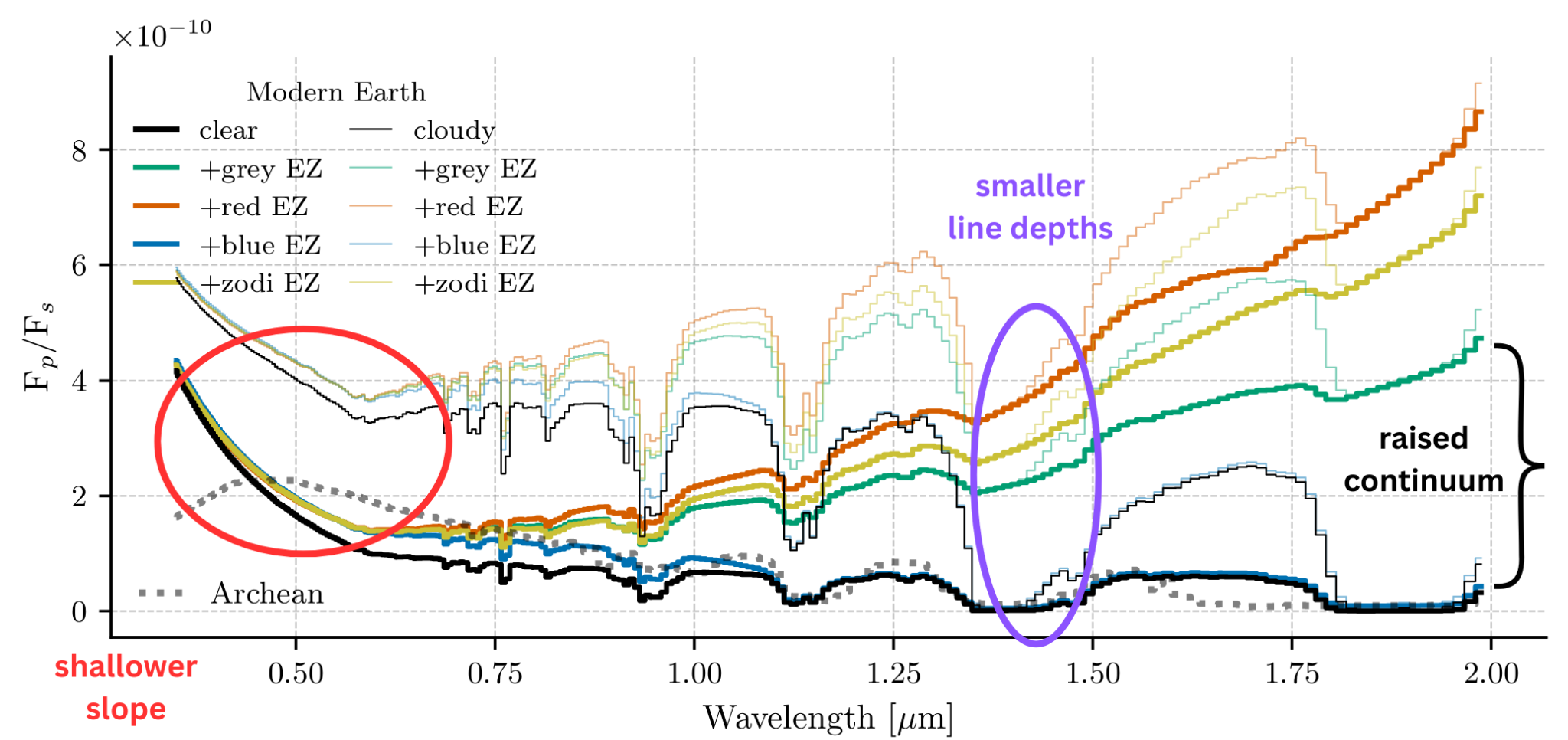
In the case of the continuum, exozodiacal emission raises the continuum, meaning the base flux of the planet is raised and absorption lines become more shallow. These effects can be seen in Figure 3, where the authors’ simulated spectra are plotted with and without zodiacal dust included. Not only is the continuum elevated for all models including zodiacal dust, notice how the dips become shallower at longer wavelengths. Because dust primarily radiates thermally, the red debris disk model nearly smooths out all dips beyond 1.25 microns! Molecules that absorb at these longer wavelengths, such as water or methane, may not be correctly identified with this type of exozodiacal emission.
simulated spectra of Earth-like planets with varying atmospheres and types of exozodiacal dust

Figure 3: Spectra of simulated modern-Earth atmospheres for clear (solid bright lines) and cloudy (solid dimmer lines) scenarios. The Archean Earth atmosphere is plotted in dotted gray. The redder exozodiacal spectrum has an elevated continuum and smoothed spectral features as opposed to the original, zodi-free spectrum plotted in black. [Currie et al. 2026, with annotations by Kaz Gary]

Additionally, the slope of the spectra between 0.25 and 0.75 microns (called the Rayleigh scattering slope) becomes shallower with zodiacal dust emission, which may bias our models toward lower-molecular-weight atmospheres. The slope at these wavelengths is dependent on the size distribution of molecules in the atmosphere, meaning it can tell us how much the average molecule in an atmosphere weighs.

From Figure 3, the effects of zodiacal dust are minimized with a bluer zodiacal dust model. This means systems with “bluer” zodiacal dust may be more optimal for HWO observations, as bluer dust does not scatter as much starlight as gray, solar system–like, or red dust. From their results, the authors recommend that the residual exozodi-to-planet flux ratio (in the V-band wavelengths) be kept to less than 10-2 in order to correctly understand the line depths (identify if a molecule is present or not) and 10-3 in order to accurately retrieve molecular abundances (understand how much of a molecule is present in the atmosphere). Dust is pesky enough here on Earth, but to find life on another planet like ours, we’ll dust have to deal with it.

Original astrobite edited by Anavi Uppal.

About the author, Kaz Gary:

I am a fourth-year PhD candidate at The Ohio State University with a passion for planets. My current work focuses on modeling exoplanet observations for the Habitable Worlds Observatory and understanding planetary atmospheres. Outside of research, I help develop planetarium shows and love all forms of science communication. In my free time, I enjoy playing tabletop RPGs, painting, watching terrible reality TV, and hanging out with my pet hedgehog.

The post Dust Deal with It appeared first on AAS Nova.

Welcome and Farewell to Our AAS Media Fellows

14 September 2026 at 17:00

logo of the American Astronomical Society

In 2017, we announced a new AAS-sponsored program for graduate students: the AAS Media Fellowship. This quarter-time opportunity is intended for current graduate students in the astronomical sciences who wish to cultivate their science-communication skills. This year, for the first time, we are welcoming two Media Fellows to the team.

We are pleased to announce that Lucas Brown and Alexia Kubas have been selected as our AAS Media Fellows for 2026–2027.

Alexia Kubas

Alexia Kubas, a 2026–2027 AAS Media Fellow, is a graduate student at Cornell University.

Alexia majored in astronomy with minors in physics, math, and planetary sciences at the University of Arizona. They are now a fifth-year PhD candidate at Cornell University, researching periglacial processes on Earth and Ceres. Outside of research, Alexia founded and currently helps run an Ithaca, NY, chapter of Astronomy on Tap.

Lucas majored in physics with an astronomy concentration at the University of California, Davis, and he has a master’s degree in physics from Tufts University. He is now a physics PhD candidate at the University of California, Santa Cruz, where he works with Stefano Profumo on studying the phenomenology of primordial black holes. Outside of research, Lucas participates in outreach activities through organizations like the Santa Cruz Organization for Outreach in Physics and the Project for Inmate Education. He also serves as co-chair of the Astrobites collaboration.

Lucas Brown

2026–2027 AAS Media Fellow Lucas Brown is a graduate student at the University of California, Santa Cruz.

As AAS Media Fellows, Alexia and Lucas will regularly write and publish summaries of the latest astronomy research on AAS Nova, assist in managing the distribution of press releases as part of the AAS press office, and gain a broad understanding of the worlds of scientific publishing, communications, and policy. Alexia and Lucas will also be assisting with the press conferences at the upcoming AAS meetings, so please say hello if you spot them at future meetings!

As we welcome our new Fellows to the team, we’ll also soon bid farewell to Lexi Gault, our 2024–2026 AAS Media Fellow. Lexi will be continuing her PhD research at Indiana University, where she studies the interstellar medium conditions in nearby low-mass galaxies. After defending her PhD in Spring 2027, Lexi plans to pursue a postdoc in extragalactic astronomy or a full-time science writing position.

Please join us in welcoming Lucas and Alexia as our new Media Fellows and wishing Lexi the best in all her future endeavors!

The post Welcome and Farewell to Our AAS Media Fellows appeared first on AAS Nova.

Breaking the Ice: Origins of Carbon Oxides on Uranian Moons

11 September 2026 at 22:06

Uranus close-up

For decades, astronomers have tried to decipher the source of carbon oxides on Uranus’s largest moons from ground-based telescopes. A recent study has leveraged JWST spectroscopy and laboratory experiments to identify carbon oxides and their origins for Ariel, Umbriel, Titania, and Oberon.

Unknown Origins of Carbon Oxide Enrichment

Forty years ago, the Voyager 2 spacecraft flew past Uranus and its twenty-seven moons, sending back prized portraits of the planet’s large and tidally locked satellites Miranda, Ariel, Umbriel, Titania, and Oberon. These images revealed extensive valleys, smooth plains, deep canyons, and possible icy volcanic (cryovolcanic) activity across the surfaces of the icy moons — the telltale signs of intense geologic activity. While Voyager 2 could take spectacular pictures, the spacecraft was not capable of identifying the molecules and materials making up these active surfaces.

Six largest moons of Uranus

Voyager 2 images of Uranus’s six largest moons. Click to enlarge. [NASA / JPL-Caltech / Ted Stryk; CC BY-NC-ND 4.0]

In the decades that followed, astronomers have used ground-based near-infrared spectroscopy of these moons to investigate their chemical compositions. These observations have detected weak carbon dioxide and hints of carbon monoxide ice features on the moons with clear spatial trends across the moons’ surfaces, but the origins of these carbon oxides remain unknown. There are two potential explanations for the presence of these molecules: 1) carbon oxides are native to the Uranus system, present from formation, or 2) they formed via radiolysis, in which charged particles trapped in Uranus’s magnetic field interact with water ice and carbon-bearing molecules on the moons’ surfaces.

Ground-based detections are limited due to contamination from Earth’s atmosphere as well as the overall weakness of the carbon dioxide spectral features, thus space-based near-infrared observations of the Uranian moons are necessary to better constrain the carbon oxides on the satellites. Luckily, JWST’s Near-Infrared Spectrograph (NIRSpec) now offers astronomers unimpeded access the moons’ carbon oxide spectral features.

Chemical Clues from Space and in the Lab

In 2024, a study acquired NIRSpec observations of Uranus’s moon Ariel, revealing prominent carbon dioxide features and confirming the presence of carbon monoxide ice hinted at by ground-based studies. Expanding on these observations to include Umbriel, Titania, and Oberon alongside Ariel, Richard J. Cartwright (Johns Hopkins University) and collaborators obtained JWST NIRSpec spectroscopy of Uranus’s four largest moons in hopes of disentangling the origin story of their carbon oxides.

Leading and trailing diagram

Diagram illustrating the leading and trailing sides of a moon orbiting Uranus. Click to enlarge. [AAS Nova/Kerry Hensley]

In addition to the JWST spectra, Cartwright and team performed laboratory experiments measuring the spectral properties of carbon dioxide ice over a range of very low temperatures (tens of kelvin). These experiments provided a better understanding of the spectral properties and nature of carbon dioxide on the surfaces of the Uranian moons. Comparing the JWST spectra with the laboratory spectra, the authors found that Ariel, Umbriel, Titania, and Oberon exhibit a variety of spectral features resulting from carbon dioxide ice, carbon monoxide ice, and other carbon-bearing molecules. The presence of these molecules varies between the leading and trailing hemispheres of the moons, these variations appearing strongest in Ariel and Umbriel. The carbon dioxide and carbon monoxide spectral features are stronger on the trailing hemispheres, decreasing with increasing distance from Uranus for all four moons.
spectral ratios

Spectral ratios of the trailing and leading hemispheres for each moon, labeling spectral features of multiple carbon-bearing molecules. Click to enlarge. [Cartwright et al 2026]

Carbon Oxide Origins

What does this mean for the origins of the carbon oxides on the Uranian moons? Spectral features of carbonate minerals and the widespread presence of carbon dioxide throughout the Uranus system suggest that these compounds exist natively. On the other hand, the concentration of carbon oxide features on the trailing hemispheres supports radiolytic production as these hemispheres are bombarded with more ionizing particles from Uranus’s magnetosphere.

Based on these results, the authors have postulated that both origin scenarios, native presence and radiolysis, are required to fully explain the presence of carbon oxides. Future laboratory studies and JWST observations will continue to reveal the nature and composition of bodies in the Uranus system, furthering our understanding of our solar system siblings.

Citation

“Tracing the Source of Carbon Oxides on the Large Moons of Uranus,” Richard J. Cartwright et al 2026 Planet. Sci. J. 7 199. doi:10.3847/PSJ/ae8818

The post Breaking the Ice: Origins of Carbon Oxides on Uranian Moons appeared first on AAS Nova.

❌