❌

Normal view

FAST telescope completes survey, mapping 156,411 galaxies in largest hydrogen gas atlas

11 September 2026 at 11:33

In one of the most ambitious mapping efforts in the history of radio astronomy, China’s Five-hundred-meter Aperture Spherical radio Telescope — better known as FAST — has delivered a cosmic atlas of staggering proportions. The FASHI team, headquartered at the National Astronomical Observatories of the Chinese Academy of Sciences (NAOC), has announced the second data release of the FAST All Sky HI Survey, published as a cover story in the journal Science China Physics, Mechanics & Astronomy. Just two years after the survey’s first data release catalogued 41,741 galaxies, the new edition explodes that figure to 156,411 extragalactic sources detected in neutral hydrogen — nearly a fourfold leap that firmly establishes FASHI as the largest census of atomic hydrogen gas in galaxies ever compiled.

The scale of the achievement is difficult to overstate. FASHI DR2 now spans roughly 19,500 square degrees of sky, equivalent to 47.3 percent of the entire celestial sphere, and reaches out to redshifts below z = 0.09 — distances of well over a billion light years. For comparison, the previous benchmark in this field, the ALFALFA survey conducted with the now-collapsed Arecibo telescope in Puerto Rico, charted approximately 31,500 hydrogen-bearing galaxies across about 7,000 square degrees. FASHI DR2 has thus quintupled the galaxy count of its Arecibo predecessor while covering nearly three times the sky area, and it has done so with a sensitivity roughly 0.7 times deeper than ALFALFA’s, measured as a median noise level of 0.57 mJy per beam at a velocity resolution of 6.4 kilometers per second. In radio astronomy, lower numbers mean better sensitivity — and FASHI’s numbers are among the best ever achieved in a blind, wide-area survey.

The engine behind this performance is FAST itself. With its 500-meter dish nestled in the karst hills of Guizhou Province, the telescope remains the most sensitive single-dish radio instrument on Earth at the 21-centimeter wavelength of neutral hydrogen. The survey exploited a 19-beam receiver array, allowing the telescope to sweep the sky in an efficient drift-scan mode that turned routine transits of the sky above the dish into a torrent of data. Crucially, the instrument maintained exceptional stability across five full years of observing, from August 2020 through July 2025. In surveys of this kind, calibration drifts and instrumental fluctuations can quietly corrupt weak extragalactic signals; FAST’s long-term steadiness meant that faint hydrogen emission from distant galactic disks could be stacked, averaged and trusted.

Neutral hydrogen — the primordial fuel of star formation — is invisible to optical telescopes. The 21-centimeter spectral line, produced when the electron in a hydrogen atom flips its spin relative to the proton’s, provides the only direct tracer of the cold atomic gas from which galaxies build their stars. Detecting this feeble signal across cosmological distances requires both enormous collecting area and exquisite receiver stability. A blind HI survey, unlike targeted observations, simply listens to every direction on the sky and catalogs whatever whispers back, making it an unbiased inventory of gas-rich galaxies regardless of their optical brightness, dust content or morphology. That is precisely why such surveys are prized: they catch the dim, gas-dominated dwarfs and bloated hydrogen clouds that optical catalogs systematically miss.

To give the hydrogen detections physical meaning, the FASHI team cross-matched their radio catalog with the two great optical spectroscopic endeavors of the current era: the Dark Energy Spectroscopic Instrument survey and the Sloan Digital Sky Survey. This cross-identification yielded precise optical counterparts for approximately 64,000 sources, anchoring the hydrogen detections to galaxies with measured distances, stellar masses and star-formation rates. From these matches the team constructed a completeness-corrected statistical sample of more than 109,000 galaxies — a sample robust enough to push fundamental measurements into territory previously beyond reach.

The flagship result of the release is a new measurement of the HI mass function, the statistical distribution describing how many galaxies of a given hydrogen mass populate the local universe. Thanks to the sheer sample size and FAST’s depth, the team extended the reliable measurement range of this function down to hydrogen masses of about one million solar masses — roughly 10 to the power 6.2 in solar mass units — a regime where only the faintest dwarf galaxies live. These smallest gas reservoirs are the building blocks of galaxy evolution, the raw material that hierarchically assembles larger systems, and their census has long been fragmentary. Equally striking is the derived cosmic density of neutral hydrogen: Ω_HI equals (4.71 ± 0.03 statistical ± 0.40 systematic) × 10⁻⁴ in units of h₇₀³ Mpc⁻³ dex⁻¹. The statistical uncertainty is a mere 0.6 percent — the most precise determination of the universe’s atomic hydrogen budget ever made at low redshift.

Why does such a number matter? The cosmic HI density tracks how much raw fuel exists for future star formation, and comparing its evolution across cosmic time constrains how galaxies acquire and exhaust their gas. Because atomic hydrogen sits at the interface between the intergalactic medium and the star-forming interstellar medium, its abundance is a sensitive probe of gas accretion onto dark matter halos and of the feedback processes that heat or expel gas from galaxies. Baryonic matter, after all, is hidden in far more places than stars: cold gas, warm gas, plasma in and around halos. A precision measurement of the hydrogen component anchors models of where ordinary matter resides within the cosmic web of dark matter.

The applications of the new catalog ripple far beyond that single number. For galaxy evolution studies, the 156,411 detections provide direct observational constraints on gas accretion, star formation feedback and galaxy transformation — the processes that turn blue, gas-rich spirals into passive red systems. For cosmology, the HI mass function tests galaxy formation models within the prevailing dark matter framework. For large-scale structure work, the survey complements optical galaxy catalogs to trace the so-called HI cosmic web, revealing how diffuse gas threads through filaments and pools in voids — architecture that optical surveys alone can only infer. The dataset will also aid gravitational-wave and transient science: rapid localization of the host galaxies of gravitational-wave events depends on accurate galaxy catalogs, and an inventory of hundreds of thousands of nearby galaxies sharpens those host identifications. Finally, FASHI serves as a pathfinder for the Square Kilometre Array, the giant interferometric observatory under construction in Australia and South Africa, providing benchmark samples against which next-generation interferometric surveys will calibrate their systems and select their targets.

The trajectory of the project tells its own story. When FASHI DR1 appeared, it broke ALFALFA’s long-standing record for the largest blind HI survey. With DR2, the team argues, FASHI has moved from record-breaking to benchmark-setting — a transition that observers of Chinese radio astronomy describe as the shift from follower to leader in 21-centimeter science. The cover of the journal issue reinforces the mood: a warm sunset scene evoking the faint 21-centimeter photons from distant galaxies arriving at FAST after journeys of billions of light years, messengers of the cold gas that permeates the universe.

The survey’s story is also one of institutional perseverance. The work is led by NAOC in collaboration with the Guizhou Radio Astronomical Observatory, the Shanghai Astronomical Observatory, the CAS South America Center for Astronomy, Peking University and other partner institutions, with funding from the National Natural Science Foundation of China, the Chinese Academy of Sciences and the Ministry of Science and Technology of China. Sustained national investment in a single flagship instrument has now produced a dataset whose statistical power no other facility can currently match at these wavelengths.

The full FASHI DR2 source catalog has been released to the public through the FAST data portal, a decision that will likely seed hundreds of follow-up studies in the coming years, from targeted observations of hydrogen-rich dwarfs to statistical analyses of gas in galaxy groups and environmental studies of gas stripping in clusters. As the SKA era approaches, FASHI DR2 stands as both a scientific foundation and a demonstration: that a single dish, used patiently and precisely over five years, can still redraw the map of the gaseous universe. With nearly half the sky covered and a quarter of a million more square degrees potentially within reach, the question is no longer whether FAST will extend the hydrogen frontier, but how far.

Subject of Research: The FAST All Sky HI Survey (FASHI) second data release — a blind survey of extragalactic neutral hydrogen (21 cm) sources using the FAST telescope, measuring the HI mass function and cosmic HI density.

Article Title: FAST All Sky HI Survey completes “two-step leap” — from 41,741 to 156,411 galaxies, China’s FAST telescope maps the largest cosmic gas atlas

Article References: FAST All Sky HI Survey completes “two-step leap” — from 41,741 to 156,411 galaxies, China’s FAST telescope maps the largest cosmic gas atlas. https://doi.org/10.1007/s11433-026-3072-1 Original publication

Image Credits: AI Generated

DOI: 10.1007/s11433-026-3072-1

Keywords: FAST telescope, FASHI survey, neutral hydrogen, HI mass function, cosmic web, galaxy evolution, 21 cm line, ALFALFA, radio astronomy, Square Kilometre Array, dark matter halos, cosmology

Scientists discover mysterious new X-ray objects 'unlike any they have seen before'

11 September 2026 at 11:00

NASA's Chandra X-ray Observatory has found a brand new type of an otherwise familiar object – compact binary systems that steal gas from other stars, but which do so while emitting very low-energy X-rays but copious amounts of ultraviolet.

Chandra spotted 84 suspicious object emitting very low-energy X-rays in six galaxies – four evolved ellipticals and two spirals, namely our near-neighbor the Andromeda Galaxy (M31) and the Pinwheel Galaxy (M101).

"We've never encountered a group of objects that act like this," said Mustafa Muhibullah of the University of Alabama in a statement.

Compact objects, in the form of black holes, neutron stars and white dwarfs, are the remains of stars that have died. Their small size and powerful gravity means that they're adept at getting close to orbiting companion stars and ripping the stars' outer layers of gas away. The gas swirls around the compact object, falling onto its surface, and this accretionary process usually produces torrents of high-energy X-rays because the stolen gas becomes superheated by the compact object's gravitational vice-like grip.

Because of their weak X-rays, Muhibullah's team refer to them as 'hypersoft X-ray sources'. Since low-energy X-rays and ultraviolet light are next to each other on the electromagnetic spectrum, Muhibullah and his team suspect that the low-energy X-rays are spillover from objects emitting prodigious amounts of ultraviolet. Moreover, they think that these objects are lower-level compact binaries.

They're hard to find though, because the interstellar medium of hydrogen and helium gas between the stars absorbs ultraviolet light. This could be why we have yet to find any hypersoft X-ray sources in our own galaxy, because we have to look through the interstellar medium through the plane of the Milky Way.

Consequently, there could be a large population of hypersoft X-ray sources that remain undiscovered and they could have an important effect on the universe around them.

"These clandestine X-ray sources are actually among the most energetic objects in galaxies, and they could be solving two cosmic mysteries at once," said Muhibullah.

The interstellar medium is filled with ionized gas where atoms have been shorn of electrons. Hot, massive stars do output a lot of high-energy ultraviolet light, but there are not enough of these stars to account for all the ionization. If hypersoft X-ray sources are dumping torrents of ultraviolet into space, they could explain the ionization instead. For stars to form, gas has to be cold and not ionized, so hypersoft X-ray sources could be gently regulating star formation within galaxies.

The second mystery is the puzzle over how exactly type Ia supernova explosions detonate. We know that they are fueled by white dwarfs accreting matter from a close companion star and, once the accumulated matter raises the white dwarf's mass beyond 1.44 times the mass of our sun – known as the Chandrasekhar limit – it explodes, but the details of what on the white dwarf actually ignites and how are fuzzy.

Studying a new breed of compact binary might finally reveal the answers and offer more clues about when white dwarfs become ready to explode.

"If we could find a way to spot these type Ia supernova explosions before they go off, that would be really important," said Jimmy Irwin of the University of Alabama, who is a member of Muhibullah's team. "Right now, we study them after they've exploded and astronomers have struggled to understand what is actually ignited."

Since type Ia supernova explosions are used as markers on the cosmic distance ladder, used for measuring the strength of dark energy and the expansion of the Universe, the benefits from understanding them better are clear to see in our efforts to understand how the Universe is evolving.

The findings were published on Sept. 9 in Nature Astronomy.

NASA’s Chandra Unveils Mysterious X-Ray Objects

9 September 2026 at 19:11
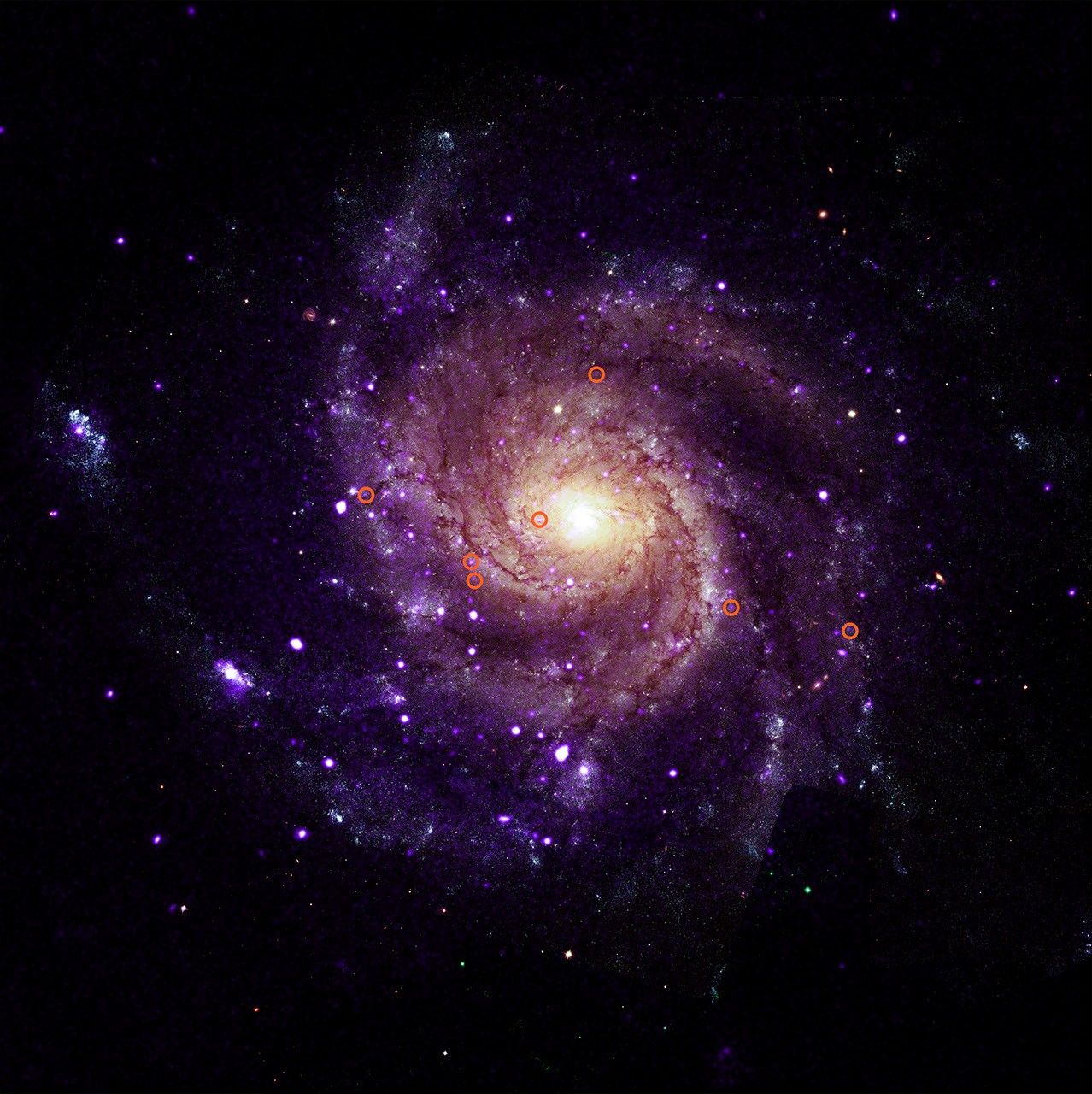
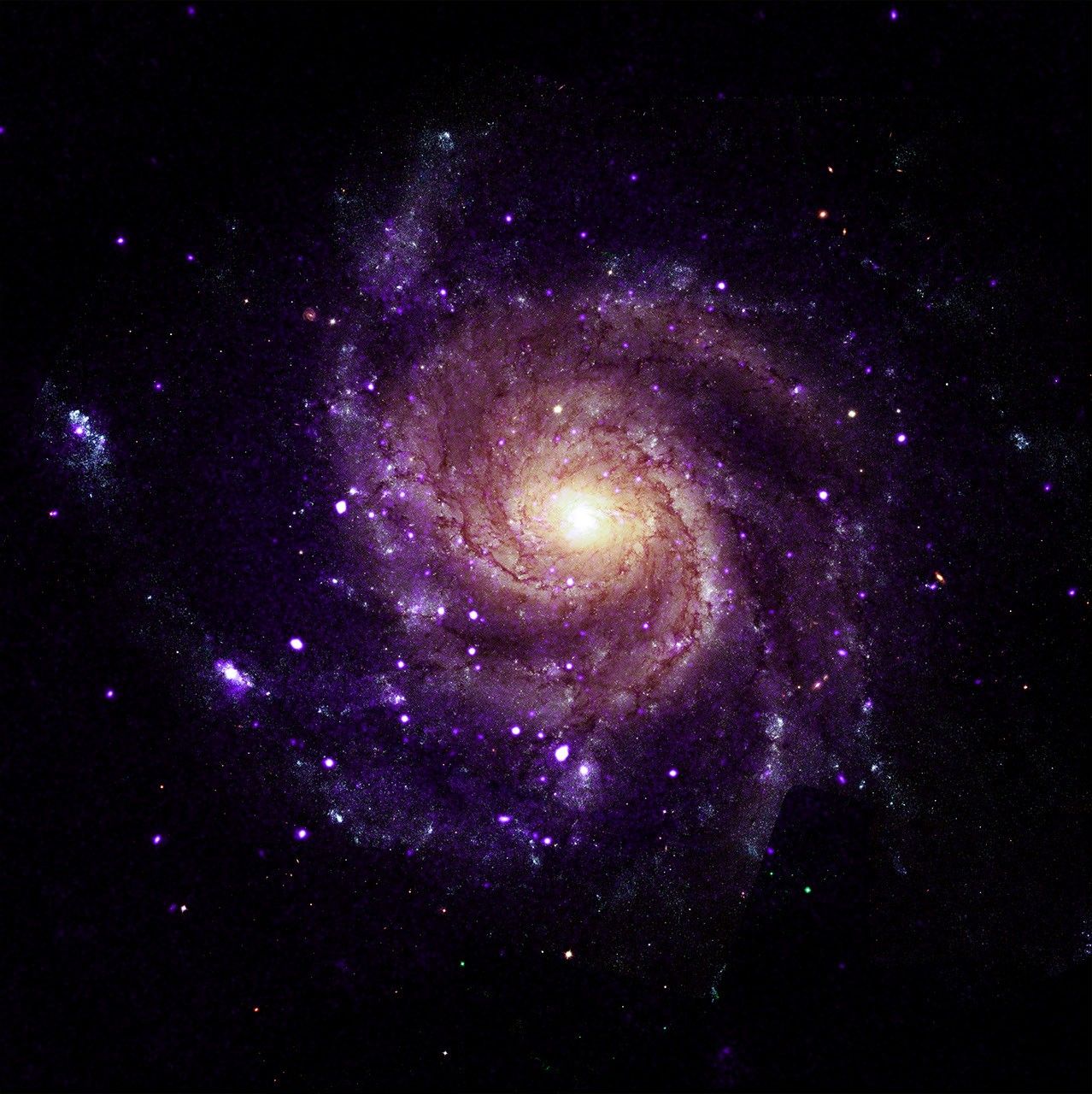
Researchers found 84 so-called hypersoft X-ray sources in M101, Messier 31, and four elliptical galaxies. This newly-discovered class of objects give off very low-energy X-rays and likely high levels of ultraviolet light. Their existence may help explain questions around Type Ia supernova explosions and the intergalactic medium. These images of the face-on spiral galaxy M101 show X-ray data from Chandra and an optical image from the Hubble Space Telescope.
X-ray: NASA/CXC/Univ. of Alabama/M. Muhibullah et al.; Optical: NASA/ESA/STScI; Image Processing: NASA/CXC/SAO/N. Wolk

Using NASA’s Chandra X-ray Observatory, scientists have discovered a new class of objects behaving unlike any they have seen before. Astronomers suggest these newly spotted objects in other galaxies may help solve not one, but two long-standing questions in astrophysics.

These mysterious objects give off unusually low-energy X-rays but intense levels of ultraviolet radiation. This discovery is featured in a paper published Wednesday in Nature Astronomy.

“We’ve never encountered a group of objects that act like this,” said Mustafa Muhibullah of the University of Alabama who led the study. “Of course, the next step was to try to figure out what these things are.”

Researchers found 84 so-called hypersoft X-ray sources in M101, Messier 31, and four elliptical galaxies. This newly-discovered class of objects give off very low-energy X-rays and likely high levels of ultraviolet light. Their existence may help explain questions around Type Ia supernova explosions and the intergalactic medium. These images of the face-on spiral galaxy M101 show X-ray data from Chandra and an optical image from the Hubble Space Telescope.
M101 with illustrated circles calling out seven of the newly-discovered objects.
X-ray: NASA/CXC/Univ. of Alabama/M. Muhibullah et al.; Optical: NASA/ESA/STScI; Image Processing: NASA/CXC/SAO/N. Wolk

The researchers found a total of 84 of these “hypersoft X-ray sources” – so named because they give such low-energy X-rays – in the six different galaxies they searched, using data openly available to the public in the Chandra archive. Two of the galaxies are spirals, M31 (the Andromeda galaxy) and M101 (the Pinwheel galaxy), while the other four are ellipticals. They found hypersoft X-ray sources both in regions of active star formation and areas where there are older stars.

The team spotted the sources by finding objects that appeared in Chandra images taken at the lowest X-ray energies but vanished in higher-energy images. That means these objects give off far more low-energy X-rays than high-energy ones. Because low-energy X-rays border energetic ultraviolet radiation on the electromagnetic spectrum, the researchers determined that these sources are producing large amounts of energetic ultraviolet radiation as well.

It is unclear what types of objects are responsible for these low-energy X-rays and intense ultraviolet radiation. The team thinks they most likely involve a black hole, neutron star, or white dwarf pulling material from a companion star. The material pulled from the companion star is heated up to produce X-rays before falling onto the white dwarf or neutron star, or into the black hole. Such binary systems have been seen before, but not with such bright ultraviolet radiation and low-energy X-rays.

The discovery suggests that there may be large populations of binary systems with energetic ultraviolet radiation that have been undetected until now.

“These clandestine X-ray sources are actually among the most energetic objects in galaxies, and they could be solving two cosmic mysteries at once,” said Muhibullah.

Scientists think that some white dwarf systems pulling material from companion stars may eventually explode as a supernova – known as a Type Ia – that is critical for measuring the expansion of the universe. These supernovae played a key role in discovering that this expansion is accelerating. Astronomers have been looking for the stars that turn into Type Ia supernovae for many years, so far without success.

“If we could find a way to spot these Type Ia supernova explosions before they go off, that would be really important,” said co-author Jimmy Irwin, also of the University of Alabama. “Right now, we study them after they’ve exploded, and astronomers have struggled to understand what is actually ignited.”

The other mystery these hypersoft X-ray sources might explain is what strips electrons from gas between the stars in some galaxies. This stripping of electrons is important to probe because it can affect how quickly stars form and influence the life cycles of galaxies. Hot, massive stars play a role, but they do not completely explain what is causing this stripping. The intense levels of ultraviolet radiation from the hypersoft X-ray sources may play a vital role.

Why were these hypersoft X-ray sources not found until now? In addition to the low-energy X-ray output, which is very difficult for X-ray telescopes to detect, the high-energy ultraviolet radiation is readily absorbed by helium and hydrogen gas that fills the space between the stars, creating a nearly impenetrable barrier to look through.

“By combing through the Chandra archive, we were able to eliminate what used to be a blind spot for telescopes,” said co-author Rosanne Di Stefano of the Center for Astrophysics | Harvard & Smithsonian. “That’s how we found what appears to be a new class of cosmic objects with remarkable qualities.”

NASA’s Marshall Space Flight Center in Huntsville, Alabama, manages the Chandra program. The Smithsonian Astrophysical Observatory’s Chandra X-ray Center controls science operations from Cambridge, Massachusetts, and flight operations from Burlington, Massachusetts.

Read more from NASA’s Chandra X-ray Observatory

To learn more about NASA’s Chandra mission, visit:

https://www.nasa.gov/chandra

Visual Description

This release features a composite image of a spiral galaxy, M101; one of six identified galaxies housing a new class of mysterious objects that give off unusually low-energy X-rays.

In this composite image, M101 faces us directly. It has multiple arms in shades of purple, spiraling clockwise around a golden yellow core. Scattered along and between the arms are scores of tiny specks in white and purple. Most of those specks are pairs of stars, but seven of them are a mystery.

To casual observers, the unusual objects are visually indistinguishable from the other specks of light in the galaxy. An annotated version of the composite image is included in this release, with red circles around the mysterious specks for easy identification.

These mystery specks behave like no other class of object discovered before. The curious objects give off X-rays of such low energy, they in fact produce large amounts of ultraviolet radiation, as UV radiation borders X-rays on the electromagnetic spectrum. Searching images of galaxies with low-energy X-rays in the Chandra Observatory archive, scientists have found a total of 84 such objects spread across M101 and five other galaxies. They have dubbed these mysterious objects “hypersoft X-ray sources.”

Share

Details

Last Updated
Sep 09, 2026
Editor
Lee Mohon
Contact
Location
Marshall Space Flight Center
❌