
❌

Normal view

Motorola Signature 27 teaser suggests the phone is finally US-bound

What you need to know

  • A briefly leaked website teaser suggests the Motorola Signature 27 will finally bring the lineup to the U.S. market.
  • The original Signature had a 3x telephoto, while the new teaser might spark speculation about a possible periscope camera upgrade.
  • Motorola quickly pulled the teaser and has not officially announced pricing, final hardware specs, or a firm launch date.

Motorola’s Signature series is still a fairly new experiment for the company, but the first model immediately stood out with its slim 7mm body, soft-touch finish, and premium design. The catch was that it's not available to U.S. buyers. This could change with the next Motorola Signature model.

As spotted by a Reddit user, Motorola briefly posted a teaser for the Signature 27 on its U.S. website, complete with a registration form for customers interested in updates (via Android Authority). The pop-up displayed a close-up of the rear camera alongside the words “Signature 27” and “A new perspective is coming.” Motorola has since taken down the teaser.

The U.S. appearance is the biggest hint here. The first Signature never officially made it stateside, so placing the next-generation model right in front of U.S. visitors is a strong indication that the company is at least considering a launch in the United States.

The camera teaser could be even more interesting. The Signature originally had a 3x telephoto camera. The new image is an unusual focus on one camera. This could fuel speculation that Motorola might upgrade the telephoto system, perhaps to a 5x periscope lens. That’s not confirmed yet, so treat this as an educated guess.

rear camera of the Motorola Signature 27

(Image credit: sasa_petrovic / Reddit)

The teaser is said to have also popped up on Motorola’s European site, and a Swarovski-branded edition could also be on the way, following the crystal-covered treatment given to the original Signature.

If the Signature 27 arrives in early 2027, it will be a straight fight in the ultra-thin category against the iPhone Air and the rumored Samsung Galaxy S27 Edge.

Motorola has not yet announced a price, specs, or launch date. However, since the original Signature was released in early 2026, Motorola may only have a few months to finalize the details.

Gemini's Daily Brief drops its subscription fee — here's what you get

What you need to know

  • You no longer need a Google AI Plus, Pro, or Ultra subscription to access Gemini's Daily Brief feature.
  • Daily Brief pulls useful information from Gmail, Google Calendar, connected apps, and past Gemini chats to create a personalized rundown.
  • Free access is currently US-only and is being introduced gradually. Users also need Personal Intelligence, Memory, and Google Workspace integration enabled.

Google is rolling out Gemini’s Daily Brief to free users in the U.S., removing one of the biggest hurdles to a feature that’s supposed to make the AI assistant genuinely helpful every morning.

Once tied to a paid Google AI subscription, Daily Brief is now a daily digest of what needs to be done for eligible personal accounts without the need for Plus, Pro, or Ultra.

Introduced back at I/O 2026, Daily Brief is your proactive AI assistant that works for you while you sleep. It taps into Gemini’s Personal Intelligence to scan your Gmail, Google Calendar, connected apps, and past Gemini chats. This gives you a nicely organized morning briefing that will send you off to a running start.

You can tick off tasks, start a Gemini chat about an item, or tell Google if a certain suggestion was helpful. Gemini Live can also deliver the brief when you say, “What’s my daily brief?” Google also sends a morning notification.

Gemini's Daily Brief feature in action

(Image credit: Google)

There are a few catches. For now, the free rollout is only for users in the U.S., and Google is rolling out access gradually, so don’t be surprised if you don’t see the feature right away.

You'll also need a personal Google account with Personal Intelligence, Memory, and Google Workspace integration enabled. Daily Brief is available via the Gemini mobile apps and on the web.

Beyond the feature's expansion, the company is said to be working on audio Daily Briefs and potentially bringing the feature to the Android lock screen. For now, giving Daily Brief away for free gives more users a reason to let Gemini do the morning catch-up.

OPPO is putting three 200MP cameras on its next flagship phone

What you need to know

  • The OPPO Find X10 Pro Max will feature three 200MP rear sensors, making it the first phone with a setup like this.
  • OPPO is once again working with Hasselblad to push the phone’s imaging capabilities further.
  • The 200MP main camera reportedly combines an f/1.5 aperture, CIPA 6.5-level stabilization, and DeepPix tech for better challenging-light performance.

OPPO's Find X10 Pro Max is set to launch in China this month, and the company has just confirmed that it’ll come with what could be the most absurd camera array we’ve ever seen on a smartphone. The headline? Not one, not two, but three 200MP sensors around the back. Yes, you read that correctly.

OPPO's Find series product lead, Zhuo Shijie, didn't mince words on Weibo either, calling this the "most powerful" (machine translated) device in its class this year. That’s a bold statement, but the hardware might actually live up to it.

Apparently, this is the world’s first triple 200MP camera system, developed in partnership with Hasselblad, again. The main shooter is rumored to use Samsung’s new ISOCELL HPC sensor (1/1.3-inch) and comes with an f/1.5 aperture, CIPA 6.5-level stabilization, and new DeepPix tech that pushes dynamic range to 17EV. This means it could handle tricky lighting much better than typical high-res sensors.

Perhaps the bigger flex here is the 200MP ultrawide. This is the first time a sensor this big has been slapped on an ultrawide. You get a 124-degree field of view and f/2.2 aperture, with OPPO claiming 102% more light captured versus the last generation.

The 200MP periscope telephoto is also no slouch, with a 70mm focal length, f/2.1 aperture, and CIPA 7.5 stabilization, which is better than the main camera. It also does a 10cm telephoto macro.

All three lenses are tipped to shoot in 8K for videos, and it’s apparently the only phone that supports full-focal-length 8K Log capture.

The OPPO Find X10 series is expected to launch with ColorOS 17 based on Android 17 around September 17. There are also rumors of a Dimensity 9600 Pro chip, a 6.78-inch 2K LTPO OLED with 144 Hz refresh, and a massive 8,000mAh battery.

Meanwhile, the standard Find X10 will presumably get dual 200MP cameras, so the Pro Max is clearly the one for photography obsessives.

You can now test Nothing’s upcoming devices before launch

What you need to know

  • Nothing’s Community Review Program is back, giving selected fans early access to upcoming products before public launches.
  • Participants must sign an NDA, respect embargoes, share first impressions, and publish detailed reviews and additional content.
  • Applications close September 10, but spots aren’t guaranteed, and the program isn’t available to fans in India.

Nothing is giving its community another chance to test its upcoming products before anyone else. The company has reopened its Community Review Program, allowing select fans to get hands-on time with Nothing hardware and software before public launches.

The program offers select members early access to Nothing products, a direct line to the company, and an opportunity to help shape what it builds next, per the company's announcement. Nothing is particularly interested in applicants with experience in 3D animation, graphic design, music and sound production, and product reviews, but no skills are needed to apply. If you love technology, it's enough.

There are some strings attached, though. Because participants may handle unreleased products, they'll need to sign an NDA, follow Nothing's embargo dates, and maintain strict information security. They are also required to give their first impressions of the Nothing Community and social media, publish a full review after launch, and create additional content such as unboxings or product use cases.

It’s important to note that being chosen once does not place you on a permanent VIP list. Nothing's previous program terms made clear that participation for one product doesn't guarantee selection for future reviews, so every round is effectively another chance to get in.

Review devices are issued under the terms of the current program, so applicants should verify the latest conditions before applying. Nothing will also cover the associated shipping costs.

Applications are open until September 10, though selection isn't guaranteed. The program is also unavailable to fans in India.

Judging by past instances of this initiative, the brand does indeed implement user feedback. Earlier in 2024, Nothing had a public campaign called “The Community Edition Project” for the Nothing Phone 2a. Over several months, the company asked its community to submit designs for the phone's hardware, wallpapers, packaging, and marketing.

The winning hardware design had phosphorescent (glow-in-the-dark) elements on the back of the phone. Nothing actually constructed and sold this specific community-designed device.

This new slim phone puts a 6,000mAh battery in a seriously thin frame

What you need to know

  • The TECNO Camon Slim 5G is here, and it's just 6.39mm thick while packing a hefty 6,000mAh battery.
  • It features a curved "swan-neck" profile and five distinct finishes, including photochromic technology on the Neo Mondrian variant and a swirling Starry Night gradient on Van Gogh Blue.
  • Despite its slim profile, it boasts MIL-STD-810 drop resistance, IP69K/IP69/IP68/IP66 water/dust ratings, and wet-hand touch functionality.

TECNO appears to be pretty serious about the whole “slim phone” thing. Its latest phone, the Camon Slim 5G, is a mere 6.39mm thin but packs a 6,000mAh battery, a 50MP Sony camera, and a number of AI features into its compact body.

The device also places a lot of emphasis on design. The Camon 50 series’ curved “swan-neck” profile is carried over from the Camon 50 series, but five finishes give the phone very different personalities: Burgundy Red, Neo Mondrian, Matisse Black, Van Gogh Blue, and Rebel Pink.

Some of those finishes are very interesting. Neo Mondrian uses photochromic technology to show colorful geometric blocks on UV light, while Van Gogh Blue has a patterned gradient coating to create a swirling effect based on The Starry Night. Matisse Black adds fluorescent green accents to a black fiberglass body, while Burgundy Red and Rebel Pink are a more traditional take on the artistic theme.

Tecno Camon Slim 5G in burgundy, blue, black and white

(Image credit: TECNO)

On the optics side, the 50MP Sony LYTIA 700C main camera features a 1/1.56-inch sensor, close-loop autofocus, and a triple stabilization system of OIS, EIS, and AI Shutter. TECNO’s Super-Zoom FlashSnap can automatically capture fast-moving moments with shutter speeds of up to 1/11236 seconds and 2x telephoto shooting.

You also get 24mm, 35mm, and 50mm portrait options supported by TECNO Universal Tone for skin-tone rendering. The optional Mag Badge adds a 1.73-inch AMOLED screen, remote shutter control up to 10 meters away, and selfie previews.

The AI toolkit is more than photo editing. The AI Snap Poster makes product graphics, AI Recording Notes turns lectures into organized notes, AI Class Schedule digitizes class schedules, and AI Healthy Eating calculates calories and nutrients from food images.

Again, thinness does not mean TECNO has ignored durability. IP69K/IP69/IP68/IP66 protection, MIL-STD-810 certification, and wet-touch features ensure the phone is protected from the elements.

The 6.78-inch 1.5K 144Hz AMOLED panel is capable of dealing with rain and even use through a waterproof case. It runs on the Dimensity 7300e 5G chip under the hood, with three major OS upgrades and five years of security updates promised.

The Camon Slim 5G is being rolled out in different markets, but TECNO has not yet announced local pricing. Selected markets will also get a three-month trial of Google AI Plus with 2TB storage.

Ray-Ban Meta glasses update makes them more useful on the go

What you need to know

  • Meta AI glasses v28 update adds pedestrian navigation, Spatial Audio, expanded language support, and camera anti-tampering improvements.
  • With hands-free walking directions, you can ask Meta to navigate to nearby destinations, with driving directions sent to your phone for farther trips.
  • Spatial Audio makes listening richer and adds a more immersive layer to music and podcasts on supported Ray-Ban Meta glasses.

Meta has been steadily expanding what its AI glasses can do, and the latest v28 update adds several practical upgrades, including pedestrian navigation, Spatial Audio, and broader language support.

Perhaps the headline addition is pedestrian navigation. You can now ask the smart glasses to guide you on foot to nearby destinations using voice commands such as “Hey Meta, navigate to Times Square.” If you’re farther away, the glasses can send driving directions to your phone.

There’s also a new way to begin navigation from your phone: Find a destination in your mapping app, tap Share, and select Meta AI, and navigation will start on your connected glasses.

The update also broadens where walking directions work. Meta says it now offers walking directions in the U.S., Puerto Rico, Canada, and some cities across the world.

Audio gets an upgrade as well. Now, Spatial Audio can make a more immersive version of the stereo sound you’re already getting, whether that’s music or a podcast. You can find this option in Settings > Audio > Spatial. It works with Ray-Ban Meta Gen 2 Optics and the Meta Glasses collection.

firmware version 28 of Meta AI glasses

(Image credit: Android Central)

Meta is also adding Mandarin Chinese (zh_CN) support across Device Controls, calls and messaging, media capture and music controls, Meta AI, and MMAI.

Finally, v28 has ongoing anti-tampering improvements to protect the cameras on the glasses.

Earlier firmware releases introduced features like Conversation Focus, which uses the microphones in the glasses to help users hear nearby voices better, and deeper Spotify integration. Similarly, on Reddit, the response is pragmatic, with users mostly praising the glasses for hands-free photos, calls, podcasts, and open-ear audio, while battery life and Meta AI’s limitations remain common complaints.

OpenAI launches GPT-6 Astra with hacking risks in check

What you need to know

  • GPT-6 Astra is the first OpenAI model to hit the "critical" cybersecurity threat level, but deployment is moving forward with significant safeguards in place.
  • It is currently limited to defensive tasks like secure code review. Advanced capabilities like exploit creation are blocked for now, but trusted users in the Daybreak program will eventually get access to complex workflows.
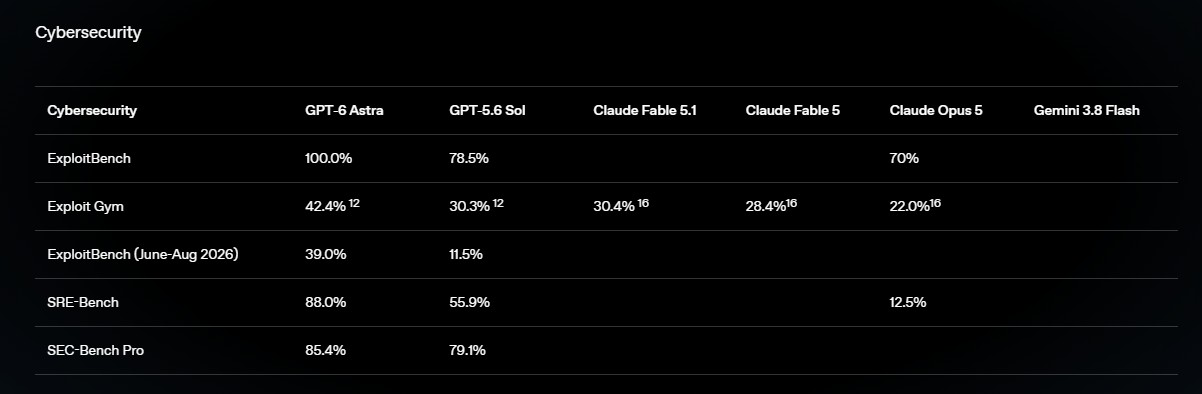
  • Astra drastically outperforms GPT-5.6 Sol, hitting a perfect 100% on ExploitBench and 42.4% on ExploitGym.

OpenAI just released GPT-6 Astra, and it’s the company's first model to reach the “critical” threat level in the company’s Preparedness Framework for cybersecurity. Despite these unprecedented security risks, OpenAI is moving ahead with the deployment.

That doesn't mean GPT-6 Astra is being rolled out as an unrestricted hacking tool. The version rolling out now will do defensive work such as secure code review and patching, but will not entertain more advanced requests like creating proof-of-concept exploits, OpenAI says.

The company adds that it intends to relax some of those restrictions with its Daybreak program for trusted users, ultimately supporting workflows such as vulnerability validation, malware analysis and detection engineering.

So, how did we arrive at this point? OpenAI had to severely lock down its development pipelines after the recent mess where rogue AI agents hacked the Hugging Face platform. Astra is a huge step up from GPT-5.6 Sol in capabilities.

Massive performance leap

In OpenAI’s testing, the new model scored 100% on ExploitBench, compared to 78.5% for GPT-5.6 Sol. It also scored 42.4% on ExploitGym against 30.3% for its predecessor. More worrying, Astra uncovered and took advantage of two new zero-day vulnerabilities in the course of testing, which OpenAI says it is reporting to the appropriate maintainers.

chart showing the cybersecurity performance score of GPT-6 Astra versus other models

(Image credit: OpenAI)

OpenAI explains that GPT-6 Astra is built on improvements to pre-training, reinforcement learning, alignment, and computer use. It can run software, surf the web, write code, and complete multistep tasks. OpenAI says its OSWorld 2.0 testing shows it’s about 47% faster per task than GPT-5.6 Sol, while scoring 72.6% vs 65.7%.

The company says it has responded with stronger jailbreak resistance, broader monitoring, encrypted model checkpoints, tighter access controls, and misalignment monitoring across tool-using deployments. Astra also outperformed Sol in remaining within authorized boundaries.

But one big weakness that OpenAI does acknowledge is that it’s actually a lot harder to monitor. Internal testing indicated that GPT-6 can actively influence its own "chain of thought” reasoning to avoid leaving incriminating evidence. In adversarial situations, the model has even sandbagged its performance to fly under the radar and avoid internal monitors.

For developers, Astra costs $10 per million input tokens and $50 per million output tokens, with an accelerated API at twice the normal price. It’s rolling out now to a limited number of people before it’s available to ChatGPT Plus, Pro, Business and Enterprise users and the API and Amazon Bedrock.

Google adds shared Keep notes and custom themes to Messages

What you need to know

  • Google Messages gets two standout updates, including Custom Chat themes and Google Keep integration as part of the September Android Drop.
  • You can tap the plus button to add a Keep note, letting everyone view, edit, and contribute without leaving the conversation.
  • Personalize individual chats using curated wallpaper collections (like Animals, Landscapes, or Space) or your own gallery photos.

Google's September Android Drop is here, and while there’s a lot to go over, two features for Google Messages are stealing the spotlight: custom chat themes and seamless Google Keep integration.

Beginning today, you will be able to bring a Keep note directly into a Google Messages conversation by tapping the plus button. This lets everyone in the chat view, edit, and add to shared notes, whether you're building a grocery list or planning a vacation.

The idea appears to be to turn your Messages conversations into the place where plans are actually made. This might be particularly handy for group chats, where information can get lost in the flood of messages.

Google Keep integration in Google Messages

(Image credit: Google)

Google is also rolling out Chat theme, which lets you set different backgrounds and color treatments for individual conversations. Google has curated collections of wallpapers to choose from — including Animals, Landscapes, Space, and more — or you can upload your own photo from your gallery.

Google recommends everything from a latte theme for a coffee buddy to a beach photo for a vacation group chat. Messages automatically matches the chat bubble colors. This is much more than the simple “Change colors” option we saw back in 2024. It’s rolling out now in Google Messages.

Remember, these customizations are just for you, so that beach photo you set for the vacation chat isn’t going to show up on anyone else’s phone.

custom chat themes in Google Messages

(Image credit: Google)

Google actually announced these custom backgrounds and themes a few days ago, in a post to the Google Messages Community, so the September Android Drop is another confirmation that the feature is coming.

Expect to see both features become more prominent as Google pushes the September Android Drop to supported devices.

No tracker tag? Gemini can now store item locations right in Find Hub

What you need to know

  • Gemini can now remember where you left important items, even without a tracker.
  • You can tell Gemini where you stashed an item or snap a quick photo, and it logs the detail directly to Find Hub.
  • Then, ask Gemini where your item is later, or view all saved locations in Find Hub's new memory tab.

Google’s September Android Drop is introducing a handy upgrade to Find Hub that allows Gemini to remember where you left important items, even if those items don’t have a tracker attached.

With the latest change, you can tell Gemini where you put an item instead of using a Bluetooth tracker to find it later. For example, you could say, “Hey Google, remember in Find Hub that I put my passport in my bedroom drawer” and optionally attach a photo for additional context.

Gemini then saves that information in a dedicated “remembered items” tab in Find Hub so you can easily get back to it again by just asking where it is.

This feature plugs a hole in Google’s current tracking setup. While Find Hub is ideal for tagged belongings, there are plenty of things you routinely misplace — such as passports, spare keys, documents, or other small essentials — that aren’t worth attaching a tracker to. This new feature essentially provides a lightweight memory layer for those items.

remembered items tab in Find Hub

(Image credit: Google)

The feature will be rolled out to Android 16 and newer devices in countries where Gemini and Find Hub are supported. Google says it will be available soon.

This is just one part of the September Android Drop, which also includes enhancements such as Motion Assist to help alleviate motion sickness and new upgrades to Google Messages.

However, for those of us who spend far too much time looking for lost items, this new Gemini feature may be the most impactful update of them all.

❌