
❌

Normal view

Researchers shrink double-slit experiment to atomic scale
8 September 2026 at 09:00
Shrinking Young’s double-slit experiment
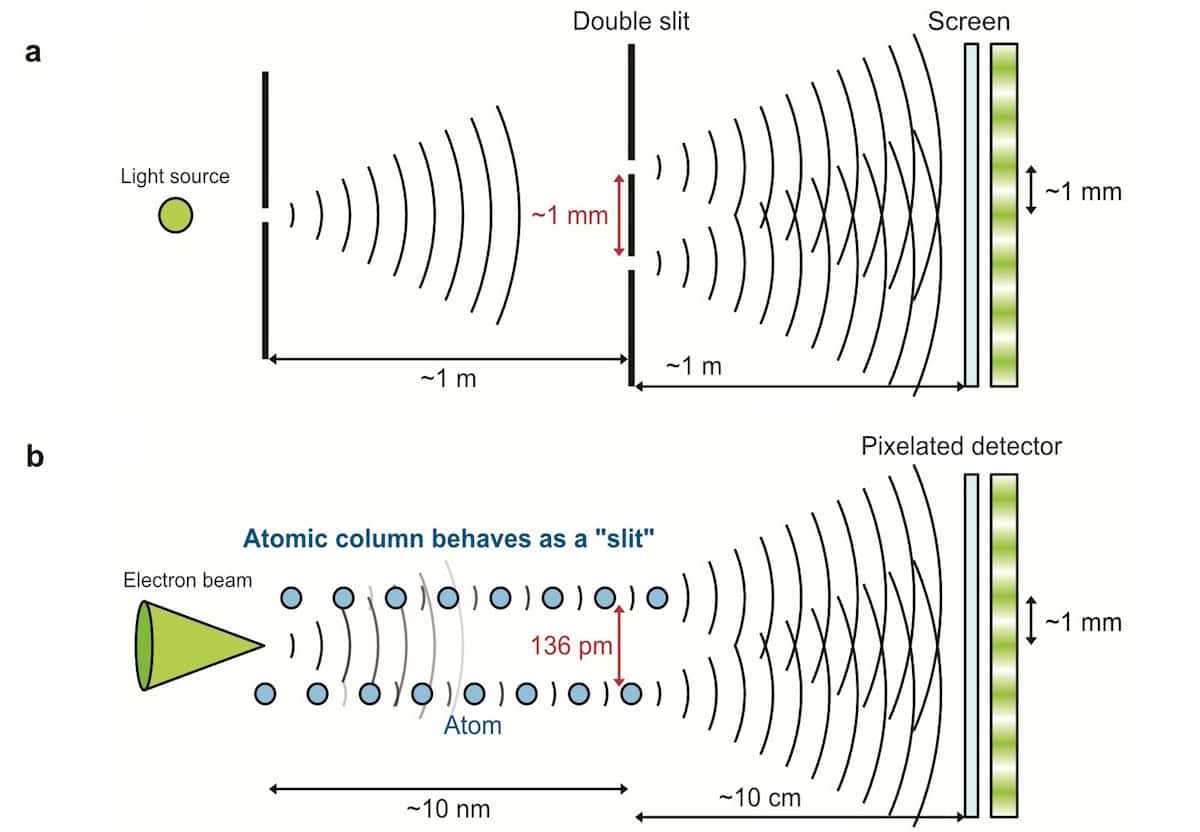
Shrinking Young’s experiment (a) The classical double-slit experiment using light (slit spacing ~1 mm, propagation distance ~1 m). (b) Schematic of atomic-scale interference in which a pair of neighbouring silicon atomic columns act as a “double slit” for a focused electron probe (spacing 136 pm; crystal thickness ~10 nm; distance to detector ~10 cm). (Courtesy: Koudai Tabata/University of Tokyo)

For the first time, physicists in Japan have carried out an atomic-scale version of the double-slit experiment. Using an ultraprecise electron beam channelled along two adjacent columns of atoms in a crystal of silicon, Naoya Shibata and colleagues at the University of Tokyo observed clear interference fringes in electrons scattered by the atoms: fringes that persisted even at high temperature, thanks to correlations in the atoms’ thermal vibrations.

The double-slit experiment is perhaps the most iconic demonstration in quantum mechanics: showing how a single particle’s wavefunction interferes with itself as it passes through two slits at once, with a tangible impact on where the particle is ultimately observed.

In practical research, this effect is now routinely harnessed in electron, neutron and atom interferometers. By observing the interference fringes that it creates, researchers can extract valuable information about both the quantum matter wave and whatever object is doing the diffracting.

Recently, physicists have attempted to push double-slit interferometry all the way down to the atomic scale, replacing conventional slits with crystal lattices. When a moving electron encounters an atom in a crystal, it scatters across a range of angles – producing an outgoing spherical wave that’s mathematically identical to the diffraction pattern from a classical slit.

Since atoms in a crystal sit at such well-defined separations, any neighbouring pair of them could, in principle, act as a double-slit interferometer. In reality, however, the many repeated unit cells in a crystal mean the resulting interference fringes are washed out, making it difficult to isolate the signal from a single atomic pair.

To address this challenge, Shibata’s team used the ultraprecise probe of a 4D scanning transmission electron microscope: an instrument designed to capture electron diffraction patterns with a pixellated detector. Fired into a pure silicon crystal at just the right orientation, the microscope’s precision let the researchers target two adjacent columns of aligned silicon atoms, separated by just 136 pm. As a result, the electron wave overlapped both columns, and no others.

“Our key idea was to use these two atomic columns as the two slits,” describes team member Takehito Seki. “By channelling the probe along both columns at once, we turned them into two coherent scattering sources – effectively making the crystal itself into an atomic-scale double-slit interferometer.”

At this scale, Shibata and Seki’s team created electron interference fringes some seven orders of magnitude smaller than in Thomas Young’s original double-slit experiment with light, first carried out in 1801.

Just as in a larger-scale experiment, these patterns encoded information about the crystal and the electron beam. But at this scale, the researchers could also detect the signature of individual phonon modes in the columns. Rather than destroying coherence as uncorrelated atomic motion would in a classical picture, these correlated vibrations between the two atomic columns kept them moving in sync, preserving the interference.

“In a which-path picture, relative motion of the two atomic columns makes the two electron pathways more distinguishable and reduces the interference, whereas correlated in-phase motion preserves coherence,” Shibata explains. As a result, distinct interference fringes remained visible across temperatures ranging from 300 to 900 K.

The team’s results already point to how an atomic-scale double-slit experiment could offer new ways to measure phonon correlations directly between single pairs of atoms. But as Shibata explains, the possible applications could stretch much further.

“It also opens a route to probing local lattice dynamics at the scale of individual atomic bonds, including at interfaces and defects, where local lattice dynamics can strongly influence thermal transport,” he says. “In the long run, such atomic-scale insight could help inform better thermal management strategies for future chip technologies.”

The study is published in Nature.

The post Researchers shrink double-slit experiment to atomic scale appeared first on Physics World.

Quantum voting system aims to keep ballots secret

25 August 2026 at 14:06

A voting system with a high level of security intrinsically guaranteed by quantum mechanics has been demonstrated by two independent teams – one led by Federico Centrone at the Barcelona Institute of Technology and the other led by Rob Thew at the University of Geneva.

Their systems employ a quantum protocol that was first proposed by Centrone and colleagues in 2022 and uses a system of entangled qubits to ensure every voter has complete anonymity.

A conventional voting system – paper or electronic – could be hacked or corrupted at the counting stage, resulting in a rigged outcome or lack of anonymity. In 2007, Anne Broadbent and Alain Tapp at the University of Montreal proposed a possible solution: an e-voting protocol in which an election is broken into as many rounds as there are voters.

Before anyone casts a vote, Broadbent and Tapp’s system secretly assigns each participant to be the “real” voter in exactly one designated round. In that round, the chosen voter picks a value (either 0 or 1) representing their actual choice.

Secret ballot

In every other round, the system automatically submits a pre-assigned value on the voter’s behalf, engineered so the round’s total has a fixed parity – either always odd or always even. The real voter’s free choice then either flips this total to the opposite parity or leaves it unchanged, and the final odd or even result is recorded. Once every round is complete, each voter will have had their real say – but from the outside, the identity of the real voter in any given round is completely hidden.

Although this scheme is watertight in principle, there is still no guarantee that the e-voting system itself can be fully trusted. In 2022, a team led by Centrone proposed how this loophole could be closed by harnessing entanglement between quantum bits, or qubits.

In the quantum protocol, each voter is assigned a single qubit, prepared as part of one joint entangled state spanning all voters together. When measured, each qubit is randomly either a 0 or 1, But, because of the type of entanglement between the qubits, the total number of 1s across all voters is guaranteed to have the expected parity. Since not even the e-voting system itself can know the outcome of any individual measurement in advance, the protocol removes the need to trust whoever is distributing the values.

Easily adapted

Thew’s team realised that it could create this protocol in the lab. “We had just finished another experiment concerning distributed polarization entanglement and realized we could ‘easily’ adapt our setup to produce the entangled states required for the voting protocol,” says Geneva’s Joey Marcellino.

Both teams used spontaneous parametric down-conversion (SPDC) to create the entangled qubits, which were photons. Here, a laser is fired into a nonlinear crystal, splitting single photons into pairs of lower-energy photons that are entangled in terms of their polarization states.

SPDC is then repeated using the newly-entangled photons, chaining pairs together until reaching the same number of entangled photons as there are voters – albeit a small number in these demonstrations. The result is one single, large entangled state. Each individual photon then passes through a 50/50 beam splitter, is coupled into an optical fibre, and sent to a detector, where its state is measured.

Fidelity and success

In their first experimental tests of the technique, Centrone and colleagues were able to create the entanglement required for the voting protocol at success rate of about 96%. Meanwhile, Thew’s team achieved an 87% success rate.

Commenting on his colleagues’ result, Marcellino says, “This suffices as a proof-of-principle for the protocol and our modified approach, although obviously we would want to improve these numbers significantly for real-world applications”.

For now, the result demonstrates that e-voting systems with quantum-guaranteed security are achievable, using existing technologies including single-photon sources, detectors, and entanglement generation schemes.

“Moreover, in the end the protocol is just a way to anonymously distribute a bit with perfect security,” Marcellino adds. “While this is obviously useful for voting, it could also work as an anonymous message board, or to enable anonymous distributed computation.”

The research is described in Physical Review Letters: Thew and colleagues; Centrone and colleagues.

The post Quantum voting system aims to keep ballots secret appeared first on Physics World.

❌