
❌

Normal view

Universities should judge quantum-computing investments by what students learn

9 September 2026 at 11:00

The best moment in my quantum-computing class often comes when something fails. A student writes a short quantum circuit – a program that tells qubits what operations to perform – then runs it on an ideal simulator and gets the clean answer theory predicts. Yet when the same circuit runs on real quantum hardware, unexpected results appear.

What once looked certain now becomes messy. The student may think the machine has failed but this is, in fact, when the real lesson begins. A run on a quantum processor is a physical experiment that produces a computational result.

Quantum education is expanding rapidly. A recent analysis of course catalogues from 1456 US institutions identified more than 8000 courses the titles or descriptions of w hich mentioned “quantum”. That growth is welcome, but it also carries a risk. Many students on such courses first meet quantum computing as a perfect cartoon: ideal qubits, flawless gates and clean probabilities.

Such idealization can be useful with computer simulators – ordinary software that imitates a quantum computer without real qubits. Simulators make excellent first classroom tools because they let students grasp three basic quantum ideas: superposition, where several outcomes remain possible before measurement; interference, where those possibilities strengthen or cancel one another; and entanglement, where two qubits become linked so measuring one helps predict the other.

Students should feel the shock of an imperfect result

Simulators also let students debug code and see the mathematics clearly. That matters in my classroom, because many students arrive with more confidence in Python than in quantum mechanics.

Useful as those abstractions are, they are not enough: students should learn not only the algorithm but also the machine that runs it. Real hardware exposes the gap between an ideal circuit and a physical device. A qubit is not a tiny coin showing heads and tails at once. It is a fragile physical system that gives different answers with varying probabilities when measured. Qubits lose information, gates make small mistakes, measurements misread states and nearby qubits can disturb one another.

The educational goal is to connect a quantum circuit to a real device – one in the lab, or one reached through the cloud. Yet that same circuit can behave differently after a recalibration, or after the device has “drifted”.

Students should see this as soon as possible. Teaching noise early shows students that quantum computing is an experimental science. If universities buy or rent quantum computers merely so that students can press “run”, they miss the best part of the lesson.

Intel inside

At Florida International University, this view shapes how I teach quantum computing. My students use Python, Qiskit, Jupyter notebooks, simulations and cloud quantum systems. My students have cloud access to an IonQ quantum computer that uses trapped-ion qubits, charged atoms confined by electromagnetic fields and manipulated with lasers. For now, our teaching uses cloud access to a quantum processing unit (QPU), raising a useful question: what does that access teach well, and what does it hide?

What cloud access teaches best is comparison. Students can run the same circuit on a simulator and a real QPU, then ask why the histograms – bar charts of measured output strings – differ. On platforms that expose device details, students can compare connectivity maps and calibration data such as coherence times, readout error rates and gate error rates.

Cloud systems, however, can still hide too much. A polished interface can make a QPU look like a web service rather than a delicate machine. Students may not see the lasers that control ions or atoms, the cryostat that cools a superconducting chip, the microwave electronics that drive gates, or the human work behind calibration, where engineers tune the machine to keep it reliable. Cloud access teaches students to submit and analyse circuits. Access to hardware, control settings and error data helps them understand how the processor operates.

On-campus systems matter when students can inspect what sits behind the screen. In 2024 Rensselaer Polytechnic Institute in New York became the first university campus to host an IBM Quantum System One, initially powered by a 127-qubit Eagle processor. It is a striking example of a university putting a major machine within students’ reach.

Yet the educational value of any system depends less on qubit count than on what students can inspect, control and measure. A modest, accessible teaching platform – such as a photonic testbed that uses light to process information, a cryogenic set-up for testing devices at extremely low temperatures or a control-electronics lab that shows how signals drive qubits – can often teach more than a larger system that students cannot inspect.

Universities then should judge quantum-computing investments by learning outcomes, not headlines. Can students compare simulation and hardware? Can they test how a quantum computer changes over time by running the same circuit in the morning, afternoon and again the next day? Can they keep a notebook of circuits that worked in simulation but failed on hardware? Can they explain why one qubit pair works better than another? Can they connect algorithms to measurement, control, optics, microwaves, cryogenics and error reduction?

The experience has an emotional dimension too: a beautiful circuit on the whiteboard can become a difficult experiment on the chip. Students need to ask, “What algorithm did I write, and what physical experiment did the machine actually run?”

Students should feel the shock of an imperfect result, the frustration of a circuit that should have worked and the satisfaction of tracking down the physical cause. That experience turns quantum computing from a diagram into a craft.

A university quantum computer should be a teaching instrument that reveals the machine behind the calculation. Its purpose is to train people who can question claims, understand the hardware, and build the technology with sound judgement. The field needs graduates who understand the algorithm, the machine and the gap between them.

The post Universities should judge quantum-computing investments by what students learn appeared first on Physics World.
Quantum voting system aims to keep ballots secret

25 August 2026 at 14:06

A voting system with a high level of security intrinsically guaranteed by quantum mechanics has been demonstrated by two independent teams – one led by Federico Centrone at the Barcelona Institute of Technology and the other led by Rob Thew at the University of Geneva.

Their systems employ a quantum protocol that was first proposed by Centrone and colleagues in 2022 and uses a system of entangled qubits to ensure every voter has complete anonymity.

A conventional voting system – paper or electronic – could be hacked or corrupted at the counting stage, resulting in a rigged outcome or lack of anonymity. In 2007, Anne Broadbent and Alain Tapp at the University of Montreal proposed a possible solution: an e-voting protocol in which an election is broken into as many rounds as there are voters.

Before anyone casts a vote, Broadbent and Tapp’s system secretly assigns each participant to be the “real” voter in exactly one designated round. In that round, the chosen voter picks a value (either 0 or 1) representing their actual choice.

Secret ballot

In every other round, the system automatically submits a pre-assigned value on the voter’s behalf, engineered so the round’s total has a fixed parity – either always odd or always even. The real voter’s free choice then either flips this total to the opposite parity or leaves it unchanged, and the final odd or even result is recorded. Once every round is complete, each voter will have had their real say – but from the outside, the identity of the real voter in any given round is completely hidden.

Although this scheme is watertight in principle, there is still no guarantee that the e-voting system itself can be fully trusted. In 2022, a team led by Centrone proposed how this loophole could be closed by harnessing entanglement between quantum bits, or qubits.

In the quantum protocol, each voter is assigned a single qubit, prepared as part of one joint entangled state spanning all voters together. When measured, each qubit is randomly either a 0 or 1, But, because of the type of entanglement between the qubits, the total number of 1s across all voters is guaranteed to have the expected parity. Since not even the e-voting system itself can know the outcome of any individual measurement in advance, the protocol removes the need to trust whoever is distributing the values.

Easily adapted

Thew’s team realised that it could create this protocol in the lab. “We had just finished another experiment concerning distributed polarization entanglement and realized we could ‘easily’ adapt our setup to produce the entangled states required for the voting protocol,” says Geneva’s Joey Marcellino.

Both teams used spontaneous parametric down-conversion (SPDC) to create the entangled qubits, which were photons. Here, a laser is fired into a nonlinear crystal, splitting single photons into pairs of lower-energy photons that are entangled in terms of their polarization states.

SPDC is then repeated using the newly-entangled photons, chaining pairs together until reaching the same number of entangled photons as there are voters – albeit a small number in these demonstrations. The result is one single, large entangled state. Each individual photon then passes through a 50/50 beam splitter, is coupled into an optical fibre, and sent to a detector, where its state is measured.

Fidelity and success

In their first experimental tests of the technique, Centrone and colleagues were able to create the entanglement required for the voting protocol at success rate of about 96%. Meanwhile, Thew’s team achieved an 87% success rate.

Commenting on his colleagues’ result, Marcellino says, “This suffices as a proof-of-principle for the protocol and our modified approach, although obviously we would want to improve these numbers significantly for real-world applications”.

For now, the result demonstrates that e-voting systems with quantum-guaranteed security are achievable, using existing technologies including single-photon sources, detectors, and entanglement generation schemes.

“Moreover, in the end the protocol is just a way to anonymously distribute a bit with perfect security,” Marcellino adds. “While this is obviously useful for voting, it could also work as an anonymous message board, or to enable anonymous distributed computation.”

The research is described in Physical Review Letters: Thew and colleagues; Centrone and colleagues.

The post Quantum voting system aims to keep ballots secret appeared first on Physics World.

Seven writers, four physicists, one room, lots of plushies

19 August 2026 at 11:00

How many times have you wanted to throttle a journalist? Do you ever get incensed about articles, podcasts or videos that simplify, dumb down or belittle your research? Don’t you ever want to teach a science writer the basics?

Earlier this summer the US quantum physicist Christopher Fuchs got the chance. Thanks to some funding at the end of a grant cycle, Fuchs arranged a face-off between science journalists and writers, and a philosopher (me) at Royal Holloway, University of London. But the meeting wasn’t all about Fuchs having a big fat moan; he also gave the journalists the chance to push back.

Fuchs, who is from the University of Massachusetts, Boston, is the principal expositor of QBism, originally an acronym for “Quantum Bayesianism”, a research programme devoted to trying to figure out what the world must be like if quantum formalism is correct. But even top-flight writers, Fuchs thinks, get it wrong. And so emerged his idea for the workshop, called “Communicating QBism”.

Attendees at the workshop, besides Fuchs himself, included his collaborator Rüdiger Schack from Royal Holloway – the gracious host of the meeting. There was also John DeBrota, who’s a postdoc at Ludwig Maximilian University, Munich, and Matthew Liefer, associate professor at the Institute for Quantum Studies at Chapman University, California.

The science writers were all experienced. One was Philip Ball, the author of some 30 books who has a PhD in physics and contributes regularly to Physics World. Jo Marchant, the sole female writer to attend, has a PhD in genetics and medical microbiology and is a New York Times bestselling author who recently wrote for New Scientist on QBism.

The four other writers were Robert Henderson, who has a PhD in quantum field theory; George Musser, who has a PhD in planetary science and is a contributing editor at Scientific American; Ulf von Rauchhaupt, a science editor at the Frankfurter Allgemeine Zeitung who has a PhD in extraterrestrial physics; and Zack Savitsky, a physics correspondent for Science.

I was invited at the last minute as a philosopher and writer who might find value in the event. I did.

Pugnacious and self-deprecating

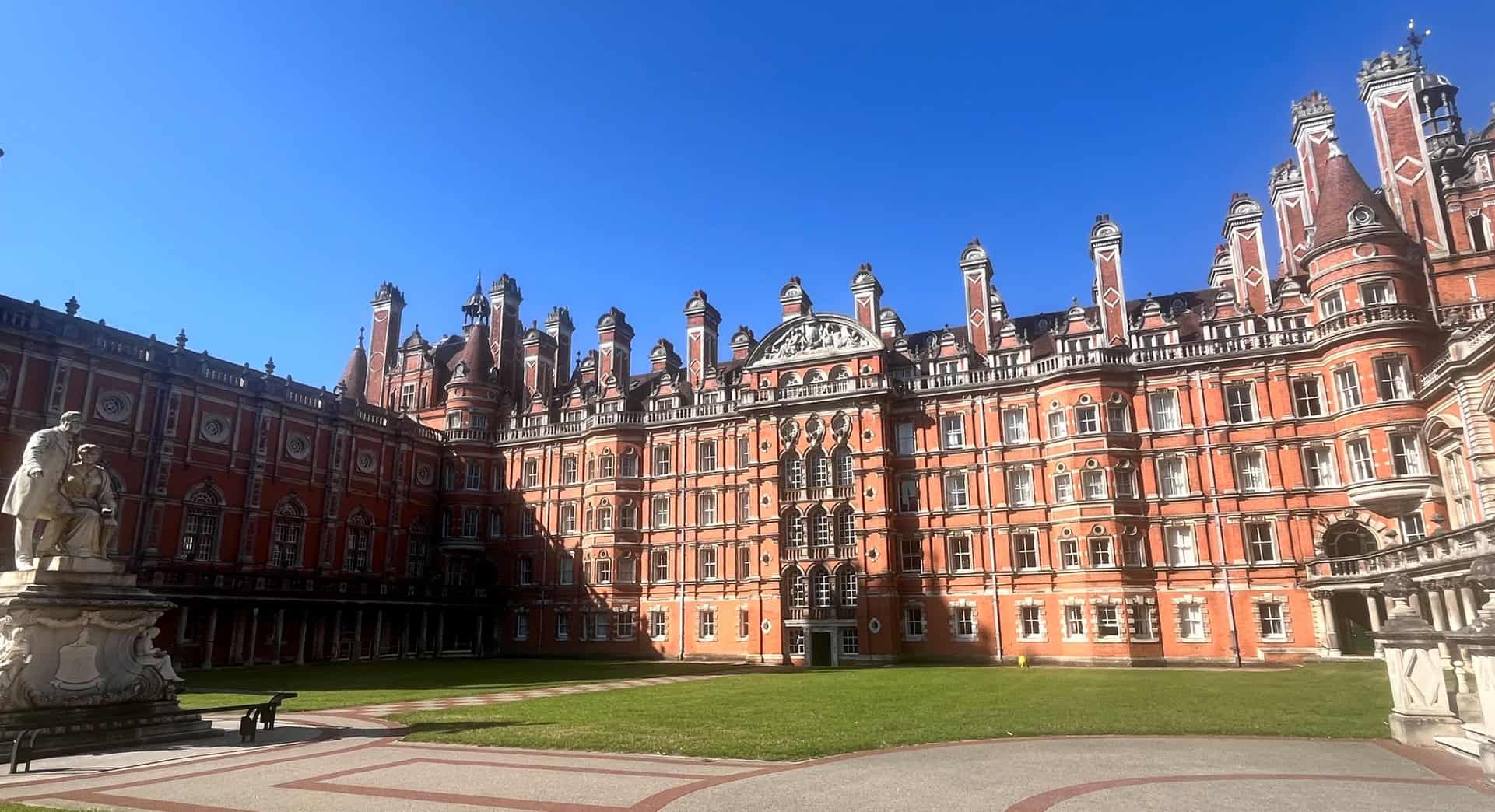
Royal Holloway’s wooded campus on the western outskirts of London is dominated by the Founder’s Building, a beautifully ornate late-19th-century red-brick castle-like structure modelled on a French chateau with a central courtyard. But that’s only where we ate. Fuchs’s face-off, which took place on June 18–19, was holed in a modest modern science building down the hill.

Fuchs, whom I’ve met and written about several times, including for Physics World and a philosophy journal, is charmingly pugnacious. He approaches talks and conversations with unwavering zest and easily out-talks critics. He is relentless in pointing out even years-old mistakes to journalists and writers [editor’s note: I can confirm this]. Yet Fuchs can also be endearingly self-deprecating.

If you didn’t know Fuchs, you might be forgiven for thinking that he had an inquisition in mind. “I explain the ideas until I’m blue in the face,” the invitation ran, but you journalists are “pretty deficit in getting QBism right”. He continued, “What is it that makes QBism so damned hard to understand for journalists and the lay public?”

Fuchs then described himself as “communication impaired” – which was disingenuous. Based on Shack’s estimate, he’s sent about 150,000 QBism-related e-mails, he’s got “3 Million Miler” status from American Airlines thanks to his trips to give talks, and he was a lead speaker at the Helgoland conference on the centenary of quantum mechanics last year.

Some invitees were cautious, even sceptical. “QBism isn’t just another quantum physics interpretation”, Marchant replied to Fuchs’s invitation. “You’re challenging ideas of what physics is even about and requiring a radically different conception of what nature is”. Ball, meanwhile, perceptively reminded Fuchs that QBism is so novel that “the misrepresentations don’t just come from journalists”.

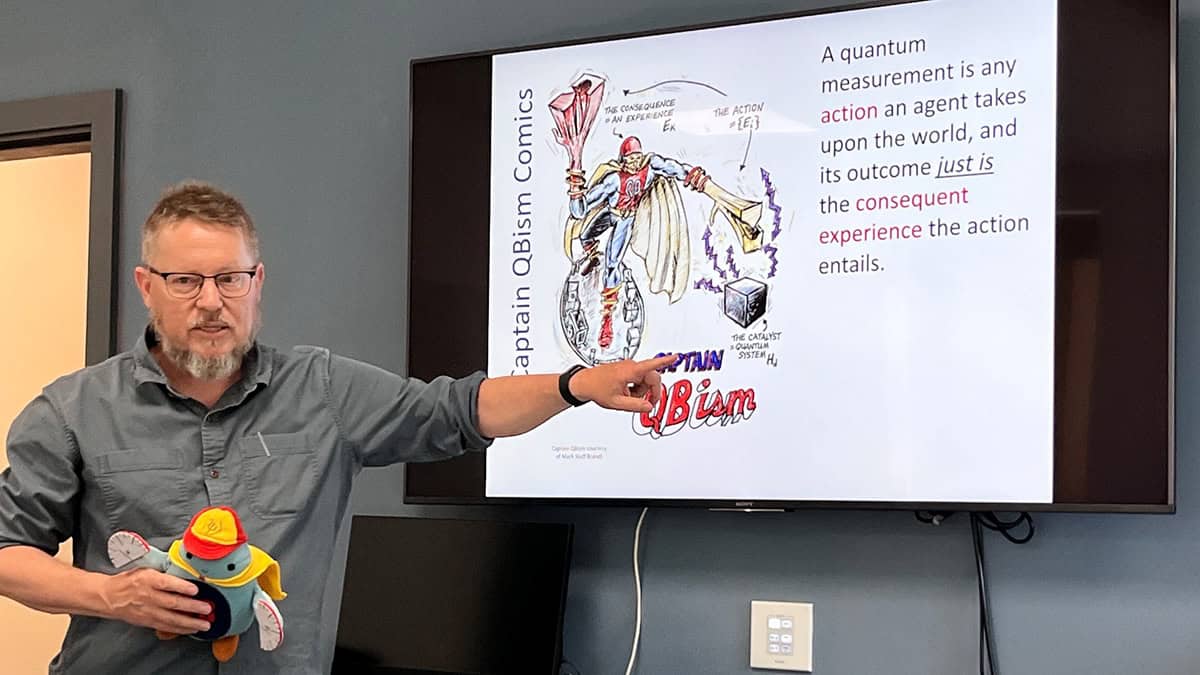
As for Musser, he warned Fuchs that the encounter may not be pleasant. “We will need to have free, open and frank discussions”, he responded, that may be “infuriating to you”. He counselled Fuchs to bring “plenty of plushy toys” for participants to safely throw at each other.

Fuchs’s invitation, however, also expressed warm and genuine respect for the coterie of science writers, who all agreed to come. Still, Fuchs brought a box of plushies just in case.

Speaking about science

On the meeting’s first day, the writers listened and learned. Schack opened the workshop by going over QBism’s vocabulary. “Probability” is not a property of things but refers to the expectations that an experimentalist has about outcomes of an action they are about to take. “Measurement” is that outcome.

“Quantum formalism”, meanwhile, is a tool that any experimentalist can use for making the best estimate they can about which outcome they will get. “Quantum states” are not properties of the world but compendia of probabilities to inform the agent about which actions they ought to take to achieve their goals.

Royal Holloway, London
Scene of the action Royal Holloway, University of London, was the venue for the stand-off between scientists and science journalists. (Courtesy: Robert P Crease)

After Schack, Fuchs gave a talk showing that QBism is neither a philosophical add-on to quantum theory nor something motivated by an attempt to resolve issues to do with entanglement, Bell inequality violations, and so on. Rather, QBism is the only satisfactory coherent account of what the world must be like if the quantum formalism is correct.

Fuchs quashed the idea that QBism is solipsistic; quantum formalisms, he pointed out, have been hammered out for a century and can be picked up by anyone as the best guide to their laboratory experience. He vented ire over stories that use the word “observe” and visual images to characterize what experimentalists do as if they were flies on the wall rather than actors in measurement events.

When Fuchs complained about a clause in an article by Savitsky which suggested such an interpretation, the writers cried “Foul!”. They accused Fuchs of “niggling” about a few words in a lengthy 4000-word article. When Fuchs replied, “I want to niggle over words!” he dodged a plushie.

Learning about writing

On the second day of the meeting, it was the scientists’ turn to listen and learn. Henderson talked about his struggle to “think like a QBist”, explaining how, during the Covid-19 pandemic, he joined Fuchs’s weekly Zoom sessions known as “QBukis”. These made him feel like he had come across “a more advanced civilization of aliens maybe, to whom premises I’d never thought to question were deemed antiquated and naïve”.

Henderson had an epiphany one day when he saw a bird hopping across his snow-covered lawn. The bird, he realized, was not a thing-in-itself but “the designation of a bundle of expectations” that he was bringing to bear to recognize it. What’s most challenging in learning to think like a QBist, Henderson concluded, is that QBism is “playing a different game than the rest of physics, or even science”.

Marchant followed with a talk entitled “Why QBism keeps getting misheard”, in which she showed a picture of a tennis player about to smash a rocketing tennis ball. What was happening, she said, wasn’t just body movements and ball trajectories – but a process of unfolding and continually updated predictions of actions.

QBism sees experimentalists like that tennis player, Marchant said, shepherding new events into the world, but it’s unintuitive to think that way. “QBism isn’t just another quantum physics interpretation,” Marchant said; “you’re challenging ideas of what physics is even about and requiring a radically different conception of what nature is and how we are related to it”. This, she concluded “is always going to be difficult”.

Ball pointed out that journalists are forced to keep in mind “mental attractors” that entice the public, journalists and even scientists to think in classical rather than quantum terms.

Between talks, the writers cited other constraints, such as time, money, audience and the space allotted by editors, all of which shape and dictate their output. Furthermore, writers are sometimes forced to use words whose meanings vary from their technical use.

At one point Fuchs showed a slide of Marchant’s New Scientist article and complained about the word “perspectives” in the standfirst. But Marchant and others objected that Fuchs’s “Gotcha!” play was again committing a foul; writers must lead readers gently into difficult stories with prose that sometimes must violate what researchers mean. “We have to write so people keep listening,” Marchant pointed out.

Impressed, Fuchs had to admit that he does something similar in his lectures, not leading with his most radical ideas but holding off until later.

One scientist then asked why writers don’t routinely run stories by sources before publication. Even if you accurately regurgitate the sources’ words, the writers replied, they often insist on changes, demand that their editors alter or retract the story, heap abuse on you, or even threaten to sue, causing the magazine to drop your article.

Christopher Fuchs at Royal Holloway
Tread carefully QBism is an alternative interpretation of quantum mechanics, but woe betide anyone whose explanation of it fails to live up to Christopher Fuchs’s standards. (Courtesy: Robert P Crease)

When a writer asked why scientists should even care about representations of their work in the media, the answers were difficult to synthesize. They ranged from the noble wish to nurture a scientifically literate public to the self-interested hope that good coverage might influence public perceptions and thus lead to more money from funding agencies.

But what’s hardest writing about QBism, explained the writers, has to do with Henderson’s “civilization of aliens” and Marchant’s “keep ‘em listening” points. Readers instinctively think, contra QBism, that the world has permanent residents and chiselled-in laws. The tennis player’s dive for the ball can always be reconstructed afterwards from a god’s-eye perspective in terms of classical physics, and it’s second-nature for both the public and even scientists to assume that the end of physics is to make such reconstructions.

The critical point

Years ago I wrote a column “The press is a foreign country” whose message was that communicating science is like engaging with another culture. Science and the media, I wrote, are separate institutions with different values, traditions and methods and reasons for seeking and justifying knowledge. The cross-cultural interaction, though, cannot always be made trouble-free, with all conflicts reconcilable by facilitators or relationship counsellors.

Given the qualifications of the participants at “Communicating QBism” – all but Zack had PhDs – one might have thought that the cross-cultural interaction at the workshop would be relaxed. It was, for the most part. But good scientific communication, it emerged, is not always a matter of clear explanations, demonstrations of relevance, dazzling imagery, or scientifically literate journalists.

Positive interactions may require constantly negotiating trade-offs between accuracy and comprehensibility, as well as setting up flinty encounters in which both scientists and writers actively hunt down and expose their own assumptions. These encounters must risk conflict and discomfort on both sides. Good science communication, in short, can use some genial pugilism, and Fuchs’s workshop was an excellent example.

The post Seven writers, four physicists, one room, lots of plushies appeared first on Physics World.

Crystal symmetry controls hydrogen’s quantum tunnelling

13 August 2026 at 09:00

The quantum tunnelling of hydrogen atoms plays a central role in many physical, chemical and biological process, but a practical means of controlling it has proved elusive. Researchers from the University of Tokyo, Japan have now demonstrated that the way hydrogen permeates through a material depends on the degree of symmetry in the material’s crystal structure. By controlling this symmetry, scientists could therefore gain control over hydrogen’s ability to tunnel, potentially leading to safer and more efficient media for storing this industrially important clean-burning fuel.

“We found that hydrogen undergoes pronounced quantum tunnelling in a highly symmetric crystal environment, whereas the tunnelling is strongly suppressed when the symmetry is lowered,” explains Katsuyuki Fukutani, who led the research together with colleagues Takahiro Ozawa and Sudhansu Sekhar Das. “This is particularly exciting because it identifies crystal symmetry as a fundamental principle for controlling the quantum behaviour of hydrogen in materials, opening new possibilities for tailoring hydrogen transport.”

A model hydrogen-storage material

The researchers, who work at Tokyo’s Institute of Industrial Science, obtained their results by studying how hydrogen atoms move through a model hydrogen-storage material, vanadium, at low temperatures. To do this, they combined two complementary techniques. The first is called nuclear reaction analysis and it measures the hydrogen’s depth distribution directly with high resolution. The second involves measuring electrical resistance, which sensitively monitors how the hydrogen redistributes itself over time.

These measurements revealed that at temperatures of around 70 K, hydrogen atoms begin to migrate through vanadium’s crystal lattice, hopping between its interstitial spaces. At low hydrogen concentrations, this hopping occurs within a highly symmetric structure known as α-phase vanadium, and the hydrogen atoms easily tunnel between neighbouring lattice sites. At higher hydrogen concentrations, however, vanadium’s crystal lattice distorts, forming a β-phase. Under these conditions, the hydrogen atoms must overcome an energy barrier (of 148 meV in this case) before they can tunnel to neighbouring sites.

Quantum tunnelling or classical thermal activation?

Based on changes to vanadium’s electrical resistance, the researchers were able to calculate the diffusion coefficient of hydrogen over a wide range of temperatures, including those for which quantum tunnelling is important. They then interpreted these results using quantum-mechanical calculations of hydrogen motion, which revealed that the crystal symmetry determines whether hydrogen moves by quantum tunnelling or by classical thermal activation. They found that in the α-phase, hydrogen’s ground states are delocalized over tetrahedral sites thanks to tunnelling. In the β-phase, in contrast, the uniaxial strain produced by the distortion of the crystal lattice leads the quantum states of the hydrogen atoms to localize around certain (Oz) sites in the material.

Hydrogen is the lightest element, so Fukutani says it’s not surprising that it exhibits pronounced quantum behaviour. However, while quantum tunnelling had long been assumed to play an important role in hydrogen diffusion, it was difficult to obtain direct experimental evidence for it because we cannot easily observe hydrogen inside materials using conventional techniques. “We wanted to clarify how hydrogen actually behaves in the quantum regime and identify the factors that control its tunnelling,” he explains.

New possibilities for controlling hydrogen permeation and storage

“Our findings suggest that hydrogen transport can be controlled by tuning quantum tunnelling through crystal symmetry — for example by applying external strain,” he adds. “This capability opens up new possibilities for controlling hydrogen permeation, storage and even catalytic reactions.”

More broadly, Fukutani says the team’s work establishes crystal symmetry as a new design principle for tailoring quantum hydrogen behaviour in functional materials. The Tokyo researchers now plan to extend their work to a wider range of hydrogen storage media, including metal alloys and oxide materials. “Ultimately, we hope to establish a universal framework describing how local atomic structure and crystal symmetry govern the quantum behaviour of hydrogen,” Fukutani tells Physics World.

They report their present work in Nature Communications.

The post Crystal symmetry controls hydrogen’s quantum tunnelling appeared first on Physics World.

❌