The fall of 1618 was a standout when it came to notable comets, boasting three visible to the naked eye. In late August, C/1618 Q1 appeared, first spotted in the skies over Hungary. Johannes Kepler observed the comet throughout the month of September, spotting it from Linz, Austria, through a small telescope on Sept. 6.Continue reading "Sept. 6, 1618: The first comet seen through a telescope"
Astronomers have witnessed a small, icy body that orbits the sun out beyond Jupiter transforming into a comet, providing a missing link between comets and inert bodies called centaurs.
The object in question is called 450P/LONEOS and is named after the Lowell Observatory survey that found it back in 2004. It is a centaur, which is a breed of inactive body that orbits the sun between Jupiter and Neptune. These objects are thought to have wandered in from the Kuiper Belt beyond Pluto, their paths perhaps perturbed by distant gravitational interactions with the gas giant planets, or even a nudge from a passing star.
Because a given centaur's orbit crosses the path of at least one of Jupiter, Saturn, Uranus and Neptune, a centaur's orbit is unstable over millions of years. Consequently, the giant planets can push them even closer to the sun or kick them out of the solar system entirely.
It has long been suspected that those pushed closer to the sun turn into what are called Jupiter-family comets, which are comets with orbital periods around the sun of less than 20 years and which are influenced by the gravity of Jupiter.
To date, no one has ever seen a centaur turn into a Jupiter-family comet. The orbital period of 450P is currently 22 years, so it isn't a Jupiter-family comet yet, but astronomers led by planetary scientist Charles Schambeau of the University of Central Florida have been observing the onset of comet-like behavior on the centaur. In particular, using the Gemini North telescope in Hawaii they have seen the formation of a cloud of gas and dust called a coma around the solid nucleus of 450P, with this coma brightening in the period between 2019 and 2024, when 450P arrived at perihelion (the closest point to the sun in its orbit).
Should 450P keep up this comet-like behavior and receive one more gravitational nudge from one of the giant planets, then it could finally become a Jupiter-family comet.
"Studying objects like 450P helps us connect different stages of small-body evolution," said Schambeau in a statement. "Centaurs are likely related to trans-Neptunian objects, and some will eventually become short-period comets. By studying their activity, surface properties and volatile [substances with low boiling or sublimation points such as water and carbon dioxide] composition, we can learn how comet nuclei change as they move inward through the solar system, how long they preserve primitive ices and what physical processes turn an otherwise quiet icy body into an active comet."
Using the James Webb Space Telescope (JWST), Schambeau's team analyzed 450P's coma, finding carbon dioxide gas and suggestions of particles of crystalline ice and dust.
Its transition from a centaur into a comet is thought to have resulted from 450P having a date with destiny. By tracking back its orbit to before its 2004 discovery, astronomers found that 450P had come within 2.9 million miles (4.6 million kilometers) of Saturn in 1992. That's pretty close on solar-system scales. The object's gravitational interaction with the ringed planet caused 450P's orbit to significantly shorten so that its perihelion is now at 5.4 astronomical units 506 million miles, or 813 million km), which is only slightly beyond the orbit of Jupiter at 5.2 astronomical units.
Its last perihelion was in August 2024 and, by getting closer to the sun, 450P received substantially more heat than it has in the past.
"That increased solar heating can warm the surface and the subsurface layers of the nucleus," said Schambeau. "As those layers heat up, volatile ices or trapped gases can be released, which can drag dust away from the surface and produce a coma."
The significance of the JWST's discovery of carbon dioxide gas in 450P's burgeoning coma, coupled with the complete absence of water vapor, tells us that it is carbon-dioxide driving the activity on 450P.
This NASA animation depicts a comet as it enters the inner solar system, with light from the sun warming the comet to create its coma and tail. (Image credit: NASA/JPL-Caltech)
"At 450P's distance from the sun, the nucleus is too cold for normal water-ice sublimation to be the main activity source, so detecting carbon dioxide gives us an important clue about what is powering the coma," said Schambeau.
While there is no water vapor, JWST has picked up hints of solid particles of crystalline water-ice.
"The possible crystalline water-ice is also interesting because it suggests that some of the ice in the coma has experienced heating or physical processing, rather than remaining completely unchanged since formation," said Schambeau.
On pristine cometary bodies and Kuiper Belt objects, ice is usually in an amorphous state, meaning the frozen water molecules are not structured or arranged in any particular way, giving the ice a porous composition that allows it to trap pockets of gas. As 450P nears the sun, the extra warmth that it receives causes the amorphous ice to morph into crystalline ice that has a more regular structure. During the transformation the gases escape, dragging dust and ice particles off the surface with them. Therefore, the presence of crystalline ice is telling us that 450P is in the process of being thermally altered from its pristine state that quite possibly harkens back to the birth of the solar system 4.5 billion years ago.
Only a very small fraction of Centaurs have ever shown signs of activity, which makes 450P's recent perihelion a very important one to have studied because it is a rare example of an early stage in a centaur's transition into a comet.
"Centaurs are scientifically important because they are thought to be transitional objects that originated further out in the solar system and are slowly evolving toward becoming Jupiter-family comets," said Schambeau. "In that sense, they give us a way to study relatively primitive material from the outer solar system while it is beginning to respond to stronger solar heating."
The findings have been accepted for future publication in the Planetary Science Journal and is currently available on the arXiv pre-print archive.
Astronomers have been measuring comets for centuries. But in December of last year, researchers collected a unique set of comet observations: they recorded some of the highest-quality data of one of the weirdest known comets while it was far from the Sun.
Simultaneous Spectra and Images
A few months after the famous interstellar comet 3I/ATLAS rounded the Sun and began its journey back into the space between the stars, a group of astronomers led by Nathan Roth (NASA Goddard Space Flight Center) aimed JWST in the direction of its retreat to watch it fade away. Using a special observing mode that leveraged the Integral Field Unit (IFU) in JWST’s Near Infrared Spectrometer, these observations didn’t result in just a single image of the comet, but a full stack of images, each corresponding to a different wavelength of light.
Using the IFU allowed the observers to combine the best of both regular imaging, which reveals spatial structure, and standard spectroscopy, which reveals wavelength dependencies. As a result, they could make spatially resolved maps of how the emission from the comet’s fuzzy atmosphere of gas and dust, or coma, changed with distance from the comet’s icy nucleus and angle to the Sun. Since different molecules radiate at different wavelengths, these maps in turn reveal the composition and geometry of 3I/ATLAS’s coma.
Mapping the Coma
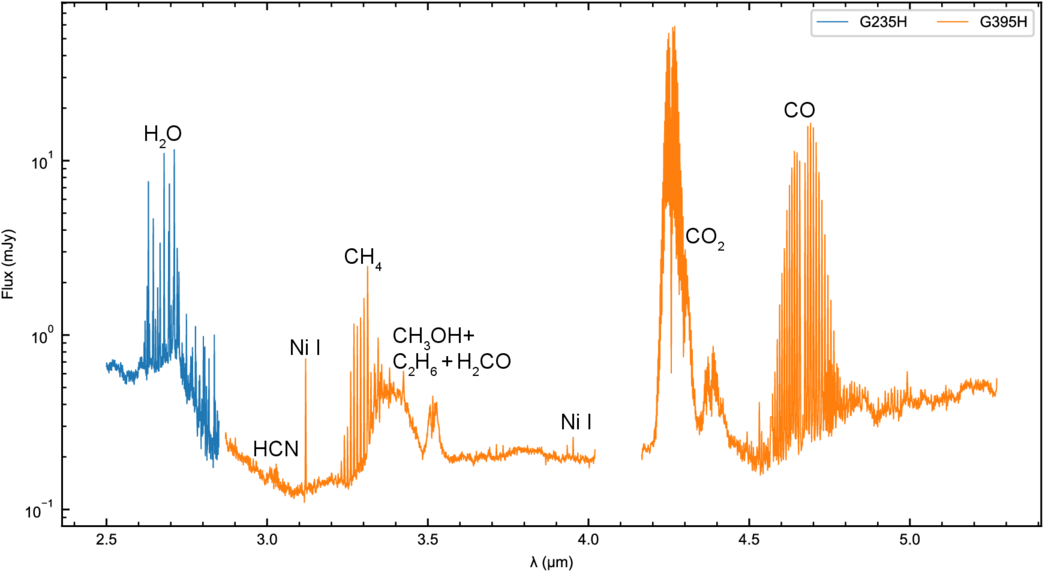
The spectrum of the coma of 3I/ATLAS. Note that this is a real spectrum, not a simulation. The contributions of various molecules are labeled alongside their most prominent emission lines. Click to enlarge. [Roth et al. 2026]
These maps, and the spectrum created by summing all of the spatial pixels together, reveal the comet’s coma in gorgeous detail, including hundreds of individual spectral lines that can be attributed to specific molecules. These maps revealed two unique features.
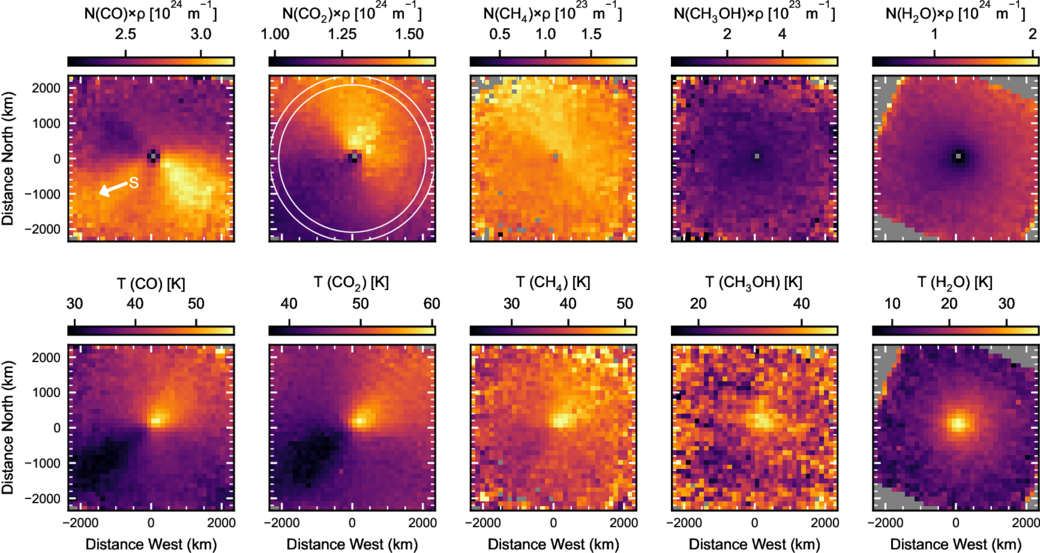
First, in contrast with normal solar system comets where water is the most abundant molecule, water was actually a secondary player here: there was significantly more carbon monoxide, or CO, than water in 3I/ATLAS’s coma. The researchers note that this might not be representative of the true distribution of the two species, but instead be the result of the timing of these observations. When observing a standard solar system comet, astronomers usually examine their targets when the object in question is within 2 au of the Sun. At these close distances, solar radiation is strong enough that water ice dominates the outgassing and activity in a coma.
However, these IFU measurements were taken when 3I/ATLAS was about 2.4 au from the Sun, or right in the transition region where water doesn’t sublimate as easily as CO or carbon dioxide (CO2). It’s likely that as the comet approaches the so-called “ice line” where water will naturally freeze out, CO will only increase its domination of the coma.
Top row: Maps of the distribution of various molecules in the coma. The white arrow shows the direction toward the Sun. Bottom row: The spatial distribution of the temperature of each species. Click to enlarge. [Roth et al. 2026]
Every Molecule for Itself
Second, each molecule seemed to be outgassing in its own unique direction from the coma. CO is leaving the nucleus in two different jets, one aimed directly back at the Sun and one perpendicular to it; CO2 and methane (CH4) are both leaking away in the anti-Sun direction; and water and methanol (CH3OH) are sublimating in nearly spherically symmetric shells. The authors speculate that these geometries may be caused by different “active sites” on the comet, and that had they observed the comet for one full rotational period, they might have seen these jets pointing in different directions.
Although 3I/ATLAS is now too far and faint for observations like these, this study reveals just how much we can learn in the brief time interstellar visitors spend in our solar system. When the fourth interstellar comet inevitably wanders through the inner solar system, astronomers will doubtless be ready to use this observing mode again.
Citation
“Coma Physics of an Interstellar Object: JWST Spatial-Spectral Mapping of 3I/ATLAS,” Nathan X. Roth et al 2026 ApJL1005 L5. doi:10.3847/2041-8213/ae7443

 Login