A slew of recent studies indicate that AI isn’t dramatically displacing workers. At the same time, there were no indicators that the fast-moving technology is creating a lot of jobs, even as AI skills remain in high demand.
Stanford University researchers in an August study found that any AI-related job declines were concentrated among young workers aged 22–25. But for older and more experienced workers that wasn’t the case.
“Claims of economy-wide AI-driven job losses are not visible in payroll data through June 2026,” the researchers said, citing ADP payroll information. Stanford partnered with ADP to conduct the research.
The decline for young workers is more often related to the automation of some work tasks by AI, as opposed to its use to complement work. In contrast, AI is more often used by experienced workers to augment what they do.
According to the Stanford report, workers between 22 and 25 and employed in jobs highly exposed to disruption by AI are falling behind their older counterparts. Their employment levels in June were about 19% below the same age group in less-exposed occupations. That’s compared to where they would be if both groups had kept pace with each other.
“Experienced workers show no comparable gap,” the researchers said, adding that “this is consistent with recent reports of a worsening job market for entry-level workers.”
Employment of younger workers in AI-exposed jobs fell about 11% from late 2022, while the same age group in less-exposed jobs actually grew about 10%. “For older age groups, we find much less marked differences in employment growth across AI exposure quintiles,” the researchers said.
Stanford, which created a lab last year to study AI’s impact amid heightened fears of the technology’s economic effects, said its numbers were based on available indicators.
AI was cited for 116,175 job cuts in 2026, but that number is declining. The technology was blamed for 3,462 cuts in August, according to data from Challenger, Gray and Christmas.
It’s the “lowest monthly total since December 2025 when 142 cuts were attributed to AI,” the company wrote in a blog entry. The research firm also noted aggressive hiring plans for companies in 2027.
AI is adding value to companies in different ways, and humans are an important part of that process, said Michael Chui, a senior fellow at QuantumBlack, AI at McKinsey. “The night shift is real now,” he said. “People are sending off their agents to write code and checking in the morning.”
MIT late last year established an AI labor index to determine how agents are affecting the workforce. The school’s Project Iceberg looks at how the coordination and interaction with agentic AI changes how work is done.
Despite the disruptions, demand for AI-related talent continues to rise, tech industry consortium CompTIA said last week. About 320,000 job listings in August required AI-related capabilities, a 4.5% increase from July.
AI-related hiring is outperforming the broader tech market, with demand for AI skills up 96% year-over-year, said Kye Mitchell, head of Experis North America, which is part of ManpowerGroup.
“We’re seeing real growth…in marketing management and project management roles, suggesting employers are looking beyond the people building AI to the people applying it,” Mitchell said.
More broadly, the US economy added 162,000 jobs in August, according to US Department of Labor figures released last week. CompTIA noted that tech employment across all sectors rose by 86,000 workers in August.
But within the tech sector, 14,700 positions were cut, CompTIA said.
My first programming language was BASIC. My seventh-grade math teacher, Mr. Schulte, taught BASIC to us on Fridays. He gave us programming assignments for homework during the week. Some of us loved it so much we stayed after school to play games and create extra programs, including our own crude, text-based adventure games. I remember hearing a story about a crazy new language called Pascal that didn’t have line numbers. How in the world would that work?
Years later I became a Pascal programmer — an ardent one. So ardent, in fact, that I would argue for hours with Visual Basic developers on CompuServe, AOL, and Usenet, telling them how Turbo Pascal, and then Delphi, was clearly a superior language. I was completely self-taught — if you count all the help that others gave me as teaching myself. I wrote shareware, became pretty competent, and eventually started helping others.
People would tell me I should branch out and learn other languages — C++ or C#. But I wanted to be a master of one instead of a jack of all trades. Besides, we were all Windows developers and there was no better tool for writing Windows applications than Delphi. It became a point of pride for me, and I would stick up for Delphi and its company Borland no matter what. It got so bad that my friends would tease me, calling me “Baghdad Nick” after the famously optimistic Iraqi foreign minister during the Iraq War.
Delphi by day
Looking back, I was foolish. I did become a pretty good Object Pascal programmer, but I would have benefited from learning JavaScript or a functional language. I did eventually learn TypeScript and a bit of C#. (I guess I was following Anders Hejlsberg around…)
But if you were to ask me to this day what kind of code I write, I’d say I’m a Delphi developer. Indeed, that is my day job. I understand Delphi deeply, knowing all the nuances and insider tricks to making the language my own.
But over the course of a day or two, I’m now a Go developer, too.
If coding all day isn’t enough, I have taken on a side project for a friend. I’ve been writing Delphi code for him for a while, but now he wants to shift gears. He has asked me to build a cross-platform application for his company written in Go and Wails Version 3. Now, I’m no Go expert. In fact, I only have a passing familiarity with the language. I can decipher what is going on, but I’m far from understanding the intricacies of what makes Go tick.
I asked Claude to give me a tutorial on Go and Wails. It did a great job, quickly bringing me up to speed on the basics. (How cool is it that you can so easily turn a struct into a JSON object?) I described what I wanted, and asked for recommendations for libraries. The project uses Go for the “back end” and React on the “front end.” (I use the quotes because those “ends” are actually all built into a single binary.)
In about an hour I came to understand the architecture and got a basic application up and running. I told Claude what I wanted, and it obliged. I described the basic data structures and objects needed, and Claude wrote them quite elegantly. I didn’t actually write a line of code, but there the project was, in all its glory. Go, TypeScript, and HTML.
Claude managed the Git repository and even created a nice little CI/CD pipeline for me, building binaries for Mac, Linux, and Windows, all in one step.
I went from being basically ignorant of the Go language to having a moderately sophisticated application in a day.
The thing is, I’m still not that good at Go. Not that good at all. But I’m a Go programmer nonetheless. Maybe next weekend I’ll become a Python programmer.
This episode of the Physics World Weekly podcast features two conversations. The first is with career consultant Alaina G Levine who gives advice on how to build a “unicorn career” in science, technology, engineering, and mathematics. Our second guest is the optics and artificial-intelligence researcher Janelle Shane who writes extensively about the absurd, and often hilarious, side of AI.
This podcast is supported by American Elements, the world’s leading manufacturer of engineered and advanced materials. The company’s ability to scale laboratory breakthroughs to industrial production has contributed to many of the most significant technological advancements since 1990 – including LED lighting, smartphones, and electric vehicles.
Whether it’s cosmology, quantum mechanics or particle theory, most of us go into physics because we’re fascinated by the universe and its mysteries – and not because of the career options it might lead to. In fact, by the time you’re at university, you’re so snowed under with lectures, labs, coursework and tutorials – not to mention having fun – that there’s almost no time to think about what to do after graduating.
It doesn’t help either that most university staff are only familiar with careers in research, and so aren’t the best career mentors for physics students exploring the many options outside academia. That’s why Physics World has published countless careers articles over the years looking at what physicists do after they graduate – not just in research but also in industry, finance, teaching, IT and engineering. Each year we also gather many of these into our annual Physics World Careersguide – which includes a directory of employers seeking physics graduates.
But when the time comes to look for a job or plan your next steps, you won’t want to plough through every guide we’ve published. So to help you through the maze of options, this article brings together all our tips, information and help in one place. In today’s tough job market, a physics degree is an absolutely fantastic thing to have, giving you a deep technical knowledge and an ability to think rigorously. But before even starting to apply for jobs or courses, you first need to sit down and think hard about what it is that makes you happy and fulfilled in life.
Stop and think
As Crystal Bailey from the American Physical Society advised in a 2025 Physics World Live discussion “Not sure what to do with your physics degree? Our expert panel give their careers advice”, first ask yourself what it is you want for your career and your life. Do you prefer theoretical questions or practical problems? Do you like working alone or with people? Do you want a good work–life balance, a flexible schedule or just to make pots of money? “You need to understand what will be a good match for you,” she advises.
We suggest you do this kind of self-reflection long before you expect to graduate – don’t leave it to the last minute when you’re short of time. It also helps to make an audit of all the “soft skills” you have as a physicist, of which there are 16 different kinds. From being able to manage your time, knowing how to communicate or sort out conflict, these attributes are just as important to employers as your technical prowess.
Think for a minute Before even starting to apply for jobs, first reflect on what it is you want from life. (Courtesy: iStock/Layla Bird)
The “hard” skills you gained while studying – such as knowing how to solve a differential equation or line up mirrors on an optics bench – are easy to provide evidence for, from the modules you took, or the lab work you did. But the other more nuanced and practical skills – such as presenting in front of your peers, writing reports or keeping to deadlines – are just as crucial.
While you’re still at university, it also helps to take advantage of the huge amount of talented people you’re surrounded by – or as Katie Perry, a physicist who works at the Daphne Jackson Trust, once put it, “network like crazy”. Scientific meetings, talks and conferences are a great place to do this, where our tip is to devise an “elevator pitch” – a short and pithy statement of who you are. If someone asks you about yourself, you can then confidently reel off a few well-considered words.
Networking doesn’t necessarily come easy so if you find it awkward, you just need to get out there and practise. As science communicator Claire Malone believes, networking doesn’t have to be scary and something that only super confident people excel at. Learn to ask questions, be a good listener, take an interest in other people – and remember to ask for their business card so you can contact them later.
And our final piece of advice before even brushing up your CV or creating a LinkedIn page is to get a sense of the current job market for physics. It always goes through ups and downs, with the rise of artificial intelligence (AI) causing huge uncertainty right now. But overall there are some constant characteristics to the physics jobs market, as you can find out in a 2023 Institute of Physics report, which is packed with information about the UK physics jobs market by size, location and salary.
From reflection to action
So now you’ve done all that self-reflection, analysed the job market, audited your soft skills, and had a go at networking, it’s time to start applying for things to do after you graduate.
A number of you might be considering a PhD and, if so, we have some specific advice just for you (see “The PhD pathway” box below). But more than half of today’s graduates move into the private sector and pursue industry careers instead. If that’s your target, plan ahead by spending a summer interning at a company and try to find the right mentor for you. It’s also a good idea to do some extracurricular activities beyond your core academic aims, which will help you develop a range of transferable skills that can help you switch into a different area beyond physics.
The PhD pathway
(Courtesy: iStock/elenabs)
For graduates who choose to remain in academia, and have found a PhD position, resilience and critical thinking are key skills to have. While it can be exciting and fulfilling to do your own research for the first time, completing a PhD is challenging. Most people have tough moments during a PhD, but people don’t often share their difficulties and it’s easy to think you’re the only one struggling.
Once you have completed all your research and gathered your data, the final step is to write your thesis – which can be a particularly stressful task, so its important to find different ways to motivate yourself and complete that final hurdle. Even if you don’t stay in academia, a PhD will teach you a lot about how to get ahead under your own steam and complete a major piece of work on your own.
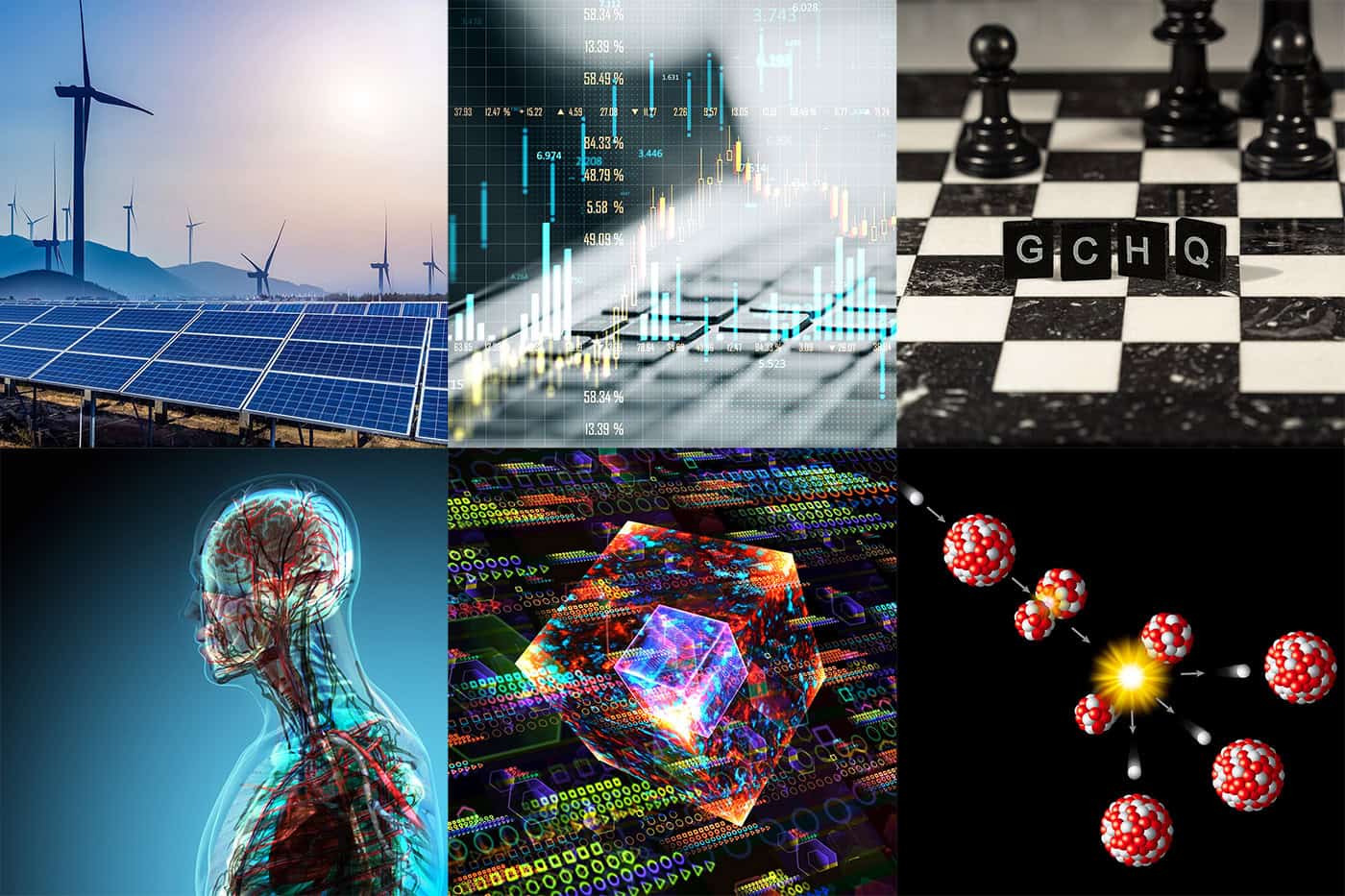
Take your pick From medical physics to green energy, and everything in between; your physics degree offers you many options. (Top row: Shutterstock/hrui; iStock/peshkov; Shutterstock/shaneinsweden. Bottom row: Shutterstock/Yevhen Vitte; iStock/chayanan; iStock/Peter Hermes Furian)
Green energy and sustainability: Physics graduates are ideally placed to tackle the world’s environmental challenges, with their technical knowledge and problem-solving skills. You can find out more about the physicists who are doing their bit to build a greener, more sustainable future in the field of decarbonizing energy sources.
Quantitative finance: With strong mathematical and analytic skills, physicists are a great fit for the financial world, and are often in high demand in quantitative finance in particular. Meet five physicists who pivoted to a career in finance, and explore what physics skills they use day to day.
Intelligence and cyber security: If a challenging but rewarding career is what you are looking for, you may want to consider a role in security. Here you can find out more about the careers of two leaders from GCHQ – the UK’s intelligence, security and cyber agency – with a background in physics.
Medical physics: Medical physicists have a wide variety of roles across academia and industry. From clinical research and medical imaging to computational simulations and testing new scanners, many job options for medical physicists around the world are included here.
Nuclear energy: With the push away from fossil fuels, there is a shortage of skills in the nuclear power sector. Here we speak to six physicists working across the nuclear energy industry – from design and construction, to safety and waste and beyond – highlighting how a background in physics can open many doors in this expanding sector.
The overall picture for all of you graduating with a degree in physics is positive. Physicists all over the world are keen to help solve some of humanity’s biggest challenges and help further our understanding of the universe at large. We hope that all of the resources above – alongside the annual Physics World Careers guide, the Physics World Jobs Hub and the Physics World LinkedIn page – will give you the headstart you need in planning your path and building a fulfilling career.
You can sign up to our bi-monthly careers newsletter from your account area on Physics World. Just click on My Alerts and tick the box to start receiving it
When I went to university, I didn’t know what kind of career I wanted to pursue. I’d originally applied to study geophysics, but after a few weeks realized mineral exploitation wasn’t my thing and quickly switched to maths. Then, at the end of my first year, I had a range of degree options open to me and, whilst I preferred (and was better at) maths, I just didn’t feel it was my best choice for a career.
So I decided to switch again, this time to physics. During my degree, a few friends and I joined the Student Industrial Society (now known as the Bright Future Society). It gave us the chance to visit a range of companies – from micro-breweries and wine importers to TV studios, nuclear-power stations and semiconductor manufacturers. We also went to Llanwern steelworks in South Wales, where a closing session with a British Steel careers advisor really shook me up.
A feisty Yorkshireman, he started off by directly asking each of us what we planned to do after university. We were all put on the spot and our answers, which were embarrassingly unsure, failed to impress him. The advisor firmly suggested that if we didn’t know what our plans were by now, we had better find out before it was too late. For me, it was a wake-up call and when I got back to campus, I went straight to the careers office and started applying for summer student placements.
To my amazement, and despite my lack of experience, I was offered several positions and decided to take a summer job in Malvern at the Royal Signals and Radar Establishment, which is now part of the private defence-technology firm QinetiQ. Somehow, I managed to find something useful to work on and after 12 weeks had done enough to be as included as co-author on a peer-reviewed publication.
Summerlove sensation
After the placement, I continued with my physics degree, but began to feel something about physics wasn’t quite right for me. Whilst I loved the classical side of the subject and the real-world applications, I struggled with the less visible aspects, such as quantum and nuclear. So after a final-year project investigating the aerodynamics of cars – and finding myself more interested in my housemate’s mechanical engineering course – I wondered if I might be better suited to a career in engineering.
On the back of this growing interest, I applied to do a PhD in high-speed aerodynamics at the University of Southampton. My final-year project – coupled with my grounding in physics and the fact that I had a journal publication to my name – must have impressed my future supervisor, who picked me for the project. I had a great time on my PhD, which proved I loved engineering – particularly aerospace.
After four years in research, I realized an academic career wasn’t for me. But my PhD proved handy as it led to me getting a job with a small business called Stewart Hughes Ltd, which built vibration-monitoring equipment for use on mechanical machines. The company was looking for people with an academic background whose presence could help secure US government research funding. It turned out to be a sound strategy, as the firm built up a significant track record in winning high-value government grants.
My advice to you
These days I work a lot with interns and science or engineering students, who often ask me about my career path. As you can see, it wasn’t straightforward – and I believe a lot of people struggle making choices early in their careers. It’s easy to think you need to have everything mapped out in advance, which is rarely how things pan out. With that in mind, here are a few tips if you are starting out on your own career journey.
Top 10 tips
1 Even if you’re not sure what’s right for you – just try things out. Visiting industrial sites or attending topical lectures is great, even if it doesn’t lead to any work experience.
2 Be honest about what you like and don’t like – and don’t be afraid to change direction if things don’t feel right.
3Be prepared to stretch yourself to find out more. Go outside your comfort zone.
4 Remember your degree subject may not be the most important thing unless you’re aiming for a career needing specific vocational training to get in. It’s far more important to study a subject you enjoy.
5 Get yourself a mentor who can be a constant in your career. They don’t have to be more senior to you; they could be a peer or someone more junior (i.e. a “reverse mentor”).
6 It’s fine if you enjoy doing lots of different things – but it doesn’t mean you have to do them all at once.
7 Being happy in what you do is more important than ultimate career goals.
8 Career opportunities don’t arise exactly when you’d like them to so be prepared to jump in or try different options if they pop up. A lateral move can be just as effective.
9 Don’t be afraid to nominate yourself for awards and prizes. An award will look good on your CV and there are a surprising number of opportunities.
10 Network and use your friends’ and peers’ experience.
Doing the rounds
One interesting bit of advice was once given to me on a career session led by a senior human-resources executive who works for a global corporation. The exec told us how he’d been having a golf lesson and was about to hit the ball down the fairway when the coach stopped him and asked where he was aiming. After explaining he was hoping to land the ball on the green, the coach shot back: “Yes…but where exactly on the green?”
Set your goal, do your best to reach it, and don’t worry too much about potential pitfalls.
Obviously the exec said he wanted to get a hole in one, but he was also trying to avoid the bunker and the long grass. The coach went on to explain that golfers should aim at the target and not be distracted by obstacles. Stay focused and the ball will land at or near the target. The exec saw this as the perfect analogy for one’s career: set your goal, do your best to reach it, and don’t worry too much about potential pitfalls.
Now that’s easier said than done – in fact, my career journey has not been the epitome of this advice. There have been bumps and detours along the way, which haven’t necessarily been through lack of focus, but because it took me time to discover what I really wanted to do. To stretch the golf analogy to breaking point, my first green might have not been great, but I’ve certainly had fun making it round the course.
Multinational missions Ariane 6 is the latest rocket in a long history of launchers – demonstrating the power of multinational co-operation for more than five decades. More than 3000 staff are working at ESA to implement space missions for exploring the universe, protecting our planet or serving our daily life. (Courtesy: ESA)
The European Space Agency (ESA) is globally recognized for its iconic space missions that push the boundaries of science and technology, whether it’s a rendezvous with a comet, landing a probe on Saturn’s giant moon Titan or mapping the stars of the Milky Way in unprecedented detail. But ESA does so much more than these headline-grabbing scientific and exploratory endeavours.
“Space is no longer solely a playground for curious minds,” says Eric Wille, ESA Head of the Opto-Electronics Section. “It’s really important for our everyday life too.” In fact, modern society relies on space technologies.
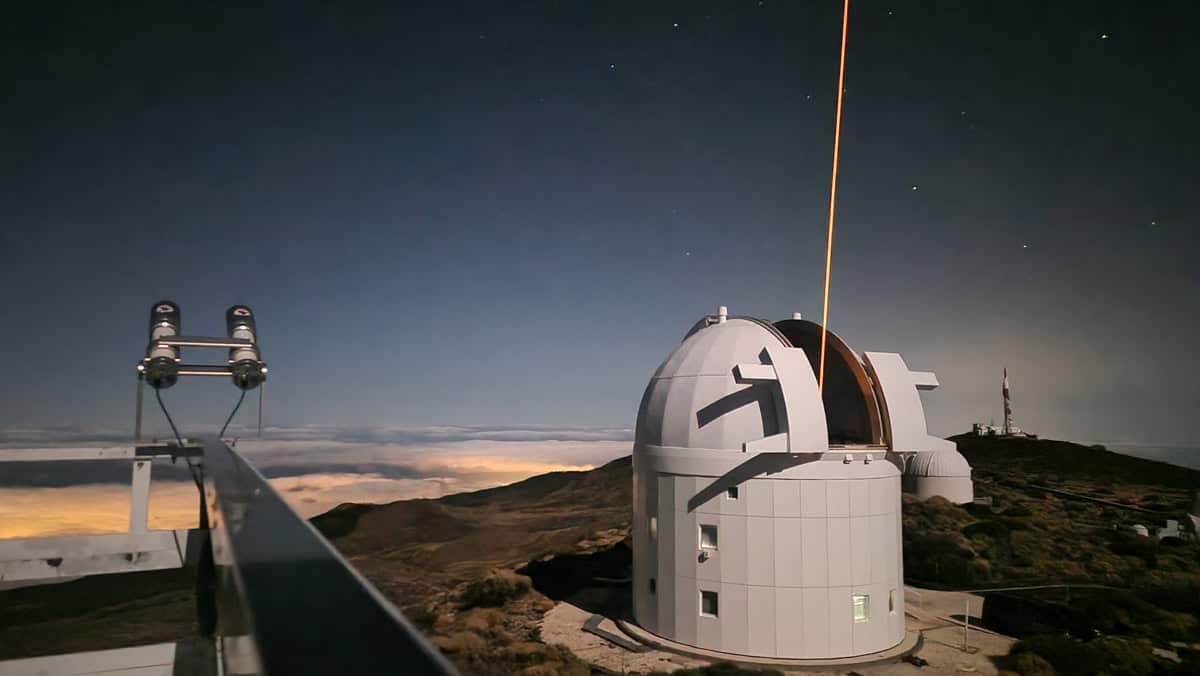
Project management The ESA Optical Ground Station in Tenerife is used to develop laser technologies for high-speed data links or quantum communication. The laser beam projects a guide star to control an adaptive optics system that improves the beam quality of the optical communication link. It is one of several ESA laboratories managed by Eric Wille and the opto-electronics section for testing optical systems for space. (Courtesy: ESA)
Satellite-based environmental monitoring, weather forecasting and global navigation are obvious examples, but there are many other important applications. For instance, the global financial system could not function without atomic clocks aboard satellites time-stamping millions of stock trades and digital payments every second. Similarly, when natural disasters strike, satellite networks become essential lifelines: mapping floods, tracking wildfires and helping with the co-ordination of emergency response efforts on the ground.
Fulfilling all of these roles and ESA’s bold space ambitions – from seeking answers to big questions about the universe to watching over our precious planet – requires a highly dedicated, technically proficient and multi-skilled workforce made up of scientists, engineers and various other professionals.
Diverse and challenging work
When Wille joined ESA as an optical systems engineer in 2009 after completing his PhD in experimental quantum optics, it was the sheer diversity of challenging work that attracted him. “Working in an international space agency, you’re partly a researcher, partly a project manager, partly also someone with ambassadorial skills,” he says. “That mixture is really something which I found at that time very attractive and I still like today, very much.”
Charlotte Pachot also craved a technically challenging role after her master in optics. She found it at Thales Alenia Space in France as a space engineer working on optical instruments. But after a few years, her interactions with ESA staff through joint projects convinced her to join the Agency as an optical engineer. She is now Lead Payload Engineer for the Laser Interferometer Space Antenna (LISA) mission, intended for launch in 2035, which will be the first gravitational wave detector in space.
Both Wille and Pachot have found that the technically challenging work at ESA is particularly satisfying because it has real-world impact. The first 10 years of Wille’s ESA career were largely spent on Athena (Advanced Telescope for High ENergy Astrophysics; now renamed NewAthena), a powerful X-ray observatory set to launch in the late 2030s that will provide fresh eyes on a wide range of hot and energetic processes in the universe.
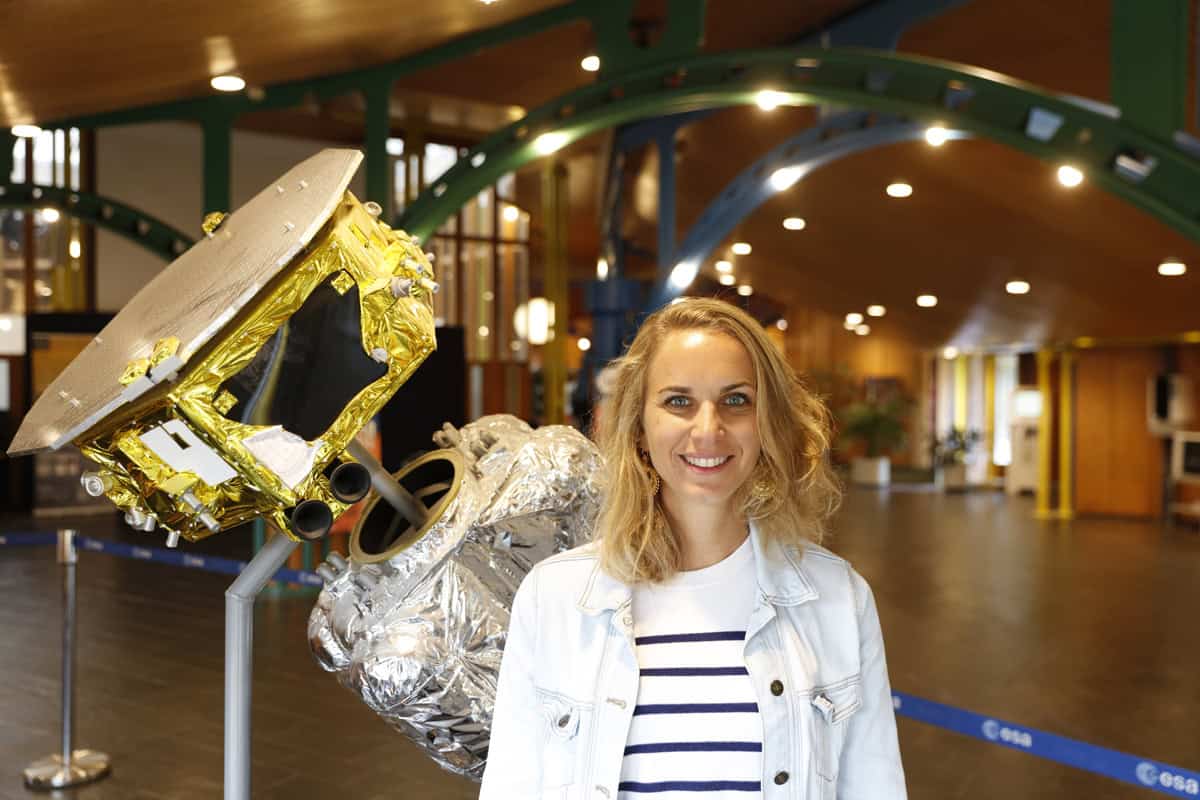
Charlotte Pachot is overseeing the LISA optical bench assembly. Next to her is a model of LISA Pathfinder that tested critical technologies in space in 2016. (Courtesy: ESA)
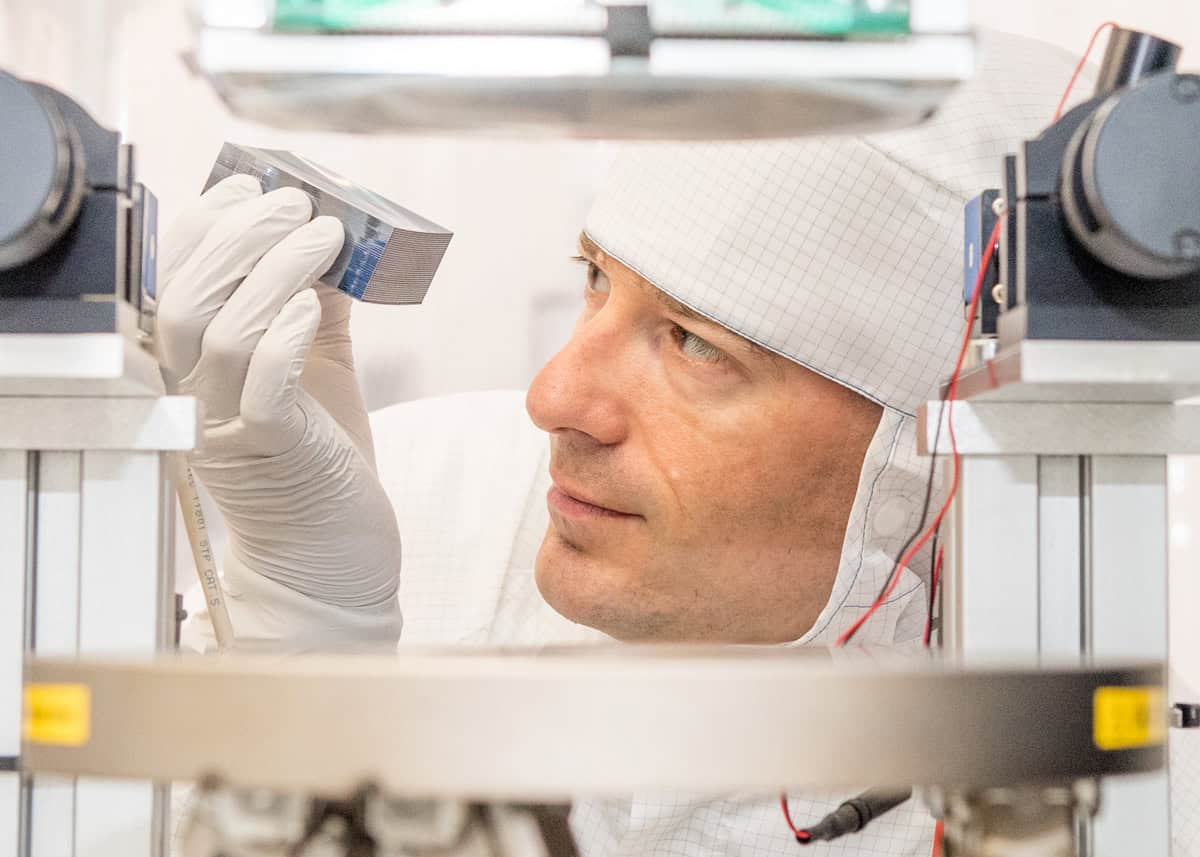
In this role, Wille and the ESA team collaborated with an industrial consortium led by Dutch measuring instrument supplier cosine to develop a completely new type of optics, called silicon pore optics. Using techniques perfected by the semiconductor industry, cosine bonded and stacked many silicon plates on top of each other. By shaping the plates, a lightweight mirror to focus X-rays was created; in fact, 10 times lighter than the ones flying on current X-ray missions XMM-Newton and the Chandra X-ray Observatory.
Like Athena, LISA will also provide fresh eyes on cosmic events, but through the unique prism of gravitational waves. This will be achieved through a completely new approach involving a triangle of three satellites spaced 2.5 million kilometres apart.
Understandably, LISA calls for a unique optical bench, which Pachot is managing from design to manufacturing and testing. She sees her role as being like that of a conductor of an orchestra: a lot of her time is spent co-ordinating team members and partners, while also helping to solve technical, budget and schedule problems. For Pachot, tackling these daily friction points is part and parcel of working on real-world big science. “The instruments are very complex technically, very challenging, but they are also real pieces of hardware as part of a real project,” she says.
International community
As Wille and Pachot’s stories show, ESA selects talent from different career stages. The Agency offers several programmes that support students, graduates and experienced professionals in finding the right role for their profile and interests.
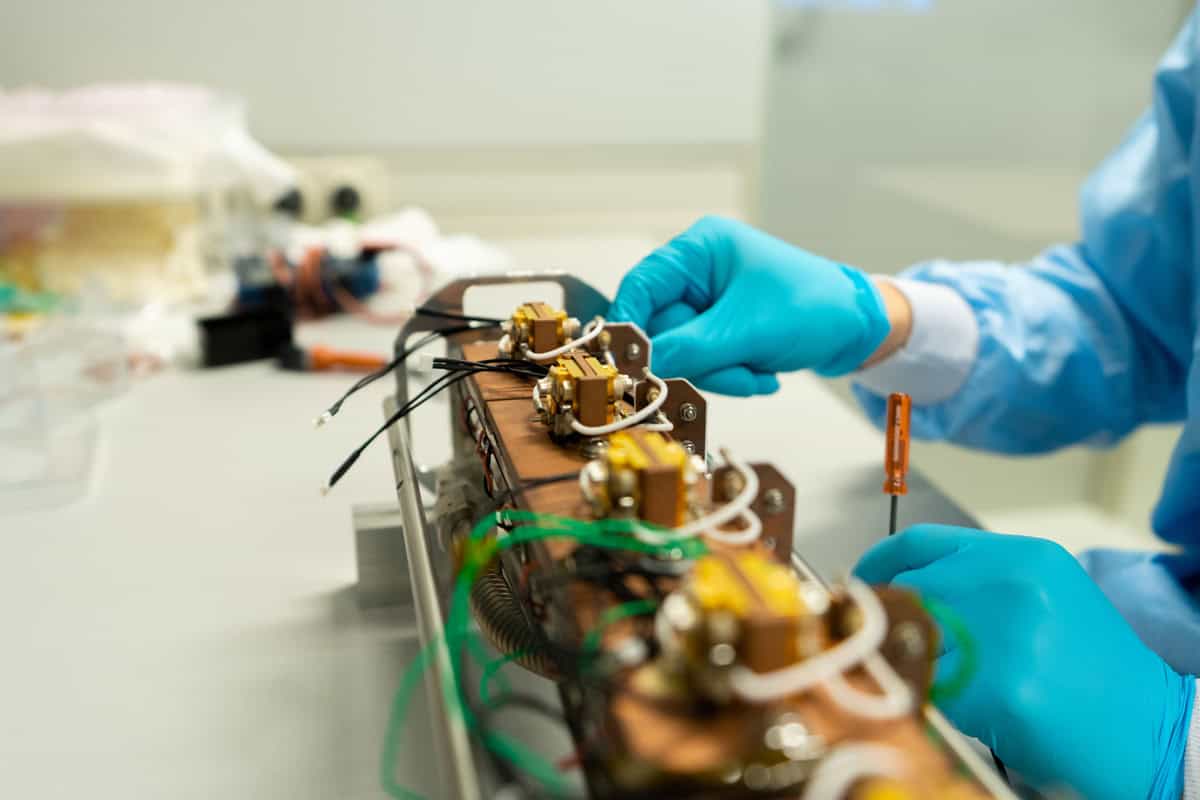
Device testing Lasers are used in many different space applications. Igniting launchers, high-speed optical communication, LIDARs for atmospheric measurements or for measuring gravity waves with LISA. The opto-electronics laboratory at ESTEC is frequently used to characterize the lifetime and performance of high-power diode lasers.(Courtesy: ESA)
For example, university students can benefit from ESA Academy sponsorship, such as participating in hands-on projects or training sessions. They can also join ESA as interns. Graduates can apply to ESA’s Graduate Trainee Programmes where they can gain experience on actual ESA projects and develop technical and professional skills. And for those currently in industry with less than three years’ experience, the Junior Professional Programme allows them to join ESA as staff members for four years and benefit from tailored learning and development opportunities to prepare them for a long-term position.
Whichever pathway they take, once new recruits get started in their first role, an excellent employment package – including competitive salary and pension scheme, hybrid working and flexible hours, and professional development training opportunities – comes as standard.
Eric Wille inspecting a new X-ray mirror using stacked silicon plates. The mirror was assembled using an automated stacking robot partially visible in the foreground. (Courtesy: ESA)
What sets ESA apart is the multicultural work environment. Team members might come from any of ESA’s 23 Member States and nine further Cooperating States and Associate Members. And recruits can be based in more than nine locations in seven countries (France, Germany, the Netherlands, Italy, Belgium, Spain and the UK). This makes for a melting pot of cultures.
“There’s a very lively expat community,” says Wille. “At the European Space Research and Technology Centre (ESTEC) and other big sites, it’s like a small Europe.” This cultural diversity is of course intentional. “The problems we have to solve require teamwork,” says Pachot. “And this is made easier at ESA because we all see problems in a different way depending on our culture.”
Working life at ESA
Want to learn more about working at ESA? Take a look at life at ESA and what ESA offers. Quickly find out which programme could be the best fit for you by following the pathways to ESA on this flowchart.

 Login