A new theoretical approach helps connect quantum physics with classical thermodynamics by clarifying what counts as heat and useful work in tiny quantum machines. When a machine is reduced to a single atom and particles of light, even basic concepts such as heat and useful work become difficult to define. This problem sits at the [...]
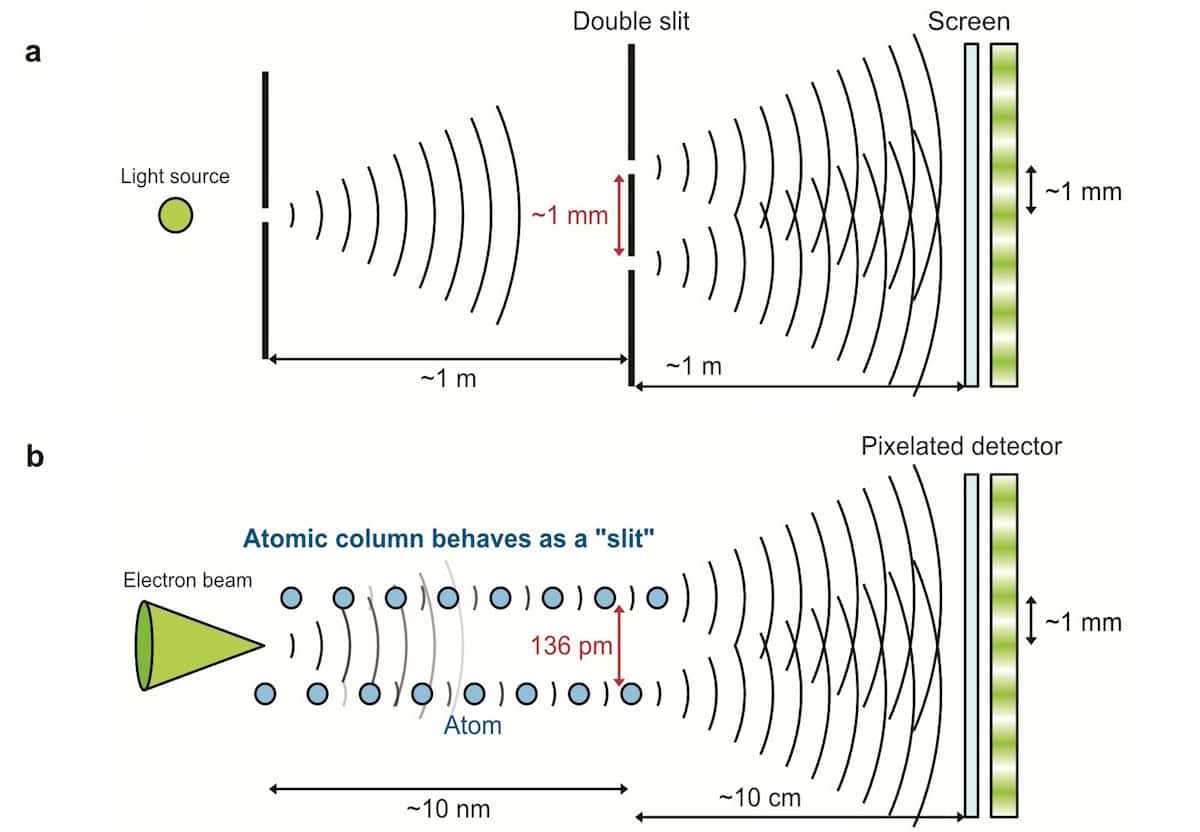
Shrinking Young’s experiment (a) The classical double-slit experiment using light (slit spacing ~1 mm, propagation distance ~1 m). (b) Schematic of atomic-scale interference in which a pair of neighbouring silicon atomic columns act as a “double slit” for a focused electron probe (spacing 136 pm; crystal thickness ~10 nm; distance to detector ~10 cm). (Courtesy: Koudai Tabata/University of Tokyo)
For the first time, physicists in Japan have carried out an atomic-scale version of the double-slit experiment. Using an ultraprecise electron beam channelled along two adjacent columns of atoms in a crystal of silicon, Naoya Shibata and colleagues at the University of Tokyo observed clear interference fringes in electrons scattered by the atoms: fringes that persisted even at high temperature, thanks to correlations in the atoms’ thermal vibrations.
The double-slit experiment is perhaps the most iconic demonstration in quantum mechanics: showing how a single particle’s wavefunction interferes with itself as it passes through two slits at once, with a tangible impact on where the particle is ultimately observed.
In practical research, this effect is now routinely harnessed in electron, neutron and atom interferometers. By observing the interference fringes that it creates, researchers can extract valuable information about both the quantum matter wave and whatever object is doing the diffracting.
Recently, physicists have attempted to push double-slit interferometry all the way down to the atomic scale, replacing conventional slits with crystal lattices. When a moving electron encounters an atom in a crystal, it scatters across a range of angles – producing an outgoing spherical wave that’s mathematically identical to the diffraction pattern from a classical slit.
Since atoms in a crystal sit at such well-defined separations, any neighbouring pair of them could, in principle, act as a double-slit interferometer. In reality, however, the many repeated unit cells in a crystal mean the resulting interference fringes are washed out, making it difficult to isolate the signal from a single atomic pair.
To address this challenge, Shibata’s team used the ultraprecise probe of a 4D scanning transmission electron microscope: an instrument designed to capture electron diffraction patterns with a pixellated detector. Fired into a pure silicon crystal at just the right orientation, the microscope’s precision let the researchers target two adjacent columns of aligned silicon atoms, separated by just 136 pm. As a result, the electron wave overlapped both columns, and no others.
“Our key idea was to use these two atomic columns as the two slits,” describes team member Takehito Seki. “By channelling the probe along both columns at once, we turned them into two coherent scattering sources – effectively making the crystal itself into an atomic-scale double-slit interferometer.”
At this scale, Shibata and Seki’s team created electron interference fringes some seven orders of magnitude smaller than in Thomas Young’s original double-slit experiment with light, first carried out in 1801.
Just as in a larger-scale experiment, these patterns encoded information about the crystal and the electron beam. But at this scale, the researchers could also detect the signature of individual phonon modes in the columns. Rather than destroying coherence as uncorrelated atomic motion would in a classical picture, these correlated vibrations between the two atomic columns kept them moving in sync, preserving the interference.
“In a which-path picture, relative motion of the two atomic columns makes the two electron pathways more distinguishable and reduces the interference, whereas correlated in-phase motion preserves coherence,” Shibata explains. As a result, distinct interference fringes remained visible across temperatures ranging from 300 to 900 K.
The team’s results already point to how an atomic-scale double-slit experiment could offer new ways to measure phonon correlations directly between single pairs of atoms. But as Shibata explains, the possible applications could stretch much further.
“It also opens a route to probing local lattice dynamics at the scale of individual atomic bonds, including at interfaces and defects, where local lattice dynamics can strongly influence thermal transport,” he says. “In the long run, such atomic-scale insight could help inform better thermal management strategies for future chip technologies.”
An international research team has announced the first-ever successful observation of gravity’s effect on a falling quantum object, demonstrating a connection between gravity and the quantum world first predicted by Albert Einstein.
The research team said the result does not unify quantum mechanics and gravity, nor does it prove that gravity is a quantum phenomenon.
However, the researchers said their study offers experimental support that Einstein’s equivalence principle, a fundamental concept at the heart of the famed scientist’s theory of gravity, remains consistent with matter in the quantum world.
Unifying Einstein’s Theory of Gravity with Quantum Mechanics
When physicists want to describe nature, they rely on two distinct sets of rules. Einstein’s theory of gravity explains the mechanics of large-scale phenomena like stars and galaxies. Conversely, quantum mechanics helps scientists characterize the behavior of extremely small objects. Still, finding a scientific bridge uniting the two sets of rules has proven elusive.
“These two pillars of modern physics have so far eluded all attempts at a unified theoretical framework,” explained Professor Ron Folman from Ben-Gurion University of the Negev and the lead author of the new study.
Einstein did, however, identify one mechanism where the two worlds meet. Called the equivalence principle, the concept says that gravity should effectively disappear for an observer in free fall. For example, NASA simulates zero-gravity environments by flying astronauts in a plane, making successive rising and falling parabolic arcs. During the short periods of falling, the astronauts briefly experience ‘weightlessness” due to the equivalence principle.
Above: The 2D MOT apparatus which feeds the science chamber with cold atoms. At the centre is a glass cell held under vacuum between coils producing magnetic fields. The atoms go into the science chamber through the tiny hole that may be seen in the centre of the yellow (reflecting) surface (Image Credit: Or Dobkowski).
Curious if the same phenomena would apply to the quantum world, the research team, which included Nobel Prize-winning physicist Professor Sir Roger Penrose, designed experiments. According to a statement announcing the research, the team hoped their setup would allow them to measure a “distinctive change in the quantum properties of atoms as they fell under gravity.”
Experiments Show Gravitational Pull Affecting Quantum Objects
To search for gravity’s effect in the quantum world, the researchers created clouds of rubidium atoms cooled to just above absolute zero. The researchers used a specially designed atom chip that allowed the team to manipulate the ultracold rubidium atoms.
Next, PhD student Or Dobkowski and colleagues used microwave pulses to place the atoms in quantum superposition. This unique quantum state lets each atom travel down two paths at once.
Using tiny electrical wires embedded on the specialized chip, the researchers generated tunable magnetic fields. The researchers said the field’s precision tunability allowed them to apply an upward force to one half of the atomic wave. For this experiment, the team created a magnetic field at the precise strength needed to counter gravity, effectively holding that half of the wave stationary relative to Earth.
After suspending the first half of the wave, the team used a magnetic pulse to lift the second part. Then, the team switched to a state almost unaffected by the magnetic field, allowing it to fall under gravity.
Once the second half completed its fall, the team used magnetic fields to reunite the two halves. When reunited, the two halves of the atomic wave interfered with each other. The researchers said that interaction allowed them to “measure the tiny difference in quantum phase accumulated while one was falling and the other was held still.”
“The phase measured in the new experiment is the same as the one predicted when Einstein’s principle is applied to such a quantum wave,” they explained.
“One of the Most Fundamental Questions in Physics”
When discussing the results, the research team said their result should not be construed as proof that gravity is quantum. The results also do not unite gravity and quantum mechanics. However, Folman noted, “this complex experiment gives more hints as to how such a unification may be achieved.”
Study co-author Professor Vlatko Vedral from the University of Oxford’s Department of Physics agreed, while also noting that their experimental results successfully demonstrated Einstein’s equivalence principle’s consistency with quantum mechanics, which alone provides an experimental connection between quantum physics and Einstein’s theory of gravity.
“This experiment pushes quantum mechanics into one of its most intriguing frontiers, gravity, and shows that, once again, its predictions hold,” Professor Vedral explained.
The professor also noted the experiment’s combination of hard experimental data with “a far-reaching theoretical interpretation, about one of the most fundamental questions in physics: How can gravity (described by Einstein’s theory of relativity) and quantum theory be unified into one understanding of the universe?”
Christopher Plain has spent the last six years as Associate News Editor and Head Science Reporter at The Debrief. Follow and connect with him on X, learn about his novels at plainfiction.com, or email him at christopher@thedebrief.org.

 Login

 A new theoretical approach helps connect quantum physics with classical thermodynamics by clarifying what counts as heat and useful work in tiny quantum machines. When a machine is reduced to a single atom and particles of light, even basic concepts such as heat and useful work become difficult to define. This problem sits at the [...]