
❌

Normal view

Thermal imaging technique helps overcome a major problem for gravitational-wave astronomy

11 August 2026 at 09:00

Black hole collisions, merging neutron stars, exploding supernovae – these massive cosmic events are all observed by interferometer-based gravitational-wave observatories such as LIGO. Detection of the ripples in space-time caused by these phenomena is dependent on the careful control of the mirrors used in these observatories.

Led by Jonathan Richardson at University of California, Riverside, a research team has demonstrated a new wavefront actuator that can correct deformations in the surface of the mirrors by applying carefully mapped heating patterns. In a new development, reported in Classical and Quantum Gravity, Richardson’s team has used thermal imaging cameras to pinpoint where the corrections are needed. This approach should massively reduce the main limitation on the sensitivity of gravitational-wave observations.

Limiting LIGO

Since their first detection in 2015, the world of gravitational-wave observation has thrived. Now, with two major updates planned for pioneer interferometer observatory LIGO (LIGO A+ and LIGO A#) and plans for a more powerful generation of new sites, the field has reached a major turning point. Richardson describes this transition as moving from “an initial discovery era – a time when the closest, loudest events were just barely resolvable above the detectors’ noise floors – to an era of precision science”.
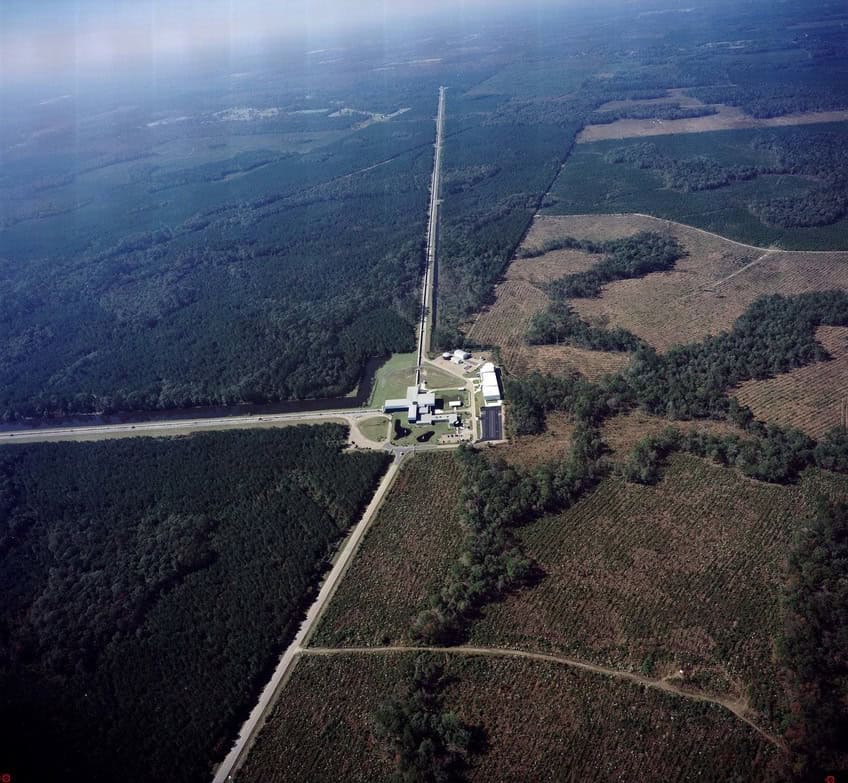
LIGO’s Livingston site
View from above An overhead view demonstrates the immense scale of LIGO’s Livingston site. (Courtesy: Caltech/MIT/LIGO Lab)

Richardson notes that, even now, observations such as that of a binary black hole merger with a record signal-to-noise ratio of 80 are allowing researchers to test our most fundamental theories of the nature of gravity and black holes. Heightened sensitivity will allow the observation of waves that have travelled far greater distances, over longer time periods, and are weaker as a result. These new developments will allow astrophysicists to peer further out into our universe and further back in cosmic time than ever before.

This major increase in sensitivity requires new levels of power, with LIGO A# reaching an unprecedented 1.5 MW of circulating laser arm power. The mirrors used in these detectors absorb some of the power of the incident lasers as thermal energy, resulting in heat-induced distortions that have a detrimental effect on the sensitivity of the detector. It is these deformations that place a limiting factor on the capabilities of gravitational-wave observatories.

A surprisingly simple solution

Richardson’s team has already taken huge steps towards reducing this effect with the development of new adaptive optics. In principle, these devices can apply a variable blanket of heat across the surface of the mirror that cancels out the thermal deformation from the laser heating at the nanoscale. Unfortunately, the application of this method is limited by researchers’ ability to precisely map these aberrations. This lack of sensing capability posed a roadblock on the path to high-powered gravitational-wave observation.

Richardson’s group discovered a solution to this problem when testing this new technology on a full-scale 40 kg LIGO mirror. They realised that they could accurately reconstruct the optical distortions across the entire 34 cm-diameter mirror by combining direct measurements of the surface temperature with a well programmed model of heat flow in the material.

In a surprising turn of events, the thermal imaging cameras needed to survey the full aperture of the mirror are widely commercially available and can be calibrated using LIGO’s Hartmann wavefront sensors that are already in place. Without the need for a lengthy process of technology development, as is usually required to solve LIGO instrumentation problems, Richardson is “all the more hopeful that we will reach megawatt-scale interferometry in the coming years”.

The future of gravitational-wave detection

The planned improvements to LIGO will drastically increase the observational power of this leading facility, but designs for a new generation of observatories could present even greater opportunities.

Cosmic Explorer is the US-led contribution to a new class of interferometers. Its arms will reach an enormous 40 km each, with ten times the sensitivity of LIGO. Richardson’s team will be responsible for implementing their cutting-edge research in laser wavefront sensing and correction as part of Cosmic Explorer’s base design. As a testing ground for these developments, LIGO will pave the way for an exciting new era of gravitational-wave detection.

With these levels of sensitivity, Cosmic Explorer aims to observe gravitational waves from hundreds of thousands to millions of black hole and neutron star mergers per year. Gravitational-wave detection will then reach close to the edge of our observable universe, looking back approximately 14 billion years across cosmic time.

Using existing, widely available technology, Richardson’s research group is pushing the limits of gravitational-wave detection and spurring on the development of a new, more powerful class of observatory.

The post Thermal imaging technique helps overcome a major problem for gravitational-wave astronomy appeared first on Physics World.

Why physics should move beyond prestige in PhD admissions

10 August 2026 at 11:00

Physics faces a persistent and uncomfortable paradox. While we repeatedly assert that scientific excellence depends on creativity, rigour, resilience and collaborative problem-solving, the way we select the next generation of researchers still relies heavily on institutional prestige, grades and prior access to opportunity. Although easy to use, these criteria are deeply entangled with structural advantage resulting in a system that is efficient to operate and familiar – yet systematically exclusionary.

Traditional admissions criteria are heavily shaped by unequal access to resources, inside knowledge, mentors and cultural capital

Most academics recognize the limitations of traditional admissions criteria, but we continue to rely on them. Degree classification, university ranking, publications and reference letters feel like comfortable objective indicators of merit. In reality, however, they are heavily shaped by unequal access to resources, inside knowledge, mentors and cultural capital.

Two students with equal underlying potential, for example, can present very different CVs depending on whether they had access to a research-intensive institution, informal advice networks, paid research internships, or simply, the financial security to take risks. When admissions panels default to these signals as primary filters, they are not solely selecting for ability – they are also selecting for accumulated advantage.

This is not merely a matter of fairness but a strategic problem for science. Science and technical subjects in the UK face chronic recruitment and retention challenges. At the same time, major issues facing our society are too complex to solve from a single perspective. Physics skills are in growing demand across the UK and Ireland with PhD graduates entering industry, policy, entrepreneurship, education and beyond. This demands not only technical brilliance, but adaptability, communication and ethical judgement.

To achieve the interdisciplinary breadth required to tackle today’s issues, we need to implement thoughtful strategies and processes. If we continue to draw from a narrow and self-reproducing talent pool, we constrain not only who gets to participate in science, but the kind of science we are able to do.

A new approach

At the Centre for Doctoral Training (CDT) in Diversity-Led, Mission-Driven Research (DiveIn) based at the University of Glasgow, we saw an opportunity to move away from PhD admissions criteria being focused on prior privilege towards one based on demonstrable competencies relevant to excellent research and successful completion of a PhD. While most PhD programmes recruit students to predefined projects, which rewards prior disciplinary alignment and insider knowledge, DiveIn instead recruits a cohort first and co-creates projects later.

We worked with the Equity in Doctoral Education through Partnership and Innovation (EDEPI) programme to design a CDT with this mind. EDEPI was created to tackle persistent inequalities that create barriers to access and participation for racially minoritized groups. The EDEPI framework identifies three broad areas: comprehension and evaluation (analytical and problem solving, communication, planning and organization); delivering results (integrity, working with others, independence); and socio-emotional competencies (motivation, curiosity, resilience). We expanded the EDEPI framework to emphasize an appetite for interdisciplinary research; cohort-based development; and advocacy.

A core pillar of the DiveIn approach to the EDEPI framework is anonymization. Our applications are divided into separate components, with personal data, CVs and competency statements de-linked during evaluation. Assessors also never see names, genders, nationalities or institutional affiliations.

The DiveIn admissions process consists of four key elements. The first is an anonymized, competency-based written application, structured around five targeted questions probing motivation, resilience, curiosity and self-reflection. The second is a task-based exercise, in which all applicants analyse the same dataset and explain their reasoning – testing analytical thinking and communication independently of discipline.

Another aspect of the process is a double-marked, wide-ranging assessment, ensuring that no single impression dominates and that different aspects of the application are judged independently. The final aspect is a transparent, structured interview with questions shared in advance and mapped explicitly to competencies.

Applicants are assessed for their ability to thrive in a diverse, collaborative cohort

Importantly, applicants also receive active support, which includes webinars explaining the process, guidance videos for each question and live drop-in sessions. This is not coaching for advantage – it is an explicit attempt to dismantle the “hidden curriculum” that privileges those already familiar with academic selection rituals. Applicants are, therefore, assessed not only for individual PhD readiness, but for their ability to thrive in a diverse, collaborative cohort.

Diversity gains

DiveIn’s first full recruitment cycle provides some encouraging evidence that our approach is working. The resulting cohort is naturally diverse in background, discipline and experience. Our results also suggest that undergoing such a shift can widen participation without lowering standards and may, in fact, improve the quality and impact of the research that the PhD cohort carry out. In other words, the process did not abandon standards but changed what those standards were designed to measure.

If we continue to admit PhD candidates primarily based on narrow retrospective signals, we will systematically under-select precisely the kinds of researchers the future requires. Conversely, if we treat admissions as a design problem – something that can be structured, tested, iterated and improved – we open the door to a more resilient, creative and socially responsive generation of researchers. As diversity gains in the technology sector are stalling, this reform to admissions could help sustainably boost diversity in UK Tech.

We can build systems that are fairer, more principled, and more aligned with the realities of modern research

We now need to refine, scale and continue to evaluate the programme. But the core insight is robust: we can do better than prestige-driven selection. We urge anyone who selects PhD students for their programme to think about these issues and make use of the resources available at EDEPI on inclusive PGR admissions. We can build systems that are fairer, more principled, and better aligned with the realities of modern research.

For a discipline built on careful measurement and experimental design, it is striking how little physics has applied those principles to choosing who gets to become a scientist. Perhaps it is time we did.

  • This article was written with Ross Forgan, Sandra Dopico Ardao, Qammer Abbasi and Caroline Gauchotte-Lindsay.

The post Why physics should move beyond prestige in PhD admissions appeared first on Physics World.

❌