❌

Normal view

It’s Official: This Is the Hottest America Has Ever Been

11 August 2026 at 17:06

It’s not just you — the United States is going through a record-bustingly hot summer.

According to the National Oceanic and Atmospheric Administration, the contiguous US averaged 76.89 degrees Fahrenheit in July, which is even hotter than the July 1936 Dust Bowl, an environmental and agricultural disaster marked by devastating dust storms.

Much like the Dust Bowl, which was the result of both natural and human-made factors, this year’s record-breaking temperatures are the result of a strong El Niño — a naturally occuring weather pattern — exacerbating the calamitous effects of human-caused climate change.

“It’s not good when you’re breaking records from the Dust Bowl, which we are in this case,” Yale Climate Connections meteorologist Jeff Masters told the Associated Press. “And that was a crazy sort of situation where you put tens of millions of people in motion. You had this great migration because of the drought and the heat that hit the center of the US — just a cataclysmic event in US history.”

“If we’re exceeding records from the Dust Bowl, that says that we’re in deep trouble,” Masters added.

While the heat was more concentrated in the Midwest during the Dust Bowl, all 48 lower states experienced excessive heat this summer — at least one degree Fahrenheit warmer than the 20th century average.

And instead of focusing on ways to fight the effects of climate change, much of the country is moving in the opposite direction. The Trump administration is closely aligned with the fossil fuel industry and is actively seeking to reopen coal-burning plants. AI data centers powered by gas generators are compounding a major uptick in greenhouse gas emissions.

The result is a country literally on fire, while suffering the second-worst July drought conditions on record for the contiguous US, according to Yale Climate Connections. Per the US Drought Monitor, a whopping 71 percent of the contiguous US experienced abnormal dryness or drought during the first week of August, coming on top of billions of dollars in direct damages during the first half of 2026.

Meanwhile, major wildfires continue to burn across both the US and Canada, exposing millions to dangerous levels of air pollution and causing an estimated 4,000 premature deaths across the continent within a single week last month, according to The Economist.

The prognosis is just as grim as one might think.

“This may be one of the coolest years we’re gonna experience for the rest of our lives,” Masters told the AP.

To give humanity a fighting chance we need to “stop burning so many fossil fuels,” he added. “We also need to be spending money to adapt to the new climate that we’ve put in place.”

More on climate change: AI Data Centers Are Causing Unfathomable Amounts of Air Pollution, and It Gets Worse With Each New One They Build

The post It’s Official: This Is the Hottest America Has Ever Been appeared first on Futurism.

Amazon’s New AI Data Center Is So Enormous That It Appears It Will Become the Largest Single Source of Pollution in the United States

11 August 2026 at 15:09

Tech Goliaths are scrambling to build as much AI computing capacity as they possibly can, come hell or low water. One of the dominant players in the space, Amazon Web Services, has its heart set on an AI data center so enormous that it could easily become the largest source of carbon dioxide emissions in the United States.

According to the New York Times, Amazon has confirmed its investment in a massive gas-burning power plant in Texas, meant to supply up to 7.65 gigawatts of energy to a planned data center in Pecos County. Should it come online as planned, the plant’s 35 turbines would be allowed to spew 33 million tons of CO2 a year, the NYT notes, which would easily make it the largest single fount of emissions in the country.

That’s a stunning amount of carbon exhaust, putting that single data center in a league with entire countries including Switzerland, Ireland, and Bulgaria.

It would also be in stark defiance of Amazon’s stated climate goals, which center on reaching net-zero carbon emissions by 2040.

That’s not lost on the tech giant. But as Amazon spokesperson Margaret Callahan told the NYT, the “world looks different now than when we co-founded the climate pledge.”

“We’re being transparent about the challenges, investing in innovation, and delivering measurable results,” Callahan continued. “Growth and sustainability don’t have to be in opposition — in fact, our results show they reinforce each other.”

Even without the new Pecos County plant, Amazon’s emissions are staggering. The company recently disclosed a record increase in its total emissions last year, with company-wide electricity usage rising by 34 percent across 2025.

That the company is blatantly papering over its previous climate commitments isn’t a shocker at this point, in other words, as the company reaches new emission highs with each passing year.

More on Amazon: Jeff Bezos Harshly Criticized for $200 Million Pledge to Protect the World’s Most Endangered Species

The post Amazon’s New AI Data Center Is So Enormous That It Appears It Will Become the Largest Single Source of Pollution in the United States appeared first on Futurism.

Reader Q&A: ask our reporters anything about fossil fuel profits and the climate crisis – live

Last week reporters Jillian Ambrose and Damian Carrington published a piece which revealed that biggest oil firms made $93bn in profits in three months amid the war in Iran and the climate crisis. They’re online now to to discuss their story and any other questions you might have

Ask a question: log in or sign up here


StanEthel asks: Does anyone in the fossil fuel industry accept responsibility for climate change? If they don’t, how is their denial structured: it’s not happening, it’s someone else’s fault, it’s not our fault?

Damian:

The short answer is no, and a rising tide of lawsuits against fossil fuel companies for their role in the climate crisis means that is unlikely to change anytime soon. The science is ever clearer though. An analysis published last September showed for the first time that carbon emissions from the world’s biggest fossil fuel firms were directly linked to fatal spells of hot weather.

The big oil companies were among the first to realise the dangers of global warming half a century ago. But decades of denial then followed. As the reality of climate crisis has become undeniable, the arguments of the fossil fuel industry have shifted. Gas was cleaner than coal, for example, or that carbon credits from new forests could offset emissions. Today, the industry likes to tout carbon capture and storage (CCS) as a solution. But just this week, one of CCS’s loudest cheerleaders, ExxonMobil, has started a process to sue the European Union which wants to make the company actually store a small amount of CO2.

In the first weeks of the conflict, some predicted that the government’s taxes on North Sea oil and gas would yield a £20bn tax windfall for the Treasury if surging oil and gas prices remained high over the whole year. This is because the government’s windfall tax on North Sea oil and gas, known as the Energy Profits Levy, imposes an effective headline tax rate on North Sea profits of 78%, and the Treasury collects VAT from petrol and diesel sales too.

But prices have not climbed by as much as first feared. So what can we reasonably expect? Before the war, the Office for Budget Responsibility forecast that oil and gas revenues would raise £2.7bn in the 2025/26 financial year. It also suggests that for every $10 increase to the benchmark oil price, the Exchequer can expect an extra £900m in revenue. Meanwhile, every 1p increase in the price of gas hands the Treasury an extra £55m.

Continue reading...

© Composite: Guardian Design

© Composite: Guardian Design

© Composite: Guardian Design

HD Hyundai Oilbank Commercializes Engine Oil for Hydrogen Internal Combustion Engines

11 August 2026 at 11:03
HD Hyundai Oilbank's XTeer H2-ICE engine oil for hydrogen internal combustion engines.

HD Hyundai Oilbank said on Aug. 11 it has commercialized South Korea's first engine oil specifically designed for hydrogen internal combustion engines (H2-ICE).

The company said it has begun supplying its XTeer H2-ICE engine oil to hydrogen commercial vehicle manufacturers, including Tata Daewoo Mobility.

HD Hyundai Oilbank began developing lubricant technology for hydrogen internal combustion engines in 2023 and completed product development and performance validation last year.

Hydrogen internal combustion engines operate at higher combustion temperatures than conventional internal combustion engines and generate moisture during combustion, which can accelerate engine wear and degrade lubricant performance.

According to the company, the new engine oil incorporates technologies designed to protect engine components, control moisture and suppress deposits generated during the combustion process.

An HD Hyundai Oilbank official said the company has secured proprietary lubricant technology for hydrogen internal combustion engines and successfully commercialized the product.

The official added that the company plans to expand its portfolio of high-value-added lubricant products targeting the global market.

SFA to Supply 150 Billion Won of Equipment for LS Cable & System's US Subsea Cable Plant

11 August 2026 at 11:03
SFA employees commemorate the first shipment of turntables to be supplied to the US subsea cable plant.

SFA has begun shipping manufacturing equipment for LS Cable & System's subsea cable plant in the United States.

The company said on Aug. 11 it held a shipment ceremony for the first 10,000-metric-ton-class turntable destined for LS Cable & System's manufacturing facility in Virginia. Between the fourth quarter of last year and the first quarter of this year, SFA secured turntable supply contracts worth approximately 150 billion won.

SFA will deliver dozens of turntables to the Virginia plant in phases through the end of 2027.

Turntables are used to wind, store and transport completed subsea cables to the next stage of the manufacturing process. Because long-distance subsea cables are highly susceptible to excessive tension and twisting, the equipment must precisely control cable handling. The turntables supplied by SFA measure more than 40 meters in diameter.

Working with LS Cable & System, SFA has developed subsea cable manufacturing equipment, including vertical continuous vulcanization (VCV) systems and turntables. The company has also supplied similar equipment to LS Cable & System's subsea cable plant in Donghae, Gangwon Province.

An SFA official said the company intends to successfully complete the Virginia project by leveraging its experience supplying 3,000-ton-class VCV systems and 10,000-ton-class turntables, while positioning itself to secure additional business opportunities as LS Cable & System expands its US investment.

Hanwha Solutions Commercializes Power Cable Material Made With 50% Recycled Feedstock

11 August 2026 at 11:02
Hanwha Solutions' CHBA-8241RC power cable jacket material.

Hanwha Solutions said on Aug. 11 it has commercialized a power cable material containing 50% post-consumer recycled (PCR) plastic feedstock.

The company said it has completed customer qualification for CHBA-8241RC, a high-density polyethylene (HDPE)-based jacket material for power cables made with recycled plastic feedstock.

CHBA-8241RC is a proprietary composite material developed by Hanwha Solutions. According to the company, it maintains electrical performance comparable to conventional products while reducing carbon emissions by approximately 34% per kilogram of material.

Hanwha Solutions completed product development and pilot production last year. In the first half of this year, it finished production trials and quality validation with cable manufacturers. The company said the commercialization expands its cable materials portfolio from ultra-high-voltage insulation materials to environmentally friendly cable jacket compounds.

Hanwha Solutions is also expanding its recycled polyethylene (rPE) business using waste plastics. Its related products have obtained Global Recycled Standard (GRS) and ISCC PLUS certifications and are used in applications including consumer electronics packaging, cosmetic containers and industrial recycled packaging bags.

AI’s potential climate benefits outweighed by role in boosting fossil fuels, study finds

11 August 2026 at 10:15

Modelling finds AI-driven productivity gains in coal, oil and gas enable more emissions than applications in renewables avoid

AI-driven productivity gains enable more planet-heating pollution from fossil fuels than they avoid from renewables, a study has found.

Researchers modelled the technical potential for AI to boost clean power generation along with projections for how it can help produce coal, oil and gas. Across 64 scenarios, they found net yearly carbon pollution rose by 0.47-1.8 gigatonnes, or about 1-5% of the energy sector’s annual emissions.

Continue reading...

© Photograph: KENDALL/Alamy

© Photograph: KENDALL/Alamy

© Photograph: KENDALL/Alamy

Tuesday briefing: To drill or not to drill – Burnham’s first big climate test

11 August 2026 at 06:46

In today’s newsletter: As we enter our fifth summer heatwave, Andy Burnham’s government is looking at what the UK should do with its remaining North Sea oil and gas

Good morning. What a difference a new job can make. “To have a shot at staying within 1.5C global warming, we can’t have any new oil or gasfields … It’s irresponsible and shortsighted to be funding new #fossilfuels when we need to be getting to #NetZero.”

This was the 2022 message from Miatta Fahnbulleh, now the secretary of state for energy security and net zero. It’s a testament to her remarkable rise that Fahnbulleh wasn’t even an MP when she posted it four years ago. Today, she is in the cabinet, facing (or is the face of, at least) one of the most challenging, and potentially controversial questions looming for the new government: to drill or not to drill, baby?

Two sites are the focus of fierce debate. Yesterday, a public consultation on whether to greenlight extraction at one of them – Jackdaw – closed. Next Monday, it’ll be the same for the other, Rosebank. Andy Burnham has been silent about the climate crisis since taking office. As we enter yet another heatwave, what his government does next will be a defining signal of intent on the issue.

Colombia | More than 100 people have died after a powerful earthquake struck western Colombia, collapsing and severely damaging scores of buildings in major cities including Cali and Pereira.

UK weather | Almost three-quarters of England is now in drought, with four more regions officially declared, and as much of Europe braces for its fifth climate crisis-driven heatwave this summer.

Crime | Police are investigating whether Joshua Kerry, the man charged with the murder of the former Reform UK and Conservative politician Ann Widdecombe, had any role in an attempted burglary last year at the then London home of Nigel Farage.

China | More than a million people were moved to safety across eastern China by Sunday evening as powerful Typhoon Dolphin made landfall amid fears torrential rain would cause flooding and landslides.

Ukraine | Russia has banned voting against the war in September’s elections, after the supreme court upheld a suit brought by a small pro-Kremlin nationalist party, and stripped voters of their last option on the ballot: Yabloko, the country’s only remaining anti-war party.

Continue reading...

© Photograph: Martin Langer/Alamy

© Photograph: Martin Langer/Alamy

© Photograph: Martin Langer/Alamy

Do Galaxies Really Glow in Sync — or Are We Just Tilting Our Heads?

10 August 2026 at 17:00

NGC 1068

Editor’s Note: Astrobites is a graduate-student-run organization that digests astrophysical literature for undergraduate students. As part of the partnership between the AAS and astrobites, we occasionally repost astrobites content here at AAS Nova. We hope you enjoy this post from astrobites; the original can be viewed at astrobites.org.

Title: Geometry, Not Calorimetry, Drives the Radio–Infrared–γ Ray Correlation
Authors: T. A. Porter, I. V. Moskalenko, and G. Jóhannesson
First Author’s Institution: Stanford University
Status: Published in ApJ

Galaxies emit light not only in the visible band, but also across other wavelengths via different physical mechanisms. Finding correlations between emissions at different wavelengths is a powerful tool for astrophysicists to explore the underlying mechanisms of galaxy formation. One of the most famous examples is the infrared–radio continuum correlation, which holds across several orders of magnitude in luminosity.

The typical explanation for this correlation is that both infrared light and radio synchrotron emission share the same energetic origin: star formation. Young stars emit ultraviolet radiation, which is absorbed by interstellar dust and re-radiated in the infrared. When these stars end their lives in core-collapse supernovae, the resulting shock waves accelerate cosmic-ray electrons, which then interact with the magnetic field to produce synchrotron emission.

For this correlation to hold, cosmic-ray electrons must radiate away all their energy within the galaxy, unable to escape and carry away some of their energy. Otherwise, the amount of radio emission would depend on how quickly cosmic rays escape and would no longer correlate with the infrared emission. This assumption is called the “electron calorimeter” model, which assumes that electrons lose all their energy due to radiation without escaping the galaxy. However, observations show that the infrared–radio correlation persists even in low-density galaxies where cosmic rays can easily escape, suggesting that the calorimeter model may not be the full story. To reconcile this, previous studies proposed “conspiracy-like” scenarios in which cosmic-ray injection, transport, magnetic-field amplification, and gas density are all coupled in a finely self-regulating way to maintain the correlation across diverse galactic environments — a somewhat awkward explanation that requires multiple unrelated physical processes to conveniently work together.

With the increased sensitivity of the Fermi Large Area Telescope, high-energy gamma-ray (or γ-ray) detections add new information to this picture. A galaxy’s γ-ray emission is produced by two different sources: cosmic-ray protons interacting with the interstellar medium gas, and cosmic-ray electrons inverse-Compton scattering off of nearby starlight or photons from the cosmic microwave background. Since both processes involve cosmic rays, the total γ-ray emission should also reflect the amount of star formation and therefore correlate with infrared and radio emission.

Because all three wavelengths trace different pieces of the same cosmic-ray population, studying them together reveals how the galaxy’s total cosmic-ray energy budget is distributed across its multi-wavelength emission.

The infrared–radio correlation has been established not only at the scale of entire galaxies, but also locally, down to patches roughly 100 parsecs across. Think of it like the relationship between a city’s electricity consumption and its population: we have long known they track each other city-wide, but it turns out the same relationship holds block by block. The infrared–radio correlation works the same way: zoom into any 100-pc region within a galaxy, and the correlation is still there. Unfortunately, the resolution of γ-ray observations is still stuck at around the kiloparsec scale. It is therefore unclear whether the local infrared–radio correlation reflects a genuine local physical coupling, one that would extend to γ-rays if we had sufficient resolution, or whether it is simply a spatial average of the emission, smoothed out by insufficient resolution. The answer determines whether radio and γ-ray emission can be used as reliable tracers of star formation, or whether they are just smeared out by cosmic-ray propagation over kiloparsec scales.

In this study, the authors numerically model galactic cosmic-ray transport, building a suite of physically motivated three-dimensional models of the Milky Way. They consider two variants for each of the four key inputs: 1) the cosmic-ray source distribution, 2) the interstellar gas, 3) the amount of starlight within the galaxy (the interstellar radiation field), and 4) the galactic magnetic field. Crucially, every model is normalized to reproduce the locally observed cosmic-ray data to within 5%, so that any differences in the predicted emission come purely from the large-scale geometry of each input, rather than from variations in the total cosmic-ray budget.

After evolving cosmic-ray transport for these realistic models, the authors then compute synthetic observations at radio, infrared, and γ-ray bands from various viewing inclinations to investigate how the underlying galactic model and the viewing angle affect the correlations between these emissions.

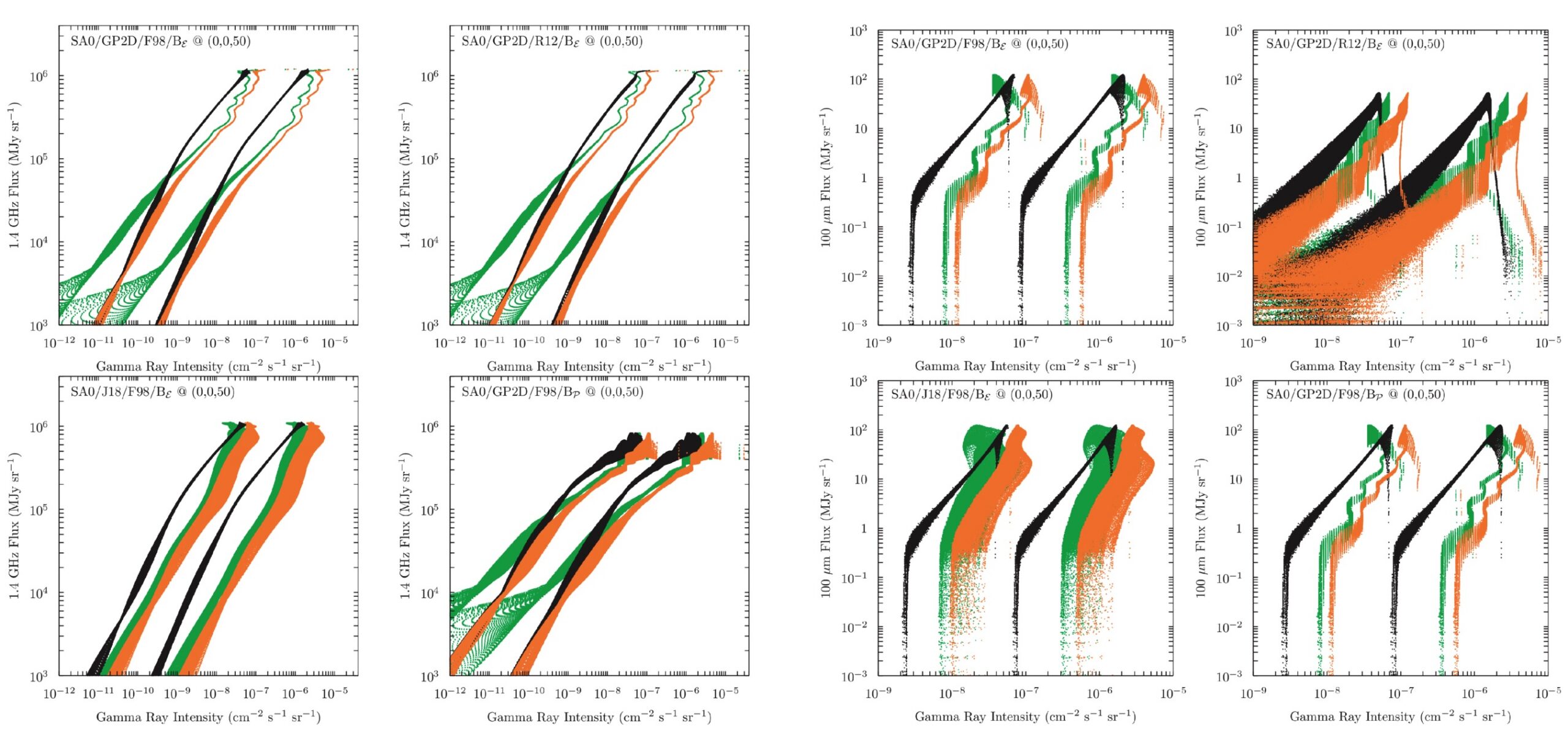
Surprisingly, inclination plays the most important role — more so than the cosmic-ray source distribution, the radiation field, or the magnetic field. Figure 1 shows the correlation plots between the radio and γ-ray emission (left two columns) and between infrared and γ-ray emission (right two columns) when viewing the galaxy face-on (i.e., viewing the galaxy from directly above the disk). Different colors represent γ-ray emission components from different physical mechanisms, with orange showing the total γ-ray emission. For both sets of correlation plots, starting from the upper-left panel, each panel modifies one physical input and recomputes the emission. Although there is some variation, one can see that the γ-ray emission correlates with both the radio and the infrared emission over several orders of magnitude, regardless of the underlying input model.

plots of radio and infrared flux versus gamma-ray intensity

Figure 1: Radio (left two columns) and infrared (right two columns) vs. γ-ray correlation plots for a galaxy viewed face-on from 50 kpc. Each panel modifies one input — the cosmic-ray source distribution, gas, radiation field within the galaxy, or magnetic field — relative to a baseline model. Colors indicate γ-ray production mechanisms (green: proton–gas; black: inverse-Compton; orange: total). Across all variations, both the radio–γ-ray and infrared–γ-ray correlations remain quasi-linear over several orders of magnitude, showing that the correlations are robust to the choice of underlying galactic model. [Adapted from Porter et al. 2026]

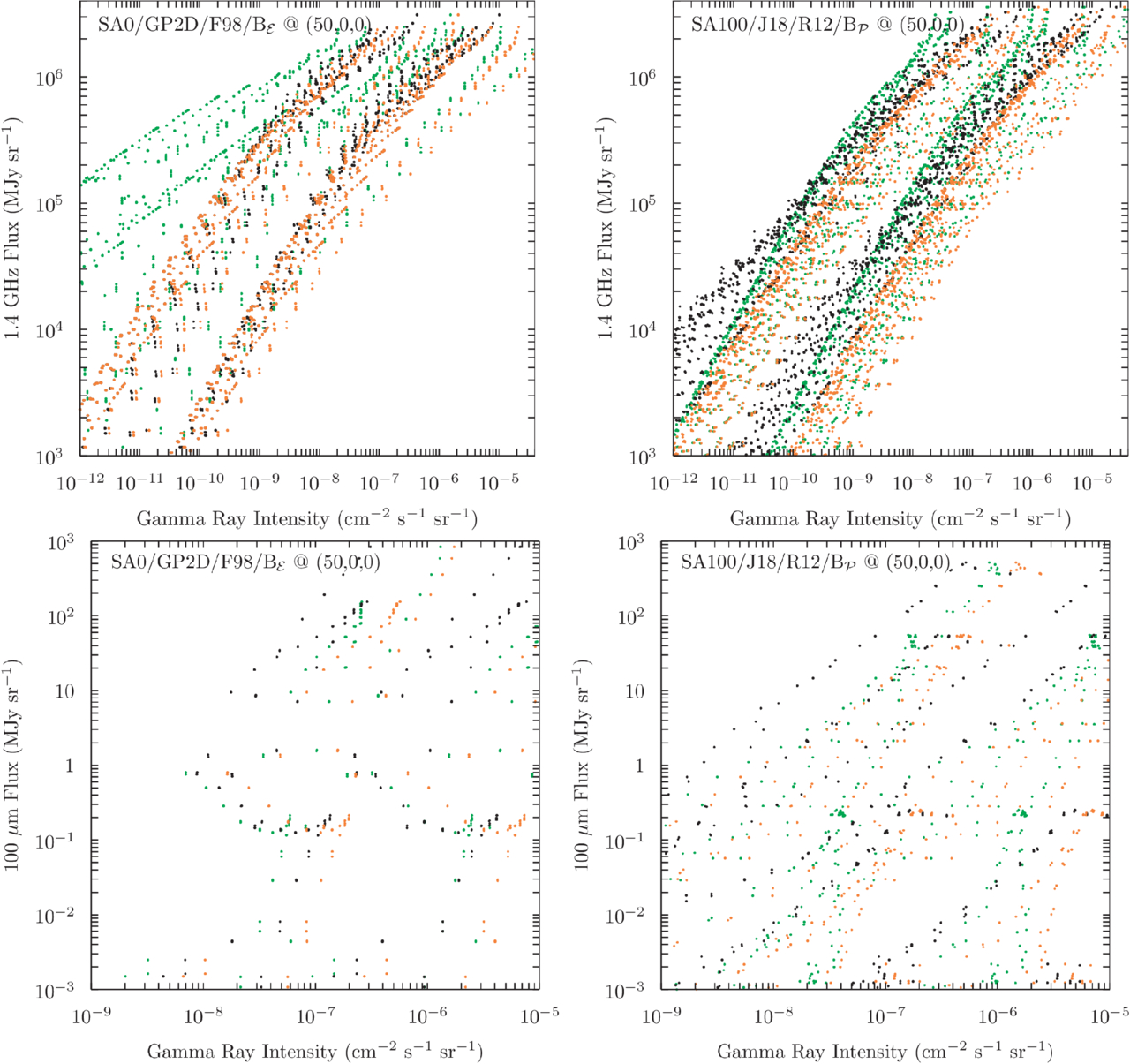
In contrast, Figure 2 shows the correlation plot between radio and γ-ray emission (upper panels) and between infrared and γ-ray emission (lower panels) when viewing the galaxy edge-on (viewing the disk from the side). The radio–γ-ray correlation is preserved, while the infrared–γ-ray correlation is no longer observed. This is because, at this inclination, geometric projection separates the emission components. Infrared-emitting dust and γ-ray emission from cosmic ray–interstellar medium interactions are confined to the disk, while synchrotron radio emission and γ-ray emission from inverse-Compton scattering extend to larger distances above and below the disk. As a result, in an edge-on view, a sight line passing through the disk sees strong infrared emission, while a sight line that misses the disk sees zero infrared but still some γ-ray emission, breaking the infrared–γ-ray correlation. On the other hand, because radio emission is more extended than infrared emission, sight lines that miss the disk can still see both radio and γ-ray emission together, preserving the radio–γ-ray correlation.
relationships between infrared, radio, and gamma-ray flux for two types of galaxy models

Figure 2: Correlation plots for two galaxy models viewed edge-on from 50 kpc — simple axisymmetric (left) and complex with spiral arms (right). Top: radio vs. γ-ray; bottom: infrared vs. γ-ray. Colors indicate γ-ray production mechanisms (green: proton–gas; black: inverse-Compton; orange: total). The infrared–γ-ray correlation breaks down, while the radio–γ-ray correlation is broadened but partially preserved. [Porter et al. 2026]

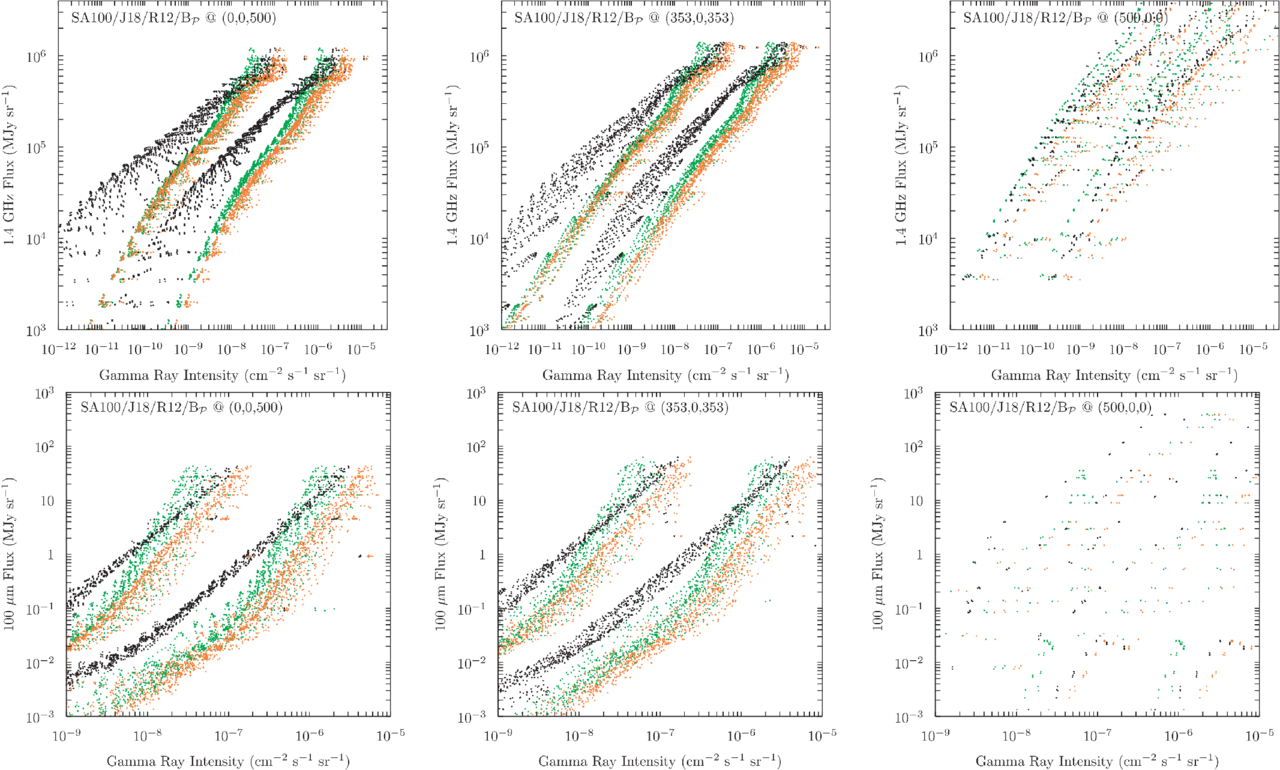
However, there is one situation where the edge-on correlation comes back: when the observer is far enough away that the image becomes too blurry to resolve the galaxy’s internal structure. Figure 3 shows the same galaxy model viewed from 500 kpc, roughly the distance to Messier 31, our nearest large neighbor. At this distance, a single pixel in the image covers about 1 kpc, large enough for everything along the line of sight. The messy, broken-up pattern seen in the closer 50 kpc edge-on view (lower-right panel of Fig. 2) disappears, and a tight, nearly linear correlation comes back. This explains why nearly all distant, unresolved galaxies show tight radio–infrared–γ-ray correlations: the tightness is simply what you get when you blur everything together, not evidence that cosmic rays are actually losing all their energy locally inside those galaxies.
relationships between infrared, radio, and gamma-ray flux for simulated galaxies viewed from 500 kiloparsecs

Figure 3: Correlation plots from a complex galaxy model viewed from 500 kpc, at three different inclinations (face-on, 45°, edge-on). Top row: radio vs. γ-ray; bottom row: infrared vs. γ-ray. Colors indicate different γ-ray production mechanisms (green: proton–gas; black: inverse-Compton; orange: total). At this distance, the blurring effect of large pixels restores a tight correlation even in the edge-on view. [Porter et al. 2026]

Now we have a consistent picture of the radio–infrared–γ-ray correlation: the authors conclude that this correlation is not a direct signature of cosmic-ray calorimetry, but a geometric projection effect. In face-on systems, a single sight line integrates emission from both the disk and off-disk regions, naturally producing a linear correlation, even when cosmic rays do not lose all their energy locally to radiation (i.e., local calorimetry is absent). In edge-on systems, the correlation breaks down because geometric stratification separates the different emission components. The practical implication is significant: for unresolved galaxies, the tightness of the global correlation alone cannot be used as evidence for cosmic-ray calorimetry, and the physically meaningful information about cosmic-ray transport and escape efficiency is encoded in the scatter around the mean trend, not in the correlation itself.

Original astrobite edited by Kelsie Taylor.

About the author, Sandy Chiu:

I’m a PhD candidate at the University of Michigan, Ann Arbor. I’m interested in numerical simulations of cosmic rays feedback in galaxies and their comparison with observation.

The post Do Galaxies Really Glow in Sync — or Are We Just Tilting Our Heads? appeared first on AAS Nova.

Octopus Energy urges millions of households to use less electricity during solar eclipse

Firm urges customers to avoid running washing machines and dishwashers between 6pm and 8pm on Wednesday

Great Britain’s biggest household energy supplier is calling on its customers to use less electricity this week during the deepest solar eclipse in almost 30 years.

Octopus Energy has urged customers to avoid running washing machines and dishwashers between 6pm and 8pm this Wednesday as the moon is expected to block up to 95% of the sun over parts of Britain.

Continue reading...

© Photograph: Dan Kitwood/Getty Images

© Photograph: Dan Kitwood/Getty Images

© Photograph: Dan Kitwood/Getty Images

Droughts Are Getting So Intense That Ancient Ruins Are Beginning to Surface From Dried Up Rivers

10 August 2026 at 13:27

Water levels in rivers across Europe are reaching astonishing lows lately as a record heatwave continues to bake much of the continent.

Images captured by the European Union’s Copernicus Sentinel-2 satellite revealed the extraordinary extent of the drought, which is clearly desiccating Europe’s major waterways. Water levels in one of those rivers, the Danube, have become so low that ancient ruins are beginning to surface for the first time in centuries.

As Reuters reported, the portion of the Danube that flows through Bulgaria has slowed to a mere trickle, revealing foundations of the Constantine Bridge, a nearly 1,700 year-old structure that was opened for business back during the rule of Roman Emperor Constantine the Great in the year 328 AD.

Though the bridge is believed to have been destroyed just a few decades after it was finished, researchers regard it as among the longest bridges engineered by the Roman Empire, a marvel of ancient engineering. Though receding water levels come with plenty of downsides, Pavel Popov, a Bulgarian archeologist with the Pleven Regional Historical Museum told Reuters that the droughts do offer a unique opportunity to study the ancient wonder.

“For archaeologists, these moments are ​extremely valuable because nature briefly reveals an object that ​is hidden beneath the Danube for most of the time,” Popov explained. “It gives us ​a rare opportunity to observe, document and study it ​in its real environment.”

After the ruins surfaced, Reuters reports that local researchers used drones to survey the exposed ruins, with the low water levels offering a chance to trace the bridge’s physical footprint and evaluate the condition of the foundation materials.

Numerous other treasures have surfaced across the Danube, like the remains of a mammoth tusk in the Bulgarian village of Ryahovo, and a sunken Nazi warship near the Croatian town of Opatovac.

More on climate change: El Niño Already Killing Thousands in Europe

The post Droughts Are Getting So Intense That Ancient Ruins Are Beginning to Surface From Dried Up Rivers appeared first on Futurism.

❌