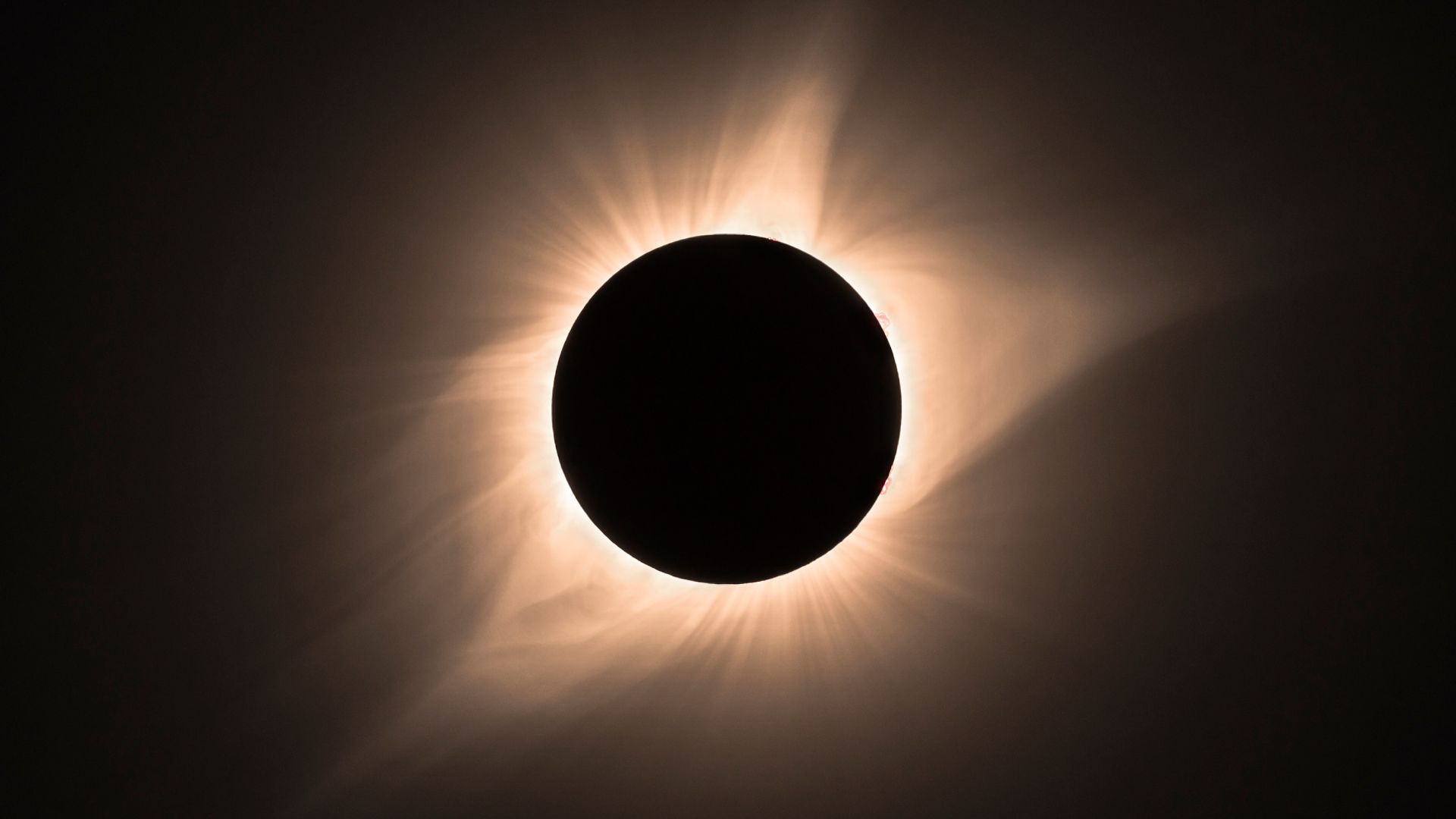
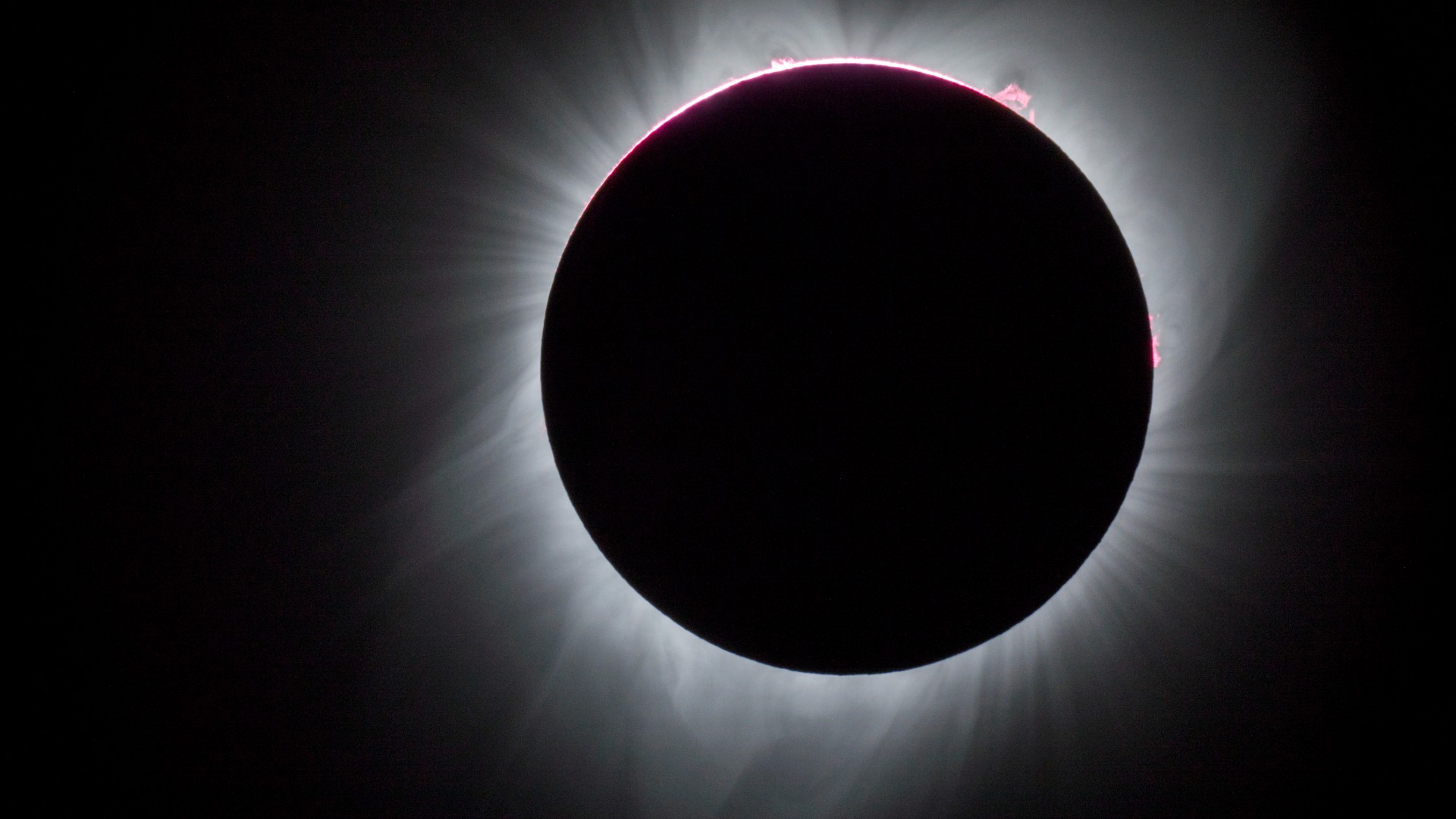
A spectacular total solar eclipse will coincide with the peak of the Perseid meteor shower on Aug. 12-13. But will you be able to spot shooting stars in the false twilight of totality?
Perseids appear as Earth plows through the stream of debris shed by comet Swift-Tuttle. Up to 100 shooting stars may be seen each hour around its peak under ideal dark skies, as particles from the ancient comet collide with our atmosphere at speeds of 133,200 mph (214,365 km/h) to etch a fiery path through the summer night sky.
It's an unmissable highlight of the skywatching calendar, supercharged in 2026 by the spectacle of a total solar eclipse, which will plunge millions across Greenland, Iceland and Spain into the darkness of an eerie twilight, as the moon crosses the face of the sun.
Is it possible to see shooting stars during totality?
Yes. The most brilliant Perseid shooting stars can shine bright enough to be spotted in the brief twilight of totality. But it's all a question of timing.
"It would have to be a fireball that passed through the darkest portion of the sky," Robert Lunsford of the American Meteor Society told Space.com in an email. "The Perseids usually produce about one fireball per three hours at night. That's asking a lot for one of these bright meteors to appear during a 2-3 minute window. If anyone does see one, they had better go play the lottery asap!"
The sky will take on the appearance of dusk as totality falls. (Image credit: John Finney Photography via Getty Images)
NASA Meteoroid Environments Office head Bill Cooke added his own word of caution, noting that the relatively bright sky during totality will likely hide all but the most brilliant Perseids from sight.
"Only Perseid fireballs will be visible," Cooke told Space.com in an email. "Given the brightness and duration of the eclipse, you might see one if you're extremely, extremely lucky. [The] most likely scenario is that you will see no meteors whatsoever."
The odds are definitely stacked against you. But you never know. A piece of comet Swift-Tuttle could've broken away at just the right time, at just the right point in its orbit to meet a fiery end in Earth's atmosphere, just as the sun slips from view. As for our advice? Keep your eyes locked firmly on the eclipse as it unfolds in the skies above you. There'll be plenty of time for hunting Perseids later.
Editor's Note: If you would like to share your astrophotography with Space.com's readers, then please send your photo(s), comments, and your name and location to spacephotos@space.com.
The Aug. 12 total solar eclipse is just one day away! Here's how you can watch the entire show live online from the comfort of your home
Millions of people across Spain, Iceland and Greenland will see the moon completely hide the sun during the climactic phase of totality on Aug. 12. Countless more skywatchers across Europe will witness a deep partial solar eclipse, as the moon's curved silhouette covers a swathe of the sun's surface, while failing to cover it entirely.
Thankfully, we live in modern times. So there's no need for you to miss out on the solar spectacle if you find yourself outside of the path of totality, or if clouds conspire to ruin your view. Here's where to watch every phase of the 2026 total solar eclipse live online.
NASA
NASA will be hosting its own livestream of the event starting at 1:15 p.m. EDT on Aug. 12, featuring live views of totality from cameras spread throughout the path of the eclipse. The visuals will be accompanied by information on the science of the incredible event and details on how the agency is working to learn more about our sun.
Time and Date's YouTube livestream kicks off at 12 p.m. EDT (1700 GMT) on Aug. 12, bringing live views of the eclipse from Leon in northwestern Spain and the island of Mallorca, along with live commentary from journalist Anne Buckle and astrophysicist Graham Jones.
The European Space Agency
An official European Space Agency (ESA) livestream will begin at 1:30 p.m. EDT (1730 GMT) on Aug. 12. The stream will feature expert commentary on the science of the eclipse along with live views from telescopes at the Observatorio Astrofisco de Javalambre, which is located close to the Spanish city of Teruel directly in the path of totality.
Royal Observatory Greenwich
London's historic Royal Observatory Greenwich will host two simultaneous YouTube streams featuring live views of the partial solar eclipse starting at 1:15 p.m EDT (1815 GMT) on Aug. 12. The first livestream will be presented by Royal Observatory astronomer Greg Brown, who will discuss the science of the sun while providing expert commentary on the eclipse, while the second will offer a silent livestream, featuring visuals of the eclipse with no accompanying audio.
Be sure to check out our live blog for all of the latest news on the Aug. 12 total solar eclipse. We'll also have reports from Skywatching Writer Anthony Wood as he watches the eclipse unfold low in the horizon in central Spain, and also from Skywatching Editor Daisy Dobrijevic as she witnesses the spectacle during a voyage with HX Expeditions to Greenland!
Editor's Note: If you would like to share your eclipse photos with Space.com's readers, then please send your photo(s), comments, and your name and location to spacephotos@space.com.
Originally launched a decade ago, the ZWO ASI174MM is a planetary astrophotography camera — something you insert into the eyepiece of a telescope to take images and video of deep-sky objects, planets, the moon and the sun. This one is very much geared towards the latter, with solar and lunar imaging its goal.
Specifications
Product type: Monochrome astronomy camera
Sensor: 1/1.2-inch Sony Exmor IMX174LLJ / IMX174LQJ CMOS
Resolution: 2.3MP, 1936x1216
Pixel size: 5.86µm
Shutter: Pregius global shutter
Maximum frame rate: 164.5fps at full resolution in 10-bit mode; 128.2fps at full resolution in 12-bit mode
At first glance, the specification looks simple: a 2.3MP monochrome Sony IMX174 sensor, 5.86µm pixels, USB 3.0 connectivity and a compact red aluminum body. The important details are the sensor size, speed and global shutter. For lunar and solar imaging, where you often want to capture large areas in high frame rate videos and freeze split-seconds of steady “seeing” — when turbulence in Earth’s atmosphere doesn’t degrade an image of an astronomical object — those traits matter more than headline megapixels.
The ASI174MM is especially attractive for solar imaging with an H-alpha telescope — a filter that blocks all wavelengths of light other than H-alpha, which is emitted by hydrogen atoms. That’s because its 5.86 μm pixels match the focal ratios typical of solar telescopes, yielding sharp, efficient detail. Its relatively large sensor can cover more of the solar disc than many small planetary cameras, while its high frame rate supports the usual lucky-imaging workflow of capturing video, selecting the best frames and stacking them for sharper images.
ZWO ASI174MM astronomy camera: Design
Large 5.86µm pixels help with solar and lunar capture. (Image credit: Jamie Carter)
Compact aluminum camera body
USB 3.0 and ST4 guide port included
Useful adapter bundle
The ZWO ASI174MM has a compact, lightweight and practical design that’s ideal for use as a camera attached to a telescope. Its small cylindrical aluminum body adds very little strain to a focuser, solar diagonal or off-axis guider, which is particularly useful when working with solar telescopes.
The compact aluminum body weighs just 140g. (Image credit: Jamie Carter)
Usefully, the camera includes a high-speed USB 3.0 connection, which is important because the ASI174MM’s main strength is capturing and transferring many video frames very quickly. It can also be used over USB 2.0, but doing so gives up much of the performance that makes the camera appealing in the first place.
The 2.3MP resolution is modest, but well suited to bright solar system targets. Jamie CarterIt’s a tough, practical performer for imaging the sun and moon. Jamie Carter
An ST4 guide port adds extra flexibility. Although the ASI174MM is primarily sold as a planetary camera, it can also be used as a guide camera (mounted on top of a main imaging scope to capture a wide field of view), especially with off-axis guiders (a device that sits between a main camera and the telescope to precisely track stars), where the larger sensor helps find guide stars more easily than smaller-chip models.
ZWO ASI174MM astronomy camera: Performance
A mono image of the sun using data captured by the ZWO ASI174MM. (Image credit: Jamie Carter)
Excellent for solar and lunar video capture
Global shutter is a real advantage
Large pixels favor longer focal lengths
A prominence on the sun captured using the ZWO ASI174MM. (Image credit: Jamie Carter)
The ASI174MM’s combination of a relatively large 1/1.2-inch sensor, 5.86µm pixels, and fast video capture makes it particularly well-suited to imaging the sun and moon. Compared with planetary cameras built around smaller sensors, it records a considerably larger area of the telescope’s field of view, reducing the number of panels needed for mosaics and making it easier to locate and frame a target.
At full resolution, the ASI174MM can capture over 100 frames per second. (Image credit: Jamie Carter)
That larger sensor is especially useful for solar imaging, which is what we tested it with. The exact field of view depends on the telescope’s focal length, but the ASI174MM can capture larger active regions — and, with some setups, most or all of the solar disc — without immediately requiring a mosaic. For example, we tested it with the Sky-Watcher Heliostar 76Ha solar telescope, for which it is a natural match, where prominences, filaments, sunspots and rapidly changing structures on the solar surface need to be recorded at high speed.
A mono image of the sun using data captured by the ZWO ASI174MM. (Image credit: Jamie Carter)
The camera’s global shutter is another advantage for solar imagers. A rolling shutter (the standard choice for deep-sky imaging) records an image progressively, one row of pixels at a time, to produce a low-noise, high-dynamic-range image. However, atmospheric turbulence, which slightly shifts the image, can cause distortion. A global shutter exposes the entire sensor simultaneously, helping the ASI174MM preserve the shape of solar and lunar features more accurately from frame to frame.
The ASI174MM works well with solar telescopes, lunar rigs and longer focal-length scopes. (Image credit: Jamie Carter)
High-speed capture also supports lucky imaging. Instead of trying to produce one perfect exposure, the camera records thousands of short exposures in rapid succession. Software then identifies and stacks the sharpest frames — the brief instants when Earth’s turbulent atmosphere becomes relatively steady.
A colorized image of the sun via the ASIStudio software. (Image credit: Jamie Carter)
While it’s ideal for solar imaging, the ASI174MM is much less convincing as a conventional deep-sky camera. Long exposures can reveal pronounced amp glow towards one side of the frame, while the uncooled sensor becomes increasingly noisy as exposure times increase. Calibration with dark frames can reduce these effects, but it adds complexity and cannot turn the ASI174MM into a modern cooled deep-sky camera. It can be used for short-exposure imaging, guiding and some specialist applications, but solar, lunar and planetary video remain its natural strengths.
ZWO ASI174MM astronomy camera: Functionality
The sun through the ASICap software. (Image credit: Jamie Carter)
Captures good data
ZWO software works well
Little guidance available
The ASI174MM fits neatly into the established workflow for solar, lunar and planetary imaging: capture a high-speed video, identify the sharpest frames, align and stack them, then sharpen and process the image. Its fast USB 3.0 connection enables high data transfer rates, while region-of-interest controls allow the user to record only a selected portion of the sensor. Reducing the size of the recorded area can substantially increase the frame rate, which is particularly useful when imaging an individual sunspot.
USB 3.0 connectivity allows fast frame rates for lucky imaging. (Image credit: Jamie Carter)
Several free applications can control the camera and record these videos, including SharpCap and FireCapture. AutoStakkert! is widely used to analyze, align and stack solar, lunar and planetary frames, while programs such as ImPPG, RegiStax, Siril, Adobe Photoshop and GIMP can be used for sharpening, contrast adjustment and final processing. Windows users have the widest choice of third-party astronomy software.
However, ZWO also provides its own free ASIStudio software suite. For the ASI174MM, the most relevant applications are ASICap, which controls the camera and records lossless SER or AVI video, and ASIVideoStack, which analyses and stacks the resulting frames (and can also be used for post-processing). ASIStudio is available for both Windows and macOS.
A sunspot on the sun through the ASICap software. (Image credit: Jamie Carter)
The basic capture process is straightforward. After connecting the ASI174MM to ASICap, exposure time and gain are adjusted until the brightest areas of the sun or moon remain below saturation. Because this is a monochrome camera, the live view can be shown either in grayscale or with false color applied for easier viewing. A video containing around 1,000 to 3,000 frames is then recorded, though the ideal number depends on the target, seeing conditions and available storage.
Storage requirements are significant. Uncompressed high-frame-rate video from the full sensor can consume several gigabytes in a matter of seconds, so a fast computer, a USB 3.0 connection and plenty of free drive space are essential.
Stacking using the ASIVideoStack software. (Image credit: Jamie Carter)
Once a video is loaded into ASIVideoStack, the software can assess frame quality, align the image and combine a chosen percentage of the sharpest frames. The finished stack can be exported in formats including JPEG and FITS. JPEG is convenient for immediate sharing, but FITS preserves more of the original image data and is better suited to serious post-processing.
Image editing using the ASIVideoStack software. (Image credit: Jamie Carter)
The workflow is functional rather than polished. There is relatively little guidance for beginners and obtaining the best results requires experimentation with exposure, gain, frame rate, focus, stacking percentages and sharpening settings. It can take many attempts to determine which combination works best with a particular telescope and observing conditions. For that reason, it’s wise to archive the video files, which can be revisited and processed later as processing skills/software improves.
How we tested the ZWO ASI174MM
Its Sony IMX174 sensor gives a wider field than many smaller planetary cameras. (Image credit: Jamie Carter)
We tested the ZWO ASI174MM planetary camera for two weeks and used it in conjunction with the Skywatcher HelioStar 76mm solar telescope and Solar Quest mount to image the sun in H-Alpha (Hα).
Should I buy the ZWO ASI174MM?
Buy it if:
✅ You mainly image the sun or moon: The ZWO ASI174MM astro cam excels in solar, planetary and lunar imaging, so if these are your main astrophotography targets, it's the perfect choice.
✅ You have an H-Alpha telescope: If you have a solar telescope and want to move on from observation to start imaging the sun with it, you will need a monochrome astrocam like the ZWO ASI174MM.
Don't buy it if:
❌You want a dedicated deep-sky imaging camera: This model exhibits severe amp glow for exposures longer than a few seconds and lacks thermoelectric cooling (TEC) needed for noise reduction.
❌You need high megapixel resolution: The low resolution is another reason it fails as a deep-sky imaging camera as you would want a higher resolution model for detail in star clusters and galaxies.
Buy the ZWO ASI174MM if your main targets are the sun and moon, especially if you want a monochrome camera with a larger-than-average sensor, fast frame rates and a global shutter. It remains particularly suited for H-alpha solar imaging, where monochrome capture, speed and sensor area matter.
If this product isn’t for you
If you want a cheaper first planetary camera, a smaller-sensor ZWO ASI120-series-style camera may be enough for basic lunar, planetary and guiding use, though it will not offer the same field of view.
If you want a more modern planetary camera, look at newer monochrome planetary models like the ZWO ASI585MM with lower read noise, smaller pixels or higher resolution, depending on your telescope’s focal length.
If your goal is deep-sky imaging, a cooled astronomy camera is a better choice than the ASI174MM. We have reviewed the ZWO ASI533MC Pro and the ASI183MC Pro and gave both of them nothing less than four and a half stars for beautiful deep-sky astrophotography.
Stars do not actually switch their lights on and off when they twinkle. The flicker happens between the star and your eyes, as its light passes through Earth’s moving atmosphere. Planets are affected by the same air, but they usually look steadier because their light arrives from a small disk rather than a single point. […]
On Aug. 12, 2026, a total solar eclipse will sweep across Earth, giving skywatchers across Greenland, Iceland and northern Spain an incredible view of totality. As the moon completely covers the sun, day will briefly turn to twilight, revealing the sun's faint outer atmosphere, the corona. But could totality reveal something else too?
Although totality never produces true nighttime darkness, it does briefly dim the sky to roughly the brightness of twilight. Since eclipse chasers in Greenland and Iceland will be in the auroral zone — the geographic zone around Earth's magnetic pole where auroras are most frequently seen — it's natural to wonder whether the two phenomena could appear together.
The answer is yes — but only if everything falls perfectly into place.
"During totality, the sky brightness is comparable to civil twilight (the first period of darkness after sunset, until the sun reaches six degrees below the observer's horizon). It's uncommon to see auroras during this time, but by no means impossible," Tom Kerss, independent astronomer and Chief Aurora Chaser for tour company Hurtigruten, told Space.com in an email.
Kerss knows this from experience. Last year, he photographed the northern lights in Norway at twilight, demonstrating that sufficiently bright auroras can remain visible even before the sky becomes fully dark.
Twilight aurora captured by Tom Kerss in Norway, 2025. (Image credit: Tom Kerss)
However, the aurora's position in the sky would impact its visibility.
"During totality in August, the surface brightness of the sun's corona would almost certainly outshine auroras in its vicinity, but other parts of the sky away from the eclipse could host visible auroral structures," said Kerss.
So while it's physically possible, how likely is it?
Not very.
"If the auroral activity stays quiet, we wouldn't expect to see it during totality even though we know some energy is probably being emitted in the dayside portion of the oval," Kerss said.
To have any realistic chance of seeing the northern lights during the eclipse, Earth would need to be in the grip of a severe geomagnetic storm. These storms occur when eruptions from the sun, such as coronal mass ejections (CMEs), slam into Earth's magnetic field. During such conditions, auroras can get a dramatic boost, appearing brighter and more widespread than usual.
Kerss explained that observers would almost certainly need a G4 or G5 geomagnetic storm (G5 is the most powerful category) to overlap with the eclipse to have any realistic chance of seeing an aurora show because they will be on Earth's dayside.
"Bright, nightside aurora can be driven by powerful substorm activity, in which energy is stored and released," Kerss explained. "The dayside aurora is driven by a combination of favorably aligned solar wind (which opens the field lines around the Earth's polar cusps) and strong precipitation directly into the auroral oval. This latter requirement is contingent on very strong or extreme geomagnetic activity."
Kerss' thoughts are echoed by Pål Brekke, a solar physicist and northern lights expert working as Lead of Space Science at the Norwegian Space Agency.
Brekke knows just how difficult this is. He attempted to spot auroras during the 2015 total solar eclipse over Svalbard but found the sky never got dark enough.
"The sky never got that dark — we could hardly see any planets and no stars," Brekke told Space.com in an email. "Most probably because the snow-covered valley and mountains reflecting lights leaking in from the side of the moon's shadow. Making the sky too bright even during the eclipse."
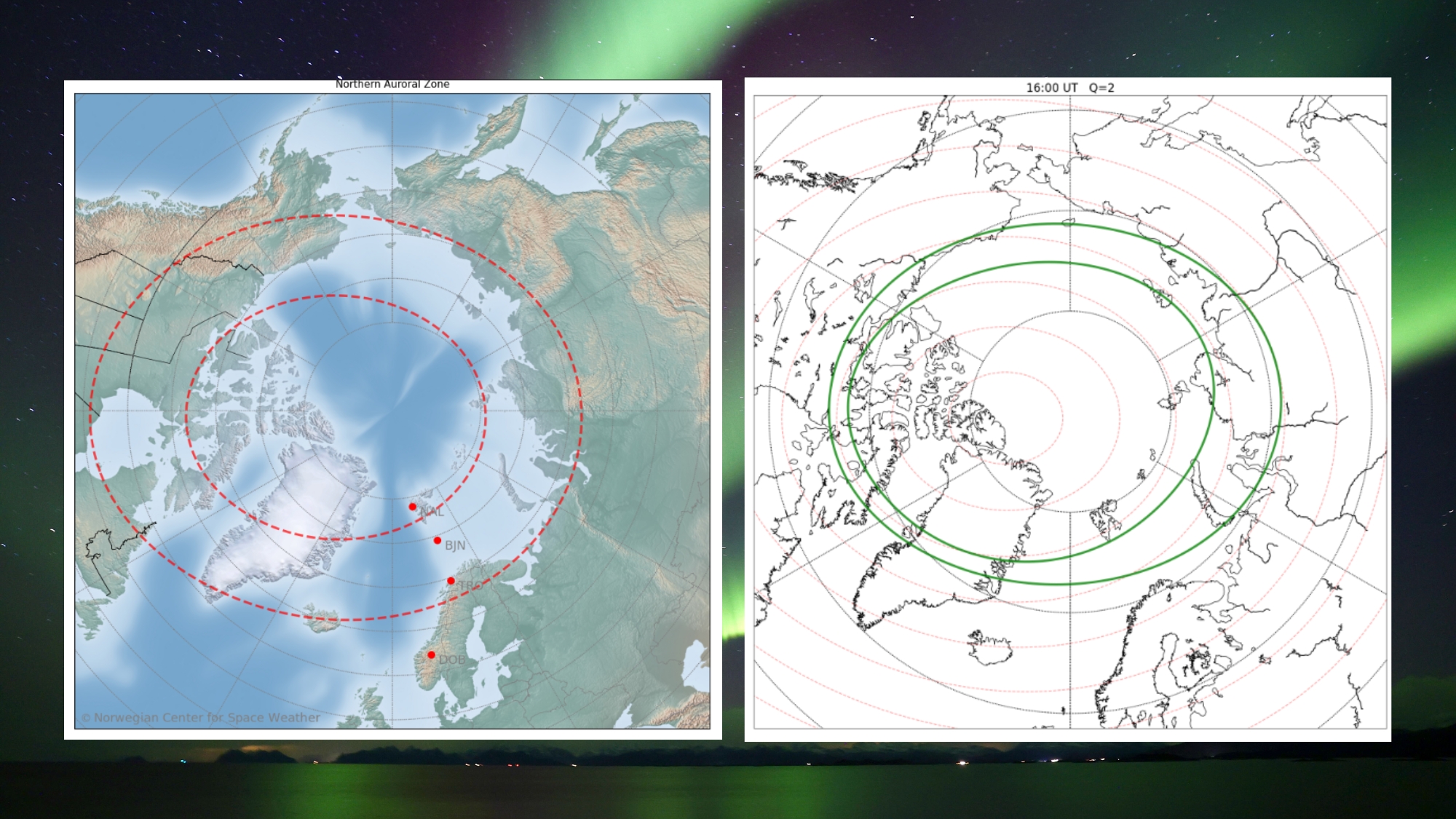
Brekke also pointed out that the timings work against eclipse chasers. Totality occurs in the afternoon over Greenland and Iceland, meaning observers will be beneath the daytime portion of the auroral oval. Unlike the nighttime aurora oval, which expands dramatically during geomagnetic storms, the dayside auroral oval changes much less, making displays harder to see even during active space weather.
Left: The auroral zone — a geographic band on Earth that passes under the oval. Right: The approximate location of the daytime auroral oval at 1600 UTC (around the time of totality for observers in Greenland and Iceland) showing the instantaneous, ring-shaped region where auroras are most likely to occur at that time. (Image credit: Magnar Gullikstad Johnsen, Background added in Canva Pro by Daisy Dobrijevic)
"The chance for aurora over Spain is very low — that would need a KP=9 or so — and 20:00 [UTC] is still very early so the fattest part of the oval is still not over Spain at that time. So our guess is it will not be very likely," said Brekke.
There is one scenario, however, that could make eclipse day even more extraordinary.
"If the sun launches CMEs in the days before the eclipse, it'll be very exciting for anyone going to Iceland or Greenland, and since the exceptional Perseid Meteor Shower will also peak on that date, there's a rare opportunity to see three of the sky's greatest wonders together if conditions line up," said Kerss.
The odds may be slim, but they're not zero.
If the sun happens to unleash a powerful geomagnetic storm in the days leading up to Aug. 12, eclipse chasers in Greenland or Iceland could witness something truly remarkable.
If not, don't be too disappointed. During totality, the sun itself puts on one of nature's greatest spectacles — and that's where your attention should be.
While totality will be visible from parts of Greenland, Iceland and Spain, millions more people across Europe will experience a dramatic partial solar eclipse. Whether you're chasing the moon's shadow in Reykjavik or watching the moon take a 'bite' out of the sun from London, Paris, or Berlin, timing is everything.
A total solar eclipse occurs when the moon moves in front of the sun and blocks it from view. (Image credit: Paul Souders/Getty Images)
A total solar eclipse occurs when the moon moves directly between Earth and the sun, completely blocking the sun's disk from view.
During totality, the sky darkens significantly, temperatures drop and bright stars and planets can even become visible. Observers can also catch a glimpse of the sun's outer atmosphere, known as the corona, glowing around the silhouetted moon.
Totality — when the sun is completely obscured — is only visible within the narrow path of the moon's shadow. Outside that path, observers may see a partial solar eclipse, whereby only a portion of the sun is covered.
REMEMBER to NEVER look directly at the sun. To view this solar eclipse safely, you must use solar filters. Only during the brief period of totality when the moon completely covers the sun, is it safe to look at the sun without protection. Observers will need to wear solar eclipse glasses, and cameras, telescopes and binoculars must have solar filters placed in front of their lenses at all other times.
After the total solar eclipse on Aug. 12, 2026, the next solar eclipse will be an annular solar eclipse on Feb. 6, 2027 visible across parts of Africa and South America. The next total solar eclipse will be a spectacular event on Aug. 2, 2027. Visible across North Africa, it will be the longest totality on land since 1991.

 Login