❌

Normal view

APOD: 2026 August 9 – Contemplating the Sun

9 August 2026 at 05:05

APOD

Astronomy Picture of the Day

Discover the cosmos! Each day a different image or photograph of our fascinating universe is featured, along with a brief explanation written by a professional astronomer.
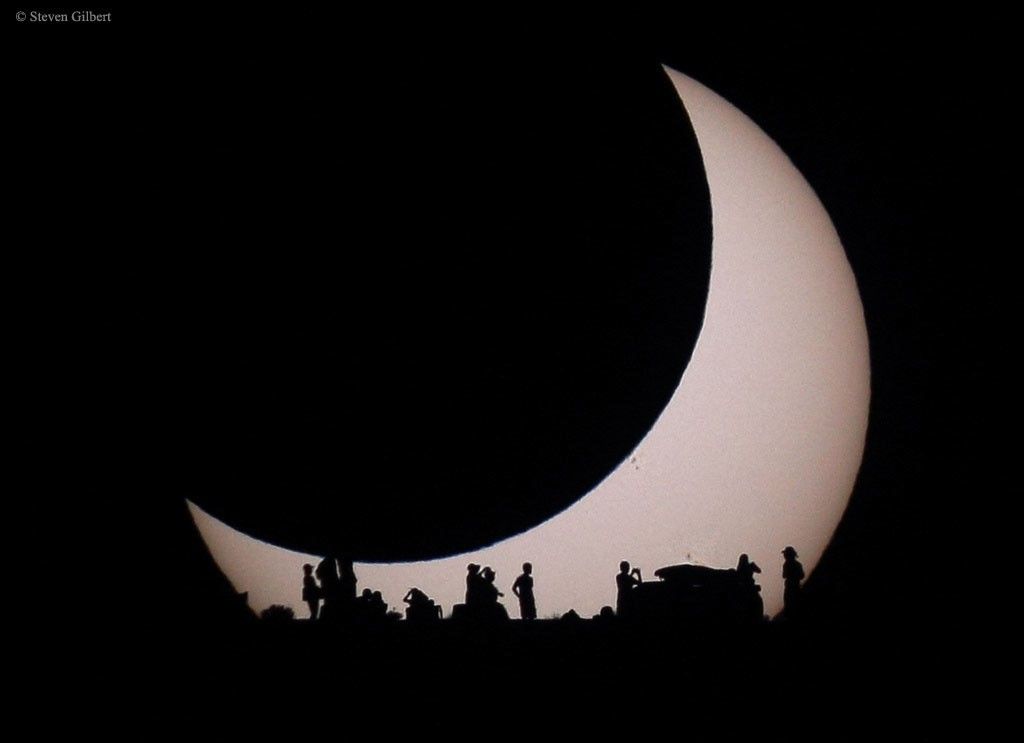
Contemplating the Sun

Explanation: Have you contemplated your home star recently? Featured here, a Sun partially eclipsed on the top left by the Moon is also seen eclipsed by earthlings contemplating the eclipse below. This spectacular menagerie of silhouettes was taken in 2012 from the Glen Canyon National Recreation Area near Page, Arizona, USA, where park rangers and astronomers expounded on the unusual event to interested gatherers. Also, faintly visible on the Sun’s disk, just to the lower right of the dark Moon’s disk, is a group of sunspots. A new solar eclipse will occur this week and give many people in northeastern North America, Europe, and northwestern Africa a new chance to contemplate a partially eclipsed Sun. A thin swath of Earth from Greenland to Portugal will further experience a total solar eclipse. An open question is whether any meteors from the peaking Perseids will be visible during totality.

Date August 9, 2026
Credit & Copyright Steven Gilbert
Authors & editors: Robert Nemiroff, Jerry Bonnell, Cecilia Chirenti, Keighley Rockcliffe
A service of: ASD at NASA / GSFC,
NASA Science Activation & Michigan Tech. U.

The post APOD: 2026 August 9 – Contemplating the Sun appeared first on NASA Science.
APOD: 2026 August 8 – A Messier Moment for Tempel 2

8 August 2026 at 05:05

APOD

Astronomy Picture of the Day

Discover the cosmos! Each day a different image or photograph of our fascinating universe is featured, along with a brief explanation written by a professional astronomer.

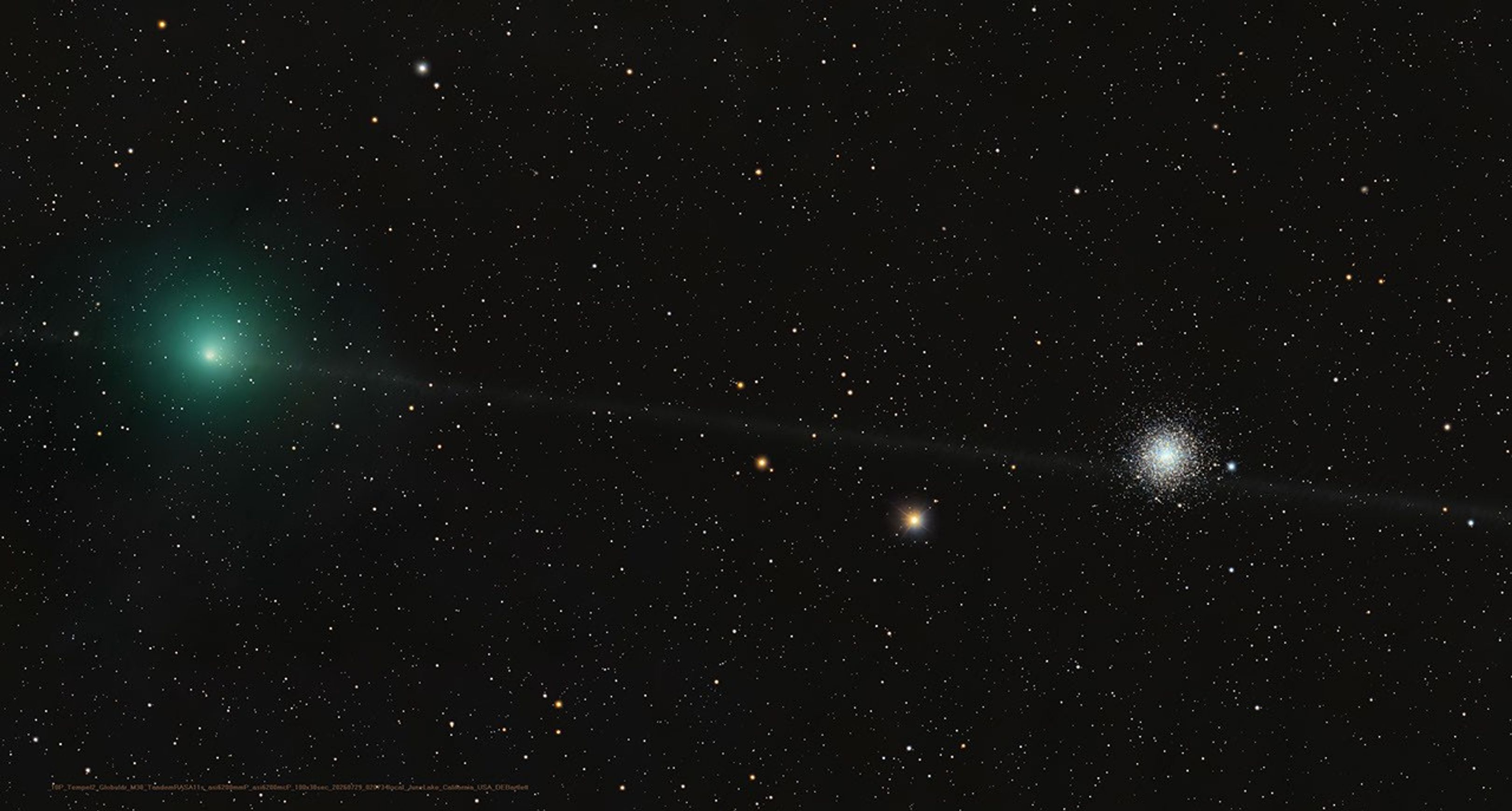
Greenish cometary coma of 10P/Tempel 2 and globular star cluster M30

A Messier Moment for Tempel 2

Explanation: Which of these is not a comet? You guessed it – the one on the right is a globular star cluster. The diffuse greenish coma of periodic comet 10P/Tempel 2 is at left in the frame. In fact the globular star cluster is Messier 30, also known as M30, or the 30th entry in astronomer Charles Messier’s catalog of things which are not comets. The well-known 18th century astronomer kept a list of objects he observed, now his famous Messier Catalogue of Nebulae and Star Clusters, which did not move from night to night against the background stars and so were not the comets he was hunting for. So the famous comet hunter would get the correct answer too, even though his telescope would show both 10P/Tempel 2 and distant star cluster as similar looking faint and fuzzy objects in his field of view. Recorded on July 29, this modern telescopic image captures periodic comet Tempel 2 as it briefly swept close on the sky to M30. While the periodic comet’s faint, narrow, orbital dust trail seems to pierce the globular star cluster, Tempel 2 was a mere 3.5 light-minutes away. Messier 30 is some 28,000 light-years distant.

Tomorrow’s picture: Contemplating the Sun

Date August 8, 2026
Credit & Copyright Dan Bartlett
Authors & editors: Jerry Bonnell, Cecilia Chirenti, Robert Nemiroff, Keighley Rockcliffe
A service of: ASD at NASA / GSFC,
NASA Science Activation & Michigan Tech. U.

The post APOD: 2026 August 8 – A Messier Moment for Tempel 2 appeared first on NASA Science.

APOD: 2026 August 7 – Rubin’s Cosmos Field

7 August 2026 at 05:05

APOD

Astronomy Picture of the Day

Discover the cosmos! Each day a different image or photograph of our fascinating universe is featured, along with a brief explanation written by a professional astronomer.

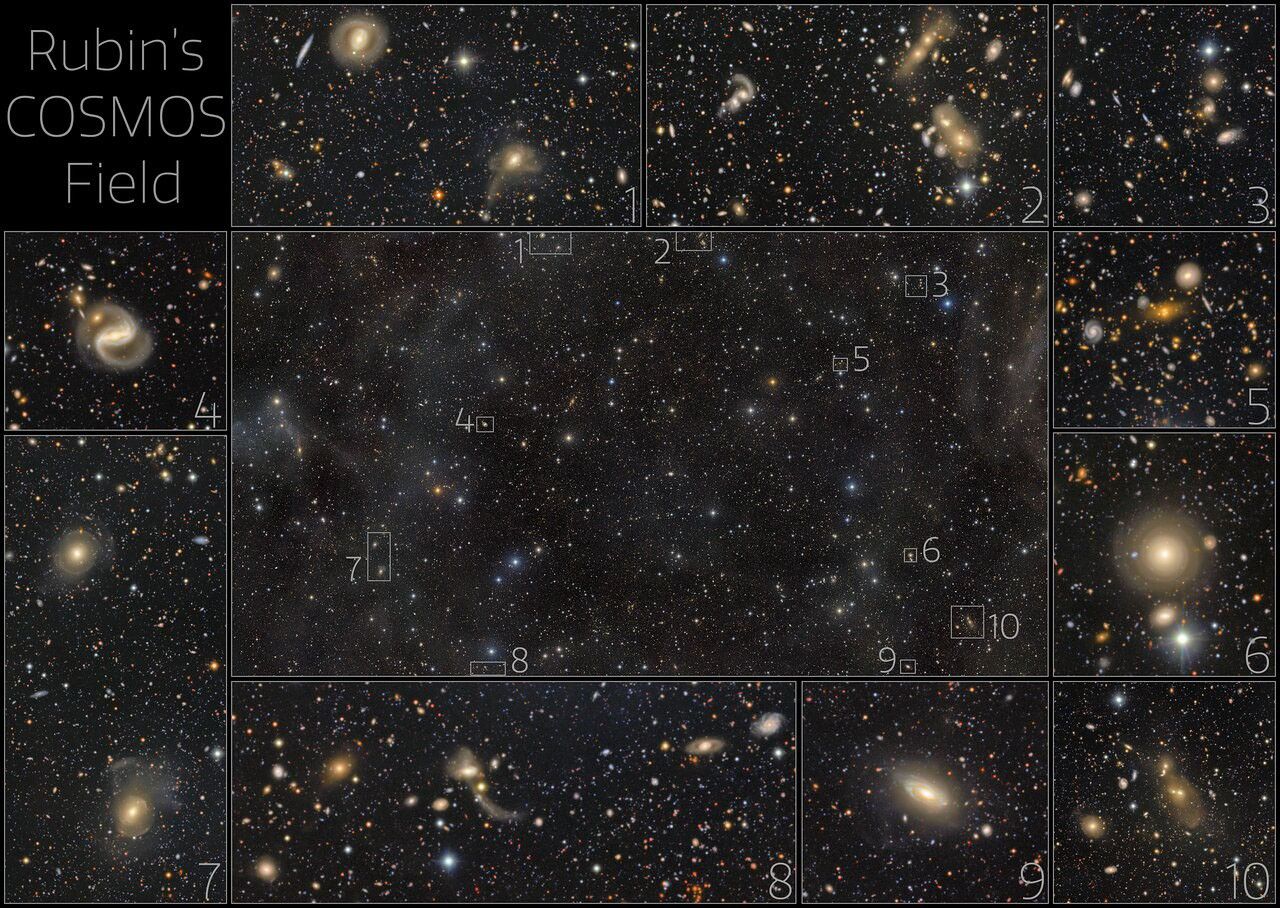
This exceptionally deep image from NSF–DOE Vera C. Rubin Observatory reveals the renowned COSMOS field and its surroundings in the constellation Sextans. The view is crowded with galaxies and galaxy clusters spanning an immense range of distances and cosmic ages, while only a handful of foreground stars belong to our own Milky Way. It was created by combining multiple observations from Rubin’s LSST Camera into a deep co-added image and is being released to mark Early Data Preview 2, the first Rubin data preview based on LSST Camera observations. Here, some selected areas are highlighted. 

Rubin’s COSMOS Field

Explanation: There are more than half a million galaxies in the central panel of this image from the NSF-DOE Vera C. Rubin Observatory in Chile. This is the COSMOS field, a patch of sky several times larger than the full moon, first observed by Hubble. It has also been observed by Webb and other telescopes because it contains comparatively few bright stars from our own galaxy, offering a relatively unimpeded view of other galaxies outside the Milky Way. The outer panels, numbered 1-10, show zoomed-in views of the corresponding small regions highlighted in the central panel. The variety of galaxy shapes and sizes is astonishing. Some of them are so far away that their light has traveled for billions of years before reaching Earth. Rubin will come back every couple of days to the COSMOS field as part of its ten-year Legacy Survey of Space and Time. It will allow a dynamic view of the COSMOS field and how the sky changes over time.

Tomorrow’s picture: a Messier moment

Date August 7, 2026
Credit & Copyright NSF–DOE Vera C. Rubin Observatory/NOIRLab/SLAC/AURA
Authors & editors: Cecilia Chirenti, Jerry Bonnell, Robert Nemiroff, Keighley Rockcliffe
A service of: ASD at NASA / GSFC,
NASA Science Activation & Michigan Tech. U.
❌