❌

Normal view

Marine Heatwaves Are Hiding Far More Heat Than Scientists Realized

Sunlight on SeagrassThe first study of its kind shows that ecosystems experience far more cumulative heat than standard measurements reveal. A marine heatwave may have an official beginning and end, but the warm water affecting an ecosystem often does not. Like a pot that continues absorbing heat over time, coastal waters can remain unusually warm for weeks [...]

Bentham Science Launches International Journal of Wireless and Communication Engineering Innovation

2 August 2026 at 06:24

Bentham Science Launches Two New Journals to Accelerate Research in Wireless Communications and Engineering

Bentham Science Publishers has announced the launch of two new peer-reviewed journals designed to capture the rapid transformation of modern technology: Wireless and Communication Letters and Current Engineering Letters and Reviews. Both publications are now open for manuscript submissions, offering researchers an international platform to share emerging discoveries in communication systems, engineering technologies, and interdisciplinary innovation. The launches arrive as advances in artificial intelligence, sixth-generation wireless networks, satellite systems, advanced materials, and sustainable engineering continue to reshape scientific research and industrial development.

Wireless and Communication Letters is focused on the technologies that enable today’s increasingly connected world. The journal will publish original letters, full-length research articles, comprehensive reviews, mini-reviews, and guest-edited thematic issues addressing both theoretical developments and practical applications. Its scope covers the complete communication chain, from antennas and radio-frequency hardware to signal processing, network architecture, cybersecurity, and intelligent software. By emphasizing the efficient dissemination of research, the journal aims to provide a rapid channel for findings that could influence the next generation of wireless infrastructure.

The technical challenges addressed by the journal are central to the future of digital connectivity. Fifth-generation networks have already introduced high-speed mobile broadband, ultra-reliable low-latency communication, and massive machine-type connectivity, but researchers are now investigating 6G systems capable of supporting even greater data rates, extremely precise sensing, and seamless integration with artificial intelligence. These systems may combine terahertz frequencies, reconfigurable intelligent surfaces, distributed antennas, edge computing, and advanced machine-learning algorithms. Such technologies require new approaches to spectrum allocation, energy efficiency, network coordination, and data security.

The journal also welcomes research on the Internet of Things and machine-to-machine communication, areas in which billions of sensors and devices are expected to exchange data with minimal human intervention. In these environments, communication protocols must operate reliably despite limited power, unpredictable radio conditions, and enormous numbers of connected nodes. Research into low-power wide-area networks, intelligent scheduling, network virtualization, and secure device authentication could help support applications ranging from industrial automation and smart cities to remote healthcare and environmental monitoring.

A further component of the journal’s scope involves the physical science of communication. Antenna design, electromagnetic propagation, microwave engineering, optical links, and satellite communication determine how information travels through real environments. Engineers must account for obstacles, atmospheric conditions, interference, polarization, bandwidth limitations, and the movement of users or spacecraft. Developments in compact antennas, beamforming, optical wireless communication, and satellite-terrestrial integration could improve connectivity in rural regions, disaster zones, transportation systems, and future space missions.

Wireless and Communication Letters is led by Editor-in-Chief Dr. Nasimuddin of the Antenna and Optical Department at the Institute for Infocomm Research in Singapore. Supported by an international editorial board, the journal states that it will apply a rigorous and objective peer-review process. This is particularly important in a field where theoretical claims must often be tested through simulations, prototypes, channel measurements, or performance comparisons. Research involving modulation, coding, information theory, cognitive radio, software-defined networking, artificial intelligence, privacy, and communication protocols will be considered within the journal’s broad technological remit.

Alongside the communications title, Bentham Science has introduced Current Engineering Letters and Reviews, an interdisciplinary journal intended to connect research across the full spectrum of engineering sciences. Announced on 3 August 2026, the journal will publish research articles, short communications, comprehensive reviews, mini-reviews, and thematic issues. Its mission is to bring together discoveries that are often separated into specialist fields, reflecting the reality that many modern technologies emerge from collaboration among mechanical, electrical, materials, chemical, biomedical, environmental, and computer engineers.

The new engineering journal will cover aerospace, civil, structural, transportation, manufacturing, energy, robotics, automation, nanotechnology, artificial intelligence, and digital engineering. It will also address sustainable engineering, renewable energy systems, smart materials, advanced manufacturing, and biomedical technologies. These subjects are increasingly connected: an electric vehicle, for example, depends simultaneously on materials science, power electronics, software, communications, manufacturing, and transportation engineering. An interdisciplinary publication can provide a forum for examining such systems as integrated technological platforms rather than isolated components.

The scientific importance of this approach is becoming more visible as engineers confront challenges involving climate change, resource efficiency, resilient infrastructure, and automation. Renewable energy systems require improved storage, power conversion, and grid management; smart materials can respond to changes in temperature, pressure, or electromagnetic fields; and artificial intelligence can optimize industrial processes by identifying patterns in large streams of sensor data. At the same time, engineering research must demonstrate reliability, scalability, safety, and economic feasibility if laboratory innovations are to produce measurable benefits in society and industry.

Both journals invite contributions from researchers, engineers, scientists, academics, and industry professionals worldwide. Bentham Science says that information about open-access policies, article processing charges, waiver eligibility, editorial policies, and complaints and appeals procedures is available through the respective journal websites. With their emphasis on rapid communication, technical rigor, and interdisciplinary exchange, the two publications seek to become new hubs for research at the intersection of connectivity, intelligent systems, sustainable technology, and engineering innovation.

Subject of Research: Wireless communications, communication engineering, interdisciplinary engineering research, emerging technologies, artificial intelligence, sustainable engineering, and advanced technological systems.

Article Title: Bentham Science Launches Two New Journals to Accelerate Research in Wireless Communications and Engineering

News Publication Date: 3 August 2026 (for the announcement of Current Engineering Letters and Reviews; no publication date is provided for Wireless and Communication Letters).

Keywords

Wireless communications, 5G, 6G, Internet of Things, satellite communications, antenna design, signal processing, artificial intelligence, engineering research, sustainable engineering, robotics, renewable energy, smart materials, advanced manufacturing.

Microsoft vows to make Windows 11 fly on 8GB RAM amid memory shortage — optimizations to reduce OS memory footprint have begun

Microsoft said that it’s planning to optimize Windows 11 for systems with 8GB of RAM and above as part of its promise to improve Windows 11 in March 2026. The company said in its latest update that the optimization is part of expanding its focus on operating system upgrades, which include a faster out-of-the-box experience, easier parental controls, and improved voice interactions.

While the official minimum specifications for Windows 11 sit at just 4GB of RAM, most PC builders advise getting at least 16GB if you want to have a smooth experience. In fact, Microsoft has previously recommended 32GB of RAM for Windows 11 for gamers, especially if they want a system that can handle games in the near future. Unfortunately, the RAMpocalypse has forced both users and manufacturers to stick with slower DDR4 memory and lower capacities. Some experts predict that the entry-level PC will disappear by 2028, and we’ve even seen some manufacturers, including Apple, reintroduce 8GB laptops just to hit a specific price point.

The resurgence of 8GB systems will likely deliver a bad experience for users who stick with Windows 11, which is the likely reason why Microsoft is pushing for the optimization of its operating system. If Windows 11 performs poorly on these systems, it could draw users towards macOS or Linux alternatives as they blame the operating system for underperforming on limited hardware. In fact, we’ve already seen this happen before — after Microsoft ended support for Windows 10, MacBooks saw an uptick in sales as users migrated towards macOS instead of going for Windows 11. SteamOS is also encouraging some gamers to ditch Windows, and Valve is working on a general release for the OS, which many say contains less bloat and is a bit snappier than what Microsoft offers.

The RAM shortage crisis, alongside increasing competition, is forcing Microsoft to do better with Windows 11. Hopefully, these optimizations arrive sooner and don’t introduce new bugs, allowing both new and existing users to get more out of their systems.

The Windows blog post also gave an update on what improvements the company has made to Windows 11 so far. This includes a better Windows Search experience, more Taskbar and Start customizations, a more responsive and reliable File Explorer, among others. Many of these changes are still in preview, though, so unless you’re part of the Windows Insider Program, you’ll have to wait a few more weeks to months before you can start enjoying these changes.

Valve funding port of Linux RADV Radeon Vulkan driver to Windows — cross-platform effort already runs 'Counter-Strike 2'

The Steam Machine helped grow the popularity of Linux gaming, including installations of Bazzite and other gaming-oriented Linux distributions. Valve seemingly doesn't want to stop its open-source development efforts anytime soon, and is now working on a port of the Mesa Radeon Vulkan driver (RADV) to Windows; It's already running Counter-Strike 2, according to developers at Collabora.

As cross-platform development is rather tricky, Valve opted to get a port of RADV to Windows going by way of sponsoring contractors at Collabora. In its blog post, Collabora explained the several hoops it had to jump through to accomplish this task.

With Windows 10 and WDDM 2.0, Microsoft improved the split between graphics drivers' userspace code (the vast majority of the driver itself) and the kernel-level portion that actually talks to the graphics card. This presented the opportunity to hook RADV to the AMD kernel card driver. That's easier said than done, however, as communication between those parts often carries non-standardized data that RADV needs to understand. And to understand the "conversation," it needs to be recorded and analyzed.

An earlier 2024 effort by Faith Ekstrand yielded a basic-but-valuable utility for logging WDDM 2.0 calls and reverse-engineering them to produce a basic RADV implementation. Out of both debugging necessity and as a development tool, Collabora built and expanded upon Ekstrand's work, improving the logger to the point where it can now fully analyze any Vulkan application that runs with AMD's official driver and dump all the data passing to the kernel.

After a lot of work getting to grips with how the AMD driver interacts with the kernel driver, including but not limited to reverse-engineering obscure data structures, the team made progress, and Windows RADV is now able to run some games, including Counter-Strike 2.

Despite the ongoing effort, Collabora explains that since user- and kernel-space driver are a matched pair, changes to those aren't guaranteed to be backwards-compatible, meaning that even a fully functional RADV could break at any point. For that reason, Collobora is requesting that AMD, Microsoft, or both provide a documented interface to the kernel driver or an intermediary compatibility layer.

AMD graphics driver development on Linux has coalesced around the Mesa Vulkan stack, with both company and community devs contributing to the RADV project. Over in the Windows world, the only option is AMD's proprietary driver, which can cause a lot of headaches when developing cross-platform games and applications.

AMD's Vulkan driver for Windows has developed a reputation for instability. Meanwhile, Linux RADV is generally praised for its stability and performance, sometimes running faster than the AMD Windows driver, especially on older cards. With a rapid development schedule, it also generally sees fixes and speed upticks often.

If at some point using RADV on Windows becomes viable, you'd be getting an arguably more stable, mature driver with active development. Games' graphical issues could become far easier to debug and patch thanks to the open nature of RADV, and studios developing with Linux in mind can target the one platform instead of two with different behaviors. Any developer or company can contribute to the project, too.

Furthermore, this lets Valve improve Windows compatibility layers, and any optimizations can be carried over to both operating systems. All told, this is likely one of the several moving parts to improve Linux — thus the Steam Deck, Steam Machine, and upcoming hardware — as a viable gaming platform. Even a future notion of gamers installing RADV on Windows to get a performance or stability boost isn't too far-fetched.

Additionally, RADV on Windows would also help keep discontinued cards usable, and given pricing right now, that certainly would be a good thing.

Windows NT 4.0 brought the Win95 UI to servers 30 years ago today — milestone unifying modern Windows OS hit RTM in the Pentium era

31 July 2026 at 10:00

Microsoft released Windows NT 4.0 to manufacturing partners on July 31, 1996. Codename Cairo marked an important milestone in the history of Microsoft’s original server OS and would far outlive Microsoft’s original plans as enthusiasts and administrators clung to it, as older readers will be aware. Headlining features of NT 4.0, which made it a winner, include the melding of the intuitive new Windows 95 UI into the fully 32-bit enterprise OS. It was also notable for being the last version of NT to support Alpha, MIPS, or PowerPC CPU architectures.

Historical Windows NT timeline:

  • Windows NT Server 3.1 – in 1993, the first version of Windows NT also introduced NTFS
  • Windows NT Server 3.5 – in 1994, this update provided integrated support for Winsock and TCP/IP
  • Windows NT Server 3.51 - client/server support added in 1995
  • Windows NT 4.0 – in 1996, NT got the Windows 95 UI and the familiar My Computer, My Documents, and so on
  • Windows 2000 Server – the 5th NT release started a new naming scheme, introduced Active Directory, plus NTFS 3.0 with file system encryption
  • Followed by the more modern Server releases…

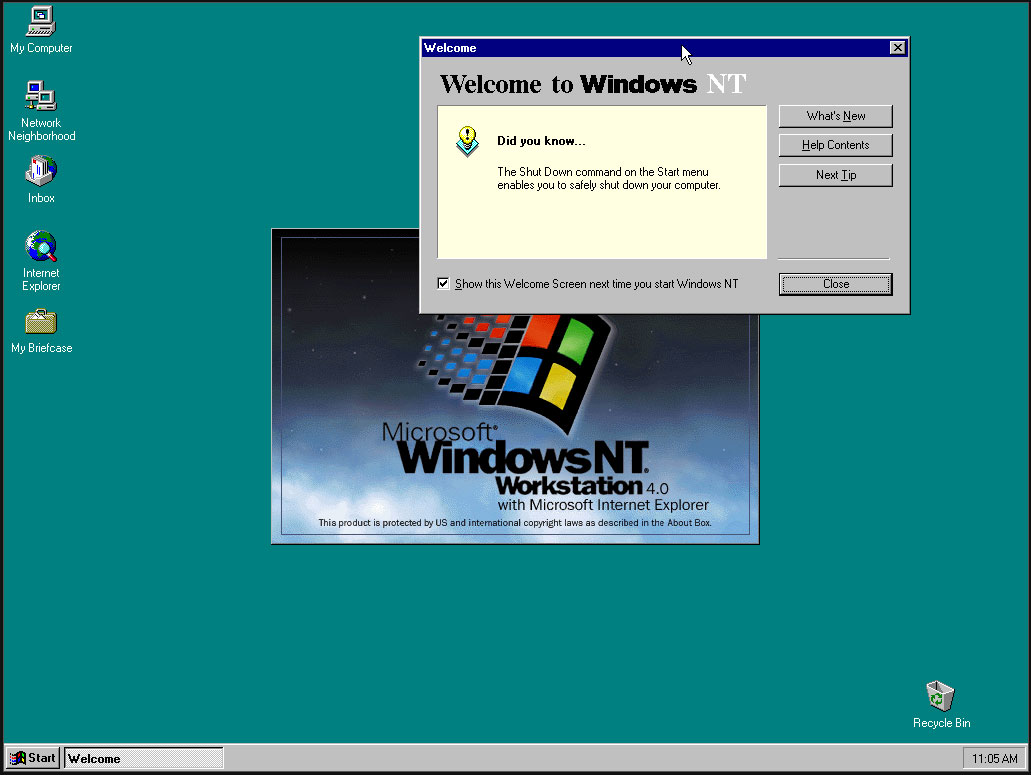
Windows NT 4.0

(Image credit: Microsoft)

After the initial Windows NT 4.0 release, Microsoft followed up with a version for embedded systems and its Terminal Server edition.

The Windows NT line was critical to Microsoft as it led the charge against dominant Unix server software ecosystems. Its first public release was in 1993, with version 3.1, but NT 4.0 coupled the underlying data server and personal workstation tooling with Win95 UI elements such as the Start Menu, Taskbar, Task Manager, and so on. It would also support new components like the cryptography API, DCOM, TAPI 2.0, and some DirectX (v2) features.

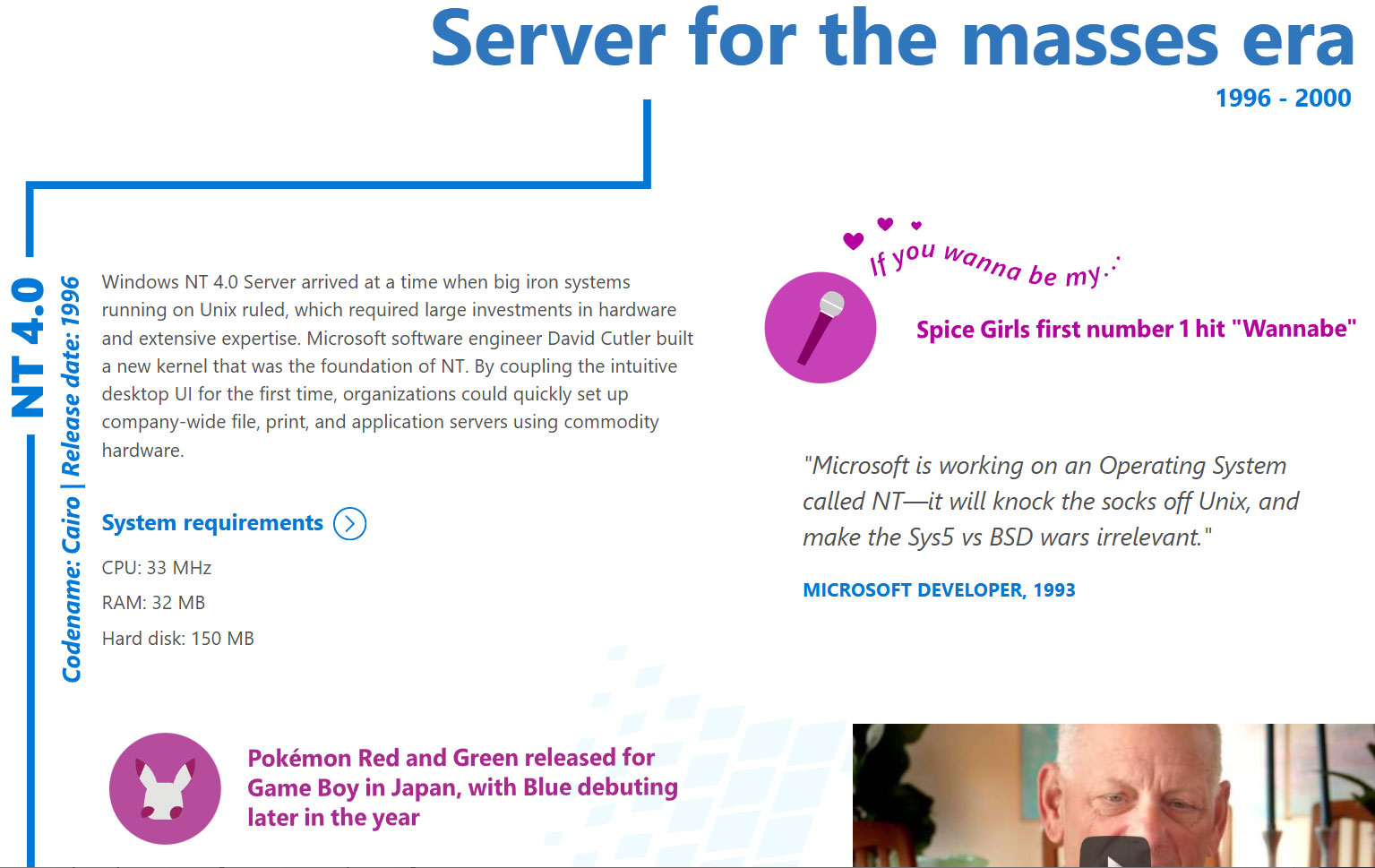
Despite all the new technology under the hood and the frills of the latest UI, Microsoft’s Windows NT 4.0 launched with remarkably low minimum requirements. Would-be users were recommended to install it on a PC with a CPU that ran at 33 MHz or better, had 32MB of RAM, SVGA graphics, and a hard disk with 256 MB capacity. This was in the Pentium / Pentium Pro era. NT 4.0 would become “the server for the masses,” boasted Microsoft on the OS’s 20th anniversary.

Another reason that NT 4.0 was so important is that it formed the foundation for the Windows XP release (2001), leaving the DOS-based 95, 98/SE, and Me versions of the consumer OS behind as archaic hybrids. In the half-decade between the release of NT 4.0 and XP, Microsoft had a lot of work to do, such as implementing Plug and Play, building out gaming tech, adding WDM drivers, and so on. Thankfully, PCs also grew in muscle, specs, and multimedia capabilities to make the larger and more demanding XP a big hit.

Windows XP landed with a core marketing line that it was “Built on NT technology,” which felt uncomfortable to read if you were from the camp that believed ‘NT’ was short for ‘New Technology.’

Windows NT 4.0 screenshots

(Image credit: Tom's Hardware)

It is pretty easy to find an old Cairo release online for retro machine tinkering. Those interested in a more casual poke around in NT 4.0 out of interest, curiosity, or nostalgia will find there are some online installs you can play with via a web browser.

What colors were prehistoric mammals?

30 July 2026 at 12:00

The spots on a leopard, the stripes on a zebra, and the mask on a raccoon are all types of coloration in mammal fur, referred to as pelage. Scientists have struggled for a long time to understand how these colorations evolved. A team of researchers recently discovered how to reconstruct the colors of ancient mammal fur using cell structures that contain the chemical pigment melanin, known as melanosomes. They hope to use this understanding of ancient mammal pelage to determine how they lived and what their environments were like.

To decipher the color of ancient mammal fur, the researchers constructed a statistical computer model to predict their fur colors based on the shape of their melanosomes. First, they needed to understand how the shapes of melanosomes control fur color in modern mammals. To measure the length and width of the modern melanosomes, the scientists used a beam of electrons like a flashlight to map them in great detail, a technique called scanning electron microscopy.

They measured the length and width of 2,615 melanosomes from the fur of 116 different living mammal species, including a Red Panda, a German Shepard, and one or more species of most types in the mammalian classification. Then they recorded the wavelengths of light reflected off each melanosome using a microspectrophotometer. These wavelengths represented the exact color of hair from each melanosome they measured. This means they now had a quantitative measurement of the color of each hair to compare with its corresponding melanosome length and width.

When they examined their data, the researchers found that spherical melanosomes produced brighter fur colors, like reds and oranges, while elongated melanosomes produced darker fur colors, like browns and grays. The researchers plotted the microspectrophotometric measurements for each melanosome as a graph showing how much light it absorbed across each possible wavelength, creating reflectance curves. Based on these data, the researchers used computer software to create a statistical model that could predict reflectance curves, and therefore color, from melanosome shape alone.

Once the researchers created a model, they needed to find fossilized mammal melanosomes to predict their fur color. Mammal fossils are rare, and pieces of cells are only preserved in the most immaculate fossil deposits. In fact, these researchers only found 6 fossils of this caliber, from Mesozoic rocks deposited around 250 million years ago, soon after mammals evolved. 

The fossils came from 2 world-renowned deposits in Northeastern China, the Yanliao and Jehol biotas. They selected 5 previously studied fossils from these locations, including 1 specimen of Megaconus mammaliaformis, 1 specimen of Vilevolodon diplomylos, 2 specimens from the group Docodonta, and 1 specimen from the group Eutheria. All of these animals were small, rodent-like mammals. The researchers also discovered a new species of tree-dwelling mammal, Arboroharamiya fuscus.

The scientists used scanning electron microscopy to measure a total of 2,159 fossilized melanosomes to refine their color predictions. The fossilized melanosomes were all slightly elongated spheres and had far fewer differences in shape than in modern mammals. The researchers used their model to predict reflectance curves based on the shapes of the fossil melanosomes to determine the ancient mammals’ colors. They found that all the extinct mammals they examined likely had dark brown fur without any color patterns.

Based on these findings, the researchers suggested that most, if not all, early mammals were nocturnal, like many dark-colored mammals today. They suggested that this nocturnal lifestyle probably helped them survive the meteorite impact that wiped out the dinosaurs 100 million years later. While dinosaurs were unable to survive in the post-impact wasteland, these smaller, dark-colored mammals were more resilient and thrived in the aftermath. As mammals filled the ecological roles left by the dinosaurs, they evolved new color patterns, some based solely on camouflage, and others on new factors, like sexual selection and visual communication.

The researchers concluded that their model can predict fossilized mammal colors and help determine how these ancient animals lived. Notably, their data suggest that mammals likely stayed small and nocturnal throughout the Mesozoic until the dinosaurs were gone. Future researchers could use similar methods to uncover exactly how mammals evolved the colors we see today. For example, studying mammals closer to the impact event could reveal if it took a long time to develop diverse fur patterns, or if they began before the dinosaurs’ demise. Ultimately, similar studies could help determine whether the extinction of dinosaurs was necessary for the rise of mammals.

The post What colors were prehistoric mammals? appeared first on Sciworthy.

Apple preps for a wearable AI revolution

29 July 2026 at 18:29

This fall, with watchOS 27, Apple Watch will finally get access to Siri AI with a software update that turns your wrist into the most widely-used wearable AI platform on Earth.

That’s not hyperbole. Siri AI on Apple Watch is arguably the most important feature to this year’s watchOS update. Though it didn’t get much attention at WWDC, the update also offers a preview into how Apple will wrap AI into its future smart glasses.

What to expect

One important caveat is to observe that Siri AI on Apple Watch still requires your Apple Intelligence-enabled iPhone to do the heavy lifting. The interaction is easy: tap the Digital Crown and Apple’s new glowing icon appears on screen (you’ll also find this in the App viewer). The experience looks identical across every Apple device — iPhone, iPad, Mac, Apple Watch, and Vision Pro — making the assistant feel like one consistent product rather than a different experience per device.

The Siri app lets you access all your past Siri conversations (unless you turn that feature off) and pick up an old conversation right where you left off. Conversation history syncs privately through iCloud, so you can start an exchange on your iPhone and continue it later from your wrist. You can also pin a conversation you expect to revisit.

You can also use Siri on the Apple Watch to ask questions, launch apps, or even get more complex responses, such as step counts on a specific day. It can also answer difficult and specific queries with detailed answers and can summon real-time information from the web.

Personal context is the real story

That’s key, of course, as it means the smartwatch on your wrist can help you access specific details from all your contextual information; it can get details from messages, emails, and notes, for instance. Or you might use it to find a number and call it, access your door code, or look up customer information for business — all without touching your phone.

One of Apple’s own examples demonstrates this well: Saying, “Show me photos from when I went to Spain,” results in precisely that. You can also ask follow-up questions and keep the conversational going naturally, rather than being confined to single, isolated commands.

Beyond personal data, the watch can also act in apps — get directions home, send an email, play a playlist, or even more specifically, “Play the song that Brandon sent me.”

Context runs deep. A new Call Context tool can proactively surface relevant information from across your apps when phoning a business or help locate a confirmation code from Mail while calling an airline. This arguably challenges a real pain point when speaking with providers and is a good illustration of Apple’s broader AI strategy: to use on-device intelligence to remove everyday friction without asking you to track down the information yourself.

Where we are, where it’s going

It’s frustrating that you still can’t use the Watch to remotely run applications on your Mac, iPhone, or iPad. What you can do is trigger Shortcuts that run on your iPhone: enable this first on your phone by selecting the Shortcut you want and switching on “Show on Apple Watch.” Once that’s done, you can run the Shortcut from your wrist, even by voice.

That’s useful now, but as more complex apps add Shortcuts support and App Intents become more widely adopted by developers, it should be easy to trigger genuinely complex, multi-stage tasks on your iPhone from your wrist.

It’s worth noting: early hands-on testing of the watchOS 27 beta has found Siri AI genuinely impressive on personal-context queries, but still buggy in places. This is very much a first-generation feature — promising, but not yet fully reliable.

Watch the developers

Developers are already beginning to experiment with the potential for wearable AI. One of the best current examples is Granola, which just launched a Watch app built specifically to take notes during in-person meetings away from a laptop. The idea is that you tap your wrist, the screen turns green and makes a sound to alert your companion(s) that it is recording and then you carry on as normal. Once the meeting stops, switch the app off and you’ll get polished notes with meeting summaries and action items provided to you.

The only reservation I have with Granola is the lack of documentation on privacy and data retention on the developer site. Tools like these will almost certainly become more private, more secure, and more prevalent once Apple’s on-device dictation APIs extend fully to watchOS.

That last thing is perhaps the most important as wearable AI emerges: the decisions Apple makes around watchOS and SiriAI will be foundational to its future wearable AI glasses products.

You can follow me on social media! Join me on BlueSky,  LinkedIn, Mastodon and subscribe to The Core.

Predicting microbial antibiotic resistance with AI

27 July 2026 at 12:00

Have you ever wondered how researchers use artificial intelligence (AI) in environmental science? Certain AI computer models can learn from scientific data and operate without manual programming, in a process called machine learning. Machine learning models can identify patterns in environmental datasets and help scientists assess public health risks linked to environmental conditions.

One well-known public health risk is the rise in antibiotic-resistant bacteria. These bacteria carry genes called antibiotic resistance genes that protect them from antibiotic medicines. As the number of these genes increases, the medicines become less effective, and diseases spread faster.

Agricultural soils are the largest reservoirs of antibiotic resistance genes, because manure from livestock like cows and pigs often contains leftover antibiotics fed to them. When used as fertilizer, this manure transfers antibiotics into the agricultural soil, where bacteria develop antibiotic resistance genes.

To better understand how antibiotic-resistant bacteria will affect global health in the future, scientists want to develop faster ways to detect antibiotic resistance genes. However, current methods of detection are slow and fail to predict future trends. To address this problem, a group of scientists from Algeria used machine learning models to predict the prevalence of antibiotic resistance genes in soil microbes under future climate scenarios, and to identify the key environmental drivers and high-risk areas.

​The team compiled existing microbial data from 3 public databases: the National Center for Biotechnology Information’s Sequence Read Archive, the Metagenomic Rapid Annotations using Subsystems Technology database, and the Joint Genome Institute’s Integrated Microbial Genomes & Microbiomes database. Their final dataset contained about 2,000 agricultural soil samples from 67 countries across 6 continents. These samples represented a wide range of soil characteristics, climate conditions, and different types of antibiotic resistance genes. 

They integrated the microbial dataset with climate data, including global temperature and precipitation measurements from WorldClim, and land use data, including crop types, irrigation systems, and livestock density from the European Space Agency Climate Change Initiative Land Cover maps. The researchers also included data on future climate projections for 2050 and 2070 from the World Climate Research Programme based on low, medium, and high global greenhouse gas emission scenarios. 

After preparing the datasets, the team set up 6 machine learning models that differ in terms of their data size, model complexity, analytical speed, and customization. These models included Light Gradient Boosting Machine (LightGBM), eXtreme Gradient Boosting (XGBoost), Random Forest (RF), Support Vector Machine (SVM), Deep Neural Network (DNN), and Logistic Regression (LR). 

They ran each model using different combinations of variables from their datasets, including soil properties, microbial community metrics, climate variables, and land use characteristics. To validate the models, the team separated the full dataset into 10 random subsets. They trained the models on 9 of the subsets, then recorded the result of the 10th subset. Each model repeated this process 10 times in a different order so that each subset was evaluated once in the results, using a technique known as stratified 10-fold cross-validation. The researchers scored each model on 5 performance metrics, including precision, sensitivity, and predictive power. Based on these results, they determined that LightGBM was the most accurate model. 

They found that the LightGBM model identified soil temperature as the strongest environmental predictor of antibiotic resistance genes. At soil temperatures above 18°C (about 64°F), the number of antibiotic resistance genes increased dramatically. The model also identified soil acidity, organic carbon content, moisture, and annual precipitation as influential variables, accounting for 71% of the increase in antibiotic resistance genes under future climate scenarios. Likewise, the LightGBM model predicted that the number of high-risk areas would increase by 35% under the high-emissions scenario, with South Asia, Sub-Saharan Africa, and Mediterranean Europe as the most vulnerable regions.

Based on the LightGBM model output, the team concluded that soil conditions will change to favor antibiotic resistance genes under all future climate scenarios. They also suggested that LightGBM is a fast and effective model for environmental predictions that could be used to assess other climate change risks such as natural disasters. They recommended that future researchers explore how to apply machine learning methods to early warning systems and utilize machine learning results in environmental management decisions. 

The post Predicting microbial antibiotic resistance with AI appeared first on Sciworthy.

❌