❌

Normal view

How do supermassive black holes grow? AI finds 7 spacetime-warping 'quasars' that could help solve the mystery

31 July 2026 at 23:00

Some of the brightest objects in the universe may also hold the key to understanding how galaxies evolve β€” especially when gravity transforms them into giant cosmic magnifying glasses.

Using artificial intelligence to search through data from the Dark Energy Spectroscopic Instrument (DESI), astronomers have identified seven promising candidates for quasars acting as gravitational lenses β€” natural cosmic magnifying glasses created when a massive object's gravity bends and magnifies light from a more distant object.

These unusual systems could help researchers better understand how actively growing supermassive black holes evolve, according to a statement from Ohio State University.

"Quasars are like the baby pictures of a supermassive black hole," Everett McArthur, lead author of the study and a graduate student in astronomy at The Ohio State University, said in the statement. "So exploring how we get from quasars to those black holes is really important."

Quasars are the intensely bright centers of galaxies powered by actively feeding supermassive black holes. Studying these objects can help researchers understand how black holes evolve into the enormous ones found throughout the modern universe. But as these black holes pull in gas and dust, they release so much energy that they can outshine their entire host galaxies, making those galaxies difficult to study.

Rare cases where a quasar acts as a gravitational lens offer a way around that problem, giving astronomers a unique opportunity to observe both the quasar and the distant galaxy whose light is magnified by its gravity.

Lots of gravitationally lensed objects in space. They look like different colored dots that are glowing. Some, which are lensed, look more like streaks.

Gravitational lensing can be seen in this cosmic deep field. Notice how some glowing spots are dots while others are lines. (Image credit: Image: NASA, ESA, CSA, STScI, Jose Diego (IFCA), Jordan D'Silva (UWA), Anton Koekemoer (STScI), Jake Summers (ASU), Rogier Windhorst (ASU), Haojing Yan (University of Missouri); Image Processing: Joseph DePasquale (STScI))

However, finding these rare alignments can be exceptionally challenging. To uncover them, the research team began with a catalog of roughly 800,000 quasars identified by DESI and used a machine-learning model to search for subtle signatures of gravitational lensing.

Because so few quasars acting as gravitational lenses are known, researchers had little real-world data to train their AI model. Instead, they generated simulated examples of these cosmic alignments, allowing the algorithm to learn what to look for before searching the DESI catalog. The algorithm narrowed the search to about 200 candidates, which researchers then reviewed manually. That process resulted in seven new quasar lens candidates.

Dense webs of blue and yellow strings above and below an image of the Milky Way.

Two "fans" representing DESI observations above and below the plane of the Milky Way. (Image credit: DESI Collaboration/DOE/KPNO/NOIRLab/NSF/AURA/R. Proctor/ Robert Lea (created with Canva))

The discoveries roughly double the number of known systems found through similar survey searches, according to the statement.

While artificial intelligence played a key role in finding the candidates, the discoveries highlight the scientific potential hidden within the massive datasets produced by modern astronomy. DESI is mapping millions of galaxies and quasars, creating an enormous archive that would be nearly impossible to search by hand.

Follow-up observations will be needed to confirm the newly identified quasar lenses and study their properties in greater detail. If verified, they could offer astronomers a powerful new way to investigate how supermassive black holes shaped the galaxies around them while demonstrating how AI can uncover rare cosmic phenomena hidden within the enormous datasets produced by modern sky surveys.

Their findings were published July 22 in The Astrophysical Journal.
Wandering Supermassive Black Hole Found at the Edge of its Galaxy

30 July 2026 at 13:00

Astronomers have long thought supermassive black holes can escape their home galaxies β€” now they've found one roaming its host's galactic outskirts.

The post Wandering Supermassive Black Hole Found at the Edge of its Galaxy appeared first on Sky & Telescope.

X-ray spacecraft detects the 36-million-degree 'breath' of an ancient black hole

29 July 2026 at 14:00

Using NASA's Chandra X-ray space telescope, astronomers have spotted the blisteringly hot exhaust fumes of one the earliest quasars, cosmic "breath" with temperatures as great as 36 million degrees Fahrenheit. This intensely bright titan is powered by a feeding supermassive black hole engine.

The Chandra X-ray telescope observed a relatively silent quasar that existed 2.1 billion years after the Big Bang. The cosmic "exhaust fumes" from this black hole engines extend out for around 100,000 light-years around a quasar at the heart of a still-forming galactic cluster, or "proto-cluster" called MQN01. These blisteringly hot gas structures will eventually become the atmospheres that envelope modern clusters of galaxies, known as the intracluster medium (ICM).

Thus, this research reveals for the first time the exact moment in cosmic history that these galactic atmospheres began to form and gather.

"The central scientific question is to understand how this hot phase forms: what are the physical conditions of the gas during its formation and what processes contribute to its heating," team member Sebastiano Cantalupo of the University of Milan-Bicocca said in a statement.

"[The data] show extraordinary properties of the gas that could provide us with the first insights into how this hot phase of the circumgalactic medium, which we now see as intracluster medium, formed."

Start your engines...

The team behind this research spotted this hot gas structure after 180 hours of X-ray observations conducted by Chandra. Until now, X-ray detections such as this have only been made for quasars that sit in active galactic nuclei (AGNs) at the heart of "radio-loud" galaxies.

The X-ray emissions from these radio galaxies come from jets of particles blasted out from around feeding supermassive black holes at near-light speeds.

But the quasar at the heart of MQN01 differs from these because it is radio-quiet. This means the X-rays detected by Chandra from this quasar are uncontaminated by plasma jets, so the observation is entirely the result of the cosmic "motorbreath" from the quasar.

"We are facing one of the most distant detections of extended thermal X-ray emission associated with the formation of hot gas in dense regions of the universe, which will likely evolve into the known local ICM," Cantalupo said.

"We believe we have identified a phase in its life in which cold gas falls towards the gravitational potential of this massive halo and is heated by gravitational shocks, reaching temperatures of about 20 million Kelvin [36 million degrees Fahrenheit (20 million degrees Celsius)].

"The densities and pressures we measured are high: one to two orders of magnitude higher than those of clusters in our local universe."

a multi-colored swirl of light with a black orb in the center. the black orb is blasting out a white line of light

An illustration of a supermassive black hole powering a quasar in the early cosmos (Image credit: Robert Lea (created with Canva))

The observations of this radio-quiet galaxy were possible thanks to the application of a technique usually used to analyze Seyfert galaxies, which host feeding supermassive black holes in the local universe (the area of space found within 1 billion light-years of Earth). The challenge the team faced was isolating the faint light from the gas from the blinding glare of gas closer to the central black hole.

"We were initially extremely skeptical ourselves," team leader Andrea Travascio of the INAF said. "Given the exceptional nature of the data, we sifted through every alternative explanation: from artificial outflows to instrumental contamination or other unsuspected effects. But each alternative scenario encountered insurmountable theoretical limitations. The thermal explanation is the only one consistent with the physical data."

Travascio and the team are now analyzing archival datasets from hundreds of other quasars to discover if this heating phase is common to protoclusters or if MQN01 is a rarity.

"Considering how unique the result was and also taking into account Chandra's technical difficulties in the final phases of its mission, the satellite has once again demonstrated its extraordinary ability to produce scientifically relevant results even after decades of operation," Travascio said.

The team's research was published on Friday (July 24) in the journal Astronomy & Astrophysics.

First-Generation Stars Provide Better Fit than a Black Hole for Early-Universe Gas Clump

27 July 2026 at 17:00

Star formation in the early universe.

An unusual clump of gas 450 million years after the Big Bang may contain stars hailing from the universe’s elusive first generation of stars. New research examines an alternative explanation involving an accreting black hole.

Meet Hebe

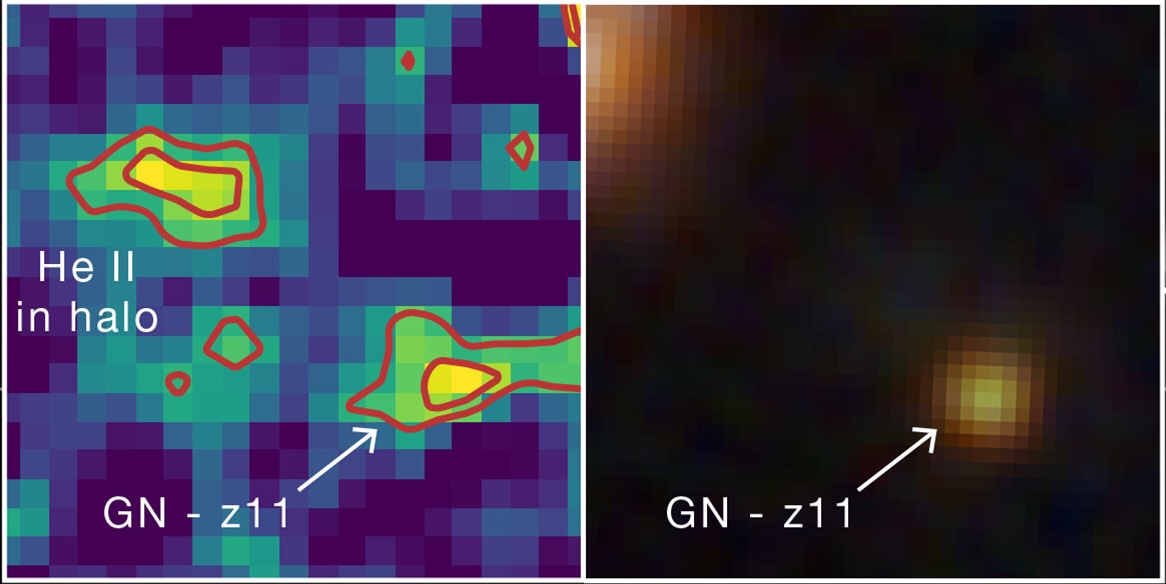
Hebe and GN-z11

Hebe is visible in the image on the left as a prominent blob of helium emission up and to the left from GN-z11, a luminous galaxy hosting an accreting supermassive black hole. On the right is an infrared image of the same region, in which Hebe is not visible. Click to enlarge. [Adapted from NASA, ESA, CSA, Ralf Crawford (STScI)]

Initially spotted in 2024, an early-universe gas clump nicknamed Hebe has now been identified as a possible hiding place of Population III (Pop III) stars β€” the universe’s first generation of stars. Pop III stars are thought to be massive and chemically pristine, containing only hydrogen, helium, and a whisper of lithium. This exciting hypothesis was prompted by the detection of recombination lines from helium, which could be ionized by the high-energy radiation of the first stars.

Before the community settles on this exciting explanation, however, the hypothesis must withstand all the tests astronomers can throw at it. In a recent research article, Junehyoung Jeon, Tae Bong Jeong, and Saiyang Zhang (The University of Texas at Austin) along with Volker Bromm (The University of Texas at Austin) attempted to explain Hebe’s properties in another way.

Considering Alternatives

Hebe glows with distinctive helium emission that requires a source of high-energy radiation. This radiation could be provided by a cluster of Pop III stars, but it could also, in theory, arise from an accreting supermassive black hole embedded within the gas clump.

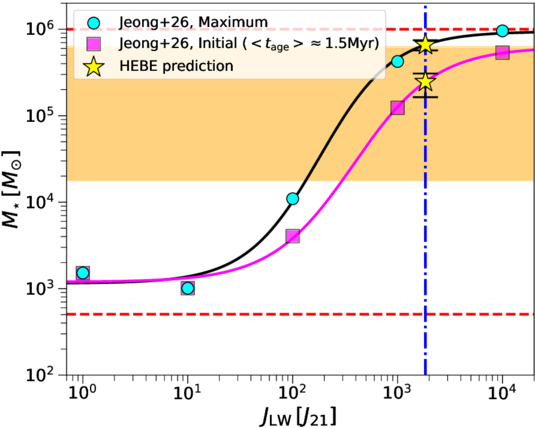
predicted Pop III star mass in Hebe

Predicted total mass of Hebe’s Pop III stars as a function of the Lyman–Werner flux from the nearby galaxy GN-z11. Click to enlarge. [Jeon et al. 2026]

The authors used models to explore both possibilities. For the first scenario, in which the telltale helium emission is driven by a cluster of Pop III stars, the team calculated the maximum possible mass of the cluster, which sets how much high-energy radiation is produced. The cluster mass is moderated by high-energy radiation from another source: GN-z11, a starburst galaxy situated about 10,000 light-years from Hebe. For the second scenario, the team modeled the spectral energy distribution arising from a supermassive black hole β€” either a direct-collapse black hole or a primordial black hole β€” accreting pristine gas from the surrounding cloud.

Still a Leading Explanation

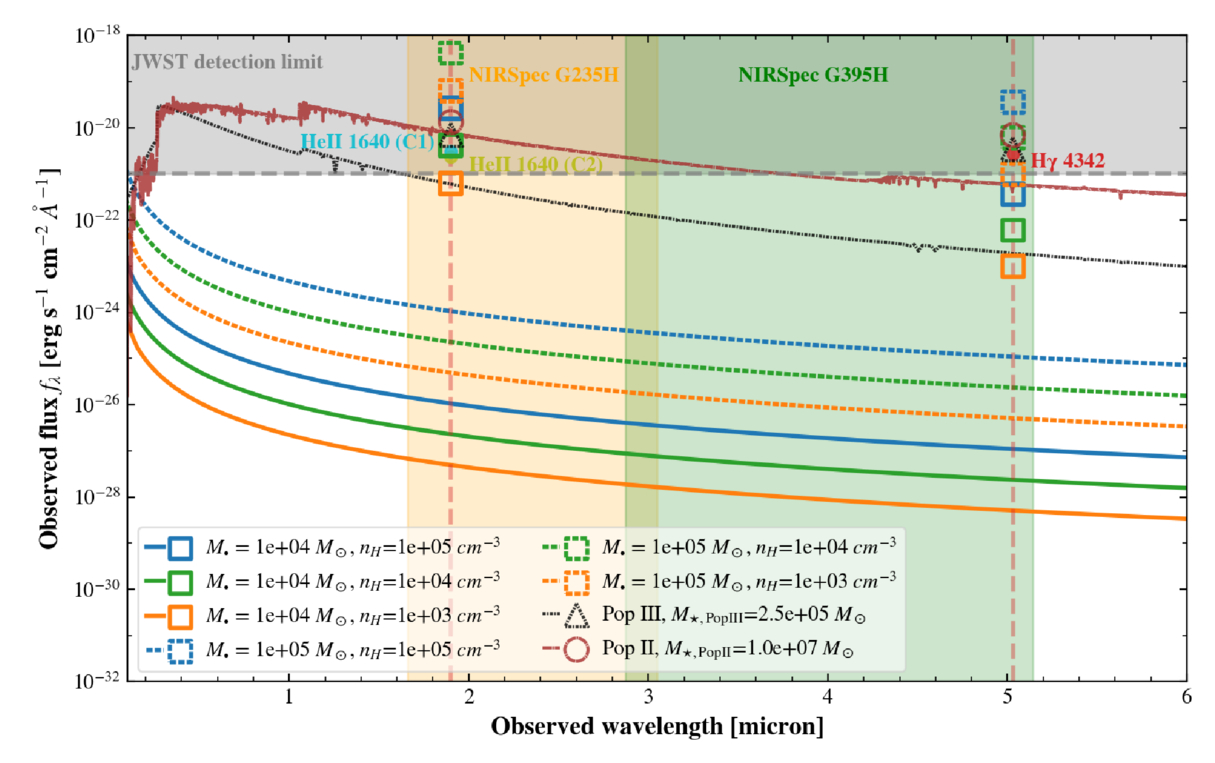
While the black hole scenario could, with reasonable black hole masses, gas densities, and accretion rates, reproduce individual flux measurements drawn from JWST observations, this hypothesis struggled to simultaneously match multiple measurements. The Pop III star cluster scenario, with a cluster mass of a few hundred thousand solar masses, provided the best fit to the JWST data.

modeled spectral energy distributions for Hebe based on the black hole or Pop III star hypotheses

Modeled spectral energy distributions (lines) and predicted line flux densities (open symbols) for the accreting black hole, Pop III star, and Pop II (second-generation) star hypotheses. The observed JWST line fluxes are shown as filled circles. Click to enlarge. [Jeon et al. 2026]

As a final test, the team introduced a third possibility involving a population of second-generation stars, which are more chemically enriched than Pop III stars. While this model fit well, the number of stars necessary to match the data β€” roughly 10 million β€” would produce a stellar continuum detectable (but so far not seen) by JWST.

While a cluster of Pop III stars is still the leading explanation for Hebe’s properties, the team noted that the Pop III star and black hole hypotheses aren’t mutually exclusive; Hebe could very well harbor a primordial black hole and a smattering of Pop III stars. Regardless of what powers its characteristic helium emission, Hebe offers an enticing glimpse into the early universe, and more work is needed to understand this intriguing object.

Citation

β€œWhat Is Powering the Enigmatic He II Emitter Hebe: The First Stars or Black Holes?” Junehyoung Jeon et al 2026 ApJ 1006 27. doi:10.3847/1538-4357/ae7bea

The post First-Generation Stars Provide Better Fit than a Black Hole for Early-Universe Gas Clump appeared first on AAS Nova.

❌