
❌

Normal view

Undersea optical fibres detect the motion of silent whales
1 July 2026 at 09:00
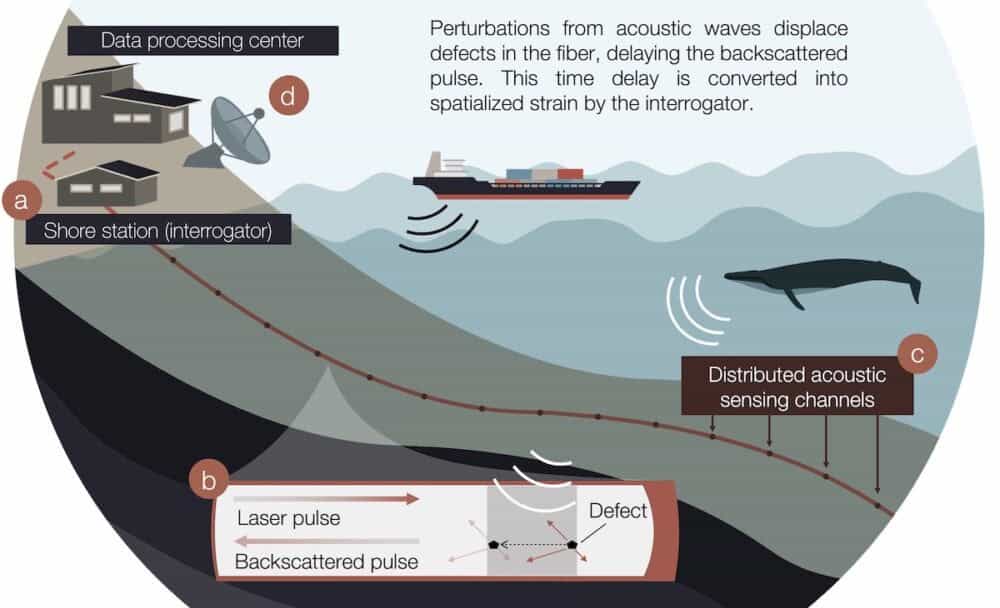
Distributed acoustic sensing system
Detecting whale motion Graphic showing a distributed acoustic sensing system that uses fibre-optic cables to help researchers detect ships and whales in the waters near Svalbard. (Courtesy: Léa Bouffaut)

A technique currently used to track whale vocalizations could be adapted to pick up the hydrodynamic pressure fields created as they swim, researchers in Norway have demonstrated. Through analysis of backscattered light in an undersea optical fibre, Robin Rørstadbotnen and Martin Landrø at the Norwegian University of Science and Technology (NTNU) showed how silent whales can be detected as they swim close to the fibre. The duo hopes the discovery could ultimately provide a valuable new tool for whale conservation.

With the combined disruption of climate change and human activity, whales are rapidly being forced into new habitats and migration patterns. To understand these profound shifts in behaviour, conservationists widely rely on a technique named distributed acoustic sensing (DAS), which detects acoustic waves via the strain they induce on optical fibres.

When coherent laser pulses are passed through a fibre, a small portion of laser light is inevitably scattered back to the source by small fluctuations in the fibre’s structure and density. If the fibre is strained by an acoustic wave, the oscillating pressure field imprints a phase shift on this backscattered light, which varies in proportion to the degree of strain.

So far, this approach has been used to pick up whale vocalizations: the loudest sounds produced by any animal, which can travel for thousands of kilometres through the ocean. By analysing backscattered light across the global network of undersea optical fibres, researchers have gathered valuable information about how the habitats and migration paths of these marine mammals are changing.

“At NTNU, we started activity within distributed acoustic sensing in 2016,” Rørstadbotnen describes. “When the Center for Geophysical Forecasting was launched in 2021, this technology became a key field of interest.”

Despite the value of data that can be gathered through whale vocalizations, the approach leaves conservationists with a significant blind spot for the majority of the time when whales are silent. To address this limitation, Rørstadbotnen and Landrø considered how DAS could be adapted to pick up the hydrodynamic pressure and velocity fields constantly being created by the whales moving through the water, which generates ultralow-frequency signals similar to those created by the movement of ships.

To test this idea, the duo revisited scattering data gathered from a seabed optical fibre off the coast of Svalbard in the Norwegian Arctic. After filtering the data for a selected band of frequencies, they carried out frequency–wavenumber analysis to determine how rapidly the signals varied along the length of the fibre. Just as they hoped, “we found that this new approach could be applied to detect silent whales, given that they are swimming close to the fibre optic cable,” Rørstadbotnen says.

Through this analysis, the researchers were able to identify ships crossing the fibre from depths of up to 413 m, and at a maximum distance of 550 m from the fibre. They also managed to determine the vessel speeds and roughly estimate their sizes. Crucially, they were also able to distinguish the speeds and approximate sizes of silent whales swimming less than 40 m away from the fibre, as well as estimating their depths.

“Since we also recorded the acoustic signals in the frequency range from 5 to 100 Hz, we could identify whales when they were vocalizing closer to the sea surface,” Rørstadbotnen describes. “Thereby, we could use this information as a strong indication that the low-frequency signal observed a bit later in time was most likely generated by the whale moving closer to the fibre.”

Having demonstrated this possibility, Rørstadbotnen and Landrø now hope that their technique could provide researchers with a new tool for tracking whales around the world, even when they aren’t vocalizing. “In addition, this method can potentially detect toothed whales that vocalize in the high-frequency band outside what is normally recorded for distributed acoustic sensing,” Rørstadbotnen adds.

Beyond its potential for whale conservation, the duo is also hopeful that the technique could help researchers build up a more extensive picture of marine mammals more generally, along with other vital elements of fast-changing marine ecosystems.

The research is described in Proceedings of the National Academy of Sciences.

The post Undersea optical fibres detect the motion of silent whales appeared first on Physics World.
Radar identifies insect species via reflections from wingbeats

28 May 2026 at 09:00

Pollinating insects form a vital part of any ecosystem, enabling the biodiversity that we see on Earth today. However, biodiversity is in rapid decline around the world, and monitoring insect species is a difficult task that often requires some insects to be killed. To support the conservation of biodiversity, which is critical to ensure the sustainability of human civilization, more robust monitoring is required. In a study published in PNAS Nexus, researchers have developed a new method to identify and classify individual insects, based on radar imaging and machine learning.

Radar has long been used to study migrating insects that fly at high altitudes and in large numbers, but such systems typically perform wide-area, long-range monitoring. However, thanks to a combination of millimetre-wave radar and machine learning, narrow focused identification is now possible, by detecting changes in the radar reflection of insects caused by the flapping of their wings.

“Having a background in antenna engineering, there was always the question of whether this technology can be used to address some of the environmental challenges that we’re facing,” says co-lead author Adam Narbudowicz from the Technical University of Denmark. “Some five or six years ago, we started talking with [co-author] Ian [Donohue] about those possibilities, and eventually the idea of micro-Doppler emerged, which seemed feasible from an engineering point of view and could provide some useful data on biodiversity.”

The approach taken in this study doesn’t focus on morphological features of the insects, as these are difficult to detect with radar. Instead, it uses the harmonic patterns generated by the micro-Doppler effect of an insect beating its wings as a detection strategy. Millimetre-wave radar can provide insight into biomechanical characteristics not visible with cameras, and these characteristics are encoded in the harmonic patterns of the wingbeat.

The team used machine learning to improve the accuracy of the identification and incorporated a SHAP (SHapley Additive exPlanations) analysis – an explainable AI tool that interprets and explains key outputs and prioritizes key features – to identify which signal features are the most critical for differentiating insect species. The SHAP analysed each insect across the full spectrum of micro-Doppler harmonics, extracting key features including fundamental wingbeat frequency, energy distributions, cepstral coefficients (sound signals) and how quickly an insect’s wing movement change. These data were then used to train the machine learning model.

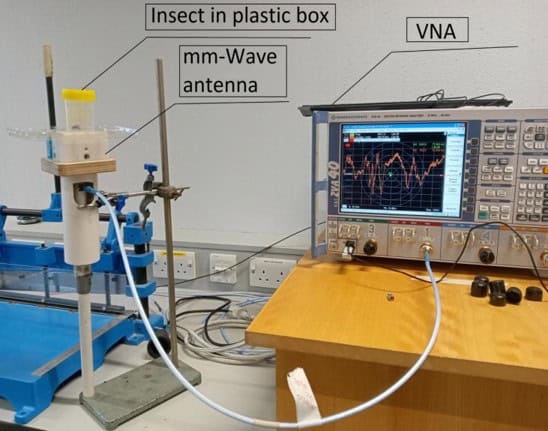
Training the model The radar system used to collect data from insects. (Courtesy: Linta Antony)

The actual process of obtaining this data from the insects involved capturing insects at the Trinity College Dublin campus and placing them in a plastic box on top of a millimetre-wave antenna that recorded their radar signatures. The researchers then released the insects back into the wild. After data capture, the relevant micro-Doppler features were extracted from the data for model training.

The model allowed non-invasive monitoring of different insects and could distinguish between bees and wasps with 96% accuracy. The model also classified five key pollinating insect species – red-tailed bumblebee, buff-tailed bumblebee, moss carder bumblebee, western honeybee and common wasp – with an accuracy of 85%.

“I think the most impressive thing is that we can detect and classify them with such an accuracy. From a biological point of view, it’s impressive how different species beat their wings in different manner, and from an engineering point of view it’s fascinating how different wingbeats affect harmonics of radar micro-Doppler reflections,” says Narbudowicz. “Those differences are of course impossible to see just by looking at spectrograms, but it appears that a sufficiently trained machine learning algorithm can see them.”

Narbudowicz points out that the current study used precise lab-grade transceivers and a relatively controlled set-up, and that the natural next step is to move this technology to outdoor field deployment. “This requires a number of steps,” he explains. “Firstly, the device needs to be miniaturized, and battery operated; the transceiver will be less accurate than the one used in the lab, but a big problem is the ground truth verification, since in the field it can be difficult to verify exactly which species flew over the sensor.”

Despite the greater challenge with deploying the technology in the field today, the researchers suggest that this radar reflection approach could be utilized in the future in a fly-through device, which would make it much easier and cheaper to achieve non-lethal monitoring of insect biodiversity in different environments.

The post Radar identifies insect species via reflections from wingbeats appeared first on Physics World.

❌