NASA is teaming up with 37 companies to develop the next generation of technologies that could make long-term exploration of the Moon and Mars possible. NASA has chosen 41 proposals from 37 U.S. companies to help develop technologies needed for a sustained human presence on the Moon and eventual crewed missions to Mars. The companies [...]
NASA is taking another major step toward a permanent Moon base with four new commercial missions that will test technology, deliver science, and help prepare for humanity’s future beyond Earth. NASA has selected three commercial space companies to carry out four new lunar missions in late 2028 through the agency’s Moon Base Program. Astrobotic, Firefly [...]
Landing spacecraft on the moon could contaminate ancient clues about how life may have originated on Earth, a new study finds.
As NASA continues on with its plan of sending astronauts back to the moon with the Artemis program, researchers are exploring what possible unintended consequences may arise from humans visiting the lunar surface. For instance, Artemis IV will land astronauts near the moon's south pole and the agency has future plans for building a longer-term moon base on the lunar surface, which would require many more trips. And indeed, a new study has found the exhaust from spacecraft involved with these landings could expel enough methane to contaminate the moon's surface — possibly destroying molecules that could help to explain how life may have originated on Earth.
"We are trying to protect science and our investment in space," senior study author Silvio Sinibaldi, the planetary protection officer at the European Space Agency, said in a statement. "Our activity can actually hinder scientific exploration."
While experts have had concerns for some time about how rocket launches on Earth pollute our planet and atmosphere, scientists have only really considered this issue with our own planet. This is especially because we haven't been to the moon's surface in over 50 years; concerns of accidental effects of a lunar landing simply haven't been top-of-mind. That's what makes this new study so important. It points to a potential issue that could mean that future moon landings might actually be detrimental to science.
An artist's concept of Blue Origin's lunar lander. Lunar landings could pose a serious issue for science on the moon if methane contaminates ancient polar ices, a new study has found. (Image credit: Blue Origin)
Life's clues on the moon?
So why do we think the signs of life could be hiding on the moon? It's actually hiding in ice. Dark craters near the moon's poles, which exist in perpetual shadow, hold ancient ice. This ice is thought to contain material from asteroids and comets that smashed into the moon billions of years ago. Trapped in lunar ice to this day, these bits of ancient collisions could include what the researchers describe as "prebiotic organic molecules," or molecules that could have preceded life on Earth.
It's thought that these molecules from asteroid and comet visitors could have sparked life on Earth, and by studying those possibly trapped on the moon, researchers could be looking at the molecules that ended up combining and creating life as we know it.
The molecular history of life on Earth is pretty much nonexistent on our own planet, as it was largely destroyed by the billions of years of changes we've experienced. But the moon has remained mostly unchanged, so these wells of ice are a uniquely-preserved sampling of pre-life molecules.
"We know we have organic molecules in the solar system — in asteroids, for example," Sinibaldi said. "But how they came to perform specific functions like they do in biological matter is a gap we need to fill."
This ice exists in a somewhat fragile ecosystem, so left alone in darkness, this ice isn't going anywhere anytime soon. But with Artemis, NASA is planning on sending crewed landers to the moon's south pole. That might pose a problem. With computer models in this new study, researchers have shown that the methane exhaust from these landers could very quickly and permanently contaminate this ancient ice, destroying the molecular evidence sealed within.
Inside the simulations
This image shows the distribution of surface ice at the moon’s south pole (left) and north pole (right). Blue represents ice locations, and the gray scale corresponds to surface temperature, with darker gray representing colder areas and lighter shades indicating warmer ones. (Image credit: NASA)
In those computer models, the researchers simulated how methane, the main organic component expelled by planned lunar landers, would spread across the moon's surface after a landing at the south pole. While the simulations included the effects of solar wind and radiation, the moon's lack of an atmosphere caused the methane to spread incredibly quickly, reaching the moon's north pole in under two lunar days.
Within one lunar week (which is roughly seven months on Earth), over half the methane was trapped at the moon's cold polar areas, with a whopping 42% of the substance trapped at the south pole compared to 12% at the north pole. This methane could collect in the same cold pockets where ice and ancient molecules have been collected for billions of years, possibly contaminating this finite, scientific evidence.
"Their trajectories are basically ballistic," lead author Francisca Paiva, a physicist at Instituto Superior Técnico in Portugal, said in the statement. "They just hop around from one point to another."
In better news, there may be a way to circumvent some of this methane disturbance. For instance, the study suggests it's possible that by choosing colder landing sites, scientists can avoid having the methane travel as quickly or as far. Additional simulations are needed to better understand how exhaust compounds travel on the moon, however, as well as the risks that this poses for scientific investigations and if there are other materials lunar trips will involve that could contaminate the environment. Above all, the new study's team emphasizes that as we push toward future lunar exploration, it is key to balance our dreams of settling the moon with preserving its priceless history.
"We have laws regulating contamination of Earth environments like Antarctica and national parks," Paiva said. "I think the moon is an environment as valuable as those."
NASA is once again sending scientific missions to the Moon. But under the new commercial framework for getting there, researchers need to invent a new method for how to pick where to land.
A New Process for Picking Sites
NASA’s Commercial Lunar Payload Services program is a bold innovation in organizing robotic missions to the Moon. Under this model, rather than keeping the mission process entirely in-house, the agency selects the scientific mission they want to support then simply buys a ride to the lunar surface from a commercial vendor. But, how do you pick a landing site before you know exactly how you’re getting there?
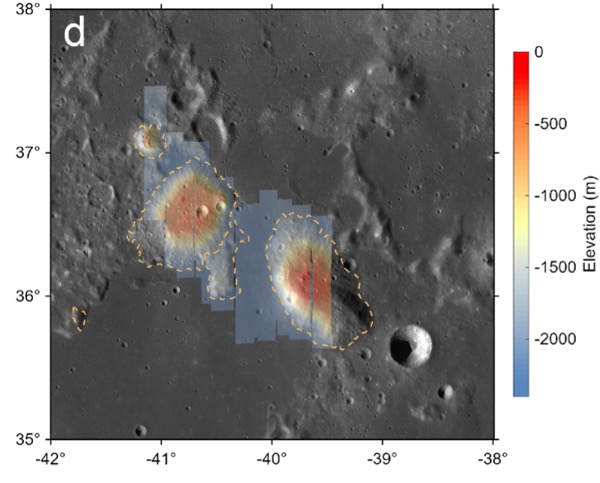
The Gruithuisen domes region, the broad area the Lunar-VISE team searched for potential landing sites. Click to enlarge. [Adapted from Williams et al. 2026]
The Lunar Vulkan Imaging and Spectroscopy Explorer (Lunar-VISE) mission, set to launch in mid-2028, was one of the first programs to go through this new landing site selection process. After being officially selected in 2022, the team had just nine months to nail down exactly where their mission should touch down. A recent article led by Jean-Pierre Williams (University of California, Los Angeles) detailed exactly how the team accomplished this task and presented some lessons they learned along the way.
No Parking Lots on the Moon
Picking a landing site is no small task: for context, selecting the landing sites for each of the most recent Mars rovers took five years and multiple community workshops. The Lunar-VISE team therefore took a streamlined and logic-driven approach. They started by explicitly laying out their science objectives: Lunar-VISE’s purpose is to investigate some strangely silicate-rich volcanic formations called the Gruithuisen domes, so they had to land either on or near those. They also had to have access to boulders that were excavated from deep within the domes during a crater formation event, so they had to pick a spot with boulders relatively nearby.
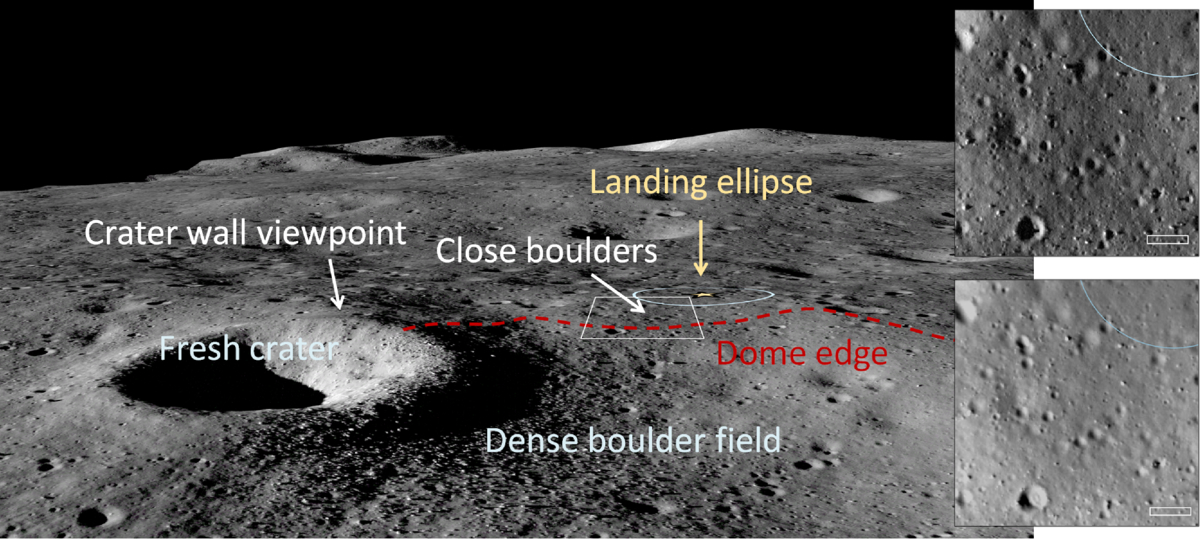
In addition to objectives, they also laid out a slew of constraints. Although they needed boulders nearby, they couldn’t have too many boulders, or any particularly large boulders, since those could pose hazards for landing. There also couldn’t be any steep slopes in the field. Most of the area had to maintain a line of sight with a supporting orbiter for communications, so they couldn’t set down near any ridges. Also, they had to consider how the terrain would cast shadows as the lunar day progressed, since they didn’t want their mission cut short by freezing temperatures and a lack of solar power. As the team quipped, “many interesting, high-science value locations on the Moon may not be in proverbial ‘parking lots.'”
An image from the Lunar Reconnaissance Orbiter overlaid onto a terrain model of the final landing site. Click to enlarge. [Williams et al. 2026]
By combing through archival data and working with the team that operates the Lunar Reconnaissance Orbiter Camera, a key asset for making detailed maps of the Moon, the researchers found the perfect spot: alongside a 190-meter-diameter crater named Mareta. This feature is named after Mareta West, one of the first female planetary geologists at the United States Geological Survey and the scientist who selected the landing site for Apollo 11’s historic touchdown.
In addition to presenting their landing site, the researchers offered a handful of lessons to others who may someday be in the fortunate and thrilling position of needing to pick a landing spot on the Moon. For one, they urged teams to coordinate with the Lunar Reconnaissance Orbiter specialists as early as possible, since processing the imaging data for lander-quality maps is a specialized and intensive task. For another, they recommended that all of the software tools used be made publicly available so that future missions don’t need to duplicate their work.
As this article laid out, the Commercial Lunar Payload Services program and Lunar-VISE take us one step closer to making missions to the Moon routine — but we’re still figuring out exactly how to do that.
Citation
“Lunar-VISE Landing Site Selection and Characterization at Mons Gruithuisen Gamma,” Jean-Pierre Williams et al 2026 Planet. Sci. J.7 161. doi:10.3847/PSJ/ae7d2c

 Login

 NASA is teaming up with 37 companies to develop the next generation of technologies that could make long-term exploration of the Moon and Mars possible. NASA has chosen 41 proposals from 37 U.S. companies to help develop technologies needed for a sustained human presence on the Moon and eventual crewed missions to Mars. The companies [...]