America and Hollywood might feel like the natural home of sci-fi, but Britain has quite the science fiction pedigree of its own.
Doctor Who is obviously our great nation's most famous sci-fi export, standing tall amongst the other giants of the genre, but it's far from our only contribution. From television to literature, there is a history of some truly great and groundbreaking science fiction coming from this loose collection of islands.
So, make yourself a nice cup of tea and have a seat while we break down the UK’s 10 best science fiction shows of all time (in no particular order).
1. Doctor Who
(Image credit: BBC)
Release date: November 23, 1963 | Seasons: 41 | Cast: William Hartnell, Patrick Troughton, Jon Pertwee, Tom Baker, Peter Davison, Colin Baker, Sylvester McCoy, Paul McGann, Christopher Eccleston, David Tennant, Matt Smith, Peter Capaldi, Jodie Whittaker, Ncuti Gatwa (& many more)
Doctor Who might not be the juggernaut that it once was, but it is one of the longest-running science fiction shows in the world. It's been going (on and off) since 1963, and it has always had something important to teach its audience.
From the off, it was a show championing scientific curiosity, kindness, and openness, though the stern tones and prickly demeanour of William Hartnell have since given way to a minimum of 14 different actors playing the same role.
While there’s certainly a difference between the original run of television serials and the typically self-contained format of the modern incarnation, the sheer wealth of different stories available means you can find something for everyone.
2. The Quatermass Experiment
(Image credit: BBC)
Release date: July 18, 1953 | Seasons: 4 | Cast: Reginald Tate, Wilfrid Brambell, Katie Johnson
From Doctor Who to one of its contemporaries, or rather, the show that inspired it. The Quatermass Experiment was a set of four different sci-fi serials, each containing 6 episodes, that debuted in 1953, a full decade before Who hit our screens.
The Quatermass Experiment is a striking piece of television, partially because it was really the first of its kind, because it was squarely aimed at adults. Before this, most sci-fi TV was aimed at kids, while silver screen efforts focused on schlocky B-movie-style effects, such as those seen in “The Day the Earth Stood Still”.
Humanity's first rocket launch to space goes awry when it returns to Earth with two crew members missing, and the one remaining astronaut is gravely ill. Professor Quatermass and his team are left struggling to unravel the mystery of what happened to the crew.
While only the first two episodes managed to survive the original live broadcast, the serial still went on to have a huge impact on science fiction. It was one of the first sci-fi shows with mass appeal, and the trio of follow-up serials kept Bernard Quatermass as an icon of pop culture all the way into the 70s, with a variety of Hammer Horror adaptations to bring the character to new audiences.
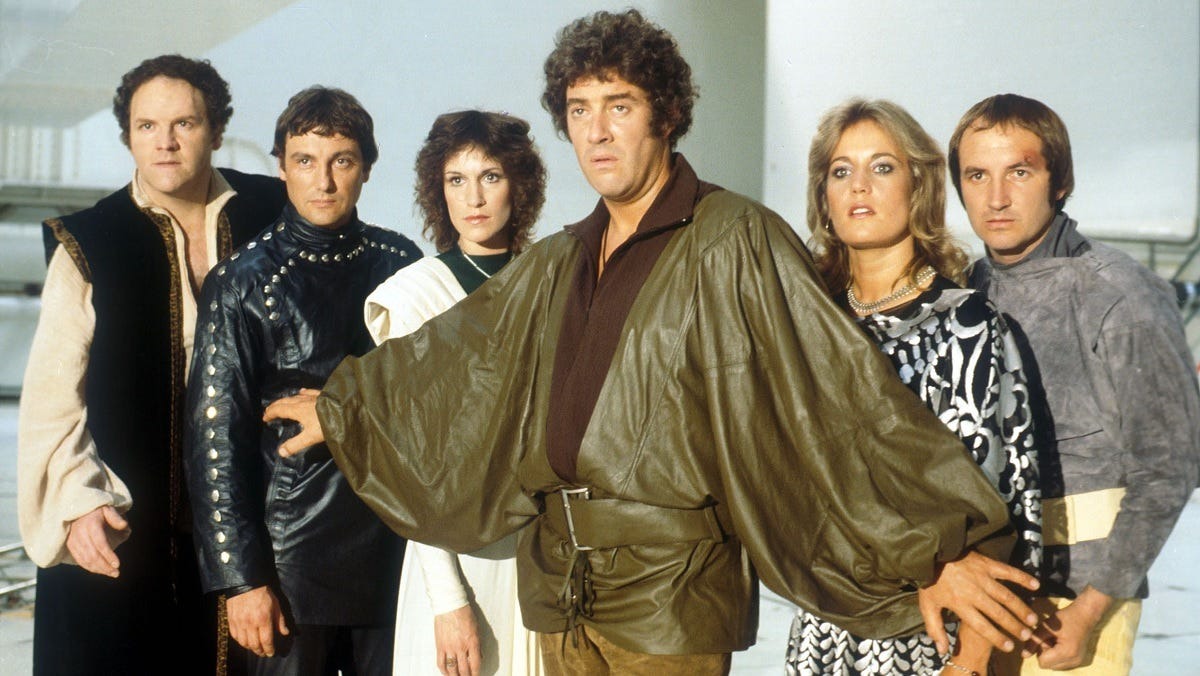
3. Blake’s 7
(Image credit: BBC)
Release date: January 2, 1978 | Seasons: 4 | Cast: Gareth Thomas, Michael Keating, Sally Knyvette, Paul Darrow
And now for something completely different: Blake 7, aka one of the grittiest and most depressing space shows that Britain ever produced.
Blake’s 7 tells the story of Roj Blake, a political dissident working against the totalitarian Federation controlling Earth and its colonies. On his way to a lifetime of false imprisonment, Blake manages to escape and capture a powerful alien vessel, which he then crews with another 5 people and 1 computer, to work together to overthrow the federation.
While most sci-fi of the time was chipper and optimistic about our future, Blake’s 7 was a sci-fi show that explored themes of political dissidence, cynicism, and freedom fighting. It’s a show about a small group fighting a much more powerful enemy, and frankly, it goes to some very, very dark places. When the phrase “mass-murder” has to be bandied around more than once, you know you've left happy-go-lucky behind.
It has an incredibly dour feeling most of the way through, and the ending does nothing to change that vibe. Dark tone aside, Blake’s 7 is the sort of sci-fi show that we just don’t see anymore.
4. The Prisoner
(Image credit: ITV Studios)
Release date: September 29, 1967 | Seasons: 1 | Cast: Patrick McGoohan, Angelo Muscat, Peter Swanwick, Denis Shaw, Fenella Fielding
If you’re a British sci-fi fan of a certain vintage, then you should already be familiar with The Prisoner.
Filmed (mostly) in Portmeirion, the show has some of the most iconic visuals in sci-fi history, despite only being a single self-contained series. From the giant evil balloon, known as Rover, to the beautiful houses of Portmeirion itself, The Prisoner is an incredibly visually striking show.
It follows the plot of a British secret agent who becomes frustrated with his position and resigns. While preparing for a trip, he is rendered unconscious using knockout gas and awakes to find himself inside a perfect recreation of his own home, but this one is located in a mysterious settlement known as The Village.
The plot goes to some wild places from there, but the story is deeply rooted in the societal fear that was surrounding the ongoing counter-cultural movements of the day. Individualism is pitted against collectivism throughout the show, and it’s a testament to the writing that neither ideal is shown to be the obvious right choice by the end.
5. Red Dwarf
(Image credit: BBC)
Release date: February 15, 1988 | Seasons: 12 | Cast: Chris Barrie, Craig Charles, Danny John-Jules, Robert Llewellyn, Norman Lovett
If you’re into Space and British Comedy but you’ve not watched Red Dwarf yet, then what the smeg have you been doing?
This space sitcom follows the adventures of mega-slob Dave Lister, his neurotic, hologramatic bunk-mate Rimmer, their evolved Cat (of the same name), and square-headed mechanoid Kryten. Each episode sees the crew dealing with various sci-fi calamities, from emotion-sucking monsters and time travel shenanigans to being stuck on a frozen asteroid, as they make their way through a harsh galaxy.
The show packs some of the funniest moments in British TV history, especially during the first 5 series or so. They parody every sci-fi concept known to humanity, balancing straight comedy, horror, and drama. You'll get introspective looks at what it means to be human alongside ridiculous situations where Lister gets turned into a 6-inch-tall RoboCop rip-off.
It's also deeply rooted in the British working-class culture of the time, which means plenty of time for curry, beer, banter, and slobbing around the place.
6. Hyperdrive
(Image credit: BBC)
Release date: January 11, 2006 | Seasons: 2 | Cast: Nick Frost, Kevin Eldon, Miranda Hart, Stephen Evans
In a similar vein to Red Dwarf, but nowhere near as popular, Hyperdrive is a Nick Frost-led sci-fi sitcom from 2006. It tells the tale of a British spaceship, the HMS Camden Lock, in its attempts to serve the national interest in an ever-evolving galaxy.
Starring British comedy favourites such as Kevin Eldon and Miranda Hart, Hyperdrive is a very silly show that ended up more like a workplace sitcom in space rather than the next Red Dwarf.
What saves Hyperdrive is the dry humour and the slightly insane set and character design. The series is replete with a baffling array of alien races, almost all of which are basically humans with varying levels of prosthetic facial makeup or zany outfits. Some of these guys are obvious parodies of alien races from classic shows, but they’re all thoroughly weird and worth the price of admission on their own.
7. The Hitchhiker’s Guide to the Galaxy
(Image credit: BBC)
Release date: January 5, 1981 | Seasons: 1 | Cast: Peter Jones, Simon Jones, David Dixon, Mark Wing-Davey, Sandra Dickinson
If you’re more familiar with the movie adaptation or the original radio show, then you might have missed out on the slightly more obscure The Hitchhiker’s Guide to the Galaxy TV series. A decent amount of the radio cast reprise their roles in this single season of British TV, and much like the radio show, the production was ground-breaking for its time.
The show is a ramshackle blend of production techniques, using everything from model shots, classical animation, and even a fair few instances of matte painting to show the truly impossible on a grand scale.
As a result, the TV show has its own surreal vibe that isn’t always found in other versions, and it can get surprisingly grimy and dark when it needs to. Plus, if you get the DVD version, there’s an added joke where every so often it’ll pretend to have an ‘infinite improbability drive’ issue and stop working.
Any talk about British sci-fi cannot fail to mention Charlie Brooker’s seminal science fiction Netflix series that was so popular it damn-near became a phenomenon.
If you’ve somehow missed out on the show so far, it’s a sci-fi anthology series where each episode tells a self-contained story, usually about an element of modern-day society. This ‘reflecting society’ element is why it’s called ‘Black Mirror’, as it could be said the show is holding up a ‘black mirror’ to society.
Black Mirror mostly works in the realm of speculative fiction, but several episodes have a more contemporary, real-world setting. The bulk of the show, though, deals with the pitfalls of technology, modern consumer culture, and the modern media landscape, certainly realms more than familiar to science fiction.
9. Life on Mars
(Image credit: BBC)
Release date: January 9, 2006 | Seasons: 2 | Cast: John Simm, Philip Glenister, Liz White, Dean Andrews, Marshall Lancaster
While it might not be what you immediately think of when it comes to sci-fi, Life on Mars is a fantastic show that straddles the space between speculative science fiction and crime drama, though it’s closer to ‘A Stir of Echoes’ rather than ‘Childhood’s End’.
The show tells the story of Sam Tyler, a modern-day police officer who hits his head and wakes up in the 1970s. While trying to figure out what’s going on, Sam has to deal with the realities of life and policing in the UK in the early 70s, something that’s shockingly entertaining to watch him attempt to juggle.
The real draw of the show is the mystery. Throughout the runtime, you’re never really sure if he has travelled back in time or if he’s either dead or in a coma. Even when you start to think that the show is giving you answers, you’ll soon find the rug pulled out from under you, and the want to finally learn what is happening will keep you coming back.
10. Utopia
(Image credit: Channel 4)
Release date: January 15, 2013 | Seasons: 2 | Cast: Alexandra Roach, Nathan Stewart-Jarrett, Paul Higgins, Fiona O'Shaughnessy, Adeel Akhtar
The final entry on the list is a bit more of an obscure one. Back in 2014, Channel 4 put out Utopia, a sci-fi conspiracy thriller with a comedic bent to it.
Utopia follows a group of nerds who discover a comic has been predicting historic events and accidentally unmask a shadowy conspiracy. While the show was unceremoniously ended after only two series, and on something of a cliffhanger, it offers something that is dark, gritty, humorous, and horrific in equal measure.
Utopia doesn’t shy away from the violence inherent in telling a dystopian story. In fact, the level of violence can be a bit much at times, which is part of the reason some audiences shied away from it. But, if you can stomach it, Utopia is some of the most thrilling British sci-fi ever produced.
More sci-fi TV
That’s it for our list of excellent British Sci-Fi Shows, but if you enjoyed the list, you might want to check out our list of upcoming sci-fi shows. If the big screen is more your speed, we also have a list of upcoming sci-fi movies.
As our planet revels in the recent achievements of this spring’s Artemis 2mission and its four astronaut crew members, a new four-part PBS documentary series takes a scrutinizing look at space exploration and its inherent perils and promises. "Once Upon a Time in Space" will be available to watch on PBS (and the PBS app) starting on July 14, 2026 (9pm ET).
Directed by James Bluemel and his filmmaking team — the crew behind the award-winning "Once Upon a Time in Northern Ireland" and "Once Upon a Time in Iraq" — "Once Upon a Time in Space" explores the connections between those venturing beyond Earth's gravity and the support staff remaining behind while pioneering souls venture into hostile outer space territory.
"'Once Upon a Time in Space' tells the human stories behind one of our most extraordinary endeavors: the exploration of space," states the official synopsis. "Moving beyond scientific achievement, the series examines the personal experiences of astronauts, cosmonauts, ground-based participants, and the loved ones left on Earth. Across four episodes, it traces significant landmarks in spacefaring history, from the birth of the Shuttle and the pioneering Space Station Mir to the rise of commercial spaceflight."
"Once Upon a Time in Space" launches on PBS on July 14 (Image credit: PBS/BBC)
"Through powerful firsthand testimony and intimate, unseen archival footage, a complex portrait of humanity emerges: one that lays bare both our fragility and boundless curiosity. Accounts of bravery, friendship, and tragedy are told against the backdrop of a rapidly changing world, connecting technical and geopolitical developments to those who experienced them."
Here’s a schedule of the docuseries’ chapters and their slated air dates:
Episode 1 "America First" – Tuesday, July 14 – 9:00 p.m. ET
Episode 2 "The Russian Thing" – Tuesday, July 21
Episode 3 "Politics Always Wins" – Tuesday, July 28
Episode 4 "Friends Forever" – Tuesday, August 4
This remarkable show features NASA astronauts Charlie Bolden, Anna Lee Fisher, Bill Fisher, Michael Foale, Jerry Linenger, Mike Mullane, Dan Tani, and Terry Virts. They’re joined by cosmonauts Sergei Zalyotin and Alexander ‘Sasha’ Lazutkin, NASA officials, aerospace engineers, and numerous family members.
Produced in collaboration with the BBC, "Once Upon a Time in Space" was first broadcast last fall in the UK, but now makes its U.S. premiere at 9:00 p.m. ET on PBS, PBS.org and the PBS app.
Disney+’s imaginative anime anthology series, "Star Wars: Visions", is getting a standalone expansion next month with "Star Wars: Visions Presents –The Ninth Jedi".
This 8-episode limited series is a continuation of the saga of Lah Kara, Margrave Juro, and their ragtag crew in the search for her kidnapped father. "Star Wars: Visions Presents – The Ninth Jedi" debuts on Disney+ on Aug. 5, 2026.
Fans were first introduced to the intriguing story in "Star Wars: Visions" Volume 1’s chapter titled "The Ninth Jedi", and now writer/director Kenji Kamiyama and his animation studio Production IG will revisit Kara’s world to elaborate more on the mythology behind lightsabers of different hues.
In the original 2021 episode, viewers met a bright Force-sensitive girl named Kara and her sabersmith father, Zhima, as they harvest Kyber Crystals to forge new lightsabers for Margrave Juro, the leader of an outer rim planet called Hy Izlan.
Juro is collecting worthy Jedi to help repopulate the Jedi Order, but evil Sith mercenaries are hiding within his candidates’ ranks. Kamiyama’s short initially presented the cool notion of lightsabers changing colors to reflect their users’ true links to the Force.
A direct sequel to Kamiyama's episode, "The Ninth Jedi: Child of Hope," was delivered by anime master Naoyoshi Shiotani and premiered on Oct. 29, 2025, for"Star Wars: Visions" Volume 3. Lucasfilm's new show takes place shortly after the events seen in the two "Star Wars: Visions" shorts as Kara advances her training and searches for her father.
(Image credit: Disney+)
"Every time we finished one of the anthologies, the first conversation would be, 'God, I’d love to expand that story,'" James Waugh, Lucasfilm Senior V.P. and "Star Wars: Visions" executive producer, told TechRadar last year after the project was announced at Star Wars Celebration Japan.
"We love the shorts, but Kathy [Kennedy] heard that, and there was a moment to say, 'Let’s see what could happen if we expanded this.' That’s really where 'Visions Presents' comes from. If we could give a bigger canvas to paint on, what would we get? We’ve been so impressed with what Kamiyama and his Production IG team has delivered so far."
Directed by Shunsuke Tada and with Kenji Kamiyama acting as supervising director, "Star Wars: Visions Presents - The Ninth Jedi" arrives Aug. 5 on Disney+ and Hulu.
Space is incomprehensibly vast. So huge that the human mind struggles to even conceptualize it. The observable universe spans roughly 93 billion light-years. Even our own humble galaxy, the Milky Way — a few tiny stitches of the universal canvas — stretches across 100,000 light-years and contains hundreds of billions of stars.
It's no wonder, then, that space video games struggle so mightily with anything approaching a "realistic" interpretation of those incredible distances, especially in an age where we have yet to invent a technology that can traverse them in a reasonable time.
The Artemis 2 mission's Orion module got up to speeds of around 25,000 mph during its trans lunar injection burn. Ignoring fuel and safety concerns, at those speeds, it would still take us at least 80,000 years to reach our nearest neighbor, Alpha Centauri.
So how do game developers manage to distill some of the awe of the vastness of space while making it feel like a manageable space? How do they shrink space to a navigable size without making it feel small or claustrophobic?
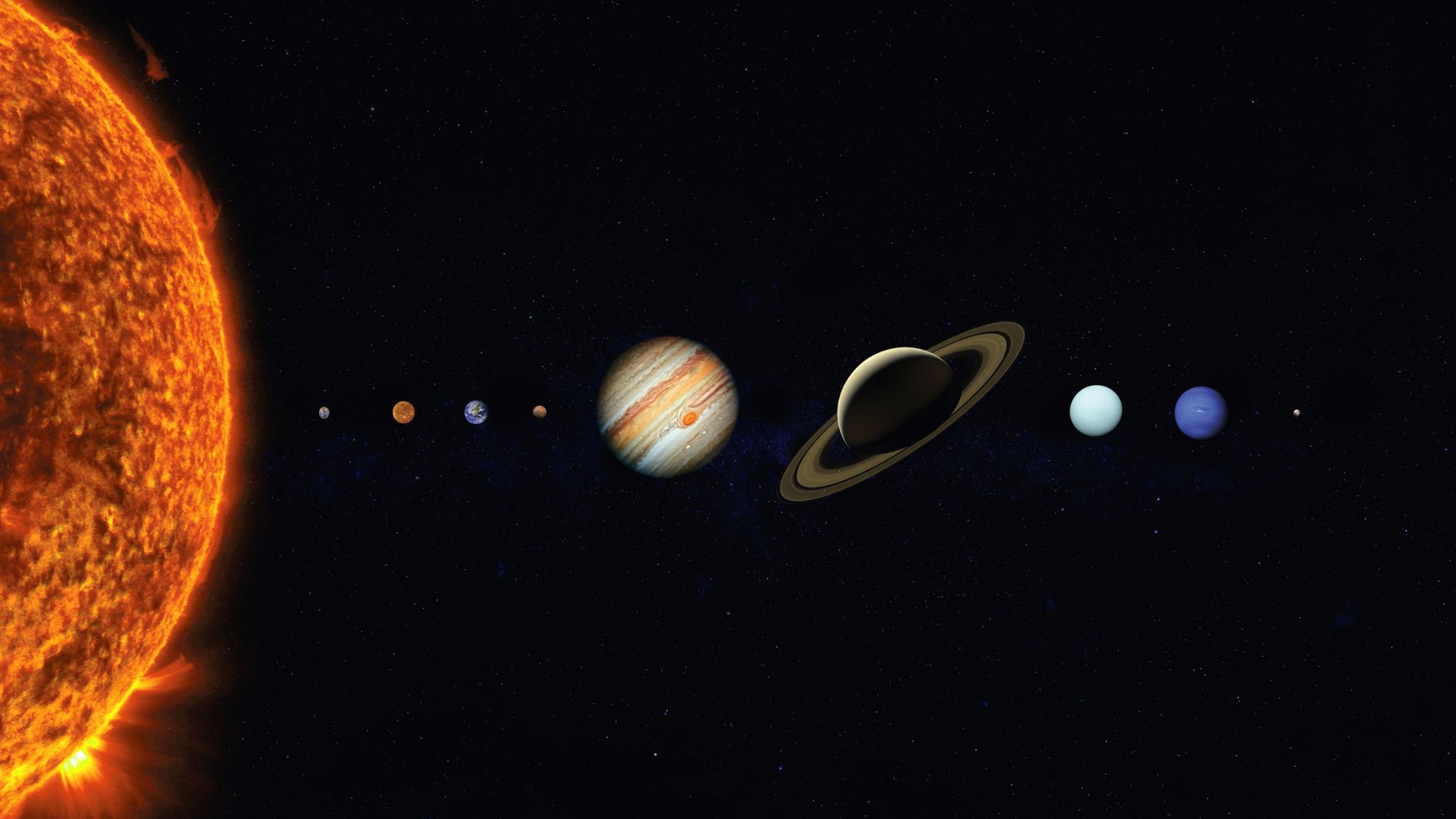
"On a 1 to 10 billion scale — which makes the Sun about the size of a large grapefruit — Earth is smaller than the ball point in a pen and located about 15 meters (49 feet) away from the Sun," explains Bennett. "On that same scale, the Moon — the farthest a human being has ever traveled — lies only about 4 centimeters (1½ inches) away from us. The planets of our solar system are much farther, though you can still walk to the outermost planets in only 10 minutes or so."
Bennett said most science fiction films and games get the scale wrong by making long-distance travel look too easy. Considering the above 1-to-10 billion-scale representation, for instance, and given that reaching the outermost planets in our system — far further than any human being has ever travelled — would take ten minutes, "to reach the nearest stars, you’d have to walk the distance across the United States."
Just simulating a small part of the existing universe would push current hardware to its limits, even with crutches like procedural generation. Developers use various techniques, like level-of-detail scaling, instancing, and streaming, to create the illusion of vastness without melting hardware.
Bennett also talks about how scale works in the case of interstellar objects like asteroids and maneuvering around them.
Films and games, he says, "tend to make it look very difficult to avoid collisions with asteroids, with spacecraft having to dart this way and that to pass through an asteroid region safely. In fact, while there are many millions of asteroids in the asteroid belt of our solar system, the full region is so large that it would take incredibly bad luck to crash into an asteroid by accident. That is why spacecraft studies of asteroids require careful planning to get a spacecraft close enough to any asteroid to get photos and other data."
The reality is that even in its most populated regions, asteroids are typically hundreds of thousands to millions of kilometers apart in our system's asteroid belt. Standing on one of the asteroids, it would be incredibly unlikely that you'd be able to see even one of the largest other asteroids with the naked eye.
How games cope with the enormity of space
(Image credit: Egosoft)
"This absolutely IS a design conflict that all space games have to solve," said Bernd Lehahn, Founder and Managing Director of Egosoft, the company that makes the successful X franchise of space simulators (most recently X4: Foundations).
"On the one hand, space must feel very large, or else players will feel cheated. Space and sci-fi have always been about the dream of infinite distances and exploration in a seemingly endless universe. At the same time, most games, the X games included, do not want to force players through unnecessarily long flight times or, god forbid, boredom."
Lehahn says his studio tries to strike a balance between areas that feel more content dense with regions that feel more like an unsettled frontier, to impart a sense of the true emptiness of space.
(Image credit: Egosoft)
"There should be room for both extremes: dense, highly populated regions, often with artificial means of transportation that allow the player to find and visit many important places relatively quickly, but also the empty, remote, fringe areas of space, where the experience is much slower, but where exploration happens, and the uncharted map allows for mystery and secrets."
Finding a solution to modeling and traversing the vastness of space has been an issue for Egosoft from the release of the original X game back in 1999, and continues to be something the studio grapples with today. The reality is that most of space is empty, so empty that you don't even have visual cues to indicate you're moving through it. Traveling through it without some kind of cheat or compression would involve unimaginable stretches of black emptiness with nothing happening, but too much compression begins to feel artificial.
"X4: Foundations probably has the most sophisticated solution to this conflict," Lehahn said. For the latest game, the team combines a number of solutions. It starts with scaled tiers of engine technologies with increasingly limited steering. Faster, more powerful engines allow for increasingly speedy, but more straight-line or on-rails travel.
(Image credit: Egosoft)
The team also uses the conceit of "jump gates" to leap across huge swaths of the universe in a blink, as well as teleportation and time acceleration to similarly compress travel. There are also space highways with slipstream acceleration to hurry things along.
Importantly, the X games also often give players things to do during the downtime of space travel. Giving players minor, uneventful tasks or other distractions can help fill out long stretches of uninterrupted travel. Above all else, Lehahn wants to ensure players are enjoying themselves.
"X4: Foundations is still a game. We want it to feel as realistic as possible—allow players to experience the universe and truly believe the 'sectors' are endless, planets are real size, and you can move in relation to planets and even larger celestial objects. But sometimes, if there is a conflict between fun gameplay and realism, then we may have to compromise on realism a bit."
A different approach
(Image credit: Frontier Developments)
Rather than compress space into a manageable slice, the Elite Dangerous team at Frontier Developments takes on a much more ambitious challenge.
"We have a 1:1 scale Milky Way," says Executive Producer Gauthier Verquerre. "Roughly 400 billion star systems."
To create that vast canvas, the team uses a technology called the Stellar Forge, which uses real astronomical catalog data and models phenomena like the collision of stellar systems and the way stars and planets form to procedurally generate systems. The systems are generated once when a system is discovered and regenerated in the same way whenever a player visits them.
(Image credit: Frontier Developments)
One of the most daunting challenges Elite Dangerous faces is that the game doesn't just model the galaxy on a macro scale. It also has to generate planetary surfaces and space station interiors for players to explore.
"Throughout the universe, we have these spectacular stellar phenomena which players are out there discovering every day," said Verquerre. "The flip side of that is that we have players meeting in the same star systems, or on the planetary surface. We have to represent both the huge 1:1 scale of space that we have in the game for interstellar elements like Lagrange clouds or nebulae, and the personal scale of 'I'm on foot in a planetary settlement.'"
Despite releasing way back in 2014, only a tiny fraction of the space the game simulates has been explored by players.
According to Verquerre, "There's still over 99% of the universe out there, waiting to be explored, where any Commander can be the first to add their name to the system and say 'I was the first one to see this'. We also added System Colonisation last year, allowing our players to construct space stations and planetary settlements. That's been really rewarding for us, seeing the rate at which the bubble has expanded."
(Image credit: Frontier Developments)
To empower players to explore that nearly infinite playground, Elite Dangerous (like X4) takes a tiered approach. Three methods of travel provide increasing compression of space/travel time.
"There's Deep Space, where ships move at ‘slow’ speeds (around 300m/s, under Mach 1) to access individual gameplay actions like combat or mining," Verquerre told me, "Supercruise, which is essentially a form of FTL travel within a system useful for scanning systems, and Hyperspace, where players travel between star systems through a tunnel."
The game also recently introduced a fourth tier of movement, dubbed Supercruise Overcharge, which allows players to navigate star systems at a much greater speed. Even with these many systems for speeding up transit, however, traversing such unimaginably vast distances can eat up a huge amount of time, and Frontier has tried to ensure that travel is peppered with events and resource management to keep players engaged.
"It's all about the player," Verquerre explains. "Explorers often want a little solitude, or an unexpected encounter, whilst our traders are considering the risk of what they're carrying. Fuel and heat management tend to be primary considerations; no one wants to be marooned out in deep space! There are also interdictions, where a Commander can be pulled out of a jump and find themselves hunted."
(Image credit: Frontier Developments)
"Additionally, those long trips that our players are taking out into deep space mean that small damage adds up, canopy cracks and moments of tension take the beauty of space and translate it almost instantly into abject fear."
The magic and awe of the staggering scope of space is a core part of the Elite Dangerous mystique, and it's not lost on Verquerre.
"I remember a journey I once made to Beagle Point, one of the most remote star systems found in Elite Dangerous, which I’d consider to be one of the most memorable gaming moments in my life. The sense of achievement in reaching a system that you’ve plotted out at the end of a journey is something very tangible, and it always makes me look forward to the next adventure."
A (nearly) infinite challenge
(Image credit: ESA/Hubble & NASA (D. Calzetti (University of Massachusetts) and the LEGUS Team))
Space games don't fail to simulate the scale of the cosmos because developers lack ambition or imagination.
The reality is that the universe operates on scales that challenge not only the capacity of the human behind them, but also that of our machines to reproduce them. Bridging that gap requires not just bigger maps, but smarter design, and a recognition that sometimes, the awe of the infinite matters more than the numbers behind it.
"X4: Foundations" and "Elite Dangerous" are both available to play now on PC. You can also pick up Dr Bennett's book, "The Scale of the Universe", on Amazon.
On Episode 218 of This Week In Space, Rod Pyle and Tariq Malik discuss NASA's new moonbase plans with planetary scientist Dr. Pascal Lee.
Starting with Artemis V (so far), the US plans to begin preparations for a permanent base situated in the south polar regions of the moon. Details are somewhat fluid, but one thing stands out: the poles are likely to be the most challenging places to set up shop in an already hostile environment. Pascal joins us to discuss moonbase siting options and why the poles may not be the best choice at first.
This Week in Space covers the new space age. Every Friday we take a deep dive into a fascinating topic. What's happening with the new race to the moon and other planets? When will SpaceX really send people to Mars?
Join Rod Pyle and Tariq Malik from Space.com as they tackle those questions and more each week on Friday afternoons. You can subscribe today on your favorite podcatcher.
We didn't realize it at the time — nobody ever does — but the '90s were a vintage era in Hollywood.
It was a time when major studios were happy to take a punt on original scripts, knowing that people would, as often as not, buy theater tickets to watch quality releases. Good movies will always be made, of course — just as even the most golden of ages produce their fair share of stinkers — but this was a time when the Venn diagram circles labelled 'acclaimed' and 'popular' intersected on a satisfyingly regular basis.
But beyond the critic-friendly fare produced by the likes of Quentin Tarantino, the Coen Brothers, Paul Thomas Anderson, and Martin Scorsese, this was also a peak period for popcorn-friendly action movies… and especially sci-fi action movies. Highbrow reviewers didn't always appreciate their brilliance back then, but looking back all these decades later, many of the best examples still stand up now.
"Independence Day" — which turned 30 last week — isn't even the best entry in the genre, but it repeatedly shows why the end of the 20th century was the perfect time to experience blockbuster thrills and spills in a multiplex. And, spoiler, there was barely a superhero in sight.
The '80s had teed up the subsequent decade's action explosion perfectly. On one side was the family-friendly fare championed by George Lucas and Steven Spielberg, timeless movies like the "Star Wars" sequels, "ET", "Back to the Future," and "Indiana Jones" that produced a generation of budding cinephiles. They were complemented by the more rugged, violent, and grown-up adventures popularized by the likes of "Aliens", "Predator", and "Die Hard".
(Image credit: 20th Century Studios)
Anything less than spectacular would no longer cut it in the blockbuster stakes, as the kids of the '80s got that little bit older and decided to take their new favorite genre with them.
It's easy to dismiss this kind of filmmaking as simplistic and dumbed down. Its poster boys were uber-producers Jerry Bruckheimer and his late filmmaking partner Don Simpson, whose "high concept" ethos distilled movies down to a pithy elevator pitch you could squeeze into a single sentence.
But the company's undisputed classics of the era make it obvious they were on to something — "Crimson Tide" (feuding submariners try to avert World War III), "The Rock" (rogue marines capture Alcatraz to hold San Francisco to ransom) and "Con Air" (a bunch of prisoners capture their transport plane). It's a formula that also worked for "Speed" (a bomb will explode if a bus goes under 50mph), "Twister" (scientists chase tornadoes across America), and "Under Siege" ("Die Hard" on a boat).
(Image credit: 20th Century Studios)
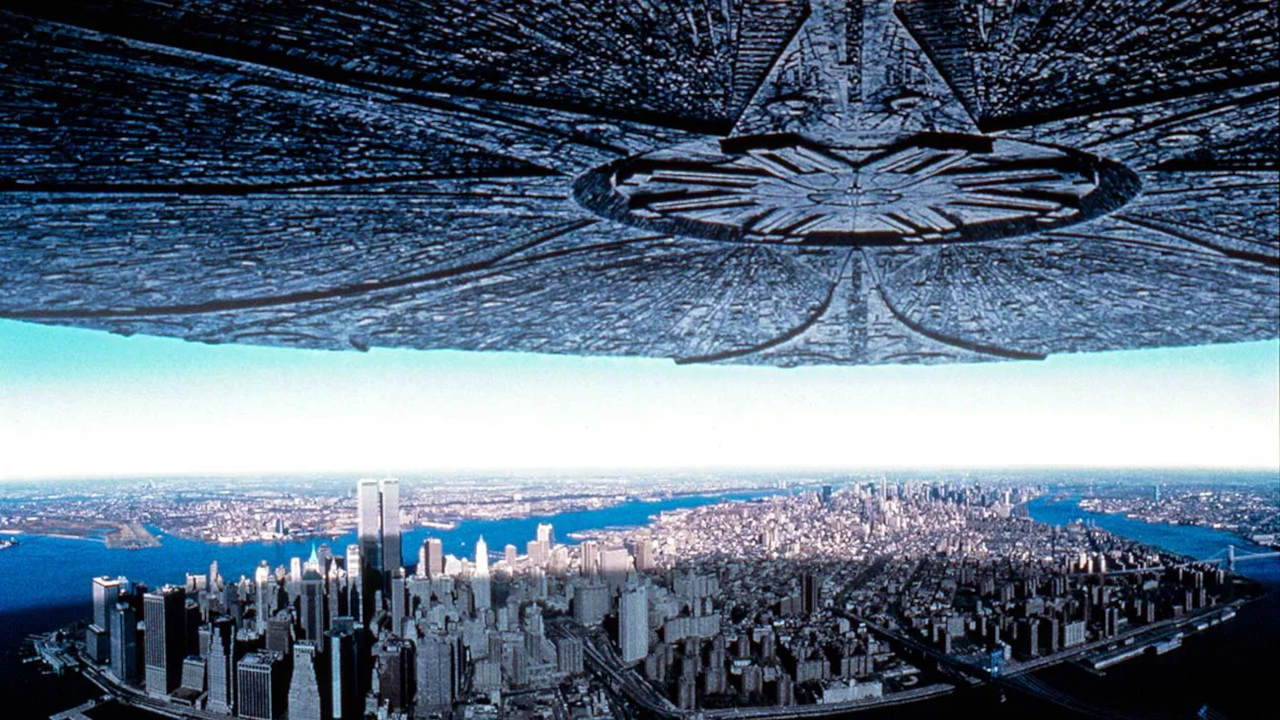
The director/producer duo of Roland Emmerich and Dean Devlin were clearly paying attention when they made "Independence Day", their follow-up to 1994's "Stargate". Let's start with their own high concept, easily summed up as a modern-day spin on HG Wells' "The War of the Worlds", but with bigger spaceships and a more pronounced fetish for major landmarks.
Speaking to the Guardian, Devlin recalled Emmerich's original idea. "[He said], 'What if we woke up tomorrow morning and we walked outside to get the newspaper and above it was a 15-mile-wide spaceship blotting out the sun for an entire city?' Then he turned to look at me and goes, 'I think I have our next movie.'"
"Independence Day" didn't need to be part of a major franchise to get noticed. The teaser trailers, with their carefully choreographed moments of tourist hotspot destruction, were enough for that, as was the brilliant sci-fi movie poster, which saw Manhattan dwarfed by a flying saucer. "The question of whether or not we are alone in the universe has been answered," said the wonderfully doom-mongering tagline.
(Image credit: The Independent )
As with many of the other action movie classics of the era — not to mention the classic Irwin Allen disaster epics of the 1970s, such as "The Poseidon Adventure" and "The Towering Inferno" — "Independence Day" prioritized its cast over spectacle.
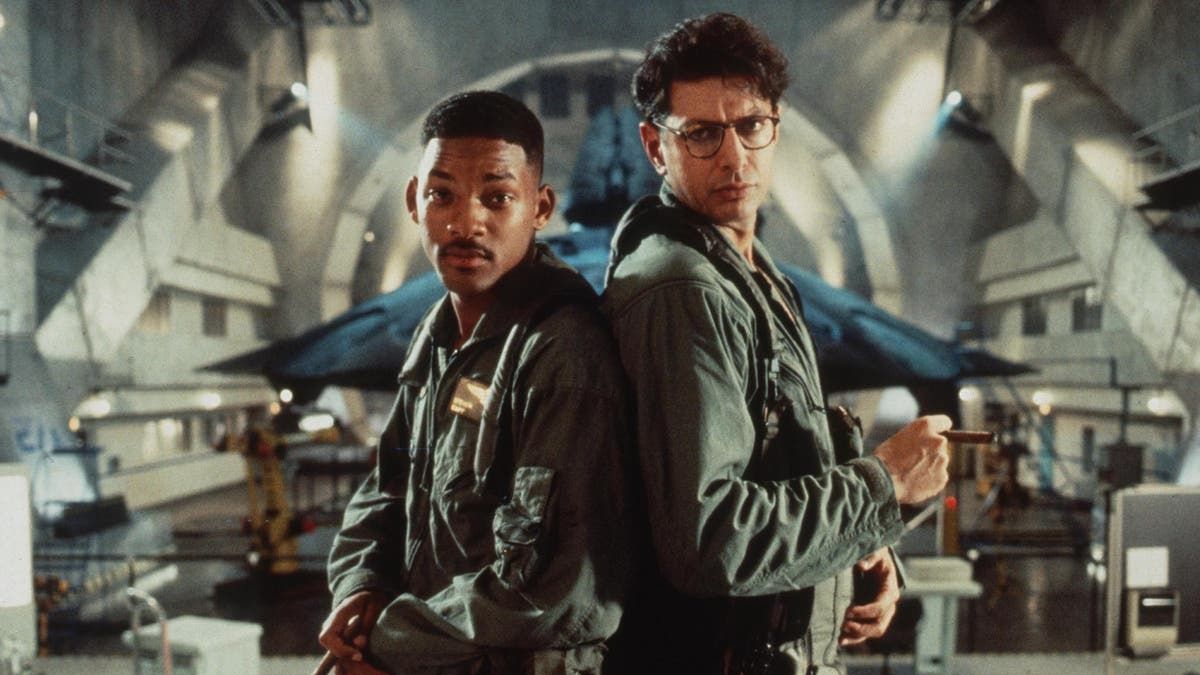
The biggest name on the roster was arguably Jeff Goldblum, who, thanks to the double whammy of "Jurassic Park" and "ID4", briefly had the two highest-grossing films of all time on his resumé.
But Emmerich and Devlin also spotted the star power of Will Smith before he became a bona fide A-lister, and packed out the vast supporting cast with familiar — though not necessarily movie star — names: "Taxi"'s Judd Hirsch as Goldblum's dad, Bill Pullman as an idealistic POTUS, and Randy Quaid as a former pilot with a bone to pick with ET. They also boosted the film's geek credentials by casting Brent Spiner ("Star Trek: The Next Generation"'s Data) as Area 51's eccentric head of ET research.
Populating the film with quality actors paid big dividends, helping to ground a film whose script rarely shied away from the ridiculous. In a screenplay that shifts from gung-ho action to self-aware gags to over-earnest, tub-thumping presidential speeches (and back again), it certainly helps if your cast can play their roles as if they're on stage at the Royal Shakespeare Company. In the same way, nobody could watch Ed Harris in "The Rock" or Gene Hackman in "Enemy of the State" and claim they were phoning it in.
(Image credit: 20th Century Studios)
There's also a lot to be said for the "Independence Day"'s deployment of practical effects. The mid-'90s were a dangerous time to be a filmmaker, when many were tempted to use computer effects when they should have known better. Look at the best action movies of the era, however, and they tend to use the CG to enhance, rather than replace, more traditional techniques.
As groundbreaking as "Jurassic Park" was, Steven Spielberg was remarkably sparing with the digital moments, while "The Matrix" — a film whose bullet-time effects quickly became ubiquitous — hung its action credentials on its live-action fights and wire work.
"Independence Day" was cut from the same cloth, using CG in the right places (most notably in its spectacular aerial dogfights) while also building (and subsequently blowing up) intricate practical models to deliver moments of pure, joyous cinematic carnage. These moments would undoubtedly be animated in a computer now, losing the tactile qualities — and the intrinsic gravity of the situation — you only capture in real life.
(Image credit: 20th Century Studios)
Thirty years on, "Independence Day" and its '90s action brethren have come to feel like relics. Sure, superhero movies, their most obvious descendants, still set their eyes on top acting talent, and the best directors (most notably Christopher Nolan) tend to make a point of shooting practically when they can.
But, aside from the numerous "Die Hard" spin-offs, the '90s generation were predominantly telling original stories, well away from the restrictions of franchise filmmaking, starting and finishing an entire story in roughly two hours. Indeed, it's remarkable how few of the classics of the era were followed up by a successful sequel. ("Independence Day: Resurgence" took 20 years to arrive, and when it did, didn't even make half as much at the box-office as its predecessor.)
And crucially, the action movies of the late 20th century were usually about people. Most of the time, they were ridiculous, over-the-top, broadly drawn, clichéd, cookie-cutter characters, but they also tended to — more or less — obey the laws of physics. Without superpowers or magic to fall back on, heroes had to rely on little more than implausible levels of ingenuity and resilience, a capacity to dodge bullets/laser fire, and a gift for making the right quip at the right time. "Independence Day" may just have been on to something.
"Independence Day" is available on Hulu in the US and Disney+ in the UK.
 Login