❌

Normal view

Scientists Have Made a Sweet Discovery in Interstellar Space, Offering Clues to Mystery of Life’s Origins

15 July 2026 at 12:59

Scientists have discovered an abundance of molecules in the cosmos, but for the first time ever, they were able to detect one in interstellar space very familiar to us here on Earth: sugar. 

The discovery, made in the vast clouds of gas and dust between stars, could help scientists better understand how some of the chemical ingredients necessary for life formed long before Earth existed.

Researchers at the Centro de Astrobiología, part of the Spanish National Research Council (CSIC), identified the sugar molecule erythrulose within the interstellar medium.

Sugars are considered fundamental building blocks of life. On Earth, they play vital biological roles, including forming the backbone of RNA and contributing to the chemistry that ultimately supports DNA, while also serving as an important source of energy. Scientists studying the origins of life have long sought to understand how the first sugars formed, since they are essential ingredients in the molecules associated with life’s earliest development.

“The detection of erythrulose is very exciting because it opens up the possibility of discovering in space other sugars such as ribose, which is part of RNA, and other important molecules for the origin of life,” says Carlos Briones, co-author of the study, in a statement. 

Even so, one major question remains: where did the first biologically important sugars originate?

Previous studies have identified sugars such as ribose and glucose in meteorites and asteroid samples, suggesting that some organic compounds may have been delivered to the early Earth from space. Until now, however, no sugar had been directly detected in the cold molecular clouds where stars and planets form.

The newly identified molecule, erythrulose, was found in the molecular cloud G+0.693−0.027 near the center of the Milky Way. On Earth, erythrulose is a naturally occurring four-carbon ketose sugar.

The discovery was made using highly sensitive radio astronomy observations from the Yebes Observatory’s 40-meter radio telescope and the 30-meter telescope operated by the Institute for Radio Astronomy in the Millimeter Range. Researchers analyzed the unique radio signatures, or spectral fingerprints, emitted by molecules in space.

The team identified 12 spectral lines matching laboratory measurements of erythrulose, confirming the molecule’s presence.

The findings also challenge some existing ideas about how complex molecules form in space. Scientists have generally proposed that interstellar chemistry builds larger molecules by gradually adding carbon atoms. Yet erythrulose proved to be more abundant than related three-carbon sugars that researchers expected would appear first.

“This finding was unexpected, as the prevailing view in astrochemistry is that interstellar molecules grow in size through the sequential addition of carbon atoms,” said Izaskun Jimenez Serra (CAB), the lead author of the recent study. 

Instead, the researchers found that erythrulose could form inside icy dust grains from simpler two-carbon alcohols and aldehydes. These frozen environments may function as natural chemical laboratories, allowing increasingly complex organic molecules to develop over time.

The team estimates that during the Late Heavy Bombardment—roughly 4.1 to 3.8 billion years ago, when Earth experienced intense asteroid and comet impacts—between 500,000 and 50 million tonnes of erythrulose may have been delivered to the planet’s surface.

The discovery adds another piece to the puzzle of life’s origins, suggesting that some of its essential ingredients may have arrived with something surprisingly sweet.

This paper was published in the journal Nature Astronomy.

Chrissy Newton is a PR professional and the founder of VOCAB Communications. She currently appears on The Discovery Channel and Max and hosts the Rebelliously Curious podcast, which can be found on YouTube and on all audio podcast streaming platforms. Follow her on X: @ChrissyNewton, Instagram: @BeingChrissyNewton, and chrissynewton.com. To contact Chrissy with a story, please email chrissy @ thedebrief.org.

New Spectral Signs of Buckyballs Discovered in Planetary Nebula

24 June 2026 at 17:00

illustration of buckyballs in a planetary nebula

Fullerenes — a class of molecules composed entirely of interconnected carbon atoms — are the largest molecules definitively detected in space. Researchers using JWST to study a planetary nebula have found new spectral features from a fullerene composed of 60 carbon atoms, offering another way to study how these molecules form and survive in space.

Full of Fullerenes

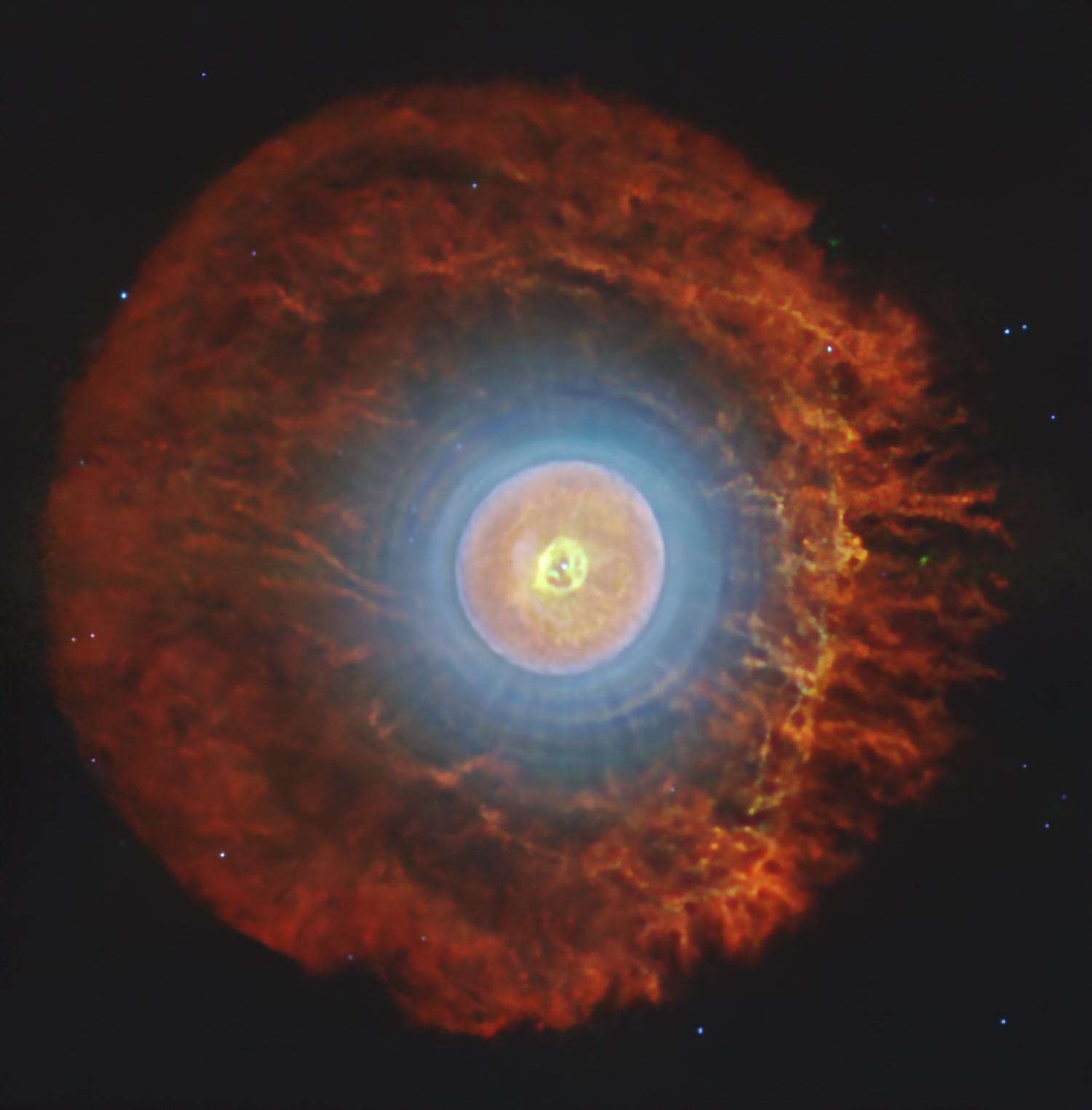
planetary nebula Tc 1

Planetary nebula Tc 1 as seen by JWST. [NASA / ESA / CSA / Western University, J. Cami]

The planetary nebula Tc 1 holds special significance in the field of astrochemistry. More than a decade ago, researchers using the Spitzer Space Telescope studied this wispy nebula illuminated by the core of a dead star. These observations led to the first confident identification of molecules called fullerenes in space. Fullerenes are large molecules constructed from interconnected rings of carbon atoms, forming hollow spheres, rugby-ball shapes, and long tubes. Spheroidal fullerenes, especially C60, are commonly referred to as buckyballs.

Since that discovery, Tc 1 has been a hot spot for studies of buckyballs. However, researchers are still puzzling over how these large molecules form and survive in harsh space environments.

closeup of planetary nebula Tc 1

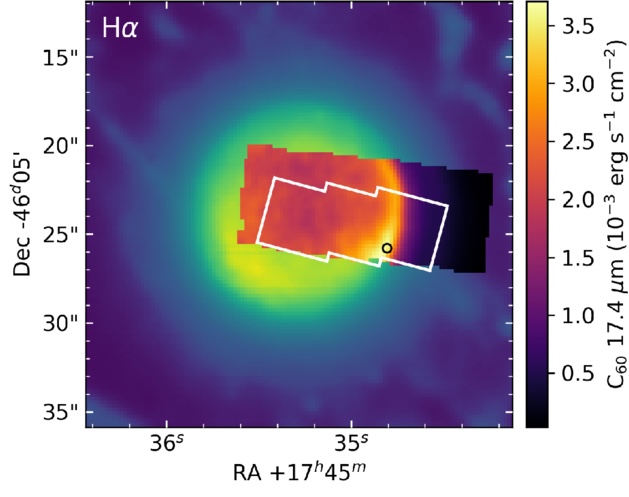
A closeup of the center of Tc 1, showing the region observed with JWST’s Mid-Infrared Instrument (black-to-yellow color scale) and Near-Infrared Spectrograph (white outline). The background color scale shows the nebula’s H-alpha emission as seen by the Very Large Telescope. [Adapted from Giese et al. 2026]

From Spitzer to JWST

Morgan Giese (The University of Western Ontario) and collaborators recently reported on the results of a JWST observing program that aimed to understand how fullerenes respond to changes in their environment. The team mapped the distribution of C60 molecules at varying distances from the powerful ionizing radiation of Tc 1’s central star.

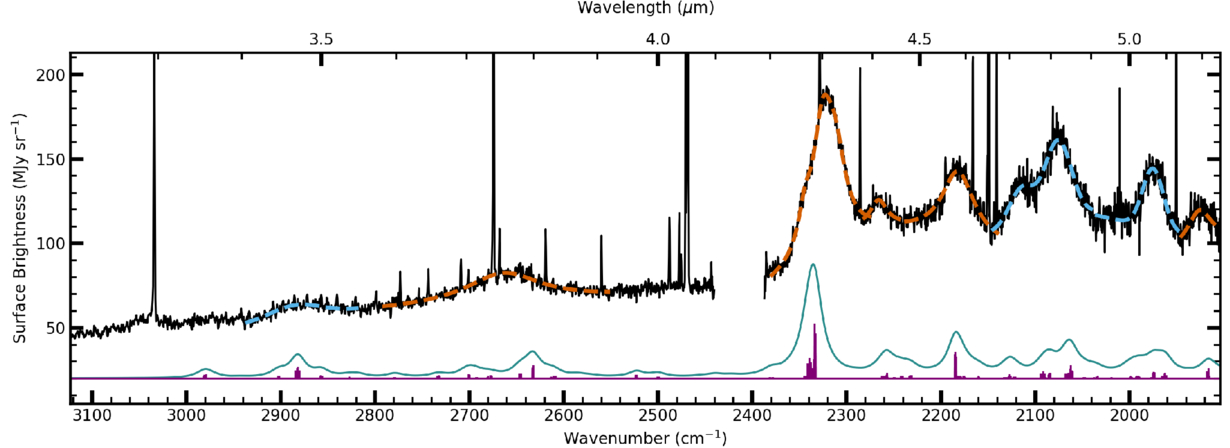
The team successfully spotted the emission features from the fullerene C60 seen in earlier observations, but they also turned up something unexpected: a handful of prominent emission features from 3.5 to 5.2 microns that had not been reported previously.

Feature Presentation

What’s the source of these emission features? The distribution of the emission provides a strong clue: known spectral features from fullerenes C60 and C70 are concentrated in a narrow, bright ring around the center of the nebula, with diffuse emission suffusing the rest of the nebula — and the newfound spectral features follow the same distribution.

JWST spectrum of Tc 1

JWST spectrum of Tc 1 (black line) extracted from the area indicated by a black circle in the previous image. The orange and blue dashed lines show fits to the newfound emission bands, and the results of the anharmonic calculations are shown as the teal line below the JWST spectrum. Click to enlarge. [Giese et al. 2026]

This evidence hints that C60 or C70 is the source of these new features, but Giese’s team took the investigation a step further. Using anharmonic quantum chemical calculations, they computed the spectrum of C60‘s combination bands, which arise when multiple vibrational modes are excited at the same time. This is the first time this type of spectrum has been calculated for C60, and the authors found good agreement between their computed spectrum and the JWST spectrum, providing further evidence that C60 is the source of these bands.

Giese and coauthors found that 17% of the energy emitted by the C60 molecules in Tc 1 is released in these  combination bands, suggesting that these features must be taken into account when modeling the cooling of C60 molecules. The discovery of new fullerene spectral features also has implications for future studies of these molecules: since these features appear in a wavelength range where features from other complex molecules like polycyclic aromatic hydrocarbons are weak, these newly identified bands provide a promising way to spot and study fullerenes across space environments.

Citation

“Detection of C60 Combination Bands in the Near-IR Spectrum of Tc 1,” Morgan M. Giese et al 2026 ApJL 1004 L32. doi:10.3847/2041-8213/ae76d5

The post New Spectral Signs of Buckyballs Discovered in Planetary Nebula appeared first on AAS Nova.

❌