❌

Normal view

The 1st of 10,000 'missing' black holes in the Omega Centauri star cluster has been found by the Hubble and James Webb space telescopes

14 July 2026 at 21:00

The first of 10,000 missing black holes in the Omega Centauri globular cluster has been found thanks to teamwork by the Hubble and James Webb space telescopes.

The two observatories discovered the black hole after watching a star orbiting around something massive but dark, and which therefore could not be seen. The Hubble data ran from 2003 to 2023, and the James Webb Space Telescope picked up after that to help refine the measurements.

Astronomers used the space telescopes to focus on a particular star in a binary system that appeared to be home to another, dark object called oMEGACat BH-2. Previous studies had suggested that the dark object was a neutron star. However, the new results are conclusive: the object has a mass 4.46 times that of the sun. This is too massive to be a neutron star, so it must therefore be a black hole.

Omega Centauri is the most massive of our Milky Way galaxy's globular clusters. It is so massive that astronomers suspect that it is actually the core of a dwarf galaxy that has lost most of its stars to the Milky Way's gravitational cannibalism, which over the aeons has torn strips from Omega Centauri. Even so, Omega Centauri still contains about 10 million stars, collectively located 18,000 light-years from Earth.

In 2024, astronomers using the Hubble Space Telescope found clinching evidence that an intermediate-mass black hole – one that has a mass about 8,200 times that of our sun – lurks at the center of Omega Centauri, strengthening its claim of being the remnant of a dwarf galaxy, since galaxies harbor black holes at their center but star clusters typically do not.

However, alongside this intermediate-mass black hole should be about 10,000 other stellar-mass black holes born from the supernova explosions of massive stars. Searches have focused on binary systems where a star orbits a compact object, but until now astronomers had drawn a blank.

Now, a team led by Matthew Whitaker of the University of Utah in Salt Lake City have come along to save the day by diligently sifting through 20 years of Hubble observations, plus additional supporting views from the JWST, to uncover a stellar-mass black hole in Omega Centauri for the first time.

Whitaker's team used a technique called astrometry, which is the measurement of the changing positions of stars as they move through space. Although the black hole itself is dark, it is orbited by a normal star with a mass 78% that of our sun. Thanks to the unprecedented vision of Hubble and the JWST, Whitaker and his colleagues were able to track the motion of this star around the black hole.

It turns out that the star is on a 94-year-long orbit around the black hole, which is the widest separation of a binary composed of a stellar-mass black hole and star ever found. Over that 20-year-period, Hubble saw less than a quarter of the star's total orbit, but it coincided with the star's closest approach to the black hole, during which the star moved faster.

Based on this motion, Whitaker's team were able to measure the strength of the black hole's gravitational field acting on the star, and from that calculate the mass of the black hole.

a dense field of stars on a black background

An image of the globular cluster Omega Centauri. (Image credit: ESA, NASA, Maximilian Häberle (MPIA), Joseph DePasquale (STScI))

"The precision of these measurements is incredible, down to a fraction of a pixel on Hubble and Webb's detectors," said Whitaker in a statement. "It would not have been possible to find this black hole without these two space telescopes."

Given how wide the orbit of the star is around the black hole, the likelihood is that the black hole's gravity captured the star when it passed close. This is a state of affairs that will not last forever; within another billion years, encounters with other stars in the crowded environs of the cluster will probably pluck the black hole's companion away.

The mass of oMEGACat BH-2 does seem unusual, however, in the sense that it is lower than expected. The mass of oMEGACat BH-2 exists in a void that has only become apparent during the past eleven years of gravitational wave detections. These gravitational waves are produced by the mergers of stellar-mass black holes, but black holes with masses between 2.5 times the mass of our sun (the theoretical limit for neutron stars) and five solar masses are conspicuous by their absence in the gravitational-wave events. Yet here is oMEGACat BH-2, sitting within that mass gap.

"It's important to understand black hole populations in globular clusters because there's uncertainty about their physics and formation," said Anil Seth of the University of Utah.

"More specifically, understanding the process of forming black holes and then dynamically forming binaries is vital, because it affects our ability to interpret and understand gravitational-wave events. Environments like Omega Centauri are the primary places where we think binaries are merging and creating these waves."

a dense field of multi-colored dots on a black background

A colorful collection of 100,000 stars are displayed in this small region inside the Omega Centauri globular cluster, a dense group of nearly 10 million stars. (Image credit: NASA, ESA, and the Hubble SM4 ERO Team)

In particular, the stars of Omega Centauri are more primitive than our sun, chemically speaking, with fewer elements heavier than hydrogen and helium. Which types of massive stars produce black holes when they explode as supernovas is still an area of active research, but oMEGACat BH-2 adds another complication to the mix in that its progenitor star contained few heavy elements.

"We need to figure out how that happens," said Seth.

So that's one down, and 9,999 or thereabouts to go. Whitaker's team continue to use Hubble and JWST data to find more stellar-mass black holes in Omega Centauri, but he also highlights the potential of NASA's Nancy Grace Roman Space Telescope to find black-hole binary systems in our Milky Way galaxy at least when the telescope launches later this year.

"Roman … will image the crowded galactic bulge, including the galactic center, very regularly with Hubble-like resolution and with a much wider field of view," said Whitaker. "We're hoping we'll be able to find black hole binary systems like this one because of the regular cadence of Roman's observations."

The details regarding oMEGACat BH-2 are described in a paper published on July 13 in The Astrophysical Journal Letters.
A ravenous black hole in our backyard could be our window into the ancient universe

10 July 2026 at 22:00

A supermassive black hole at the heart of a nearby galaxy is behaving similarly to black holes that existed just after the Big Bang, voraciously feeding on copious amounts of matter. The relatively close cosmic titan could therefore provide insight into the much more distant universe.

Indeed, the intense accretion behavior demonstrated by the supermassive black hole, which sits at the center of the galaxy SDSS J110546.07+145202.4 located 1.8 billion light-years away, is something scientists have only ever seen in the earliest supermassive black holes.

SDSS J110546.07+145202.4 has been shining brightly in radio waves for many years, and these waves were the smoking gun that pointed to the feeding habits of the galaxy's central black hole.

"Such high-energy events can provide astronomers with a wealth of insights," Kovi Rose from the University of Sydney’s Sydney Institute for Astronomy said in the statement. "By observing these jets and outbursts, we can study the physical processes in some of the most extreme environments in the universe."

Even the hungriest black holes are messy eaters

All large galaxies have a supermassive black hole at their heart with masses of millions or even billions of times that of the sun. However, not all supermassive black holes accrete vast amounts of matter.

For example, the supermassive black hole at the heart of our galaxy, the Milky Way, Sagittarius A*, consumes so little gas and dust from its surroundings that, were it a human being, it would be existing on a diet of one grain of rice every million years. (That is one heck of a diet.)

When black holes are surrounded by copious amounts of gas and dust, their immense gravitational influence causes this material, in a flattened swirling cloud called an accretion disk, to glow brightly across the electromagnetic spectrum, from low-energy radio waves to high-energy X-rays.

Additionally, supermassive black holes are notoriously messy eaters, meaning some of the matter in accretion disks is channeled to the poles of the black hole, from where it is blasted out as jets of plasma traveling at speeds approaching the speed of light. These jets too are responsible for bright emissions of electromagnetic radiation.

Radio signals from the spiral galaxy SDSS J110546.07+145202.4 underwent a 20-fold increase in radio brightness over a short period, increasing to around 10 quadrillion times the intensity of the radio brightness of the sun. This happened around 8 years ago, and the galaxy has yet to show any sign of dimming.

"We are dealing with the prototype of a new class of galaxies that undergo rapid changes in radio emission," team member Phil Edwards from CSIRO, Australia’s national science agency, said.

Team leader Stefanie Komossa of the Max-Planck-Institute for Extraterrestrial Physics in Garching, Germany, added: "Luminous radio radiation from rapidly growing, lightweight black holes is rare to begin with. Their transition into a long-lasting, radio-bright state has never been observed before."

A blurry image of a blue blob on a black background.

The galaxy SDSS J110546.07+145202.4 is so close to Earth that its shape, with its two spiral arms, can be clearly seen in images. (Image credit: DESI Legacy Survey)

The source of this electromagnetic radiation is situated at the heart of SDSS J110546.07+145202.4, right by its central supermassive black hole. The team thinks the brightening of this galaxy began because the rate of matter falling into its supermassive black hole had increased, triggering the generation of plasma jets.

The increase in mass consumption of the supermassive black hole is leading to a level of growth that hasn't been seen in black holes outside of the early universe before. That means that SDSS J110546.07+145202.4 and its feasting supermassive black hole are set to be prime targets for astronomical investigations for some time to come, especially as proxies for ravenous black holes and rapidly growing early galaxies.

"With sensitive facilities like the incoming SKA telescopes, we'll be able to identify similar radio transients in future sky surveys," Komossa said. "This is crucial for filling the gaps in our understanding of the early universe."

The team's research was published in May in The Astrophysical Journal.

A Wandering Supermassive Black Hole Eating a Star

29 June 2026 at 17:00

disk of hot gas swirling around a black hole

Editor’s Note: Astrobites is a graduate-student-run organization that digests astrophysical literature for undergraduate students. As part of the partnership between the AAS and astrobites, we occasionally repost astrobites content here at AAS Nova. We hope you enjoy this post from astrobites; the original can be viewed at astrobites.org.

Title: The Wandering Supermassive Black Hole Powering the Off-Nuclear Tidal Disruption Event AT2024tvd
Authors: M. Guolo et al.
First Author’s Institution: Johns Hopkins University
Status: Published in ApJL

A Star Gets Eaten in the Wrong Neighborhood

We find supermassive black holes at the centers of most large galaxies. They end up there because of how galaxies form: as matter collapses and merges over time, material sinks to the gravitational center, and the black hole settles in.

So, what happens when we catch a star being ripped apart by a supermassive black hole that is not at the center of its galaxy?

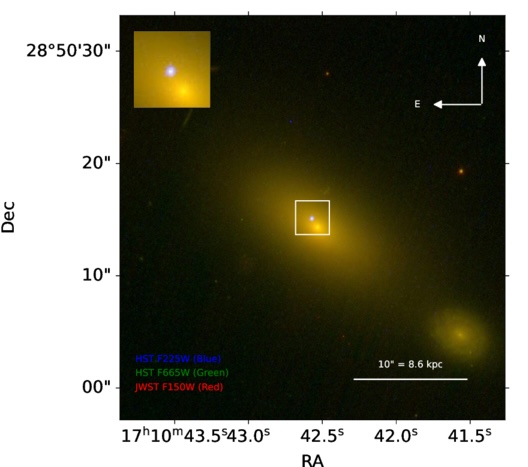
That is exactly the puzzle posed by AT2024tvd, a tidal disruption event (TDE) spotted roughly 2,600 light-years from the center of a massive galaxy located 600 million light-years away from us (see Figure 1).

AT2024tvd from Hubble and JWST

Figure 1: A color image of AT2024tvd from the Hubble Space Telescope and JWST. The yellow dot inside the square marks the galaxy’s center, while the TDE is the white dot, which is visibly offset to the upper left, about 2,600 light-years away. [Adapted from Guolo et al. 2026]

We see TDEs when a black hole tears apart a star that gets too close to it. It happens because the black hole’s gravity pulls harder on the near side of the star than the far side, stretching the star until it comes apart. The stellar debris then forms a hot accretion disk, a ring of material swirling around the black hole that spirals inward and releases a burst of electromagnetic energy across many wavelengths — from visible light to X-rays. These events are valuable to astronomers because they briefly light up black holes that would otherwise be invisible, giving us a rare window to measure their properties. Since supermassive black holes live at galactic centers, that is also where we expect TDEs to happen, which makes a TDE found away from a galactic center rare and puzzling. The galactic center is often called the nucleus of a galaxy, so astronomers refer to these displaced events as “off-nuclear” TDEs. AT2024tvd is only the third known off-nuclear TDE, and this research article makes a strong case that it is the most remarkable one yet.

Measuring Mass Using Light

To figure out the mass of the black hole responsible for AT2024tvd, the authors needed to get creative. You cannot weigh a black hole directly, so astronomers have to work backward from what they can see. The key idea is that a black hole’s mass controls how its accretion disk behaves. A more massive black hole produces a larger, cooler disk, while a less massive one produces a smaller, hotter disk. By measuring how bright the disk is at different wavelengths and how hot it gets, you can figure out how massive the black hole must be.

The authors did this by modeling the light the event produced across many wavelengths. They combined data from several telescopes: the Zwicky Transient Facility, the Neil Gehrels Swift Observatory, Pan-STARRS, and two rounds of high-quality X-ray data from XMM-Newton. TDE light curves go through different phases. The early flare in visible and ultraviolet light is bright but complicated, and the physical processes behind it are not fully understood. But after a few hundred days, TDEs settle into a quieter “plateau phase,” where the ultraviolet and visible light come directly from the accretion disk. At this stage, the emission follows well-understood physics, and astronomers can model it reliably.

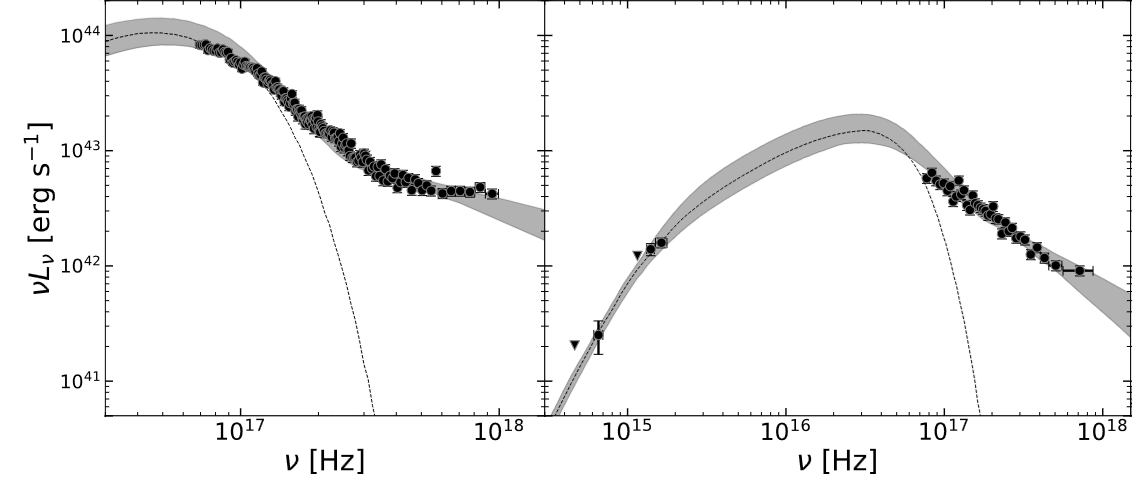
The authors used a model called kerrSED, which describes the spectral energy distribution (SED) of a spinning black hole’s accretion disk (kerr). It accounts for the disk’s temperature, its physical size, the black hole’s spin (how fast it rotates), and the angle at which we are viewing the system. It also accounts for a process called Comptonization, where hot electrons near the black hole boost lower-energy photons (particles of light) up to X-ray energies. By fitting this model to the observed light at multiple wavelengths simultaneously, the authors could pin down the disk properties and extract the black hole mass. The result was a clean fit: the disk model alone could explain all the observed light during the plateau phase, with nothing significant left over (see Figure 2).

brightness evolution of AT2024tvd

Figure 2: The brightness of AT2024tvd measured across a wide range of wavelengths, after correcting for absorption and the galaxy’s motion. The symbols show individual measurements from different telescopes, while the shaded contours represent the best-fit disk model and its uncertainty. Left: The early X-ray data, which is well explained by emission from the hot inner accretion disk. Right: The later data covering both visible/ultraviolet light and X-rays, all consistently explained by the same disk model. [Adapted from Guolo et al. 2026]

Not an Intermediate, but a Supermassive Black Hole

From their fit, the authors found a black hole mass of about one million solar masses. Black holes above about 100,000 solar masses are considered supermassive, while those below that threshold but above about 100 solar masses are called intermediate-mass black holes. So, this puts AT2024tvd in the supermassive category. This matters because the two previously known off-nuclear TDEs, called 3XMM J2150-05 and EP240222a, were both powered by intermediate-mass black holes. Those black holes were found inside small, dense collections of stars called ultra-compact dwarf galaxies that were orbiting larger host galaxies.

AT2024tvd is different. When the authors looked at deep images of the location where the TDE happened, they found no star cluster or small galaxy there. Whatever group of stars once surrounded this black hole has been almost entirely pulled apart by the gravity of the much larger parent galaxy. The ratio of the black hole’s mass to the mass of any remaining stars around it is extreme: greater than 3%, which is far above what we normally see. This is the signature of a “wandering” supermassive black hole, one that was brought in during a past galaxy merger and has been slowly sinking toward the center of its new host ever since, losing its surrounding stars along the way.

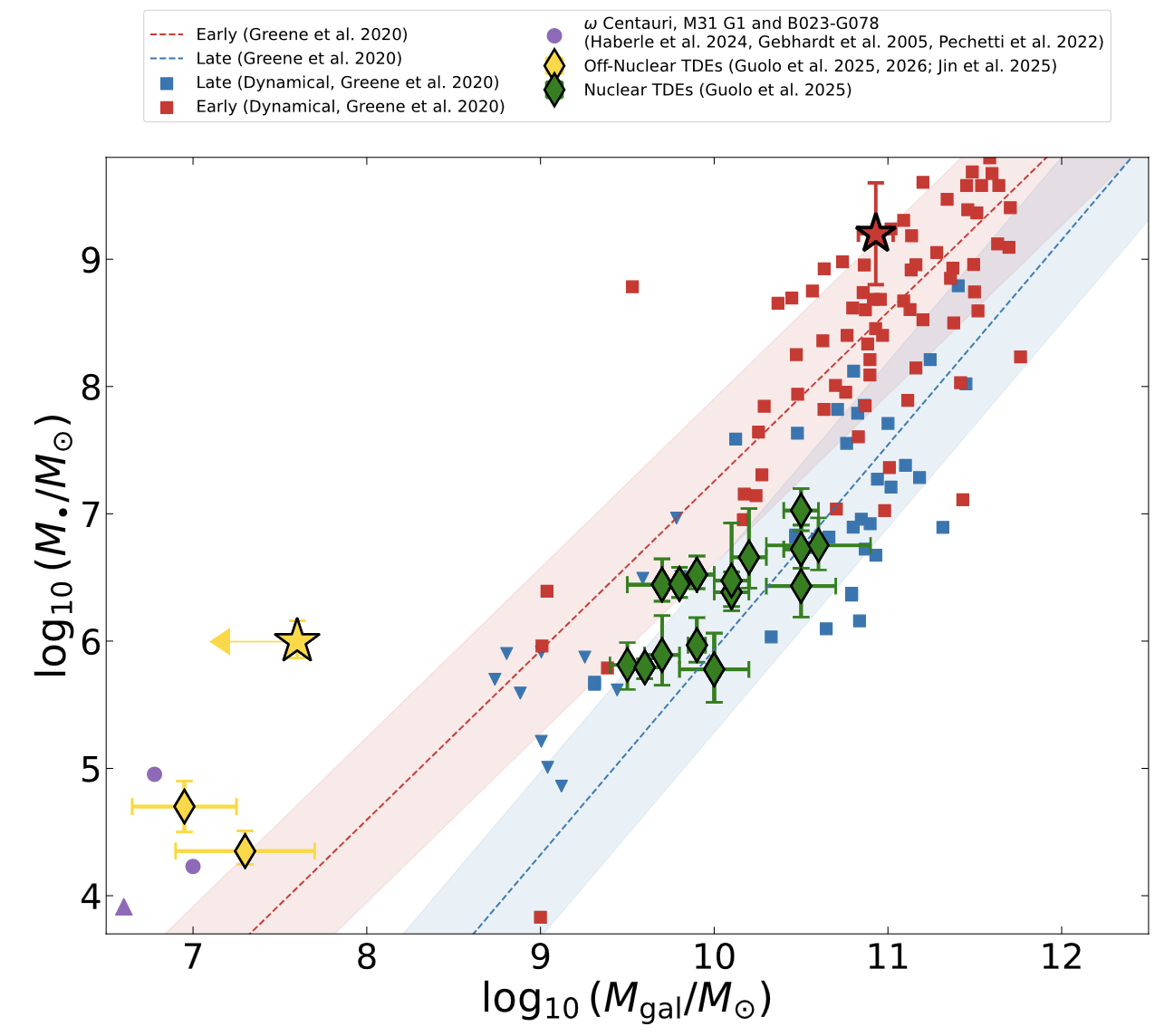
The authors compared AT2024tvd to other TDEs using established relationships between accretion disk properties and black hole mass (Figure 3). In terms of its disk temperature, luminosity, and inferred mass, AT2024tvd behaves like a typical nuclear TDE powered by a supermassive black hole. However, when placed on the black hole mass versus host stellar mass relation, it stands out as a strong outlier. The black hole mass is far too large for the small amount of surrounding stellar mass detected at its location.

plot of black hole mass versus host galaxy mass

Figure 3: AT2024tvd (yellow star) plotted on the relationship between black hole mass and host galaxy stellar mass. Red squares show nearby galaxies with dynamically measured black hole masses plotted against galaxy bulge stellar mass, while blue squares show the relation using total galaxy stellar mass. Purple points and green diamonds represent nuclear TDE host galaxies with black hole masses inferred from different TDE modeling techniques. Yellow diamonds mark the two previously known off-nuclear TDEs. AT2024tvd stands out as a clear outlier, with a very high black hole mass compared to the upper limit on any surrounding stellar mass. [Guolo et al. 2026]

The Big Picture

This discovery matters for several reasons. It shows that off-nuclear TDEs are not limited to intermediate-mass black holes sitting in small satellite galaxies. Some are powered by fully supermassive black holes that have been displaced from their original galactic centers. It also shows that TDE modeling, when done carefully during the plateau phase of the light curve (when the emission is dominated by well-understood accretion disk physics), can provide reliable black hole masses on its own, without assuming any relationship between the black hole and its host galaxy. This is particularly important for wandering black holes, where those relationships do not apply.

Looking ahead, upcoming surveys like Vera C. Rubin Observatory’s Legacy Survey of Space and Time are expected to find many more off-nuclear TDEs. Combined with X-ray follow-up from telescopes like XMM-Newton, these events could become our main tool for mapping out the population of displaced black holes in the nearby universe. One disrupted star at a time, we are starting to find black holes that theory told us should exist but that had, until now, stayed hidden.

Original astrobite edited by Kelsie Taylor and Veronika Dornan.

About the author, Serat Saad:

Serat is a first-year PhD student in astronomy at The Ohio State University. His research is on stellar and galactic dynamics, where he uses observational data to understand gravity. He also has interests in active galactic nuclei and tidal disruption events.

The post A Wandering Supermassive Black Hole Eating a Star appeared first on AAS Nova.

❌