
❌

Normal view

An Impostor Explosion

27 March 2026 at 16:00

A rendering of two purple jets streaming away from a central explosion.

Over many centuries of observing the night sky, astronomers have found only a single visible afterglow of a collision between neutron stars. For a few days in the summer of 2025, it seemed like observers may have found another of these treasured but elusive prizes; unfortunately, the promising candidate turned out to be a supernova in disguise.

A Rare Prize
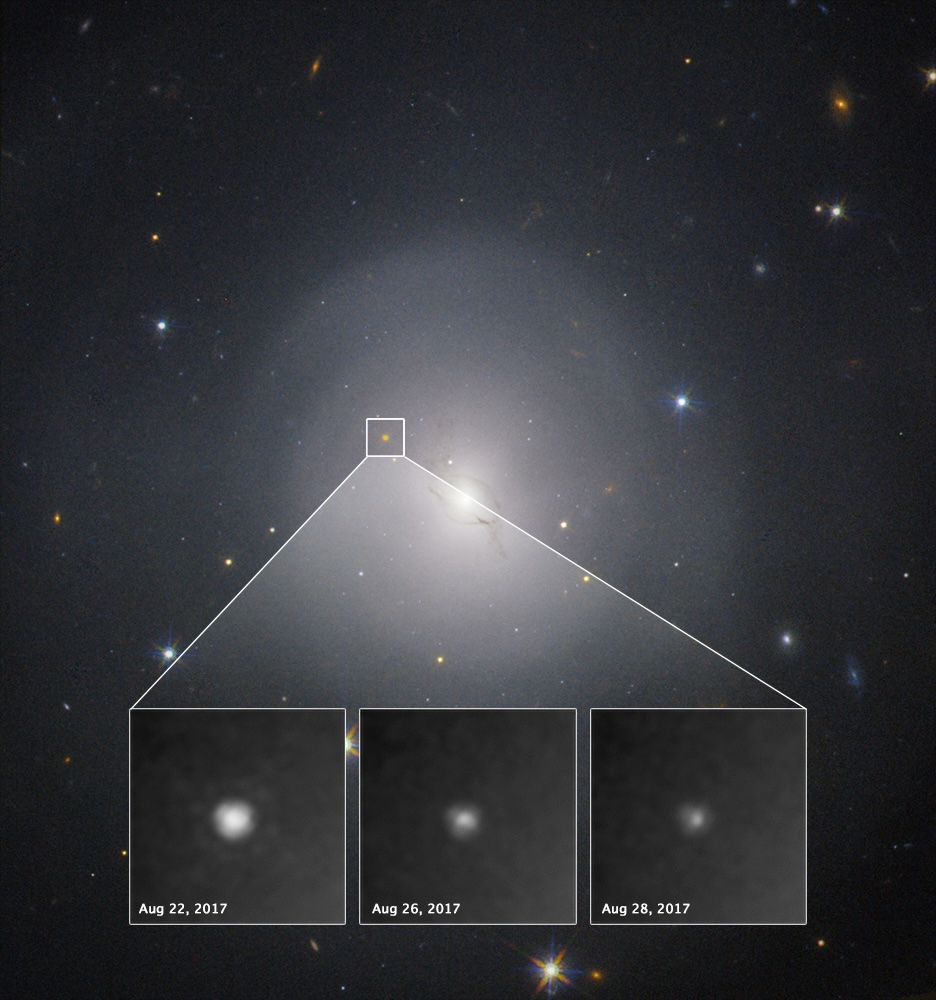
kilonova as seen by Hubble

These images from the Hubble Space Telescope show the fading light of the kilonova associated with the gravitational wave event GW170817. [NASA and ESA Acknowledgment: A. Levan (U. Warwick), N. Tanvir (U. Leicester), and A. Fruchter and O. Fox (STScI)]

When two neutron stars (the ultra-dense remnants of massive stellar explosions) spiral together and collide, the cataclysm is energetic enough to release strong gravitational waves, forge heavy elements, and briefly glow across the electromagnetic spectrum. These events are called kilonovae, and they’re quite rare; while we may have detected a handful at high energies, there is only one event for which astronomers managed to record both gravitational waves and an optical transient.

That one kilonova, found back in 2017, taught astronomers much about how heavy elements are formed and left the scientific community hungry for more data. Since then, each time a gravitational wave detector like LIGO reports that it may have spotted a neutron star merger, telescopes across the world scramble to look in the probable region of the sky, hoping to find the short-lived electromagnetic counterpart.

Too Good to Be True

On 18 August 2025, the LIGO/Virgo/KAGRA collaboration sent out an alert that it may have detected a neutron star–neutron star merger. The odds that their signal was real weren’t great, and the researchers gave it just a 29% chance of being a genuine astrophysical signal. Still, given the potential payoff of finding the next kilonova, several telescopes quickly began searches for the optical counterpart. The gravitational wave signal suggested that the event likely came from a curved patch of sky delightfully referred to as the β€œnorthern banana,” and after trawling that region for a few nights, astronomers hauled in 47 new transients. Any one of these could have been the kilonova, and all of them received extensive follow-up observations.

A team led by James Gillanders (University of Oxford) recently summarized some of these follow-up observations carried out with the Pan-STARRS and ATLAS telescopes. In the initial exciting few days after the alert went out, one candidate transient stood out as the most promising. Named AT2025ulz, it was first spotted by the Zwicky Transient Facility and initially started fading rapidly and changing colors, just as models of kilonovae predict. For four days, it seemed like the world may have witnessed its second-ever kilonova. But then the telescopes began their fifth night of observations.

Supernova Unmasked

A scatter plot showing a rapidly fading, then reversing and spiking, light curve.

The light curve of SN2025ulz. Note that the source appeared to grow brighter again after about 5 days. Click to enlarge. [Gillanders et al. 2025]

The light curve of AT2025ulz, after fading steadily in the preceding days, suddenly turned upwards; in other words, whatever was causing the transient got brighter. Models of kilonova evolution predict no such brightening, but Type IIb supernovae are known to follow just this behavior. AT2025ulz showed itself to be another run-of-the-mill stellar explosion, not the sought-after fireworks of two neutron stars slamming together.

Frustrating as this particular result may be, the effort was far from wasted. The team could use their non-detection of the true kilonova to place limits on its timing and peak magnitude, assuming it existed in the first place. And, as gravitational wave detectors grow more sensitive and alerts like this more common, hindsight will likely frame this scramble as a dress rehearsal for an ultimately successful kilonova recovery effort. Until then, astronomers will keep searching, and will keep their guard up against cosmic impostors.

Citation

β€œPan-STARRS Follow-Up of the Gravitational-Wave Event S250818k and the Light Curve of SN2025ulz,” J. H. Gillanders et al 2025 ApJL 995 L27. doi:10.3847/2041-8213/ae2125

The post An Impostor Explosion appeared first on AAS Nova.
How Many Kilonovae Will Rubin Observatory Help Us Spot?

4 February 2026 at 17:00

Vera Rubin Observatory

The detection of gravitational waves and light from a single source was one of the most important discoveries of the gravitational wave era. Can upcoming data from Vera C. Rubin Observatory help astronomers repeat that feat?

kilonova as seen by Hubble

These images from the Hubble Space Telescope show the fading light of the kilonova associated with the gravitational wave event GW170817. [NASA and ESA Acknowledgment: A. Levan (U. Warwick), N. Tanvir (U. Leicester), and A. Fruchter and O. Fox (STScI)]

Not Yet Repeated

When two neutron stars merge, the collision sends ripples through spacetime and generates an electromagnetic signal called a kilonova. In 2017, researchers detected gravitational waves and kilonova emission from colliding neutron stars β€” the first and, to date, only electromagnetic signal definitively associated with a gravitational wave event.

In a research article published this week, a team led by Simon Stevenson (Swinburne University of Technology; OzGrav) considered how the much-anticipated Legacy Survey of Space and Time (LSST), carried out by Rubin Observatory, can enhance our ability to detect kilonovae and pair them with their gravitational wave counterparts.

Survey Simulations

When a new gravitational wave signal is detected, researchers rush to search for an electromagnetic counterpart to the signal. While Rubin Observatory can aid this type of reactive search, Stevenson’s team focused on a different strategy: spotting kilonovae during routine survey operations and using these detections to trigger a targeted hunt through gravitational wave data, searching for signals missed by automated detection algorithms.

Over the 10-year course of LSST, Rubin will scan the visible southern sky every few days, uncovering a wide variety of transient sources such as supernovae, novae, and tidal disruption events.Β Because Rubin will amass a huge amount of data each night, astronomers worldwide will use data brokers to pass along the most promising signals. Stevenson’s team used for their analysis a bespoke and modular data broker called Fink.Β Fink currently handles 200,000 alerts per night from the Zwicky Transient Facility and will be scaled up to handle 10 million alerts per night as Rubin requires.

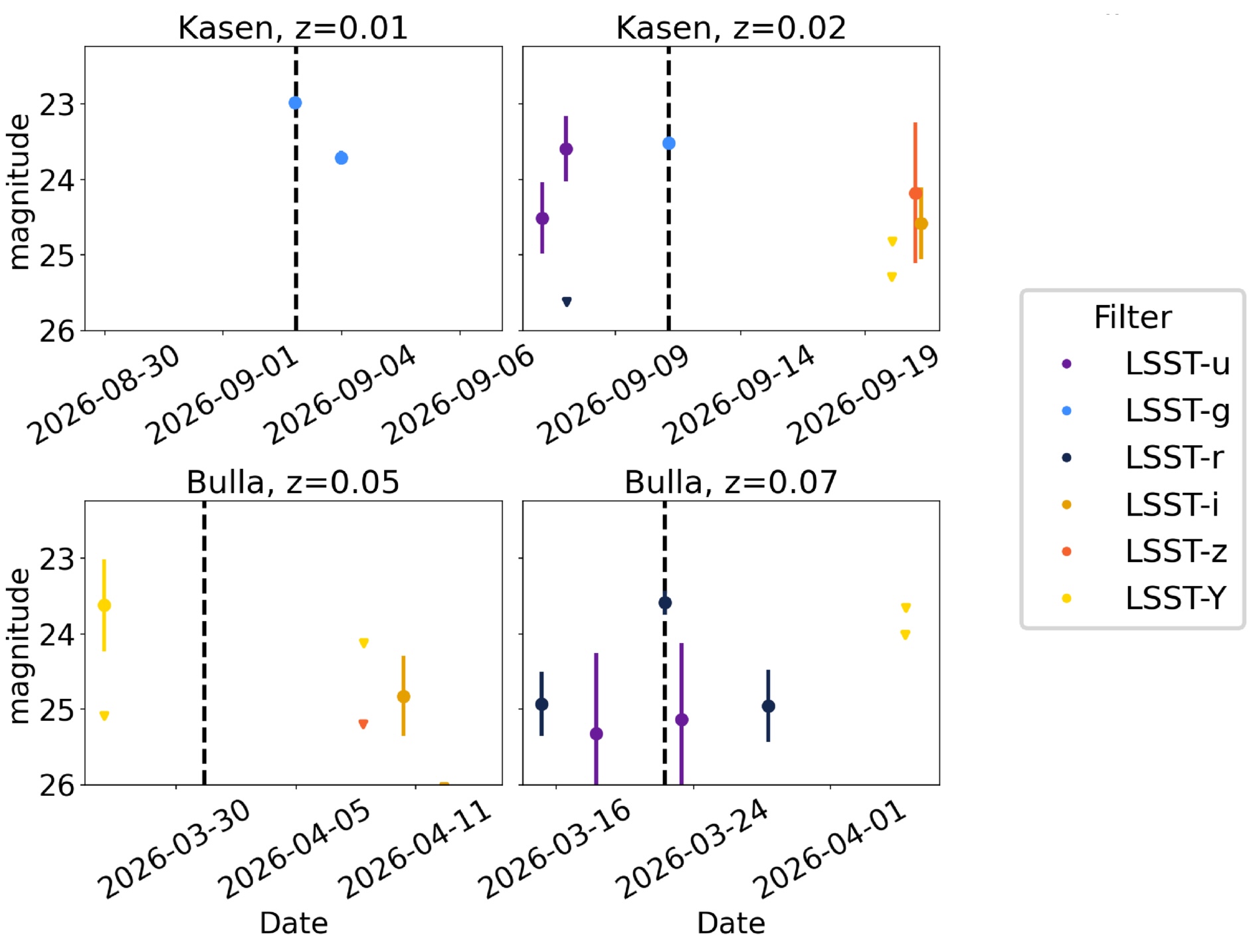
simulated kilonova light curves

Examples of simulated kilonova light curves for different redshifts and models (Kasen and Bulla). Click to enlarge. [Adapted from Stevenson et al. 2026]

Searching for Signals

Though Rubin is a transient-tracking powerhouse, it’s not ideally suited to discovering kilonovae specifically; these events evolve so rapidly that Rubin may only be able to collect a few data points before the event fades from its view. To gauge Rubin’s efficacy as a kilonova detector, Stevenson and collaborators simulated kilonova light curves and identified detections with a signal-to-noise ratio greater than 5; these detections will be passed to the data broker. They found that Rubin will detect about 42 kilonovae per year, but only a few will have a strong enough signal to be passed to the broker.

For the handful of detections that are passed to the broker, what are the prospects for tracking down the associated gravitational wave signals? Due to the survey cadence, most kilonova detections occurred 1–2 days after the gravitational waves from the neutron star collision would have reached Earth, but delays of up to 5 days were possible. This means that searches for gravitational wave signals must sift through multiple days of data β€” a computationally intensive prospect that might require the development of new search techniques. The computational requirements of this search are increased by the possibility of contaminants (signals misclassified as kilonovae and passed on by the data broker), which will require additional followup.

Despite these challenges, it’s clear that Rubin’s upcoming detections of kilonovae will advance our study of these rare events. With LSST expected to get underway early this year, the next multi-messenger signal may be just around the corner.

Citation

β€œStrategy for Identifying Vera C. Rubin Observatory Kilonova Candidates for Targeted Gravitational-Wave Searches,” Simon Stevenson et al 2026 ApJ 998 8. doi:10.3847/1538-4357/ae244e

The post How Many Kilonovae Will Rubin Observatory Help Us Spot? appeared first on AAS Nova.

❌