The European Union has now published a set of measures aimed at boosting Europe’s tech industry to help reduce reliance on US and Chinese suppliers for AI, cloud, and semiconductors. The proposals include rules to restrict the use of US hyperscalers for certain public sector procurement purposes, but stop short of banning them outright.
“Technological sovereignty does not mean protectionism. Europe remains grounded in openness, partnership, and fair competition,” Henna Virkkunen, executive vice president for Tech Sovereignty, Security and Democracy, said in a statement Wednesday. “At the same time, Europe wants to be in the position to make its own choices, avoiding dependence on single dominant suppliers, especially from non-like-minded countries.”
The European Technological Sovereignty Package — released after several delays — includes two legislative proposals: the Cloud and AI Development Act and Chips Act (CAIDA) 2.0 and the Open Source Strategy and Strategic Roadmap for Digitalization and AI in Energy.
CAIDA aims to triple data center capacity in the next five to seven years by easing restrictions for deployments across the EU. It also includes rules that, if enacted, would require EU public bodies to meet certain sovereignty criteria for cloud service procurement related to certain sensitive workloads.
Amid ongoing trans-Atlantic tensions and a long-time deep reliance on US tech providers, European organizations have become increasingly wary of a “kill switch” that would cut off access to digital services. There are also concerns that US hyperscalers could be compelled to share data with US government under the CLOUD Act and Foreign Intelligence Services Act (FISA), even when data centers are located in Europe.
The CAIDA proposals include four levels of criteria for suppliers; the most basic includes data center infrastructure located and operated in the region – something many US cloud suppliers already provide – with stricter rules around supplier ownership, full control over the software stack, and more stringent cybersecurity certification.
The majority of existing EU public sector workloads (70%) fall under the first level, with 20% at level 2, and 9% at level 3. Only a small proportion (1%) of the most sensitive workloads would require level 4.
Other proposals include the Chips Act 2.0, a follow-up to the 2023 legislation that sought to improve semiconductor production capabilities; the updated version now aims to boost research and spur demand for domestically produced processors.
The legislative proposals must be negotiated by the European Parliament and Council of the European Union before adoption.
When students first learn quantum field theory, the mathematical language the underpins the behavior of elementary particles, they start with the simplest possible interaction you can write down : a particle with no spin and no charge scattering off another copy of itself. One then eventually moves on to the more complicated interactions that describe the behavior of fundamental particles of the Standard Model. They may quickly forget this simplified interaction as a unrealistic toy example, greatly simplified compared to the complexity the real world. Though most interactions that underpin particle physics are indeed quite a bit more complicated, nature does hold a special place for simplicity. This barebones interaction is predicted to occur in exactly one scenario : a Higgs boson scattering off itself. And one of the next big targets for particle physics is to try and observe it.
A Feynman diagram of the simplest possible interaction in quantum field theory, a spin-zero particle interacting with itself.
The Higgs is the only particle without spin in the Standard Model, and the only one that doesn’t carry any type of charge. So even though particles such as gluons can interact with other gluons, its never two of the same kind of gluons (the two interacting gluons will always carry different color charges). The Higgs is the only one that can have this ‘simplest’ form of self-interaction. Prominent theorist Nima Arkani-Hamed has said that the thought of observing this “simplest possible interaction in nature gives [him] goosebumps“.
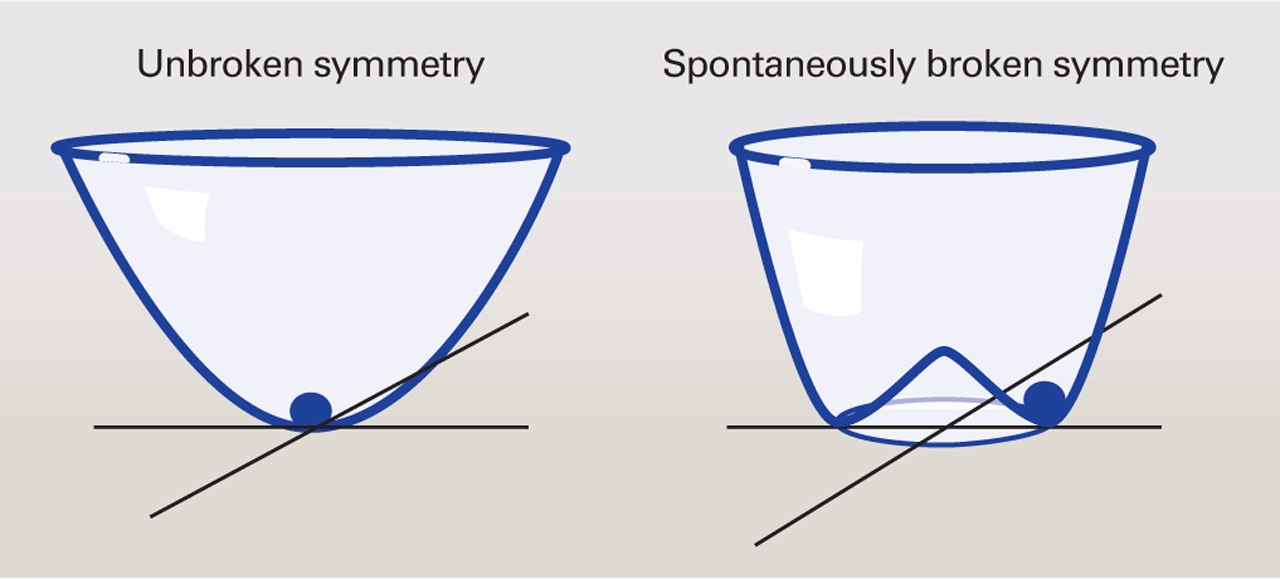
But more than being interesting for its simplicity, this self-interaction of the Higgs underlies a crucial piece of the Standard Model: the story of how particles got their mass. The Standard Model tells us that the reason all fundamental particles have mass is their interaction with the Higgs field. Every particle’s mass is proportional to the strength of the Higgs field. The fact that particles have any mass at all is tied to the fact that the lowest energy state of the Higgs field is at a non-zero value. According to the Standard Model, early in the universe’s history when the temperature were much higher, the Higgs potential had a different shape, with its lowest energy state at field value of zero. At this point all the particles we know about were massless. As the universe cooled the shape of the Higgs potential morphed into a ‘wine bottle’ shape, and the Higgs field moved into the new minimum at non-zero value where it sits today. The symmetry of the initial state, in which the Higgs was at the center of its potential, was ‘spontaneously broken’ as its new minimum, at a location away from the center, breaks the rotation symmetry of the potential. Spontaneous symmetry breaking is a very deep theoretical idea that shows up not just in particle physics but in exotic phases of matter as well (eg superconductors).
A diagram showing the ‘unbroken’ Higgs potential in the very early universe (left) and the ‘wine bottle’ shape it has today (right). When the Higgs at the center of its potential it has a rotational symmetry, there are no preferred directions. But once it finds it new minimum that symmetry is broken. The Higgs now sits at a particular field value away from the center and a preferred direction exists in the system.
This fantastical story of how particle’s gained their masses, one of the crown jewels of the Standard Model, has not yet been confirmed experimentally. So far we have studied the Higgs’s interactions with other particles, and started to confirm the story that it couples to particles in proportion to their mass. But to confirm this story of symmetry breaking we will to need to study the shape of the Higgs’s potential, which we can probe only through its self-interactions. Many theories of physics beyond the Standard Model, particularly those that attempt explain how the universe ended up with so much matter and very little anti-matter, predict modifications to the shape of this potential, further strengthening the importance of this measurement.
Unfortunately observing the Higgs interacting with itself and thus measuring the shape of its potential will be no easy feat. The key way to observe the Higgs’s self-interaction is to look for a single Higgs boson splitting into two. Unfortunately in the Standard Model additional processes that can produce two Higgs bosons quantum mechanically interfere with the Higgs self interaction process which produces two Higgs bosons, leading to a reduced production rate. It is expected that a Higgs boson scattering off itself occurs around 1000 times less often than the already rare processes which produce a single Higgs boson. A few years ago it was projected that by the end of the LHC’s run (with 20 times more data collected than is available today), we may barely be able to observe the Higgs’s self-interaction by combining data from both the major experiments at the LHC (ATLAS and CMS).
Fortunately, thanks to sophisticated new data analysis techniques, LHC experimentalists are currently significantly outpacing the projected sensitivity. In particular, powerful new machine learning methods have allowed physicists to cut away background events mimicking the di-Higgs signal much more than was previously thought possible. Because each of the two Higgs bosons can decay in a variety of ways, the best sensitivity will be obtained by combining multiple different ‘channels’ targeting different decay modes. It is therefore going to take a village of experimentalists each working hard to improve the sensitivity in various different channels to produce the final measurement. However with the current data set, the sensitivity is still a factor of a few away from the Standard Model prediction. Any signs of this process are only expected to come after the LHC gets an upgrade to its collision rate a few years from now.
Current experimental limits on the simultaneous production of two Higgs bosons, a process sensitive to the Higgs’s self-interaction, from ATLAS (left) and CMS (right). The predicted rate from the Standard Model is shown in red in each plot while the current sensitivity is shown with the black lines. This process is searched for in a variety of different decay modes of the Higgs (various rows on each plot). The combined sensitivity across all decay modes for each experiment allows them currently to rule out the production of two Higgs bosons at 3-4 times the rate predicted by the Standard Model. With more data collected both experiments will gain sensitivity to the range predicted by the Standard Model.
While experimentalists will work as hard as they can to study this process at the LHC, to perform a precision measurement of it, and really confirm the ‘wine bottle’ shape of the potential, its likely a new collider will be needed. Studying this process in detail is one of the main motivations to build a new high energy collider, with the current leading candidates being an even bigger proton-proton collider to succeed the LHC or a new type of high energy muon collider.
A depiction of our current uncertainty on the shape of the Higgs potential (center), our expected uncertainty at the end of the LHC (top right) and the projected uncertainty a new muon collider could achieve (bottom right). The Standard Model expectation is the tan line and the brown band shows the experimental uncertainty. Adapted from Nathaniel Craig’s talkhere
The quest to study nature’s simplest interaction will likely span several decades. But this long journey gives particle physicists a roadmap for the future, and a treasure worth traveling great lengths for.
Cloud computing has reached a crossroads. The high cost and data sensitivity of AI workloads are raising the appeal of private clouds, even as neoclouds and sovereign clouds shake up the cloud provider landscape. New cyberthreats, shifting compute requirements, and management complexity are adding to cloud complications.
Download the June 2026 issue of the Enterprise Spotlight from the editors of CIO, Computerworld, CSO, InfoWorld, and Network World, and learn how to navigate the latest cloud strategy developments.

 Login