❌

Normal view

How do you design an invisibility cloak?

16 September 2026 at 08:53

Material behaviour is traditionally determined by chemistry. Free electrons in metals give rise to conductivity, unfilled orbitals make elements reactive. Metamaterials, on the other hand, have properties that come mainly from its internal design, not just from what it is made of.

These types of materials are characterised by a specifically designed larger-scale repeating pattern that interacts with waves in a chosen way. Invisibility cloaks are one such example. These are designed so that waves bend around an object and then recombine on the other side, making the object scatter much less light, sound or another type of wave.

The challenge is designing metamaterials to give you exactly the properties that you want. Two equations come into play.

  1. The Laplace equation. This describes steady-state conditions with no oscillations or waves and has only one free parameter. It is easy to use but the metamaterial properties you can get are often limited.
  2. The Helmholtz equation. This describes oscillations – sound waves, light waves etc. To use this equation, the wave medium usually needs two material parameters. For acoustics, these are equivalent to mass density and bulk modulus, which together determine how sound travels. Harder to work with, but more powerful.

The goal of new research from a team of researchers from China and Singapore is to have the best of both worlds. They were able to develop a mathematical correspondence between these two equations and use it to design metamaterials with new properties. Counterintuitively, they found that less complicated designs can achieve more. This less-for-more approach doesn’t try to design every aspect of how a wave behaves, but instead starts with a simpler, more manageable problem to access a wide range of useful effects.

The team used acoustics as testbed to demonstrate the power of their work. They demonstrated a range of novel phenomena such as three-dimensional freeform conformal cloaking, an experimentally validated waveguide cloak and the hyperbolic invisibility mentioned earlier. Because the technique is based on equations shared by several types of waves, their approach could also be applied to water waves and electromagnetic waves. This makes it a broadly transferable strategy for designing metamaterials

Real devices will still face practical limits from losses, dispersion and the need to approximate continuous material properties with fabricated structures. However, this new work does offer a practical method to design new metamaterials with exotic properties, and to manipulate waves beyond conventional constraints.

Read the full article

A less-for-more metamaterial paradigm via Laplace-Helmholtz correspondence – IOPscience

Z. Guo et al 2026 Rep. Prog. Phys. 89 077501

The post How do you design an invisibility cloak? appeared first on Physics World.
Real-number quantum theory can be more wrong than you thought

9 September 2026 at 10:29

Imaginary numbers first appeared in the 16th century as a mathematical invention, introduced to solve equations that real numbers could not. As the name implies, many treated them as kind of trick to get results, rather than an underlying truth about the nature of reality. Although highly controversial at the time, these numbers are now ubiquitous in many fields of physics and mathematics.

One such field is quantum mechanics. Researchers routinely use complex numbers, which include both imaginary and real parts. For many simple quantum systems, you could think this is a mathematical convenience rather than a physical necessity. Predictions made with complex numbers can often be reproduced using only real numbers, albeit in a larger mathematical space.

The key question is: are complex numbers merely just a convenience, a trick, or are they necessary to understand complicated quantum systems? And if they are necessary, to what extent?

A team of researchers from France, Poland and Spain have been working on this problem and they’ve now come up with an answer. Their work relies on the composition postulate – a standard starting point for formulations of quantum mechanics which describes how quantum systems are combined mathematically.

They set out by studying a star-shaped quantum network. In this network, a number of outer parties (N) each receive one part of a quantum system, while a central party (Eve) receives the other parts from independent sources.

Each outer party chooses between several simple two-outcome measurements, while the central party performs one measurement with many possible outcomes.

Their strategy was to build a specially designed, conditional Bell test. The most well-known Bell test compares classical physics with quantum mechanics, with experiments demonstrating the latter is a better description of reality.  However, Bell tests can compare the correlations predicted by many other different theories.

The two theories studied here were standard quantum theory using complex numbers and a different formulation of the theory only using real numbers. While it was already shown that complex numbers are necessary, just how much the predictions of complex and real quantum theories differ is still an open question.

They found that the ratio between the predictions of the two theories increased proportional to N-1. So as the network gets larger, real-number quantum theory becomes increasingly bad at reproducing the results of standard complex-number quantum theory.

The work therefore gives a clear answer to the original question. Namely, in sufficiently large quantum networks, complex numbers provide an advantage that can become arbitrarily large. If the composition postulate is respected, they are physically required.

Read the full article

Gap between quantum theory based on real and complex numbers is arbitrarily large – IOPscience

S. Sarkar et al 2026 Rep. Prog. Phys. 89 070503

The post Real-number quantum theory can be more wrong than you thought appeared first on Physics World.

Optical vortices provide a natural way to create topologies

9 September 2026 at 10:26

Structured light is light with a designed spatial pattern. It can be shaped into standard topological structures, such as a twist in its phase or a changing polarisation across the beam. These patterns are useful because they can encode information, probe small distances and create topological field structures.

However, the issue is that is that these carefully engineered patterns often spread or degrade as the beam travels. This is a problem for real-world applications, such as precision metrology and super-resolution sensing.

In a new work, a team of researchers from Singapore and Spain went down a different route. They identified a spin structure which is both a topological texture and topological defect that is not laboriously engineered but appears automatically at the dark core of an optical vortex because Maxwell’s equations require it.

An optical vortex is a dark core in a light beam where the electric field vanishes. Because the field is zero there, the phase cannot be defined. The researchers found that the light around this core has a tiny, ordered spin pattern.

The called this a meronic spin defect. A meron is a texture that covers half of a sphere of possible spin directions, while a defect is a point where the direction becomes undefined. Here, both features occur together: the spin vanishes at the centre but forms a half-sphere-like pattern around it.

Crucially, these defects do not spread out during propagation. The beam might diffract as usual, but the normalised spin and polarisation patterns remain confined on subwavelength scales. They are also more stable against turbulence than standard engineered structures, because they arise intrinsically from Maxwell’s equations rather than from carefully balanced beam components.

Although still a fundamental result, the finding suggests that vortex cores could provide unusually stable and compact building blocks for future structured-light technologies.

Read the full article

Non-spreading meronic spin defects around optical vortices – IOPscience

N. Mata-Cervera et al 2026 Rep. Prog. Phys. 89 077901

The post Optical vortices provide a natural way to create topologies appeared first on Physics World.

Quantum computers may pay a price for keeping time

26 August 2026 at 07:58

Most quantum computers today do not work in isolation. They rely on carefully timed signals from classical electronics, lasers or magnetic fields to tell the qubits when to perform each operation.

In ordinary quantum-computing theory, the qubits are treated as the computer while these timing signals are treated as external infrastructure. When calculating the energy required to run a quantum computer, drawing a boundary around the qubits like this will inevitably hide part of the real-world energy cost. Draw the boundary around the whole computing machine, including its clock, and a new energetic cost appears.

This is the idea behind new research from a team of researchers from Austria. In a new study, they introduced the idea of an autonomous quantum processing unit (aQPU). The aQPU has four main parts: a memory where the calculation happens, an instruction register that stores the program, a tick register that counts the steps, and an internal quantum clock that drives the whole process. The idea is similar to a mechanical machine that, once started, runs without an external operator.

The team showed there is an inescapable trade-off between accuracy and thermodynamics. If the clock ticks at slightly uncertain times, the quantum gates are applied imperfectly, reducing the fidelity of the computation. The authors found that the error grows with the length of the program and shrinks as the clock becomes more accurate. But more accurate clocks generally dissipate more entropy, meaning they produce more thermodynamic irreversibility.

In practice, such entropy production is usually associated with dissipated energy, often as heat. For quantum computers, this is especially awkward because many platforms already need delicate cooling and isolation procedures.

The new study does not propose a practical computer yet. Instead it gives physicists a cleaner way to ask how much energy quantum computation fundamentally requires. Even when quantum gates are mathematically reversible, the physical act of controlling them with sufficient precision may not be thermodynamically free.

Read the full article

Autonomous quantum processing unit: an autonomous thermal computing machine & its physical limitations – IOPscience

Florian Meier et al 2026 Rep. Prog. Phys. 89 077601

The post Quantum computers may pay a price for keeping time appeared first on Physics World.

Do exceptional-point sensors really measure better?

19 August 2026 at 08:06

Exceptional points occur in open physical systems where two or more resonances merge so completely that both their measured values and their underlying states become identical. (Technically speaking, the eigenvalues and the eigenvectors coalesce.) Exceptional points are different from ordinary degeneracies, where two frequencies may be the same but the corresponding states remain separate.

Near an exceptional point, a tiny change in the system can produce a relatively large change in the resonances. That is why exceptional points have been proposed for sensitive devices such as optical sensors. But there is a catch: a large response is not automatically useful if quantum noise also increases at the same time.

In a new paper, researchers Jan Wiersig and Stefan Rotter tackled this problem using quantum Fisher information. This is a quantity that sets the best possible precision of a measurement under ideal conditions.

Their approach treats the sensor as a scattering device, where incoming coherent light is transformed into outgoing light, and asks how much information about a small perturbation can be extracted from that change.

The results are, unsurprisingly, complicated – but that complexity turns out to be revealing.

For several years, different groups have reached seemingly contradictory conclusions about whether exceptional points actually improve sensing at the quantum limit, with some studies reporting a clear advantage and others finding none. Wiersig and Rotter’s analysis helps explain these disagreements: the answer depends on the physical assumptions and, in particular, on how the input light, losses and perturbation are matched to the resonant modes.

The analysis therefore does not yield a simple yes-or-no verdict. Under suitably matched conditions, exceptional points can provide substantially more quantum Fisher information. For example, a factor-of-four enhancement for a second-order exceptional point in a two-microring system, and an even larger enhancement in the third-order case.

What’s more, the optimum operating point need not be the exceptional point itself. Moving slightly away from it can produce linewidth splitting, creating a longer-lived mode that interacts more strongly with the perturbation and thereby increases the useful signal.

The take-home message is that exceptional points are not magic sensitivity boosters. They can provide an advantage when the light field, perturbation and resonant mode are well matched. Internal losses may weaken or remove this advantage, although small losses do not destroy the overall picture.

Future exceptional-point sensors will therefore need to be designed as complete measurement systems, rather than around the exceptional point alone.

Read the full article

Fundamental limits of non-Hermitian sensing from quantum Fisher information – IOPscience

Jan Wiersig and Stefan Rotter 2026 Rep. Prog. Phys. 89 067501

The post Do exceptional-point sensors really measure better? appeared first on Physics World.

Quantum effects in chemical reactions

19 August 2026 at 08:05

Chemical reactions are usually modelled as random, statistical events, with particles bumping into each other and rearranging according to energy and probability. But at extremely low temperatures, atoms and molecules can behave as coherent matter waves, meaning many particles share a common quantum phase. In this setting, a reaction can look less like classical chemistry and more like wave mixing in optics.

In order to learn more about this phenomenon, a team of researchers from the University of Chicago studied a gas of caesium atoms, cooled down to 11nK to form a Bose–Einstein condensate.

Their approach was to use a Feshbach resonance to initiate the chemical reaction. This resonance is a way of using a magnetic field to tune how strongly ultracold atoms interact with each other.

At this point, two atoms can couple strongly to a bound molecular state, so pairs of atoms can be converted into weakly bound caesium diatomic molecules. Using this technique, they were able to transform an atomic Bose–Einstein condensate into a molecular Bose–Einstein condensate, consisting of about 10,000 molecules.

Their key result is the observation of phase doubling. This is the matter-wave version of phase matching in second harmonic generation, where two red photons in a nonlinear medium combine to produce one blue photon with twice the frequency and twice the momentum. Here, two atomic matter waves combine into a molecular matter wave whose phase is twice the atomic phase.

They also showed that molecules formed from atoms in different momentum states were enhanced beyond a classical expectation. This allowed the team to identify non-separable, entangled two-atom momentum states created during the reaction.

This work is one example of quantum many-body chemistry, where reactions are governed by the shared quantum phase of many atoms and molecules. This is also similar to how the direction of a Josephson supercurrent is determined by the phase difference across its junction.

Read the full article

Observation of phase doubling and entanglement in coherent matter-wave reactions – IOPscience

Shu Nagata et al 2026 Rep. Prog. Phys. 89 060501

The post Quantum effects in chemical reactions appeared first on Physics World.

When topology meets entanglement

12 August 2026 at 09:38

Topological materials have been receiving a lot of attention in recent years because of their potential applications in future electronic and quantum technologies.

These are a type of material whose electrons have properties that stay stable even when the material has small defects, impurities, or imperfections. They often have surface or edge behaviour that is very different from the interior, because of the structure of the material’s quantum states.

Researchers use quantities such as Berry curvature and Chern numbers to describe topological materials. Berry curvature measures how an electron’s quantum state changes as its momentum changes. Adding this curvature across the whole band gives a Chern number, a whole-number label that can show whether the material is topological.

A key question in this area is: when a material has topological properties, how much of that behaviour is actually tied to quantum entanglement?

In a new paper published recently, Kazuki Ikeda and Steven Rayan tackled this question using the spinless Haldane model. This is a widely used theoretical model for understanding topological materials. This model describes electrons moving on a honeycomb lattice, which has two different sublattices, called A and B.

Here, the researchers added an extra layer of analysis. Instead of only calculating whether the model is topological, they were able to determine where the topological signal comes from.

By introducing a filter based on quantum entanglement, they tested whether the Berry curvature is associated with electron states that are spread across both A and B sublattices, or with states that mostly sit on one sublattice.

They also focused on what happens when the system moves between different topological phases, giving a more organised way to describe what changes when the energy gap closes and the material switches phase.

These results will provide invaluable insights into understanding and designing topological materials going forward.

What’s also interesting here is that, in order to obtain these results, the authors employed Langlands-inspired mathematics to keep track of what changes when the material switches between topological phases.

The Langlands programme is an ambitious mathematical dictionary that tries to translate problems about numbers into problems about symmetry, geometry and analysis.

Although the link in this work is purely conceptual, it does show that Langlands-style structures can organise real physics problems in topological matter.

Read the full article

Quantum entanglement, stratified spaces, and topological matter: towards entanglement-sensitive Langlands data – IOPscience

Kazuki Ikeda and Steven Rayan 2026 Rep. Prog. Phys. 89 067601

The post When topology meets entanglement appeared first on Physics World.

A new way to trap and twist light inside quasicrystals

29 July 2026 at 07:53

Quasicrystals are unusual yet relatively common materials.  They show up in lots of different places from alloys to colloids and even in meteorites. They have some ordered structure, but unlike ordinary crystals their patterns never repeat.

This mix of order and irregularity leads to interesting behaviour when waves move through them. In optical versions of these materials, light can become trapped or guided in ways that doesn’t happen in regular structures.

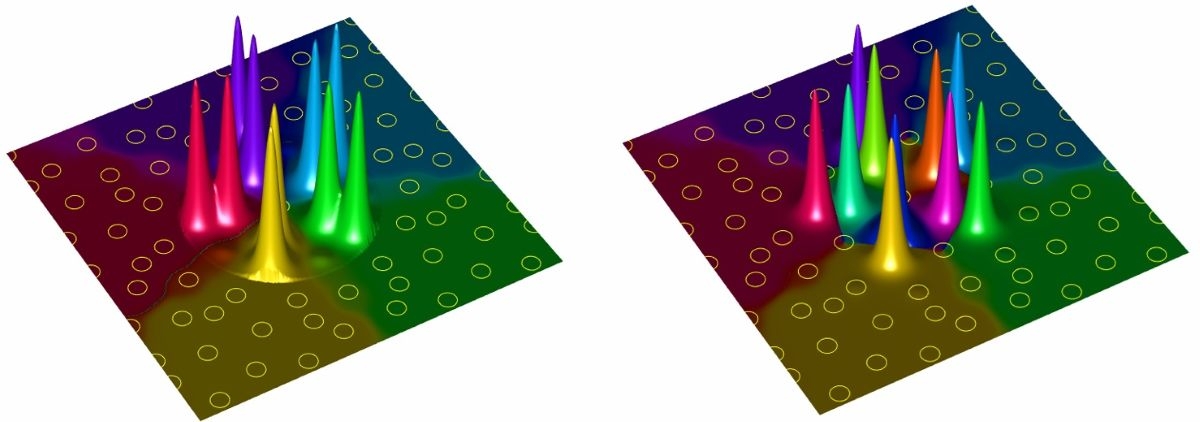
In a new study published recently, a team of researchers investigated what happens when light beams with a twist, called vortex beams, travel through quasicrystals that have been deliberately altered. They began with a classic pattern known as the Penrose tiling and then introduce large scale defects by removing or adding wedge shaped sections. This let the researchers tune the rotational symmetry of the structure and compare how light behaves in each case.

Using a standard model for how light travels through the material, the researchers showed that these modified quasicrystals can support new vortex states. These include two distinct types of vortex solitons, which are twisted beams of light that keep their shape as they travel rather than spreading out.

Usually, these light states require carefully tuned input power and are easily disrupted. What’s different in this case though is they form even with weak input and remain stable under small disturbances. This makes them far more applicable to real-world conditions.

These vortex beams can carry information in the amount of twist they have, providing an extra way to encode data alongside commonly used properties such as intensity or colour. If they remain stable as they travel, they would allow more information to be sent through the same optical system. This could be very useful in optical communication systems, where fast and efficient data transmission is essential.

vortex solitons in quasicrystals
Vortex soliton maps (Credit: Hua Zhong et al)

Read the full article

Vortex solitons in disclination quasicrystals – IOPscience

Hua Zhong et al 2026 Rep. Prog. Phys. 89 067903

The post A new way to trap and twist light inside quasicrystals appeared first on Physics World.

How can you fast-forward a quantum simulation?

1 July 2026 at 08:48

Quantum computers promise to simulate physical systems far beyond the reach of classical machines. But even quantum algorithms face fundamental limits: no fast-forwarding theorems. These say that if you want to simulate a system for longer, the computational effort increases at least in proportion.

In many real algorithms, the situation is even worse than the ideal case. This is because the requirements of accuracy and runtime compound one another, so that running longer and running precisely become entangled and costly together.

In their new study, a team of researchers from Beijing and Hong Kong showed that this link between time and cost is not as rigid as it seems, at least for a broad class of realistic systems that interact with their surroundings. These so‑called open quantum systems are described by Lindbladian dynamics, which include both ordinary evolution and the effects of noise or dissipation.

In earlier approaches, improving the accuracy of a simulation made long-time calculations much more demanding, because the two effects multiplied together. The new method separates these contributions, so that the cost of simulating longer times does not automatically amplify the cost of achieving accuracy. In practical terms, this means that extending a simulation in time becomes far more manageable than before.

An even more surprising result appears when the dissipative processes in the system have a particular structure common in quantum physics. In these cases, the number of sequential computational steps needed grows only very slowly as the simulated time increases. Instead of needing proportionally more effort to simulate longer dynamics, the algorithm can effectively skip ahead, compressing what would normally be a long sequence of steps into a much shorter one. This fast‑forwarding is a dramatic departure from the usual expectation that longer simulations must always take longer to run.

The team also demonstrated how these ideas can be applied to studying thermal properties of quantum systems. These are essential for understanding matter at finite temperature. Such calculations are especially challenging at low temperatures, where lots of interesting physics often occurs. By exploiting their more favourable scaling, the new approach can extract certain thermal properties more efficiently, making it easier to probe regimes that are typically hard to access.

Beyond the specific application of this advance itself, the work highlights an important shift in perspective. Rather than focusing only on the worst‑case limits imposed by general theorems, it shows that carefully chosen physical structure can loosen those limits. Only time will tell what the implications for quantum simulation and computation will be in the future.

Read the full article

Exponential Lindbladian fast forwarding and exponential amplification of certain Gibbs state properties – IOPscience

Zhong-Xia Shang et al 2026 Rep. Prog. Phys. 89 057602

The post How can you fast-forward a quantum simulation? appeared first on Physics World.

How do collisions cause light to condense in solid-state devices?

17 June 2026 at 09:00

Light normally spreads out and escapes from optical devices, so it is not obvious how photons can ever behave like the atoms in a Bose–Einstein condensate (BEC). Yet experiments have shown that, under the right conditions, photons trapped in microscopic semiconductor cavities can collect into a single quantum state, even at room temperature. What has been missing is a clear explanation of how this happens in real semiconductor materials.

New research provides that explanation. The authors develop a detailed theory that tracks how photons interact with the electrons and holes inside a semiconductor while the system is continuously pumped with energy. Unlike earlier models that treated the semiconductor as a simple thermal background, this theory follows how all parts of the system evolve together, including particle collisions, energy losses and heat exchange with the surrounding material.

The key finding is that collisions between charge carriers (Coulomb scattering) allow the photons to share energy and effectively cool down. At high particle densities, this process is strong enough to make photons behave as if they were in thermal equilibrium, enabling them to form a condensate. This mechanism is very different from that in dye‑based photon condensates, where vibrations of molecules do most of the thermalising.

The theory also predicts several distinct regimes: ordinary thermal light, single‑mode and multimode photon condensation, and standard laser behaviour. Importantly, experiments can move between these regimes by adjusting parameters such as the cavity design and the pumping strength.

By explaining how quantum states of light can emerge in compact, room‑temperature semiconductor devices, this work could enable new quantum photonic technologies, including advanced light sources for communications, sensing and information processing.

Read the full article

A quantum kinetic theory of photon Bose–Einstein condensation in semiconductors – IOPscience

J. L. Figueiredo et al 2026 Rep. Prog. Phys. 89 057901

The post How do collisions cause light to condense in solid-state devices? appeared first on Physics World.

Exotic physics revealed in a simple circuit

17 June 2026 at 08:58

Physics ideas often travel far from their origins, but few make the leap from the Standard Model of particle physics to a circuit board. A surprising new experiment shows that custodial symmetry, best known for stabilising fundamental particle masses, can also emerge in an entirely classical electrical system built from off‑the‑shelf components.

Symmetry plays a central role across physics. As formalised by Noether’s theorem, every continuous symmetry is linked to a conserved quantity. This principle underpins everything from energy conservation to modern field theory. In particle physics, custodial symmetry acts as a safeguard, suppressing large corrections and keeping key quantities stable even when other symmetries are broken. A classical analogue of this idea was theoretically proposed several years ago, but its experimental realisation had remained elusive until now.

A team of researchers from China have now brought this concept to the laboratory using a topolectrical circuit — an electrical analogue of a topological lattice. Their system is based on the Su–Schrieffer–Heeger (SSH) model, a one‑dimensional chain known for hosting edge states that remain pinned to a boundary as long as a certain symmetry is present. The researchers deliberately disrupted that symmetry by introducing memristors: circuit elements whose resistance changes depending on how they have been used in the past.

Surprisingly, the edge states do not simply vanish. Instead, the team finds that a weaker form of protection remains. By measuring how the circuit’s behaviour changes, they identified a correction that shrinks smoothly as the memristive effect is reduced. This closely mirrors how custodial symmetry suppresses mass‑like corrections in quantum field theory.

The novel work shows how tabletop circuits can serve as accessible testbeds for ideas drawn from fundamental physics, opening new ways to explore symmetry, topology and memory using electronics rather than particles.

Read the full article

Observation of custodial chiral symmetry in memristive topological circuits – IOPscience

W. Li et al 2026 Rep. Prog. Phys. 89 048004

The post Exotic physics revealed in a simple circuit appeared first on Physics World.

Attosecond interferometry meets quantum optics

3 June 2026 at 07:26

Experimental attosecond science is built around the ability to generate and control light flashes lasting billionths of a billionth of a second. Such extreme pulses can be created through high harmonic generation (HHG), where an intense laser field drives electrons out of atoms or solids and then forces them back, releasing bursts of extreme ultraviolet radiation. Techniques like this have transformed our ability to observe electron motion on its natural timescale.

To extract information from such ultrafast processes, physicists often rely on attosecond interferometry. By combining a strong laser field with a weaker second colour, different electron trajectories are made to interfere, imprinting timing and phase information onto the emitted harmonics. Over recent years, these schemes have become standard tools for attosecond metrology and spectroscopy.

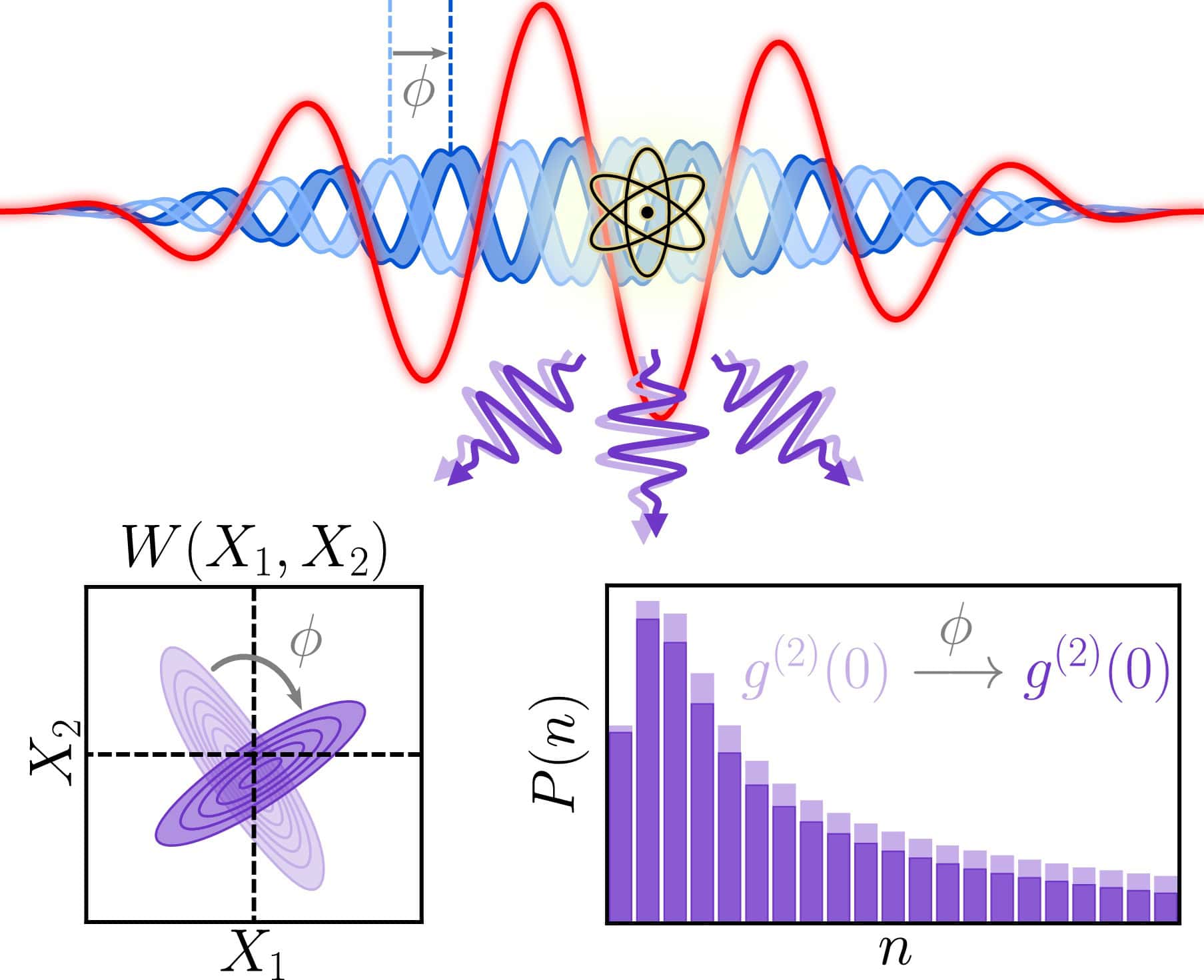
In a recent paper published in Reports on Progress in Physics, Javier Rivera Dean et al, revisited this idea from a quantum optical perspective. Treating both the driving fields and the emitted harmonics as quantum rather than classical objects, they analysed how attosecond interferometric control influences the photon statistics, correlations and phase space structure of the generated light. Their calculations show that even when harmonic radiation appears classical in its average properties, its underlying quantum state can carry rich and measurable structure.

The study also explores how interferometric phase control can be repurposed as a practical probe of quantum optical features in spectral regions where standard techniques, such as homodyne detection, are unavailable. This represents a new approach for measuring phase-space distributions through tomographic reconstruction: attosecond quantum tomography.

Attosecond quantum scheme
Illustrative image new of experimental scheme proposed in their paper (Credit: J. Rivera-Dean).

By combining quantum optics with common attosecond techniques, the work shows how ultrafast science is increasingly becoming a platform not just for watching electrons move, but also for studying light itself at the shortest timescales accessible in the laboratory.

Read the full article

Attosecond quantum optical interferometry – IOPscience

J. Rivera-Dean et al 2026 Rep. Prog. Phys. 89 047901

Do you want to learn more about this topic?

The physics of attosecond light pulses – IOPscience by P. Agostini and L. F. DiMauro (2004)

The post Attosecond interferometry meets quantum optics appeared first on Physics World.

Pushing many-body entanglement to its absolute limit

27 May 2026 at 08:07

An absolutely maximally entangled (AME) state is one in which every possible division of a many-body system into two groups is as entangled as quantum mechanics allows. This makes AME states uniquely valuable as benchmarks for quantum theory and as resources for quantum technologies. Yet basic questions about their existence, structure and classification have remained unresolved, even after two decades of study.

In a new work, dedicated to Ryszard Horodecki, this field has been advanced in several important ways. First, the authors provided a comprehensive and up to date overview of known methods for constructing AME states, going beyond traditional approaches based on stabilizer and graph states. The authors showed how recent ideas from combinatorics, matrix and group theory generate entirely new families of highly entangled states that were previously unknown.

They also went on to study how entanglement behaves when particles are removed from an AME system. This reveals how robust these extreme states are to loss and noise, an essential consideration for real quantum technologies.

One highlight is a solution to the quantum version of Euler’s famous “36 officers” problem.  This puzzle asks whether 36 officers from six ranks and six regiments can be arranged in a 6 x 6 grid so that no row or column repeats a rank or regiment. Classical mathematics proves this is impossible.

The paper shows however, that quantum mechanics can bypass this restriction altogether. By using an absolutely maximally entangled quantum state, the researchers constructed a quantum version of the puzzle in which all constraints are satisfied simultaneously. The solution relies on superposition and quantum entanglement rather than fixed arrangements, illustrating how quantum theory enables outcomes forbidden in classical mathematics.

By mapping the limits of multipartite entanglement, this work connects abstract theory with practical goals such as quantum error correction, secure communication, and benchmarking future quantum computers.

Read the full article

Absolutely maximally entangled pure states of multipartite quantum systems – IOPscience

Grzegorz Rajchel-Mieldzioć et al 2026 Rep. Prog. Phys. 89 057601

The post Pushing many-body entanglement to its absolute limit appeared first on Physics World.

❌