Our basic understanding of core-collapse supernovae hasn't changed in decades. Large stars burn through all the fuel at their cores and start creating heavier elements in reactions that consume energy. The lack of energy from these reactions allows gravity to pull the interior of the star in on itself, collapsing it into a neutron star or black hole. The energy released by this process then blows the remainder of the star apart.
And, generally, that's right. But there's an entire busload of devils in the details. The statistics of supernovae that we've observed indicate that the model may be seriously incomplete. And on the theoretical side, there are still plenty of uncertainties, including over some of the basics, such as whether all core collapses actually result in a supernova.
A paper being released by Physical Review D provides what might be a potential explanation for the discrepancy: flavor-changing neutrinos. Neutrinos play a key role in our current models of supernovae, and right now, those models don't take into account one of neutrinos' most striking features: their ability to change identity.
Conversely, the researchers calculated that smaller settlements with fewer than 10,000 human colonists could have enough accessiblewater to survive for centuries. They also suggested that other technological advances inwater harvesting or advances in scanning techniques that explore below the top few meters of surface regolith may reveal significant amounts ofhidden lunar water.
Water Ice Stored in Moon’s Pits of Eternal Darkness
The Moon’s surface is covered with visible evidence ofasteroid collisions. Along with its textured appearance, some of these massiveimpact craters contain areas that are permanently shaded from direct sunlight.
The Harvard-Smithsonian research team behind the new study said some of the earliest “pits of eternal darkness” could be over one million years old. More critically, they can maintain a temperature of 110K, or just above absolute zero. At this low temperature, frozen water ice trapped in the sunless craters won’t lose more than a millimeter of thickness to space every billion years.
When announcing the new study, the researchers noted that “a succession of Moon-orbiting missions” has mapped out possible locations of stored water ice since 2013. The results suggested that the Moon’s pits of eternal darkness may contain as much as a billion tons, with the largest concentrated around the Moon’s northern and southern poles.
Since those missions, scientists and industrialists have begun to speculate about the viability of long-term human lunar habitation. Unlike astronauts trapped in capsules or space stations, lunar colonists could theoretically possess enough on-site water to support farming, full-service bathroom facilities, and production of hydrogen-based fuels.
Still, researchers wondered if one billion tons of stored water ice is enough to support the types of cities that billionaire industrialists and science fiction authors have proposed.
On-Site Solar Power Could Support One-Million-Person Lunar City
To start, the team modeled how long large human settlements ranging from 100,000 to one million people could survive on the water stored in lunar pits of eternal darkness. This included water-recycling rates up to 98%, as achieved on the International Space Station (ISS).
After running the numbers, the team found mixed results.
First, even colonies up to one million humans wouldn’t run out of power. The team said that number is based on solar power generation and excludes nuclear reactors.
Instead, the Harvard-Smithsonian team proposed constructing one-kilometer-tall solar energy towers near the rims of the craters. Their models suggest that an array of towers covered in photovoltaic arrays could generate three gigawatts of usable electricity.
The team noted that the materials needed to build solar panels, including the primary ingredient, silicon, are plentiful on the Moon, meaning future lunar colonists could manufacture new solar power-generating towers on-site. Such lunar colonists could theoretically maintain enormous AI data centers near these towers capable of servicing paying customers back on Earth.
“That would be the start of a true lunar economy,” the research team explained.
Even Generous Water Ice Estimates Limit Large Lunar Colonies
When the researchers crunched the water numbers, long-term lunar habitability became significantly more dubious. In fact, most estimates had future lunar colonists exhausting the most generous one-billion-ton projected supply of water ice within “a few years.”
When researchers modeled an ISS-level water recycling efficiency level using those same water estimates, a colony of one million humans would run out of water “in just over a century.”
“And today’s best estimates of the amount of water on the Moon are about 30 times less than a billion tons, shortening the time to water exhaustion by the same factor,” they add.
For example, if more conservative ‘pits of eternal darkness’ water ice estimates are closer to reality, the researchers said that “even a small city” likely wouldn’t make it past a decade before they had tapped the Moon dry.
Untapped Sources Could Improve Long-Term Habitation Prospects
Fortunately, the news was not all bad. When the team assumed a smaller “Moon village” of over one thousand people, up to a larger settlement of 10,000, the researchers found that the water ice stored in the Moon’s pits of eternal darkness “would instead be sustainable for several centuries or more.”
The team also suggested alternate solutions for supporting a larger, long-term lunar settlement. These included potential improvements in water recycling, improved farming efficiency, or mining nearby asteroids for water.
The team also noted that additional pockets of stored lunar water ice may be awaiting discovery, suggesting that finding such lunar water may be easier than achieving sufficient farming and recycling efficiency improvements.
“Current water surveying techniques do not reach below the surface more than a few meters, while the rubble-like rocks of the surface regolith typically extend tens of meters down and may contain water in the cold traps,” they explained.
Christopher Plain has spent the last six years as Associate News Editor and Head Science Reporter at The Debrief. Follow and connect with him on X, learn about his novels at plainfiction.com, or email him at christopher@thedebrief.org.
Ancient meteorite minerals reveal a surprisingly strong magnetic field from the solar system’s first 200,000 years. About 4.6 billion years ago, before the Sun and planets existed in their familiar forms, the solar system was a vast cloud of gas and dust. Within a few million years, this “solar nebula” collapsed and flattened into a [...]
Astronomers once thought winds generated by supermassive black holes affected only their host galaxies, but a recent study found that their energy can also reach surrounding galaxies. Winds from a supermassive black hole can carry energy far beyond the galaxy that contains it. New observations show that this influence can extend roughly 300,000 light-years and [...]
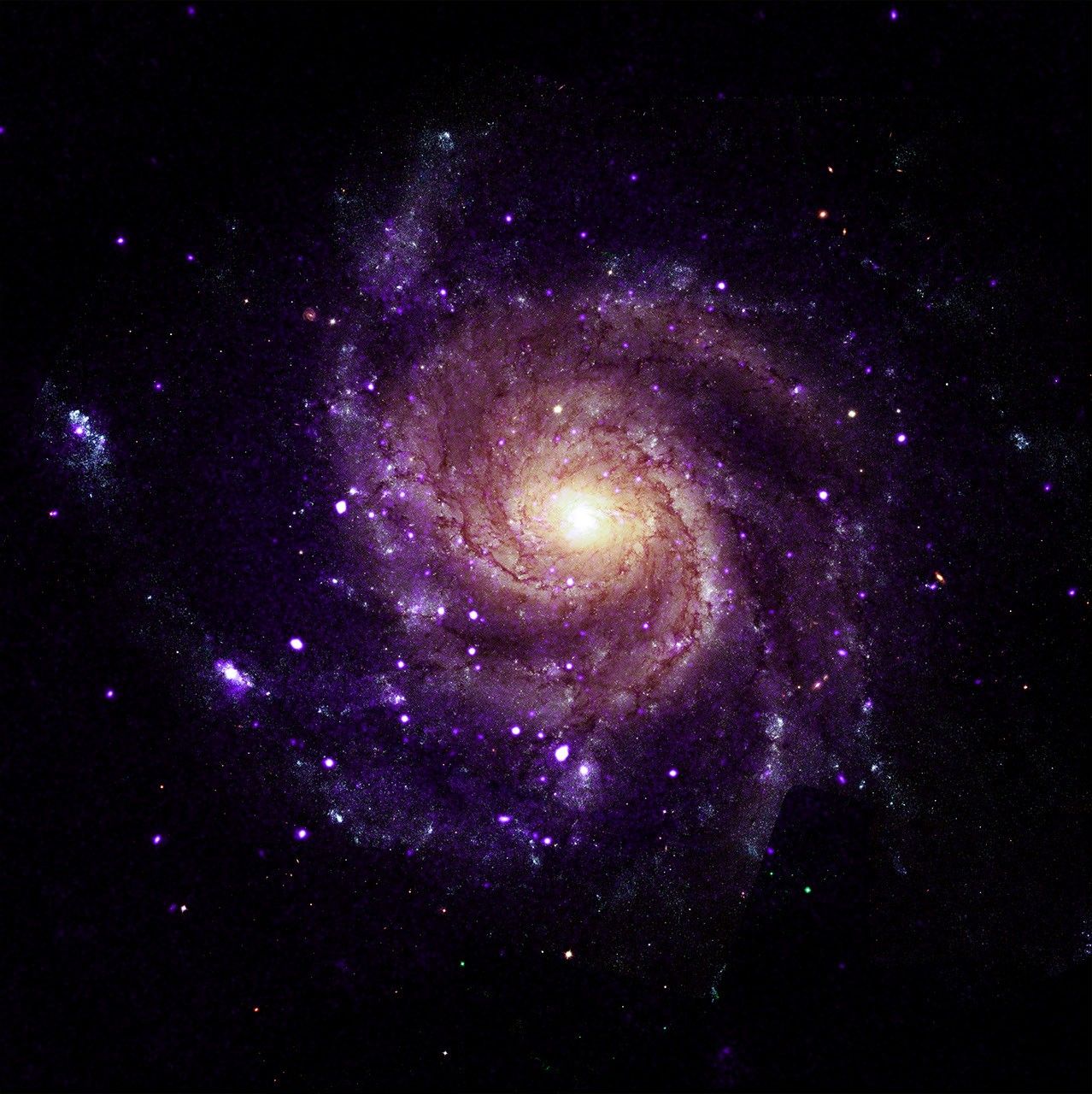
X-ray: NASA/CXC/Univ. of Alabama/M. Muhibullah et al.; Optical: NASA/ESA/STScI; Image Processing: NASA/CXC/SAO/N. Wolk
Using NASA’s Chandra X-ray Observatory, scientists have discovered a new class of objects behaving unlike any they have seen before. Astronomers suggest these newly spotted objects in other galaxies may help solve not one, but two long-standing questions in astrophysics.
These mysterious objects give off unusually low-energy X-rays but intense levels of ultraviolet radiation. This discovery is featured in a paper published Wednesday in Nature Astronomy.
“We’ve never encountered a group of objects that act like this,” said Mustafa Muhibullah of the University of Alabama who led the study. “Of course, the next step was to try to figure out what these things are.”
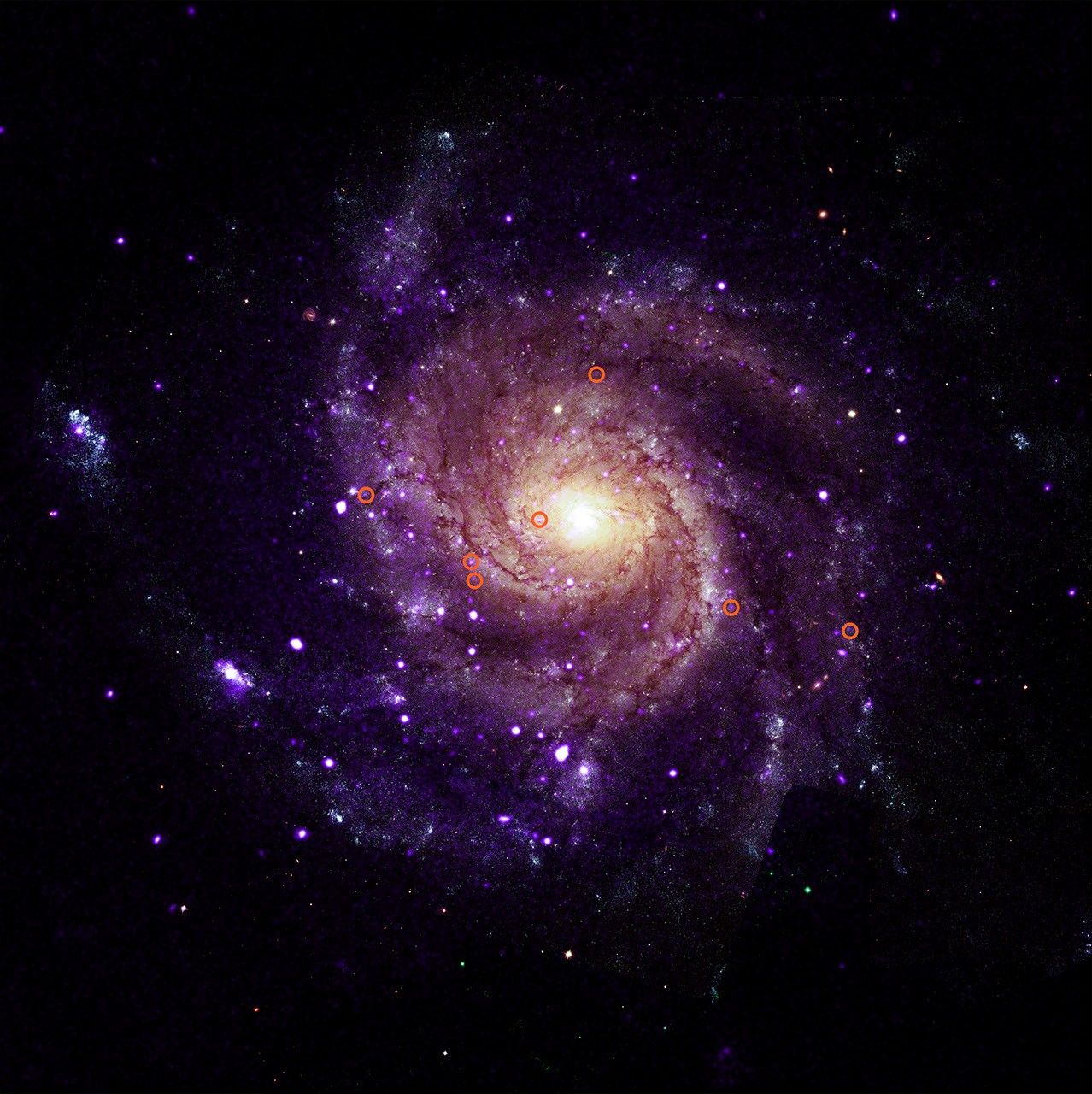
M101 with illustrated circles calling out seven of the newly-discovered objects.
X-ray: NASA/CXC/Univ. of Alabama/M. Muhibullah et al.; Optical: NASA/ESA/STScI; Image Processing: NASA/CXC/SAO/N. Wolk
The researchers found a total of 84 of these “hypersoft X-ray sources” – so named because they give such low-energy X-rays – in the six different galaxies they searched, using data openly available to the public in the Chandra archive. Two of the galaxies are spirals, M31 (the Andromeda galaxy) and M101 (the Pinwheel galaxy), while the other four are ellipticals. They found hypersoft X-ray sources both in regions of active star formation and areas where there are older stars.
The team spotted the sources by finding objects that appeared in Chandra images taken at the lowest X-ray energies but vanished in higher-energy images. That means these objects give off far more low-energy X-rays than high-energy ones. Because low-energy X-rays border energetic ultraviolet radiation on the electromagnetic spectrum, the researchers determined that these sources are producing large amounts of energetic ultraviolet radiation as well.
It is unclear what types of objects are responsible for these low-energy X-rays and intense ultraviolet radiation. The team thinks they most likely involve a black hole, neutron star, or white dwarf pulling material from a companion star. The material pulled from the companion star is heated up to produce X-rays before falling onto the white dwarf or neutron star, or into the black hole. Such binary systems have been seen before, but not with such bright ultraviolet radiation and low-energy X-rays.
The discovery suggests that there may be large populations of binary systems with energetic ultraviolet radiation that have been undetected until now.
“These clandestine X-ray sources are actually among the most energetic objects in galaxies, and they could be solving two cosmic mysteries at once,” said Muhibullah.
Scientists think that some white dwarf systems pulling material from companion stars may eventually explode as a supernova – known as a Type Ia – that is critical for measuring the expansion of the universe. These supernovae played a key role in discovering that this expansion is accelerating. Astronomers have been looking for the stars that turn into Type Ia supernovae for many years, so far without success.
“If we could find a way to spot these Type Ia supernova explosions before they go off, that would be really important,” said co-author Jimmy Irwin, also of the University of Alabama. “Right now, we study them after they’ve exploded, and astronomers have struggled to understand what is actually ignited.”
The other mystery these hypersoft X-ray sources might explain is what strips electrons from gas between the stars in some galaxies. This stripping of electrons is important to probe because it can affect how quickly stars form and influence the life cycles of galaxies. Hot, massive stars play a role, but they do not completely explain what is causing this stripping. The intense levels of ultraviolet radiation from the hypersoft X-ray sources may play a vital role.
Why were these hypersoft X-ray sources not found until now? In addition to the low-energy X-ray output, which is very difficult for X-ray telescopes to detect, the high-energy ultraviolet radiation is readily absorbed by helium and hydrogen gas that fills the space between the stars, creating a nearly impenetrable barrier to look through.
“By combing through the Chandra archive, we were able to eliminate what used to be a blind spot for telescopes,” said co-author Rosanne Di Stefano of the Center for Astrophysics | Harvard & Smithsonian. “That’s how we found what appears to be a new class of cosmic objects with remarkable qualities.”
NASA’s Marshall Space Flight Center in Huntsville, Alabama, manages the Chandra program. The Smithsonian Astrophysical Observatory’s Chandra X-ray Center controls science operations from Cambridge, Massachusetts, and flight operations from Burlington, Massachusetts.
This release features a composite image of a spiral galaxy, M101; one of six identified galaxies housing a new class of mysterious objects that give off unusually low-energy X-rays.
In this composite image, M101 faces us directly. It has multiple arms in shades of purple, spiraling clockwise around a golden yellow core. Scattered along and between the arms are scores of tiny specks in white and purple. Most of those specks are pairs of stars, but seven of them are a mystery.
To casual observers, the unusual objects are visually indistinguishable from the other specks of light in the galaxy. An annotated version of the composite image is included in this release, with red circles around the mysterious specks for easy identification.
These mystery specks behave like no other class of object discovered before. The curious objects give off X-rays of such low energy, they in fact produce large amounts of ultraviolet radiation, as UV radiation borders X-rays on the electromagnetic spectrum. Searching images of galaxies with low-energy X-rays in the Chandra Observatory archive, scientists have found a total of 84 such objects spread across M101 and five other galaxies. They have dubbed these mysterious objects “hypersoft X-ray sources.”
For the first time, astronomers have pointed NASA’s two flagship space telescopes at the same patch of sky beyond Neptune and let them work as a team. Hubble handled the visible light. Webb handled the infrared. Together, they picked out 27 previously unknown trans-Neptunian objects, or TNOs — small, icy bodies that drift in the […]
A photon, or particle of light, from the biggest cosmic explosion since the Big Bang, nicknamed "the BOAT" (for the brightest of all time), should not have reached Earth. That is, unless it defied rules defined by Einstein. Now scientists may know how it did this, with new research suggesting how the high-energy photon may have survived a journey of more than two billion light-years without being absorbed.
The BOAT, a gamma-ray burst officially designated GRB 221009A, was first detected on Oct. 9, 2022. Among the ocean of photons from the event that rained down on our planet was the highest-energy photon ever detected originating from a gamma-ray burst. It was detected by Carpet, an ultra-high-energy cosmic-ray detector located at the Baksan Observatory in the Russian Caucasus.
The problem is, according to all current rules of physics, a particle with such high energy shouldn't reach Earth from an explosion occurring such a vast distance away. That's because space isn't empty; it is filled with a "fossil" radiation field of photons left over from just after the Big Bang called the cosmic microwave background (CMB). It should be virtually impossible for a high-energy photon to travel 2 billion light-years without interacting with a CMB photon and being transformed. And still it came.
"We started from a very simple question: how did this photon survive a journey that, according to known physics, should have destroyed it?" team leader Giorgio Galanti from the Italian National Institute for Astrophysics (INAF) said in a statement. "The new data from the Carpet experiment showed us that the explanations proposed so far were no longer sufficient.
"We therefore looked for a theoretical scenario capable of consistently describing what we observe, without resorting to arbitrary corrections to the equations."
A hypothetical transformation
To investigate the mystery of how this high-energy photon reached our planet, Galanti and colleagues turned to incredibly light hypothetical particles called axion-like particles (ALPs).
ALPS could serve as a solution to this puzzle via a mechanism that would allow photons to transform into ALPs as they travel and then convert back into photons as they reach the Milky Way. The problem is that this still can't account for such a high-energy photon.
This team combined the idea of ALPs with a proposed violation of one of the fundamentals of Einstein's 1905 theory of special relativity called "Lorentz invariance."
In short, Lorentz invariance says that observers moving at different speeds should experience the same physical laws. The team tested the idea that Lorentz invariance could be violated at high energies, thus changing how photons propagate through space.
An illustration of the supernova that launched teh BOAT, the gamma-ray burst that is the most powerful cosmic explosion since the Big Bang (Image credit: Aaron M. Geller / Northwestern / CIERA / IT Research Computing and Data Services.)
In the scenario devised by the team the photon would have avoided being wiped out by interactions with the CMB as it would avoid interactionc with these fossil photons.
The new research therefore implies that at high enough energies, photons can take a "fast lane" through a transparent universe, dodging the physics that would normally force their destructive transformation.
Interestingly, there is some evidence relating to the BOAT that seemingly backs this theory. According to the picture developed by the team, this high-energy photon should have arrived at Earth around one hour after lower-energy particles of light originating from the BOAT. Indeed, that is exactly what happened.
"The most interesting aspect of our work is that, for the first time, it brings together two ideas that until now had been developed separately," team member Marco Roncadelli of the National Institute for Nuclear Physics (INFN) said. "If future observations confirmed this scenario, the universe would become a natural laboratory for studying quantum gravity at energies enormously higher than those achievable by any accelerator built on Earth."
The team's research is available on the repository site arXiv and has been accepted for publication in the journal Physical Review Letters.
Physicists around the world remain deeply divided on key mysteries of the universe, from dark matter to quantum gravity. The standard cosmological model failed to gain majority support, and no leading theory dominated the survey results. The largest survey ever conducted among physicists worldwide reveals surprisingly little agreement on some of the field’s biggest mysteries, [...]
Beyond the solar system, the line between planet and star can get blurry. Astronomers call objects that fall between the size ranges of planets and stars substellar objects. One type of substellar object, called a brown dwarf, forms from collapsing gas clouds like a star, but is not quite massive enough to fuse hydrogen in its core. Some can briefly fuse a heavier form of hydrogen, known as deuterium, in their cores, though never enough to produce starlight. Others are small and cold enough to develop complex atmospheres.
Recently, astronomers discovered a new type of substellar object in a star-forming region of the Milky Way Galaxy called IC 348. Using observational data from the JWST’s Near InfraRed Spectrograph (JWST NIRSpec), they found objects 0.2% to 1.2% the mass of the Sun that float freely like stars but have carbon-containing molecules called hydrocarbons in their atmospheres. Because these objects are smaller than known brown dwarfs and have evidence of hydrocarbons, scientists refer to them as H-type objects.
To investigate what H-type objects are and where they fit within the spectrum of substellar objects, researchers Richard J. Parker and Catarina Alves de Oliveira analyzed survey data on stars and substellar objects in IC 348, then conducted follow-up simulations to uncover how H-type objects formed. The main question they asked was whether H-type objects form from collapsing gas clouds, like brown dwarfs and stars, or develop around host stars before being ejected and drifting freely through space, like planets.
First, they reviewed the observational records of IC 348 obtained with the JWST NIRSpec and the near-IR spectrograph SpeX at the NASA Infrared Telescope Facility. IC 348 has 495 stars and brown dwarfs combined, as well as 9 H-type objects. Estimates for the age of this star-forming region range from either 1 to 3 million years or 5 to 6 million years, depending on how different teams calculated it. From there, Parker and Alves de Oliveira compared where the stars, brown dwarfs, and H-type objects were located within the cluster. They found no unique spatial distribution among the 3 types of objects.
Then, the team simulated the evolution of IC 348 over 10 million years to determine which initial conditions would result in a spatial distribution closest to the survey data. They simulated an initial giant gas cloud and used a mathematical function to distribute its mass among the 495 constituent objects. The researchers then placed a Jupiter-sized planet around each simulated star that was approximately the Sun’s mass to determine whether they could grow and escape their home star and become H-type objects. They also repeated the simulations by placing the Jupiter-sized planets at distances from the Sun similar to those of Earth, Jupiter, and Neptune, and varied the sizes and star densities of the simulated IC 348 regions.
They found that if Jupiter-sized planets orbited their stars at roughly Jupiter’s distance from the Sun, then 5 to 15 of them could escape their stars in a region like IC 348, which would roughly match the number of known H-type objects. However, the escaped planets were distinctly more spread-out than the observed H-type objects, which share a similar spatial distribution with the cluster’s stars and brown dwarfs. Since the simulations did not match the observed distribution, the researchers suggested that these H-type objects are likely a new sub-category of very small brown dwarfs rather than escaped planets.
Although this study favors a brown dwarf origin for H-type objects, the exact details of how they formed remain up for debate. Astronomers still have multiple competing theories about how ordinary brown dwarfs form. Perhaps they are ejected from their gas cloud before fully forming, have their outer layers stripped by radiation from a nearby massive star, or simply form like stars on a slightly smaller scale. Regardless, future researchers will continue to explore this murky area of substellar astronomy.
Dark matter, the invisible substance thought to make up around 85 percent of all mass in the universe, forms an essential part of the standard cosmological model, providing the gravitational glue that holds together entire galaxies. What it actually is, though — and even if it truly exists — remains one of the great mysteries of science.
Now, a bizarre event that occurred nearly a mile underground at the world’s largest dark matter detector in South Dakota, the LZ detector, could be the first direct evidence of the substance. Or it could be something else entirely. Either way, it has scientists mystified and excited.
In a new paper published Tuesday and has been submitted to the journal Physical Review Letters, physicists running the LZ Dark Matter Experiment say that their detector recorded a stunning subatomic interaction that doesn’t fit anything else ever documented in physics.
Again, it’s not necessarily a dark matter discovery — but it’s so unusual that it warranted sharing.
“How do you even make sense of one event?” Tom Shutt, a particle astrophysicist at SLAC National Accelerator Laboratory and cofounder of the LZ project, told Science magazine. “We just decided we should publish and think really, really, really hard about what that event could be.”
Dark matter is a sort of ghost haunting the cosmos. We can’t see it because it doesn’t emit, absorb, or reflect light, or otherwise interact with any ordinary matter — except through gravity.
We see the fingerprints of its gravitational pull all around the universe, in fact. Galaxies aren’t massive enough to hold themselves together with their own gravity, so without the invisible presence of something with incredible mass, the very realms that define the universe, and which we call home, would fly apart.
There are countless candidates for what dark matter is, but the prevailing theory is that it’s made up of weakly interacting massive particles, or WIMPs. As their feeble acronym suggests, WIMPs are thought to be a hundred times as massive as a proton, but have such a weak nuclear force that they don’t interact with ordinary particles.
Because of their mass, they move much slower than ordinary particles, too, allowing them to clump together and form giant “halos” that provide the gravitational pull for galaxies to form in. There is no single agreed-upon definition of a WIMP, though, and it’s possible that WIMPs could be a whole family of particles, rather than just one.
If these theories are correct, then every once in a while, errant WIMPs can bump into the nucleus of an unsuspecting atom and create a trace amount of energy.
This is what the LZ detector is built to find. It’s essentially a tank filled with seven tons of liquid xenon, placed 1,480 meters underground in a former gold mine. At such a depth, the preponderance of xenon is shielded from the space radiation that our planet is routinely bombarded with (though there is a still a background level of other interactions that scientists can’t control, but can account for.) Anything that causes a a big enough stir in this controlled, quiet environment would be significant.
After spending years poring over the data the detector has collected so far, the physicists found a striking interaction that took place in 2023. Something, we don’t know what, smashed into a xenon particle, and produced a flash of light. If it was dark matter, it produced more energy than traditional WIMP models predict.
The scientists say that the detection has about a one in 400 chance of being a fluke. Scientific discoveries, though, need to meet at least a five sigma threshold, meaning that there should be only as roughly one in 3.5 million that it’s a fluke.
Still, physicists are absolutely thrilled. Even if this event isn’t a smoking gun by itself, there are other, larger dark matter detectors coming online, such as China’s PandaX experiment and Italy’s XENONnT, that should be able to hunt for the same high energy type of event.
“We can perform this study independently with a blind analysis to validate or invalidate LZ’s claim,” Elena Aprile, a physicist at Columbia University and spokesperson for the XENON experiment, told Science.
The dark matter search LUX-ZEPLIN has announced that they have made a detection that could be the first ever evidence for a dark matter particle. Just what have they measured, what could it be, and what does it mean? I have a brief summary.
In November of last year, scientists warned of a “severe” solar storm, the strongest in over two decades, colliding with the Earth.
Solar storms are the result of a surge in solar activity, with the Sun unleashing a barrage of charged particles that can trigger spectacular auroras — and wreak havoc with communications satellites and radio signals — when they reach the Earth’s magnetosphere.
Beyond being ferocious enough to delay the launch of a Mars-bound NASA spacecraft, the storm wreaked absolute havoc with GPS systems back on the ground for hours at a time. As detailed in a new paper published in the journal Geophysical Research Letters, a team of scientists found that global navigation satellite systems experienced “significant positioning errors” of over 33 feet during the superstorm, “large enough to disrupt precision agriculture and autonomous transportation industries” across the continental United States.
That’s enough risk to warrant a careful study on these types of events can impact human activity on Earth.
“The results underscore the importance of accurate understanding of various space weather phenomena to enhance our predictive capabilities through coordinated observations and physics‐based modeling and ultimately reducing disruptions to RF applications during space weather events,” the paper reads.
The researchers analyzed observations from several scientific instruments spread out across the US to watch the chaos unfold last November. The Aurora Oval, a ring-shaped area of pronounced activity around the Earth’s geomagnetic north pole where auroras conventionally occur, was pushed south toward the equator. This triggered a “horizontally extended band of intense density gradients” in the upper atmosphere, causing fluctuations in how long signals take to travel through it.
The result: “significant positioning errors at mid-latitudes,” the researchers noted.
The researchers also found that as the auroras became brighter, the observed irregularities became more intense, deteriorating GPS accuracy accordingly.
Fortunately, while farming equipment like GPS-equipped tractors would’ve likely been affected, the November storm occurred long after the farming season concluded.
“Had the November superstorm occurred during the farming season in the American sector, it could have caused significant economic losses for the American farming industry, in addition to affecting the autonomous transportation industry,” the paper reads.
An astrophysicist has claimed that some unidentified anomalous phenomena that were observed in recent years in the United States might be warp drives. He has written a paper about it in which he calculates how such a warp drive would look. I have a brief summary.
This computer-simulated image shows gas from a tidally shredded star falling into a black hole. Astronomers observed the flare in ultraviolet light using NASA’s Galaxy Evolution Explorer. Source: NASA/ S. Gezari (JHU)/ J. Guillochon (UCSC)
At the center of most galaxies lies a supermassive black hole, with a mass millions to billions of times that of our sun and some of the most extreme gravity in the universe.
Some stars that venture too close to such black holes live to tell the tale. Rather than being completely destroyed, they survive to make repeated close passes, producing a new flare of light each time.
These repeating partial tidal disruption events (rpTDEs) give astronomers the opportunity to watch the same star and black hole interaction unfold again and again, thanks to wide-field time-domain surveys that repeatedly scan large areas of the sky for objects that change in brightness.
But in several cases, researchers have noticed a puzzling pattern: The successive flares grow progressively dimmer. For years, theoretical models couldn’t explain why.
Now, a team of astrophysicists at Syracuse University has shown that the answer may lie in a previously overlooked factor—the star’s spin.1
When stars meet black holes
In a typical tidal disruption event (TDE), a black hole’s tidal force—the difference in gravitational pull across a nearby star—tears the star completely apart.
As the disrupted stellar debris falls toward, or “accretes” onto, the black hole, it loses energy that is emitted in the form of light over the course of days to months.
While black holes themselves emit no light, TDEs provide a short-lived supply of fuel that lights up the surrounding region, allowing astronomers to study these otherwise invisible objects indirectly.
If a star orbiting a black hole does not come close enough to be completely ripped apart, it can, however, lose a fraction of its mass, resulting in a partial TDE. In a repeating partial TDE, the surviving core continues orbiting the black hole, losing more material with each new close pass, a few months to several years apart.
The dimming mystery
How much material a star loses during repeated encounters depends partly on its internal structure. Bandopadhyay compares a low-mass star to a fluffy meringue, which can become increasingly vulnerable to the black hole’s tidal forces. By contrast, a higher-mass star has a more centrally concentrated, onion-like star and can shed its outer layers while its dense core remains relatively unaffected, losing decreasing amounts of mass over time.
Those differences can help explain why rpTDEs don’t all behave the same way. But one pattern in particular has mystified researchers. Of the roughly 10 repeating systems identified to date, four have produced flares that grow progressively dimmer.
Decreasing mass loss might seem like an obvious explanation. But previous hydrodynamical simulations showed that, surprisingly, even as the material lost decreased with each encounter, the predicted flares retained roughly the same brightness.
“We were puzzled by this for two years,” Bandopadhyay says.
Their previous work had revealed another effect of the black hole’s tidal forces.In addition to stripping material from the star, they exert a torque that causes the star to spin faster with each close encounter. As a result, although less material falls back toward the black hole, it returns over a shorter period of time, helping to keep the predicted flare at roughly the same brightness.
To reproduce the dimming astronomers were actually observing, the researchers needed what Bandopadhyay called “a new ingredient”—a star that was already spinning rapidly before its first encounter with the black hole.
The new study found that this initial rotation prevents the star from being significantly spun up during each passage. Without that additional spin-up, the timescale over which the stripped material falls back remains relatively constant. As the star loses less material with each encounter, the peak fallback rate—and the predicted brightness of the flare—can finally decline.
Tracing the star’s past
But why would the star already be spinning so rapidly?
“It is also extremely difficult to ‘bind’ a star to a supermassive black hole so tightly that it orbits the black hole in a matter of months, and yet they seem to do so in rpTDEs,” Coughlin says.
The so-called Hills mechanism may explain both. Under this scenario, a pair of closely orbiting stars passes near a supermassive black hole, which tears the binary apart, ejecting one star and capturing the other.
In a close binary, the stars can become tidally locked, causing each to rotate on its axis at the same rate that the pair orbits each other. The tighter the binary, the shorter that orbital period and the faster a tidally locked star spins. The binaries capable of leaving a captured star on the short orbit observed in rpTDEs would have to be extremely tight—also leaving a tidally locked star spinning rapidly before its capture.
“Ananya’s work demonstrates that each of these peculiarities can be explained by the same underlying phenomenon: the tidal destruction of a binary system and the capture of one of the stars,” Coughlin says. “From a theoretical standpoint, this is a major step forward in our understanding of the physics at play in these systems.”
Zooming out, Coughlin notes that Hills capture may also have produced some of the stars orbiting Sagittarius A*, the supermassive black hole at the center of the Milky Way. The new findings could therefore help explain some of the properties of stars in what he calls “our own cosmological backyard.”
References
Ananya Bandopadhyay, Benjamin Amend, Eric R. Coughlin, C. J. Nixon, Dheeraj R. Pasham, and T. Wevers (2026) The Astrophysical Journal doi: 10.3847/1538-4357/ae8f31↩

 Login