❌

Normal view

Fast Radio Bursts Are Starting to Map the Universe’s Missing Gas

15 September 2026 at 16:00

A new Nature Astronomy study uses 114 fast radio bursts to trace cosmic gas and test how stellar and black-hole feedback reshapes matter around galaxies.

The post Fast Radio Bursts Are Starting to Map the Universe’s Missing Gas appeared first on Curiosmos.

Diving into the Darkest Corners of the Universe with Fast Radio Bursts

5 August 2026 at 18:25

The cosmic web

Even the darkest corners of the universe are not completely empty. A recent study has used fast radio bursts to provide the first estimate of the baryon content in cosmic voids.

What’s in a Void?

Cosmological studies have revealed the large-scale filamentary structure of the universe known as the cosmic web. Chains of galaxies and galaxy clusters fall into spindly strands (or filaments) of matter overdensities, opening up cavernous cosmic voids that comprise the darkest corners of the universe. These seemingly vacant voids serve as critical test beds for cosmology, allowing researchers to constrain things like the nature of dark energy and the matter density of the universe.

Despite their name, voids are not completely empty but are instead underdensities with considerably less matter compared to the bustling filaments they border. The baryon (normal matter) content of cosmic voids has important implications for cosmological models and large-scale galactic feedback processes, but assessing how many baryons actually occupy voids has only recently become observationally accessible.

FRB and void sky maps

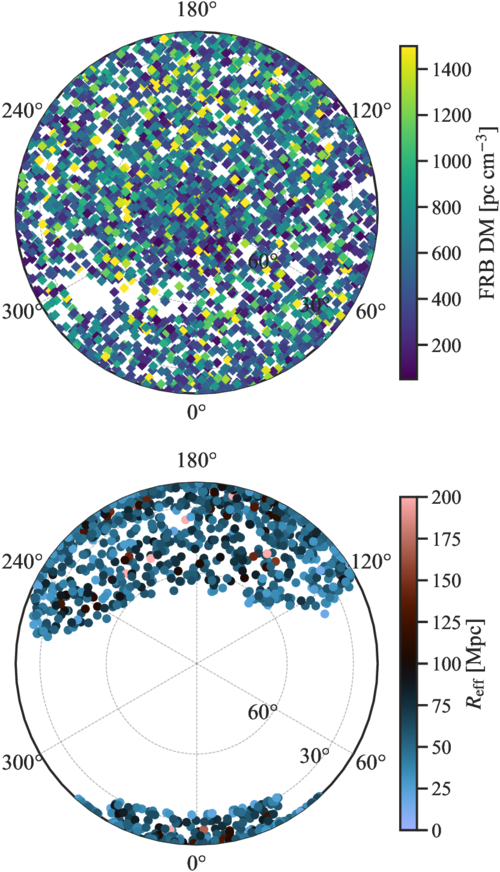
Sky maps centered on the north celestial pole showing the CHIME fast radio burst sample (top) and the SDSS void catalog (bottom). [Sharma et al 2026]

Fast radio bursts — brief, intense flashes of radio waves emitted by compact objects — have proven to be versatile tools for measuring both underdensities and overdensities throughout the universe. The dispersion measure of fast radio bursts, which tells us how many free electrons fall between the radio emitter and observer, can be directly used to map the baryon content along the lines of sight. Fast radio burst sight lines passing through overdensities will produce a dispersion measure excess, and those passing through underdensities will produce a dispersion measure deficit relative to the cosmic mean. Thus far, fast radio bursts have been used extensively to study overdense galaxy and cluster filaments, but their sensitivity to underdense regions like voids has yet to be explored.

Chiming In on the Baryon Search

In concept, directly stacking fast radio burst sight lines that coincide with the positions of known cosmic voids provides a direct measurement of the baryon underdensity inside voids. With no previous observational exploration of this quantity, Kritti Sharma (California Institute of Technology) and collaborators leveraged the second catalog of the Canadian Hydrogen Intensity Mapping Experiment Fast Radio Bursts (CHIME/FRB) sample in conjunction with the Sloan Digital Sky Survey (SDSS) Baryon Oscillation Spectroscopic Survey (BOSS) void catalog to provide the first observational assessment of the baryon underdensity in cosmic voids.

Anticorrelations between FRB dispersion measures and void positions

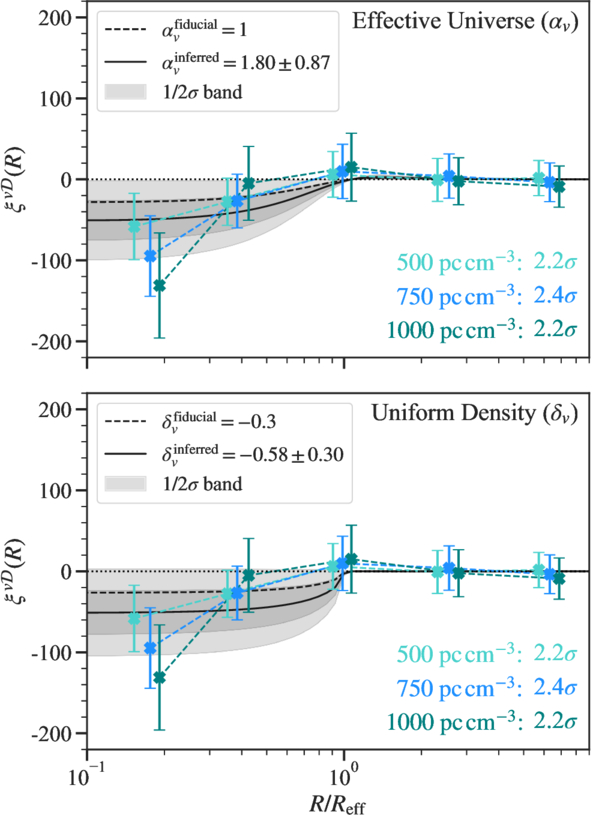
Anticorrelations between fast radio burst dispersion measures and void positions. There is a clear dispersion measure deficit closer to voids centers. [Sharma et al 2026]

Stacking thousands of fast radio burst sight lines that spatially align with thousands of known voids, the authors measured a statistically significant dispersion measure deficit toward void centers. This deficit indicates that, as theory predicts, baryons inhabit cosmic voids at a suppressed level. The team used cosmological models to quantify the electron density contrast between the interior and exterior of voids, finding an approximate baryon underdensity of 60% ± 30% relative to the cosmic mean. Combining this result with existing thermal scattering measurements of the cosmic microwave background, the authors estimated a mean void gas temperature of about 1.1 million kelvin — voids are occupied by a suppressed amount of warm-hot diffuse gas.

This study provides a unique approach to baryon mapping and opens up the door for future investigation of cosmic voids. While not physically containing much, voids hold vast astrophysical and cosmological significance. With the astronomical stage primed with galaxy-mapping powerhouses like the Dark Energy Spectroscopic Instrument, Vera Rubin Observatory, Nancy Grace Roman Space Telescope, and Euclid Space Telescope, cosmic voids will become a cornerstone of cosmological studies.

Citation

“Baryons in the Darkest Sites of the Universe,” Kritti Sharma et al 2026 ApJL 1006 L3. doi:10.3847/2041-8213/ae81ac

The post Diving into the Darkest Corners of the Universe with Fast Radio Bursts appeared first on AAS Nova.

Triple Double: Do Merging White Dwarfs Produce Fast Radio Burst–Emitting Remnants?

24 March 2026 at 16:00

Illustration of two white dwarfs about to merge

Editor’s Note: Astrobites is a graduate-student-run organization that digests astrophysical literature for undergraduate students. As part of the partnership between the AAS and astrobites, we occasionally repost astrobites content here at AAS Nova. We hope you enjoy this post from astrobites; the original can be viewed at astrobites.org.

Title: Fast Radio Bursts from White Dwarf Binary Mergers: Isolated and Triple-Induced Channels
Authors: Cheyanne Shariat et al.
First Author’s Institution: California Institute of Technology
Status: Published in ApJL

The History of Fast Radio Bursts

Since the discovery of the Lorimer Burst in 2007, astronomers have studied fast radio bursts (FRBs) in extreme detail. However, these extragalactic millisecond-duration radio transients have remained an enigma. Like many astrophysical phenomena, their discovery was serendipitous. The most prolific FRB-discovery instrument, CHIME, was not originally built to study them; the acronym stands for “Canadian Hydrogen Intensity Mapping Experiment,” reflecting its original (and ongoing) mission to map the cosmological distribution of hydrogen in the primordial universe. Since its construction, CHIME has discovered several thousand FRBs and even identified a smaller fraction that are known to repeat, some with consistent periods and others that are sporadic and seemingly random. (Check out their live catalog of repeating sources.)

Despite having thousands of sources to study, the only thing we know fairly confidently about FRBs is that many of them are extragalactic, and some others are even at cosmological distances. If we don’t understand how FRBs are produced, how can we know their distance? FRBs display a unique signature in their radio spectra, where higher frequencies arrive at the telescope first and lower frequencies arrive later, delayed by an inverse frequency-squared relationship. In a “dynamic spectrum,” this makes the pulse actually appear like a sweep from high to low frequency that follows the shape of a parabola; for example, the brightest pixels in Figure 1 of this Bite display this sweeping shape. This effect results from the FRB propagating through an ionized plasma with a specific density. Since the FRB is ultimately an electromagnetic wave, this slows down the speed of the FRB as a function of frequency. Measuring this effect, called dispersion, allows us to infer that the FRB signal passed through more plasma than can be accounted for within our own Milky Way galaxy, indicating that the FRB must have originated from much farther away. So far, there is only one example of an FRB from within our own galaxy, which was identified as originating from a magnetar, a highly magnetic pulsar.

FRB Progenitor Candidates

Although we know that most FRBs are located at extragalactic or even cosmological distances, it’s still not clear what objects that can generate them. Since magnetars and other compact objects are often considered reliable progenitors of FRBs, understanding their populations and comparing them with observed FRBs may reveal the origin of FRBs. Candidate FRB progenitor systems are usually divided into “prompt” channels — like the collapse of a star into a magnetar during a core-collapse supernova — and “delayed” channels where the FRB engine is formed on longer timescales, like accretion-induced collapse of white dwarfs or compact-object mergers. Figure 1 displays several of these channels, particularly those considered in today’s article, in which stellar evolution results in the transfer of material from one star to another (accretion-induced collapse) or gravitational radiation allows two objects to inspiral and merge. These events could create highly magnetized white dwarfs or magnetars that may produce FRBs.

different pathways and their associated fractions for producing an FRB candidate

Figure 1: Three different pathways and their associated fractions for producing an FRB candidate. Depending on the mass and composition of the merging objects, an FRB candidate may be produced instead of causing the white dwarf to explode in a Type Ia supernova. These are the systems of interest in today’s article. [Shariat et al. 2026]

Simulating Hierarchical Triples

In today’s article, we’re considering the role of hierarchical triple star systems in producing FRB-emitting objects. A hierarchical triple consists of an inner binary and a distant, tertiary star; see the first panel of Figure 1. These systems may play an important role because many stars that become white dwarfs of at least 0.8 solar mass exist in hierarchical triples: 35% of 2-solar-mass stars and 50% of 8-solar-mass stars are in triples. Stars of both masses will end their lives as white dwarfs.

The tertiary star plays an essential role in increasing the likelihood of the inner binary interacting: the eccentric Kozai–Lidov (EKL) mechanism causes the inner orbit to oscillate between highly inclined (with respect to the orbit of the tertiary star) and highly eccentric. Unlike isolated binaries that aren’t excited in this way, the eccentric orbit phase causes the inner stars to pass much closer to each other, increasing the likelihood of interaction or even a merger that could produce an FRB-emitting remnant.

The authors of today’s article produced a realistic population of triple systems by sampling from empirically measured distributions of masses, periods, and orbital eccentricities. These distributions were derived from observations collected by the Gaia satellite, an all-sky optical telescope that has now observed more than one billion stars in the Milky Way. The authors also created a “control” sample of isolated binaries by removing the tertiary star from the same sample of systems. The systems were then evolved for an age randomly selected between 0 and 12.5 billion years to simulate “constant” star formation similar to that in the Milky Way. Finally, they reapply these simulations at three different “metallicities” — the fraction of elements other than hydrogen or helium relative to that of the Sun.

Figure 2 displays these two populations: the isolated binaries are shown as filled histograms, and the hierarchical triples are shown as histograms with dashed lines. Each column represents the three different progenitor classes considered in Figure 1. At solar metallicity, the delays to merging are greater in triples than in secular binaries, leading to more mergers overall (top left panel). At lower metallicities, there are fewer mergers in all progenitor pathways in triples than in isolated binaries due to changes in stellar evolution attributed to weaker winds and larger pre-white dwarf masses.

mergers as a function of time for different metallicities and formation pathways

Figure 2: The number of mergers as a function of time from the hierarchical triple’s formation, given different three metallicities (rows) and the three primary formation pathways for FRB-emitting merged remnants considered in Figure 1. Filled histograms are isolated binaries, dashed histograms are triples. [Shariat et al. 2026]

A Cosmic Population of FRBs

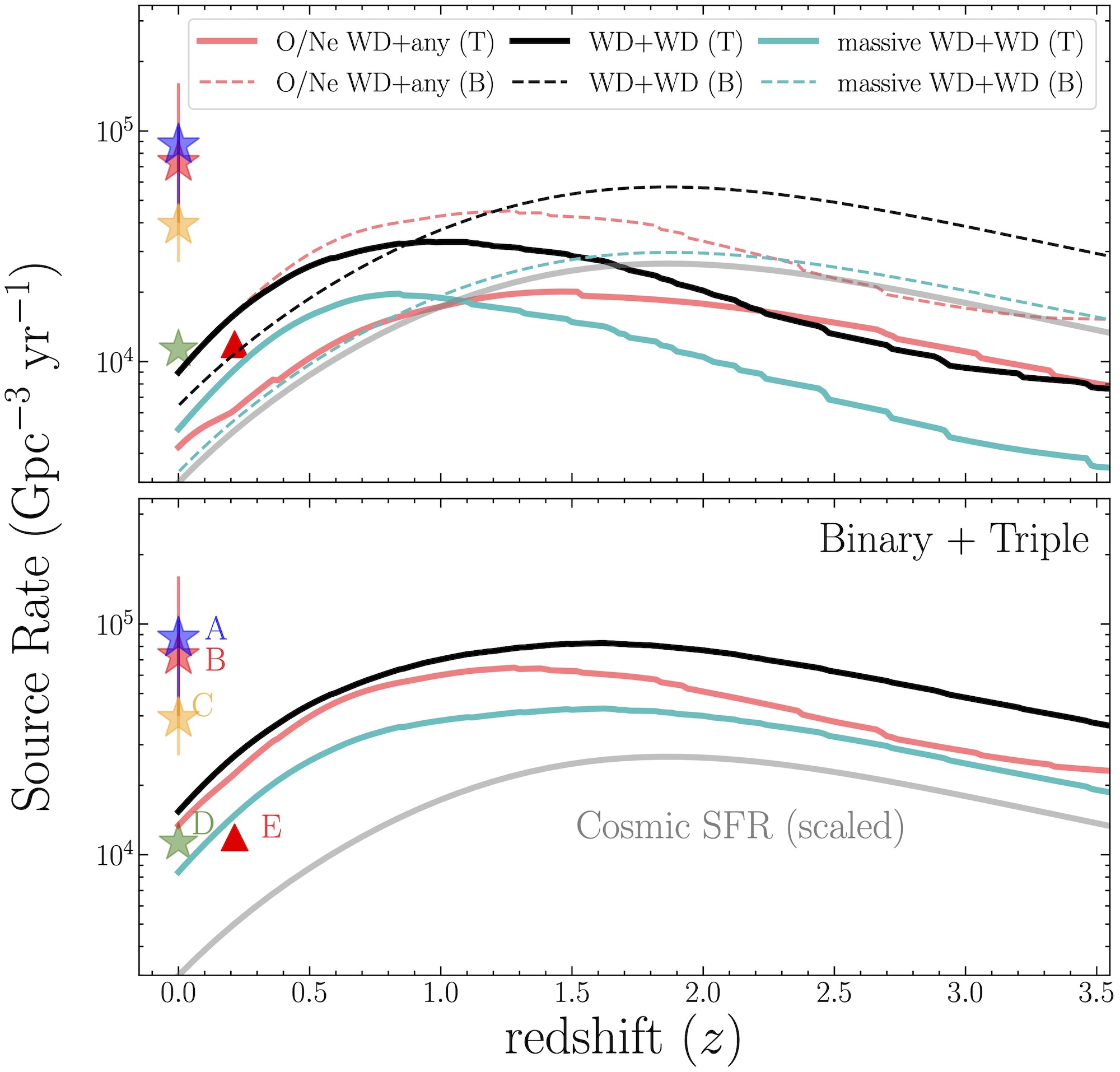
Since we can’t realistically track individual star systems from their formation to the end, we need to convert the delay-time distributions shown in Figure 2 to an observable. To do this, the authors combine the results of their simulations with measurements of the cosmic star formation rate — how many stars form per unit time as a function of the universe’s age — and the evolution of the universe’s metallicity as stars fuse hydrogen into heavier elements and return this material to the interstellar medium as these stars end their lives in shedding red giants or supernovae. This analysis produces the number of FRBs that should be observed as a function of distance or lookback time into the universe’s history, which is displayed in Figure 3.

number of FRBs expected as a function of cosmological redshift

Figure 3: The number of FRBs expected as a function of cosmological redshift. The present is to the left, the distant and early universe is on the right. The top panel shows the three formation channels, with binary and triple systems separated. The bottom panel displays the composite rate and compares it with empirical estimates from existing FRB observations. [Shariat et al. 2026]

This analysis reveals key measurable differences between lone binaries and hierarchical triples: most notably, binary white dwarf mergers peak later in the universe (redshift of z ~ 1), while single binaries peak earlier (redshift of z ~ 2). These results highlight the importance of including triples in FRB progenitors because they are more likely to contribute to populations at later times — making them closer and more easily detectable — in the total population of FRBs. Future instruments like CHIME with the new outriggers and the Deep Synoptic Array will expand the sample of FRBs to reach farther cosmological distances, with better localizations, enabling more statistically motivated tests of different formation pathways.

Original astrobite edited by Catherine Slaughter.

About the author, Will Golay:

I am a graduate student in the Department of Astronomy at Harvard University and the Center for Astrophysics | Harvard & Smithsonian, advised by Edo Berger. I study radio emission from transient astrophysical objects like tidal disruption events.

The post Triple Double: Do Merging White Dwarfs Produce Fast Radio Burst–Emitting Remnants? appeared first on AAS Nova.

Selections from 2025: Pinpointing a Bright Fast Radio Burst with CHIME

29 December 2025 at 17:00

JWST image of the galaxy NGC 4141

Editor’s Note: For the remainder of 2025, we’ll be looking at a few selections that we haven’t yet discussed on AAS Nova from among the most-downloaded articles published in AAS journals this year. The usual posting schedule will resume January 2nd.

FRB 20250316A: A Brilliant and Nearby One-Off Fast Radio Burst Localized to 13 pc Precision

Published August 2025

Main takeaway:

NGC 4141

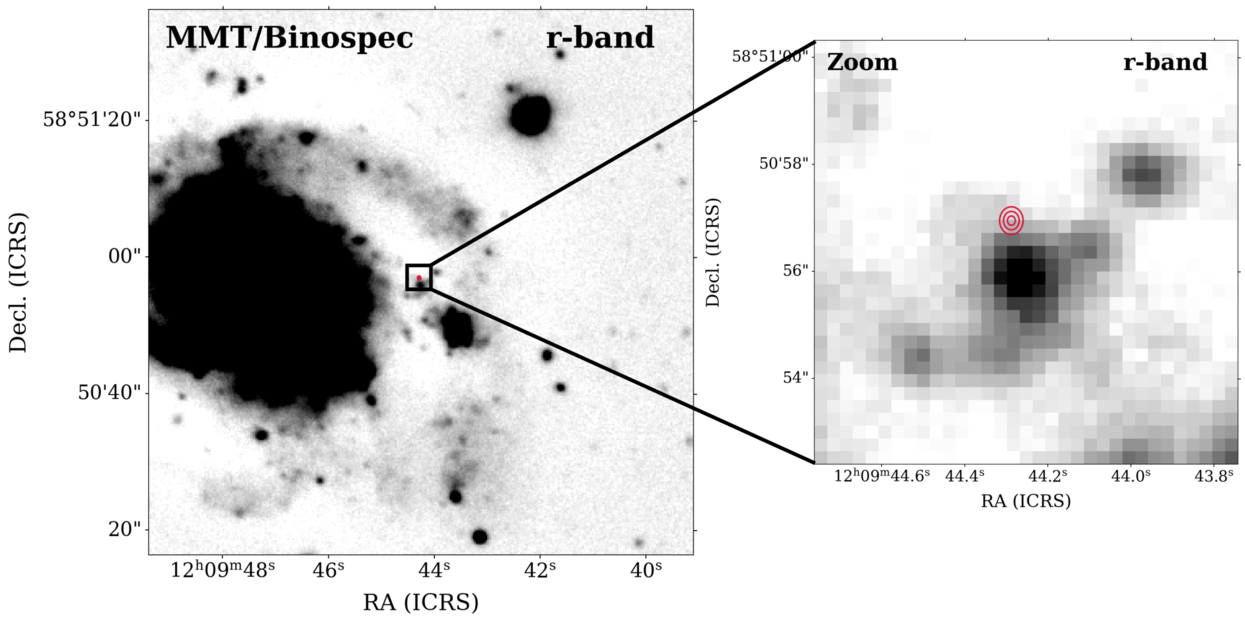
MMT observation of NGC 4141 (left) and zoomed-in on FRB 20250316A’s location. The red lines show the 1-, 2-, and 3-sigma localization ellipses of the burst. Click to enlarge. [CHIME Collaboration 2025]

Discovered in March 2025 by the Canadian Hydrogen Intensity Mapping Experiment (CHIME) Outrigger array, FRB 20250316A is one of the brightest fast radio bursts ever observed. The CHIME collaboration traced the burst to the galaxy NGC 4141, 130 million light-years from Earth, and locked in on the source’s position with a precision of just 42 light-years.

Why it’s interesting:

The origins of fast radio bursts — bright flashes of radio waves lasting on the order of milliseconds — are mysterious, despite several thousand bursts having been cataloged. Among the many questions that remain is whether one-off bursts and repeating bursts arise from the same population of objects, or if they have entirely different origins. So far, FRB 20250316A appears to be a one-off burst; while it’s still possible that the source could emit another burst, the team noted that the burst’s properties don’t mesh with those of known repeating bursts. This makes the discovery and localization of FRB 20250316A an excellent opportunity to investigate the sources of one-off fast radio bursts.

More about the potential source of this burst, and prospects for pinpointing future sources:

After homing in on FRB 20250316A’s location, the CHIME collaboration embarked on a multi-wavelength follow-up campaign to learn more about where the burst came from. This campaign placed constraints on the metallicity and gas density near the source, which lies about 600 light-years from the center of the nearest star-forming region. A separate research article, published the same day as this work from the CHIME collaboration, described the discovery of a red giant star in the FRB 20250316A source region. This star may be located near FRB 20250316A’s source by chance, or it could be in a binary system with the source. With the main CHIME array in British Columbia continuing to scan for new bursts and three newly built outrigger telescopes in British Columbia, West Virginia, and California now online, we can expect many more precise localizations in the future!

Citation

The CHIME/FRB Collaboration: et al 2025 ApJL 989 L48. doi:10.3847/2041-8213/adf62f

The post Selections from 2025: Pinpointing a Bright Fast Radio Burst with CHIME appeared first on AAS Nova.

Selections from 2025: A Repeating Fast Radio Burst in a Quiescent Galaxy

17 December 2025 at 17:00

CHIME radio telescope

Editor’s Note: For the remainder of 2025, we’ll be looking at a few selections that we haven’t yet discussed on AAS Nova from among the most-downloaded articles published in AAS journals this year. The usual posting schedule will resume January 2nd.

A Repeating Fast Radio Burst Source in the Outskirts of a Quiescent Galaxy

Published January 2025

Main takeaway:

FRB 20240209A localization region and likely host galaxy

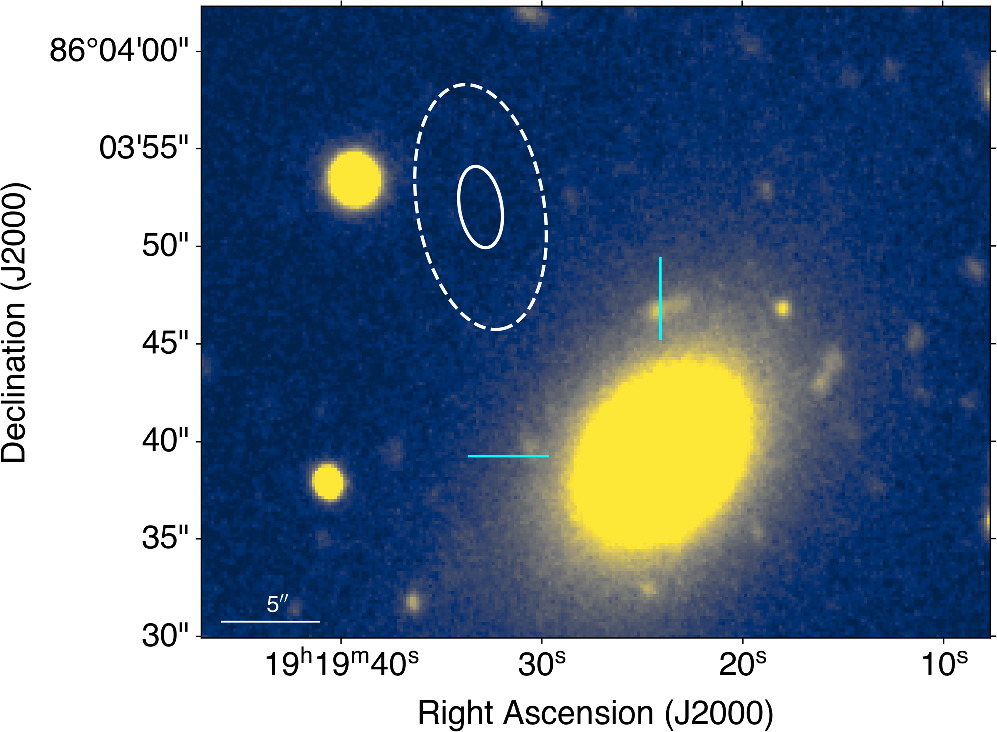
Gemini-North image of the FRB 20240209A localization region (white lines) and the source’s likely host galaxy (cyan crosshairs). [Shah et al. 2025]

Using the Canadian Hydrogen Intensity Mapping Experiment (CHIME), Vishwangi Shah (McGill University) and collaborators discovered the repeating fast radio burst source FRB 20240209A. The team localized the source to roughly 130,000 light-years from the center of a quiescent elliptical galaxy about 1.8 billion light-years away. This suggests that the bursts originated from a globular cluster on the outskirts of the galaxy, pointing to a delayed formation pathway for the source.

Why it’s interesting:

Fast radio bursts are brief, intense flashes of radio waves from sources across the universe. Aside from one fast radio burst that has been associated with a magnetar within our own Milky Way, the source of these outbursts remains mysterious, and precise localization of these bursts is key to pinning down their origins; fast radio bursts that come from galaxies with active star formation may be linked to “prompt” formation channels like core-collapse supernovae or young magnetars, while bursts that arise in quiescent galaxies might be due to “delayed” formation pathways such as neutron stars that are born from merging white dwarfs.

How FRB 20240209A compares to other fast radio bursts, and what may have caused it:

FRB 20240209A is similar to other repeating fast radio bursts in terms of the shape of its individual bursts as well as its tendency to undergo periods of high and low bursting activity. Its location makes it quite unusual, though: it’s the only repeating fast radio burst known to come from a quiescent galaxy, and it’s the only burst — repeating or not — that has been found in an elliptical galaxy. If confirmed to originate from a globular cluster, FRB 20240209A would also be only the second known fast radio burst source to come from this type of environment. Shah’s team explored multiple possible origin stories for FRB 20240209A, including the possibility that the source was ejected from its host galaxy. The team favors an origin involving a magnetar formed through the collapse or merger of a compact object.

Citation

Vishwangi Shah et al 2025 ApJL 979 L21. doi:10.3847/2041-8213/ad9ddc

The post Selections from 2025: A Repeating Fast Radio Burst in a Quiescent Galaxy appeared first on AAS Nova.

A Unified Explanation for Fast Radio Bursts

10 December 2025 at 17:00

artist's impression of a magnetar in a binary system

A discovery that linked a fast radio burst to a magnetar in the Milky Way showed that certain fast radio bursts come from magnetars. A new study explores whether all fast radio bursts could have magnetar origins.

Varied Bursts

magnetar SGR 1935+2154

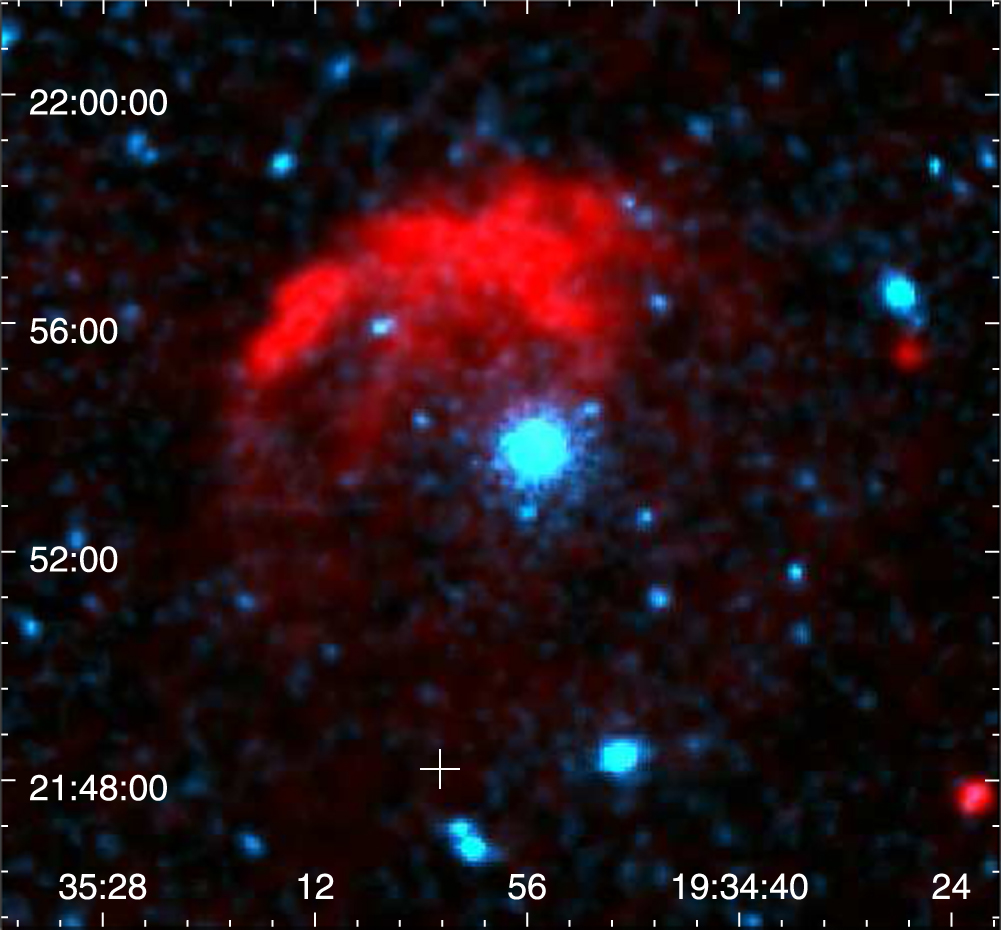
The bright blue source at the center of this X-ray image is SGR 1935+2154, the first magnetar to be associated with a fast radio burst. [Zhou et al. 2020]

Fast radio bursts — extremely bright radio blips lasting anywhere from a fraction of a millisecond to a few seconds — have provided researchers with one of the best recent astronomical mysteries. What causes these brilliant radio flashes, and why are they so varied? Most fast radio bursts seem to happen just once, while others repeat frequently or infrequently on irregular or regular timescales.

In July 2020, astronomers reported the discovery of a fast radio burst likely associated with a magnetar in the Milky Way. This discovery suggested that at least some fast radio bursts come from magnetars, the rapidly spinning, intensely magnetized remnants of certain massive stars. However, it’s still not known whether all fast radio bursts share this origin, or if their varied behaviors can be traced to equally varied origins.

Mystery Solved by Magnetars?

In a recent research article, Bing Zhang (University of Hong Kong; University of Nevada) and Rui-Chong Hu (University of Nevada) set out to explore the possibility that all fast radio bursts have magnetar origins.

illustration of magnetar origins

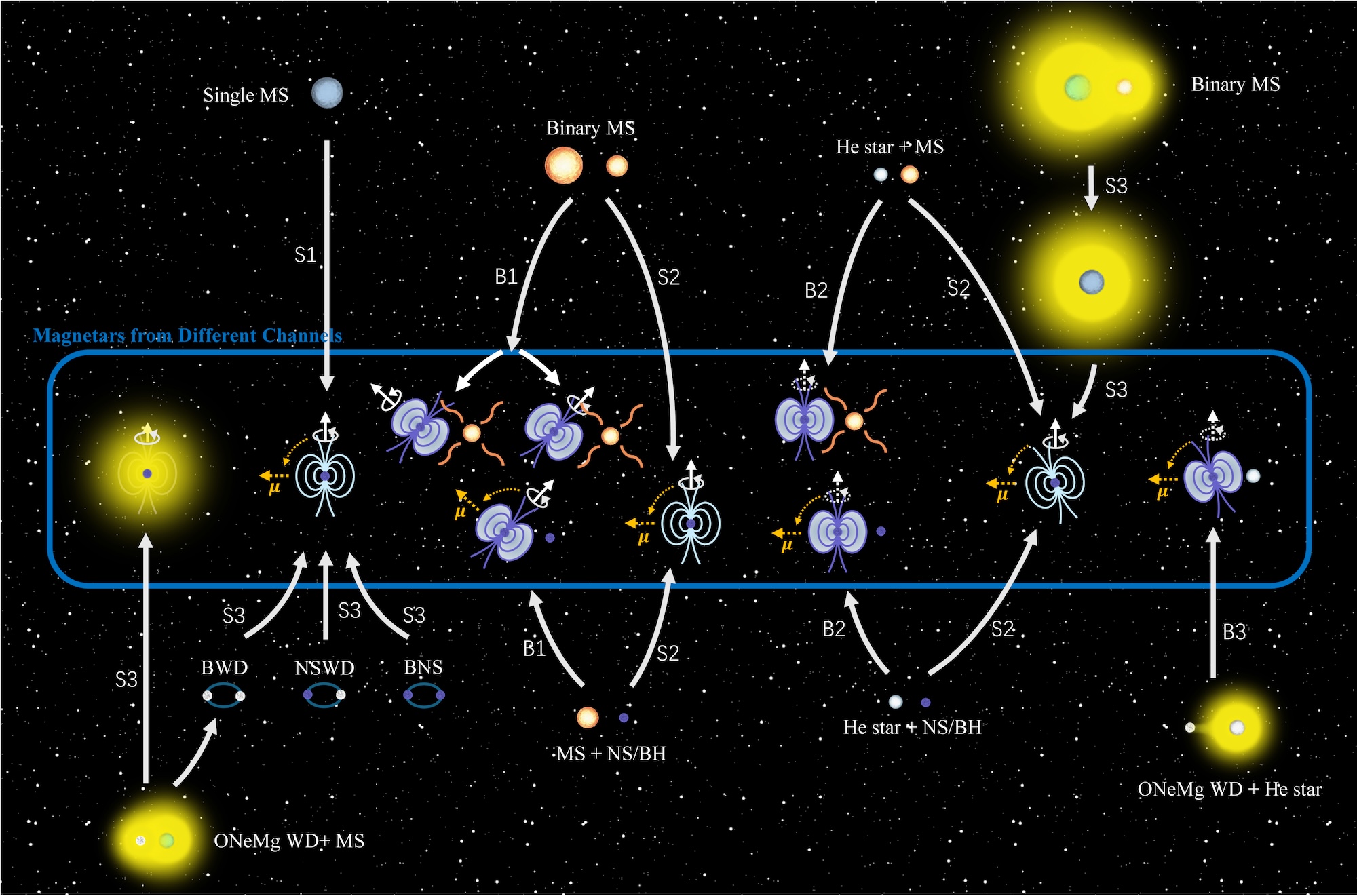
Magnetar formation pathways. The magnetic field lines of isolated magnetars have a black background, while the field lines of magnetars in binary systems have a white background. Click to enlarge. [Zhang & Hu 2025]

Zhang and Hu examined the different pathways through which magnetars form, as well as what properties they tend to have in each of these scenarios. This analysis suggested that the vast majority of magnetars in our universe are singletons, having formed from isolated stars, disrupted binary systems, or stellar mergers. This aligns with observations of magnetars in the Milky Way, none of which appear to have companions.

The remaining few percent of magnetars reside in binary systems. These coupled-up magnetars largely have companions more than twice as massive as the Sun, though some are paired with helium stars or compact objects.

Multiple Possible Arrangements

illustration of a magnetar in a binary system

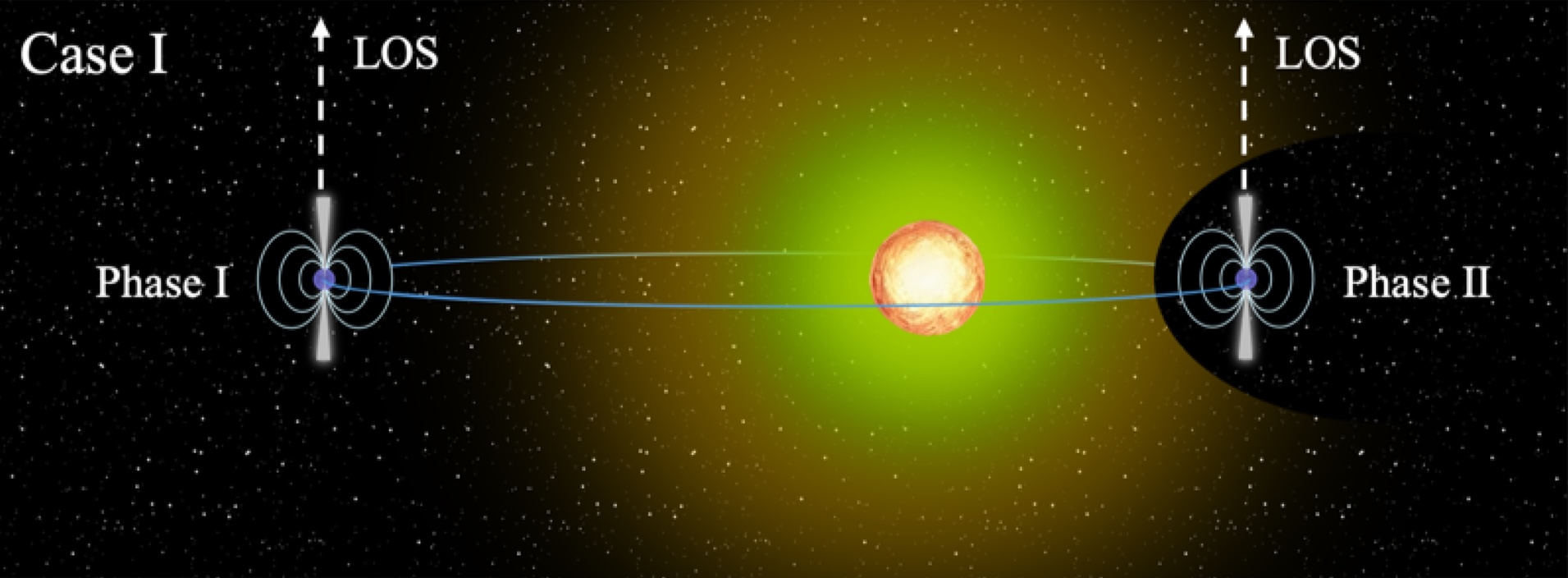
Illustration of a magnetar in a binary system with a star with a stellar wind. As the magnetar moves along its orbit, it encounters differing amounts of stellar wind. This affects the polarization angle of the bursts. Click to enlarge. [Adapted from Zhang & Hu 2025]

Zhang and Hu found that both isolated and paired-up magnetars tend to form with their spin and magnetic axes in close alignment — a setup that likely enables the production of rapid-fire fast radio bursts. For isolated magnetars, these axes may become misaligned over time, sapping their ability to produce repeated bursts. In binary systems, magnetars that accrete mass from the stellar winds of a companion likely retain their alignment, creating a long-lasting engine of repeating fast radio bursts. The presence of winds from a stellar companion may also explain several curious traits of some fast radio bursts, such as rapid changes in polarization angle.

In this framework, actively repeating fast radio bursts arise from aligned magnetars in binary systems, while one-off or infrequently repeating bursts come from isolated magnetars or misaligned magnetars in binary systems. Isolated magnetars could also be responsible for some actively repeating bursts, though this ability is likely short lived.

Though this work demonstrates that magnetars could be the source of all fast radio bursts, it doesn’t rule out the possibility that fast radio bursts have diverse origins instead. Further work is needed to explore other pathways and make even more headway on the mystery of fast radio bursts.

Citation

“Magnetars in Binaries as the Engine of Actively Repeating Fast Radio Bursts,” Bing Zhang and Rui-Chong Hu 2025 ApJL 994 L20. doi:10.3847/2041-8213/ae1023

The post A Unified Explanation for Fast Radio Bursts appeared first on AAS Nova.

❌