Jase Parnell-Brookes has reviewed a huge range of skywatching optics, including the best telescopes, binoculars and image-stabilized binoculars. As our trusted authority and expert tester, when they recommend a product and you're in the market for it, their opinions and recommendations are worth paying attention to.
In their Nikon Stabilized 12x25 binoculars review, Jase reckoned they were without doubt the best compact image-stabilized (IS) binoculars they had ever tested. Right now they have $73 off and are at the best price we've seen since Black Friday 2025.
Jase awarded them with a perfect 5-star rating, which was mostly thanks to their excellent stabilization, their unobtrusive controls and incredibly small form factor. They also earned a place on our best binoculars guide as the best compact IS binoculars. This Best Buy deal is worthy of your attention if you're in the market for an incredibly versatile pair of binoculars that deliver still views in a compact body.
Save $73 on these pocket-sized image-stabilized (IS) binoculars from Nikon. They offer a strong 12x magnification and are portable enough to just slip into your pocket. In our review, we noted that the compact size and amazing IS system delivered amazing stargazing performance and earned them a perfect five-star review.
The Nikon Stabilized 12x25 S binoculars are incredibly compact and are a handy pair to take wherever you go. Kimberley LaneThe smaller objective lenses mean that the image looks a stop darker than viewing with the naked eye. Kimberley LaneThe eyecups rotate freely to adjust the amount of eye relief. Kimberley LaneThe binoculars are incredibly lightweight, considering their onboard image-stabilization system. Kimberley Lane
These image-stabilized (IS) binoculars punch well above their weight. Tipping the scales at a feathery 13.9 oz (395 g), they pack effortlessly into any bag, giving you rock-steady views wherever you roam. While the compact objective lenses yield a slightly dimmer view than the naked eye, they still deliver fantastic, crisp performance for casual stargazing.
In their testing, Jase managed to see the Andromeda galaxy (M31) with averted vision and the Orion nebula (M42), so these are worth taking out with you at night for a better look at the stars and some of the brighter deep sky objects.
They are also relatively cheap in the image-stabilized world where models can easily go for $1000 and up, depending on the model. Jase was happy to recommend these over another compact IS model, the Canon 8x20 IS binoculars, and they are actually lighter and smaller too. With their silky smooth steadying and clear views, they highly recommended them for anyone looking to get image-stabilized binoculars but doesn't want to spend big bucks.
Key features: 12x magnification, 25mm objective lens diameter, 4.5-degree angular field of view, 12.3mm eye relief, 13.9 oz (395 g) weight.
Product launched: November 2024
Price history: The Nikon Stabilized 12x25 binoculars usually retail for $699.95 on Amazon. This deal from Best Buy beats the Amazon price easily and, at just $626.95, is the best price we've seen since Black Friday 2025.
✅ Buy it if: You are looking for an affordable way into image-stabilized binoculars and need a pair that you can slip into your pocket.
❌ Don't buy it if: You need really high magnification or bigger objective lenses. For more powerful image-stabilized binoculars, try the Canon IS 15x50 binoculars.
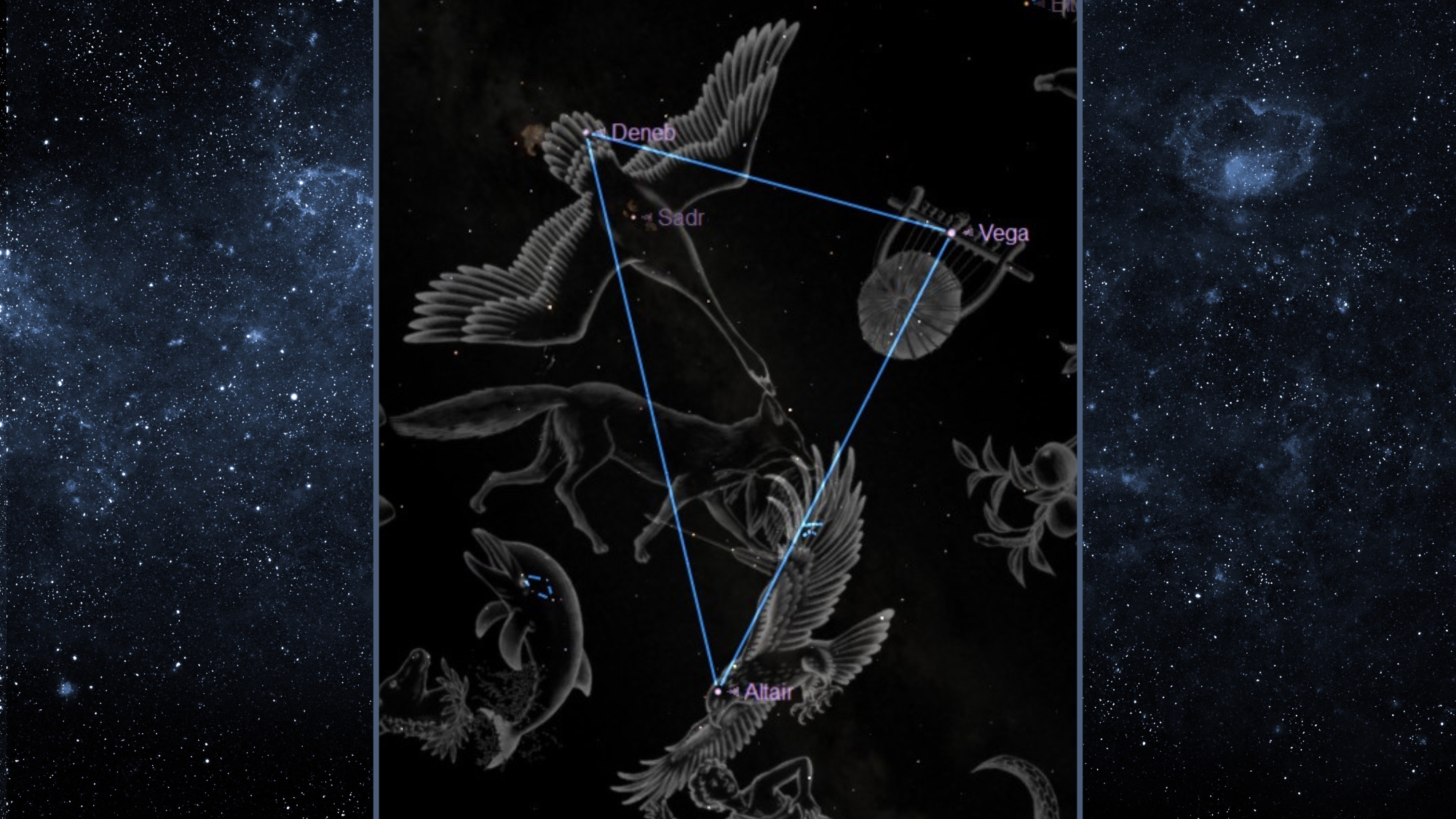
On clear September evenings, I often find myself looking up just after dusk, expecting the sky to feel a little less like summer. Yet there, still commanding the overhead darkness, are Vega,Altair, and Deneb — the three brilliant stars of the famous Summer Triangle.
Their familiar pattern can make the season feel as though it is lingering above us, even as cooler nights and earlier sunsets suggest otherwise. In fact, even as late as mid-November, the Triangle is still nearly overhead soon after sunset at dusk. That contrast raises a simple but intriguing question: if this bright celestial landmark remains so prominent well into autumn, why do we still call it the Summer Triangle?
Why not simply call it the Autumn Triangle?
Why it belongs to summer
The answer lies not in the calendar, but in how the Triangle moves across the sky over the course of a summer night. The chief reason is that, at this time of year, the Triangle does not remain visible all night. By dawn, it has begun to drop beyond the west-northwest horizon. During summer, by contrast, it remains with us from dusk until dawn: already evident in the east-northeast at nightfall, near overhead around the middle of the night, and descending in the west-northwest as daybreak approaches.
A matter of distance and brightness
The stars that compose the Triangle — Vega, Altair, and Deneb — lie at very unequal distances from us, so their apparent brightness can give a misleading impression of their true luminosity.
The closest of the three is Altair, 16.7 light-years away, followed by Vega at 25 light-years. Deneb, however, is vastly farther off, at roughly 1,600 light-years, though various sources place it between 1,400 and 2,600 light-years. Even though we see Deneb by light that may have begun its journey during the last days of the Roman Empire, it still shines at first magnitude (+1.3, to be exact) because it is a brilliant blue supergiant, at least 55,000 times brighter than the sun.
But their apparent superiority is largely a consequence of distance: Vega and Altair are only a few dozen light-years away, while Deneb lies well over a thousand light-years from Earth. Compared with the stellar lighthouse of Deneb, Vega and Altair are, comparatively speaking, penlight flashlights.
How to say "Vega"
Before continuing with this discussion about the Summer Triangle, it is worth pausing briefly on the pronunciation of Vega, a point that became especially noticeable after the 1997 science fiction drama Contact. Based on Carl Sagan's 1985 novel, the film follows astronomer Dr. Ellie Arroway, played by actress Jodie Foster, as she discovers a radio signal from Vega containing a sequence of prime numbers.
Throughout the film, the star is pronounced "Vey-gah," perhaps echoing Chevrolet's Vega, the subcompact automobile sold in the 1970s. Astronomers, however, generally use a different pronunciation.
The traditional astronomical pronunciationis Vē-ga, with the stress on the first syllable. In professional astronomical usage, Dr. Arroway and her colleagues would almost certainly have said "Vee-ga," not "Vey-gah." George Lovi (1939—1993), who was widely respected for his knowledge of star nomenclature, often reminded audiences that "Vee-ga is a star and Vey-gah is a car."
Who named the Summer Triangle?
The Summer Triangle and the allegorical figures (Cygnus, Lyra and Aquila) attributed to the three constellations it belongs to, at around 9 p.m. in mid-September. (Image credit: Starry Night Pro 8.0, background added in Canva Pro.)
There has long been debate over who first christened the bright stellar trio of Vega, Deneb, and Altair as the Summer Triangle. Some credit the legendary British astronomer Sir Patrick Moore (1923—2012), who wrote, "During a 1958 television broadcast on the BBC, I introduced the nickname of the Summer Triangle, and everyone now seems to use the term, even though it is completely unofficial." Yet several years earlier, in his 1952 sky guide, The Stars — A New Way to See Them, H.A. Rey (1898—1977) referred to the three stars as a "right triangle," and in his 1954 children's book, Find the Constellations, Rey used the Summer Triangle moniker.
Still others believe the term was popularized through U.S. navigator training manuals during World War II. Interestingly, astronomer Oswald Thomas (1882—1963) described Vega, Altair, and Deneb as "Grosses Dreieck" ("Great Triangle") in the late 1920s and as "Sommerliches Dreieck" ("Summerly Triangle") in 1934.
Starting today (Sept. 9), skywatchers in the Northern Hemisphere have a chance to spot one of the night sky's more elusive sights: the zodiacal light.
Zodiacal light is a faint, pyramid-shaped glow rising in the east before morning twilight. It is caused by sunlight reflecting off interplanetary dust.
The phenomenon is sometimes nicknamed the "false dawn" because its soft glow can be mistaken for the signs of morning twilight. Unlike dawn, however, the zodiacal light appears as a distinct cone or wedge of light extending upwards from the horizon along the ecliptic — the apparent path the sun, moon and planets follow across the sky.
Early fall provides a good opportunity for northern hemisphere observers to look for zodiacal light before dawn, when the angle of the ecliptic helps the glow stand more prominently above the eastern horizon.
Timing and location are everything in order to observe the Zodiacal Light. You must be far from city lights, looking east, around 4:00 a.m. EDT. Give your eyes plenty of time to adjust to the darkness and avoid looking at your phone or other bright lights while searching for the faint glow.
How to find it
Trace the cone of light as high as possible. Under pristine, dark skies, you can follow this glow deep into the zodiacal constellations that lie along the ecliptic. The base of the light cone will start near Cancer, resting just above the horizon, stretching upward through Gemini, and reaching high into the predawn sky toward Taurus.
The zodiacal light may be visible before dawn in early September as a faint cone of light rising from the eastern horizon through the zodiac constellations. (Image credit: Jules-Pierre Malartre/Starry Night)
How to photograph it
Capturing the Zodiacal Light is very similar to photographing the Milky Way. You will want a fast, wide-angle lens (such as a 14 mm lens at f/2.8) to properly frame the sweeping diagonal of these constellations. Use a high ISO (1600 to 3200) and take a 15-to-20-second exposure on a fixed tripod.
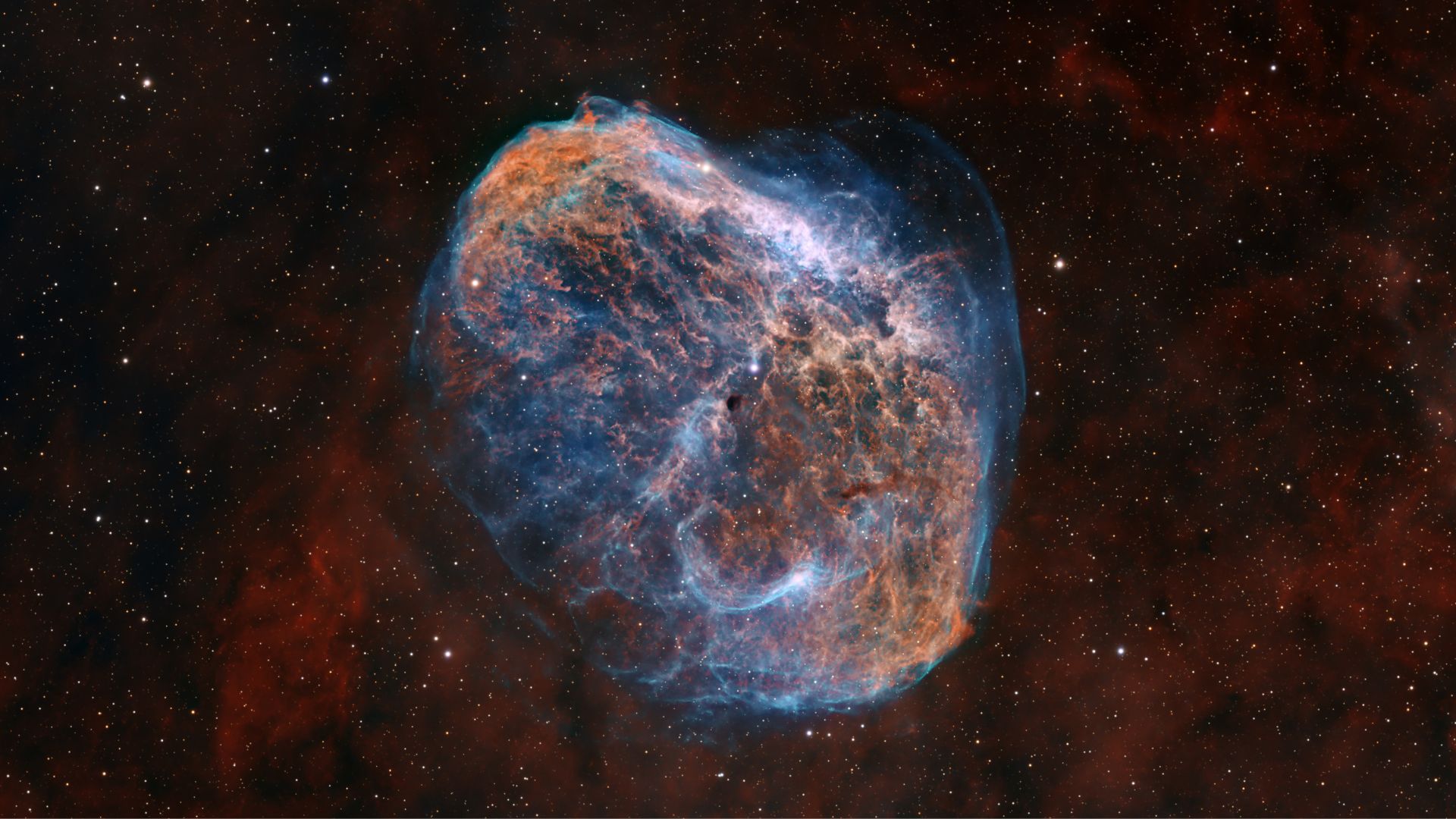
The Crescent Nebula shines in the constellation Cygnus. (Image credit: Kevin Boardman)
Astrophotographer Kevin Boardman captured this spectacular view of the Crescent Nebula, revealing intricate filaments of gas surrounding a massive star nearing the end of its life some 4,700 light-years from Earth in the constellation Cygnus.
Boardman's image represents a turbulent chapter in the life of the colossal Wolf-Rayet star WR 136 (HD 192163), which, visible as a blue point of light at the center of the image, is expected to end its life in a dramatic supernova explosion in about 100,000 years.
The 25-light-year-wide bubble is formed from stellar material cast off by WR 136 during its transformation into a red giant star, according to NASA. Repeated impacts by fast-moving stellar winds later send shockwaves through the outer shell, creating the complex filaments we see today.
ZWO ASI533MC Pro
(Image credit: Amazon)
The ZWO ASI533MC Pro camera is the best dedicated astro camera out there, in our opinion. It features zero amp glow, 80% quantum efficiency and a 20FPS frame rate. It also features a 9MP sensor and you can check out our ZWO ASI533MC Pro review for a more in-depth look.
Catalogued as NGC 6888, or Caldwell 27, the Crescent Nebula, gets its nickname from its crescent-moon like appearance when observed in certain wavelengths of light. Boardman revealed spectacular detail in the nebula by imaging it with a set of narrowband filters over 16 hours and 18 minutes spread across five nights in late July.
"In the image, orange-red H-alpha reveals the tangled filaments while blue-cyan [O III] outlines emission from doubly ionized oxygen around the shell," Boardman told Space.com in an email. Each filter isolates specific wavelengths of light emitted by ionized gases, allowing different structures within the nebula to stand out.
Boardman collected roughly 12 hours of narrowband data from the nebula itself, along with four hours and 20 minutes of data capturing the surrounding stars, before combining exposures using the astronomy software PixInsight during post-processing.
The Crescent Nebula is too faint to be spotted with the naked eye, but can be seen with a moderate-to-large telescope equipped with a light pollution filter throughout September.
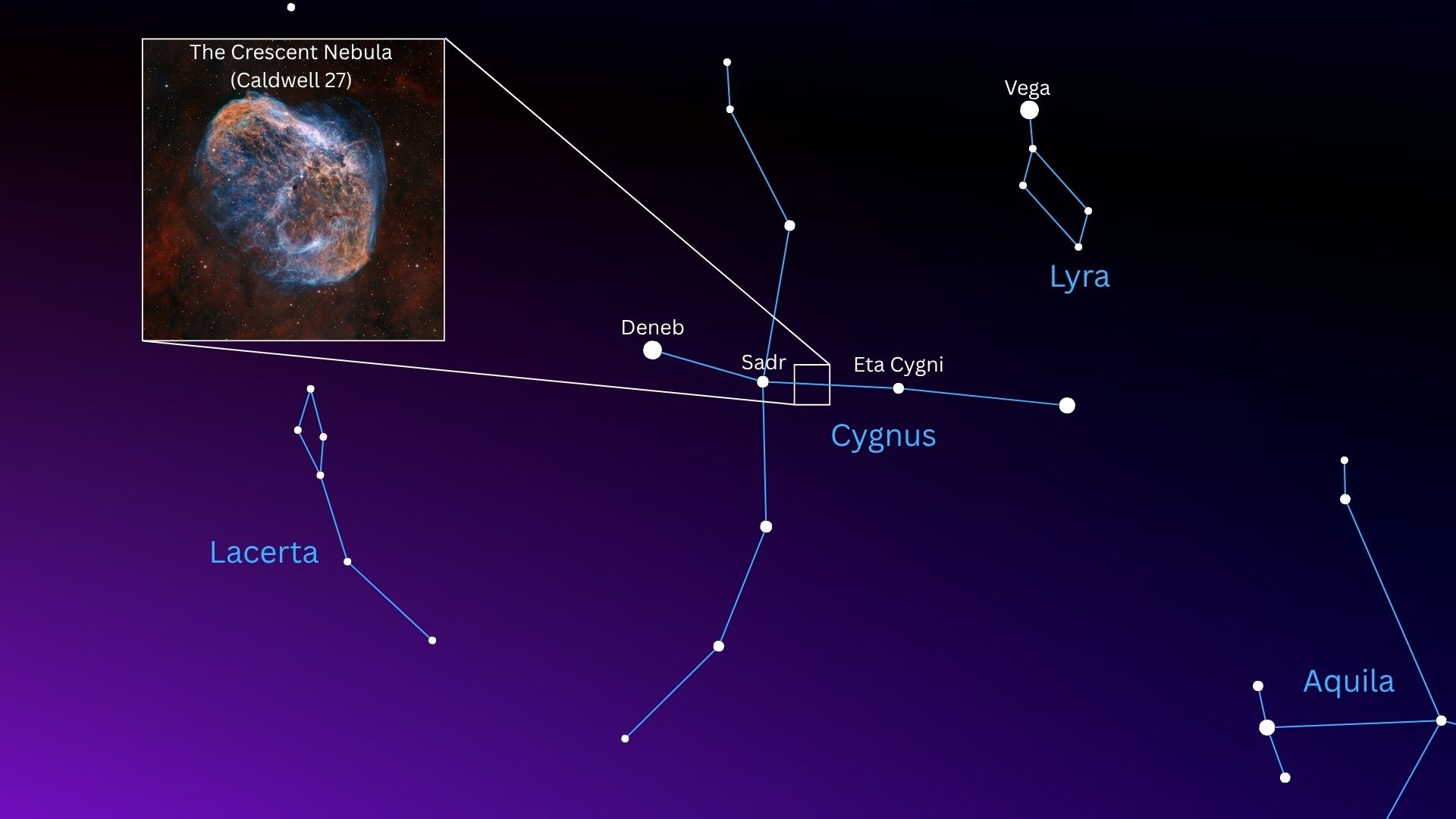
How to find the Crescent Nebula among the stars of the constellation Cygnus. (Image credit: Inset image: Kevin Boardman, created by Anthony Wood in Canva.)
First, locate the magnitude +2.34 star Sadr at the center of the cross-shaped constellation Cygnus, which appears high overhead for Northern Hemisphere observers in late summer.
Next, locate the dimmer magnitude +4.03 star Eta Cygni using the simplified star chart above, or with the aid of a smartphone astronomy app. The Crescent Nebula lies directly between these two bright stars and is best seen on the dark nights surrounding this month's new moon phase on Sept. 10-11.
Editor's Note: If you would like to share your astrophotography with Space.com's readers, then please send your photo(s), comments, and your name and location to spacephotos@space.com.
Looking for a quality camera that marries style and performance? Look no further than the Nikon Zf. Despite its vintage looks, it's one of the best Nikon cameras you can buy and with its excellent low-light performance, we also rank it as one of the best astrophotography cameras. Now, thanks to this deal, it's the cheapest it's been since last year's Black Friday.
In our Nikon Zf review, our expert called it "A great buy that offers excellent value for money when compared with some of the much more expensive Nikon models." Now less than $1,800, this is a steal for astrophotographers and photographers in general.
Save $453 on this impressively capable Nikon Zf camera. It isn't just a great low-light performer, it's an excellent all-rounder. Its retro-aesthetic is a bonus for those who miss the look and feel of film cameras. View Deal
Couple the Nikon Zf with a suitable lens and you've got a camera that excels at astrophotography. FutureFutureFutureFutureFuture
What's not to love about this Nikon Zf camera? We ranked it as the best camera under $2,000, before inflation pushed it past that price point, and this deal makes it the cheapest it's been since last Black Friday.
Not only does this full-frame mirrorless camera offer excellent low-light performance, so much so that we think it's one of the best cameras for astrophotography, it's a brilliant all-rounder too.
In their Nikon Zf review, expert Jase Parnell-Brookes awarded it four-and-a-half stars, discovering that its strengths go far beyond its vintage stylings, remarking that "It delivered an impressive dynamic range and performed well in various lighting scenarios."
And, while you can point and shoot, the Nikon Zf is packed with controls designed to enhance your experience. From changing the ISO and ISO sensitivity, through to switch to black-and-white mode, you have complete control over your images. That much choice may seem daunting but the buttons and dials are intuitive enough that using them becomes second nature.
There are Nikon cameras out there that can beat its 24.5 MP images, but you'd have to spend significantly more. The Nikon Z8, for example, is over half as much again. If you want to make your money count, the Nikon Zf is the camera to buy. However, you'll have to hurry if you want to make the most of this deal. As we write this, there are just a handful of units left in stock.
Key features: 24.5 MP FX CMOS Sensor, Z mount, 100-64000 (expandable to 204,800) ISO, 4K UHD 30p video, 1 lb 9.1 oz / 710 g weight, 1SD UHS-II + MicroSD UHS-I card slots.
Product launched: September 2023
Price history: This is the cheapest this camera has been all year. It last dropped to around this price last Black Friday.
Reviews consensus: Reviewing theNikon Zf, we awarded it four-and-a-half stars praising, in particular, its low light performance and how it stacks up to Nikon's more expensive cameras. We were also impressed by its vintage appearance, replicating the look of a film camera. Its Amazon reviews are just as positive, with just a few purchaser complaining about its weight.
Today (Sept. 8), skywatchers can first catch a striking predawn pairing of the crescent moon and Jupiter, then — where conditions and location allow — attempt the much harder daytime occultation, when the moon hides the planet from view.
Before sunrise: Find the moon and Jupiter
Set your alarm for 5 a.m. local time on Tuesday and look low toward the east-northeast sky. Check in advance for tall obstructions that could block your view of this delicate predawn tableau. A slender waning crescent moon — just under 10% illuminated and resembling a "celestial smile" — will be immediately apparent. About 5 degrees below it, roughly half the width of your clenched fist held at arm's length, will be brilliant Jupiter.
Jupiter rises in the east-northeast shortly before 4 a.m. local daylight time, but it does not climb fairly high until just before dawn's first light. The planet is in the dim zodiacal constellation Cancer; one of my astronomy mentors at New York's Hayden Planetarium, Dr. Ken Franklin, used to call Cancer "the empty space between the Sickle of Leo and the Gemini Twins." If you set up a telescope before dawn, you can be among the first to see what became of Jupiter's tumultuous cloud belts while the planet was hidden in the sun's glare from early July through mid-August.
Later in the day: The daytime occultation
Another moon-Jupiter show awaits later in the day: a daytime occultation, when the thin waning crescent moon will hide Jupiter from much of North America. Unfortunately, a swath of the western United States — anywhere west and south of a line running roughly from Bellingham, Washington, to Rockport, Texas — falls outside the occultation's visibility zone.
The occultation occurs during the afternoon, when the moon and Jupiter will appear somewhat lower than the sun and well off to its right. Jupiter will disappear behind the moon's sunlit limb, with the moon taking roughly a minute or more to inch across the giant planet's face. Approximately 50 minutes later (give or take ten minutes), Jupiter will gradually reappear from behind the moon's dark edge.
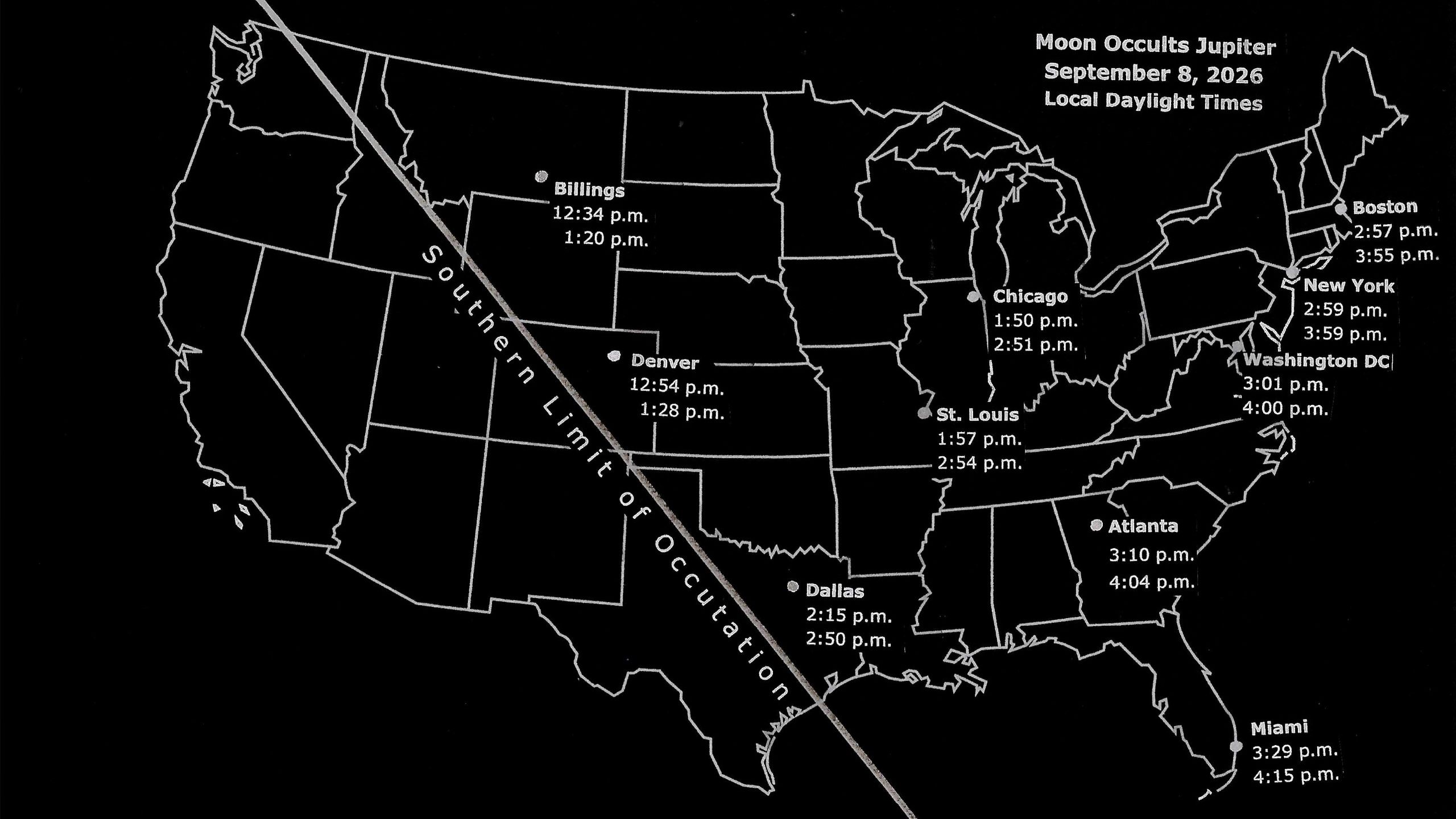
Jupiter will vanish (going from north to south) between 2:55 and 3:30 p.m. for those in the Eastern Time Zone, 1:45 to 2:20 p.m. for the Central Time Zone, and 12:30 to 1:00 p.m. in the Mountain Time Zone.
To find out when these events occur at your location, use the accompanying map. Interpolate between the ten selected cities to find the local daylight time of Jupiter's disappearance (top) and reappearance (bottom) for your site.
(Image credit: Joe Rao)
How to find them in daylight
The chief challenge will be finding the moon and Jupiter at all, so give yourself plenty of time. The easiest method is to locate the pair before sunrise and track them into daylight. Much will depend on the transparency of your local sky — how deep its blue color is. If the day is hazy, the search will be harder.
Start before sunrise, when the crescent moon and Jupiter are easiest to identify.
As daylight strengthens, keep tracking the pair or return to the same region of sky about 30 degrees — roughly four fist-widths at arm's length—from the sun, mostly to the right and, for most locations, somewhat lower.
Sweep the area with a finderscope or binoculars, remembering that the crescent moon's low surface brightness may make it hard to distinguish from the blue sky.
Once you have the moon, the next challenge is Jupiter. In a telescope, it will appear far smaller than the moon — about one-sixtieth of the moon's diameter — and it will have an even lower surface brightness. Watch for Jupiter to return along the moon's dark limb, a captivating sight as the planet seems to emerge literally from out of the blue.
If you miss it
Sighting the moon and Jupiter in daytime will be challenging, so do not despair if you fail to find them. In less than a month, on the morning of Tuesday, Oct. 6, the moon and Jupiter will have another interaction, but this time about eight hours earlier, before sunrise in a dark or twilight sky. That resultant event should be a spectacular sight, easily visible with the naked eye, binoculars, or a telescope. Space.com will provide details as the date approaches, so stay tuned!
I've got three telescopesin my home, but the Celestron FirstScope is my first stop when it comes to stargazing. Now this super-portable, beginner-friendly tabletop scope is $60 at Amazon, even cheaper than Prime Day!
What makes the Celestron FirstScope so fantastic? It's all down to ease of use and portability. There's next to no assembly and once you've unboxed it, you can pick it up in one hand and head outside.
Save $15 on this moon-themed Celestron Firstscope which, with 76mm aperture and tabletop mount, is ideal for quick stargazing sessions as well as introducing children to a new hobby. View Deal
The Celestron Firstscope is a small but perfectly formed scope, great for a quick spot of skywatching. (Image credit: Celestron)
Even though I've got two bigger telescopes in my home, a Skyatcher Classic 200Pand a Bresser Solarix 114/500, I wouldn't dream of parting with my Celestron FirstScope. This tabletop scope is so easy to use and so portable, you can just grab it, head outside and get stargazing.
No fuss, no mess, no scraping the door frame because folding the tripod down seems like too much work. It's also small enough that you can sling it in a backpack, ideal for hopping on your bike and pedalling away from light pollution.
It comes with 20mm and 4mm eyepieces, but you can also trade up to any of the best eyepieces. As a tabletop telescope you'll need to find something to rest it on but a wall or even a trash can will do. And if you're a beginner, or buying for children, you'll be delighted with how the FirstScope performs. We think it's the best tabletop telescope for kids.
The lack of a finderscope is slightly disappointing but you can purchase one separately and, even without one, this is an impressively capable telescope, at a price that won't break the bank. It really is that simple. Want to watch Saturn at opposition this Oct. 4? Grab your FirstScope, perch it on a table or wall, and home in on this ringed planet. It's excellent for moonwatching too, especially if you're short on time. We think this is the best tabletop telescope for kids and beginners will love it too.
Key features: Newtonian reflector with Dobsonian mount, 2.99-in (76mm) aperture, 11.81in (300mm) focal length, 20mm and 4mm eyepieces.
Product launched: March 2009
Price history: This is even cheaper than Prime Day, when the Celestron FirstScope dropped to $70.
Reviews consensus: Reviewing the Celestron Firstscope, we awarded it four stars, saying "It exudes portability, ease of use and a price that's not going to break the bank." That sentiment still stands and its Amazon reviews are just as positive. At this price, it's a steal.
Soon, the sky's most glamorous evening performer will take its leave.
Since late March, Venus has been the unmistakable "Evening Star," gleaming shortly after sunset and stealing attention from nearly everything else in the twilight. In June, it helped stage a striking three-planet lineup after sundown, outshining both Jupiter and Mercury.
Now the curtain is beginning to fall: Venus is sinking night by night and will trade its evening role for a morning one before October is over.
A familiar dance around the sun
Venus moves to a remarkably regular beat. Our nearest planetary neighbor circles the sun in an almost perfect path, completing 13 orbits in 8 Earth years. From Earth, that rhythm makes Venus appear to trace five great loops across the sky in the same span. It is a long cycle noticed by skywatchers — and important to the ancient Aztec and Mayan civilizations — and it gives each Venus year its own recognizable personality. In 2026, the pattern closely echoes 2018, differing by only about two days.
Key dates this month
Venus is about to blaze at peak brilliance, but this farewell performance comes with a challenge. All month long, the planet will slide lower in the southwest after sunset, shortening the window for a good view. If the horizon is clear and the weather cooperates, these are the evenings to circle on your skywatching calendar.
Sept. 7: On Labor Day, Venus sets about 1¼ hours after sunset.
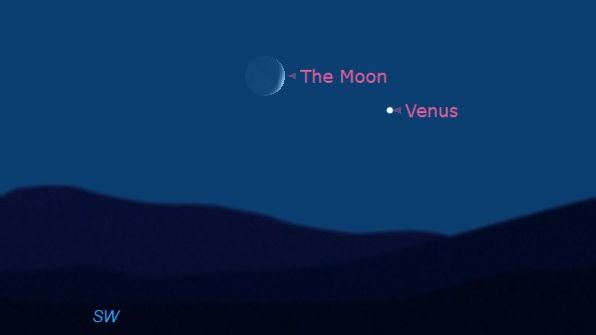
Sept. 14: Look low in the west-southwest 30 to 45 minutes after sunset, when a waxing crescent moon appears around 5½ degrees to the left of Venus.
Late September: The planet slips quickly from view, setting just 35 minutes after sundown by month's end.
Venus shines near a waxing crescent moon very low in the southwestern sky, 45 minutes after sunset on Sept. 14. (Image credit: Starry Night Pro 8.0)
Why this farewell is so low-key
Ordinarily, the weeks between greatest elongation and greatest brilliancy are prime time for Venus watchers. Not this year. For evening observers, this apparition has been more frustrating than triumphant, with Venus lingering low in the glow of twilight instead of climbing into a commanding position.
The best views came back in June, when Venus lingered until around 11 p.m. Since then, it has been ducking out earlier each night. By Aug. 15, the evening of greatest elongation — when Venus reached its greatest apparent distance east of the sun — it was already setting just as evening twilight faded.
For observers at mid-northern latitudes, the finale is especially low to the horizon. Around 40 degrees north latitude, Venus will stand only about 5½ degrees above the southwest horizon at sunset by the end of September. That is barely more than half the width of your clenched fist held at arm's length — a beautiful but fleeting target in the fading light.
A crescent world in the twilight
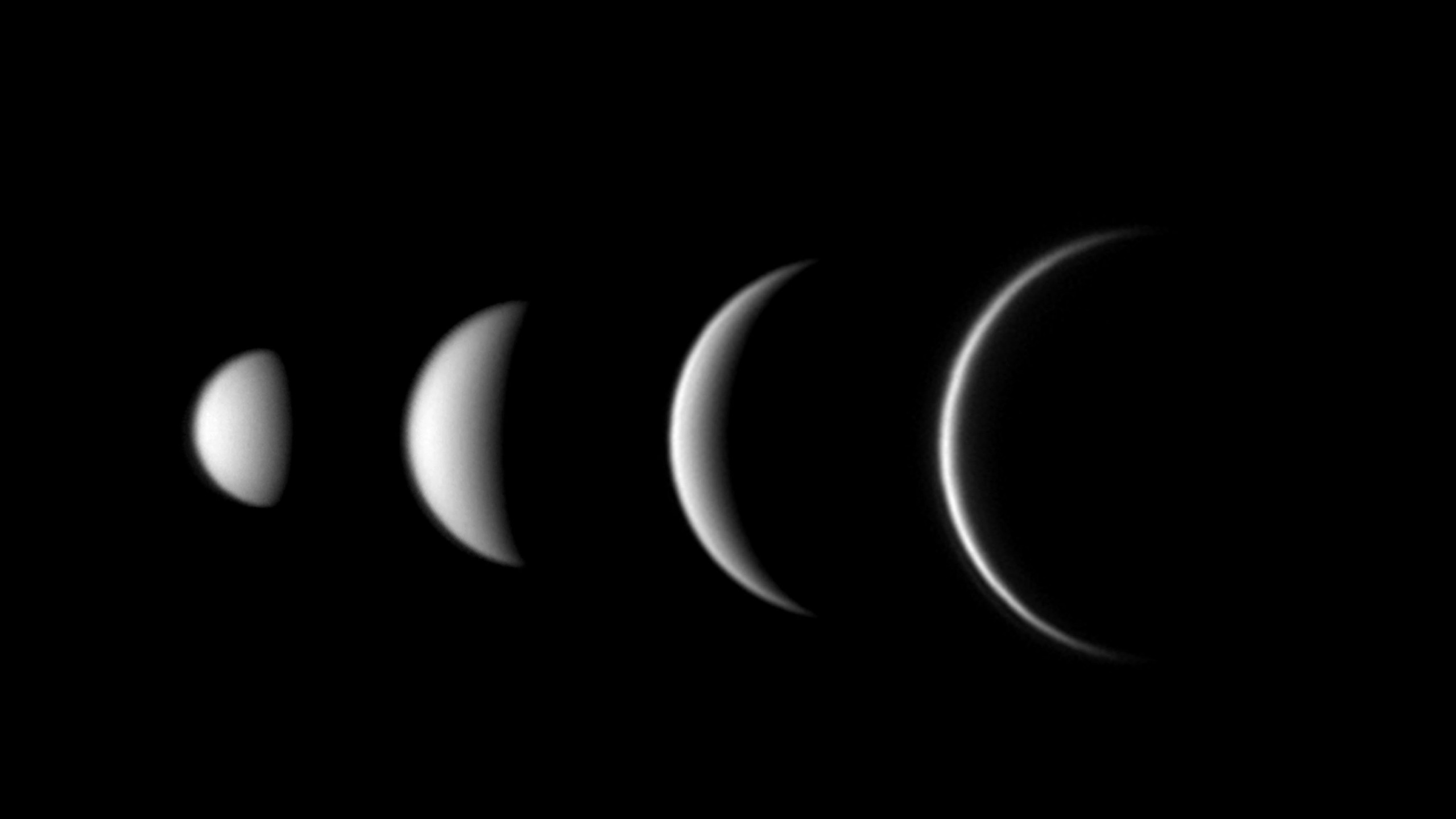
Through a telescope, Venus now shows one of its most striking faces: a narrowing crescent. As its sunlit side turns farther away from Earth, that crescent grows thinner and longer, becoming a delicate arc of brilliant light. With very steady binoculars, you may even glimpse the shape during the next couple of weeks, though the planet's low altitude will make the view shimmer and blur.
Set of images taken in 2004 show the phases and relative size of Venus as seen from Earth as it moves around the Sun. (Image credit: Photograph by Jamie Cooper. (Photo by SSPL/Getty Images))
The morning star returns
By the end of the first week of October, Venus will have slipped from the evening sky altogether. It reaches inferior conjunction on Oct. 24, passing about 6 degrees south of the sun. Around that time, spotting it on nearby evenings or mornings will be extremely difficult.
But Venus never stays away for long. In November, it reappears before dawn, opening a brilliant new morning apparition. By the winter holidays, it will shine high in the eastern sky as a fitting "Christmas Star," rising more than two hours before daybreak — and nearly four hours before the sun.
Venus is something of a frustration for stargazers. It's the brightest planet and the easiest to see, while the sight of it close to a crescent moon is one of the most achingly beautiful sights in the sky. Yet it gives almost nothing away.
Mars has its reddish color. Saturn rewards even a small telescope with its spectacular rings. Jupiter has moons, belts and an obvious disk. Venus, meanwhile, spends months blazing away in twilight looking exactly like what people who do not stargaze assume a star should look like — a brilliant white point. What we're seeing is sunlight reflected by its global cloud cover, which in turn makes it impossible to see in any detail.
But every now and then, it does something revealing by becoming a crescent. That is when Venus, an inner planet relative to Earth, finally makes sense.
Put a small telescope on Venus this week and its appearance is completely different from the dazzling dot seen with the naked eye. This week, its disk will dim from 36% to 32% lit as it shrinks toward a thinner crescent as September progresses. At the same time, its apparent disk is getting larger because Venus is moving closer to Earth.
Those two changes are connected. Venus reached its greatest eastern elongation, about 46 degrees from the sun, on Aug. 15. It's now swinging around the inside of its smaller, faster orbit of the sun towards inferior conjunction on Oct. 24, when it will pass roughly between Earth and the sun, and be lost in the sun's glare. Before that, it will reach its peak — greatest brilliancy — in the evening sky on Sept. 18, shining at magnitude -4.8 while just 26% lit. That's the sweet spot, when its increasing angular size and decreasing crescent combine at their brightest, as seen from Earth (though its modeled visual brightness peaks a few days later, around Sept.22). After that, it becomes an increasingly dim crescent.
Seeing Venus as a crescent makes the geometry beautifully obvious. We are no longer looking across the solar system towards the brightly illuminated side of Venus. We are increasingly looking at the planet from behind, towards its night side, with sunlight catching only one edge.
It is almost the same idea as a crescent moon — except Venus is another world tens of millions of miles away. As it passes roughly between Earth and the sun on Oct. 24, it will be 0.27 AU away — equivalent to 25 million miles (40 million kilometers). At its farthest, Venus can be 162 million miles (261 million kilometers) from Earth.
The phases of Venus were historically important. When Galileo observed Venus through a telescope in the early 17th century, seeing it display a broad range of phases helped demolish the traditional Ptolemaic model in which Venus was supposed to orbit Earth in a way that could not produce the full sequence he observed.
Four centuries later, the same observation remains one of the simplest ways to understand our place in the solar system.
Venus becomes far more interesting when it stops looking its best through the naked eye and instead becomes a "wow" moment in a small telescope. As the "Evening Star" sinks lower into twilight, we're not just seeing a crescent — we're seeing a planet orbit the sun.
What's happening and when to look
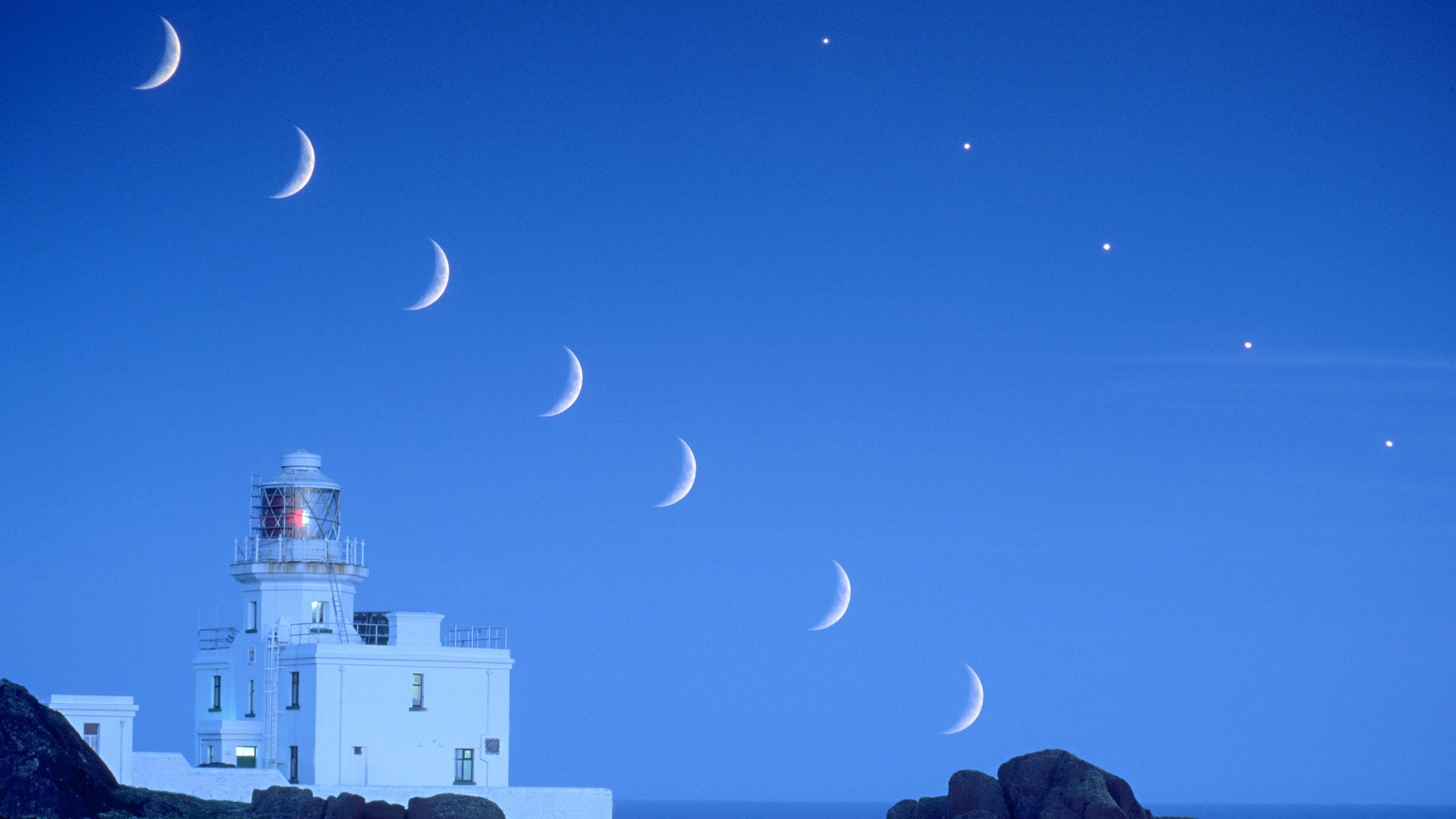
A crescent moon and Venus over a lighthouse. (Image credit: Richard Packwood via Getty Images)
Venus remains an evening object throughout September, but it is rapidly becoming more challenging from mid-northern latitudes. Look very low towards the west-southwest shortly after sunset, where it should be obvious because practically nothing else in the twilight comes close to its brilliance.
Do not search for Venus with a telescope or binoculars while the sun is still above the horizon. Wait until sunset and make sure the sun has disappeared before pointing optical equipment anywhere near the western sky.
Venus will move through Virgo during the coming days before a particularly attractive conjunction on Sept. 14, when a 16%-lit waxing crescent moon will pass extremely close to a 29%-lit Venus. Two crescents together.
How and when I'm watching it
Venus is one of those objects I prefer to revisit several times rather than observe once. A single look shows a crescent, but observing every week reveals movement.
I'll mostly use my small spotting scope in the front yard to look at Venus as a crescent this month, but if I'm short on time, I'll use some 10x50 binoculars, which can also reveal the phase. The trick is not to expect surface detail — just a clean geometric shape.
Atmospheric turbulence near the horizon can make Venus wobble and shimmer, but its phase usually cuts through.
Stargazer's corner: Sept. 4–10, 2026
Saturn continues to brighten in the east after dark. (Image credit: SCIEPRO/SCIENCE PHOTO LIBRARY via Getty Images)
With the moon now past last quarter, the early evening sky is finally free from bright moonlight. It's an excellent opportunity to revisit the Milky Way, along with star clusters, nebulas and other deep-sky objects before autumn gradually takes over and its bright center slumps into the horizon. Before dawn, the waning crescent moon moves through Taurus, passing close to Mars on Sept. 6 in Gemini, while brilliant Venus continues to dominate the western twilight after sunset. The dazzling planet remains the unmistakable evening beacon, shining low above the west shortly after sunset. Saturn, meanwhile, continues to brighten in the east during the late evening, making this an increasingly good time to point binoculars or, better still, a small telescope toward the ringed planet.
Constellation of the week: Pisces
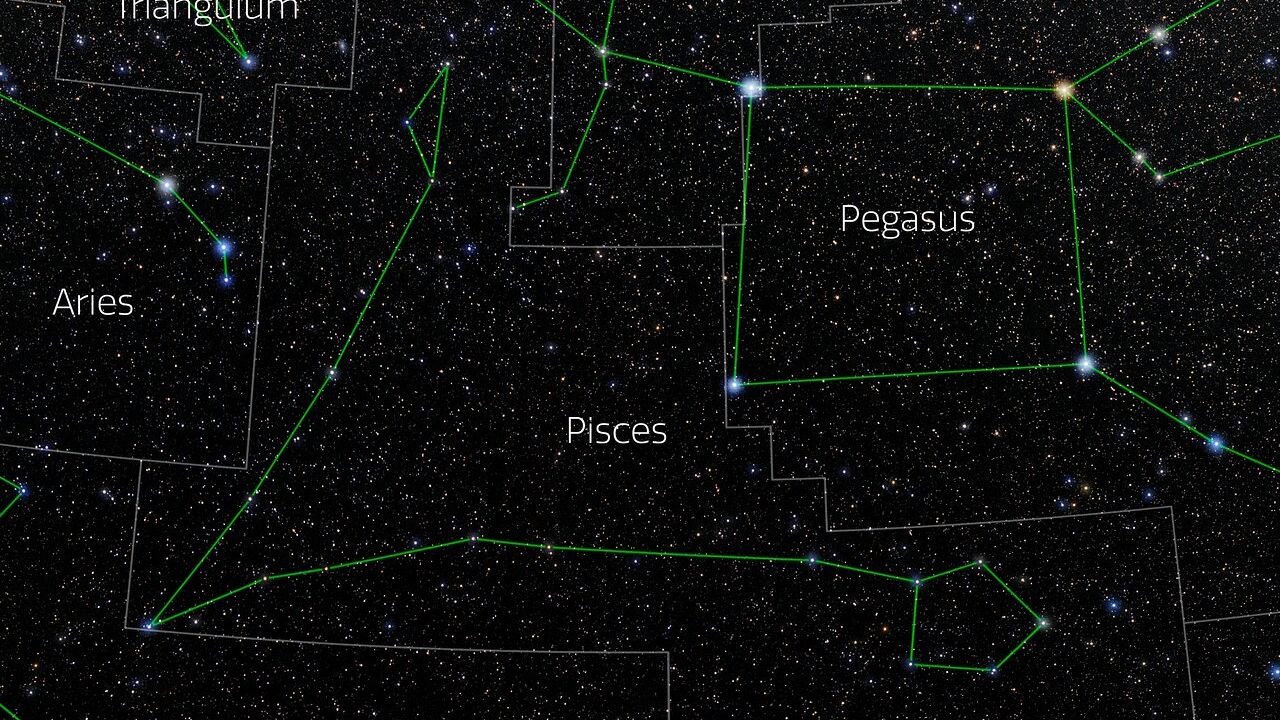
Pisces, "The Fishes," is now visible in the south after dark. (Image credit: E. Slawik/NOIRLab/NSF/AURA/M. Zamani))
Pisces is easy to overlook. Its faint stars form two celestial fish joined by a long cord, creating a broad V-shape beneath the easy-to-find Great Square of Pegasus in the eastern evening sky after dark this month.
This week is a great time to find it because Neptune soon reaches opposition within Pisces, making the distant planet brighter than at any other time this year. Although Neptune needs binoculars or a telescope to spot it, learning the constellation
Pisces has been associated with mythology and water for thousands of years, but finding its subtle pattern also signals that the autumn constellations are beginning to take over the night sky.
A spectacular total solar eclipse will coincide with the peak of the Perseid meteor shower on Aug. 12-13. But will you be able to spot shooting stars in the false twilight of totality?
Perseids appear as Earth plows through the stream of debris shed by comet Swift-Tuttle. Up to 100 shooting stars may be seen each hour around its peak under ideal dark skies, as particles from the ancient comet collide with our atmosphere at speeds of 133,200 mph (214,365 km/h) to etch a fiery path through the summer night sky.
It's an unmissable highlight of the skywatching calendar, supercharged in 2026 by the spectacle of a total solar eclipse, which will plunge millions across Greenland, Iceland and Spain into the darkness of an eerie twilight, as the moon crosses the face of the sun.
Is it possible to see shooting stars during totality?
Yes. The most brilliant Perseid shooting stars can shine bright enough to be spotted in the brief twilight of totality. But it's all a question of timing.
"It would have to be a fireball that passed through the darkest portion of the sky," Robert Lunsford of the American Meteor Society told Space.com in an email. "The Perseids usually produce about one fireball per three hours at night. That's asking a lot for one of these bright meteors to appear during a 2-3 minute window. If anyone does see one, they had better go play the lottery asap!"
The sky will take on the appearance of dusk as totality falls. (Image credit: John Finney Photography via Getty Images)
NASA Meteoroid Environments Office head Bill Cooke added his own word of caution, noting that the relatively bright sky during totality will likely hide all but the most brilliant Perseids from sight.
"Only Perseid fireballs will be visible," Cooke told Space.com in an email. "Given the brightness and duration of the eclipse, you might see one if you're extremely, extremely lucky. [The] most likely scenario is that you will see no meteors whatsoever."
The odds are definitely stacked against you. But you never know. A piece of comet Swift-Tuttle could've broken away at just the right time, at just the right point in its orbit to meet a fiery end in Earth's atmosphere, just as the sun slips from view. As for our advice? Keep your eyes locked firmly on the eclipse as it unfolds in the skies above you. There'll be plenty of time for hunting Perseids later.
Editor's Note: If you would like to share your astrophotography with Space.com's readers, then please send your photo(s), comments, and your name and location to spacephotos@space.com.
The Aug. 12 total solar eclipse is just one day away! Here's how you can watch the entire show live online from the comfort of your home
Millions of people across Spain, Iceland and Greenland will see the moon completely hide the sun during the climactic phase of totality on Aug. 12. Countless more skywatchers across Europe will witness a deep partial solar eclipse, as the moon's curved silhouette covers a swathe of the sun's surface, while failing to cover it entirely.
Thankfully, we live in modern times. So there's no need for you to miss out on the solar spectacle if you find yourself outside of the path of totality, or if clouds conspire to ruin your view. Here's where to watch every phase of the 2026 total solar eclipse live online.
NASA
NASA will be hosting its own livestream of the event starting at 1:15 p.m. EDT on Aug. 12, featuring live views of totality from cameras spread throughout the path of the eclipse. The visuals will be accompanied by information on the science of the incredible event and details on how the agency is working to learn more about our sun.
Time and Date's YouTube livestream kicks off at 12 p.m. EDT (1700 GMT) on Aug. 12, bringing live views of the eclipse from Leon in northwestern Spain and the island of Mallorca, along with live commentary from journalist Anne Buckle and astrophysicist Graham Jones.
The European Space Agency
An official European Space Agency (ESA) livestream will begin at 1:30 p.m. EDT (1730 GMT) on Aug. 12. The stream will feature expert commentary on the science of the eclipse along with live views from telescopes at the Observatorio Astrofisco de Javalambre, which is located close to the Spanish city of Teruel directly in the path of totality.
Royal Observatory Greenwich
London's historic Royal Observatory Greenwich will host two simultaneous YouTube streams featuring live views of the partial solar eclipse starting at 1:15 p.m EDT (1815 GMT) on Aug. 12. The first livestream will be presented by Royal Observatory astronomer Greg Brown, who will discuss the science of the sun while providing expert commentary on the eclipse, while the second will offer a silent livestream, featuring visuals of the eclipse with no accompanying audio.
Be sure to check out our live blog for all of the latest news on the Aug. 12 total solar eclipse. We'll also have reports from Skywatching Writer Anthony Wood as he watches the eclipse unfold low in the horizon in central Spain, and also from Skywatching Editor Daisy Dobrijevic as she witnesses the spectacle during a voyage with HX Expeditions to Greenland!
Editor's Note: If you would like to share your eclipse photos with Space.com's readers, then please send your photo(s), comments, and your name and location to spacephotos@space.com.
Originally launched a decade ago, the ZWO ASI174MM is a planetary astrophotography camera — something you insert into the eyepiece of a telescope to take images and video of deep-sky objects, planets, the moon and the sun. This one is very much geared towards the latter, with solar and lunar imaging its goal.
Specifications
Product type: Monochrome astronomy camera
Sensor: 1/1.2-inch Sony Exmor IMX174LLJ / IMX174LQJ CMOS
Resolution: 2.3MP, 1936x1216
Pixel size: 5.86µm
Shutter: Pregius global shutter
Maximum frame rate: 164.5fps at full resolution in 10-bit mode; 128.2fps at full resolution in 12-bit mode
At first glance, the specification looks simple: a 2.3MP monochrome Sony IMX174 sensor, 5.86µm pixels, USB 3.0 connectivity and a compact red aluminum body. The important details are the sensor size, speed and global shutter. For lunar and solar imaging, where you often want to capture large areas in high frame rate videos and freeze split-seconds of steady “seeing” — when turbulence in Earth’s atmosphere doesn’t degrade an image of an astronomical object — those traits matter more than headline megapixels.
The ASI174MM is especially attractive for solar imaging with an H-alpha telescope — a filter that blocks all wavelengths of light other than H-alpha, which is emitted by hydrogen atoms. That’s because its 5.86 μm pixels match the focal ratios typical of solar telescopes, yielding sharp, efficient detail. Its relatively large sensor can cover more of the solar disc than many small planetary cameras, while its high frame rate supports the usual lucky-imaging workflow of capturing video, selecting the best frames and stacking them for sharper images.
ZWO ASI174MM astronomy camera: Design
Large 5.86µm pixels help with solar and lunar capture. (Image credit: Jamie Carter)
Compact aluminum camera body
USB 3.0 and ST4 guide port included
Useful adapter bundle
The ZWO ASI174MM has a compact, lightweight and practical design that’s ideal for use as a camera attached to a telescope. Its small cylindrical aluminum body adds very little strain to a focuser, solar diagonal or off-axis guider, which is particularly useful when working with solar telescopes.
The compact aluminum body weighs just 140g. (Image credit: Jamie Carter)
Usefully, the camera includes a high-speed USB 3.0 connection, which is important because the ASI174MM’s main strength is capturing and transferring many video frames very quickly. It can also be used over USB 2.0, but doing so gives up much of the performance that makes the camera appealing in the first place.
The 2.3MP resolution is modest, but well suited to bright solar system targets. Jamie CarterIt’s a tough, practical performer for imaging the sun and moon. Jamie Carter
An ST4 guide port adds extra flexibility. Although the ASI174MM is primarily sold as a planetary camera, it can also be used as a guide camera (mounted on top of a main imaging scope to capture a wide field of view), especially with off-axis guiders (a device that sits between a main camera and the telescope to precisely track stars), where the larger sensor helps find guide stars more easily than smaller-chip models.
ZWO ASI174MM astronomy camera: Performance
A mono image of the sun using data captured by the ZWO ASI174MM. (Image credit: Jamie Carter)
Excellent for solar and lunar video capture
Global shutter is a real advantage
Large pixels favor longer focal lengths
A prominence on the sun captured using the ZWO ASI174MM. (Image credit: Jamie Carter)
The ASI174MM’s combination of a relatively large 1/1.2-inch sensor, 5.86µm pixels, and fast video capture makes it particularly well-suited to imaging the sun and moon. Compared with planetary cameras built around smaller sensors, it records a considerably larger area of the telescope’s field of view, reducing the number of panels needed for mosaics and making it easier to locate and frame a target.
At full resolution, the ASI174MM can capture over 100 frames per second. (Image credit: Jamie Carter)
That larger sensor is especially useful for solar imaging, which is what we tested it with. The exact field of view depends on the telescope’s focal length, but the ASI174MM can capture larger active regions — and, with some setups, most or all of the solar disc — without immediately requiring a mosaic. For example, we tested it with the Sky-Watcher Heliostar 76Ha solar telescope, for which it is a natural match, where prominences, filaments, sunspots and rapidly changing structures on the solar surface need to be recorded at high speed.
A mono image of the sun using data captured by the ZWO ASI174MM. (Image credit: Jamie Carter)
The camera’s global shutter is another advantage for solar imagers. A rolling shutter (the standard choice for deep-sky imaging) records an image progressively, one row of pixels at a time, to produce a low-noise, high-dynamic-range image. However, atmospheric turbulence, which slightly shifts the image, can cause distortion. A global shutter exposes the entire sensor simultaneously, helping the ASI174MM preserve the shape of solar and lunar features more accurately from frame to frame.
The ASI174MM works well with solar telescopes, lunar rigs and longer focal-length scopes. (Image credit: Jamie Carter)
High-speed capture also supports lucky imaging. Instead of trying to produce one perfect exposure, the camera records thousands of short exposures in rapid succession. Software then identifies and stacks the sharpest frames — the brief instants when Earth’s turbulent atmosphere becomes relatively steady.
A colorized image of the sun via the ASIStudio software. (Image credit: Jamie Carter)
While it’s ideal for solar imaging, the ASI174MM is much less convincing as a conventional deep-sky camera. Long exposures can reveal pronounced amp glow towards one side of the frame, while the uncooled sensor becomes increasingly noisy as exposure times increase. Calibration with dark frames can reduce these effects, but it adds complexity and cannot turn the ASI174MM into a modern cooled deep-sky camera. It can be used for short-exposure imaging, guiding and some specialist applications, but solar, lunar and planetary video remain its natural strengths.
ZWO ASI174MM astronomy camera: Functionality
The sun through the ASICap software. (Image credit: Jamie Carter)
Captures good data
ZWO software works well
Little guidance available
The ASI174MM fits neatly into the established workflow for solar, lunar and planetary imaging: capture a high-speed video, identify the sharpest frames, align and stack them, then sharpen and process the image. Its fast USB 3.0 connection enables high data transfer rates, while region-of-interest controls allow the user to record only a selected portion of the sensor. Reducing the size of the recorded area can substantially increase the frame rate, which is particularly useful when imaging an individual sunspot.
USB 3.0 connectivity allows fast frame rates for lucky imaging. (Image credit: Jamie Carter)
Several free applications can control the camera and record these videos, including SharpCap and FireCapture. AutoStakkert! is widely used to analyze, align and stack solar, lunar and planetary frames, while programs such as ImPPG, RegiStax, Siril, Adobe Photoshop and GIMP can be used for sharpening, contrast adjustment and final processing. Windows users have the widest choice of third-party astronomy software.
However, ZWO also provides its own free ASIStudio software suite. For the ASI174MM, the most relevant applications are ASICap, which controls the camera and records lossless SER or AVI video, and ASIVideoStack, which analyses and stacks the resulting frames (and can also be used for post-processing). ASIStudio is available for both Windows and macOS.
A sunspot on the sun through the ASICap software. (Image credit: Jamie Carter)
The basic capture process is straightforward. After connecting the ASI174MM to ASICap, exposure time and gain are adjusted until the brightest areas of the sun or moon remain below saturation. Because this is a monochrome camera, the live view can be shown either in grayscale or with false color applied for easier viewing. A video containing around 1,000 to 3,000 frames is then recorded, though the ideal number depends on the target, seeing conditions and available storage.
Storage requirements are significant. Uncompressed high-frame-rate video from the full sensor can consume several gigabytes in a matter of seconds, so a fast computer, a USB 3.0 connection and plenty of free drive space are essential.
Stacking using the ASIVideoStack software. (Image credit: Jamie Carter)
Once a video is loaded into ASIVideoStack, the software can assess frame quality, align the image and combine a chosen percentage of the sharpest frames. The finished stack can be exported in formats including JPEG and FITS. JPEG is convenient for immediate sharing, but FITS preserves more of the original image data and is better suited to serious post-processing.
Image editing using the ASIVideoStack software. (Image credit: Jamie Carter)
The workflow is functional rather than polished. There is relatively little guidance for beginners and obtaining the best results requires experimentation with exposure, gain, frame rate, focus, stacking percentages and sharpening settings. It can take many attempts to determine which combination works best with a particular telescope and observing conditions. For that reason, it’s wise to archive the video files, which can be revisited and processed later as processing skills/software improves.
How we tested the ZWO ASI174MM
Its Sony IMX174 sensor gives a wider field than many smaller planetary cameras. (Image credit: Jamie Carter)
We tested the ZWO ASI174MM planetary camera for two weeks and used it in conjunction with the Skywatcher HelioStar 76mm solar telescope and Solar Quest mount to image the sun in H-Alpha (Hα).
Should I buy the ZWO ASI174MM?
Buy it if:
✅ You mainly image the sun or moon: The ZWO ASI174MM astro cam excels in solar, planetary and lunar imaging, so if these are your main astrophotography targets, it's the perfect choice.
✅ You have an H-Alpha telescope: If you have a solar telescope and want to move on from observation to start imaging the sun with it, you will need a monochrome astrocam like the ZWO ASI174MM.
Don't buy it if:
❌You want a dedicated deep-sky imaging camera: This model exhibits severe amp glow for exposures longer than a few seconds and lacks thermoelectric cooling (TEC) needed for noise reduction.
❌You need high megapixel resolution: The low resolution is another reason it fails as a deep-sky imaging camera as you would want a higher resolution model for detail in star clusters and galaxies.
Buy the ZWO ASI174MM if your main targets are the sun and moon, especially if you want a monochrome camera with a larger-than-average sensor, fast frame rates and a global shutter. It remains particularly suited for H-alpha solar imaging, where monochrome capture, speed and sensor area matter.
If this product isn’t for you
If you want a cheaper first planetary camera, a smaller-sensor ZWO ASI120-series-style camera may be enough for basic lunar, planetary and guiding use, though it will not offer the same field of view.
If you want a more modern planetary camera, look at newer monochrome planetary models like the ZWO ASI585MM with lower read noise, smaller pixels or higher resolution, depending on your telescope’s focal length.
If your goal is deep-sky imaging, a cooled astronomy camera is a better choice than the ASI174MM. We have reviewed the ZWO ASI533MC Pro and the ASI183MC Pro and gave both of them nothing less than four and a half stars for beautiful deep-sky astrophotography.
Stars do not actually switch their lights on and off when they twinkle. The flicker happens between the star and your eyes, as its light passes through Earth’s moving atmosphere. Planets are affected by the same air, but they usually look steadier because their light arrives from a small disk rather than a single point. […]
On Aug. 12, 2026, a total solar eclipse will sweep across Earth, giving skywatchers across Greenland, Iceland and northern Spain an incredible view of totality. As the moon completely covers the sun, day will briefly turn to twilight, revealing the sun's faint outer atmosphere, the corona. But could totality reveal something else too?
Although totality never produces true nighttime darkness, it does briefly dim the sky to roughly the brightness of twilight. Since eclipse chasers in Greenland and Iceland will be in the auroral zone — the geographic zone around Earth's magnetic pole where auroras are most frequently seen — it's natural to wonder whether the two phenomena could appear together.
The answer is yes — but only if everything falls perfectly into place.
"During totality, the sky brightness is comparable to civil twilight (the first period of darkness after sunset, until the sun reaches six degrees below the observer's horizon). It's uncommon to see auroras during this time, but by no means impossible," Tom Kerss, independent astronomer and Chief Aurora Chaser for tour company Hurtigruten, told Space.com in an email.
Kerss knows this from experience. Last year, he photographed the northern lights in Norway at twilight, demonstrating that sufficiently bright auroras can remain visible even before the sky becomes fully dark.
Twilight aurora captured by Tom Kerss in Norway, 2025. (Image credit: Tom Kerss)
However, the aurora's position in the sky would impact its visibility.
"During totality in August, the surface brightness of the sun's corona would almost certainly outshine auroras in its vicinity, but other parts of the sky away from the eclipse could host visible auroral structures," said Kerss.
So while it's physically possible, how likely is it?
Not very.
"If the auroral activity stays quiet, we wouldn't expect to see it during totality even though we know some energy is probably being emitted in the dayside portion of the oval," Kerss said.
To have any realistic chance of seeing the northern lights during the eclipse, Earth would need to be in the grip of a severe geomagnetic storm. These storms occur when eruptions from the sun, such as coronal mass ejections (CMEs), slam into Earth's magnetic field. During such conditions, auroras can get a dramatic boost, appearing brighter and more widespread than usual.
Kerss explained that observers would almost certainly need a G4 or G5 geomagnetic storm (G5 is the most powerful category) to overlap with the eclipse to have any realistic chance of seeing an aurora show because they will be on Earth's dayside.
"Bright, nightside aurora can be driven by powerful substorm activity, in which energy is stored and released," Kerss explained. "The dayside aurora is driven by a combination of favorably aligned solar wind (which opens the field lines around the Earth's polar cusps) and strong precipitation directly into the auroral oval. This latter requirement is contingent on very strong or extreme geomagnetic activity."
Kerss' thoughts are echoed by Pål Brekke, a solar physicist and northern lights expert working as Lead of Space Science at the Norwegian Space Agency.
Brekke knows just how difficult this is. He attempted to spot auroras during the 2015 total solar eclipse over Svalbard but found the sky never got dark enough.
"The sky never got that dark — we could hardly see any planets and no stars," Brekke told Space.com in an email. "Most probably because the snow-covered valley and mountains reflecting lights leaking in from the side of the moon's shadow. Making the sky too bright even during the eclipse."
Brekke also pointed out that the timings work against eclipse chasers. Totality occurs in the afternoon over Greenland and Iceland, meaning observers will be beneath the daytime portion of the auroral oval. Unlike the nighttime aurora oval, which expands dramatically during geomagnetic storms, the dayside auroral oval changes much less, making displays harder to see even during active space weather.
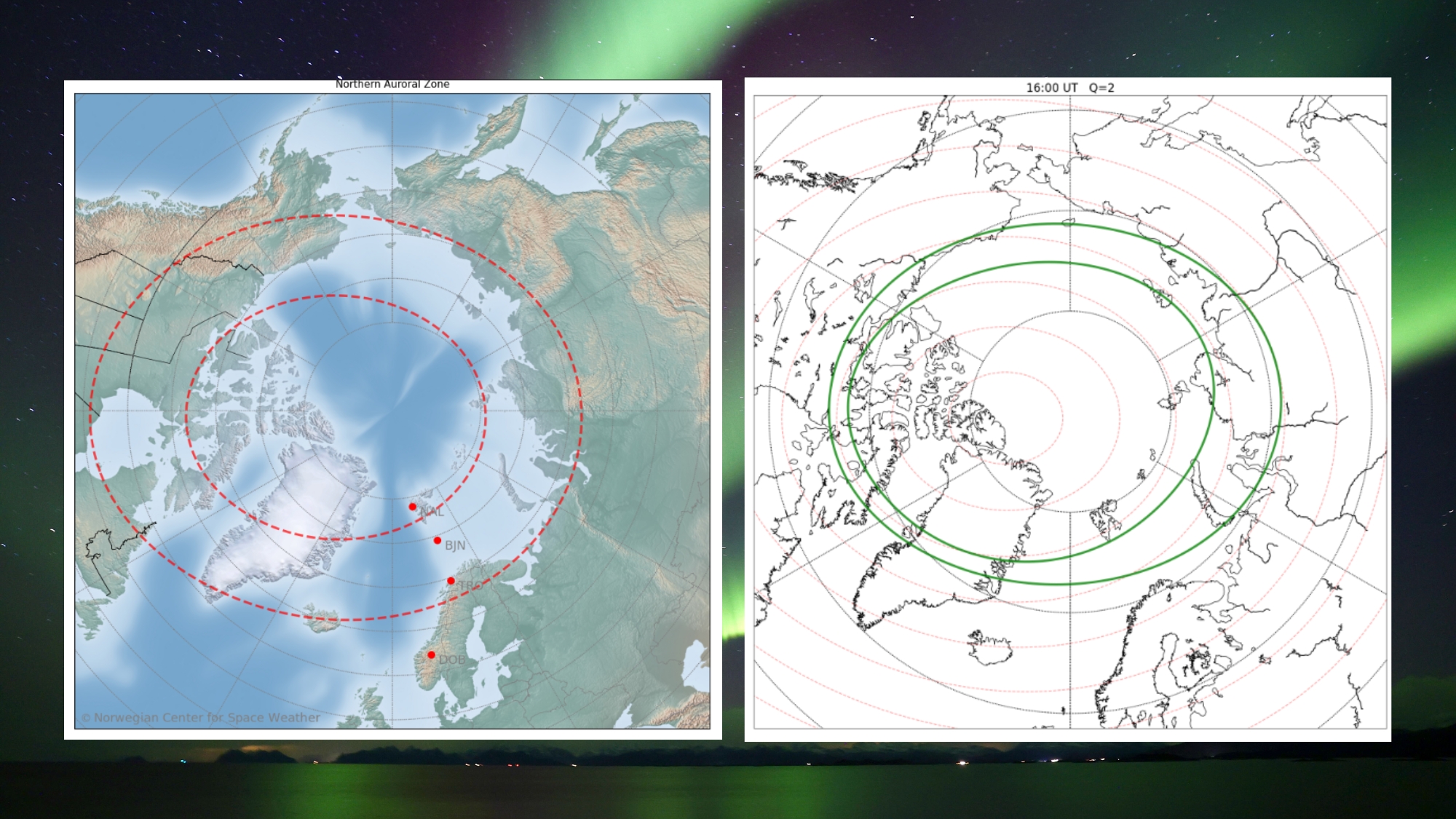
Left: The auroral zone — a geographic band on Earth that passes under the oval. Right: The approximate location of the daytime auroral oval at 1600 UTC (around the time of totality for observers in Greenland and Iceland) showing the instantaneous, ring-shaped region where auroras are most likely to occur at that time. (Image credit: Magnar Gullikstad Johnsen, Background added in Canva Pro by Daisy Dobrijevic)
"The chance for aurora over Spain is very low — that would need a KP=9 or so — and 20:00 [UTC] is still very early so the fattest part of the oval is still not over Spain at that time. So our guess is it will not be very likely," said Brekke.
There is one scenario, however, that could make eclipse day even more extraordinary.
"If the sun launches CMEs in the days before the eclipse, it'll be very exciting for anyone going to Iceland or Greenland, and since the exceptional Perseid Meteor Shower will also peak on that date, there's a rare opportunity to see three of the sky's greatest wonders together if conditions line up," said Kerss.
The odds may be slim, but they're not zero.
If the sun happens to unleash a powerful geomagnetic storm in the days leading up to Aug. 12, eclipse chasers in Greenland or Iceland could witness something truly remarkable.
If not, don't be too disappointed. During totality, the sun itself puts on one of nature's greatest spectacles — and that's where your attention should be.
While totality will be visible from parts of Greenland, Iceland and Spain, millions more people across Europe will experience a dramatic partial solar eclipse. Whether you're chasing the moon's shadow in Reykjavik or watching the moon take a 'bite' out of the sun from London, Paris, or Berlin, timing is everything.
A total solar eclipse occurs when the moon moves in front of the sun and blocks it from view. (Image credit: Paul Souders/Getty Images)
A total solar eclipse occurs when the moon moves directly between Earth and the sun, completely blocking the sun's disk from view.
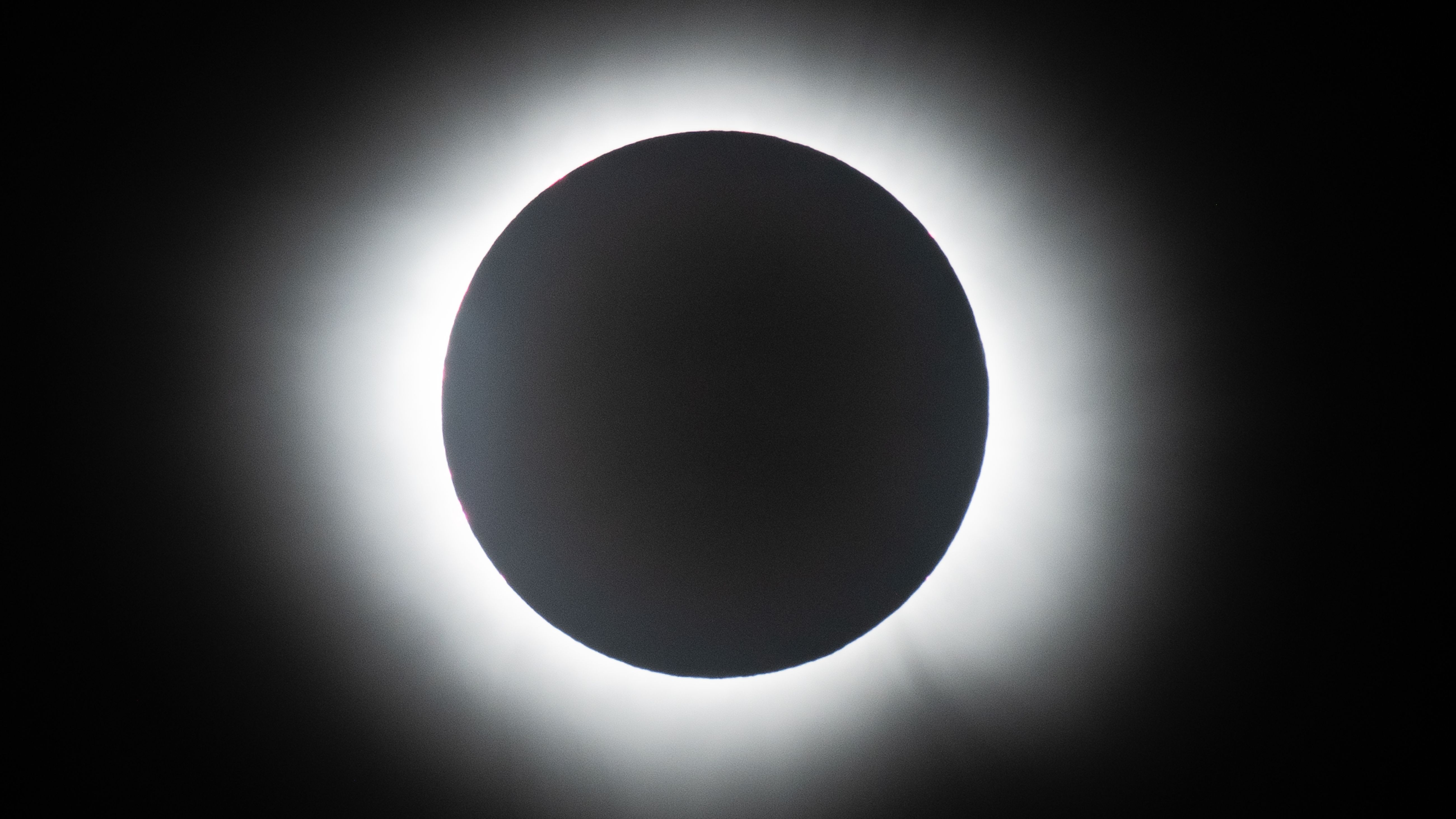
During totality, the sky darkens significantly, temperatures drop and bright stars and planets can even become visible. Observers can also catch a glimpse of the sun's outer atmosphere, known as the corona, glowing around the silhouetted moon.
Totality — when the sun is completely obscured — is only visible within the narrow path of the moon's shadow. Outside that path, observers may see a partial solar eclipse, whereby only a portion of the sun is covered.
REMEMBER to NEVER look directly at the sun. To view this solar eclipse safely, you must use solar filters. Only during the brief period of totality when the moon completely covers the sun, is it safe to look at the sun without protection. Observers will need to wear solar eclipse glasses, and cameras, telescopes and binoculars must have solar filters placed in front of their lenses at all other times.
After the total solar eclipse on Aug. 12, 2026, the next solar eclipse will be an annular solar eclipse on Feb. 6, 2027 visible across parts of Africa and South America. The next total solar eclipse will be a spectacular event on Aug. 2, 2027. Visible across North Africa, it will be the longest totality on land since 1991.
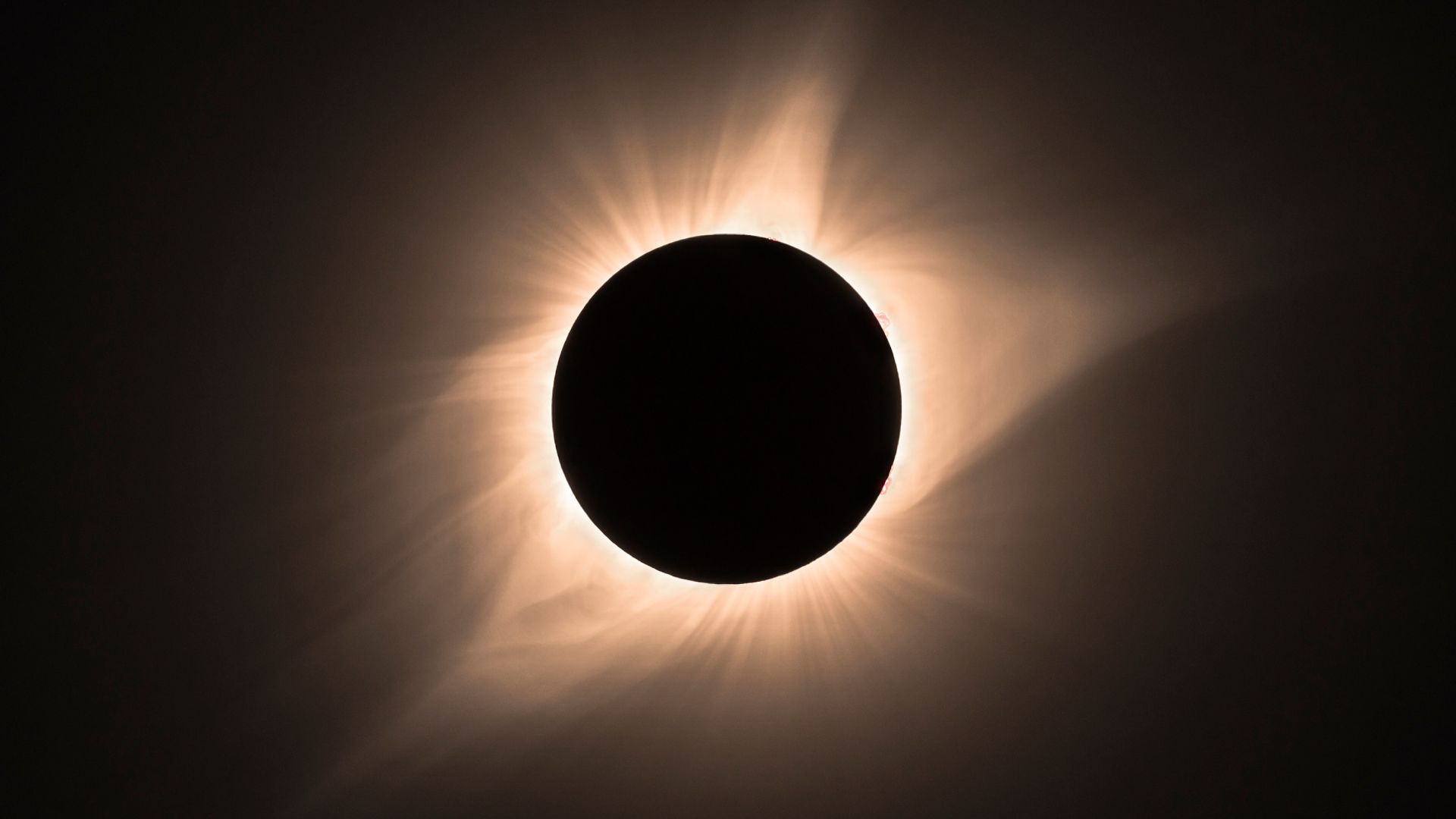
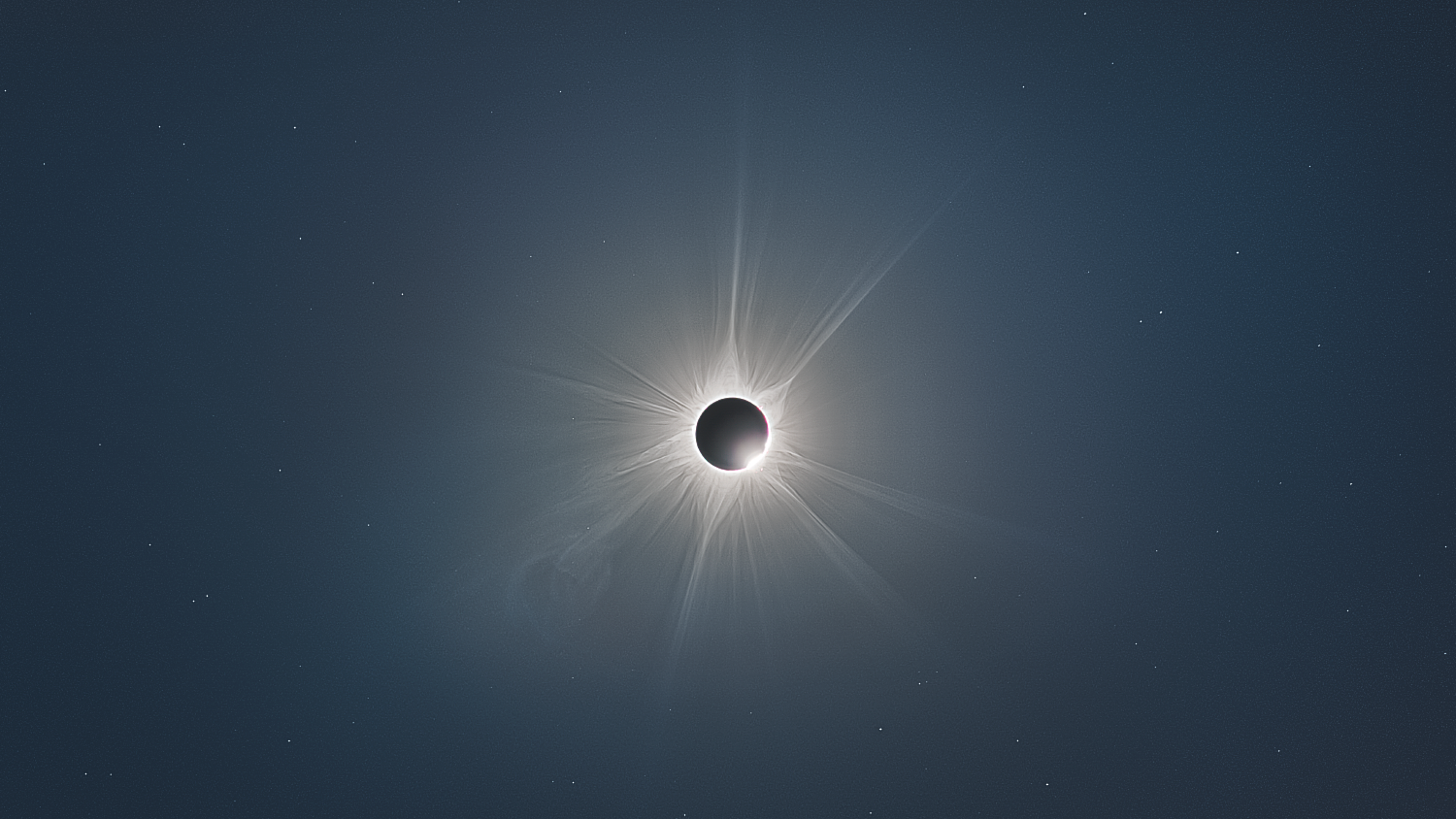
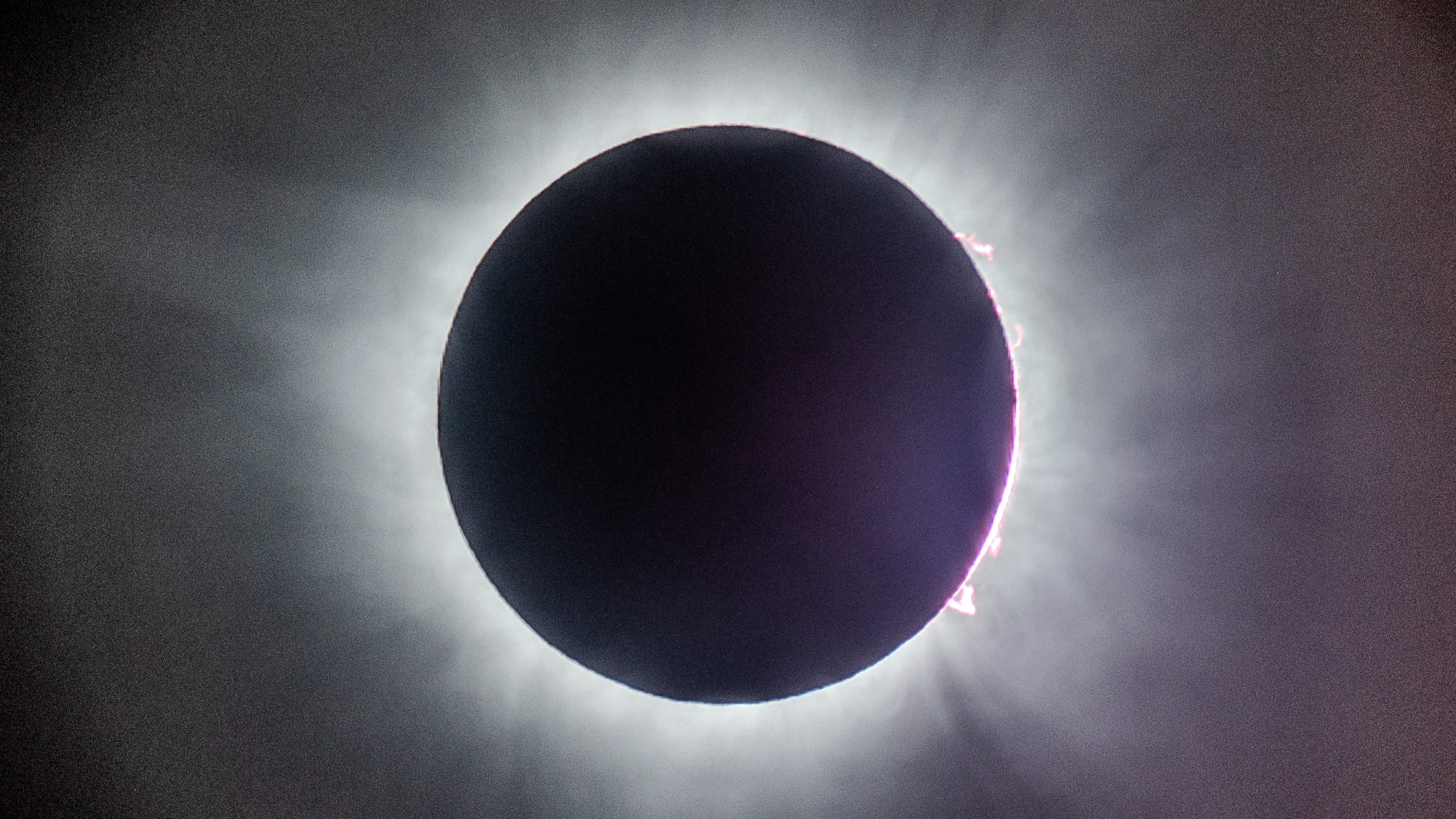
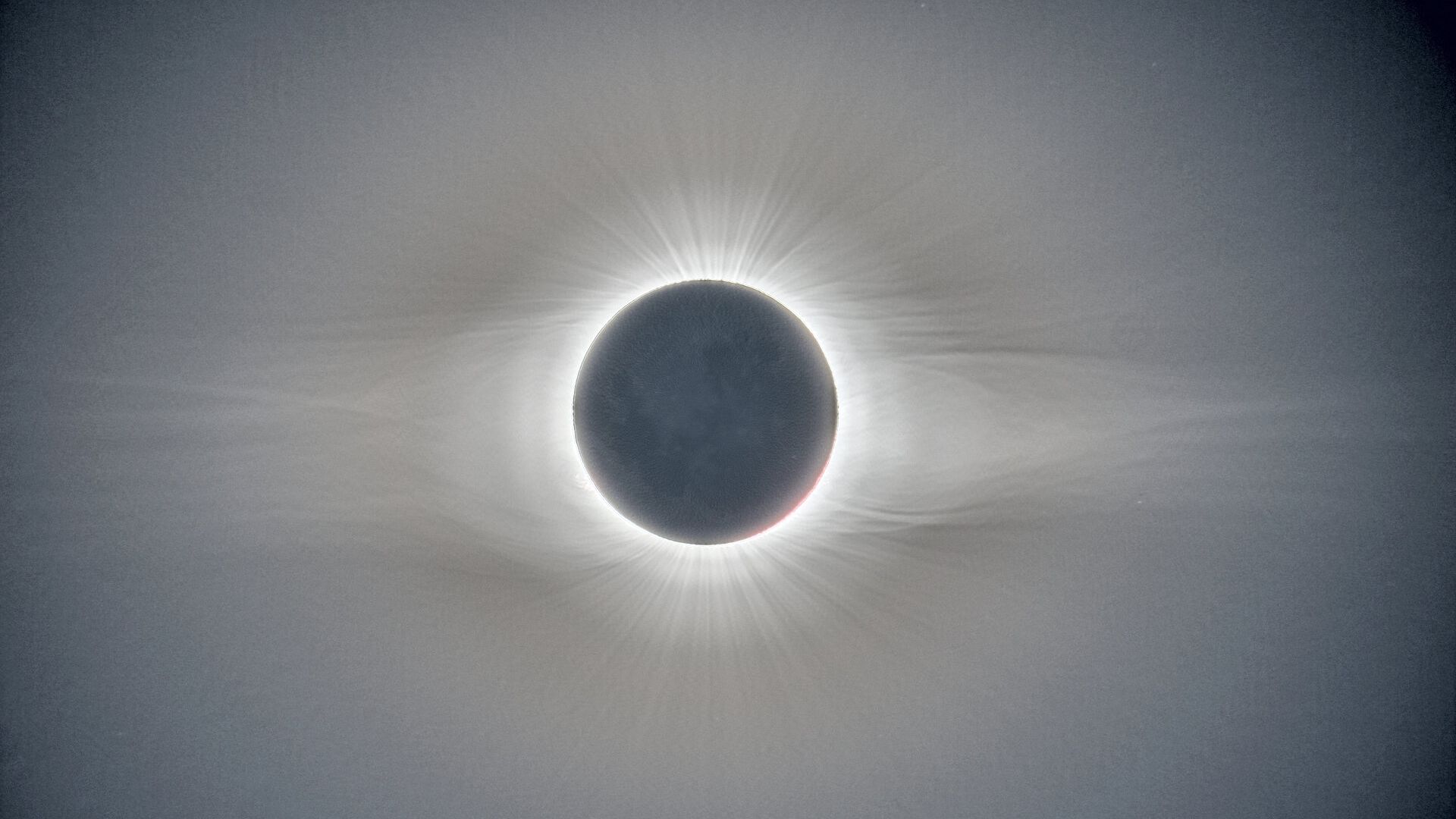
Every total solar eclipse is different. While the silhouette of the moon passing across the sun barely changes, the moment our natural satellite covers the entire solar disk, something spectacular happens — the emergence of the corona. The Latin word for "crown", the solar corona is one of the wonders of nature. To gaze upon its delicate, spiky white tendrils during brief moments of totality is to glimpse the infinite, but it's only a glimpse because the corona is always changing. Shaped by the sun's constantly changing magnetic field, the corona evolves from year to year, month to month and even day to day. No two total eclipses ever reveal exactly the same structure.
It's one reason why eclipse chasers keep traveling. The corona visible during the total solar eclipse of Aug. 12, 2026 — if skies are clear — will be a unique snapshot of the sun at a specific moment in Solar Cycle 25. It will reflect years of changing magnetic activity, thousands of sunspots and countless eruptions of solar material.
Once totality ends, that exact configuration of the corona will never be seen again. Can we know in advance what it might look like?
The sun's hidden atmosphere
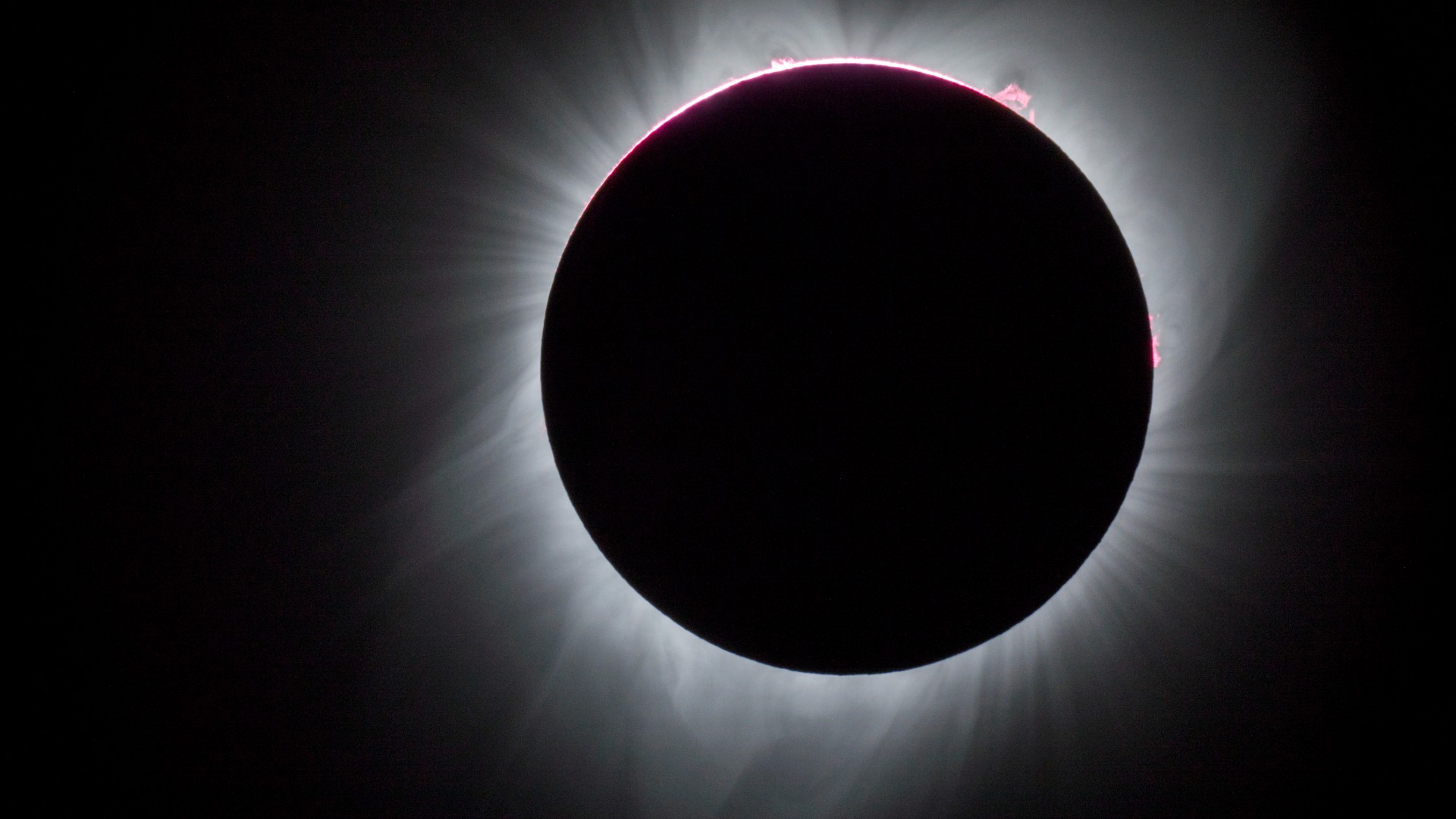
Under normal circumstances, the sun's corona — our star's outer atmosphere — is invisible. It extends millions of miles into the solar system, but it's overwhelmed by the brilliant light of the sun's photosphere, its visible surface. Totality changes that. When the moon completely covers the photosphere, the corona suddenly emerges. White streamers extend away from the black silhouette of the moon. Pink loops and prominences can appear around the edge of the moon.
For many first-time observers, the greatest surprise during totality is not only the detail but the scale. The corona often appears much larger than expected, extending several solar diameters away from the eclipsed sun. Photographs can capture some of that complexity, but they rarely reproduce the impression of depth and structure visible to the human eye, whose dynamic range is vastly superior to any camera.
The corona on Aug. 12, 2026, may resemble the total solar eclipse on April 20, 2023. (Image credit: NASA/ESA (SOHO), P. Horálek/Institute of Physics in Opava; Josef Kujal (of the Astronomy Society of Hradec Kŕlové) and Milan Hlaváč.)
Why every corona looks different
The corona is not a fixed object. It is created by extremely hot plasma — highly energized, ionized gas — that's trapped and sculpted by the sun's magnetic field. Since the sun's magnetic field is constantly changing, the corona changes with it.
"The sun follows a natural 11-year cycle of increasing and decreasing activity," Ryan French, solar physicist, author and science communicator at the Laboratory for Atmospheric and Space Physics (LASP) in Boulder, Colorado, and author of Little Book of Eclipses: An Essential Companion to Solar and Lunar Events told Space.com in an email. "At the peak of this cycle, called solar maximum, there are loads of sunspots on the sun, which are giant magnets nestled in the base of the sun's atmosphere. These sunspots produce a lot of solar flares and coronal mass ejections, which are kind of bursts and eruptions of energy from the sun's atmosphere, and at solar minimum, the sun has none of these things."
That magnetic activity determines the overall shape of the corona. During solar minimum, when the sun has few or no sunspots, the corona tends to look more uniform and more symmetrical. Long streamers often stretch from either side of the sun, giving the corona a wing-like appearance. During solar maximum, it can look much more complex. Sunspot regions act like magnetic anchors, creating structures that can appear as spikes or streamers extending in different directions.
"If you were to see a total eclipse during solar maximum, the solar corona looks almost like a five-pointed cartoon star," said French. "That's because every one of these sunspot regions creates a spire or spike that you can see with the eye."
Not solar maximum — but not quiet
The 2026 eclipse will not occur at solar maximum. Solar Cycle 25 peaked in October 2024, according to NASA and NOAA, with the Aug. 12, 2026 eclipse occurring almost two years later, during the cycle's declining phase. However, solar activity does not collapse immediately after solar maximum. It declines gradually, and the sun is expected to remain more active than it was in the lead-up to solar maximum.
"We're no longer in solar maximum — we're a third of the way past the peak in terms of amplitude and years passed," said French. "The corona will still be far more active than during the 2017, 2019 and 2020 total solar eclipses, but much less so than 2024's."
That makes the 2026 eclipse especially interesting. It likely won't show the full, highly structured corona seen close to the peak of activity in 2024, when the April 8 total solar eclipse occurred with a monthly sunspot number of about 144. Current predictions for August 2026 are closer to 102; far fewer, but still considered active by recent-cycle standards.
That means eclipse-watchers should expect something between extremes: not the clean, flattened corona of solar minimum, but not quite the wildest solar-maximum display either.
The sun's corona is only visible during the totality phase of a total solar eclipse. (Image credit: Getty Images)
A comparison with past eclipses
A useful comparison may be the total solar eclipses near the previous solar maximum. Solar Cycle 24, which peaked in April 2014, was relatively weak. The closest total solar eclipses to that peak were the rare hybrid eclipse of Nov. 3, 2013, when the monthly sunspot number was around 113. By contrast, Solar Cycle 23, which had a double peak — in March 2000 and November 2001 — was relatively strong. The closest total solar eclipse occurred on June 21, 2001, with a monthly sunspot number of around 203. Its corona was likely more complex than expected in 2026.
The 2026 eclipse therefore sits in a middle category. It's not a repeat of 2024, but it's not a quiet-sun eclipse either. An active declining-phase corona, it will likely feature strong streamers extending far into space, but with greater asymmetry, with one side of the corona more active. "It's sunspots specifically near the edge of the sun that dictate what the corona will look like," said French. The sun rotates every 27 days, so any large active region of sunspots rotating onto the sun's edge shortly before Aug. 12 could alter the corona's appearance dramatically. It's why any forecasts of what the corona looks like — which often come from Predictive Science a week before the eclipse — are generally refined on the day of the eclipse.
Red prominences may steal the show
One of the most memorable sights during totality is the appearance of vivid pink or crimson features around the moon's edge. These are usually prominences — immense structures of hydrogen plasma suspended above the sun's surface by magnetic fields. They're often mistaken for solar flares by beginners, such as after the 2024 total solar eclipse.
"Prominences are large magnetic structures that suspend plasma in the atmosphere of the sun, and they glow very bright in a very specific wavelength of light called hydrogen alpha," said French. Prominences are more likely when the sun is active, and because they can last for days or weeks, they are easier to anticipate than a flare. In hydrogen-alpha images taken before eclipse day, observers may be able to see which prominences are present around the solar edge.
The 2026 eclipse may have favorable geometry for sighting prominences. Because the moon will appear only slightly larger than the sun — which contributed to the relatively short duration of totality, at a maximum of just 2 minutes 18 seconds — smaller prominences on different sides of the sun could be visible at the same time. That is different from longer eclipses, where the larger apparent moon can cover prominences on one side before revealing others on the opposite side.
Could a CME be visible?
A coronal mass ejection (CME) is an eruption of plasma and magnetic field from the sun's atmosphere. Seeing one during totality is possible — it happened during the total solar eclipse on Dec. 14, 2020 — but requires luck. "CMEs travel very slowly, so they take several hours to traverse and escape from the sun's atmosphere, so you wouldn't see any motion during an eclipse," said French. "But what you could see, if you're lucky, is a snapshot of an eruption — though maybe a long exposure camera will be more likely to see this than your eye would." Such a view would be rare, but the chances are higher in an active solar environment than near solar minimum.
The 2019 total solar eclipse on July 2, 2019, just before the last solar minimum in December 2019. (Image credit: ESA/CESAR/Observatorio Astrofisico di Torino)
Predicting the corona yourself
There will be a forecast from Predictive Science, which can be so accurate that some eclipse chasers avoid it, so as not to ruin the surprise of totality. One way to get a general idea is to look at real-time images from telescopes that use coronagraphs to block the sun, such as the COSMO K-Coronagraph, NASA SOHO's LASCO C3 and the GOES CCOR-1. For sunspots, check the latest H-Alpha image from the Global Oscillation Network Group (GONG).
No scientist can say exactly what the corona will look like on Aug. 12, 2026. That will depend on the sun's magnetic activity in the days immediately before totality, the location of sunspot groups, the presence of prominences and the possibility of eruptions. "What exactly we see during the August eclipse will depend on what the activity is that week," said French. "And even if you saw an eclipse a month before or a month after, it could be very different." For a few fleeting minutes over Greenland, Iceland, Spain and the Balearic Islands, the sun's hidden atmosphere will become momentarily visible before vanishing back into the glare, never being seen again in quite the same way.
We're just a few short days away from the Aug. 12 total solar eclipse, when millions will watch as the moon glides across the face of the sun, hiding its light in a wondrous display of orbital mechanics.
The eclipse will unfold during August's new moon phase, as the lunar disk slips silently between the sun and Earth in the daytime sky. Ordinarily, the subtle tilt in the moon's orbit causes its shadow to pass just below, or above our planet, missing it entirely.
However, on Aug. 12, the moon's orbit will carry it into a near-perfect alignment with the sun and Earth, casting its colossal shadow across a 182-mile-wide corridor known as the path of totality, where viewers will get to see the lunar disk fully hide the sun's disk.
The path of totality for the Aug. 12 eclipse cuts through Spain, Iceland and Greenland. Hundreds of millions more watching from outside of this narrow corridor will also bear witness to a spectacular partial solar eclipse, as the moon passes in front of our parent star, without fully obscuring its surface. Those unable to watch the eclipse in person by dint of geography can also follow along online, with details of the livestream to be released closer to the event.
Read on to discover what will happen during each stage of the Aug. 12 total solar eclipse.
Stage 1: The partial eclipse begins
The partial phase of the eclipse officially begins at the moment of "first contact", when the lunar disk takes its first nibble out of the sun — a subtle transformation that will first become visible in the skies over the U.S. state of Alaska at 11:34 a.m. EDT (1534 GMT) on Aug. 12.
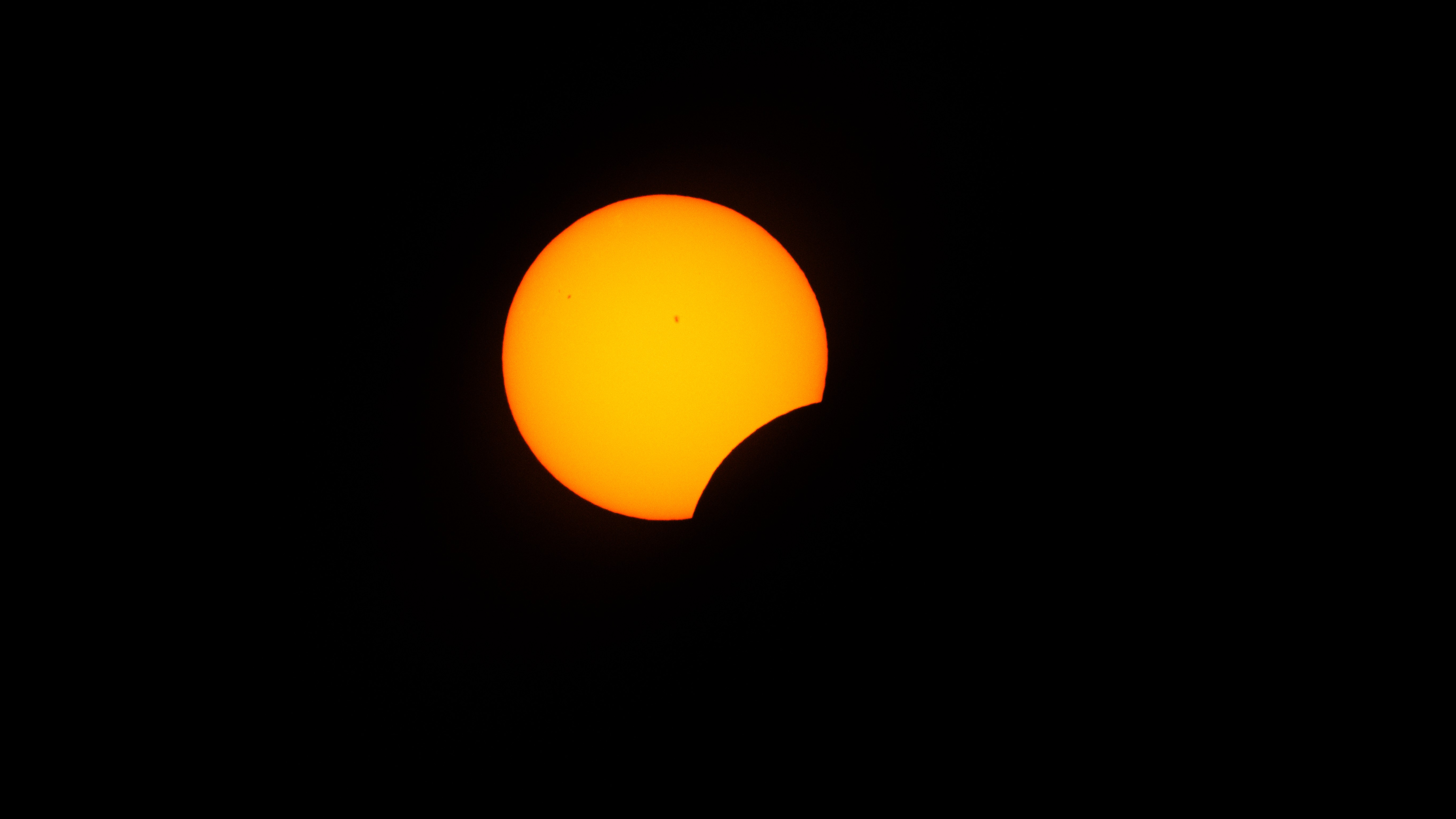
The moon takes its first "bite" out of the sun during the partial phase of a solar eclipse. (Image credit: Photo by Noam Galai/Getty Images)
You can check out exactly when the partial eclipse will begin from your location and find out exactly how much of the sun will be hidden by the moon using Time and Date's interactive eclipse tracker.
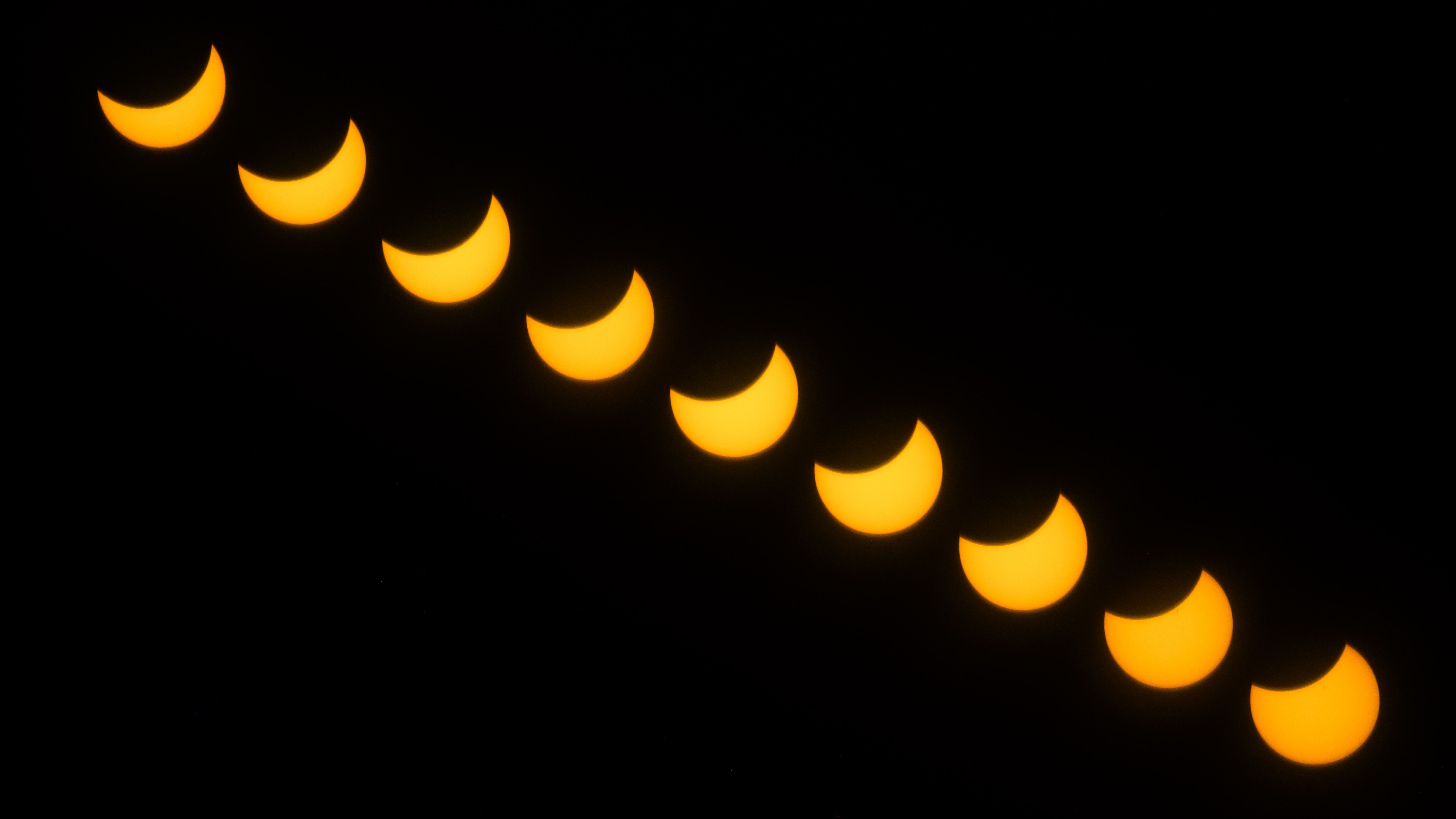
The hour and a half following first contact will see the moon sink ever farther into the sun's disk for those in the path of totality, transforming it from a burning orb into a magnificent shining crescent.
The and moon meet in the skies over Mexico during the 2024 total solar eclipse. (Image credit: Photo by: Edwin Remsberg/VWPics/Universal Images Group via Getty Images)
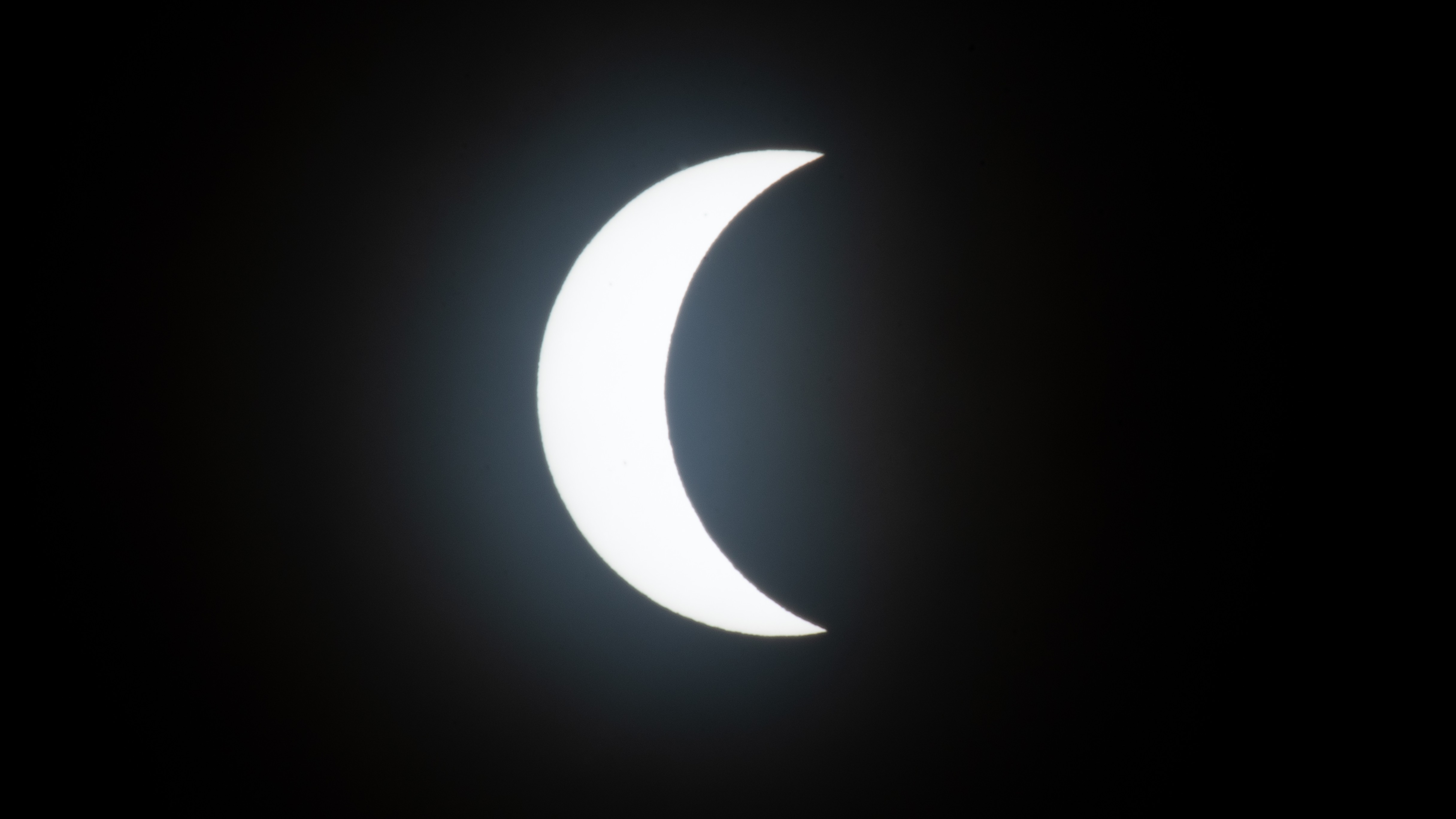
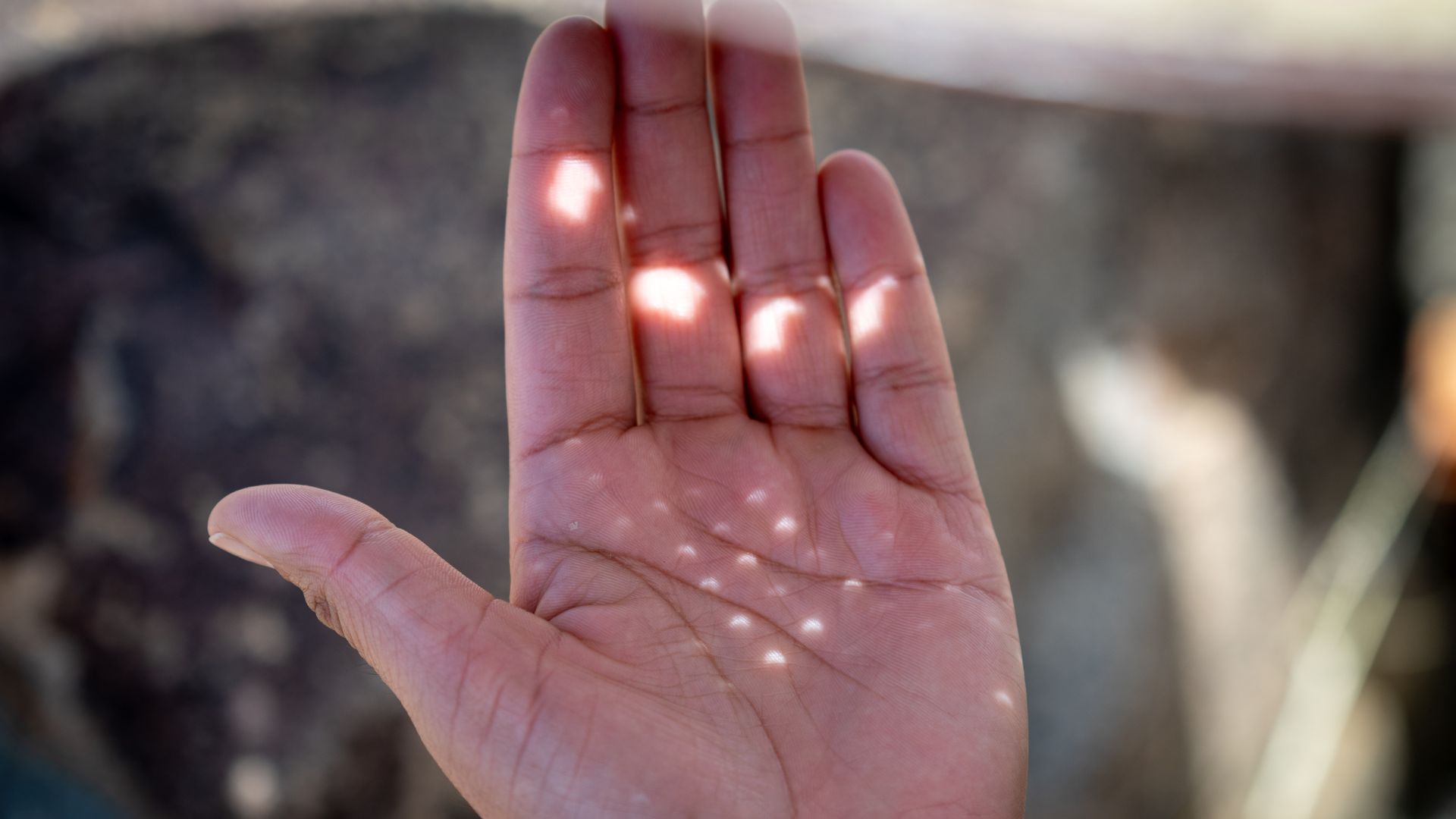
You may notice the temperature drop noticeably, accompanied by a subtle darkening of the sky in the half hour preceding the climactic phase of totality, as the moon reduces the sun to a thin sickle in the evening sky. Pinpricks of light — such as those that shine through a colander, or the gaps in a leaf — will also appear to mirror the scene above, creating a kaleidoscope of tiny bright crescents.
Pinpricks of light create tiny crescents during a solar eclipse. (Image credit: Photo by: Edwin Remsberg/VWPics/Universal Images Group via Getty Images)
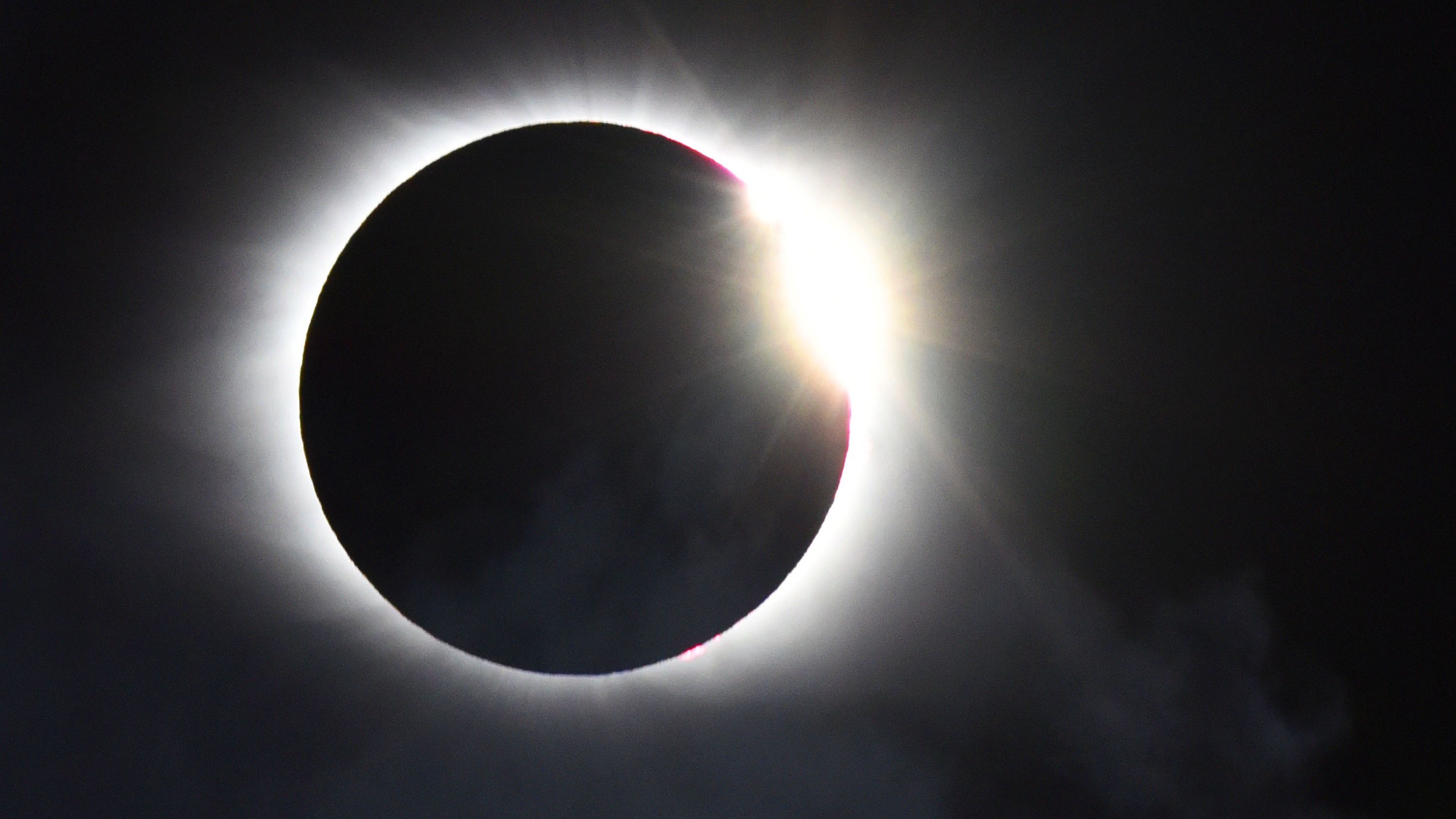
Some of the most spectacular moments of an eclipse occur just before and after totality. First, look out for the "diamond ring" effect, as the last sliver of the sun peeks out from behind the lunar disk to appear as a gorgeous celestial jewel, while the outermost layer of our star's atmosphere, the corona, creates a glowing halo around the moon.
The diamond ring effect shines from behind (Image credit: Photo by Chris McKay/WireImage)
Tear your eyes away from the sun for just a second and you may just catch sight of the moon's shadow advancing on you from the west, before it engulfs your surroundings in a false night.
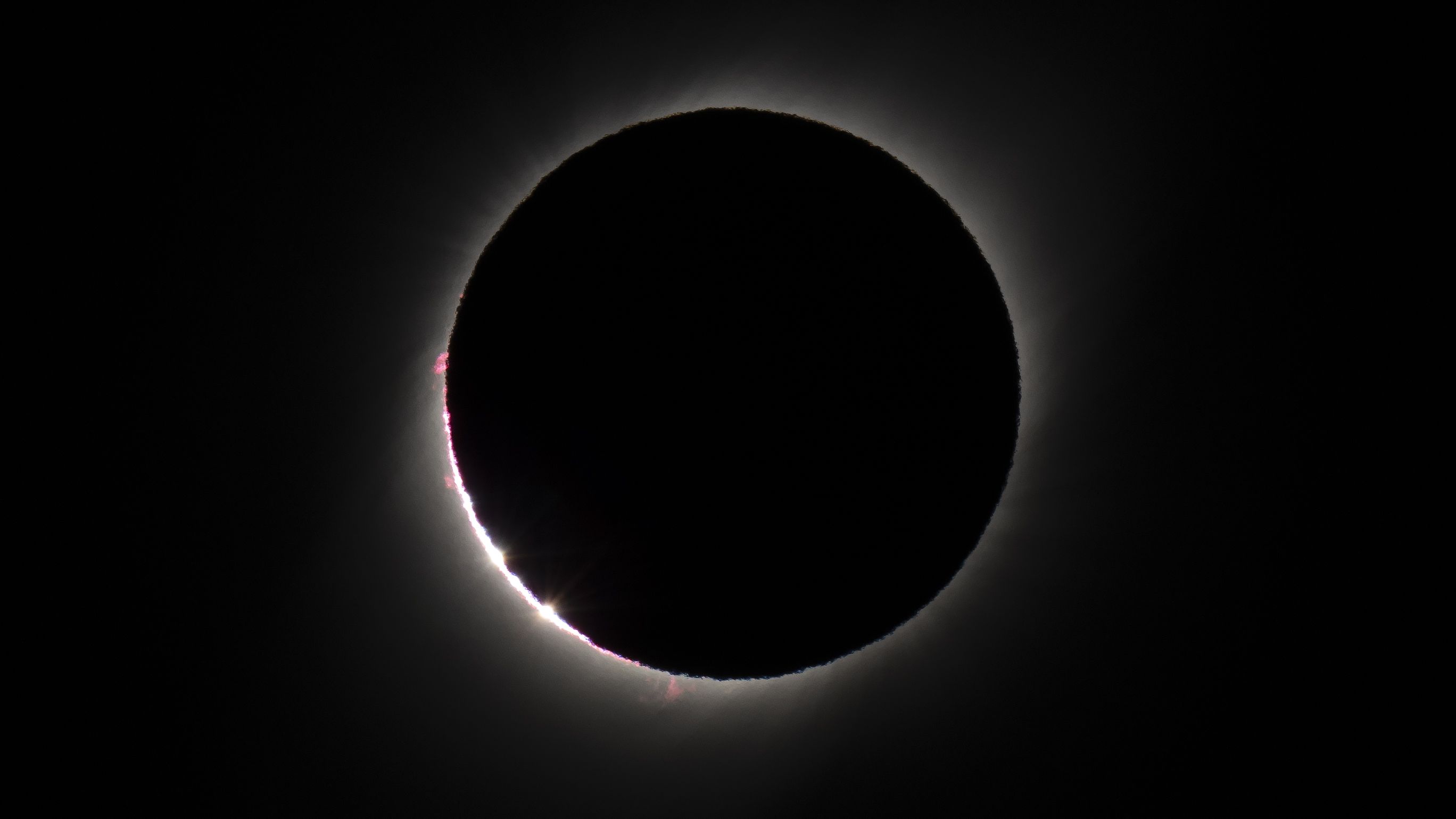
Baily's beads appear in the moments before totality. (Image credit: STAN HONDA/AFP via Getty Images)
The final seconds before totality will see bright "Baily's Beads" form dazzling points of light on the moon's edge, where the last shreds of the sun's disk shine through the ravines and valleys that scar the ancient lunar surface.
Stage 3: Totality & maximum eclipse
As the last of the sun's surface slips behind the moon, totality begins. This is the climactic phase of the eclipse, when the moon acts like a natural coronagraph to block the brilliance of the sun's disk, ushering in a false night in which our star's outer atmosphere can be seen leaping out from the lunar silhouette.
Totality will last a maximum of 2 minutes, 18 seconds, during which time it's safe to remove your glasses and look at the sun. Just be sure to put them on again before its fiery disk reemerges from the other side of the lunar disk.
The sun's corona haloes the moon at the climax of a total solar eclipse. (Image credit: Photo by: Edwin Remsberg/VWPics/Universal Images Group via Getty Images)
That white halo surrounding Earth's natural satellite is the sun's corona — a jacket of superheated gas that surrounds our parent star. Look out for glowing solar prominences leaping outward through the sun's atmosphere, along with the red line of the chromosphere — the layer of the sun's atmosphere beneath the corona — which appears fleetingly at the beginning and end of totality, according to NASA.
The point of maximum eclipse occurs roughly halfway through totality, when the sun's disk is most hidden by the moon.
Eagle-eyed skywatchers may catch Jupiter and Mercury shining to the lower right of the eclipsed sun in the faux twilight experienced during totality, while Venus will appear as a bright star-like object to its upper left. If you're incredibly lucky, you could even spot one of the brightest shooting stars or fireballs of the Perseid meteor shower, which comes to a peak around the same time as the Aug. 12 total eclipse.
Stage 4:Totality ends
The fourth stage of the eclipse comes as the very edge of the sun's disk emerges from behind the moon, marking the end of totality as Bail's Beads and the diamond ring effect play out in reverse, before giving way to an ever-thickening solar crescent.
Stage 5: The partial eclipse ends.
The waning partial eclipse will come to a global end at 3:57 p.m. EDT (1957 GMT), as the moon's silhouette exits the sun's disk in the skies off the west coast of Africa — a moment known to astronomers as fourth contact.
The moon exits the solar disk at the end of a total solar eclipse. (Image credit: Getty Images)
Space.com is on hand to provide expert coverage and on the ground reporting as the eclipse unfolds. Skywatching Editor Daisy Dobrijevic is undertaking an expedition with HX to observe the total solar eclipse from the waters around Greenland, while Skywatching Writer Anthony Wood heads to Spain in a cowboy hat, to catch the orbital showdown with citizen scientists from NASA's Dynamic Eclipse Broadcast Initiative.
Be sure to check out our total eclipse live blog to stay up to date with all the latest news, along with our handy explainer article detailing everything you need to know about the Aug. 12 total solar eclipse.
Editor's Note: If you capture footage of the Aug. 12 total solar eclipse and want to share it with Space.com's readers, then please send your photo(s), comments, name and location to spacephotos@space.com.
Early risers will catch a spectacular sight in the predawn hours of Aug. 9, as the slender crescent moon shines close to the red light of Mars among the stars of the constellation Taurus.
The 17%-lit crescent moon will rise around four hours before sunrise, or shortly after 2 a.m. for viewers in New York. The Red Planet will be visible as a steady crimson light less than 5 degrees to the lower right of the moon — close enough to share the field of view of a pair of 10x50 binoculars.
Both Mars and the moon will appear to race one another over the eastern horizon in the hours that follow, with the Red Planet gaining a slight lead over its competitor as dawn breaks.
The stars of the constellation Orion will glitter to the right of the pair throughout the race, while the Bull of Taurus watches on from above and Gemini watches from below, giving us a sneak peak at the starscape that will shine high overhead in the long winter nights a few months from now.
Celestron UpClose G2 10x50
(Image credit: Celestron)
Want to get a closer look at the moon? For around $50 you can grab these beginner binoculars for better views of craters and seas on the lunar surface. 10x is enough for a closer look without worrying about excessive shakes during handheld observation.
Look out for the subtle glow of earthshine illuminating the night side of the moon on Aug. 9, as sunlight scattered off our planet's surface and atmosphere reflects onto the nearby lunar disk, revealing the ghostly outlines of its dark lunar seas.
It's one of the last chances we'll get to gaze at Earth's satellite ahead of its new moon phase on Aug. 12, when it will cross the face of the sun in the daytime sky to trigger a spectacular total solar eclipse, which will be visible across parts of Greenland, Iceland and Spain.
Editor's Note: If you would like to share your astrophotography with Space.com's readers, then please send your photo(s), comments, and your name and location to spacephotos@space.com.
It's hardly a "Great American Eclipse," but on Aug. 12, 2026, some parts of the North American continent will see a partial solar eclipse.
Will it be as impressive as on April 8, 2024, when totality visited Mexico, 15 U.S. states and six provinces in Canada? No, yet in some parts of the U.S. and Canada, astronomers will be out in force to capture a significant chunk of the sun as it is obscured by the new moon.
The spotlight may be on the total solar eclipse in Greenland, Iceland, and Spain, but millions across North America can still see the moon take a bite out of the sun on Aug. 12. The farther northeast you are, the deeper the eclipse. Here's everything you need to know about the partial solar eclipse in North America.
Where to see the partial solar eclipse in the U.S.
Between 7:34 a.m. AKDT and 2:52 p.m. EDT, 20 U.S. states will see something of the partial solar eclipse, though only northeastern states will get a good view. Here's a sample of locations and the time of maximum eclipse. Note that the partial eclipse begins (first contact) and ends (last contact) around 55 minutes before and after the time of maximum eclipse given here.
Location
Maximum eclipse
Time (local)
Fairbanks, Alaska
37%
8:27 a.m. AKDT
Presque Isle, Maine
28%
1:50 p.m. EDT
Bangor, Maine
23%
1:53 p.m. EDT
Portland, Maine
19%
1:53 p.m. EDT
Montpelier, Vermont
17%
1:49 p.m. EDT
Manchester, New Hampshire
16%
1:53 p.m. EDT
Boston, Massachusetts
16%
1:55 p.m. EDT
Providence, Rhode Island
15%
1:55 p.m. EDT
Springfield, Massachusetts
14%
1:53 p.m. EDT
New Haven, Connecticut
12%
1:54 p.m. EDT
Bridgeport, Connecticut
11%
1:54 p.m. EDT
New York City, New York
10%
1:54 p.m. EDT
Newark, New Jersey
9%
1:53 p.m. EDT
Rochester, New York
9%
1:43 p.m. EDT
Allentown, Pennsylvania
8%
1:52 p.m. EDT
Buffalo, New York
7%
1:42 p.m. EDT
Philadelphia, Pennsylvania
7%
1:53 p.m. EDT
From most of the northeast U.S., only a small eclipse will be visible on Aug. 12, 2026. (Image credit: imageBROKER/Lucas Seebacher via Getty Images)
Where to see the partial solar eclipse in Canada
Between 8:38 a.m. MST and 4:38 p.m. NDT on Aug. 12, every province in Canada will be able to see some kind of partial solar eclipse, but those in the east of the country will see something much more significant. Here's a sample of locations and the time of maximum eclipse. Note that the partial eclipse begins (first contact) and ends (last contact) around 55 minutes before and after the time of maximum eclipse given here.
Location
Maximum eclipse
Time (local)
Iqaluit, Nunavut
61%
1:24 p.m. EDT
St. John's, Newfoundland and Labrador
53%
3:34 p.m. NDT
Moncton, New Brunswick
32%
2:55 p.m. ADT
Halifax, Nova Scotia
31%
3:00 p.m. ADT
Churchill, Manitoba
27%
12:02 p.m. CDT
Quebec City, Quebec
24%
1:46 p.m. EDT
Whitehorse, Yukon
23%
9:26 a.m. MST
Trois-Rivières, Quebec
21%
1:45 p.m. EDT
Sherbrooke, Quebec
20%
1:48 p.m. EDT
Montreal, Quebec
18%
1:45 p.m. EDT
Ottawa, Ontario
15%
1:42 p.m. EDT
Kingston, Ontario
12%
1:43 p.m. EDT
Toronto, Ontario
8%
1:40 p.m. EDT
St. Catharines—Niagara, Ontario
8%
1:41 p.m. EDT
Kitchener, Ontario
7%
1:38 p.m. EDT
Hamilton, Ontario
7%
1:40 p.m. EDT
London, Ontario
5%
1:38 p.m. EDT
Windsor, Ontario
3%
1:36 p.m. EDT
What to expect
This is a small partial solar eclipse in North America, which occurs at lunchtime. In the east of the continent, it will occur high in the sky — about two-thirds of the way between the horizon and the zenith — in the south-southwest. At maximum eclipse, the partially eclipsed sun with resemble a thick crescent or a smile. It won't get dark — that only happens within the path of totality — nor will daylight be affected.
Those using a telescope to observe or image the partial eclipse (using a solar filter) should also consider that Venus — which will be visible just after sunset — reaches dichotomy on Aug. 12. This is the point in its current apparition as the "Evening Star" that it starts becoming interesting in a telescope. Dichotomy sees it reduce to 50%-lit and gradually become an ever-shrinking crescent.
Perhaps more importantly, the early hours of Aug. 13 see the peak of the annual Perseid meteor shower.
When is the next solar eclipse visible from the US after August 2026?
The next solar eclipse on Aug. 2, 2027, will be seen in Newfoundland, Canada, where a 23% partial eclipse will occur at the province's southwestern tip.
On Jan. 26, 2028, during an annular solar eclipse across northern South America, eastern U.S. states and eastern Canada will see a very small partial solar eclipse shortly after sunrise. Florida will have the best view, with around 15% of the sun blocked.
On Jan. 14, 2029, a large partial solar eclipse will be seen in the morning sky across all of North America — up to 81% in northern Canada and 74% in northwestern U.S. states. On June 12, 2029, a smaller partial solar eclipse will peak at 34% just after sunrise from Nunavut, the Northwest Territories and the northern tips of Alberta and British Columbia.
Power: 8x AA batteries (not supplied)/external 12V DC via adaptor panel
Mount head weight: 2.9 lbs/1.3kg
Total weight with optional tripod: 8.8 lbs/4.05kg
Tripod: 31.7-59.8 inches/80.5-152cm adjustable aluminum tripod with accessory tray, bubble level and 3/8-inch screw fitting
Finding the sun sounds easy, right? Many people think of the sun as big and bright, but it’s actually rather small in the sky — it’s got an angular diameter of just half a degree, in fact, the same as the moon. Put an all-important solar filter on a telescope, and you’re left with the challenge of finding a tiny orange or white circle in a sea of black. Even if you manage to find the sun, nudging a solar telescope back into position every few minutes to keep it in the field of view quickly gets irritating.
Dual-axis alt-az tracking keeps the sun in view during observing sessions. (Image credit: Jamie Carter)
Cue the Sky-Watcher SolarQuest mount, a simple grab-and-go product that exists to solve exactly that problem. Costing around $585/£259-£359 (the latter with a tripod), it is not a general Go-To astronomy mount and it is not trying to be one. It is best understood as a dedicated solar tracking platform for small solar telescopes. That could range from regular telescopes wearing solar filters, most likely during a solar eclipse, to dedicated solar telescopes such as white-light-filtered refractors and H-alpha (Hydrogen-alpha) telescopes designed specifically for viewing the sun.
Sky-Watcher SolarQuest mount head: Design
Its 8.8-lb payload suits compact white-light and H-alpha solar scopes. (Image credit: Jamie Carter)
Lightweight and compact mount head
Simple controls make it beginner-friendly
Vixen-style saddle suits small solar scopes
The SolarQuest mount head weighs just 2.9 lbs/1.3 kg, accepts standard 45mm Sky-Watcher/Vixen-style dovetails and can be fitted to a tripod using a 3/8-inch screw. Meanwhile, the optional tripod is lightweight and easily adjustable, with a bubble level and accessory tray. Whatever tripod you use, it’s imperative to get it stable before using the SolarQuest because its ability to track the sun successfully depends on it.
The Sky-Watcher SolarQuest comes with an optional sturdy tripod.Jamie CarterThe tripod comes with a handy accessory tray.Jamie CarterThe optional tripod includes grippers to keep the rig steady.Jamie Carter
With the optional aluminum tripod — which we used in our review — the total setup is still only around 9.9 lbs/4.05 kg, making it easy to set up inside and carry into the garden. Eclipse chasers travelling abroad will easily be able to store it in a carry-on camera bag.
HelioFind technology makes solar alignment fast and beginner-friendly. Jamie CarterA Vixen-style saddle accepts many small solar telescopes and spotting scopes. Jamie Carter
The mount itself has very few controls: A power button and an 8-way sliding switch. A long press of the power button finds the sun, with the second used to make manual adjustments. There are no menus and no alignment tasks.
Sky-Watcher SolarQuest mount head: Performance
Its job is simple: Find the sun and keep it centered. (Image credit: Jamie Carter)
Finds the sun automatically in clear conditions
Fine-tuning controls keep the sun centered
Works well with solar telescopes
At first glance, the promise of the Sky-Watcher SolarQuest mount head is so simple: you level the tripod using its built-in bubble or spirit level and point the attached telescope somewhere to the left of the sun. You then long-press the power button and step back. The built-in GPS calculates the date, time, and location, as well as the sun’s altitude and azimuth. The mount levels the telescope, pauses, then slews to the right altitude. Then its photodiode solar sensor (a small camera) hunts for the solar disc and locks on. In practice, the system gets impressively close to that ideal — but with some small caveats.
A colorized image of the sun taken with a ZWO planetary camera on an H-Alpha telescope mounted on the SolarQuest. (Image credit: Jamie Carter)
The sun needs to be in a clear sky, but it doesn’t have to be high. We reviewed the SolarQuest during a summer heatwave, when getting up very early was the only sensible way to observe the sun. Having got up early to take advantage of the cool morning air before the sun rose too high, we feared the SolarQuest would fail to find such a low sun. Luckily, there were no such issues, with SolarQuest taking just under 60 seconds to be perfectly aligned with the sun.
The solar sensor uses four photodiodes to lock onto the sun. (Image credit: Jamie Carter)
For visual observing, that’s transformative. Instead of spending the first part of a session aligning, shadow-aiming and nudging a scope into position, you can be looking at the sun within minutes. However, we did have to use the joypad on the SolarQuest to center the sun. Happily, the controls are very sensitive and move slowly, so we were able to have a perfect view of the sun in under two minutes from pressing the power-on button. That’s impressive.
Sky-Watcher SolarQuest mount head: Functionality
Built-in GPS calculates the sun’s position automatically. (Image credit: Jamie Carter)
Accurately tracks the sun
8x AA batteries are old-fashioned
Payload is a limiting factor
Tracking accuracy is very good, with a tiny adjustment on the joypad required perhaps every few hours. Since it largely follows the sun’s path through the sky, it should be suitable for a total or deep partial solar eclipse, when a crescent sun could confuse the sensor (to be sure, you could cover the sensor during totality so it doesn’t hunt for the sun and try to realign during an eclipsed crescent sun).
However accurate it is, this is an alt-az mount. It can track the sun well but it cannot remove field rotation during much longer imaging sessions. For visual use and almost all solar use — including casual video capture — that is not a major issue. However, for long-duration solar imaging and creating time-lapses, it’s a limitation to keep in mind.
The battery compartment takes eight AA batteries, though external power is available. (Image credit: Jamie Carter)
One practical complaint is the battery compartment. Pop open the door (which detaches and becomes easily lost) and inside is a small plastic cradle that takes eight AA batteries. As if needing to take a trip to a store before being able to use the SolarQuest wasn’t annoying enough, it occurred to me that if I was going to an eclipse, I would need to travel with at least eight more AA batteries as spares — and possibly another 16x for true peace of mind. Not a pleasant prospect. Should any gadget like this be AA battery-powered in the age of Lithium-ion and USB-C? A resounding no. The box includes a 12V DC connection but there’s no cable. It all seems poorly thought through and old-fashioned.
The mount head weighs just 2.9 lbs, making it easy to carry outside. (Image credit: Jamie Carter)
However, the main practical limitation of the SolarQuest is its 8.8 lbs (4 kg) payload, which sets it apart as an accessory for small solar telescopes. At its best when speed and simplicity matter, SolarQuest is a travel-friendly mount ideal for beginners and eclipse chasers seeking to remove a common frustration from solar observing — finding and tracking the sun — without adding complexity. It almost totally succeeds.
How we tested the Sky-Watcher SolarQuest mount head
We tested the Sky-Watcher SolarQuest mount with the Sky-Watcher Heliostar 76mm H-alpha solar telescope. (Image credit: Jamier Carter)
We tried the SolarQuest for about two weeks with both a Celestron Regal M2 spotting scope (with a solar filter attached) for white-light observations of the solar disk and a Skywatcher HelioStar 76mm solar telescope. The latter was used to get some images of the sun in H-Alpha (Hα), in conjunction with a ZWO ASI174MM planetary camera.
Should I buy the Sky-Watcher SolarQuest mount head?
Buy it if:
✅ You want to get into casual backyard solar observing: The SolarQuest mount is great for those who have a small solar telescope or a regular telescope with a solar filter and want to start observing the sun more.
✅ You want fast, automatic solar finding and tracking: The SolarQuest mount makes solar observation super easy and super quick so finding the sun isn't a chore and allows you to focus on observation.
Don't buy it if:
❌You want a mount for nighttime astronomy as well: It has one job, to find the sun, and doesn't work for finding any targets in the dark night sky.
❌You don’t want to travel with lots of spare AA batteries: The mount is powered by eight AA batteries and if you are carrying spares, this means a lot of extra weight to carry around when travelling to observation locations.
If you need something to support a solar or solar-filtered telescope under 8.8 lbs/4kg, the SolarQuest should be on your radar. It quickly finds the sun and tracks accurately, removing the need for manual alignment. It’s also really compact, operates quietly and has very simple controls.
The included instructions are poor, the way it’s battery-powered is far from ideal, and it’s limited by its payload capacity, but it’s so easy to use and quick to work that it’s hard to criticize the SolarQuest too harshly — it’s a slick and simple accessory.
If the Sky-Watcher SolarQuest mount head isn’t for you
There are very few dedicated solar trackers like the Sky-Watcher SolarQuest. However, some star trackers do have a mode where you can choose the sun as the star to track, including the Benro Polaris. Once you’ve entered the sun in the frame using the virtual joystick, the Polaris can automatically track it. Another alternative is an equatorial mount, which, when well aligned, can handle solar observing for longer periods and/or for making time-lapse sequences.

 Login