❌

Normal view

The moon will hide Jupiter in broad daylight today β€” here's how to see it

7 September 2026 at 17:00

Today (Sept. 8), skywatchers can first catch a striking predawn pairing of the crescent moon and Jupiter, then β€” where conditions and location allow β€” attempt the much harder daytime occultation, when the moon hides the planet from view.

Before sunrise: Find the moon and Jupiter

Set your alarm for 5 a.m. local time on Tuesday and look low toward the east-northeast sky. Check in advance for tall obstructions that could block your view of this delicate predawn tableau. A slender waning crescent moon β€” just under 10% illuminated and resembling a "celestial smile" β€” will be immediately apparent. About 5 degrees below it, roughly half the width of your clenched fist held at arm's length, will be brilliant Jupiter.

Jupiter rises in the east-northeast shortly before 4 a.m. local daylight time, but it does not climb fairly high until just before dawn's first light. The planet is in the dim zodiacal constellation Cancer; one of my astronomy mentors at New York's Hayden Planetarium, Dr. Ken Franklin, used to call Cancer "the empty space between the Sickle of Leo and the Gemini Twins." If you set up a telescope before dawn, you can be among the first to see what became of Jupiter's tumultuous cloud belts while the planet was hidden in the sun's glare from early July through mid-August.

Later in the day: The daytime occultation

Another moon-Jupiter show awaits later in the day: a daytime occultation, when the thin waning crescent moon will hide Jupiter from much of North America. Unfortunately, a swath of the western United States β€” anywhere west and south of a line running roughly from Bellingham, Washington, to Rockport, Texas β€” falls outside the occultation's visibility zone.

The occultation occurs during the afternoon, when the moon and Jupiter will appear somewhat lower than the sun and well off to its right. Jupiter will disappear behind the moon's sunlit limb, with the moon taking roughly a minute or more to inch across the giant planet's face. Approximately 50 minutes later (give or take ten minutes), Jupiter will gradually reappear from behind the moon's dark edge.

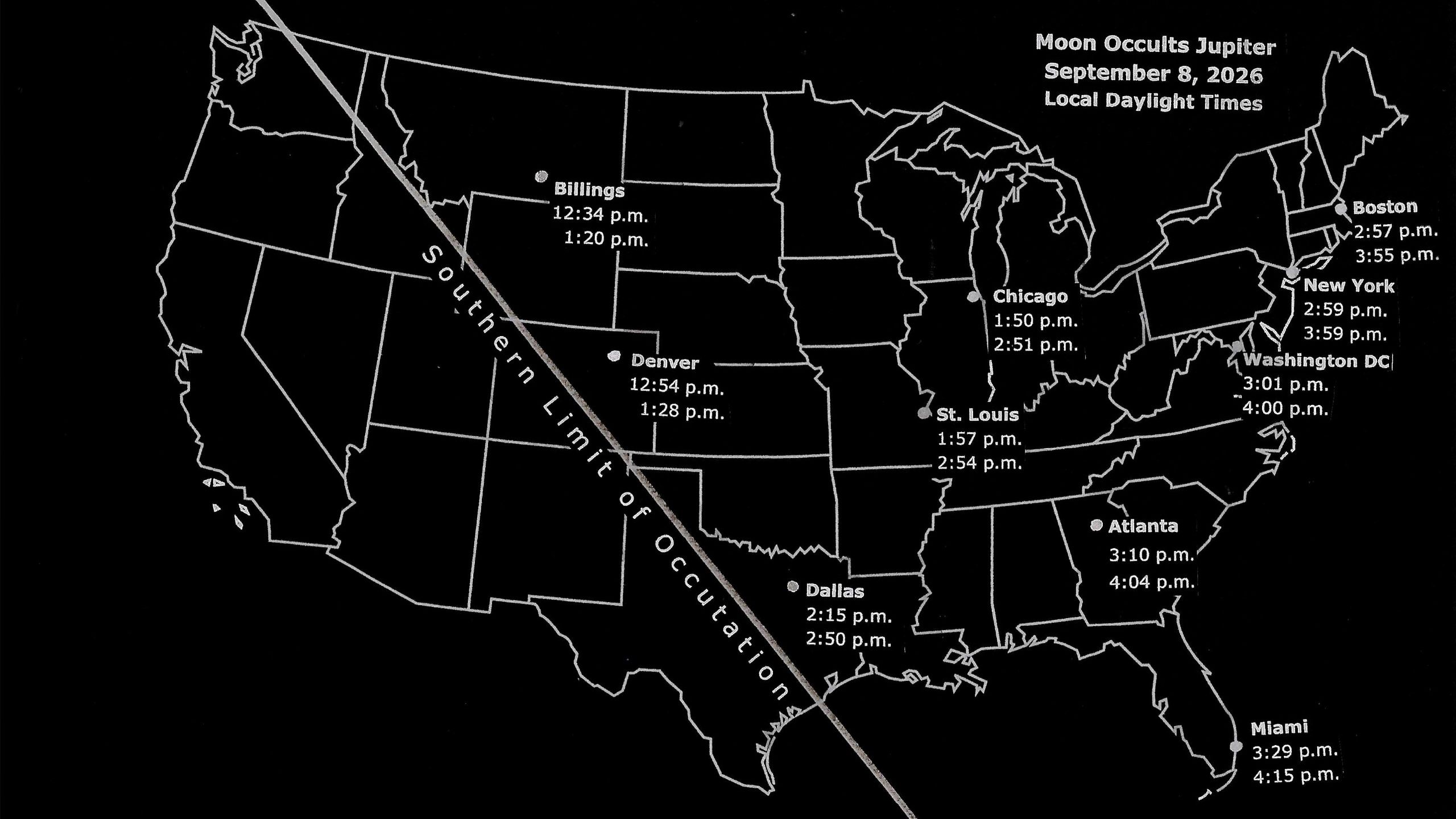
Jupiter will vanish (going from north to south) between 2:55 and 3:30 p.m. for those in the Eastern Time Zone, 1:45 to 2:20 p.m. for the Central Time Zone, and 12:30 to 1:00 p.m. in the Mountain Time Zone.

To find out when these events occur at your location, use the accompanying map. Interpolate between the ten selected cities to find the local daylight time of Jupiter's disappearance (top) and reappearance (bottom) for your site.

map of the US showing where the jupiter occultation is visible from on sept 8.

(Image credit: Joe Rao)

How to find them in daylight

The chief challenge will be finding the moon and Jupiter at all, so give yourself plenty of time. The easiest method is to locate the pair before sunrise and track them into daylight. Much will depend on the transparency of your local sky β€” how deep its blue color is. If the day is hazy, the search will be harder.

  1. Start before sunrise, when the crescent moon and Jupiter are easiest to identify.
  2. As daylight strengthens, keep tracking the pair or return to the same region of sky about 30 degrees β€” roughly four fist-widths at arm's lengthβ€”from the sun, mostly to the right and, for most locations, somewhat lower.
  3. Sweep the area with a finderscope or binoculars, remembering that the crescent moon's low surface brightness may make it hard to distinguish from the blue sky.

Once you have the moon, the next challenge is Jupiter. In a telescope, it will appear far smaller than the moon β€” about one-sixtieth of the moon's diameter β€” and it will have an even lower surface brightness. Watch for Jupiter to return along the moon's dark limb, a captivating sight as the planet seems to emerge literally from out of the blue.

If you miss it

Sighting the moon and Jupiter in daytime will be challenging, so do not despair if you fail to find them. In less than a month, on the morning of Tuesday, Oct. 6, the moon and Jupiter will have another interaction, but this time about eight hours earlier, before sunrise in a dark or twilight sky. That resultant event should be a spectacular sight, easily visible with the naked eye, binoculars, or a telescope. Space.com will provide details as the date approaches, so stay tuned!

Joe Rao serves as an instructor and guest lecturer at New York's Hayden Planetarium. He writes about astronomy for Natural History magazine, Sky and Telescope, The Old Farmer's Almanac and other publications.

Venus is disappearing from the evening sky β€” here's how to see it while you can

5 September 2026 at 16:00

Soon, the sky's most glamorous evening performer will take its leave.

Since late March, Venus has been the unmistakable "Evening Star," gleaming shortly after sunset and stealing attention from nearly everything else in the twilight. In June, it helped stage a striking three-planet lineup after sundown, outshining both Jupiter and Mercury.

Now the curtain is beginning to fall: Venus is sinking night by night and will trade its evening role for a morning one before October is over.

A familiar dance around the sun

Venus moves to a remarkably regular beat. Our nearest planetary neighbor circles the sun in an almost perfect path, completing 13 orbits in 8 Earth years. From Earth, that rhythm makes Venus appear to trace five great loops across the sky in the same span. It is a long cycle noticed by skywatchers β€” and important to the ancient Aztec and Mayan civilizations β€” and it gives each Venus year its own recognizable personality. In 2026, the pattern closely echoes 2018, differing by only about two days.

Key dates this month

Venus is about to blaze at peak brilliance, but this farewell performance comes with a challenge. All month long, the planet will slide lower in the southwest after sunset, shortening the window for a good view. If the horizon is clear and the weather cooperates, these are the evenings to circle on your skywatching calendar.

  • Sept. 7: On Labor Day, Venus sets about 1ΒΌ hours after sunset.
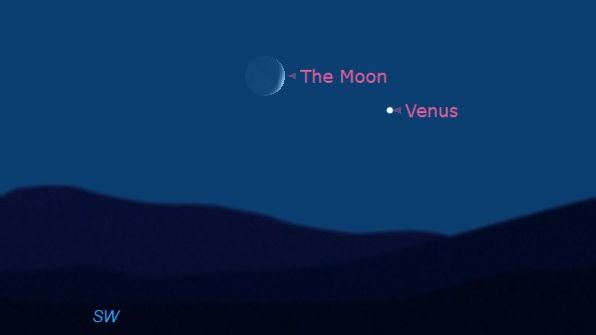
  • Sept. 14: Look low in the west-southwest 30 to 45 minutes after sunset, when a waxing crescent moon appears around 5Β½ degrees to the left of Venus.
  • Sept. 18: Venus reaches greatest brilliancy, shining at a dazzling magnitude of
    -4.8 near the horizon.
  • Late September: The planet slips quickly from view, setting just 35 minutes after sundown by month's end.

night sky graphic showing Venus shining close to the delicate crescent moon.

Venus shines near a waxing crescent moon very low in the southwestern sky, 45 minutes after sunset on Sept. 14. (Image credit: Starry Night Pro 8.0)

Why this farewell is so low-key

Ordinarily, the weeks between greatest elongation and greatest brilliancy are prime time for Venus watchers. Not this year. For evening observers, this apparition has been more frustrating than triumphant, with Venus lingering low in the glow of twilight instead of climbing into a commanding position.

The best views came back in June, when Venus lingered until around 11 p.m. Since then, it has been ducking out earlier each night. By Aug. 15, the evening of greatest elongation β€” when Venus reached its greatest apparent distance east of the sun β€” it was already setting just as evening twilight faded.

For observers at mid-northern latitudes, the finale is especially low to the horizon. Around 40 degrees north latitude, Venus will stand only about 5Β½ degrees above the southwest horizon at sunset by the end of September. That is barely more than half the width of your clenched fist held at arm's length β€” a beautiful but fleeting target in the fading light.

A crescent world in the twilight

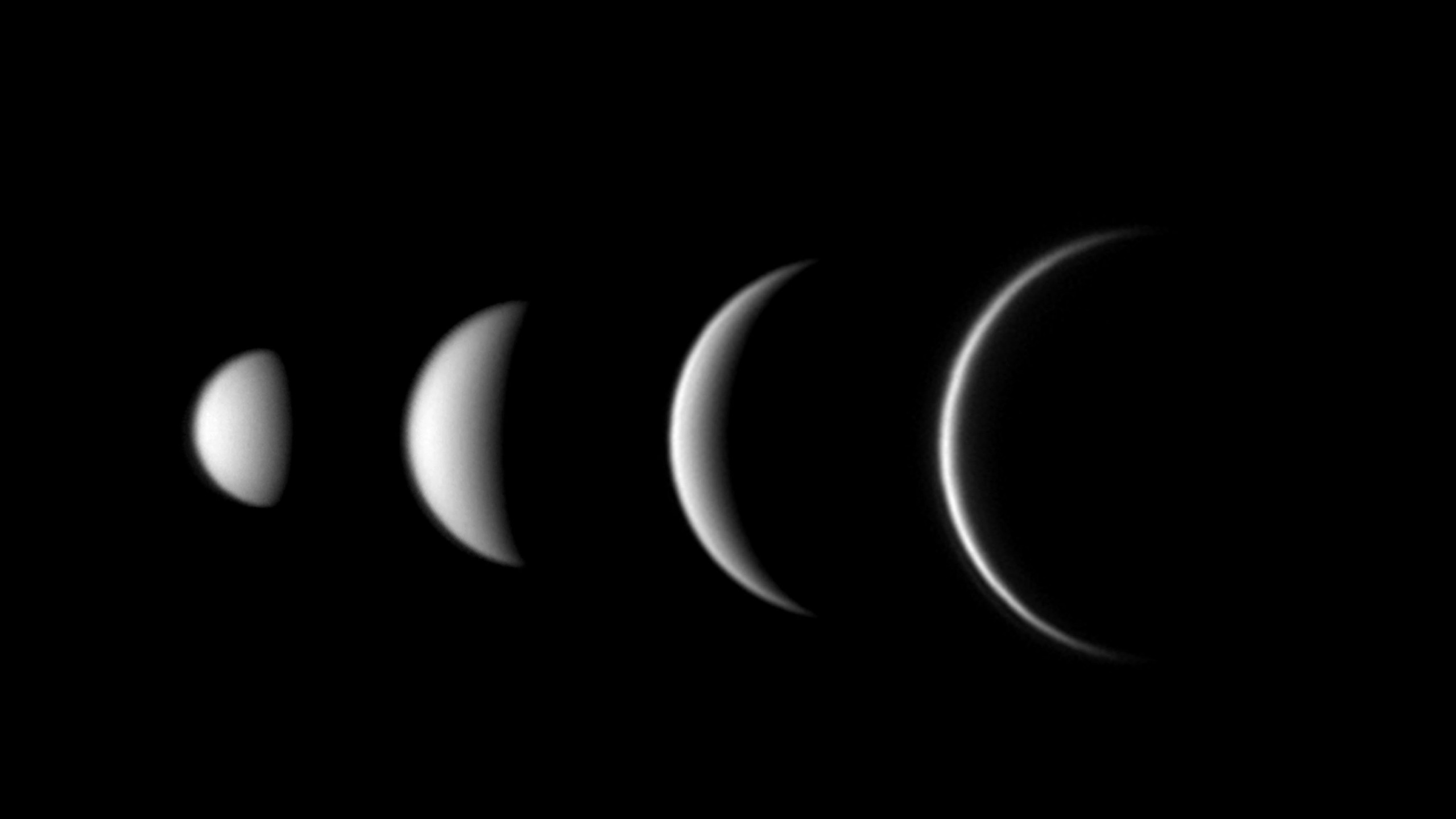
Through a telescope, Venus now shows one of its most striking faces: a narrowing crescent. As its sunlit side turns farther away from Earth, that crescent grows thinner and longer, becoming a delicate arc of brilliant light. With very steady binoculars, you may even glimpse the shape during the next couple of weeks, though the planet's low altitude will make the view shimmer and blur.

composite image showing 4 views of venus becoming an increasing crescent.

Set of images taken in 2004 show the phases and relative size of Venus as seen from Earth as it moves around the Sun. (Image credit: Photograph by Jamie Cooper. (Photo by SSPL/Getty Images))

The morning star returns

By the end of the first week of October, Venus will have slipped from the evening sky altogether. It reaches inferior conjunction on Oct. 24, passing about 6 degrees south of the sun. Around that time, spotting it on nearby evenings or mornings will be extremely difficult.

But Venus never stays away for long. In November, it reappears before dawn, opening a brilliant new morning apparition. By the winter holidays, it will shine high in the eastern sky as a fitting "Christmas Star," rising more than two hours before daybreak β€” and nearly four hours before the sun.

Joe Rao serves as an instructor and guest lecturer at New York's Hayden Planetarium. He writes about astronomy for Natural History magazine, Sky and Telescope, The Old Farmer's Almanac and other publications.
❌