❌

Normal view

China on track to launch Mars sample-return mission in 2028: 'If accurate, this represents a Sputnik moment'

9 September 2026 at 11:00

China is making progress on its Tianwen 3 Mars sample return mission, which aims to bring back to Earth roughly 500 grams (17.6 ounces) of Red Planet collectibles in 2031.

According to the China National Space Administration, the Tianwen 3 mission will have a lander, an ascender, a service capsule, an orbiter and an Earth reentry module.

If all goes to plan, Tianwen 3 will launch in 2028 on two Long March 5 heavy-lift rockets from the Wenchang Space Launch Site on the island of Hainan, China's southernmost province.

Sputnik moment

"The Tianwen 3 mission is progressing smoothly, with intensified efforts being made to overcome technical challenges," Hou Zengqian, the mission's chief scientist, recently told CCTV, a state-run Chinese broadcaster.

"The probe equipment has entered the prototype development phase, and scientifically, many scientist teams from across the country are working together to tackle the challenges in accordance with the mission's scientific objectives," Hou added.

Meanwhile, NASA's plans for hauling Mars samples to Earth are murky at the moment. So China appears to be in the lead to notch a major space milestone.

"If accurate, this represents a Sputnik moment," said former NASA "Mars Czar" Scott Hubbard, referring to the reported Tianwen 3 progress.

"China will not only grab the headlines but may be the first to find evidence of life on another planet," Hubbard, who also previously directed NASA's Ames Research Center in Silicon Valley, told Space.com.

diagram showing a spacecraft's route to from earth to mars and back again

Diagram of China's Tianwen 3 Mars sample return mission. (Image credit: The University of Hong Kong/Zengqian Hou, et al.)

Top scientific priority

"The Tianwen 3 mission will look for microbial traces potentially similar to early forms of life on Earth, while also taking into consideration the possibility of unknown forms of life that may have emerged through Mars' unique evolutionary history, providing crucial evidence to answer this major scientific question," Hou told the state-run Xinhua news agency in a recent interview.

Searching for potential signs of life on Mars is the top scientific goal of the Tianwen 3 mission, Hou said on Sept. 3 during the 2026 International Deep Space Exploration Conference on, which was held in Hefei, the capital of eastern China's Anhui Province.

Landing site

China's Mars sample-return trek will be launched "around 2028" on two Long March 5 rockets departing from the Wenchang Space Launch Site in China's southernmost island province of Hainan. (Launch windows for Mars missions come around just once every 26 months. The next one opens in November-December of this year, and the one after that, which Tianwen 3 apparently is targeting, runs from December 2028 to January 2029.)

Hou also said China expects to finalize the landing site for the mission by the end of 2026, with Chinese specialists advancing work on a next-generation geological map of Mars in its entirety.

If everything goes according to plan, the mission will collect samples from the Martian surface and then send them back to Earth around 2031.

"Regardless of whether signs of life are found, the returned Martian samples will have irreplaceable scientific value," Hou said.

Tackle the challenges

Hou added that analyses of the returned samples at microscopic, molecular and isotopic scales could deepen our understanding of Mars' geology and environment, as well as the evolution of habitability and the conditions under which life may originate.

According to Hou, Mars sample return is an extremely complex project, with landing-site selection, planetary protection and contamination control, and the identification of potential signs of life among its key challenges.

Chinese Mars researchers are selecting candidate landing sites for the mission based on factors that include geological age, history of water activity, habitability and the potential for preserving biosignatures.

Planetary protection lab

Xinhua reported last month that a "planetary protection laboratory" is to be built in the first phase of Hefei's Deep-Space Science City in east China's Anhui Province, citing the Deep Space Exploration Laboratory (DSEL).

"The planetary protection laboratory will implement a two-way protection system that guards both the returning Martian samples and Earth's biosphere," Xinhua reports.

The lab's tasks encompass sample sterilization, unsealing, processing and biological risk assessment. "The facility is designed to support the implementation of major deep-space missions and to enable scientific research on Martian samples," added Xinhua.

China "will follow the planetary protection policies of the Committee on Space Research, to prevent biological contamination of Mars by terrestrial organisms and to protect Earth from any potential extraterrestrial life forms that may be carried back in the samples," said Li Hang, director of the development planning department at DSEL, according to Xinhua.

You can view a video about China's Mars sample return plans here.

Without new landers or rovers, it's helicopters or bust for NASA's Mars program

1 September 2026 at 12:00

For the first time in more than 30 years, NASA has no firm plans to send any new landers or rovers to Mars. Instead, the agency's near-term focus at the red planet is on aerial drones, a pioneering mode of exploration that didn't seem realistic until a few years ago.

The first real use of drones for science at Mars will come with the SkyFall mission, a fleet of three helicopters set for launch as soon as late 2028. SkyFall's helicopters will ride to the red planet with NASA's Space Reactor-1 "Freedom" mission, which has the primary objective of demonstrating nuclear electric propulsion in deep space.

The launch schedule is aggressive for SR-1 Freedom and SkyFall, projects that didn't even exist in NASA's portfolio six months ago. NASA's plan for the SR-1 Freedom mission, estimated to cost $2.1 billion, calls for repurposing the core module of the canceled Gateway lunar space station into a testbed for nuclear electric propulsion. SkyFall will build on NASA's success with the Ingenuity helicopter, an experimental vehicle that became the first rotorcraft to fly on another world in 2021.

Read full article

Comments

© AeroVironment

Aug. 17, 1877: Asaph Hall discovers Phobos

17 August 2026 at 14:00

Astronomer Asaph Hall met Angeline Stickney at New York Central College in 1855. Two years his elder, she instructed him in geometry and German, and was reputedly so strong a mathematician that Hall and his classmate made a game of trying to stump her, yet never could. The pair were married the following year. ForContinue reading "Aug. 17, 1877: Asaph Hall discovers Phobos"

The post Aug. 17, 1877: Asaph Hall discovers Phobos appeared first on Astronomy Magazine.

Perseverance Watched Earth Disappear Behind Mars’ Moon Phobos

11 August 2026 at 14:00

From the rim of Jezero Crater, Earth is only a bright point in the sky. On July 2, NASA’s Perseverance rover watched that point vanish behind Phobos, Mars’ larger moon, and recorded the event with its Mastcam-Z camera. The sequence is the first time humanity has observed Earth disappearing behind an object from the surface […]

The post Perseverance Watched Earth Disappear Behind Mars’ Moon Phobos appeared first on Curiosmos.

Aug. 11, 1877: Asaph Hall discovers Deimos

11 August 2026 at 14:00

After spending the 1850s at Harvard Observatory calculating orbits, Asaph Hall became an assistant at the U.S. Naval Observatory at Washington, D.C., in 1862. He was quickly promoted, and by 1873 had not only held several scientific discussions with Abraham Lincoln during the president’s visits to the observatory, but had also been put in chargeContinue reading "Aug. 11, 1877: Asaph Hall discovers Deimos"

The post Aug. 11, 1877: Asaph Hall discovers Deimos appeared first on Astronomy Magazine.

Rare Mars Meteorite Fills a 2-Billion-Year Gap in the Red Planet’s History

11 August 2026 at 11:36

A rare meteorite from Mars is giving scientists a new look at a mysterious period in the Red Planet’s history. Researchers at Boston College have found that the rock formed about 1.27 billion years ago and may have come from a part of Mars’s deep interior that remained largely unchanged for billions of years. The […]

The post Rare Mars Meteorite Fills a 2-Billion-Year Gap in the Red Planet’s History appeared first on Knowridge Science Report.

Look What NASA’s Perseverance Rover Just Spotted Vanishing Behind the Martian Moon Phobos

10 August 2026 at 14:14

More than 140 million miles away from Earth, a rare event recently occurred in the twilight skies above Mars, and it was all captured on camera by NASA’s Perseverance rover.

Imagery of a celestial alignment, featuring Earth as it briefly vanished behind the Martian moon Phobos, was revealed in composite photos captured by Perseverance’s Mastcam-Z instrument in early July as the intrepid rover embarked on its 1,907th Martian day, or sol, on the Red Planet.

The rover’s Mastcam-Z camera system, developed by Arizona State University in collaboration with Malin Space Science Systems, was built for capturing high-resolution panoramic zoom imagery of the Martian landscape. Although its main objectives involve its investigations of Jezero Crater and ancient geological features preserved there for eons, which may even include evidence of past microbial life, cases like the recent celestial alignment showcase how the rover’s cameras can also provide unique insights into astronomical events.

Phobos Earth composite
A sequence of composite images (after color correction) reveals the irregularly-shaped Martian moon Phobos with Earth, appearing as a tiny point of light, disappearing behind it (Image Credit: NASA/JPL-Caltech/ASU/MSSS/SSI)

A Robot on Mars Captures an Occultation

Captured against fading twilight, our Earthly home appears as little more than a tiny, bright speck of light as it slowly passes behind the irregularly shaped Martian moon, in what astronomers refer to as an occultation.

NASA applied processing to the rare images, which helped to filter out some of the background light, revealing the brief celestial pairing in greater detail. The resulting imagery offers a glimpse of a dark backdrop that now better highlights the motion of Earth and Phobos in their treks through the Martian sky.

A Sunset Unlike Any Other

The image was obtained roughly 40 minutes after the Martian sunset, as the natural orbital path Phobos follows causes it to appear to drift upward in the new sequence of images, while Earth moves diagonally downward, then slips out of view behind the oddly shaped Martian companion.

Phobos Mars
Imagery with enhanced inset of the Martian moon Phobos with Earth visible behind it (Image Credit: NASA/JPL-Caltech/ASU/MSSS/SSI)

In an annotated version released by NASA, timestamps spanning just 40 seconds illustrate the progression of the event in single frames, offering a look at a sunset unlike any ever seen on Earth.

That isn’t to say that the same effect can’t be seen from our planet, but in reverse: a lunar occultation where Mars passes behind the Moon can also be observed here, under the right conditions.

Occultations are frequently used by astronomers to help study the positions and motions of various celestial bodies in this way. However, seeing one from the surface of another planet is a rare treat, offering a view of Earth as a distant point of light.

In the past, Perseverance has also captured images of a lunar eclipse from its position on the Martian surface, as Phobos was seen passing in front of the Sun. Past imagery collected by NASA’s robotic explorer has also documented appearances of the Martian moon Deimos in the Red Planet’s early morning skies.

Colors of Change on a Red Planet

Although Mars’ characteristic rusty hues are ever-present, the recent imagery also offers a glimpse of other subtle colors seen in the Martian environment, particularly at twilight. With subtle bluish grays that gradually transition to redder tones, the new images offer a more nuanced and colorful look at the Red Planet.

Phobos Earth
Close up of the original composite images before color adjustments, where Phobos can be faintly seen against the Martian twilight, with Earth appearing as a speck of light behind it (Image Credit: NASA/JPL-Caltech/ASU/MSSS/SSI).

Perseverance has now spent more than five years exploring Mars, and its ongoing discoveries have added a wealth of new information to the growing body of knowledge scientists have collected about our nearby planetary neighbor.

As for the recent imagery the rover captured, such a unique view requires careful timing, along with a bit of good fortune, according to Mark Lemmon, a Mastcam-Z co-investigator at the Space Science Institute in Boulder, Colorado.

“Phobos crosses the Martian sky three times a day, and Earth is visible for months at a stretch,” Lemmon said in a statement, adding that “catching one directly behind the other takes planning and a little luck.”

Additional details provided by NASA about the new imagery can be found here and here.

Micah Hanks is the Editor-in-Chief and Co-Founder of The Debrief. A longtime reporter on science, defense, and technology with a focus on space and astronomy, he can be reached at micah@thedebrief.org. Follow him on X @MicahHanks, and at micahhanks.com.

NASA's SkyFall Mars helicopters will wear tiny capes

7 August 2026 at 17:07

Picture it: A swarm of tiny robot helicopters descends through a reddish-brown sky, landing gracefully on the Martian surface. What are they wearing? Tiny capes.

NASA's SkyFall mission will send a trio of mini rotorcraft to Mars equipped with ground penetrating radar technology which happens to look like little capes. These uniquely designed swaths of fabric look decidedly strange or even accidental in new videos from NASA's Jet Propulsion Laboratory (JPL) that show the little drones practice landing. But these capes are actually flexible antennae that will allow the craft to peer beneath the Red Planet's surface in search of water ice.

"The only way to detect shallow subsurface ice remotely is to fly close to the ground," Adrian Tang, SkyFall’s ground-penetrating radar lead instrument scientist at JPL, said in a statement on Thursday (Aug. 6). "By flying low and slow, a SkyFall helicopter could capture radar images that resolve the fine layering where dry soil gives way to ice, detecting its presence and mapping its extent."

Orbiting spacecraft have studied Mars for decades, imaging the planet and mapping it with radar. But from orbit, their radar is unable to see the first few feet of material just below the planet's surface — a zone where scientists expect to find shallow ice deposits mixed in with the rocks and dust. This work could be important for future astronauts who need to better understand the ground below their feet for safety reasons, and for future travelers searching for accessible ice to process for drinking water, oxygen and fuel.

Skyfall will follow in the footsteps of Ingenuity, the first rotorcraft on another world, which hitched a ride to Mars aboard NASA's Perseverance rover. The new choppers are based heavily on Ingenuity, which weighed just 4 pounds (1.8 kilograms) here on Earth. But Skyfall will be more capable than Ingenuity, whose main job was to show that choppers can explore the thin skies of Mars.

SkyFall's tiny cape ground-penetrating radar, which uses a type of flexible antenna called Vivaldi that was invented back in 1978, is designed to survey up to 16 feet (5 meters) below the Martian surface. The radar will be able to reach anywhere from several yards below the planet's surface to the uppermost layers of surface material.

And the antenna's unique design ensures that the SkyFall drones will be able to make these subsurface observations without damaging the equipment during landing.. The antenna is extremely lightweight, and the team miniaturized it to be both the right size and shape to fit the tiny helicopters, which sit just 6 inches (15 centimeters) above the ground at rest. The tricky thing was, the designers had to miniaturize the radar antennae while maintaining functionality. But they did just that, and these tiny radar capes will be able to bend and move out of the way as the rotorcraft do their thing, flying above and landing on the Red Planet.

"Although we managed to shrink the antenna quite a bit, it is about 1.5 times longer than the helicopter’s legs," Christine Gebara, SkyFall ground-penetrating radar mechanical lead at JPL, added in the statement.

"That means during landing, the Vivaldi has to bend out of the way — and if it lands on a rock, it bends even further," she added. "But when the helicopter takes off again, the antenna must spring back into place for data collection. Because SkyFall is expected to make dozens of flights exploring Mars, we needed an antenna that could repeatedly handle those pressures without losing its shape in flight."

A radar engineer works on a test antenna for the SkyFall mission’s ground-penetrating radar in the electromagnetic interference chamber at JPL.

A radar engineer at NASA JPL works to test the antenna on the SkyFall helicopter. (Image credit: NASA/JPL-Caltech)

To make these little capes capable of withstanding incredible feats on another world, the engineers behind the helicopters covered the antenna in layers of polyester and Vectran, a flexible (but incredibly strong) material that was previously used for the airbag that cushioned NASA's Spirit and Opportunity Mars rovers during their touchdowns in 2004. The antenna's shape is also reinforced with flexible fiberglass tape springs and a lightweight structure. In total, each antenna weighs a miniscule 5 ounces (142 grams).

But a crafty design isn't enough. Getting to Mars is no small feat, and NASA needs to be sure that these little helicopters and their gear are up to the challenge. So, in JPL's Environmental Test Laboratory, which recreates different elements of environments beyond Earth, the SkyFall team put the rotorcraft and its little radar antenna to the test. They bent and flexed the antenna over and over, recreating multiple landings on the surface, exposed the craft to extreme temperatures, and continually checked to make sure that, throughout this testing, the helicopter could still transmit and receive radar signals. At the end of this testing, the antenna had endured 200 simulated Mars landings and was still working just fine. That is more than twice the number of landings expected from the mission.

"This test checked every box it was supposed to and answered our biggest technical questions," Tang added. "While we still have work ahead of us before the antenna is fully flight-qualified, this was a major milestone, and the hardware performed exactly as expected."

The trio of SkyFall helicopters will put their radar capes to the ultimate test when they fly to Mars. NASA plans to launch this mission to the Red Planet in 2028 aboard NASA's Space Reactor-1 Freedom, the first nuclear fission-powered interplanetary spacecraft.

Une nouvelle ère commence : comment l'IA s'apprête à rendre la vie possible sur la Lune et Mars

6 August 2026 at 20:02
Et si l'IA ne se contentait plus d'assister l'exploration spatiale, mais en devenait l'architecture fondamentale ? Maintenance prédictive, autosuffisance sur Mars ou sur la Lune, défense orbitale, médecine autonome à des millions de kilomètres de tout secours : ce que prépare la prochaine...

Lessons for the future of NASA Mars exploration from a 1970s mission

6 August 2026 at 16:00

July 20 marked the 50th anniversary of one of the biggest robotic spaceflight achievements in NASA’s history: the landing of the Viking 1 spacecraft on Mars. It was the first […]

The post Lessons for the future of NASA Mars exploration from a 1970s mission appeared first on SpaceNews.

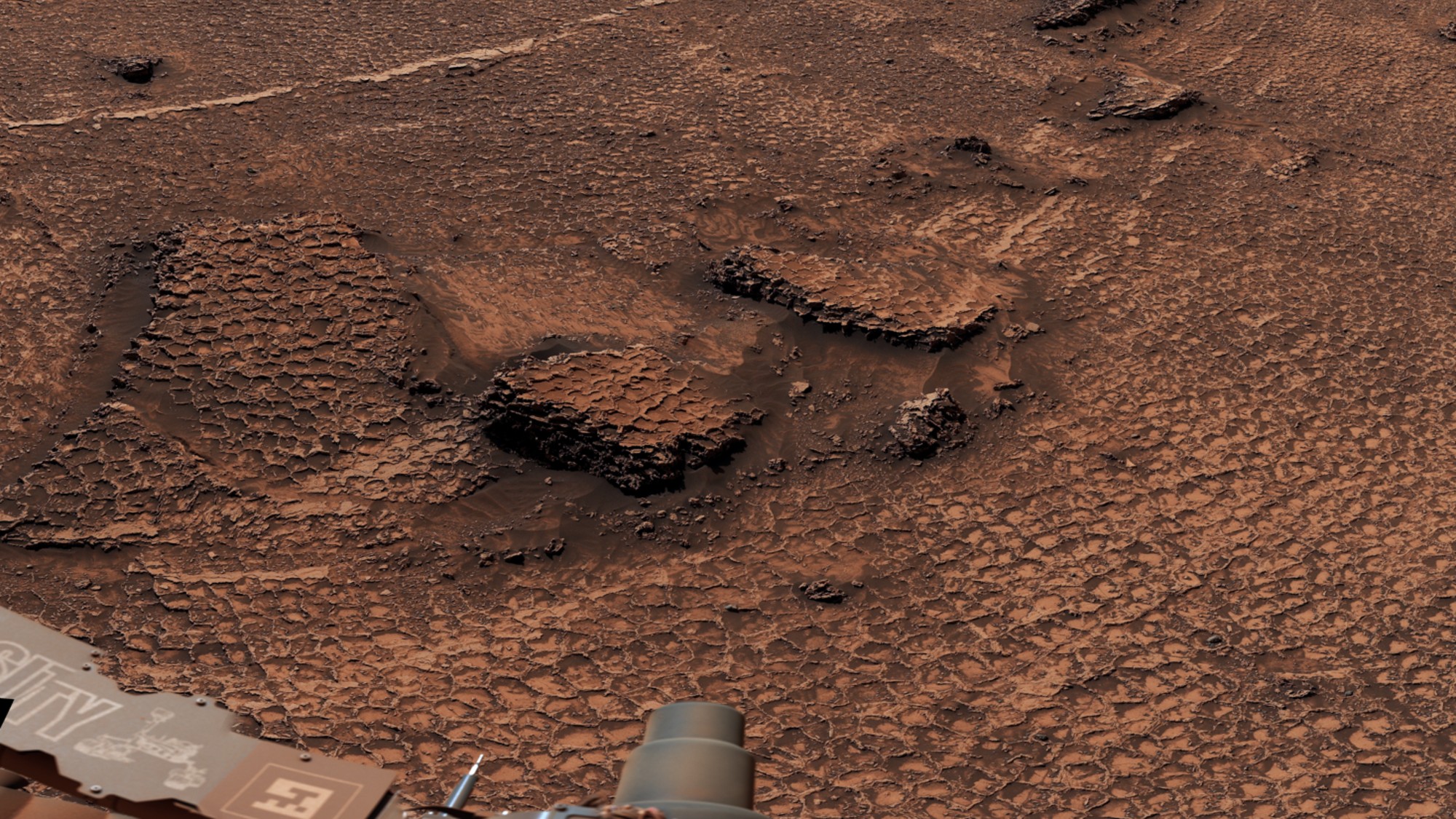
Curiosity rover spots mysterious honeycombs on Mars | Space photo of the day for Aug. 5, 2026

a reddish-brown landscape of soil and rocks covered in slightly raised hexagonal lines of nearly equal size

A close-up of the polygon fractures discovered by NASA's Curiosity Mars rover highlights their honeycomb-like textures. (Image credit: NASA/JPL-Caltech/MSSS)

NASA's Curiosity Mars rover spotted surprising shapes in the Red Planet soil while exploring a large valley.

What is it?

These images were captured on June 19 and 20, 2026, or the 4,930th and 4,931st Martian days of Curiosity's mission. They show honeycomb-like patterns referred to as "polygonal fractures" found in a valley on Mars known as Valle Grande. They measure about 1.5 to 3 inches (4 to 8 centimeters) across.

While Curiosity has seen other curious geometric patterns on Mars before, scientists were surprised by this most recent find.

"We've seen a lot of fascinating landscapes through Curiosity's eyes, but this sea of polygons took our breath away," project scientist Ashwin Vasavada of NASA's Jet Propulsion Laboratory said in a statement. "We measured their shapes and chemistry carefully and are hopeful there are clues in the data as to how these features formed."

a reddish-brown landscape of soil and rocks covered in slightly raised hexagonal lines of nearly equal size

A panorama taken by NASA's Curiosity Mars rover showing a large field of hexagonal shapes in the Martian soil. (Image credit: NASA/JPL-Caltech/MSSS)

Why is it incredible?

This field of polygons in Valle Grande extends as far as Curiosity's instruments could see, even around the base of a steep hill scientists named "Miraflores."

a reddish-brown landscape of soil and rocks covered in slightly raised hexagonal lines of nearly equal size

NASA's Curiosity Mars rover captured this sand-capped butte, nicknamed "Miraflores," estimated to be about 20 feet (6 meters) tall, on June 11, 2026. (Image credit: NASA/JPL-Caltech/MSSS)

While mission scientists have theories about how these structures form, it ultimately remains a mystery how they formed.

It's thought that changes in temperatures on Mars could have caused water to squeeze through sediment layers, but scientists will need to collect more data before they can reach a conclusive answer.

Mars dust is toxic. How will future astronauts deal with it?

5 August 2026 at 14:00

Planting boots on Mars is hard enough. But getting "breathing room" on the Red Planet without inhaling toxic dust is yet another issue.

Given NASA's plans to eventually put astronauts on the Red Planet, the agency assembled a Martian Dust Limit Working Group earlier this year to review what's known and unknown about the toxicological hazard to human crews from exposure to Mars dust. The ultimate goal was to establish a permissible exposure limit for humans on the Red Planet by compiling a comprehensive set of expert perspectives regarding Martian dust toxicology, exposure pathways and mitigation strategies.

The working group's conclusions reinforced the view that an initial Martian dust standard "must balance conservatism with operational feasibility while accommodating architectural and scientific uncertainty," the report states. Furthermore, the report explains, "as additional Martian data and toxicological research become available, this standard should be periodically revisited to ensure continued protection of crew health during human exploration of Mars."

Unique study

A panel member for that study was Brian Hynek professor in the Department of Earth Science and a research associate at the Laboratory for Atmospheric and Space Physics, both at the University of Colorado, Boulder.

"It was a unique study," Hynek told Space.com, conducted by NASA specialists, space medicine experts, habitat designers, including toxicologists, volcanologists and geologists. "The task was to help gauge health hazards to humans, both for short and long-term stays," he said.

Just highlighting the differences between the moon and Mars played a role, said Hynek. "The moon is worse in some ways and Mars is worse in other ways."

Disneyland of dust

To be sure, one outcome from Apollo moonwalkers – the "dusty dozen" – is that dealing with lunar dust proved to be troublesome, much more than expected. The aged moon is a Disneyland of dust and crews that went there attested to that fact.

Once out and about, moonwalkers coped with very fine, tiny particles composed of sharp, glassy material. Lunar dust stuck to everything it came in contact with; dust eroded their spacesuits, caused overheating on equipment and instrumentation, compromised seals on their spacesuits, even irritated the eyes and lungs of moonwalkers.

"On Mars, dust particles are a little more rounded, not as jagged and cutting into you. But then you have all the extra chemical components and minerals that you don't have on the moon, like really unhealthy perchlorates," Hynek said. "We can use the lunar knowledge, but Mars is a totally different place," he added.

helmets and white spacesuits covered in grey dust inside a cramped metallic cabin

At the conclusion of Apollo 17's mission in December 1972, moonwalking suits and space helmets are covered by lunar dust. (Image credit: NASA)

Heavy metals

Hynek noted that Martian dust is known to contain various carcinogens, such as silica and numerous heavy metals. He co-authored a recent paper on "Potential Health Impacts, Treatments, and Countermeasures of Martian Dust on Future Human Space Exploration."

"There's talk about growing crops on Mars," Hynek observed. "The martian soil is full of all these nasty chemicals. So the astronauts might get more exposure from what they are growing on Mars than the actual airborne dust," said Hynek.

Then there's the dust that will assuredly find its way into the habitat, Hynek said, so engineers are looking at filtering systems and just how much time will be required to clean the inside of the habitat.

"It's good to have the forethought and to start considering the Martian dust and its hazards. It poses a lot more health hazards than the lunar dust," Hynek concluded.

Learned our lesson

Joel Levine, a research professor in applied science at William and Mary in Williamsburg, Virginia, is a leading expert on lunar dust, engineering and safety concerns. He was not a panel member of the NASA report.

Levine cited earlier thinking from a recent National Academy of Sciences report on human exploration of Mars. Two goals noted in that 2026 report are Mars dust-related:

  • Determine what controls the onset and evolution of major dust storms, which dominate present-day atmospheric variability.
  • Characterize the effects of Martian dust on human physiology and hardware lifetime.

"This indicates that Mars dust is on the minds of mission planners! This is good news based on our experience with lunar dust on the Apollo landings," said Levine. "It looks like we learned our lesson about dust at future human landing sites."

Levine stated that Mars sample returns would be very helpful to characterize Martian dust samples for chemical composition and other qualities. "Unfortunately, it does not look like the Mars samples already collected will ever be returned to the Earth for analysis," he said.

reddish-orange soil and rocks

Martian dust seen on NASA's Perseverance rover on July 27, 2026 (Sol 1932) by the rover's Right Mastcam-Z camera. (Image credit: NASA/JPL-Caltech/ASU)

Major takeaways

Shaunna Morrison, an associate professor in the Department of Earth and Planetary Sciences at Rutgers University in New Jersey, served as a panel member on the Martian Dust Limit Working Group.

"One of the major takeaways from the Mars dust working group is that martian dust is a real crew-health and engineering issue, but it is also a tractable one if it is treated as a design requirement from the beginning," Morrison emphasized.

The worry is not that Mars dust is uniquely or catastrophically toxic based on what we know now, Morrison told Space.com.

"The concern is that future crews will be living and working in a closed habitat, repeatedly going outside, bringing dust back in on suits and equipment, in a low-humidity environment," said Morrison. That's a condition in which small particles are more prone to becoming airborne and potentially inhaled, she said, and potentially crew members being exposed to fine respirable particles over many days.

reddish-orange soil and rocks

A region-wide seasonal dust storm obscures the Jezero Crater in this image from NASA's Mars Perseverance rover, acquired using its Left Mastcam-Z camera on Aug. 20, 2024 (Sol 1244, or Martian day 1,244 of the rover's mission). (Image credit: NASA/JPL-Caltech/ASU)

Prevention first

Morrison said that a key point is that we do not have as yet returned samples of authentic airborne martian dust. So NASA has to build a conservative standard using the best available evidence: lunar dust toxicology, Mars simulant studies, and the very extensive chemical and mineralogical datasets from Mars rovers and landers, she pointed out.

"The best strategy is prevention first," Morrison said. "Keep as much dust as possible outside the habitat, remove it quickly when it gets in, monitor airborne particles, and design the system so crews are not relying on medical countermeasures after exposure," she advised.

NASA’s Curiosity Finds a Vast Sea of Mysterious Polygons on Mars

2 August 2026 at 12:23
NASA’s Curiosity Mars Rover Martian PolygonsCuriosity has found a vast sea of Martian polygons that may reveal how water and climate once reshaped the Red Planet. NASA’s Curiosity rover has encountered an enormous field of honeycomb-shaped fractures while climbing through a Martian valley known as “Valle Grande.” Each geometric feature measures roughly 1.5 to 3 inches (4 to 8 centimeters) [...]

NASA's Curiosity Mars Rover Discovers a Field of Honeycomb Textures

1 August 2026 at 22:39
NASA's Curiosity rover has sent back images of honeycomb-like textures called polygonal fractures, each one about 1.5 to 3 inches (4 to 8 centimeters) across. NASA reports: The mission has spotted small patches of these geometric shapes several times before, but nothing at the scale discovered in Valle Grande. In a 360-degree panorama that the rover captured on June 19 and 20, the 4,930th and 4,931st Martian days, or sols, of the mission, the polygonal shapes spread in all directions for as far as the rover can see... "[T]his sea of polygons took our breath away," said the mission's project scientist, Ashwin Vasavada of NASA's Jet Propulsion Laboratory in Southern California... Some of the polygons that the mission has spotted in the past clearly formed as mud cracks, though a variety of processes can contribute to their honeycomb textures, including cycles of warm and cold temperatures or compression that squeezed water out of the sediment when the surface was buried. These newly discovered polygons are among the many surprises Curiosity has trundled across since landing on Mars 14 years ago, on Aug. 5, 2012. Besides sulfur crystals, shiny meteorites, and other interesting geologic features, the rover has made major discoveries about the ancient Martian environment — most importantly, that it had the water, chemistry, and nutrients to support microbial life. Billions of years ago, lakes and streams dappled the lower foothills of Mount Sharp, a 3-mile-tall (5-kilometer-tall) mountain that Curiosity has been ascending since 2014. The rover has previously uncovered chemistry left over from Mars' watery history, including carbon-based molecules believed to be precursors to RNA and DNA, two nucleic acids that carry genetic information. Scientists have no way of knowing whether these organic molecules were created by biologic or geologic processes — either path is possible — but their discovery reconfirmed that ancient Mars had the right chemistry to support life. Dark, pebble-sized rocks also litter the area, NASA writes in a blog post, saying it's a "still-to-be-resolved question" as to whether they're bits of Mars that "floated" down from higher in the sediment layers, or "were ejected from distant impacts outside of Gale crater, or are meteorites from beyond Mars altogether."

Read more of this story at Slashdot.

« Cela nous a coupé le souffle » : une immense structure en nid-d’abeilles découverte sur Mars intrigue la Nasa

1 August 2026 at 12:27
Nous n'en sommes toujours qu'au début de l'exploration de la Planète rouge, aussi bien pour sa géologie que pour sa possible exobiologie. Cette exploration est grandement facilitée avec des machines, comme dans tout le Système solaire et comme l'avait prédit Arthur Clarke. Aujourd'hui, c'est...

❌