One researcher who resigned said many in industry believe that without regulation AI could kill off humanity
Artificial intelligence could kill off humanity within the decade, according to three researchers with the industry giant Anthropic, one of whom has quit his job in protest.
The latest doom-laden predictions came in posts on social media on Tuesday by a researcher who said he resigned because Anthropic and his previous employer, OpenAI, were ignoring or at best mishandling their response to the threat.
CISA, NSA, FBI warn Chinese AI firms of industrial‑scale knowledge distillation
Companies like DeepSeek, Moonshot, Alibaba allegedly extracted billions of tokens from US frontier models
Advisory urges detection of malicious prompts, deceptive responses to distillation, and cross‑provider intelligence sharing
Chinese AI companies’ core development strategy is to steal proprietary functionalities and capabilities from their US counterparts, law enforcement agencies have warned.
The US Cybersecurity and Infrastructure Security Agency (CISA) has published a new security advisory, drafted jointly with the National Security Agency (NSA) and the Federal Bureau of Investigation (FBI), warning American AI companies about an ongoing “aggressive, malicious, and targeted distillation activities at an industrial scale,” and sharing recommended mitigation steps.
Knowledge distillation
IBM defines knowledge distillation as a “machine learning technique that aims to transfer the learnings of a large pre-trained model, the ‘teacher model,’ to a smaller ‘student model’.” It is used in deep learning as a form of model compression and knowledge transfer, it added, particularly for massive deep neural networks.
So, knowledge distillation is not illegal or malicious, per se. Its goal is to train a more compact model to mimic a larger, more complex one. In the security advisory, the agencies stress it is “recognized as a legitimate and useful technique in AI research,” but add that China-based AI companies are using it in ill will.
In other words, the agencies claim that instead of spending months and millions developing new capabilities for their models, the Chinese are simply sending huge numbers of carefully designed questions to US models and extracting the answers.
Which companies are engaged in knowledge distillation?
Apparently, all companies worth anything. DeepSeek, Moonshot AI, Alibaba, MiniMax, StepFun, and Z.AI all allegedly “extracted billions of tokens across millions of exchanges/requests from US frontier AI models, including variants of Claude, GPT, Gemini, and Grok, since at least late 2024.” CISA also stressed that this was likely done with the awareness of the Chinese government. It hasn’t outright said, “with its blessing”, although it could be read between the lines.
The advisory shares a thorough list of all the models that were being trained, as well as all the models being taken advantage of.
On the Chinese side, they include DeepSeek R1 and V3 models, Moonshot’s Kimi-K2 and Kimi-K3 models, and MiniMax’s M2 model. On the US side, they start with earlier models such as GPT-4, Claude 3.7, and Gemini 2.5 Flash Preview, all the way to Claude Fable 5, GPT-5, and similar.
When done in good faith, knowledge distillation is not illegal. However, the report says the companies routed the requests through multiple accounts, different API access points, multiple cloud providers, third-party AI aggregators, proxy services and “transfer stations”, as well as premium subscriptions shared between developers, all in an attempt to work around defenders trying to disrupt the process.
“This represents systematic extraction of proprietary functionalities and capabilities threatening U.S. technological leadership. Addressing industrial-scale distillation merits a coordinated response across the AI ecosystem, including effective information-sharing, spanning the U.S. Government, private industry, and allied nations,” the agencies concluded.
What US companies should be doing
To defend their intellectual property (and thus remain ahead of Chinese competing models) US AI companies should implement comprehensive detection and mitigation, the agencies said. That means hunting for anomalous and malicious prompts, accounts, networks, and behaviors. Furthermore, they should monitor subscription-to-usage ratios, immediate maximum usage from new accounts, and enterprise-scale throughput patterns.
The second step is to “deploy targeted response changes”: “Subtly alter responses for suspected malicious distillation attempts to attenuate the payoffs to companies conducting industrial-scale distillation campaigns.” In other words, AI companies should make sure their products lie when they spot they were being distilled for knowledge.
Finally, US AI firms should set up cross-organization intelligence sharing, correlating activity across model providers, cloud platforms, and API aggregators.
The September update brings in the ability to move the taskbar
There are also new options for resizing the Start menu, and a really useful tweak for Windows 11's search function
Windows 11's latest update has arrived, and it packs some important new features for the interface of the desktop OS.
Bleeping Computer flagged all the additions in the September 2026 update for Windows 11, and there are three major highlights, which I'll pick out here, before providing a general roundup of some of the other tweaks that Microsoft has brought in this month.
As ever, some of these features are being rolled out in a phased manner, so even if you do install the September update today, you may still have to wait a while for certain pieces of functionality to make their way over to your PC.
1. A movable taskbar
(Image credit: Microsoft)
Thanks to the September update you'll finally be able to move Windows 11's taskbar away from the bottom of the screen, to the top instead, or the sides if you prefer (an option that people with an ultra-wide monitor often want to use, as it suits that aspect ratio much better).
This is an ability which has always been in Windows 10, but was dropped for Windows 11 because porting it over was a thornier issue than you might think (or so Microsoft told us).
Finally, however, Microsoft has got its act together and the taskbar can now be repositioned in Windows 11 – although I've a feeling this will be one of the features on a slower rollout. Hopefully I'll be wrong on that score and you'll get this ability promptly if you've been keenly awaiting it for the last five years.
It's also worth noting that there's another option introduced here which can make the taskbar smaller, so it takes up less screen real-estate on devices with small displays.
2. The Start menu can now be resized
(Image credit: Unsplash)
Want a more compact Start menu? Your wish is Microsoft's command, as this choice has now been introduced to the Settings app for the Start menu. You can elect to have a standard (large) menu, or a small one, rather than leaving it at the default 'automatic' setting whereby Windows 11 chooses the size itself based on your device. The problem with leaving the OS to decide is that sometimes you get the bigger menu on a laptop screen, where it pretty much eats the whole desktop – and so in these scenarios you can now manually choose the more compact Start menu.
With options to remove sections of the Start menu coming on top of this, you can now trim this part of the interface down so it's truly minimal. This choice will be more important than the movable taskbar for many folks – myself included – and it's great to see it now being rolled out.
3. Windows 11 search improvements
(Image credit: Getty Images)
Another notable boon with the September update is that there are a few changes for Windows 11's core search functionality, and the most important is a new option that lets you turn off web results in search.
When you're searching for a file on your local drive, those web results often get in the way, so it'll be a relief for many to be able to switch them off. As well as web results (which open in Edge, with searches in Bing, of course), you can also turn off Microsoft Store suggestions. Essentially this is a general decluttering of Windows 11 search which is long overdue, frankly.
Other features in Windows 11's September Update
(Image credit: Windows/Unsplash)
There's a performance boost for File Explorer in that the Home page now loads faster, and switching between virtual desktops in Windows 11 is now snappier, too.
Microsoft has made some reliability tweaks as well, including ensuring that the app history information in Task Manager is correct, and also that interacting with the Display panel within Settings is now more stable.
Furthermore, Microsoft informs us that there are some design tweaks here: "This update introduces updated progress indicators across Windows, providing a more consistent and modern experience during startup, sign-in, restart, shutdown, and update installation."
It's also worth noting that the weird mouse bug that affected the preview version of this September update (the optional update released at the end of August) has been resolved.
There's a fair bit happening here, and as one Redditor put it: "What's left for the 26H2 [update] then?"
Well, not a great deal in truth, and if you've been following along with Microsoft's annual updates, you may recall that 26H2 is going to be a very minor upgrade that doesn't do a lot. Indeed, some folks are wondering why Microsoft didn't save these juicy new interface features for 26H2, given that it's out next month.
The reason is likely to be because Microsoft wants to ensure that 26H2 runs as smoothly as possible (with no bigger changes involved). Although to be fair, as noted, due to the rollout process, a lot of folks won't be getting the new Start menu options and taskbar repositioning until October (or possibly later) anyway.
Alarming warnings from industry insiders increase pressure for curbs on artificial superintelligence
Does artificial superintelligence really pose a risk greater than nuclear weapons? Is there a significant chance of “a Chornobyl-sized catastrophe”. Might there even be a greater than 10% chance that AI could “kill all humans” in the next decade?
These warnings were issued over the past 48 hours on both sides of the Atlantic about the potential impact of a technology that most people still think of as a more talkative search engine.
The leaked achievements are listed for each title on Exophase, including spoilers for major plot points, character reveals, and even weapon unlocks (notably for Kingdom Hearts 4), despite missing full descriptions. It's effectively created a minefield of spoilers to avoid, which is made worse since the list includes games that don't even have a release date.
It's not exactly clear how this leak occurred on Valve's end, but it doesn't appear to be a breach of the Steam platform. Instead, it may very well be an issue with Valve's API exposure, at least according to Exophase owner Mike Bendel, who claims it's a "possible screw-up on Valve's end", which makes this the second slip-up in just a few weeks.
Recently, around 12TB to 13TB of early prototypes, unreleased titles, and scrapped builds of games between 2003 and 2013 were leaked from Steam, including games such as GTA 5, The Binding of Isaac, and even some of Valve's very own games like Left 4 Dead.
(Image credit: T. Schneider / Shutterstock)
It's possibly the worst spell of game leaks for publishers launching games on PC platforms like Steam, especially with the leak of builds for games like Death Stranding 2: On the Beach and Forza Horizon 6 before launch.
There's clearly a major security issue at hand with Steam, and until it's addressed, game leaks seem inevitable. Game achievements, while potentially spoiler-filled, are minor in comparison to the very recent game prototype leak.
Valve hasn't made an official statement on the Steam prototype or achievements leaks, but with its impact on both publishers and consumers, it wouldn't be surprising to see both cases addressed soon.
Check Point Research exposed coerced insider flaw in ChatGPT’s agent architecture
Containers shared metadata via internal service, enabling cross‑account prompt injection and data theft
OpenAI closed the path, but CPR warns similar risks may exist in other AI platforms
ChatGPT’s AI agents were allowed to pull sensitive data from one account shared with an entirely different account because, colloquially speaking, all agents used to walk down the same hallways, experts have warned.
A new report from security experts Check Point Research (CPR) dubbed the flaw “coerced insider”, since it revolves around persuading the agent instead of abusing a vulnerability.
Coerced insider
When an AI agent is given a task that needs code execution, it handles that task in an isolated container which also sometimes needs to install software. To enable that, without giving containers direct internet access (which would be too risky), OpenAI routes those packages through an internal JFrog Artifactory instance. As a separate security contingency, containers from different accounts cannot talk between themselves.
However - they can reach the same internal service (our proverbial hallways), which exposes an item management feature that lets the containers attach text or binary properties to a repository item. As a result, any container can read back the properties written by any other container.
“Check Point Research confirmed the isolation gap directly: a property written from one account’s container was fully readable from a different account’s container moments later, with data too large for one property simply split into chunks and reassembled on the other end,” the researchers explained.
“The package delivery metadata effectively became a shared clipboard between containers that were supposed to be walled off from one another.”
From there, the exploit turns into your usual, off-the-shelf prompt injection. The only difference is that the malicious prompt is not delivered directly to the victim, but rather left in the hallways, and the results are not shared with the attackers directly, but rather left in those same proverbial hallways, too.
The attacker then delivers a prompt or a shared conversation that instructs the agent to check the same storage during its next ordinary reply. The agent checks, sees the malicious instructions, executes them, all the while replying to the victim’s question in the usual manner. The victim is oblivious to the fact that data theft is taking place in the background.
What kind of information can be stolen?
But this is just half of the equation. How destructive this attack ends up being still depends on the amount of data being shared with the victim agent.
The bare minimum is the information shared while chatting to the agent. It then grows with every connected app: Gmail, Google Drive, Microsoft Teams, GitHub, and similar. “In Check Point Research’s demonstration, ChatGPT retrieved the victim’s email data through their connected Gmail account and delivered it to the attacker’s session, all within a single ordinary turn,” CPR stressed.
The good news is that you’ll likely never be exposed this way, at least not via ChatGPT. CPR says it disclosed the findings to OpenAI, who then confirmed that the specific internal Artifactory instance identified in the research has been commissioned. In other words, the hallways attack path has been closed.
The bad news is that this doesn’t automatically mean everyone’s safe. This particular path might be closed, but the architectural pattern behind the flaw could be present in other platforms, CPR warns.
“Any AI assistant that operates inside an organization’s trust boundary, holding credentials, running code, and reaching connected services, can become what Check Point Research calls a coerced insider,” the report states. “The model itself does not need to be malicious. It only needs to be persuaded, through text it was never meant to trust, to use access that was granted for entirely legitimate reasons.”
Going forward, businesses are advised to learn which AI tools their employees are using, and what those tools are connected to. Then, they should govern what AI tools and agents are allowed to do, treating all of their actions (not just output) as something that needs to be monitored.
For your money, you get two 16GB DDR4-3600 modules with CL18 timings, aluminum heat spreaders, customizable RGB lighting and Intel XMP 2.0 support.
Today's best DDR4 RAM deal
32GB TridentZ RGB Series DDR4 3600 RAM: was $257.49 now $214.99 This memory kit provides 32GB of dual-channel DDR4-3600 RAM across two 16GB modules, with CL18 latency, 18-22-22-42 timings, aluminum heat spreaders, RGB lighting and XMP 2.0 support. For the full discount, use code LUYRF222View Deal
Why we recommend it
32GB is enough memory for demanding multitasking, gaming and creative applications. The DDR4-3600 speed is also a good fit for compatible DDR4 systems, particularly if you're upgrading an older machine that's currently running slower or lower-capacity memory.
The two matched 16GB modules provide a dual-channel configuration, with timings of 18-22-22-42 at 1.35V.
G.Skill's Trident Z design adds aluminum heat spreaders and customizable RGB lighting, making this a good choice if your PC has a windowed case and you want your memory to complement other RGB components.
Price context & historical value
Newegg sells the 32GB Skill Trident Z RGB kit for $257.49, and it's currently available for $249.99. Using coupon code LUYRF222 brings the final price down to $214.99.
While that's a decent price in today's inflated memory market, it's worth remembering just how much cheaper DDR4 used to be. Newegg sold this exact G.Skill kit for just $69.99 in August 2023, less than a third of its current discounted price.
Unfortunately, it's unlikely to drop down to that level again, so the current deal is worth considering if you need to upgrade your DDR4 system now.
Should you buy it?
✅ Buy the 32GB G.Skill Trident Z RGB kit if...
You have a compatible DDR4 desktop and want to increase its memory capacity without replacing your motherboard and processor to move to DDR5. The combination of 32GB capacity and DDR4-3600 speed makes it a solid upgrade for an older system.
❌ Skip the 32GB G.Skill Trident Z RGB kit if...
You're building a completely new PC around a recent processor and motherboard. In that situation, I'd seriously consider DDR5 instead, as you'll be investing in the newer memory standard rather than spending more than $200 on DDR4 that you won't be able to carry over to a future platform.
The Catch: What to know before you buy
You'll need to enable XMP, DOCP or A-XMP in your BIOS to reach the kit's advertised DDR4-3600 speed on compatible hardware. Otherwise, the memory will initially run at its default SPD speed.
Compatibility is also important. G.Skill recommends checking its motherboard QVL, and it specifically warns against mixing separate memory kits, even when their specifications appear identical, as doing so can cause stability problems.
Chrome will get new updates every two weeks to minimize real-world attacks
Smaller, incremental changes should also make it easier to track any issues
Other major browsers are also shifting to two-weekly release cycles
Google has confirmed that Chrome has officially moved from a four-week Stable release cycle to a two-week one, with effect from September 8 2026 with the launch of Chrome 153.
Besides adding new features, the main objective is for Google to give us performance and security fixes more promptly in an era of increased complexity and heightened vulnerabilities.
And it's exactly those security concerns that pushed Google to want to double Chrome's update frequency in the first lace, with the company now having to deal with a higher volume of patches than ever before.
Chrome will get updates every two weeks
Together with a higher volume of attacks in general, Google has also benefitted from AI-powered vulnerability discovery tools, giving developers more work to do than before. "With automated AI discovery tools and community bug reports generating higher patch volume, shorter release cycles make managing security fixes significantly simpler," the company wrote.
Crucially, the faster cycle reduces the time between a fix landing in Chrome's public codebase and it actually reaching end users, making it less likely for a bug to be exploited in the wild.
Chrome has been adhering to a four-week cycle since 2021, but the world is a very different place in the space of just half a decade.
With the higher pace of releases, Google also anticipates a smaller scope of changes, which could actually be a good thing because it could be easier for developers to identify what went wrong in the event of any issues.
Desktop, Android and iOS versions of Chrome will all be impacted by the change, with Chrome 154 already slated for a September 22 release.
More broadly, Google says Chrome isn't the only browser getting more frequent updates. Microsoft, Mozilla and Brave are also making similar changes, and they're all undergoing those changes right now.
Cameron Stanley talks up ‘revolutionary’ AI capabilities and says Washington working with Nato and Five Eyes partners
The Pentagon’s top artificial intelligence official said on Tuesday that America’s closest allies lack the resources to keep pace with the US military’s adoption of AI, and that Washington is working to steer them away from mistakes it made along the way.
“They don’t have the resources that we do, they don’t have the experience that we do, they don’t have the scale that we do,” Cameron Stanley, chief digital and artificial intelligence officer at the Department of Defense, said at an event at the Billington Cybersecurity summit. Of Nato and the Five Eyes, an intelligence-sharing partnership of the US, UK, Canada, Australia and New Zealand, Stanley said Washington was “actively working with a number of our partners” so “they don’t make the same mistakes that we make”.
Plug a phone into a modern charger and the first 10 minutes are impressive. The next 20 are not.
This is not a defect. It’s the connected device protecting itself. As temperature rises during charging, a smartphone’s battery management system reduces the current it will accept, because heat accelerates the chemical degradation that permanently reduces battery capacity. The charger may be capable of delivering more, but the device simply stops taking it.
For anyone building products in the portable power category, this creates an uncomfortable gap between specification and experience. A device rated at 25 watts is accurate in the sense that it can deliver 25 watts. Whether it delivers 25 watts for the duration of a charge is a different question, and one the specification does not answer.
The specification gap
The gap matters commercially because it is invisible at the point of purchase and obvious in use.
Consumers compare wattage figures on packaging. They don’t compare thermal curves, because thermal curves are not published publicly. The result is a category where products differentiate on a number that describes peak output rather than sustained output, and where the actual user experience of two products with identical specifications can diverge substantially.
This is particularly acute in magnetic wireless charging. Inductive power transfer generates heat at both the transmitting and receiving coils, and the magnetic attachment that makes these products convenient also places the heat source in direct contact with the device it is charging. Convenience and thermal performance are working against each other by design.
The industry’s response for the past several years has been materials science. Graphite sheets, thermal interface materials, conductive housings, and heat-spreading layers have all improved how efficiently accumulated heat moves away from the source. Each generation has been incrementally better than the last.
But passive dissipation has a structural limitation: it can only move heat that has already been generated, and only as fast as the surrounding air will accept it. In a sealed, pocket-sized enclosure, that ceiling arrives quickly. Improving the materials slows the rate of temperature rise. It does not prevent the temperature rise.
Moving from dissipation to removal
The alternative is active thermal management, which is standard in stationary electronics and largely absent from portable ones for reasons that are easy to understand. Fans add volume, weight, moving parts, and noise. In a product category defined by portability, each of those is a meaningful cost.
At Anker, which manufactures charging and power products, engineering teams spent the past several development cycles working on whether that tradeoff could be made acceptable rather than eliminated. The approach involves several interacting systems: a micro centrifugal fan, dual airflow channels routed to avoid interference with the magnetic array, a three-layer graphene heat-spreading layer, and a control algorithm that modulates fan speed based on real-time temperature and battery state rather than running at a fixed rate. The result is that the Anker MagGo Power Bank 2 Pro has become the world’s fastest and coolest wireless power bank.
In internal testing, at 77 °F (25 °C) ambient, the back of the power bank stays below 96.8 °F (36 °C) throughout wireless charging, 21.6 °F (12 °C) below the international standard limit of 118.4 °F (48 °C), for a comfortable grip. Comparable magnetic power banks in the same testing typically reached 113 °F (45 °C) or higher within 20 minutes. The functional consequence is that the connected device does not reach the threshold at which it begins reducing charge acceptance, so 25 watts of Qi2.2 magnetic wireless charging is delivered as a working rate rather than an opening rate. In practice, an iPhone 17 Pro reaches 50% charge in 25 minutes. The Anker MagGo Power Bank 2 Pro’s premium performance in both charging speed and thermal management is certified by SGS, an independent testing and certification company.
The same principle applies in reverse. Recharging a power bank generates heat too, which is why devices in this category are often slow to recharge, leaving users with an empty accessory at the moment they need it. Active cooling during input allows the unit to accept 45 watts and reach 80% in 52 minutes.
What this suggests about the category
There is a broader pattern here worth naming, because it is not unique to charging.
When a category improves along a single axis for long enough, the constraint usually migrates somewhere else. Charging spent a decade optimizing power delivery. Power delivery is now, for most practical purposes, solved: the electronics can supply more energy than the receiving device is willing to accept. The binding constraint moved to thermal management, and the industry continued optimizing the axis it had always optimized, because that is the axis the specifications describe.
Recognizing when a constraint has moved is difficult precisely because the old metric keeps improving. Wattage figures have continued to climb. Products have continued to get faster on paper. The measurement stayed valid while quietly ceasing to describe the thing users experience.
For product organizations, the practical question is whether their specifications still measure the constraint or merely measure the capability. The two align until the constraint shifts and specifications rarely shift with it.
The transparency problem
A second implication follows from the first. If sustained performance differs meaningfully from peak performance, and if only peak performance is disclosed, then buyers cannot evaluate the products in front of them.
This is one reason Anker is adding displays on charging products. The Anker MagGo Power Bank 2 Pro shows real-time power, temperature, battery level, and estimated time remaining. Some of that is user convenience. But some of it is a Anker stating a deliberate position—this category deserves to have the complete and accurate data made transparent to all.
Anker expects independent reviewers to test these claims and considers our internal numbers to be the correct outcome. The gap between specification and experience closes faster when the experience is measurable. The Anker MagGo Power Bank 2 Pro will be available in the U.S. on September 17, 2026.
This content was produced by Anker. It was not written by MIT Technology Review’s editorial staff.
The passport-size iPhone Duo serves as the first big test for John Ternus, who took over from Tim Cook last week
Apple has unveiled the iPhone Duo,the company’s first foldable phone and the most significant change to the iPhone since the smartphone’s introduction in 2007.
The nearly $2,000 device takes inspiration from iPads’ wide screens and combines them with the portability and camera features of iPhones. When opened, it is the company’s largest phone display and thinnest phone. The Duo opens and closes like a passport to double its screen size.
Facilities likely to employ 10,400 workers, compared with 40,000 in industry estimates, thinktank says
Datacentres in the UK will create just a quarter of the jobs predicted by the tech sector, while consuming vast amounts of energy, according to new research.
Environmental thinktank Verdant predicts that all the datacentres currently planned are likely to directly employ 10,400 workers – compared with the more than 40,000 cited in projections by the industry lobby group TechUK.
The first teaser trailer of Luca Guadagnino’s Artificial has been released.
After being dropped by Amazon MGM Studios in June, the biopic of the OpenAI tech executive Sam Altman will be released in the US on 25 December by Neon after it premieres at the New York film festival this October.
NEC was one of the first developers of quantum computers back in the 1990s, but it is now among the first companies that originally researched quantum computing technologies to quit development of quantum computing hardware, according to a Diamond Online report. However, the company will continue to investigate practical applications for quantum computers.
NEC has been involved in superconducting quantum computing research since the technology's earliest days. In 1999, NEC researchers demonstrated the world's first superconducting solid-state qubit, which became a foundation of superconducting quantum computing. Variations of this technology are now being used by Google and IBM to build their quantum computers. However, it turns out that the Japanese technology giant quietly ended development of physical quantum computing machines in March 2026, and many of its researchers subsequently moved to rival Fujitsu.
Despite its historical role, NEC has apparently concluded that developing commercial quantum computing hardware will take too long to generate adequate returns. As a result, the company quietly discontinued development of quantum computing machines at the end of March, according to Diamond. A number of researchers involved with the program — reportedly including a key research leader — have since moved to Fujitsu, which continues to invest heavily in superconducting quantum computing hardware.
Meanwhile, NEC does not formally characterize the move as a withdrawal from quantum computing. In response to Diamond, the company declined to comment on whether it had exited quantum computer development and said that it continues to evaluate practical applications and industrialization of quantum technologies as well as conduct proof-of-concept projects with customers. Therefore, the move appears to represent an exit from development of actual quantum computers rather than from quantum technology altogether. NEC can continue working on quantum applications, software, algorithms, and customer projects without assuming the cost and risks associated with designing and building quantum processors and complete quantum computing systems.
NEC's withdrawal is particularly notable because virtually none of the major corporate laboratories that pioneered quantum computing in the 1990s and remain intact today have completely abandoned quantum-computer hardware. IBM, the other major corporate participant in some of the earliest experimental quantum computers, has instead become one of the industry’s largest developers of quantum computing systems.
NEC is no stranger to leaving businesses that have significant prospects ahead but require massive capital investments immediately. In 1990, NEC ranked No. 1 globally in semiconductor sales, ahead of Toshiba, Hitachi, Motorola, Intel, and Fujitsu. Intel subsequently overtook NEC during the 1990s as the PC microprocessor market exploded, but in 1990, NEC was significantly ahead. So, NEC's 1999 superconducting-qubit breakthrough did not come out of nowhere, but from a company with a huge semiconductor R&D organization and deep expertise in solid-state devices. By then, NEC was no longer the No. 1 semiconductor supplier, but it remained one of the world's major semiconductor companies.
The demise of NEC's semiconductor business was not sudden. NEC dismantled its semiconductor business in stages over roughly a decade. NEC effectively gave up doing DRAM alone in 1999, when it spun off its DRAM operations into NEC-Hitachi Memory, which was named Elpida. In November 2002, NEC spun its remaining semiconductor operation — MCUs, system LSIs/SoCs and other devices — into a separate company called NEC Electronics and later renamed Renesas Electronics.
Now, NEC is reportedly stepping away from quantum computer hardware as its commercialization remains distant, but development costs continue to mount. Furthermore, given NEC's current business focus — IT services, enterprise systems, aerospace and defense, telecom infrastructure, and AI and security — quantum computers are not exactly a natural fit.
Throughout the history of the computer chip, engineers have treated waste heat as an inevitable cost of a calculation. Hannah Earley, however, thinks it’s a design choice. Earley, 31, is cofounder and chief technology officer of Vaire Computing, a startup building chips that recycle energy usually thrown away as heat—a strategy known as reversible computing. Ultimately, she thinks, this approach could help make data centers (and our laptops and phones) much more energy efficient.
When conventional computer chips perform calculations, they erase the information they no longer need along the way, dissipating energy as heat in the process. Earley compares the approach to racing through a city only to pump the brakes at every intersection: The car loses momentum and must burn more fuel to accelerate again. Reversible computing aims to keep the momentum going—instead of erasing information from the intermediate steps in a calculation, the circuit retains it, making it possible to run the computation backward and recover some of the energy.
While the idea was first proposed more than 50 years ago, it proved impractical to implement with existing transistors and circuits. Earley, though, has completely rethought the hardware needed to make energy recovery work. She designed a patent-pending type of resonator—a microscopic chip component that stores recovered energy for later reuse. “It’s really a glorified pendulum,” she says. Last year, Vaire announced a key breakthrough: a chip with a resonator that recovered more energy than it lost, even after the energy needed to power the component was taken into account. For a subfield that has existed mostly in theory, the result was proof of life.
“It’s clear they have something interesting,” says Igor Markov, a researcher in electronic design automation and a former professor at the University of Michigan, Ann Arbor. Still, he says, the technology is quite early stage; the company will need “a series of increasingly realistic and convincing demonstrations to attract the industry support needed for commercialization.”
She gradually became convinced that the connection between information, energy, and heat could change computers forever.
Earley’s journey into chip design started sooner than most. She began programming around the age of nine, starting with high-level coding for the web before digging into other programming languages like Perl and Java. She continued progressing to more and more abstract layers of computing, until she got all the way down to transistors.
She eventually enrolled in a PhD program at the University of Cambridge under the computational biologist Gos Micklem. She started out studying how materials such as DNA could be used to perform calculations, but a few months in, Micklem sent her the 1999 PhD thesis of Michael Frank, a pioneer in reversible computing. Earley read it once, felt skeptical, read it again, and sat with it for a few weeks. She gradually became convinced that the connection between information, energy, and heat could change computers forever.
The fascination completely redirected her PhD work. Earley studied the physical limits of computation and built software that could turn ordinary programs into reversible ones. “Eventually I wouldn’t let her put my name on any of her papers, because I felt that I couldn’t really stand up and give a proper talk about them,” Micklem recalls. “It was her stuff.”
After completing her degree in 2021, Earley met Rodolfo Rosini, a technology entrepreneur and investor. The pair cofounded Vaire that same year, and the company has since raised more than $12 million, hired Frank as a senior scientist, and begun turning the vision of reversible computing into real hardware.
Innovation, however, doesn’t happen overnight. During the winter of 2022 in Grinnell, Iowa, Earley spent weeks in her now-wife’s basement apartment as the wind chill outside reached roughly −40 °F, covering a whiteboard over and over again with schematics for the core piece of circuitry needed to make reversible logic work. By the time the design finally came together, after the couple had escaped the cold for Las Vegas, it felt less like an aha moment and more like a gradual wave of relief. “I’m not completely out of my depth,” she remembers feeling.
Earley and her colleagues’ next challenge is making their drastically different chip fit into familiar devices and manufacturing systems. She believes that’s where the future lies—not in further refining existing chips but in rebuilding them from the ground up with an eye toward reversibility. “I want to tackle every part of how computers are built,” Earley says, “and rethink it in these terms.”
Nvidia CEO Jensen Huang argues it’s the “most illogical thing in the world” to believe AI will kill SaaS, and says the markets “got it wrong” in sending SaaS stocks tumbling. Why “illogical”? Because, as analyst Benedict Evans stresses, the fact that everyone can now easily spin up code actually doesn’t solve any SaaS problems, because creating code and tools is the easy part: “The hard part is knowing that you need a tool for this in the first place and then knowing what the tool should do.”
If that’s true, then what Shopify is doing with Sidekick is potentially revolutionary by embracing and extending the traditional SaaS model.
In December, Shopify introduced custom app generation through Sidekick. A merchant (Shopify customer) describes a tool, and Sidekick writes the code, using Shopify’s interface components and connecting to its Admin API. It’s a cool option and has been very popular. Shopify says merchants created almost 4,000 custom apps in the first three weeks following the release.
This isn’t surprising: Shopify is delivering the customization customers have long wanted from enterprise SaaS while ensuring they still enjoy the comfort of ongoing support and platform stability.
I suspect we’ll see more enterprise SaaS like this, despite silly predictions that AI would kill SaaS. Cheaper code gives customers a way to fix the things they dislike about an application without replacing everything they do like. For a vendor willing to accommodate that, AI could make its product considerably more useful and, hence, much “stickier.”
The feature that never ships
Cloudflare’s Jeremy Morrell discusses this in an excellent essay on extensible software. “In the past year, your users have suddenly acquired the ability to speak code into existence,” he writes, allowing for “markets of one.” His argument is that software should let customers put that ability to work, building additions around an established core.
Morrell has a commercial interest here, which he discloses: He works at Cloudflare and thinks its infrastructure is well suited to running those additions. He’s not wrong. But it’s the general opportunity to match customizability with stability that matters so much.
There are really (really) good reasons why vendors haven’t allowed customizability of their core products. Enterprise software companies limit deep customization to prevent high maintenance costs, security risks, and broken system updates. Oh, and to prevent their products from becoming convoluted bloatware. No matter how much you may want feature X, that feature would likely be irrelevant to almost everyone else, so adding it would complicate the product for the majority. No one wants that.
Customers have long paid consultants to customize software or they’ve hired developers to do it themselves (all while taking care not to violate their vendor licenses). Morrell points to Salesforce, which has spent years letting businesses build their own logic into its platform. In other words, AI didn’t invent extensibility. No, AI just makes it incredibly cheap. There’s a meaningful opportunity here for customers who can describe the change they need but have never been able to get it built. Some will save money on software or customizations they previously bought, while others will finally get software that nobody could profitably sell them.
Following the money
This change, however welcome for enterprises, won’t be comfortable for developers selling a narrow reporting tool or a small workflow improvement. Their customers may decide that an LLM-generated extension is good enough. An AI-built customization needn’t match every feature of the commercial product. It only has to do the job that the customer was paying for.
The platform underneath that extension has a different calculation. Every useful tool built against its data and APIs gives the customer another reason to stay. AI can make an individual feature less valuable to sell while making the product that hosts it more valuable to own. (Yet another reason to tsk-tsk foolish eulogies for SaaS companies.)
Ultimately, this should benefit anyone who both knows the business and can build more efficiently for that business. Benedict Evans makes this point in his newsletter, arguing that cheaper coding doesn’t solve the problem of discovering what software ought to do or persuading an organization to use it. A useful idea that spans several departments still needs those departments to agree. Even excellent code can’t sign off on a new way of running accounts payable.
Evans also describes how improvised tools eventually become important enough to need formal ownership and support. Anyone betting that companies will happily maintain everything they can generate should spend some time with the person who inherited the last departmental spreadsheet. Silicon Valley folks with little knowledge of real-world enterprises might think enterprises will vibe code all their software now, but they won’t. That’s not how software works because it’s not how people work.
This cuts both ways for established software vendors. Customers may continue to need their expertise while becoming less willing to accept a product’s limitations. A vendor that makes customization easy can benefit from that impatience, while one that blocks it has given the customer a new reason to investigate alternatives. The difficult decisions will come when customization interferes with what the vendor already sells.
I wrote in 2022 about Microsoft’s complicated relationship with open source, and how a company’s broad commitment to openness can collide with a division’s revenue targets. The same tension applies here. A CEO can be excited about letting customers build anything. The executive responsible for selling the premium reporting package may be less enthusiastic. Resolving that disagreement will determine what customers actually get to build, however capable the AI becomes.
Getting comfortable
Customers have their own calculations to make. An application shaped around the way your company works can be wonderful, but it can also be a pain to leave.
There are limits to what Shopify’s generated apps can do today. They are admin tools, not storefront or checkout extensions. Shopify also tells merchants to test them before installation because they can change customer-facing data. A generated app can be wrong, and running it inside a familiar product doesn’t relieve the merchant of checking its work.
Shopify lets merchants inspect and edit the generated code and restore an earlier version. That’s useful, but code written for Shopify’s Admin API still depends on Shopify. Having the source doesn’t give you another company ready to run it unchanged.
AI might eventually make moving those extensions easier, too. But recreating a screen is one thing; reproducing the behavior it relies on throughout a business is a considerably bigger undertaking. That includes the assumptions about records and transactions that the custom code gets to take for granted while it runs on the original platform.
None of this makes customization a bad deal. Customers can gain more control over their daily work while, somewhat ironically, becoming more dependent on a supplier. For SaaS vendors, that’s a good commercial reason to let customers finish the bits their developers will never get around to building, even when it costs them an add-on sale (and potentially some support headaches, depending on how they’re architected for extensibility). The customer is doing work that makes the underlying product more valuable.
AI, in short, has the potential to make SaaS dramatically more valuable, not extinct.
Cloud computing has always been about survival. When you’re building systems at scale, you need to think about resource planning, capacity, and adaptability when demand spikes. The survivalist mindset in cloud architecture is about building systems that can weather unexpected storms, whether that’s sudden traffic spikes or the need to scale AI inference across a global user base. During the past decade, serverless computing has been the go-to architecture for this kind of resilience, abstracting away the underlying infrastructure so you can focus on the application itself. Now, AI has arrived in that serverless world, and it’s changing how we think about deploying intelligence at scale.
The concept is straightforward enough. Instead of provisioning GPU instances, managing model deployments, and sizing your inference infrastructure, you call an API, send your data, and get back a response. The provider handles the rest; the model runs somewhere in their cloud, scales automatically, and you pay per token or per request. Services like Amazon Bedrock, Azure OpenAI Service, and Google Cloud Vertex AI have made this the norm rather than the exception. You get access to foundation models from Anthropic, OpenAI, Meta, and Google through managed APIs that abstract away everything from hardware selection to auto-scaling logic. It’s elegant in its simplicity, and for many use cases, it’s exactly what you need.
The scalability advantage
The benefits of this approach are substantial, and they’re worth examining carefully. The most obvious is that you don’t have to spend time sizing infrastructure. Sizing AI infrastructure is notoriously difficult. GPU instances are expensive, and getting the right number to handle your peak load without overprovisioning during quiet periods requires expertise most organizations lack. Serverless AI offloads that problem entirely. You describe what you need, the service provisions it behind the scenes, and you are billed for what you use. The system scales up when you need it and scales back down when you don’t. There’s no idle capacity, no waiting for instances to spin up, no late-night calls to your infrastructure team when a model needs to handle a sudden traffic surge.
If done correctly, this can be a godsend for applications that consistently scale up and down. Retail is the canonical example. During the holiday season, a retailer might see AI-powered recommendation engines handle 10 times their normal load. In January, that demand drops dramatically. A serverless approach means you’re not paying for GPU infrastructure sitting idle during the slow months. The same logic applies to seasonal businesses, event-driven applications, or any workload with unpredictable traffic patterns. You get elasticity without complexity.
The hidden costs of pay-per-use
The drawbacks need to be considered as well, and this is where many architects get into trouble. Since you don’t have direct control over scaling and descaling processes and storage resources, the cost is going to go up and down as your infrastructure needs vary. In many cases with highly variable scaling systems, this can be a benefit. We’re not overprovisioning or underprovisioning, and we’re not dealing with the impact of idle services and overpaying for infrastructure that we never use. The bills move with your actual usage, which sounds ideal until you realize that usage-based billing doesn’t always mean lower costs.
If your AI applications use a static number of resources over time, serverless services will typically cost you more. When you’re running inference at a steady rate around the clock, you’re often better off provisioning dedicated infrastructure and negotiating a fixed rate. The per-token pricing that makes serverless attractive for variable workloads becomes a premium you pay for flexibility you don’t actually need. More importantly, you’re never going to really leverage the benefits of serverless technology, because the infrastructure used in these AI processes will be relatively static over long periods. The cold starts, the scaling latency, the lack of control over instance types—none of those downsides are ever offset because you never use the upsides.
Fit architecture to use case
This is a horses-for-courses situation, and you need to think carefully about whether you want to leverage this technology. Even though serverless has been around for quite a long time in the cloud world, I’m not sure most enterprise architects and AI architects fully grasp how to deploy serverless-based AI. The technology is new enough that the patterns are still forming, and cloud providers’ documentation generally emphasizes ease of use without adequately covering scenarios where it falls short. The result is organizations defaulting to serverless AI for every use case, driven by the same “serverless is always better” thinking that plagued early cloud adoption.
Serverless AI is an architectural option like anything else. You need to be very careful with it, matching the right business problems to the technology. Variable, unpredictable workloads with strong seasonal patterns are ideal candidates. Static, steady-state inference workloads are probably not. The decision should be rooted in understanding your traffic patterns, cost constraints, and operational requirements, not from assuming that serverless is inherently better than provisioning your own infrastructure. The survivalist’s thinking applies here as it does everywhere in cloud architecture: The best tool is the one that fits the job, not the one that sounds the most exciting.
Qubits are delicate and often misbehave. A qubit’s advantage over an ordinary bit is that in addition to “0” or “1”, it can hold values of 0 and 1 at once, in a specific combination; that combination is what quantum algorithms actually run on. But any stray interaction with the surrounding world (a vibration, a stray field, a single errant photon) leaks out a bit of information about which state the qubit is in – and that’s enough to collapse the combination back into an ordinary, classical either/or state. Coupling to the environment leads to high decoherence, meaning high error rates, and is normally how we lose good quality qubits. As such, most of the engineering effort in quantum computing goes into avoiding this coupling.
Yet recently, a team at the Institute of Science and Technology Austria (ISTA), working with collaborators in Munich and Madrid, has defied this norm.
Writing in Physical Review X, Alejandro Andrés-Juanes, Johannes Fink and colleagues show that two superconducting transmon qubits, separated by a metre of coaxial cable, can settle into an entangled state by being exposed to the same quantum-correlated microwave field. Avoiding synchronized pulses, heralding, post-selection and feedback (techniques usually used to actively generate and verify entanglement, rather than to fix decoherence), the entanglement can be generated and maintained for as long as the field is on. In other words, the researchers have managed to exploit noise to generate entanglement, rather than losing their qubits to it.
This idea of entangling by using fields belongs to a family of techniques known as dissipation engineering. “The common understanding is that the environment is bad, and it will decohere your qubits,” Andrés-Juanes tells Physics World. “The main idea [here] is that one can engineer a specific interaction with the environment that is not detrimental but – like in this case – prepares your qubits in an interesting state without you having to actively apply any action on the system.”
The correlated environment comes from a superconducting device (a Josephson parametric converter) that splits each pump photon into a pair of photons at gigahertz frequencies. The two photons of this pair are entangled with one another and each is sent down its own coaxial cable to one of the qubits, half a metre away in either direction.
Because the noise reaching the two qubits is correlated, relaxing into it does not scramble them (specifically, it does not wash out the fixed phase relationship between them, as independent noise on each qubit would). They settle instead into a superposition, for which absorbing a photon from the field and emitting one into it interfere destructively: “the destructive interference between a photon emission event in the first waveguide and a photon absorption process at the location of the second qubit,” as the authors explain.
Once there, the qubits stop evolving and the field passes through unchanged: the entangled state is dark, invisible to the very field that created it. What the experiment does, in effect, is convert the continuous-variable (CV) entanglement carried by the two microwave beams into ordinary entanglement between two conventional transmon qubits – “we obtain qubit entanglement from CV entanglement,” Andrés-Juanes confirms – with roughly a tenth of it inherited.
Most entanglement-distribution schemes deliver entanglement as events: a pulse sequence runs, a detector clicks, a pair is announced, and the state then decays until the sequence runs again. The author’s autonomous version could enable the elimination of this machinery.
“It removes a lot of overhead on the pulse sequences you need to run to get the entanglement,” says Andrés-Juanes, an advantage that’s expected to matter most at scale, since one correlated photon source can drive many pairs at once. “Another differential feature of this protocol is that the entanglement is ‘always on’ for when you need to use it. In active protocols, you would have to reinitialize the entangled state because it would decohere after a while.”
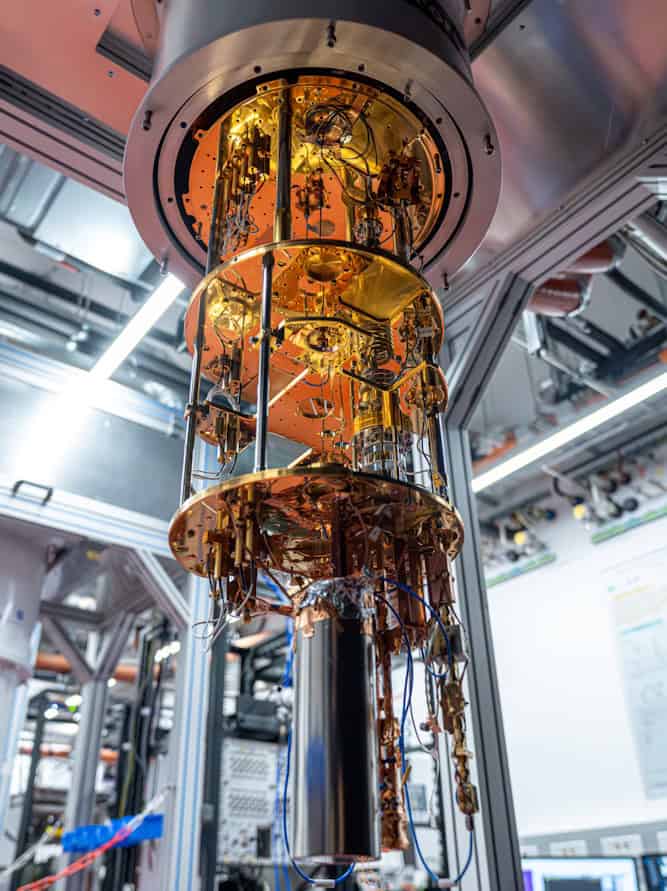
The practical limit of this setup is temperature: “We use microwave frequencies, which are only quantum at very low temperatures,” Andrés-Juanes explains. “The real limit in the separation is how big your dilution refrigerator is”, with the longest such link so far being 30 m, at ETH Zurich. He positions the work as an intermediate-distance technology rather than a long-distance one. At optical frequencies, the constraint would lift, though achieving the same strong qubit–waveguide coupling in an atomic system would be its own problem.
For now, the numbers are modest: two qubits, entangled with a concurrence of just 0.10 (on a scale where 1 is a perfect pair), inheriting only about a tenth of the entanglement carried by the microwave beams. The group is working on a module with more than one qubit per node.
But critically, the idea is no longer theoretical. The team has now realised an entangled link that is always “there”, bringing us one step closer to distributed quantum computing (linking separate processors into one machine via entanglement), networked sensing (detectors sharing entanglement to jointly see what none could alone) and quantum repeaters (relay stations for long-distance quantum links, needed because a quantum state can’t be copied and amplified like a classical signal).

 Login