
❌

Normal view

Topology affects the crumpling of growing elastic sheets
6 August 2026 at 09:10
Photo of a structure with topologically-induced dimples
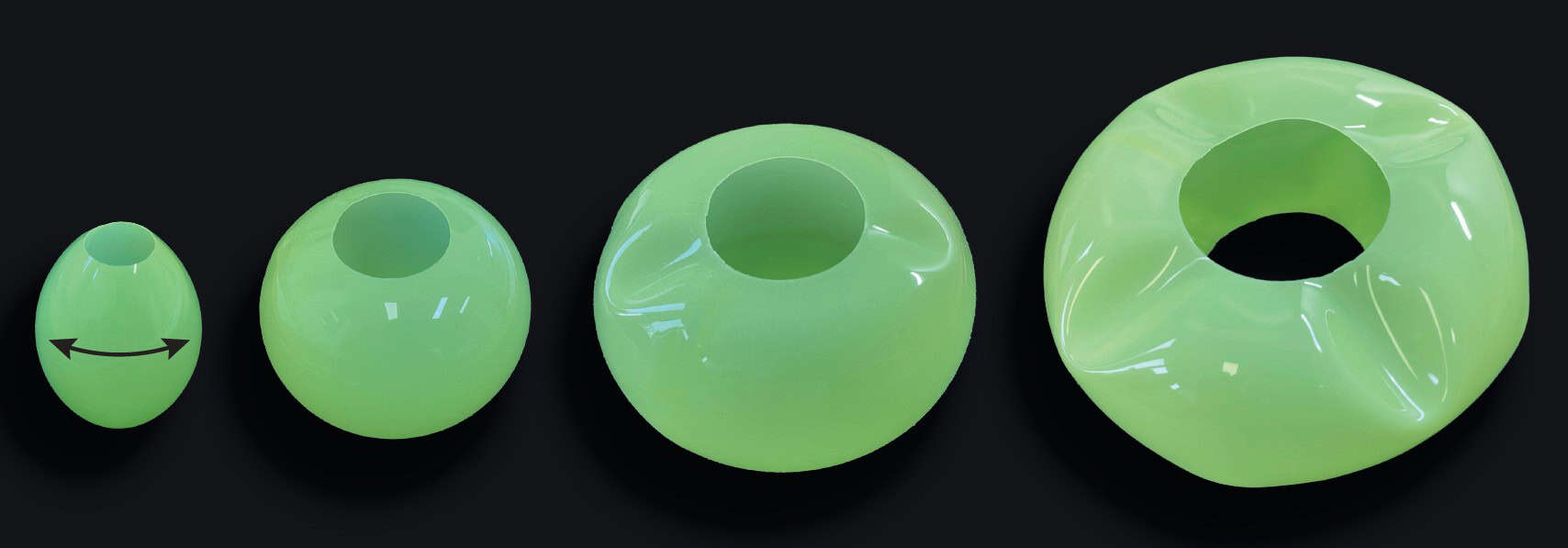
More dimples A series of hollow objects made from elastic sheets. The size of the objects increases in the directions indicated by the arrows. The number of buckles in the object is seen to increase as its shape changes. (Courtesy: Yafei Zhang)

A new mechanism governing the geometric shapes of growing elastic sheets has been identified by a trio of physicists in Israel. Through a combination of simulations and experiments, Eran Sharon and colleagues at the Hebrew University of Jerusalem showed that the dimpled patterns that form in a growing elastic object have topological origins.

This mechanism is unrelated to geometric incompatibilities, which are known to dimple natural materials. The discovery could lead to a deeper understanding of how complex shapes emerge in the natural world – and to the development of new artificial materials.

Thin sheets are ubiquitous in nature: examples include leaves, petals, and the cellular linings of organs and blood vessels. The complex makeup of natural sheets means that local regions within them have preferred mechanical rest states that are incompatible with those of other regions. As a result, there is no way to arrange the sheet so that every part is simultaneously stress free – leading to effects like wrinkling, bending, and buckling.

Called geometric incompatibility, this phenomenon is responsible for numerous geometric forms in the natural world, enabling growing tissues to shape themselves without any external influence. For some time, researchers have attempted to mimic these natural mechanisms in synthetic materials.

Richness of shapes

“Looking at natural growth processes, as in plants growth, or embryo development, we see amazing richness of shapes and shape development that currently cannot be achieved with conventional fabrication methods,” says Sharon.

Sharon’s group has already shown that many patterns in nature can be understood in terms of the Gauss and Mainardi-Codazzi-Peterson incompatibilities – which were developed in the 19th century. Together with team member Michael Moshe, whose group explores the interplay between mechanics and geometry in soft materials, their work led to discoveries including the mechanical origins of shape selection in rose petals.

Now, Moshe and Sharon have teamed-up with Yafei Zhang to identify a phenomenon that cannot be explained by those mechanical instabilities. In their experiment, they started with a uniform elastic sheet formed into a hollow sphere, with circular holes at each pole. When they added wedges of material into the sheet to mimic growth, it initially behaved like a smooth, growing sphere – but only up to a certain point.

Missing mechanism

“The growing sheet satisfies the established local compatibility conditions, and is thus expected to show smooth ‘boring’ shape,” Moshe explains. “Yet it unexpectedly, develops a crumpled appearance, suggesting that an important shaping mechanism was missing from the existing framework.”

Important clues came when the team cut into the crumpled sphere along a meridian, from pole to pole. Instantly, the crumpling disappeared, and the sphere relaxed back to its original smooth shape. This effect also occurs in simulations of a smoothly growing sphere.

With no changes to the Gauss or Mainardi-Codazzi-Peterson incompatibilities governing the mechanical forces in the sheet, the trio concluded that the sudden transformation emerged from an entirely different mechanism, rooted in the mathematical principles of topology. In this view, unlike smooth geometric transformations such as bending, stretching, or twisting, which preserve a shape’s mechanical properties, cutting introduces a sudden transformation that changes its mechanical behaviour.

In this way, the meridional cut brought the sphere into a new topological state. “Unlike conventional incompatibility, this frustration is topological in character, and can be quantified by a global measure,” Moshe explains. “It provides a new mechanism by which growing sheets can select complex, wrinkled or dimpled shapes.”

The trio’s discovery now raises new mathematical questions about the limits of growing elastic sheets, beyond which their smooth geometries can no longer be maintained. “What we have discovered that the geometrical principles we knew before should be supplemented with topological considerations, leading to an even wider class of shaping principles,” Sharon says. “This allows a better understanding of morphogenetic processes and expands our abilities to shape synthetic structures.”

In turn, the team’s insights could uncover new understanding of how shaping mechanisms could be harnessed, perhaps leading to the discovery of new metamaterials, with shapes and mechanical functions programmed into their growth.

The research is described in Physical Review Letters.

The post Topology affects the crumpling of growing elastic sheets appeared first on Physics World.

Structured light could deliver a new method for diagnosing eye disease

20 July 2026 at 15:00

By controlling a type of polarized light widely used in quantum optics, researchers have transformed subtle optical patterns in our peripheral vision into vibrant, easily perceptible shapes. Led by Dusan Sarenac at the University of Waterloo, Canada, the team showed for the first time that the “Boehm’s brushes” perceived by participants can be altered by adjusting the topology of spin-orbit coupled light. Their results, reported in Proceedings of the National Academy of Sciences, could lead to promising new techniques for checking our eye health.

For the most part, human eyes are incapable of detecting polarization in visible light. But in some rare cases, structures inside the eye itself can scatter light in different ways depending on its polarization, creating subtle yet perceivable “entoptic” patterns. Perhaps the best-known examples of these are “Haidinger’s brushes”: hourglass-shaped patterns that can form in our central vision, but only when viewing linearly polarized light at blue wavelengths.

In 1940, Swiss biophysicist Gundo Boehm discovered another example: a two-lobed, bowtie-shaped entoptic pattern that forms when viewing linearly polarized light in the peripheral vision as it scatters from subcellular structures in the inner retina. Unlike Haidinger’s brushes, this lesser-known effect is driven by angular variations in scattering strength relative to the polarization direction.

But as Sarenac explains, these ethereal shapes are more than just a curiosity. “Because retinal disease may alter a person’s ability to perceive the pattern, researchers have long considered whether Boehm’s brushes could serve as a biomarker of retinal health,” he says. “However, their weak visibility has limited practical use.”

Whereas previous studies simply asked participants to passively observe the effect, Sarenac’s team considered what would happen if the light’s polarization was constantly varied. To explore this possibility, the researchers created a beam of spin-orbit coupled light, in which polarization is linked to the light’s orbital angular momentum – a property describing how the wavefront twists as the beam travels – so that the polarization direction rotates steadily across the beam.

In quantum optics, these structured waveforms are already being widely explored for their possibilities in imaging, communication and information processing. But for the first time, Sarenac’s team considered how our eyes could actually perceive this light. “We engineered the spatial polarization of the light to match the symmetry of the retinal scattering response,” Sarenac describes. “This allowed many weak local contributions to reinforce one another.”

The researchers then projected this structured light through a ring-shaped aperture, targeting specific regions in the periphery of participants’ retinas, which could also be adjusted to target varying distances from the centre of vision. Using an automated test, they measured how much contrast participants needed to reliably distinguish a Boehm’s brush from the background at these varying distances.

Based on the subject’s responses, Sarenac’s team determined that the use of spin-orbit coupled light not only made Boehm’s brushes appear far more vivid to the participants, it also transformed the bowtie shape into a multi-lobed pattern, with the number of lobes varying depending on the topology of the light’s twisting polarization.

“Across 11 participants, detection thresholds improved exponentially away from the centre of vision, and the pattern became robustly visible at approximately one degree of retinal angular distance,” Sarenac describes. These results reveal a fascinating link between human vision and quantum mechanics, which the team hope could be harnessed in practical healthcare. With further studies involving patients with retinal disease, they now envisage eye tests where retinal conditions could be diagnosed in people who can’t clearly perceive vibrant, multi-lobed Boehm’s brushes in their peripheral vision.

“In the longer term, these patterns may provide a non-invasive functional probe of retinal integrity because their shape and visibility can be measured across different retinal locations,” Sarenac says.

The post Structured light could deliver a new method for diagnosing eye disease appeared first on Physics World.

Satellite-based sensor system designed to detect nuclear weapons in space

13 July 2026 at 15:00

For decades, the Outer Space Treaty (OST) has prevented any nation from placing nuclear weapons in space. To date, however, no mechanisms have been put in place to determine whether a signing member’s satellite may be violating this treaty, or even developing other nuclear capabilities that the original treaty never considered.

Through new analysis of the problem, Areg Danagoulian at MIT suggests a safe and feasible approach to monitoring suspicious satellites, using neutrons emitted as radioactive material is impacted by naturally occurring protons in the Van Allen radiation belt.

At the height of the Cold War in the 1960s, there seemed a growing possibility that space could be used as a platform for developing nuclear weapons. With the prospect of nuclear strikes being launched from orbit with practically no warning, both the US and Soviet governments recognised the possibility of miscalculations by either side leading to a catastrophic nuclear conflict.

In 1967, this led to the signing of the OST: which in part, demands that no signing member should ever deploy nuclear weapons in orbit, on celestial bodies or in outer space. Today, it has been signed by 117 countries, including the US, Russia and China. However, in the decades since the treaty’s origins, both political and technological landscapes have profoundly transformed, creating entirely new concerns that nobody could have conceived in the 1960s.

“In 2022, Russia launched the Kosmos 2553 satellite, which the US has determined is a platform for testing components for a future nuclear anti-satellite weapon,” Danagoulian says. With the ability to target orbiting satellites, such a programme could ultimately destroy vital communication and navigation systems – bringing society to a standstill without any direct strike on the ground.

Despite this threat, no robust mechanism has ever been developed for verifying whether a country is violating the OST, and to date, very little research has even considered the problem.

To Danagoulian’s knowledge, the only related study was an undergraduate thesis by Stanford University student Isobel Portenous – who proposed that suspicious satellites could be probed for nuclear material by measuring radioactivity in the vicinity. However, not only is space already highly radioactive, likely drowning out the signal from a single satellite; it would also require spacecraft to closely approach the satellite, which could be interpreted as a hostile act.

To address this challenge, Danagoulian considered how satellites could instead by probed by naturally occurring, highly energetic protons in the Van Allen radiation belt: which mostly originate from the solar wind, and become trapped by Earth’s magnetosphere.

When interacting with nuclear material in a suspect satellite, “these protons would trigger a process known as spallation in the uranium radiation case of the thermonuclear weapon,” Danagoulian explains. “This would produce a large flux of neutrons that can be detected and used as a fairly specific signature of a nuclear weapon.”

Crucially, the kind of device needed to detect these neutrons wouldn’t need to be too close to the satellite. From a distance of 4 km, Danagoulian calculated that a standard CubeSat detection platform could accurately determine the composition of the nuclear payload of a satellite like Kosmos 2553, within just a week of measurement time.

For now, much more work will be needed before this kind of mechanism can be realistically applied. “Uncertainty remains regarding whether this approach will be practical, so much work is still needed,” Danagoulian says. “Can one build a reliable detector array to perform this measurement? That’s to be determined.”

Yet if these hurdles can be overcome, they could provide a valuable new layer of security in a fast-changing world, and could potentially guide new international policy decisions. “The required physics and basic technology are available to solve this problem,” Danagoulian continues. “If an inspector satellite can be built, it will finally create a mechanism for verifying the OST.”

The study is reported in Nature.

The post Satellite-based sensor system designed to detect nuclear weapons in space appeared first on Physics World.

❌