NASA is testing the communications and radar hardware for a proposed Mars aircraft mission called SkyFall. The project is still on Earth, but its engineers are working through the details that would allow three small aircraft to fly in the thin Martian atmosphere and send useful data back to a rover or an orbiter. A […]
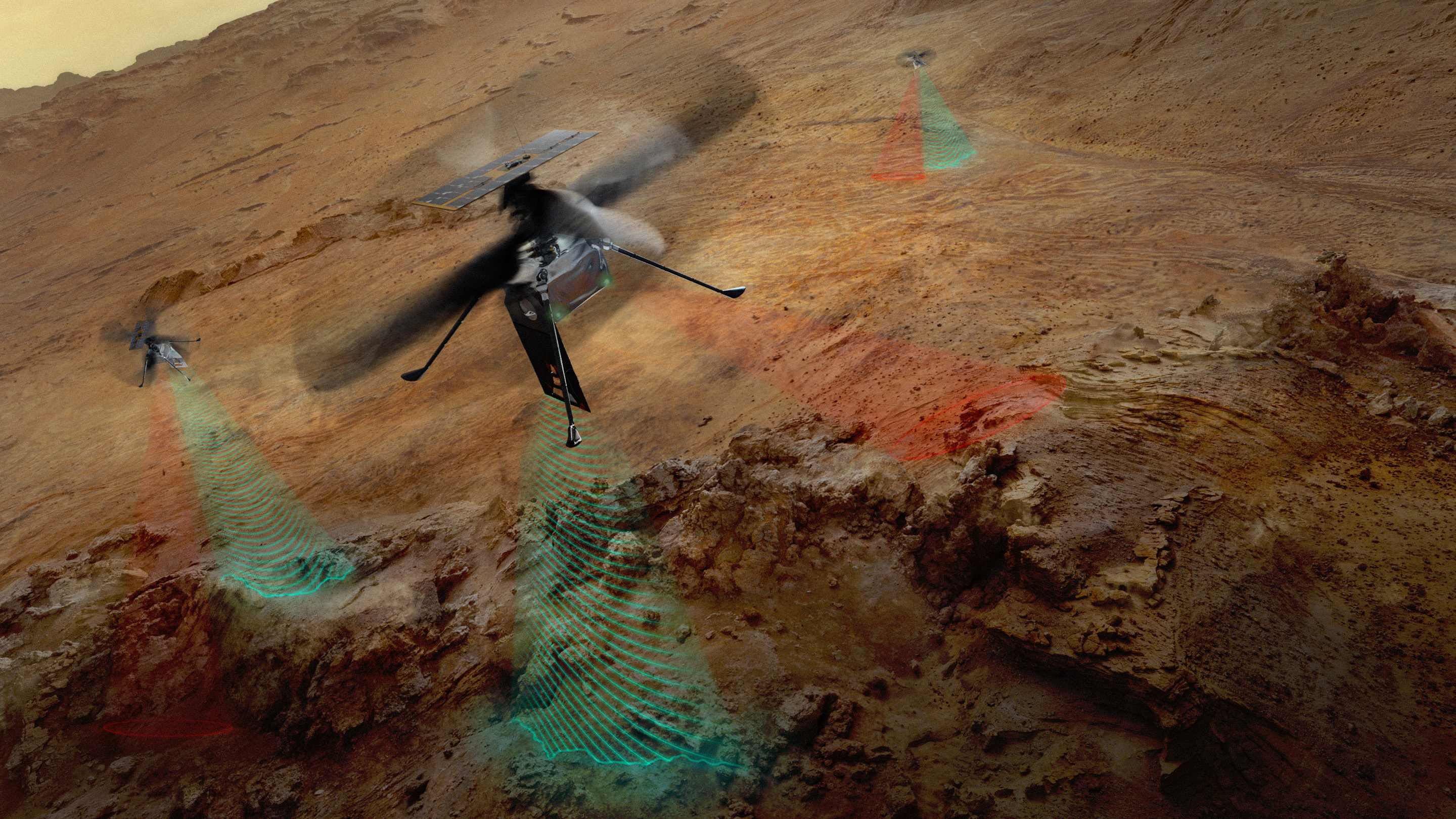
NASA’s SkyFall Helicopters at Work (Artist’s Concept)
PIA26760
Credits: NASA/JPL-Caltech
Downloads
NASA’s SkyFall Helicopters at Work (Artist’s Concept)
JPEG (3.25 MB)
Description
This artist’s concept depicts NASA’s three SkyFall Mars helicopters collecting data while flying over the surface of the Red Planet.
The green frequency waves emanating from the helicopters’ large antennas depict collection of subsurface radar data. The red beams depict collect near-infrared imagery data from regolith (crushed rock and dust) and other surface features.
Equipped with four instruments each, the three helicopters will follow in the footsteps of the agency’s Ingenuity Mars Helicopter, a technology demonstrator that flew 72 times over nearly three years, proving that powered, controlled flight is possible in the rarefied Martian atmosphere. It also demonstrated how an aerial perspective can generate valuabledata by helping NASA’s Perseverance Mars rover team plan time-saving routes and choose locations for science-gathering.
The SkyFall project, which will carry three Mars helicopters to the Red Planet in December 2028, is managed by NASA’s Jet Propulsion Laboratory. AeroVironment of Arlington, Virginia — which worked with JPL to design and build the history-making Ingenuity rotorcraft — will co-design and co-manufacture the SkyFall helicopters. Managed by Caltech for NASA, JPL manages the overall Mars Exploration Program on behalf of NASA’s Science Mission Directorate in Washington.
SkyFall ground-penetrating radar engineer Maya Román connects a coaxial cable to a test antenna in the Environmental Test Lab’s electromagnetic interference testing chamber at NASA’s Jet Propulsion Laboratory in Southern California.
The antenna was pointed up during test to minimize reflections and interferences with the antenna pattern during the measurement.
Equipped with four instruments each, the three SkyFall aircraft will follow in the footsteps of the agency’s Ingenuity Mars Helicopter, which flew 72 times over nearly three years, proving that powered, controlled flight is possible in the rarefied Martian atmosphere. It also demonstrated how an aerial perspective can generate valuable data by helping NASA’s Perseverance Mars rover team plan time-saving routes and choose locations for science-gathering.
Franchir le mur du son sur Mars sans briser ses pales : c'est l'exploit que viennent de réussir les ingénieurs de la Nasa. Cette prouesse ouvre la voie à une nouvelle génération d'hélicoptères martiens, plus lourds, plus endurants, capables d'emporter de vrais instruments scientifiques.

 Login