❌

Normal view

Rare Meteorite From New Jersey Roof Strike Offers New Clues to the Origins of Life

1 August 2026 at 14:38

Not all meteorites are created equal, and one that crashed through the roof of a New Jersey home is giving scientists a rare glimpse into the chemistry of an ancient asteroid while offering new clues to the puzzle of how life began on Earth.

On July 16, 2024, a daytime meteor streaked across the sky and produced a sonic boom as it passed south of the Statue of Liberty.

“A forensic study of the fragments revealed that they contained preserved bits from near the surface of a primitive asteroid where it experienced concentrated salty fluids—a process not previously known from this type of proto-planet world,” said lead author and meteor astronomer Peter Jenniskens of the SETI Institute and NASA’s Ames Research Center in California’s Silicon Valley in a statement.

Two years later, after analyzing fragments from the event, researchers found that the meteorite contained evidence of ancient salty fluids, complex organic chemistry, and processes that occurred on a primitive asteroid billions of years ago.

meteorite

Daytime meteor (left), impact site, and a fragment of the Hillsborough meteorite (Image Credit: (A) M. Kirschner and M. Hankey, American Meteor Society; [(B) to (D)] A. Gordon/SETI Institute).The findings, published in the journal Science Advances, come from an international team led by meteor astronomer Peter Jenniskens of the SETI Institute and NASA Ames Research Center.

“Our cameras in Northford, Connecticut, and Douglassville, Pennsylvania, as well as a doorbell camera in Wayne, New Jersey, captured the meteor, and from that we measured its trajectory,” said American Meteor Society operations manager Mike Hankey. 

Traveling at approximately 32,000 miles per hour (14.4 kilometers per second), witnesses from the surrounding areas, including New York, New Jersey, Connecticut, Rhode Island, and Pennsylvania, reported seeing a bright fireball that broke apart while a part of it broke through the roof of a New Jersey residence.

“The path traced back to low in the asteroid belt,” Hankey adds. 

Using footage from meteor cameras, including systems in Connecticut and Pennsylvania, researchers reconstructed the meteor’s path. The trajectory traced back to a region of the asteroid belt between Mars and Jupiter. The space rock disappeared from view about 22 miles above the surface. Shortly afterward, weather radar at Newark Airport detected a cloud of falling debris stretching from Staten Island into New Jersey. 

The homeowner acted quickly, handling the space rock with gloves and aluminum foil before placing it in a glass container to protect the material from contamination.

The meteorite was classified as a CM1/2 carbonaceous chondrite, a rare type of primitive meteorite known for containing organic compounds and evidence of water weathering. 

According to researchers, the Hillsborough meteorite is only the second witnessed fall of a CM1/2 carbonaceous chondrite ever recorded. Most known CM meteorites belong to the less-altered CM2 category, while no CM1-type meteorite fall has ever been observed.

Hillsborough meteorite
A fragment of the Hillsborough meteorite (Image Credit: SETI Institute).

“A high fraction of compounds were the product of organic chemistry with minerals,” said organic mass spectrometry specialist Phil Schmitt-Kopplin of Technical University Munich. “We do not know if these magnesium organic compounds were contributed by brine chemistry or were simply left over from earlier impact shock processes.”

The final analysis showed tiny salt-rich pockets inside the meteorite, pointing to a formation where water once evaporated on its parent asteroid, leaving behind highly saline fluids. Scientists are comparing these minerals with samples from the asteroids Ryugu and Bennu to better understand early solar system chemistry.

These ancient salty waters may have helped protect and change the molecules needed for life before life first began. The meteorite contained carbon, nitrogen, amino acids, and other organic compounds, many of which appear to have formed through interactions between water, minerals, and carbon-rich chemistry.

“We are thrilled that nature delivered such a precious asteroid sample on our doorstep,” said curator Denton Ebel from the Department of Earth and Planetary Sciences at the American Museum of Natural History.

The recent paper, “Meteor over New York City: Brines in a primitive CM asteroid,” appeared in the journal Science.

Chrissy Newton is a PR professional and the founder of VOCAB Communications. She currently appears on The Discovery Channel and Max and hosts the Rebelliously Curious podcast, which can be found on YouTube and on all audio podcast streaming platforms. Follow her on X: @ChrissyNewton, Instagram: @BeingChrissyNewton, and chrissynewton.com. To contact Chrissy with a story, please email chrissy @ thedebrief.org.

SETI Researchers Are Expanding the Search Beyond the ‘Water Hole’

31 July 2026 at 13:20

Astronomers searching for extraterrestrial intelligence have traditionally focused on a specific, narrow band of the radio spectrum. However, a new survey presented at the Royal Astronomical Society‘s National Astronomy Meeting (NAM2026) in Birmingham suggests that this approach may overlook a significant portion of the available frequencies.

The frequencies most often investigated by SETI (Search for Extraterrestrial Intelligence) programs are those between 1.42 and 1.66 GHz. This range, known as the ‘water hole’, is situated between the natural radio emissions of hydrogen and hydroxyl, the two molecules that make up water. Astronomers have regarded this quiet section of the spectrum as a reasonable place for interstellar communication, because any civilization acquainted with these molecules would probably also decide to send and receive signals in search of in that specific region.

Louisa Mason, who is carrying out research as a PhD student at the University of Manchester, focused on investigating frequencies outside the water hole range. To carry out the first SETI survey with that telescope, she used archived data from the Atacama Large Millimeter/submillimeter Array (ALMA) in Chile. She analyzed data originally collected for other astronomical studies instead of requesting new observation time.

Hunting for Signals in Unclaimed Territory

Mason focused on two narrow frequency bands in the ALMA Band 3 data, looking for narrowband signals that might be the result of technology rather than natural astrophysical origins. In the four observations that she examined, she did not discover any candidates for technosignatures above her detection threshold.

“For decades, SETI searches have concentrated on a relatively small part of the radio spectrum. We wanted to ask what might happen if we looked somewhere very different,” Mason said. “The millimetre and submillimetre radio bands remain almost completely unexplored for SETI, so this is really about opening up a new area of parameter space to search.”

A lack of results does not rule out the possibility of alien transmitters. It only means that none appeared in this specific region of the sky and frequency range. Mason describes the survey as a proof of concept, showing that high-frequency telescopes like ALMA could play a much larger role in future SETI efforts.

A Much Bigger Haystack Than Anyone Realized

The research also revealed a gap in how astronomers count the stars they have actually examined. Each time a telescope observes a single target, it also collects light from many other stars in the same field of view. Researchers refer to this as “stellar bycatch.”

Previous SETI surveys have made this bycatch estimate based on the Gaia catalog, which is the European Space Agency‘s survey of the stars. However, Gaia has certain limitations such as its magnitude cutoffs, uncertainties when measuring distant stars, and difficulties in crowded areas. To overcome these limitations, Mason used the Besançon Galactic Model, a simulation of the Milky Way’s stellar population that includes stars that are too faint or too far away for Gaia to detect.

When Mason applied the model to a previous survey of 1,327 telescope observations, the estimated number of stars observed increased from about 288,000 with Gaia to over 6.1 million with the galactic simulation.

“One of the most exciting things about this work is realizing that we’ve surveyed many more stars than initially thought,” Mason said. “Even a very small observation can contain a huge number and diversity of stars that we might never have intended to study. By combining high-frequency observations with galactic simulations, we can better understand exactly what we’ve searched and where we should look next.”

Recommendations for SETI

Mason carried out this research in collaboration with Professor Michael Garrett, Dr. Andrew Siemion, and Dr. Kelvin Wandia. The team argues that expanding both the radio frequencies searched and the number of stars included could reduce the influence of human assumptions on SETI strategies. Whether these broader searches will detect technosignatures missed by traditional water-hole surveys remains unknown.

Austin Burgess is a writer and researcher with a background in sales, marketing, and data analytics. He holds an MBA, a Bachelor of Science in Business Administration, and a data analytics certification. His work focuses on breaking scientific developments, with an emphasis on emerging biology, cognitive neuroscience, and archaeological discoveries.

Astronomers May Have Been Looking for Alien Megastructures Around the Wrong Stars

20 July 2026 at 12:58

Some of the most promising locations to search for possible alien megastructures, known as Dyson spheres, may not be stars like the Sun, but rather the galaxy’s smallest and dimmest stars.

Physicist Freeman Dyson introduced the idea of a Dyson sphere in 1960, describing it as a shell or, more realistically, a swarm of orbiting collectors that could capture most of a star’s energy. This concept has interested scientists searching for signs of advanced technology, but the question of how such a structure would appear in astronomical observations remained unknown.

Now, a new study, available on the arXiv preprint server, suggests that one of the coldest objects in a stellar system could, in principle, be an artificial megastructure rather than a natural astronomical object.

Amirnezam Amiri, a physicist at the University of Arkansas, explored the question of Dyson spheres by modeling these hypothetical megastructures around two often-overlooked types of stars: red M-dwarfs and white dwarfs. Amiri credits discussions with Harvard astronomer and founder of the Galileo Project, Avi Loeb, with helping shape the study.

Small, Dim, and Built to Last

Red dwarfs make up about 70% of the stars in the Milky Way. These stars burn slowly and can remain stable for trillions of years, much longer than the universe has even existed so far. White dwarfs offer a different benefit. As the dense remnants of stars like the Sun, they shrink to about 1% of their original size. This means a Dyson swarm could orbit much closer, requiring less material and a smaller structure than one built around a star like the Sun.

Amiri’s study explores how astronomers could detect such structures. Both red dwarfs and white dwarfs are dim enough that the infrared heat emitted by a Dyson swarm would stand out more clearly against the star’s own light.

Reading the Wreckage on a Star Chart

Astronomers use the Hertzsprung-Russell diagram to classify stars by temperature and brightness, and this tool is central to Amiri’s analysis. A Dyson swarm would not destroy a star’s energy, but would capture its light and re-emit it as heat at much longer wavelengths. 

In the new model, a star with a Dyson swarm would appear on the H-R diagram at the same luminosity but shifted dramatically toward the cool end. For instance, a red dwarf at about 3,000 K could appear surrounded by a shell as cold as 50 K, a difference of about two orders of magnitude. No known stars naturally occupy this region of the H-R diagram.

Identifying Factors

Dust and distant galaxies can also produce strong infrared emissions, so astronomers cannot identify a Dyson swarm using temperature alone. Amiri’s model points to a more complex set of clues. A true Dyson swarm would not show the silicate dust features seen in normal dusty disks, so its spectrum would be unusually smooth for an object with strong infrared emission.

Additionally, if the swarm consists of many separate collectors rather than a solid shell, there would be gaps that cause irregular, non-stellar flickering as the pieces move. Each of these signs can have natural causes, but finding them together is rare and hard to explain without considering artificial structures.

Future Observations

Astronomers can carry out this search using existing telescopes. The James Webb Space Telescope’s infrared instruments are already designed to detect faint, cold signals like these. The Vera C. Rubin Observatory’s new sky survey and the Nancy Grace Roman Space Telescope, which is expected to launch later this year, will add to these efforts. Together, they will generate the kinds of observations needed to search for the signatures described in the study.

Possible candidates for these future observations have already been identified. In 2024, Project Hephaistos identified seven potential Dyson sphere candidates among about 5 million cataloged stars, all linked to red dwarfs. One was ruled out after it was shown that a background black hole caused the observed signal. Several candidate Dyson sphere systems still remain under investigation. Amiri does not claim that any of these are actual Dyson spheres, and the paper makes this clear. Instead, the study offers a better way to tell true anomalies apart from dusty disks before using valuable telescope time. If a Dyson swarm surrounds a star and reradiates its energy at temperatures unlike those of natural stars, upcoming infrared surveys may finally be able to detect one.

Austin Burgess is a writer and researcher with a background in sales, marketing, and data analytics. He holds an MBA, a Bachelor of Science in Business Administration, and a data analytics certification. His work focuses on breaking scientific developments, with an emphasis on emerging biology, cognitive neuroscience, and archaeological discoveries.

Seeking Technosignatures in Polluted White Dwarfs

15 July 2026 at 17:00

white dwarf with debris disk

White dwarfs often show signs of metals in their spectra, providing evidence that these evolved stars have accreted planetary material. Could white dwarf spectra also provide evidence for technological activity in these star systems?

A Record of Planets Past

When a Sun-like star reaches the end of its hydrogen-burning lifetime, it first puffs up into a red giant before exposing its white-hot core, which evolves into a white dwarf. This dramatic transition shakes up any planets that happened to be orbiting the star, and some close-in planets may end up crumbling apart, their rubbly remains peppering the surface of the white dwarf.

So far, astronomers have found hundreds of white dwarfs that appear to be polluted with heavy elements from their destroyed planets. These observations provide a valuable look into the bulk compositions of planetary materials outside our solar system. They may also provide a way to detect patterns of chemical abundances that are not natural, resulting from technological processes like industrial refining or the creation of alloys — in other words, a technosignature that is evidence of not just life, but technologically advanced life.

Seeking Signs of Technology

abundances of meteorites compared to white dwarfs

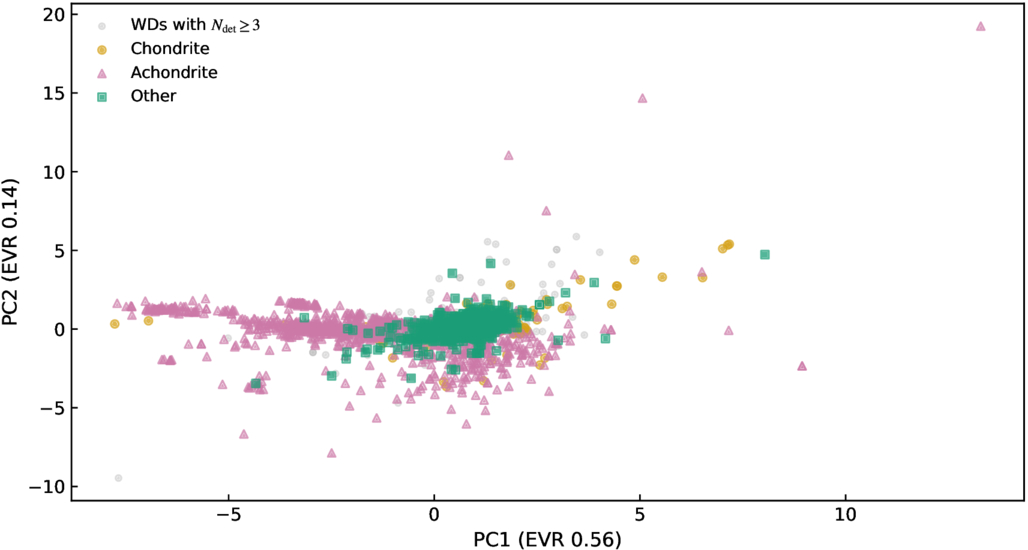
Representation of the chemical abundances of meteorites (pink, orange, and green) and white dwarfs (gray). Most white dwarf abundances overlap with the parameter space defined by the meteorite sample. Click to enlarge. [Huang et al. 2026]

A team led by Bo-Lun Huang (黄博伦) from Beijing Normal University recently investigated whether there is evidence for chemical technosignatures in the current sample of polluted white dwarfs. Huang and collaborators began their investigation with a catalog containing 697 measurements of white dwarfs with metals in their spectra. They applied Bayesian statistical methods to weigh the hypothesis that the chemical makeup of these white dwarfs is entirely natural against the possibility that they contain a blend of natural and technologically altered material.

The team used thousands of chemical abundance measurements from meteorites as a reference for the natural bulk composition of planetary material. For the mixture of natural and processed material, they combined the meteorite reference material with a template that is metal-rich and silicate-poor, with enhanced amounts of iron, nickel, chromium, and manganese.

plot showing evidence for a natural + processed model relative to a natural model as a function of the number of elements detected

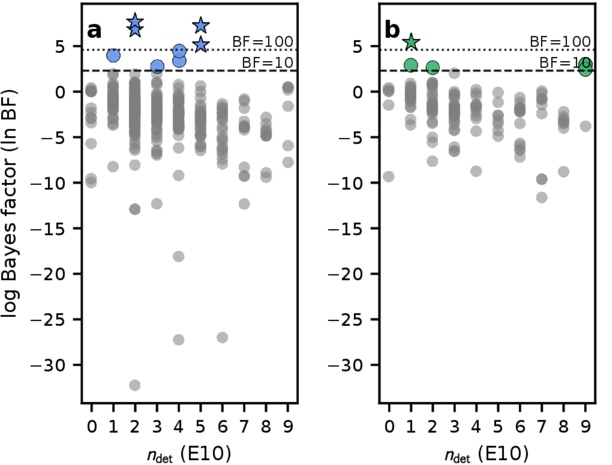
Evidence for a model including technologically processed material relative to a purely natural model, as a function of the number of elements detected in the white dwarf. ndet = 0 indicates that only upper limits were obtained on elemental abundances. Higher Bayes factors indicate stronger evidence. The left-hand plot is based on abundances measured from the white dwarfs’ photospheres, while the right-hand plot uses abundances adjusted for diffusion within the white dwarf. Click to enlarge. [Adapted from Huang et al. 2026]

No Strong Evidence, but a Path Forward

Ultimately, Huang’s team found that strong statistical support for the existence of technological processes was uncommon, though there were certain measurements in their sample of white dwarfs that were difficult to reconcile with a solely natural model.

Perhaps unsurprisingly, the team also found that the quality of the chemical abundance measurements affected the constraining power of the observation; some white dwarfs had upper limits for just a few elements, while others had definitive detections of many elements. They found that the most discerning observations recorded iron, magnesium, chromium, and titanium, plus either nickel, silicon, or sodium.

While this work didn’t dredge up firm evidence for technological activity, it provides a jumping-off point for future searches. The handful of white dwarfs in this sample that were fit poorly by a purely natural model could be compared against other technosignature models or targeted with high-resolution spectroscopy. Future measurements of iron and magnesium in polluted white dwarfs may be useful as a preliminary screening tool, helping to pick out intriguing targets for follow-up observations.

Citation

“A Calibrated Bayesian Search for Potential Chemical Technosignatures in Polluted White Dwarfs,” Bo-Lun Huang et al 2026 ApJ 1006 9. doi:10.3847/1538-4357/ae742c

The post Seeking Technosignatures in Polluted White Dwarfs appeared first on AAS Nova.

“Disclosure Day” in Real Life? Scientists and Mental Health Advocates Update Rules for Alien Contact as “Disclosure” Debate Grows

11 June 2026 at 20:31


For decades, the possibility of discovering extraterrestrial intelligence has captured the imagination of scientists, sci-fi enthusiasts, filmmakers, and the public alike.

In line with such efforts, the IAA SETI Committee and the uNHIdden Foundation, two separate not-for-profit organizations, have recently released updated rules for evaluating and disclosing detections, and preparing for public preparedness in the event of potential disclosure of extraterrestrial intelligence.

With the release of director Steven Spielberg’s new alien film Disclosure Day, nearly coinciding with the recent release of the government records from the Department of War related to UAP, it seems a growing number of individuals, from the film industry to the science community, have extraterrestrials and “disclosure” on their minds. 

The IAA SETI Committee Rules 

In June 2026, the International Academy of Astronautics (IAA) approved a major update to the protocols governing the evaluation, verification, and communication of evidence related to extraterrestrial intelligence. The revised guidelines were designed to address a modern information environment shaped by social media, artificial intelligence, and the rapid pace of the 24-hour news cycle.

Professor Michael Garrett, Sir Bernard Lovell Chair of Astrophysics, led the international effort to revise the long-standing post-detection protocols used by researchers engaged in the search for extraterrestrial intelligence. The updated guidelines have since been formally ratified by the IAA.

“The information environment we operate in today is vastly more complex than it was in 2010,” said Garrett, Chair of the IAA SETI Committee, in a statement. “In an era of deepfakes, automated misinformation, and instant global connectivity, a single unverified claim could trigger confusion or panic. These new protocols ensure that scientists maintain the highest standards of evidence before making announcements to the world.”

The revised declaration reflects the broader scope of modern SETI and technosignature research. Since the previous guidelines were adopted in 2010, advances in technology have enabled scientists to investigate the entire electromagnetic spectrum, including excess infrared heat signatures that could indicate megastructures, optical laser emissions, and even multi-messenger signals.

The updated framework also addresses modern challenges, including protections for researchers who may face harassment, doxxing, or intense media scrutiny. It further emphasizes the importance of distinguishing verified scientific data from viral rumors, hoaxes, or terrestrial interference.

“The last significant update was more than 15 years ago, and the world has changed a lot since then,” Andrew Siemion, Ph.D., Astrophysics and Director of SETI Research, said an email to The Debrief. “With the tremendous renaissance we are seeing in the technosignature field, and the advent of incredibly powerful AI tools, the prospect for a discovery of extraterrestrial intelligence has sharpened considerably.”
“In recognition of these developments, the IAA SETI Committee undertook a multiyear expansive effort to work with scientists across the world and across disciplines to present the most up-to-date guidelines possible to the community,” Siemeon said.

New Contact Rules at SETI

At the heart of the new guidelines is a familiar scientific principle: extraordinary claims require extraordinary evidence.

Under the revised protocols, no public announcement should be made until a signal or artifact has been rigorously verified by independent organizations using different instruments and methodologies.

“We do not shout ‘alien’ the moment we see a strange blip,” said Garret in a statement. “The scientific method demands we check, check again, and then ask others to check. Only when we have reached a consensus that a signal is credible do we bring it to the world.”

While the protocols explain how to share discovery news, they make one rule clear: no reply should be sent.

“The threshold for ‘extraordinary evidence’ is subjective,” Siemion says. “Because of the vast diversity of modalities in which a technosignature might manifest, it is impossible to state explicitly the criteria that would meet this threshold under all circumstances.”

“In the case of a coherent electromagnetic signal, like a narrowband carrier or a series of laser pulses, an example of ‘extraordinary’ would be if we repeatedly detected the signal at the same location with multiple independent observatories,” Siemion adds.

He also noted that, for a transient signal, compelling evidence might include multiple lines of data indicating that it traveled through interstellar space. Determining whether a phenomenon truly originated from extraterrestrial technology would likely be a lengthy process, with evidence presented, challenged, and reassessed over time.

The declaration reinforces that any response to extraterrestrial intelligence would be a decision for all humanity and should only occur following international consultation, particularly through the United Nations.

With the updated declaration now ratified by the IAA Board, it will be shared with stakeholders, including the United Nations. A formal presentation of the protocols is scheduled for the International Astronautical Congress (IAC) in Türkiye later this year.

“The release of these updated rules and protocols marks an important step in acknowledging both the radically different media landscape that science functions within today, and the vastly expanded efforts in terms of technology and resources being deployed in the search for intelligent life beyond Earth,” said Bill Diamond, President and CEO of the SETI Institute and IAA SETI Committee member. “We applaud Prof Garrett’s leadership in developing these new protocols and the IAA for their ratification.” 

First Contact and Humanity’s Mental Health

Another nonprofit organization has taken a different approach, focusing on the potential psychological and public-health implications of disclosure. The uNHIdden Foundation, whose mission is to support mental health related to Unidentified Anomalous Phenomena (UAP), recently released a preparedness framework addressing the societal impact of a paradigm-shifting discovery.

If governments prepare for natural disasters, pandemics, and other low-probability, high-impact events, should humanity also consider preparing for the possibility of contact with another intelligent civilization?

On June 8, uNHIdden Foundation Founder and Chairman John Priestland, alongside clinical spokesperson Dr. Martin Abbas, launched what they describe as the first public-health preparedness framework focused on disclosure-related scenarios.

Developed by healthcare practitioners, physicians, clinical psychologists, and public-health specialists, “Preparing for Disclosure: A Public Health Framework for Paradigm-Shifting Revelations” examines how society might reduce harm, build resilience, and support individuals processing a profound shift in humanity’s understanding of its place in the universe.

“This report is not a prediction. It is a preparedness exercise,” Priestland says. “Governments prepare for all kinds of low-probability, high-impact events.”

“Our view is that if a paradigm-shifting disclosure were ever to occur, we should at least have thought about the human consequences in advance,” Priestland added. 

The report suggests that certain groups could be more vulnerable to disclosure-related distress, including individuals with pre-existing mental health conditions, those facing socioeconomic hardship, UAP experiencers, highly religious individuals, and some STEM professionals. The authors emphasize that the report neither predicts disclosure nor attempts to judge future discoveries; rather, it argues that preparedness is a prudent response to the possibility of transformative new information.

David Whitehouse, former BBC Science Correspondent, wrote the report’s foreword, arguing that planning is essential should such a discovery ever occur.

The new framework proposes several practical actions to be taken, which include:

  • Reducing stigma surrounding anomalous experiences and disclosure-related concerns
  • Building public resilience and psychological flexibility
  • Developing trusted sources of information and support
  • Creating community conversation groups and peer-support networks
  • Strengthening mental health preparedness and triage capability
  • Encouraging collaboration between healthcare professionals, researchers, government, and civil society

The report argues that stronger community resilience, clearer communication during periods of uncertainty, and improved mental-health support would be critical not only during a disclosure event but during any large-scale societal disruption.

Ultimately, the question remains whether humanity is truly prepared—or whether a globally coordinated framework is still lacking. Voices ranging from the UAP community to figures within the U.S. government have argued that the public is ready. However, only time will tell what the result may be if confirmation of extraterrestrial intelligence were to arrive—and how humanity will collectively respond to the discovery.

Chrissy Newton is a PR professional and the founder of VOCAB Communications. She currently appears on The Discovery Channel and Max and hosts the Rebelliously Curious podcast, which can be found on YouTube and on all audio podcast streaming platforms. Follow her on X: @ChrissyNewton, Instagram: @BeingChrissyNewton, and chrissynewton.com. To contact Chrissy with a story, please email chrissy @ thedebrief.org.

The real disclosure day: The protocols for announcing extraterrestrial intelligence

11 June 2026 at 18:10

In Steven Spielberg’s Disclosure Day, opening tomorrow, protagonists race across the globe to expose a decades-long government cover-up and reveal to the world that extraterrestrial life is real. It’s a question Spielberg has been asking since his 1977 Close Encounters of the Third Kind: How would the knowledge of extraterrestrial intelligence change us? Spielberg makesContinue reading "The real disclosure day: The protocols for announcing extraterrestrial intelligence"

The post The real disclosure day: The protocols for announcing extraterrestrial intelligence appeared first on Astronomy Magazine.

Selections from 2025: Could Earth Detect Earth?

30 December 2025 at 17:00

Earth

Editor’s Note: For the remainder of 2025, we’ll be looking at a few selections that we haven’t yet discussed on AAS Nova from among the most-downloaded articles published in AAS journals this year. The usual posting schedule will resume January 2nd.

Earth Detecting Earth: At What Distance Could Earth’s Constellation of Technosignatures Be Detected with Present-day Technology?

Published February 2025

Main takeaway:

In a collaborative effort between the Search for Extraterrestrial Intelligence (SETI) Institute and the Penn State Extraterrestrial Intelligence Center, Sofia Sheikh (SETI Institute) and team turned inward to expand the search for intelligent life in the universe. Right here on Earth, humans have created a laboratory of technological signatures that can be detected from space — if another Earth-like civilization is out there, could they detect us? Using theoretical modeling, the authors determined the reaches of various human technosignatures such as radio transmissions, optical and infrared emission, satellites, and other probes sent into space. They found humanity’s strongest signals, radio transmissions, could be detected as far as 12,000 light-years away.

Why it’s interesting:

Scientists search for intelligent civilizations by hunting for signs of technology — signals or patterns that natural phenomena cannot explain. While we cannot expect other intelligent life to look exactly like Earth’s, many SETI projects have surveyed the skies for hypothetical signals far exceeding humanity’s own technological advancements. Taking a step back, Sheikh and collaborators considered where human technology is currently and what present-day instrumentation could pick up on if we were to search for ourselves. This “Earth detecting Earth” paradigm recenters the search for intelligent life and provides a multiwavelength framework for understanding the detectability of technology on far-away worlds.

Maximum detectability of Earth's technosignatures.

Maximum distances that Earth’s technosignatures could be detected by current technology. Click to enlarge. [Sheikh et al 2025]

Earth’s constellation of technosignatures:

What exactly are Earth’s many technosignatures, and how far could our current technology detect them? The most prominent and farthest detectable signal comes from radio transmissions. As the authors noted, these signals come from multiple sources: targeted radar transmissions used to characterize planets and asteroids, radio transmissions used to communicate between space probes and ground stations (e.g., space telescopes, Mars rovers, etc.), and radio leakage from Earth’s communication systems like cell towers and broadcasting stations. Additionally, there are atmospheric technosignatures from air-polluting compounds, optical and infrared emission from cities, targeted lasers from telescopes, and interplanetary and interstellar probes sent into space. All of these combined create a constellation of technosignatures detectable across a range of distances from Earth. This study underscores the importance of assessing Earth’s technology and detection capabilities, and repeating this type of study as technological advancements continue will enhance the search for intelligent life.

Citation

Sofia Z. Sheikh et al 2025 AJ 169 118. doi:10.3847/1538-3881/ada3c7

The post Selections from 2025: Could Earth Detect Earth? appeared first on AAS Nova.

The SETI Institute Searched For Signs of Technology From 3I/ATLAS—a New Paper Reveals What They Found

6 June 2026 at 15:06


Astronomers from around the world were fascinated last year when 3I/ATLAS, the third interstellar object ever observed passing through our Solar System, was discovered.

The SETI Institute was one of the many organizations that examined the unusual interstellar object, conducting a comprehensive search for any signs that it might be producing technological signals.

Using the Allen Telescope Array (ATA) at the Hat Creek Radio Observatory in Northern California, SETI researchers scanned a broad range of radio frequencies in search of potential evidence of extraterrestrial technology associated with 3I/ATLAS. The data that came back was clear: no signs of artificial signals. As most astronomers expected, 3I/ATLAS is most likely a natural comet. 

“We searched for narrowband signals across a broad range of spectrum: 1–10 GHz. We can do this efficiently due to the ATA’s ability to record and search billions of channels at a time,” says Dr. Sofia Sheik, lead author of a new paper describing the SETI Institute’s work, in an email to The Debrief.
3I/ATLAS
The interstellar comet 3I/ATLAS (Image Credit: International Gemini Observatory/NOIRLab/NSF/AURA/Shadow the Scientist)

Observations of interstellar objects have become more common in recent years, due to advances in telescopic technologies available to astronomers. Discovered last July, 3I/ATLAS is only the third confirmed interstellar visitor to enter our Solar System, preceded by 1I/ʻOumuamua in 2017, and 2I/Borisov in 2019. 

These rare discoveries help astronomers understand the materials in our cosmic backyard. By analyzing the composition of these objects, scientists can gain a deeper understanding of how planetary systems develop and evolve throughout the galaxy.

The Research 

The majority of recent astronomical observations indicate that 3I/ATLAS is a natural object, albeit one that exhibited some unusual qualities. However, the possibility remains that we may one day find a technological artifact from an intelligent civilization; it is equally possible that at some point, aliens may also discover a spacecraft of Earthly origin. 

“Eventually, our own Voyager spacecraft will be extraterrestrial artifacts in other stellar systems,” Sheik told The Debrief. “Given that, it is important that we understand the natural distribution of interstellar objects so that we will be able to identify any anomalies that could one day be signs of an artificial interstellar object.”

The SETI research team studied 3I/ATLAS for over seven hours using the ATA, searching radio frequencies from 1 to 9 gigahertz. This range is especially important because it can detect narrowband radio signals, which are rarely produced by natural space phenomena and are often considered possible signs of technological activity.

Researchers found 74 million narrowband signals, but after filtering out human interference and motion-matched sources, only about 200 remained. These were later confirmed to come entirely from Earth-based technology or satellites.

“To be clear, we did not detect any radio signals from 3I/ATLAS. We ruled out the presence of signals down to power levels comparable with everyday appliances: for example, we definitely would have picked up a cell tower or a radio station equivalent had it been on the surface of 3I/ATLAS,” Sheik said.

In other words, no technosignatures were detected. The SETI observation ruled out signals stronger than approximately 10 to 110 watts across the observed frequencies (comparable to the power consumption of a household appliance).

3I/ATLAS trajectory
NASA diagram showing the trajectory of the interstellar object 3I/ATLAS (Image Credit: NASA).

The Origins of 3I/ATLAS

For a time, there was a considerable amount of speculation over whether 3I/ATLAS could represent something more than just a natural object. Among the proponents of such ideas, theoretical physicist Avi Loeb emerged as one of the most visible supporters of the possibility that the interstellar object displayed anomalous qualities that could point to technological origins. 

Last July, shortly after the object’s discovery, Loeb predicted on his Medium page that 3I/ATLAS may be one of two things: a comet possessing a smaller core with a radius less than 400 meters, or “an object that favored a radial orbit into the inner solar system,” meaning that it may also be a larger object compared to its predecessors. Indeed, further observations of the object eventually suggested that 3I/ATLAS appears to be significantly larger than ‘Oumuamua or Borisov was.

Loeb also suggested in a podcast interview that 3I/ATLAS might not be following a random trajectory, but rather that its current motion could be understood as “directed” toward the inner solar system.

“That obviously opens the door for it being technological, because who would target the inner solar system?” said Loeb during an interview. 


In an email to The Debrief, Loeb shared his thoughts on the recent SETI findings.

“Radio communication is an old technology, which was recently accompanied by optical laser communication in NASA’s Artemis II mission to the Moon,” Loeb said. “Lasers might replace radio communication in our future space missions, and there is no guarantee that they would operate at the frequencies scanned in this study.”

“To save power, a technological transmitter might beam its signal in the direction of the receiver (rather than Earth) and might only transmit sporadically,” Loeb added.

Last September, Loeb also looked at another fairly remote possibility: that the famous “Wow!” signal might be somehow related to 3I/ATLAS.

“Interestingly, the anomalous ‘Wow! Signal’ detected on August 15, 1977, came from a direction which is separated by only 9 degrees from the arrival direction of 3I/ATLAS into the inner Solar System, but a similar signal was never detected again,” Loeb told The Debrief. 

The Search for Interstellar Objects 

For Sheik and the team, while 3I/ATLAS did not display any obvious signatures that could be associated with technosignatures, it still provided a significant learning opportunity.

“The results from 3I/ATLAS show how realistic it is to detect a signal with the technology we have today,” said co-author Valeria Garcia Lopez. “That is why it is important to keep searching for technosignatures, even from objects we might not expect to have signals.”

Additionally, this project highlighted the ATA’s ability to respond quickly to new discoveries. Observations began less than 24 hours after the discovery of 3I/ATLAS was announced, showcasing the telescope’s flexibility and preparedness. 

“One of the ATA’s advantages is being able to get quickly on-source to follow up on new and exciting discoveries, which was showcased in the 3I/ATLAS observations,” Sheik told The Debrief. “3I/ATLAS was announced on July 1st, and the ATA began observations on July 3rd.”
With ongoing advancements in technology, future observations of similar interstellar objects should become more frequent.
“For sources that might be changing quickly, this kind of rapid follow-up is essential to get early data and context for later observations with other observatories,” Sheik added.

Chrissy Newton is a PR professional and the founder of VOCAB Communications. She currently appears on The Discovery Channel and Max and hosts the Rebelliously Curious podcast, which can be found on YouTube and on all audio podcast streaming platforms. Follow her on X: @ChrissyNewton, Instagram: @BeingChrissyNewton, and chrissynewton.com. To contact Chrissy with a story, please email chrissy @ thedebrief.org.

Origin of Life | Coded Information from Space?

31 October 2025 at 21:49
Satan's rebellion has led humanity to believe in false origins of life, such as abiogenesis and panspermia, instead of a divine Creator. I critique the scientific community's efforts to explain life without acknowledging supernatural creation, asserting the biblical viewpoint that true life and intelligence can only stem from God.

Is Earth Unique? The Case Against Extra-Terrestrial Life

9 January 2025 at 22:05
The Search for Extra-Terrestrial Intelligence (SETI) program has yielded no evidence of intelligent life beyond Earth, raising questions about life’s uniqueness to our planet. Critics claim SETI lacks empirical support and resembles ufology. The author argues that life is a divine creation, asserting evolution cannot account for life's origin or complexity.

Is Earth’s water why intelligent life evolved here?

1 June 2026 at 12:00

Earth has many unique features for a planet, such as a magnetic field, a large moon, and plate tectonics. It’s also the only planet we know of that harbors life. These facts form the basis of the Rare Earth hypothesis, which posits that we haven’t found aliens because other planets in the Galaxy probably don’t have all the right conditions for life. 

Another characteristic of Earth is that about 30% of its surface is land and about 70% is ocean. Recently, Columbia University Assistant Professor David Kipping investigated whether the proportion of Earth’s surface covered by dry land versus ocean, or its land fraction, is another reason Earth is habitable not only for simple single-celled organisms, but also for intelligent species like humans. 

To test this hypothesis, Kipping created 4 statistical models of planets with different land fractions that intelligent aliens could potentially evolve on. First, he created an equation to describe the likelihood that a planet in its star’s habitable zone has a particular land fraction, known as a probability distribution. Kipping weighted this probability distribution toward the extreme ends, making it more likely that a planet would be covered by a single huge landmass or a single vast ocean than by a mix of both, as on Earth. 

Kipping then incorporated this land fraction probability distribution into his statistical models to calculate the probability that a random planet will have that land fraction and host intelligent life. The 4 scenarios Kipping tested were: 1) that intelligent life is more likely to emerge on land-dominated planets, 2) that it’s more likely to emerge on ocean-dominated planets, 3) that it’s more likely to emerge on planets with roughly equal amounts of land and ocean, and 4) that its emergence is independent of a planet’s land fraction. 

As a first step in determining the kinds of planets intelligent aliens would tend to emerge on, Kipping used each model to predict the probability that intelligent life would emerge on a planet with the same land fraction as Earth. He then compared these probabilities by calculating the ratios between each value. Because Earth is the only known planet with intelligent life, a model that predicted a greater probability for humanity’s existence on Earth would be more likely to reflect reality.

Kipping considered it strong evidence that a given model was more realistic than another if the ratio between 2 of them was greater than 10, meaning one model was 10 times more likely to predict the existence of Earth and humanity. Kipping found that no comparison of any 2 models passed this threshold. However, the models assuming that intelligent life prefers ocean-dominated planets or planets with a land-ocean balance were 2.5 and 3 times more likely to predict the existence of humanity than the model assuming that intelligent life prefers land-dominated planets. Additionally, the model assuming that intelligent life prefers a land-ocean balance was always more likely to predict humanity than any other model, though marginally. 

Kipping also addressed whether finding more planets with intelligent life would affect which model was deemed most realistic, for example, if scientists discovered conclusive evidence of life on Mars in its distant past. Here, Kipping identified 2 complications. First, it’s uncertain how much of Mars’s surface was once covered by water – some estimate it had a land fraction as high as 81%, while others estimate it was as low as 25%. Second, proving that Mars once had life would not prove it once had intelligent life.

Regardless, Kipping reran the models assuming that ancient Mars had a land fraction comparable to Earth’s. Adding this second data point produced ratios similar to those in the earlier Earth-only calculations, meaning it still didn’t make any single model 10 times more likely to predict the existence of humans and Martians, respectively. 

Kipping then took the 10-times threshold and reversed the calculations to find what conditions would exceed it. In doing so, he calculated that astronomers would need to find 14 other planets with intelligent life and known land fractions to robustly determine whether intelligent life is more likely to occur on desert planets, ocean planets, balanced planets, or without bias.

Kipping concluded that he can’t yet definitively state whether there is something special about Earth’s land fraction when it comes to producing intelligent species. However, Earth’s existence would suggest that intelligent life is unlikely to favor extreme desert planets, so the Milky Way probably isn’t filled with Tatooines and Jakkus. And while his analysis doesn’t debunk the Rare Earth hypothesis, it does undermine the argument that Earth’s ocean size explains why Earth is rare. 

The post Is Earth’s water why intelligent life evolved here? appeared first on Sciworthy.

❌