The School of Science has announced the winners of its 2025 Awards for Excellence in Teaching and Mentoring. This year, the Teaching Prizes were restructured to acknowledge early- and mid-career teaching excellence, in addition to an overall prize for teaching excellence that includes instructors and non-tenured instructors or lecturers.
Olivia Corradin, assistant professor of biology and a member of the Whitehead Institute for Biomedical Research, received an Award for Teaching Excellence. Corradin’s nominators emphasized that she is an exceptionally clear and engaging educator.
Julien Tailleur, associate professor of physics, received an Award for Excellence in Mentoring and Advising in recognition of his dedication to mentorship. Nominators describe Tailleur as an outstanding research supervisor and group leader who cultivates an open and respectful environment.
John Urschel, Class of 1956 Career Development Assistant Professor of Mathematics, received an Award for Teaching Excellence. Many students call Urschel the best instructor they have had and their favorite professor at MIT, noting that he cares greatly about his students’ success and shows them why linear algebra is “so cool.”
Recipients of the School of Science Awards for Excellence in Teaching and Mentoring were honored alongside School of Science Infinite Expansion and Mile Award winners at a celebratory luncheon.
His work paved the way for the discovery of the Higgs boson, which explained how particles acquire mass, solving one of the deepest mysteries in physics.
NASA’s Center of Excellence for Collaborative Innovation (CoECI) assists in the use of crowdsourcing across the federal government. CoECI’s NASA Tournament Lab offers the contract capability to run external crowdsourced challenges on behalf of NASA and other agencies.
Sponsored by the Administration for Strategic Preparedness and Response (ASPR), a division of the U.S. Department of Health and Human Services (HHS), this prize competition seeks forward-thinking solutions to strengthen the nation’s ability to rapidly produce and distribute critical medical supplies during public health emergencies and supply chain disruptions. Through three challenge phases, participants will develop an innovative conceptual systems design using technologies and frameworks that advance the future of resilient medical manufacturing, logistics, and digital coordination capabilities.
Phase 1: Participants will submit:
8-page submission paper
3-minute Pitch video
Blueprint supporting the key capabilities and structure of the solution
Submissions will be evaluated per challenge Judging Criteria. Following the Judge evaluation period, up to 8 Finalists will receive a $5,000 prize each and be invited to the hybrid (in-person and virtual) Pitch Event at ASPR headquarters in Washington, DC. Up to 3 Winners from the Pitch Event will receive a $150,000 prize each and be invited to the innovation development phase.
Phase 2: Two developmental milestones will monitor solution development and will include $75,000 additional prizes for each milestone complete (up to $150,000 in total milestone prize payments).
Phase 3: At the end of the development milestone period, up to 3 teams may be invited to the final Live Validation Event to test their solution under applicable real-world simulations and compete for a total prize purse up to $1,100,000.
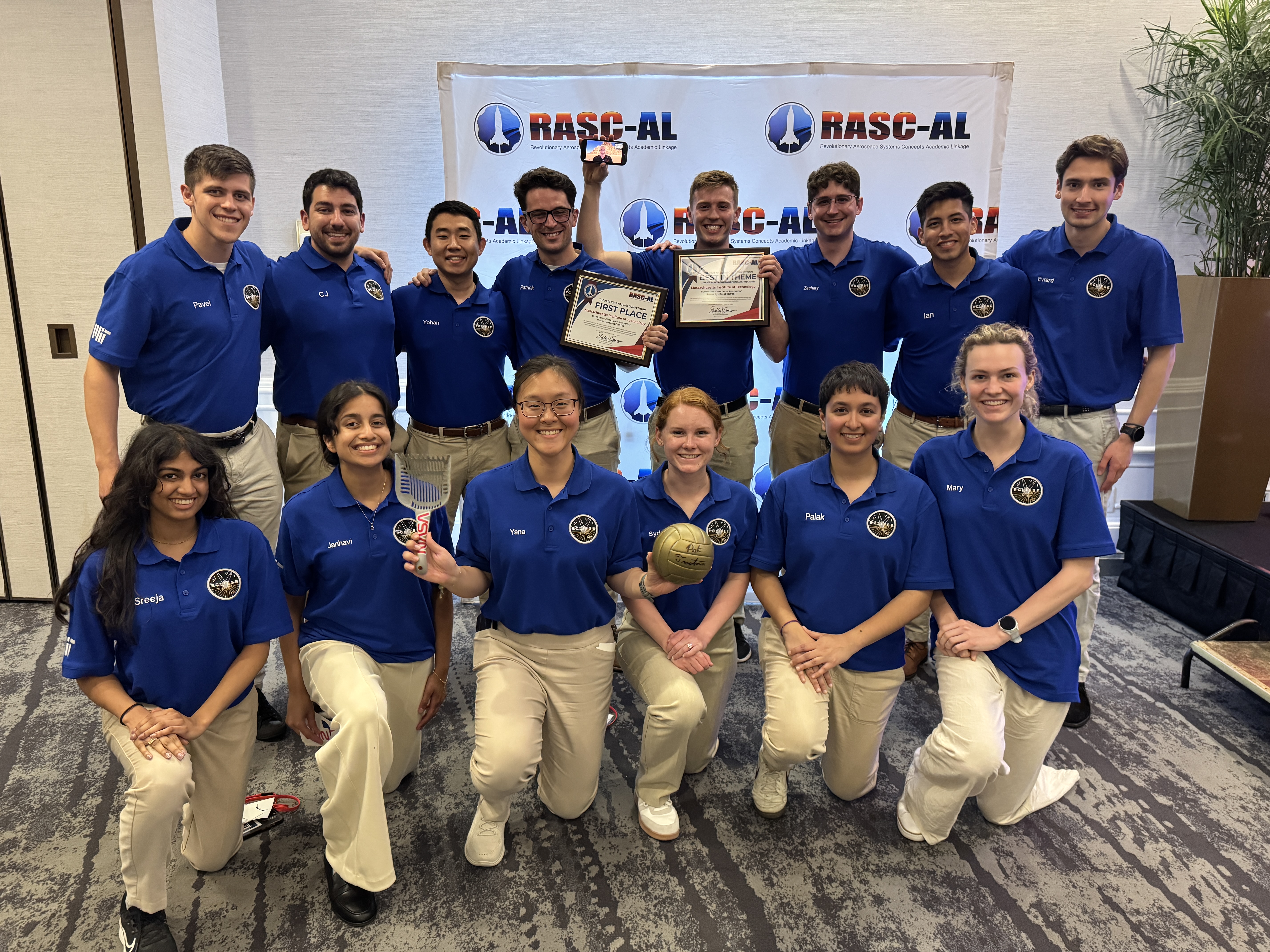
The Massachusetts Institute of Technology team that won the 2026 RASC-AL competition for their project, Exploration-Class Lunar Integrated Power SystEm.
Credit: National Institute of Aerospace
NASA announced the Massachusetts Institute of Technology project, Exploration-Class Lunar Integrated Power SystEm, as the first place winner for the 2026 Revolutionary Aerospace Systems Concepts – Academic Linkage (RASC-AL) competition, which challenges students to bridge gaps in aerospace technology by innovating new system concepts and prototypes.
Another team from the same university won second place overall for their project, Mars Exploration Layered Infrastructure for Operations, Research, and Advancement, while Virginia Polytechnic Institute and State University took third place with the Mars Pylon Network.
Empowering the next generation, the competition also supports the agency’s workforce development priorities by offering university teams hands-on experience in mission architecture development, systems engineering, and technical communication.
“The winning teams demonstrated how academic innovation can support Artemis mission goals,” said Daniel Mazanek, program sponsor for RASC-AL and senior space systems engineer, NASA’s Langley Research Center in Hampton, Virginia. “Their work highlights the important role student research plays in shaping future space exploration, and the results showcase how disciplined analysis can elevate innovative ideas into viable exploration concepts.”
Fourteen finalists attended the multi-day RASC-AL Forum in Cocoa Beach, Florida, and gave formal presentations outlining their mission architectures, technology solutions, and supporting analysis. These discussions provided students with real-time engineering feedback, exposing them to the rigor and scrutiny applied to human spaceflight concepts under development within the agency.
Awards were presented to teams demonstrating the highest levels of technical rigor, innovation, and mission alignment. In addition to the top prizes, other awards included:
Best in Communications, Position, Navigation, and Time Architectures for Mars Surface Operations Theme: Massachusetts Institute of Technology Mars Exploration Layered Infrastructure for Operations, Research, and Advancement MELIORA)
Best in Lunar Sample Return Concept Theme: South Dakota State University Sample Extraction of Lunar Elements for Network Entry (SELENE)
Best in Lunar Surface Power and Power Management and Distribution Architectures Theme: Massachusetts Institute of Technology Exploration-Class Lunar Integrated Power SystEm (ECLIPSE)
Best in Lunar Technology Demonstrations Leveraging Common Infrastructure Theme: Massachusetts Institute of Technology CLPS-enabled Highly-autonomous End-to-End isruSystem Evaluations to Build Understanding and Resilient Growth by Experimenting with Regolith (CHEESEBURGER)
Best Prototype:
Embry-Riddle Aeronautical University, Worldwide Campus Advanced Utilization of Resources for Energy & Viability Off-Earth (Project AUREVO) University of Illinois, Urbana-Champaign with Leonardo de Vinci Engineering School Mining and Advanced Transformation of Regolith for Infrastructure and eXpansion (MATRIX)
“The RASC-AL program allows students to demonstrate their ability to transform innovative concepts into technically sound studies, with emphasis on technical rigor, clear communication, and systems-level thinking,” said Christopher Jones, program sponsor for RASC-AL and chief technologist for the Systems Analysis and Concepts Directorate at NASA Langley. “These are the hallmarks of effective engineering that we’re looking for and reflect the standards required for real-world aerospace problem-solving,”
The NASA RASC-AL competition represents a cross-agency collaboration. The competition is administered by the National Institute of Aerospace and managed by the NASA Tournament Lab, part of the agency’s Prizes, Challenges, and Crowdsourcing Program.

 Login